

Planning and navigation as active inference
Open accessPublished version of a preprint
The DOI matches its Crossref record; 98 of the 98 references it cites were found in a registry or an index.
Abstract
This paper introduces an active inference formulation of planning and navigation. It illustrates how the exploitation-exploration dilemma is dissolved by acting to minimise uncertainty (i.e. expected surprise or free energy). We use simulations of a maze problem to illustrate how agents can solve quite complicated problems using context sensitive prior preferences to form subgoals. Our focus is on how epistemic behaviour-driven by novelty and the imperative to reduce uncertainty about the world-contextualises pragmatic or goal-directed behaviour. Using simulations, we illustrate the underlying process theory with synthetic behavioural and electrophysiological responses during exploration of a maze and subsequent navigation to a target location. An interesting phenomenon that emerged from the simulations was a putative distinction between 'place cells'-that fire when a subgoal is reached-and 'path cells'-that fire until a subgoal is reached.
Overview
The claims and statistics of this paper haven’t been checked yet.
Free: it reads the open-access text and checks the first 5 claims that cite a source we can check. Create a free account to check every claim.
Integrity signals
Registry
Cites
Statistics
Figures
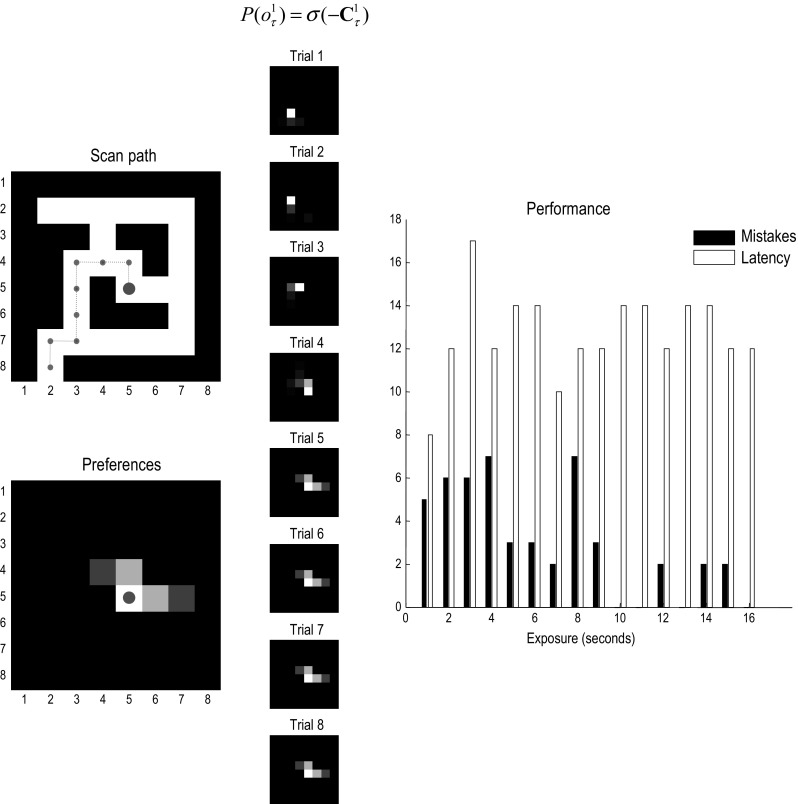
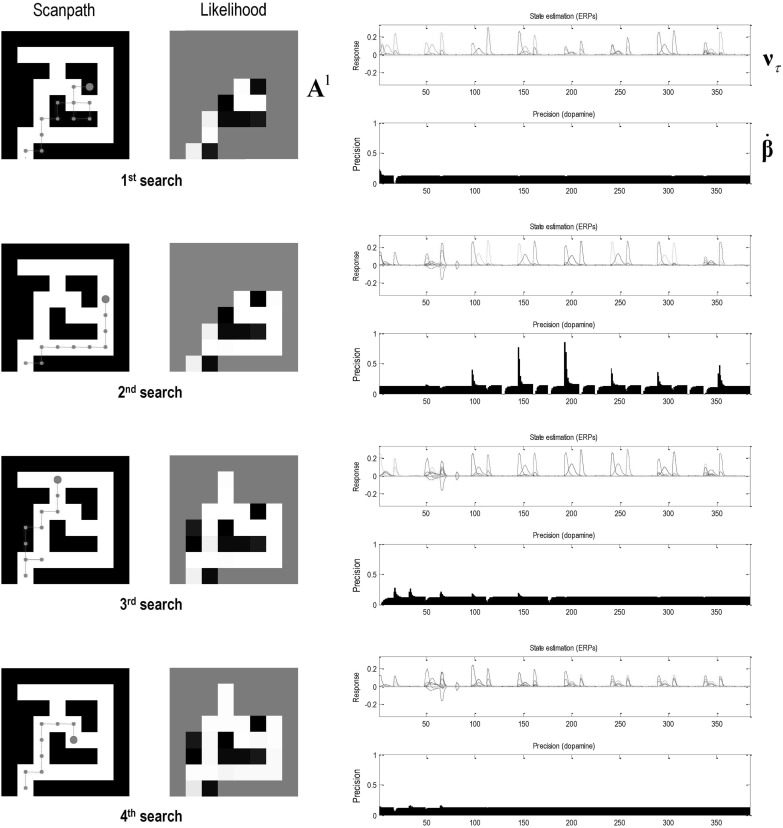
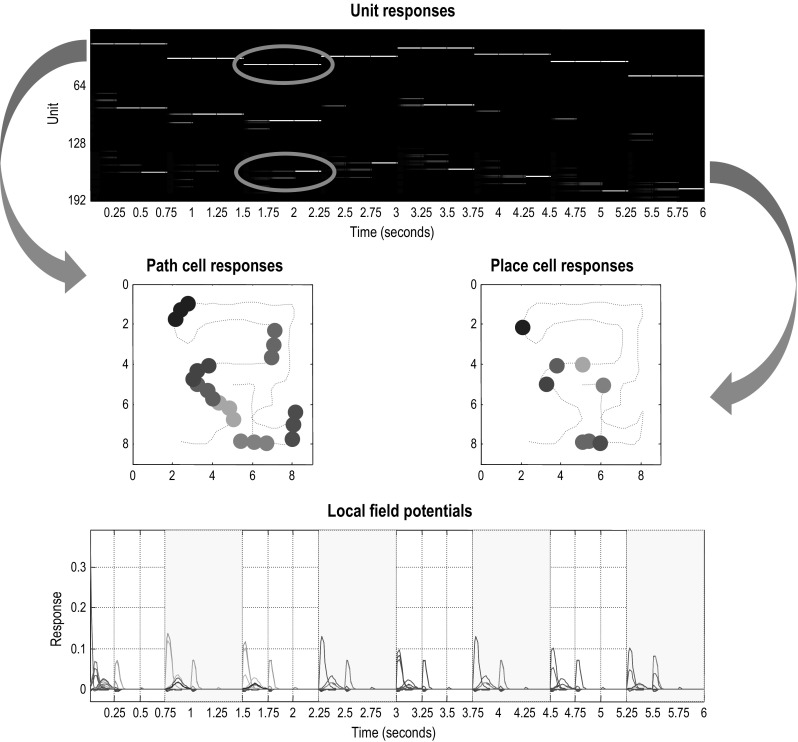
Verification
Claims the paper makes
The claims and statistics of this paper haven’t been checked yet.
Free: it reads the open-access text and checks the first 5 claims that cite a source we can check. Create a free account to check every claim.
Claims other papers make about this one
Each is checked against this paper’s own text: does it say what the citing paper says it does?
The source backs part of the claim, not all of it — or backs it for a different population, condition or comparison.
In the citing paper
“Active inference formalizes allostasis (and action) as an inference problem, ‘planning as inference’ (Kaplan and Friston 2018) under the free energy principle (Friston 2019).”
From Consciousness in active inference: Deep self-models, other minds, and the challenge of psychedelic-induced ego-dissolution (2021) · cites this paper as Kaplan and Friston 2018
Experimental — accuracy not yet measuredThe cited source says what the claim attributes to it.
In the citing paper
“This idea of using subgoals was already used in [23], but in our solution with BTs, we provide a task-independent way to define subgoals which is only based on the set of available skills of the robot, such that we can make sure that it can complete the task.”
From Active Inference and Behavior Trees for Reactive Action Planning and Execution in Robotics (2023) · cites this paper as [23]
The check wasn’t confident either way, so it gives no verdict — never disputed.
In the citing paper
“Past work on active inference, such as [23], was based on the assumption that actions were always executable and nonconflicting, but these do not hold in more realistic scenarios.”
From Active Inference and Behavior Trees for Reactive Action Planning and Execution in Robotics (2023) · cites this paper as [23]
Experimental — accuracy not yet measured
Self-check
Percentages, sums and reported differences re-computed from the paper’s own numbers.
The self-check needs the paper’s full text.
Citations
Cites
A note on two problems in connexion with graphs
Dijkstra, E. W. (1959) · Numerische Mathematik · doi:10.1007/bf01386390 · Cited by 29,065
Reinforcement Learning: An Introduction
Sutton, R. S., & Barto, A. G. (1998) · IEEE Transactions on Neural Networks · doi:10.1109/tnn.1998.712192 · Cited by 27,225
Reinforcement Learning: An Introduction
(2005) · IEEE Transactions on Neural Networks · doi:10.1109/tnn.2004.842673 · Cited by 24,496
Sampling-based algorithms for optimal motion planning
Karaman, S., & Frazzoli, E. (2011) · The International Journal of Robotics Research · doi:10.1177/0278364911406761 · Cited by 5,275
What is the role of dopamine in reward: hedonic impact, reward learning, or incentive salience?
Berridge, K. C., & Robinson, T. E. (1998) · Brain Research Reviews · doi:10.1016/s0165-0173(98)00019-8 · Cited by 4,127
Microstructure of a spatial map in the entorhinal cortex
Hafting, T., Fyhn, M., Molden, S., Moser, M.-B., & Moser, E. I. (2005) · Nature · doi:10.1038/nature03721 · Cited by 4,068 · cited 1×
“In neurobiology, a well-studied modularization of space at the level of single neurons occurs in grid cells located in the dorsomedial entorhinal cortex (Hafting et al., 2005).”
BackgroundBetween MDPs and semi-MDPs: A framework for temporal abstraction in reinforcement learning
Sutton, R. S., Precup, D., & Singh, S. (1999) · Artificial Intelligence · doi:10.1016/s0004-3702(99)00052-1 · Cited by 3,119
(1961) · Information and Control · doi:10.1016/s0019-9958(61)80064-8 · Cited by 2,875
Advances in Neural Information Processing Systems 27 (NIPS 2014)
Zhong, M., Goddard, N., & Sutton, C. A. (2014) · Cited by 2,636
Daw, N. D., Niv, Y., & Dayan, P. (2005) · Nature Neuroscience · doi:10.1038/nn1560 · Cited by 2,533 · cited 1×
“Some key theoretical papers in this setting include (Sutton and Barto, 1998, Daw et al., 2005, Keramati et al., 2011).”
Background
Research works printed but not linked: 3
- 23. Duff M (2002) Optimal learning: computational procedure for bayes- adaptive Markov decision processes. University of Massachusetts, Amherst
- 39. Hartley T, Burgess N, Lever C, Cacucci F, O'Keefe J (2000) Modeling place fields in terms of the cortical inputs to the hippocampus. Hippocampus 10:369-379 · doi:10.1002/1098-1063(2000)10:4<369::aid-hipo3>3.0.co;2-0
- 83. Sun Y, Gomez F, Schmidhuber J (2011a) Planning to be surprised: optimal Bayesian exploration in dynamic environments. In: Pro- ceedings of the 4th international conference on artificial general intelligence, pp 41-51. Springer, Mountain View, CA Sun Y, Gomez F, Schmidhuber J (2011b) Planning to be surprised: opti- mal Bayesian exploration in dynamic environments. In: Schmid- huber J et al (eds) Artificial general intelligence: 4th international conference, AGI 2011, Mountain View, CA, USA, August 3-6, 2011 Proceedings, pp 41-51. Springer, Berlin · DOI · Paper page
Cited by
Items 201–248 of 248
Discrete state-space active inference and unknown controlled state transitions
van Roessel, L. (2020) · Research Repository (Delft University of Technology)
Development and study of coadaptive interactive systems
Dechaux, A. (2024) · theses.fr (ABES) · doi:10.70675/24336488z62bdz4b32zbc69z1620e376bc34
The phantastic organ: predictive processing in the brain
Friston, K. J., & Parr, T. (2026) · Frontiers in Psychology · doi:10.3389/fpsyg.2026.1901293
Self-citationThe Bayesian Brain hypothesis: an evolutionary approach to cognition?Preprint
Daunizeau, J. (2022) · PsyArXiv (OSF Preprints) · doi:10.31234/osf.io/vgw6q
Zamora, D., & Javier, F. (2020)
Modelling and Measuring the Predictive Brain
Whyte, C. J. (2020) · The Sydney eScholarship Repository (The University of Sydney)
Rappe, S., & Werning, M. (2024) · PsyArXiv (OSF Preprints) · doi:10.31234/osf.io/t2m5u
Rappe, S., & Werning, M. (2026) · Philosophical Psychology · doi:10.1080/09515089.2025.2498738
(2021) · Elsevier eBooks · doi:10.1016/b978-0-12-821343-8.00030-7
Survival Decisions in a Multidimensional WorldPreprint
Mobbs, D., Wise, T., Tashjian, S. M., Friston, K. J., & Headley, D. B. (2023) · PsyArXiv (OSF Preprints) · doi:10.31234/osf.io/jkmpq
Self-citationDjebbara, Z., & Bogotá, J. D. (2026) · Neuroscience of Consciousness · doi:10.1093/nc/niaf050
Servajean, P., & Servajean, R. (2023) · PsyArXiv (OSF Preprints) · doi:10.31234/osf.io/2z97y
Learning to Attenuate Myself: A Predictive Processing Account of the Body-Scan MeditationPreprint
Becattini, V. (2024) · PsyArXiv (OSF Preprints) · doi:10.31234/osf.io/6mu85
Parr, T., & Manohar, S. (2025) · Physics of Life Reviews · doi:10.1016/j.plrev.2025.04.005
McIntosh, A., Griffiths, A. R., Brennan, A., & Young, H. A. (2026) · Frontiers in Psychology · doi:10.3389/fpsyg.2026.1779626
Baier, C., Rivera, D. C., Dubslaff, C., Kiebel, S. J., & Wienhöft, P. (2026) · Elsevier eBooks · doi:10.1016/b978-0-44-330044-8.00026-9
Working Memory and Self-Directed Inner Speech Enhance Multitask Generalization in Active Inference
Queißer, J. F., & Tani, J. (2025) · Neural Computation · doi:10.1162/neco.a.36
Németh, E., Chartouny, A., Jedlovszky, K., Freire, I. T., & Khamassi, M. (2025) · bioRxiv (Cold Spring Harbor Laboratory) · doi:10.1101/2025.10.31.685837
Discrete state-space active inference in nonstationary environments
Pancham, N. (. (2021) · Research Repository (Delft University of Technology)
Reframing the lived experience of persistent dizziness: insights from active inference
Broberg, M. A., Thacker, M., Friston, K. J., & Esteves, J. E. (2026) · Frontiers in Psychology · doi:10.3389/fpsyg.2026.1867836
Self-citationGordon, J. R., & Chuang, J. C.-I. (2021) · Conference on Artificial Life (ALIFE) · doi:10.1162/isal_a_00419
Navigating Spatial, Temporal, and Semantic Contexts in Memory
Convertino, L. (2024) · UCL Discovery (University College London)
Bayesian Theory of Consciousness as Exchangeable Emotion-Cognition InferencePreprint
Li, X. (2024) · arXiv (Cornell University) · doi:10.48550/arxiv.2407.09488
Investigating the interplay of physiological and psychological processes in fatigue in Long COVID
Thomas, B. (2025) · ORCA Online Research @Cardiff (Cardiff University)
Zintegrowany model złożonych działań intencjonalnych
Cichosz, M. (2023) · doi:10.14746/9788366983267
The primate hippocampus constructs a dynamic internal model of rhythmic events
Salgado-Ménez, M., Malagón, A. M., Mercado, K., & de Lafuente, V. (2026) · Scientific Reports · doi:10.1038/s41598-026-58985-y
Heikel, E. (2021) · Theseus (Ammattikorkeakoulujen)
CogNarr Ecosystem: Facilitating Group Cognition at ScalePreprint
Boik, J. C. (2024) · OSF Preprints (OSF Preprints) · doi:10.31219/osf.io/yhjt4
Servajean, P., & Servajean, R. (2025) · PsyArXiv (OSF Preprints) · doi:10.31234/osf.io/2z97y_v2
Servajean, P., & Servajean, R. (2025) · PsyArXiv (OSF Preprints) · doi:10.31234/osf.io/2z97y_v3
Serotonin in the Bayesian brain
Novický, F. (2025) · Radboud University Press eBooks · doi:10.54195/9789465151793
Navigation and Exploration with Active Inference: from Biology to IndustryPreprint
de Tinguy, D., Verbelen, T., & Dhoedt, B. (2025) · arXiv (Cornell University) · doi:10.48550/arxiv.2508.07269
Inferring Hierarchical Structure in Multi-Room Maze Environments
de Tinguy, D., de Maele, T. V., Verbelen, T., & Dhoedt, B. (2023) · Ghent University Academic Bibliography (Ghent University) · doi:10.48550/arxiv.2306.13546
Cheron, G., Ristori, D., Petieau, M., Simar, C., Zarka, D., & Cebolla, A.-M. (2022) · doi:10.3389/fpsyg.2022.792872.s001
The Thirty Years’ War on Representations and the Active Inference Westphalia
Constant, A., Clark, A., & Friston, K. J. (2026) · The MIT Press eBooks · doi:10.7551/mitpress/15999.003.0010
Self-citationBayesian cognitive modeling of the balancing between goal-directed and habitual behavior
Schwöbel, S. (2020) · Qucosa (Saxon State and University Library Dresden)
Haiduk, F., & Popescu, T. (2025) · PsyArXiv (OSF Preprints) · doi:10.31234/osf.io/6p2cu_v2
Interactive Inference for Autonomous Robotic Exploration of Uncertain Remote Environments
Wakayama, S. (2024) · CU Scholar (University of Colorado Boulder)
Dynamic computational models of risk and effort discounting in sequential decision making
Rivera, D. C. (2021) · Qucosa (Saxon State and University Library Dresden)
Expected Free Energy-based Informative Path Planning for Robotic Mars ExplorationPreprint
Meera, A. A., Lanillos, P., & Kouw, W. M. (2026) · arXiv (Cornell University) · doi:10.48550/arxiv.2608.14466
Domínguez Zamora, F. J., & Domínguez Zamora, F. J. (2020) · Summit (Simon Fraser University)
Review of the Application of Goal-directed Cognitive Mechanism in Robotics
丛明, Li, J., Liu, D., & Yu, D. (2023) · Journal of Mechanical Engineering · doi:10.3901/jme.2023.23.001
Becattini, V., Lifshitz, M., & Miller, M. M. (2025) · PsyArXiv (OSF Preprints) · doi:10.31234/osf.io/gcjth
Lifshitz, M., Becattini, V., & Miller, M. M. (2025) · PsyArXiv (OSF Preprints)
PlanningEFEMix: Hybrid Active Inference for Sequential Decision-Making under Uncertainty
Chokhawala, B., & Mohammad, A. F. (2026) · Advances in Machine Learning & Artificial Intelligence · doi:10.33140/amlai.07.02.03
Nur'aini, K. I., & Muna, I. A. (2025) · AL-ISHLAH Jurnal Pendidikan · doi:10.35445/alishlah.v17i2.6991
Erforschung von Faktorgraphen aus struktureller Perspektive für die Planung von Roboterbewegungen
Bari, S., Wollherr, D., & München, T. U. (2024) · mediaTUM (Technical University of Munich)
Metadata
- Authors
- Kaplan, R., & Friston, K. J.
- Affiliations
- Wellcome Centre for Human Neuroimaging (GB)
- Corresponding author
- Friston, Karl J.
- Venue
- Biological Cybernetics
- Published
- 2018-03-23
- Volume
- 112
- Issue
- 4
- Pages
- 323-343
- ISSN
- 0340-1200 (ISSN-L)
- 1432-0770
- PMC
- PMC6060791
- OpenAlex
- W2781668895
- Cited by
- 203
- References
- 98
- Citations by year
- 2026: 12 · 2025: 22 · 2024: 29 · 2023: 27 · 2022: 34 · 2021: 36 · 2020: 28 · 2019: 10 · 2018: 5
- FWCI
- 11.75
- Type
- journal article
- Language
- en
- Open access
- hybrid
- doi.org
- Licence
- cc-by
- creativecommons.org/licenses/by/4.0 (tdm)
- Locations
- Biological Cybernetics (publishedVersion, cc-by)
- bioRxiv (Cold Spring Harbor Laboratory) (acceptedVersion, cc-by)
- Europe PMC (PubMed Central) (publishedVersion, cc-by)
- PubMed Central (publishedVersion, cc-by)
- PubMed (publishedVersion)
- UCL Discovery (University College London) (submittedVersion)
- MPG.PuRe (Max Planck Society) (submittedVersion)
- Funders
- Wellcome Trust (088130/Z/09/Z)
- Topics
- Life Sciences › Neuroscience › Cognitive Neuroscience › Embodied and Extended Cognition
- Life Sciences › Neuroscience › Cognitive Neuroscience › Memory and Neural Mechanisms
- Physical Sciences › Computer Science › Artificial Intelligence › Reinforcement Learning in Robotics
- Keywords
- active inference, planning, navigation, free energy principle, uncertainty reduction, novelty, place cells, maze navigation, electrophysiological responses, goal-directed behavior
- MeSH terms
- Animals, Bayes Theorem, Brain, Computer Simulation, Goals, Humans, Models, Biological, Motivation, Neurons, Maze Learning, Spatial Navigation
About these checks
Registry, retraction, Cites and statistics results are computed, not judged, with one exception: a printed reference that no index lists is read once by a model before it counts as a citation error. Claims are extracted by a model and kept only when their quote appears verbatim in the text; each cited source is then checked, with a model’s help, for whether it says what the claim relies on. Those verdicts can be wrong — read the claim’s quote and the cited source before relying on one.
Statistics and arithmetic are recomputed, not judged.
Confidence bands are shown only for fields calibrated on our annotated test set. None is calibrated yet, so no band is shown.
What counts as a claim ›How we measure confidence ›How we check this ›
Are you an author, or do you see a problem with this page? Request a review
Data sources
Bibliographic data: Semantic Scholar, OpenAlex, Crossref.
Contains information from the Semantic Scholar Academic Graph Datasets, made available under the ODC Attribution License (ODC-BY 1.0).
Semantic Scholar’s data is described in: Kinney, R., et al. (2023). The Semantic Scholar Open Data Platform. arXiv:2301.10140.
