

Planning and navigation as active inference
Open accessPublished version of a preprint
The DOI matches its Crossref record; 98 of the 98 references it cites were found in a registry or an index.
Abstract
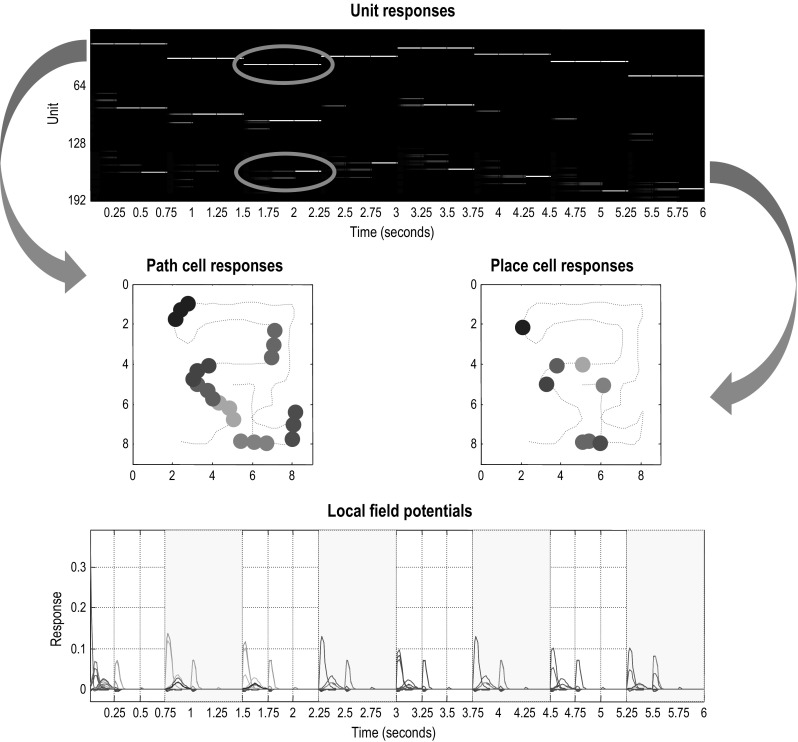
This paper introduces an active inference formulation of planning and navigation. It illustrates how the exploitation-exploration dilemma is dissolved by acting to minimise uncertainty (i.e. expected surprise or free energy). We use simulations of a maze problem to illustrate how agents can solve quite complicated problems using context sensitive prior preferences to form subgoals. Our focus is on how epistemic behaviour-driven by novelty and the imperative to reduce uncertainty about the world-contextualises pragmatic or goal-directed behaviour. Using simulations, we illustrate the underlying process theory with synthetic behavioural and electrophysiological responses during exploration of a maze and subsequent navigation to a target location. An interesting phenomenon that emerged from the simulations was a putative distinction between 'place cells'-that fire when a subgoal is reached-and 'path cells'-that fire until a subgoal is reached.
Overview
The claims and statistics of this paper haven’t been checked yet.
Free: it reads the open-access text and checks the first 5 claims that cite a source we can check. Create a free account to check every claim.
Integrity signals
Registry
Cites
Statistics
Figures




Verification
Claims the paper makes
The claims and statistics of this paper haven’t been checked yet.
Free: it reads the open-access text and checks the first 5 claims that cite a source we can check. Create a free account to check every claim.
Claims other papers make about this one
Each is checked against this paper’s own text: does it say what the citing paper says it does?
The source backs part of the claim, not all of it — or backs it for a different population, condition or comparison.
In the citing paper
“Active inference formalizes allostasis (and action) as an inference problem, ‘planning as inference’ (Kaplan and Friston 2018) under the free energy principle (Friston 2019).”
From Consciousness in active inference: Deep self-models, other minds, and the challenge of psychedelic-induced ego-dissolution (2021) · cites this paper as Kaplan and Friston 2018
Experimental — accuracy not yet measuredThe cited source says what the claim attributes to it.
In the citing paper
“This idea of using subgoals was already used in [23], but in our solution with BTs, we provide a task-independent way to define subgoals which is only based on the set of available skills of the robot, such that we can make sure that it can complete the task.”
From Active Inference and Behavior Trees for Reactive Action Planning and Execution in Robotics (2023) · cites this paper as [23]
The check wasn’t confident either way, so it gives no verdict — never disputed.
In the citing paper
“Past work on active inference, such as [23], was based on the assumption that actions were always executable and nonconflicting, but these do not hold in more realistic scenarios.”
From Active Inference and Behavior Trees for Reactive Action Planning and Execution in Robotics (2023) · cites this paper as [23]
Experimental — accuracy not yet measured
Self-check
Percentages, sums and reported differences re-computed from the paper’s own numbers.
The self-check needs the paper’s full text.
Citations
Cites
A note on two problems in connexion with graphs
Dijkstra, E. W. (1959) · Numerische Mathematik · doi:10.1007/bf01386390 · Cited by 29,065
Reinforcement Learning: An Introduction
Sutton, R. S., & Barto, A. G. (1998) · IEEE Transactions on Neural Networks · doi:10.1109/tnn.1998.712192 · Cited by 27,225
Reinforcement Learning: An Introduction
(2005) · IEEE Transactions on Neural Networks · doi:10.1109/tnn.2004.842673 · Cited by 24,496
Sampling-based algorithms for optimal motion planning
Karaman, S., & Frazzoli, E. (2011) · The International Journal of Robotics Research · doi:10.1177/0278364911406761 · Cited by 5,275
What is the role of dopamine in reward: hedonic impact, reward learning, or incentive salience?
Berridge, K. C., & Robinson, T. E. (1998) · Brain Research Reviews · doi:10.1016/s0165-0173(98)00019-8 · Cited by 4,127
Microstructure of a spatial map in the entorhinal cortex
Hafting, T., Fyhn, M., Molden, S., Moser, M.-B., & Moser, E. I. (2005) · Nature · doi:10.1038/nature03721 · Cited by 4,068
Between MDPs and semi-MDPs: A framework for temporal abstraction in reinforcement learning
Sutton, R. S., Precup, D., & Singh, S. (1999) · Artificial Intelligence · doi:10.1016/s0004-3702(99)00052-1 · Cited by 3,119
(1961) · Information and Control · doi:10.1016/s0019-9958(61)80064-8 · Cited by 2,875
Advances in Neural Information Processing Systems 27 (NIPS 2014)
Zhong, M., Goddard, N., & Sutton, C. A. (2014) · Cited by 2,636
Daw, N. D., Niv, Y., & Dayan, P. (2005) · Nature Neuroscience · doi:10.1038/nn1560 · Cited by 2,533 · cited 1×
“Some key theoretical papers in this setting include (Sutton and Barto, 1998, Daw et al., 2005, Keramati et al., 2011).”
BackgroundThe human hippocampus and spatial and episodic memory
Burgess, N., Maguire, E. A., & O'Keefe, J. (2002) · Neuron · doi:10.1016/s0896-6273(02)00830-9 · Cited by 2,401
Memory, navigation and theta rhythm in the hippocampal-entorhinal system
Buzsáki, G., & Moser, E. I. (2013) · Nature Neuroscience · doi:10.1038/nn.3304 · Cited by 1,847 · cited 2×
“…optimal integration of knowledge about the world and the goals that we are currently pursuing (Hauskrecht, 2000, Johnson et al., 2007, Pastalkova et al., 2008, Hassabis and Maguire, 2009, Humphries and Prescott, 2010, Karaman and Frazzoli, 2011, Buzsaki and Moser, 2013, Pfeiffer and Foster, 2013a).”
BackgroundModel-based influences on humans’ choices and striatal prediction errors
Daw, N. D., Gershman, S. J., Seymour, B., Dayan, P., & Dolan, R. J. (2011) · Neuron · doi:10.1016/j.neuron.2011.02.027 · Cited by 1,779
Frequency of gamma oscillations routes flow of information in the hippocampus
Colgin, L. L., Denninger, T., Fyhn, M., Hafting, T., Bonnevie, T., Jensen, O., Moser, M.-B., & Moser, E. I. (2009) · Nature · doi:10.1038/nature08573 · Cited by 1,435
Monte-Carlo Planning in Large POMDPs
Silver, D., & Veness, J. (2010) · DSpace@MIT (Massachusetts Institute of Technology) · Cited by 1,408
Internally Generated Cell Assembly Sequences in the Rat Hippocampus
Pastalkova, E., Itskov, V., Amarasingham, A., & Buzsáki, G. (2008) · Science · doi:10.1126/science.1159775 · Cited by 1,301
Possible Principles Underlying the Transformations of Sensory Messages
Barlow, H. B. (2012) · Sensory Communication · doi:10.7551/mitpress/9780262518420.003.0013 · Cited by 1,269
Bayesian surprise attracts human attention
Itti, L., & Baldi, P. (2009) · Vision Research · doi:10.1016/j.visres.2008.09.007 · Cited by 1,224
Hippocampal place-cell sequences depict future paths to remembered goals
Pfeiffer, B. E., & Foster, D. J. (2013) · Nature · doi:10.1038/nature12112 · Cited by 1,216
Representation of Geometric Borders in the Entorhinal Cortex
Solstad, T., Boccara, C. N., Kropff, E., Moser, M.-B., & Moser, E. I. (2008) · Science · doi:10.1126/science.1166466 · Cited by 1,213
Active inference: a process theory
Friston, K., FitzGerald, T., Rigoli, F., Schwartenbeck, P., & Pezzulo, G. (2017) · Neural Computation · doi:10.1162/neco_a_00912 · Cited by 1,156 · cited 2×
“A detailed description of the belief update equations – and how they might be implemented in the brain – can be found in (Friston et al., 2017a).”
BackgroundSelf-citationThe hippocampus as a predictive map
Stachenfeld, K. L., Botvinick, M. M., & Gershman, S. J. (2017) · Nature Neuroscience · doi:10.1038/nn.4650 · Cited by 1,000
On the theory of dynamic programming
Bellman, R. (1952) · Proceedings of the National Academy of Sciences · doi:10.1073/pnas.38.8.716 · Cited by 998
Howard, R. (1966) · IEEE Transactions on Systems Science and Cybernetics · doi:10.1109/tssc.1966.300074 · Cited by 995
The Head Direction Signal: Origins and Sensory-Motor Integration
Taube, J. S. (2007) · Annual Review of Neuroscience · doi:10.1146/annurev.neuro.29.051605.112854 · Cited by 927
Time cells in the hippocampus: a new dimension for mapping memories
Eichenbaum, H. (2014) · Nature Reviews Neuroscience · doi:10.1038/nrn3827 · Cited by 843 · cited 1×
“Clearly, this would be a challenging but interesting possibility that might nuance our understanding of spatiotemporal encoding; in particular, scheduling in temporal frames of reference that transcend our normal conception of the past and future (Eichenbaum, 2014).”
BackgroundActive inference and epistemic value
Friston, K., Rigoli, F., Ognibene, D., Mathys, C., Fitzgerald, T., & Pezzulo, G. (2015) · Cognitive Neuroscience · doi:10.1080/17588928.2015.1020053 · Cited by 731
Self-citationTemporal Encoding of Place Sequences by Hippocampal Cell Assemblies
Dragoi, G., & Buzsáki, G. (2006) · Neuron · doi:10.1016/j.neuron.2006.02.023 · Cited by 726
Improving generalization for temporal difference learning: The successor representation
Dayan, P. (1993) · Neural Computation · doi:10.1162/neco.1993.5.4.613 · Cited by 693
Friston, K., FitzGerald, T., Rigoli, F., Schwartenbeck, P., O⿿Doherty, J., & Pezzulo, G. (2016) · Neuroscience & Biobehavioral Reviews · doi:10.1016/j.neubiorev.2016.06.022 · Cited by 674
Self-citationBOLD responses reflecting dopaminergic signals in the human ventral tegmental area
D'Ardenne, K., McClure, S. M., Nystrom, L. E., & Cohen, J. D. (2008) · Science · doi:10.1126/science.1150605 · Cited by 661
Hierarchically organized behavior and its neural foundations: A reinforcement learning perspective
Botvinick, M. M., Niv, Y., & Barto, A. G. (2009) · Cognition · doi:10.1016/j.cognition.2008.08.011 · Cited by 646
Hohwy, J. (2016) · Noûs · doi:10.1111/nous.12062 · Cited by 578 · cited 1×
“In other words, active inference implies some form of self-evidencing (Hohwy, 2016); in the sense that inference and subsequent behaviour increase the evidence for an agent's model of its world.”
BackgroundValue-Function Approximations for Partially Observable Markov Decision Processes
Hauskrecht, M. (2000) · Journal of Artificial Intelligence Research · doi:10.1613/jair.678 · Cited by 527
Absolute Coding of Stimulus Novelty in the Human Substantia Nigra/VTA
Bunzeck, N., & Düzel, E. (2006) · Neuron · doi:10.1016/j.neuron.2006.06.021 · Cited by 503
The construction system of the brain
Hassabis, D., & Maguire, E. A. (2009) · Philosophical Transactions of the Royal Society B: Biological Sciences · doi:10.1098/rstb.2008.0296 · Cited by 483 · cited 2×
“…optimal integration of knowledge about the world and the goals that we are currently pursuing (Hauskrecht, 2000, Johnson et al., 2007, Pastalkova et al., 2008, Hassabis and Maguire, 2009, Humphries and Prescott, 2010, Karaman and Frazzoli, 2011, Buzsaki and Moser, 2013, Pfeiffer and Foster, 2013a).”
BackgroundVIME: Variational Information Maximizing Exploration
Houthooft, R., Chen, X., Duan, Y., Schulman, J., Turck, F. D., & Abbeel, P. (2016) · arXiv (Cornell University) · doi:10.48550/arxiv.1605.09674 · Cited by 472
Reinforcement learning and episodic memory in humans and animals: an integrative framework
Gershman, S. J., & Daw, N. D. (2017) · Annual Review of Psychology · doi:10.1146/annurev-psych-122414-033625 · Cited by 446
Huys, Q. J. M., Eshel, N., O'Nions, E., Sheridan, L., Dayan, P., & Roiser, J. P. (2012) · PLoS Computational Biology · doi:10.1371/journal.pcbi.1002410 · Cited by 439
Richmond, B. J., Optican, L. M., Podell, M., & Spitzer, H. (1987) · Journal of Neurophysiology · doi:10.1152/jn.1987.57.1.132 · Cited by 428
Knierim, J. J., Neunuebel, J. P., & Deshmukh, S. S. (2014) · Philosophical Transactions of the Royal Society B Biological Sciences · doi:10.1098/rstb.2013.0369 · Cited by 425 · cited 1×
“In other words, if one subscribes to the neuronal process theories above, then place cell responses can be regarded as the limiting case of a more general encoding of local paths (Knierim et al., 2014, Friston and Buzsaki, 2016).”
BackgroundThe ventral basal ganglia, a selection mechanism at the crossroads of space, strategy, and reward.
Humphries, M. D., & Prescott, T. J. (2010) · Progress in Neurobiology · doi:10.1016/j.pneurobio.2009.11.003 · Cited by 418
The successor representation in human reinforcement learning
Momennejad, I., Russek, E. M., Cheong, J. H., Botvinick, M. M., Daw, N. D., & Gershman, S. J. (2017) · Nature Human Behaviour · doi:10.1038/s41562-017-0180-8 · Cited by 390
Optican, L. M., & Richmond, B. J. (1987) · Journal of Neurophysiology · doi:10.1152/jn.1987.57.1.162 · Cited by 374
Theta-paced flickering between place-cell maps in the hippocampus
Jezek, K., Henriksen, E. J., Treves, A., Moser, E. I., & Moser, M.-B. (2011) · Nature · doi:10.1038/nature10439 · Cited by 359 · cited 1×
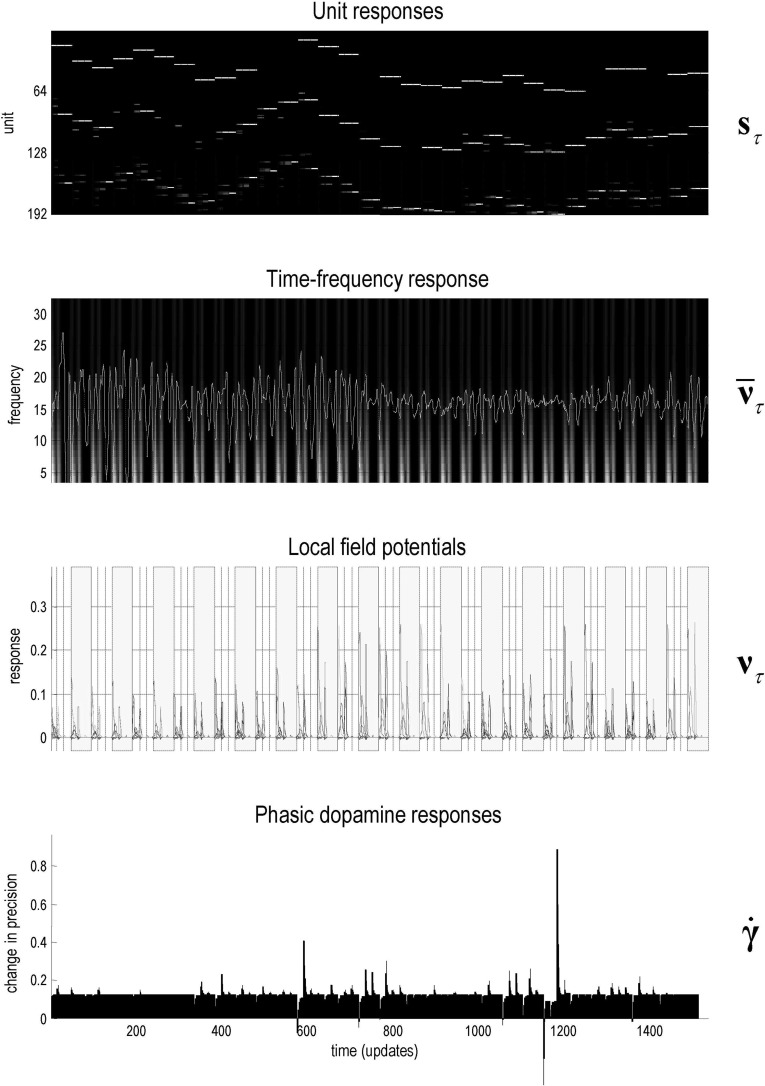
“The induced or time frequency responses over all units (second panel) are interesting from the point of view of theta-gamma coupling in the hippocampus during exploration (Dragoi and Buzsaki, 2006, Colgin et al., 2009; Lisman and Redish, 2009, Jezek et al., 2011, Buzsaki and Moser, 2013).”
BackgroundActive Inference, Curiosity and Insight
Friston, K. J., Lin, M., Frith, C. D., Pezzulo, G., Hobson, J. A., & Ondobaka, S. (2017) · Neural Computation · doi:10.1162/neco_a_00999 · Cited by 351
Self-citationSpeed/accuracy trade-off between the habitual and the goal-directed processes
Keramati, M., Dezfouli, A., & Piray, P. (2011) · PLoS Computational Biology · doi:10.1371/journal.pcbi.1002055 · Cited by 346 · cited 1×
“Some key theoretical papers in this setting include (Sutton and Barto, 1998, Daw et al., 2005, Keramati et al., 2011).”
BackgroundLinearly-solvable Markov decision problems
Todorov, E. (2007) · Advances in Neural Information Processing Systems 19 · doi:10.7551/mitpress/7503.003.0176 · Cited by 334
Using Grid Cells for Navigation
Bush, D., Barry, C., Manson, D., & Burgess, N. (2015) · Neuron · doi:10.1016/j.neuron.2015.07.006 · Cited by 329
Predictive representations can link model-based reinforcement learning to model-free mechanisms
Russek, E. M., Momennejad, I., Botvinick, M. M., Gershman, S. J., & Daw, N. D. (2017) · PLOS Computational Biology · doi:10.1371/journal.pcbi.1005768 · Cited by 326
Optimal control as a graphical model inference problem
Kappen, H. J., Gómez, V., & Opper, M. (2012) · Machine Learning · doi:10.1007/s10994-012-5278-7 · Cited by 297
Botvinick, M., & Toussaint, M. (2012) · Trends in Cognitive Sciences · doi:10.1016/j.tics.2012.08.006 · Cited by 292
The anatomy of choice: dopamine and decision-making.
Friston, K., Schwartenbeck, P., FitzGerald, T., Moutoussis, M., Behrens, T., & Dolan, R. J. (2014) · Philosophical Transactions of the Royal Society B: Biological Sciences · doi:10.1098/rstb.2013.0481 · Cited by 289
Self-citationPrediction, sequences and the hippocampus
Lisman, J., & Redish, A. D. (2009) · Philosophical Transactions of the Royal Society B: Biological Sciences · doi:10.1098/rstb.2008.0316 · Cited by 287
Integrating hippocampus and striatum in decision-making
Johnson, A., van der Meer, M. A., & Redish, A. D. (2007) · Current Opinion in Neurobiology · doi:10.1016/j.conb.2008.01.003 · Cited by 253
Perceptual Neural Organization: Some Approaches Based on Network Models and Information Theory
Linsker, R. (1990) · Annual Review of Neuroscience · doi:10.1146/annurev.ne.13.030190.001353 · Cited by 248
Explicit neural signals reflecting reward uncertainty
Schultz, W., Preuschoff, K., Camerer, C., Hsu, M., Fiorillo, C. D., Tobler, P. N., & Bossaerts, P. (2008) · Philosophical Transactions of the Royal Society B Biological Sciences · doi:10.1098/rstb.2008.0152 · Cited by 239 · cited 2×
“This is closely related to reward prediction error formulations and speaks to the similarity between precision updates and dopaminergic responses that we will appeal to later (Schultz et al., 2008, Friston et al., 2014, FitzGerald et al., 2015).”
BackgroundThe dopaminergic midbrain encodes the expected certainty about desired outcomes
Schwartenbeck, P., FitzGerald, T. H. B., Mathys, C., Dolan, R., & Friston, K. (2015) · Cerebral Cortex · doi:10.1093/cercor/bhu159 · Cited by 219
Self-citationA goal‐directed spatial navigation model using forward trajectory planning based on grid cells
Erdem, U. M., & Hasselmo, M. (2012) · European Journal of Neuroscience · doi:10.1111/j.1460-9568.2012.08015.x · Cited by 208
Dopamine reward prediction errors reflect hidden-state inference across time
Starkweather, C. K., Babayan, B. M., Uchida, N., & Gershman, S. J. (2017) · Nature Neuroscience · doi:10.1038/nn.4520 · Cited by 206
Planning by Probabilistic Inference.
Attias, H. T. (2003) · Cited by 204
Adaptive integration of habits into depth-limited planning defines a habitual-goal–directed spectrum
Keramati, M., Smittenaar, P., Dolan, R. J., & Dayan, P. (2016) · Proceedings of the National Academy of Sciences · doi:10.1073/pnas.1609094113 · Cited by 203
A Neural Signature of Hierarchical Reinforcement Learning
Ribas-Fernandes, J. J. F., Solway, A., Diuk, C., McGuire, J. T., Barto, A. G., Niv, Y., & Botvinick, M. M. (2011) · Neuron · doi:10.1016/j.neuron.2011.05.042 · Cited by 195
Rao, R. P. N. (2010) · Frontiers in Computational Neuroscience · doi:10.3389/fncom.2010.00146 · Cited by 191
The Functional Anatomy of Time: What and When in the Brain
Friston, K., & Buzsáki, G. (2016) · Trends in Cognitive Sciences · doi:10.1016/j.tics.2016.05.001 · Cited by 183
Self-citationSolway, A., & Botvinick, M. M. (2012) · Psychological Review · doi:10.1037/a0026435 · Cited by 182
Planning treatment of ischemic heart disease with partially observable Markov decision processes
Hauskrecht, M., & Fraser, H. (2000) · Artificial Intelligence in Medicine · doi:10.1016/s0933-3657(99)00042-1 · Cited by 173
Representation and timing in theories of the dopamine system
Daw, N. D., Courville, A. C., & Touretzky, D. S. (2006) · Neural Computation · doi:10.1162/neco.2006.18.7.1637 · Cited by 173
Searching for inhibition of return in visual search: A review
Wang, Z., & Klein, R. M. (2010) · Vision Research · doi:10.1016/j.visres.2009.11.013 · Cited by 168
Scene Construction, Visual Foraging, and Active Inference
Mirza, M. B., Adams, R. A., Mathys, C. D., & Friston, K. J. (2016) · Frontiers in Computational Neuroscience · doi:10.3389/fncom.2016.00056 · Cited by 165
Self-citationSolway, A., Diuk, C., Córdova, N., Yee, D., Barto, A. G., Niv, Y., & Botvinick, M. M. (2014) · PLoS Computational Biology · doi:10.1371/journal.pcbi.1003779 · Cited by 139
Planning to be surprised: optimal bayesian exploration in dynamic environments
Sun, Y., Gomez, F., & Schmidhuber, J. (2011) · Lecture notes in computer science · doi:10.1007/978-3-642-22887-2_5 · Cited by 134
Predictions derived from modelling the hippocampal role in navigation
Burgess, N., Andrew, J. O., Hartley, T., & O'Keefe, J. M. (2000) · Biological Cybernetics · doi:10.1007/s004220000172 · Cited by 134
Computational Phenotyping in Psychiatry: A Worked Example
Schwartenbeck, P., & Friston, K. (2016) · eneuro · doi:10.1523/eneuro.0049-16.2016 · Cited by 131
Self-citationDesign Principles of the Hippocampal Cognitive Map
Stachenfeld, K., Botvinick, M., & Gershman, S. J. (2014) · neural information processing systems · Cited by 112
Dopamine, reward learning, and active inference
FitzGerald, T. H. B., Dolan, R. J., & Friston, K. (2015) · Frontiers in Computational Neuroscience · doi:10.3389/fncom.2015.00136 · Cited by 112 · cited 5×
“This is closely related to reward prediction error formulations and speaks to the similarity between precision updates and dopaminergic responses that wewill appeal to later (Schultz et al. 2008; Friston et al. 2014; FitzGerald et al. 2015).”
BackgroundMethodInfluentialSelf-citationIntrinsically Motivated Hierarchical Skill Learning in Structured Environments
Vigorito, C. M., & Barto, A. G. (2010) · IEEE Transactions on Autonomous Mental Development · doi:10.1109/tamd.2010.2050205 · Cited by 105
Collins, A. G. E., & Frank, M. J. (2016) · Cognition · doi:10.1016/j.cognition.2016.04.002 · Cited by 96
Learning of Chunking Sequences in Cognition and Behavior
Fonollosa, J., Neftci, E., & Rabinovich, M. I. (2015) · PLoS Computational Biology · doi:10.1371/journal.pcbi.1004592 · Cited by 86
Spatial Learning and Action Planning in a Prefrontal Cortical Network Model
Martinet, L.-E., Sheynikhovich, D., Benchenane, K., & Arleo, A. (2011) · PLoS Computational Biology · doi:10.1371/journal.pcbi.1002045 · Cited by 82
The Neural Representation of Prospective Choice during Spatial Planning and Decisions
Kaplan, R., King, J., Koster, R., Penny, W. D., Burgess, N., & Friston, K. J. (2017) · PLOS Biology · doi:10.1371/journal.pbio.1002588 · Cited by 79
Self-citationThe Role of Mental Maps in Decision-Making
Kaplan, R., Schuck, N. W., & Doeller, C. F. (2017) · Trends in Neurosciences · doi:10.1016/j.tins.2017.03.002 · Cited by 76
Self-citationDonnarumma, F., Maisto, D., & Pezzulo, G. (2016) · PLOS Computational Biology · doi:10.1371/journal.pcbi.1004864 · Cited by 60
Divide et impera : subgoaling reduces the complexity of probabilistic inference and problem solving
Maisto, D., Donnarumma, F., & Pezzulo, G. (2015) · Journal of The Royal Society Interface · doi:10.1098/rsif.2014.1335 · Cited by 59
Predicting the past, remembering the future
Gershman, S. J. (2017) · Current Opinion in Behavioral Sciences · doi:10.1016/j.cobeha.2017.05.025 · Cited by 58
(2010) · Uncertainty in Artificial Intelligence · Cited by 56
Evidence integration in model-based tree search
Solway, A., & Botvinick, M. M. (2015) · Proceedings of the National Academy of Sciences · doi:10.1073/pnas.1505483112 · Cited by 55
Path integral control and bounded rationality
Braun, D. A., Ortega, P. A., Theodorou, E., & Schaal, S. (2011) · 2011 IEEE Symposium on Adaptive Dynamic Programming and Reinforcement Learning (ADPRL) · doi:10.1109/adprl.2011.5967366 · Cited by 54
Visual feedback of own tics increases tic frequency in patients with Tourette’s syndrome
Brandt, V. C., Lynn, M. T., Obst, M., Brass, M., & Münchau, A. (2015) · Cognitive Neuroscience · doi:10.1080/17588928.2014.954990 · Cited by 43
Grounding subgoals in information transitions
van Dijk, S. G., & Polani, D. (2011) · IEEE Symposium on Adaptive Dynamic Programming and Reinforcement Learning · doi:10.1109/adprl.2011.5967384 · Cited by 38
Real-Time Position Reconstruction with Hippocampal Place Cells
Guger, C., Gener, T., Pennartz, C. M. A., Brotons‐Mas, J. R., Edlinger, G., Badia, S. B. I., Verschure, P. F. M. J., Schaffelhofer, S., & Sanchez-Vives, M. V. (2011) · Frontiers in Neuroscience · doi:10.3389/fnins.2011.00085 · Cited by 32
INFORMATIONAL CONSTRAINTS-DRIVEN ORGANIZATION IN GOAL-DIRECTED BEHAVIOR
van Dijk, S. G., & Polani, D. (2013) · Advances in Complex Systems · doi:10.1142/s0219525913500161 · Cited by 28
Predicting the Past, Remembering the Future
Maver, T. W. (2002) · Cumulative Index of Computer Aided Architectural Design · Cited by 23
Best-response play in partially observable card games
Oliehoek, F. A., Spaan, M. T. J., & Vlassis, N. A. (2005) · Cited by 18
Efficient state-space modularization for planning: theory, behavioral and neural signatures
McNamee, D., Wolpert, D. M., & Lengyel, M. (2016) · Cambridge University Engineering Department Publications Database · Cited by 17
Flexibility to contingency changes distinguishes habitual and goal-directed strategies in humans
Lee, J. J., & Keramati, M. (2017) · PLoS Computational Biology · doi:10.1371/journal.pcbi.1005753 · Cited by 12
Context-Invariant Encoding of Reward Location in a Distinct Hippocampal PopulationPreprint
Gauthier, J. L., & Tank, D. W. (2017) · bioRxiv (Cold Spring Harbor Laboratory) · doi:10.1101/207043 · Cited by 4
Cortico-hippocampal communication by way of parallel parahippocampal-subicular pathways.
Lavenex (2000) · Pure Amsterdam UMC · doi:10.1002/1098-1063(2000)10:4 · Cited by 1
Research works printed but not linked: 3
- Duff M (2002) Optimal learning: computational procedure for bayes-adaptive Markov decision processes. University of Massachusetts, Amherst
- Hartley T, Burgess N, Lever C, Cacucci F, O’Keefe J (2000) Modeling place fields in terms of the cortical inputs to the hippocampus. Hippocampus 10:369–379 · doi:10.1002/1098-1063(2000)10:4<369::aid-hipo3>3.0.co;2-0
- Sun Y, Gomez F, Schmidhuber J (2011b) Planning to be surprised: optimal Bayesian exploration in dynamic environments. In: Schmidhuber J et al (eds) Artificial general intelligence: 4th international conference, AGI 2011, Mountain View, CA, USA, August 3–6, 2011 Proceedings, pp 41–51. Springer, Berlin · DOI · Paper page
Cited by
Thinking through other minds: A variational approach to cognition and culture
Veissière, S. P. L., Constant, A., Ramstead, M. J. D., Friston, K. J., & Kirmayer, L. J. (2020) · Behavioral and Brain Sciences · doi:10.1017/s0140525x19001213 · Cited by 348
Self-citationA step-by-step tutorial on active inference and its application to empirical data
Smith, R., Friston, K. J., & Whyte, C. J. (2022) · Journal of Mathematical Psychology · doi:10.1016/j.jmp.2021.102632 · Cited by 246
Self-citationDeeply Felt Affect: The Emergence of Valence in Deep Active Inference
Hesp, C., Smith, R., Parr, T., Allen, M., Friston, K. J., & Ramstead, M. J. D. (2021) · Neural Computation · doi:10.1162/neco_a_01341 · Cited by 246
“In brief, active inference offers a generic approach to planning as inference (Attias, 2003; Botvinick & Toussaint, 2012; Kaplan & Friston, 2018) under the free energy principle (Friston, 2010).”
MethodSelf-citationGeneralised free energy and active inference
Parr, T., & Friston, K. J. (2019) · Biological Cybernetics · doi:10.1007/s00422-019-00805-w · Cited by 236
Self-citationActive inference on discrete state-spaces: A synthesis
Da Costa, L., Parr, T., Sajid, N., Veselic, S., Neacsu, V., & Friston, K. (2020) · Journal of Mathematical Psychology · doi:10.1016/j.jmp.2020.102447 · Cited by 226
“Crucially, active inference introduces beliefs over policies that enable a formal description of planning as inference [1,158,159].”
BackgroundMethodResultSelf-citation
Metadata
- Authors
- Kaplan, R., & Friston, K. J.
- Affiliations
- Wellcome Centre for Human Neuroimaging (GB)
- Corresponding author
- Friston, Karl J.
- Venue
- Biological Cybernetics
- Published
- 2018-03-23
- Volume
- 112
- Issue
- 4
- Pages
- 323-343
- ISSN
- 0340-1200 (ISSN-L)
- 1432-0770
- PMC
- PMC6060791
- OpenAlex
- W2781668895
- Cited by
- 203
- References
- 98
- Citations by year
- 2026: 12 · 2025: 22 · 2024: 29 · 2023: 27 · 2022: 34 · 2021: 36 · 2020: 28 · 2019: 10 · 2018: 5
- FWCI
- 11.75
- Type
- journal article
- Language
- en
- Open access
- hybrid
- doi.org
- Licence
- cc-by
- creativecommons.org/licenses/by/4.0 (tdm)
- Locations
- Biological Cybernetics (publishedVersion, cc-by)
- bioRxiv (Cold Spring Harbor Laboratory) (acceptedVersion, cc-by)
- Europe PMC (PubMed Central) (publishedVersion, cc-by)
- PubMed Central (publishedVersion, cc-by)
- PubMed (publishedVersion)
- UCL Discovery (University College London) (submittedVersion)
- MPG.PuRe (Max Planck Society) (submittedVersion)
- Funders
- Wellcome Trust (088130/Z/09/Z)
- Topics
- Life Sciences › Neuroscience › Cognitive Neuroscience › Embodied and Extended Cognition
- Life Sciences › Neuroscience › Cognitive Neuroscience › Memory and Neural Mechanisms
- Physical Sciences › Computer Science › Artificial Intelligence › Reinforcement Learning in Robotics
- Keywords
- active inference, planning, navigation, free energy principle, uncertainty reduction, novelty, place cells, maze navigation, electrophysiological responses, goal-directed behavior
- MeSH terms
- Animals, Bayes Theorem, Brain, Computer Simulation, Goals, Humans, Models, Biological, Motivation, Neurons, Maze Learning, Spatial Navigation
About these checks
Registry, retraction, Cites and statistics results are computed, not judged, with one exception: a printed reference that no index lists is read once by a model before it counts as a citation error. Claims are extracted by a model and kept only when their quote appears verbatim in the text; each cited source is then checked, with a model’s help, for whether it says what the claim relies on. Those verdicts can be wrong — read the claim’s quote and the cited source before relying on one.
Statistics and arithmetic are recomputed, not judged.
Confidence bands are shown only for fields calibrated on our annotated test set. None is calibrated yet, so no band is shown.
What counts as a claim ›How we measure confidence ›How we check this ›
Are you an author, or do you see a problem with this page? Request a review
Data sources
Bibliographic data: Semantic Scholar, OpenAlex, Crossref.
Contains information from the Semantic Scholar Academic Graph Datasets, made available under the ODC Attribution License (ODC-BY 1.0).
Semantic Scholar’s data is described in: Kinney, R., et al. (2023). The Semantic Scholar Open Data Platform. arXiv:2301.10140.
