

The DOI matches its Crossref record; 71 of the 71 references it cites were found in a registry or an index.
Pain mechanisms in chronic pancreatitis: of a master and his fire.
Open accessAbstract
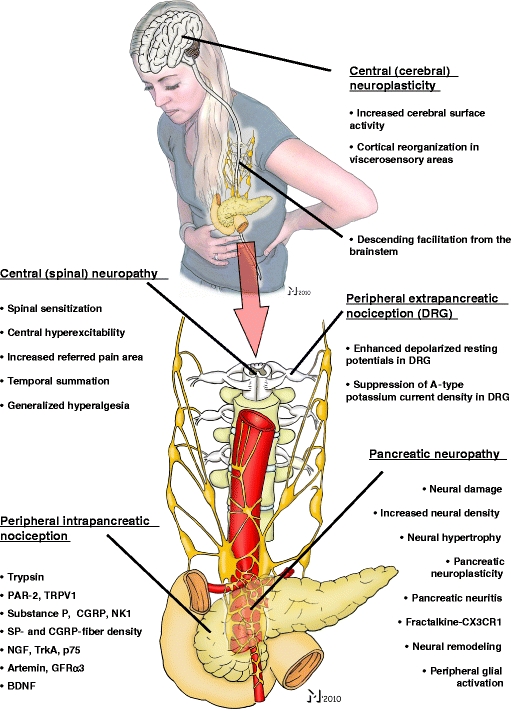
BACKGROUND: Unraveling the mechanisms of pain in chronic pancreatitis (CP) remains a true challenge. The rapid development of pancreatic surgery in the twentieth century, usage of advanced molecular biological techniques, and emergence of clinician-scientists have enabled the elucidation of several mechanisms that lead to the chronic, complicated neuropathic pain syndrome in CP. However, the proper analysis of pain in CP should include three main arms of mechanisms: "peripheral nociception," "peripheral/pancreatic neuropathy and neuroplasticity," and "central neuropathy and neuroplasticity." DISCUSSION: According to our current knowledge, pain in CP involves sustained sensitization of pancreatic peripheral nociceptors by neurotransmitters and neurotrophic factors following neural damage. This peripheral pancreatic neuropathy leads to intrapancreatic neuroplastic alterations that involve a profound switch in the autonomic innervation of the human pancreas via "neural remodeling." Furthermore, this neuropathy entails a hyperexcitability of spinal sensory second-order neurons, which are subject to modulation from the brainstem via descending facilitation. Finally, viscerosensory cortical areas react to this central sensitization via spatial reorganization and thus a central neuroplasticity. The present review summarizes the current findings in these arms of mechanisms and introduces a novel concept to consistently describe pain in CP as a "predominantly neuropathic," "mixed-type" pain.
Overview
The claims and statistics of this paper haven’t been checked yet.
Run the check — free, no account needed. It reads the open-access text and checks the sources it cites.
Integrity signals
Registry
Cites
Statistics
Figures
Verification
Claims the paper makes
The claims and statistics of this paper haven’t been checked yet.
Run the check — free, no account needed. It reads the open-access text and checks the sources it cites.
Claims other papers make about this one
Each is checked against this paper’s own text: does it say what the citing paper says it does?
In the citing paper
“Thus, for example, a neuropathic classification has recently been effectively applied to pain associated with visceral disorders such as pancreatitis, in which abnormal nerve sprouting, like that associated with endometriosis, plays a substantial role in the development of pain [23].”
From Sprouted Innervation into Uterine Transplants Contributes to the Development of Hyperalgesia in a Rat Model of Endometriosis (2012) · cites this paper as [23]
Self-check
Percentages, sums and reported differences re-computed from the paper’s own numbers.
The self-check needs the paper’s full text.
Citations
Cites
Treede (2008) · doi:10.1212/01.wnl.0000282763.29778.59 · Cited by 2,746
The neuropathic pain triad: neurons, immune cells and glia
Scholz, J., & Woolf, C. J. (2007) · Nature Neuroscience · doi:10.1038/nn1992 · Cited by 1,738
Models and Mechanisms of Hyperalgesia and Allodynia
Sandkühler, J. (2009) · Physiological Reviews · doi:10.1152/physrev.00025.2008 · Cited by 1,148
Sox10, a Novel Transcriptional Modulator in Glial Cells
Kuhlbrodt, K., Herbarth, B., Sock, E., Hermans-Borgmeyer, I., & Wegner, M. (1998) · The Journal of Neuroscience · doi:10.1523/jneurosci.18-01-00237.1998 · Cited by 781
Büchler, M. W., Frieß, H., Müller, M. W., Wheatley, A. M., & Beger, H. G. (1995) · The American Journal of Surgery · doi:10.1016/s0002-9610(99)80111-1 · Cited by 435
Pancreatic Neuropathy and Neuropathic Pain—A Comprehensive Pathomorphological Study of 546 Cases
Ceyhan, G. O., Bergmann, F., Kadıhasanoğlu, M., Altıntaş, B., Demir, İ. E., Hinz, U., Müller, M. W., Giese, T., Büchler, M. W., Giese, N. A., et al. (2008) · Gastroenterology · doi:10.1053/j.gastro.2008.09.029 · Cited by 416
Self-citationAnalysis of nerves in chronic pancreatitis
Bockman, D. E., Büchler, M. W., Malfertheiner, P., & Beger, H. G. (1988) · Gastroenterology · doi:10.1016/0016-5085(88)90687-7 · Cited by 404
Pancreatic duct pressure in chronic pancreatitis
Bradley, E. L. (1982) · The American Journal of Surgery · doi:10.1016/0002-9610(82)90008-3 · Cited by 267
Malin, S. A., Molliver, D. C., Koerber, H. R., Cornuet, P. K., Frye, R., Albers, K. M., & Davis, B. M. (2006) · Journal of Neuroscience · doi:10.1523/jneurosci.1726-06.2006 · Cited by 256
Symptoms and visceral perception in severe functional and organic dyspepsia
Mertz, H., Fullerton, S. C., Naliboff, B. D., & Mayer, E. A. (1998) · Gut · doi:10.1136/gut.42.6.814 · Cited by 252
Villanueva, L., & Bars, D. L. (1995) · PubMed · Cited by 250
Peripheral and central hyperexcitability: Differential signs and symptoms in persistent pain
Coderre, T. J., & Katz, J. D. (1997) · Behavioral and Brain Sciences · doi:10.1017/s0140525x97251484 · Cited by 225
Diffuse noxious inhibitory controls (DNIC) in animals and in man.
Bars, D. L., Villanueva, L., Bouhassira, D., & Jc, W. (1992) · PubMed · Cited by 196
Pain in chronic pancreatitis: the role of neuropathic pain mechanisms
Drewes, A. M., Krarup, A. L., Detlefsen, S., Malmstrøm, M. L., Dimcevski, G. G., & Funch-Jensen, P. M. (2008) · Gut · doi:10.1136/gut.2007.146621 · Cited by 184
Rectal afferent function in patients with inflammatory and functional intestinal disorders
Bernstein, C. N., Niazi, N., Robert, M. E., Mertz, H., Kodner, A., Munakata, J., Naliboff, B. D., & Mayer, E. A. (1996) · Pain · doi:10.1016/0304-3959(96)03062-x · Cited by 179
Changes in Peptidergic Innervation in Chronic Pancreatitis
Büchler, M. W., Weihe, E., Fries, H., Malfertheiner, P., Bockman, E., Müller, S., Nöhr, D., & Beger, H. G. (1992) · Pancreas · doi:10.1097/00006676-199203000-00009 · Cited by 171
Nerve Growth Factor and Its High-Affinity Receptor in Chronic Pancreatitis
Frieß, H., Zhu, Z., di Mola, F. F., Kulli, C., Graber, H. U., Andrén‐Sandberg, Å., Zimmermann, A., Korc, M., Reinshagen, M., & Büchler, M. W. (1999) · Annals of Surgery · doi:10.1097/00000658-199911000-00002 · Cited by 166
Ceyhan, G. O., Demir, İ. E., Rauch, U., Bergmann, F., Müller, M. W., Büchler, M. W., Frieß, H., & Schäfer, K. (2009) · The American Journal of Gastroenterology · doi:10.1038/ajg.2009.380 · Cited by 166
Self-citationCoeliac plexus block for pain in pancreatic cancer and chronic pancreatitis
Leung, J. W., Bowen-Wright, M., Aveling, W., Shorvon, P. J., & Cotton, P. B. (1983) · British journal of surgery · doi:10.1002/bjs.1800701212 · Cited by 162
Pain in Chronic Pancreatitis: The Role of Reorganization in the Central Nervous System
Dimcevski, G. G., Sami, S. A. K., Funch-Jensen, P. M., Pera, D. L., Valeriani, M., Arendt‐Nielsen, L., & Drewes, A. M. (2007) · Gastroenterology · doi:10.1053/j.gastro.2007.01.037 · Cited by 160
Balasubramanyan, S., Stemkowski, P. L., Stebbing, M. J., & Smith, P. A. (2006) · Journal of Neurophysiology · doi:10.1152/jn.00087.2006 · Cited by 147
Xu, G., Winston, J. H., Shenoy, M. M., Yin, H., Pendyala, S., & Pasricha, P. J. (2007) · Gastroenterology · doi:10.1053/j.gastro.2007.06.015 · Cited by 136
Starring roles for astroglia in barrier pathologies of gut and brain
Savidge, T., Sofroniew, M. V., & Neunlist, M. (2007) · Laboratory Investigation · doi:10.1038/labinvest.3700600 · Cited by 132
Descending Inhibitory Pain Modulation Is Impaired in Patients With Chronic Pancreatitis
Olesen, S. S., Brock, C., Krarup, A. L., Funch-Jensen, P. M., Arendt‐Nielsen, L., Wilder‐Smith, O. H. G., & Drewes, A. M. (2010) · Clinical Gastroenterology and Hepatology · doi:10.1016/j.cgh.2010.03.005 · Cited by 128
Müller, M. W., Friess, H., Martin, D. J., Hinz, U., Dahmen, R., & Büchler, M. W. (2007) · British journal of surgery · doi:10.1002/bjs.5960 · Cited by 124
Self-citationAnalgesia from a peripherally active κ-opioid receptor agonist in patients with chronic pancreatitis
Eisenach, J. C., Carpenter, R., & Curry, R. S. (2002) · Pain · doi:10.1016/s0304-3959(02)00259-2 · Cited by 124
Duodenum-preserving pancreatic head resection: long-term results
Büchler, M. W., Friess, H., Bittner, R., Roscher, R., Krautzberger, W., Müller, M. W., Malfertheiner, P., & Beger, H. G. (1997) · Journal of Gastrointestinal Surgery · doi:10.1007/s11605-006-0004-z · Cited by 123
Self-citationChronic pancreatitis patients show hyperalgesia of central origin: A pilot study
Buscher, H. C. J. L., Wilder‐Smith, O. H. G., & van Goor, H. (2005) · European Journal of Pain · doi:10.1016/j.ejpain.2005.06.006 · Cited by 122
Leitner, M. L., Molliver, D. C., Osborne, P. A., Vejsada, R., Golden, J. P., Lampe, P. A., Kato, A. C., Milbrandt, J., & Johnson, E. M. (1999) · Journal of Neuroscience · doi:10.1523/jneurosci.19-21-09322.1999 · Cited by 121
D'Haese, J. G., Demir, I. E., Friess, H., & Ceyhan, G. O. (2010) · Expert Opinion on Therapeutic Targets · doi:10.1517/14728220903540265 · Cited by 116
Self-citationVera–Portocarrero, L. P., Yie, J. X., Kowal, J., Ossipov, M. H., King, T. E., & Porreca, F. (2006) · Gastroenterology · doi:10.1053/j.gastro.2006.03.025 · Cited by 115
Müller, M. W., Frieß, H., Beger, H. G., Kleeff, J. H., Lauterburg, B. H., Glasbrenner, B., Riepl, R. L., & Büchler, M. W. (1997) · The American Journal of Surgery · doi:10.1016/s0002-9610(96)00402-3 · Cited by 112
Ceyhan, G., Bergmann, F., Kadıhasanoğlu, M., Erkan, M., Park, W., Hinz, U., Giese, T., Müller, M. W., Büchler, M. W., Giese, N., et al. (2006) · Gut · doi:10.1136/gut.2006.105528 · Cited by 111
Self-citationWick, E. C., Hoge, S. G., Grahn, S. W., Kim, E. J., Divino, L., Grady, E. F., Bunnett, N. W., & Kirkwood, K. S. (2006) · American Journal of Physiology-Gastrointestinal and Liver Physiology · doi:10.1152/ajpgi.00154.2005 · Cited by 110
Fregni, F., Potvin, K., Silva, D., Wang, X., Lenkinski, R. E., Freedman, S. D., & Pascual‐Leone, Á. (2010) · European Journal of Pain · doi:10.1016/j.ejpain.2010.08.002 · Cited by 107
Neuropathology of chronic pancreatitis in humans.
Rg, K., Keshavjee, S. H., & Nr, K. (1985) · PubMed · Cited by 101
Zhu, Z., Friess, H., Wang, L., Zimmermann, A., & Büchler, M. W. (2001) · Digestive Diseases and Sciences · doi:10.1023/a:1010684916863 · Cited by 100
Self-citationExpression of interleukin 8 (IL-8) and substance P in human chronic pancreatitis
Sebastiano, P. D., di Mola, F. F., Febbo, C. D., Baccante, G., Porreca, E., Innocenti, P., Friess, H., & Büchler, M. W. (2000) · Gut · doi:10.1136/gut.47.3.423 · Cited by 100
Self-citationWinston, J. H., He, Z.-J., Shenoy, M. M., Xiao, S., & Pasricha, P. J. (2005) · Pain · doi:10.1016/j.pain.2005.06.013 · Cited by 96
Pain management in chronic pancreatitis
Andrén‐Sandberg, Å., Hoem, D., & Gíslason, H. (2002) · European Journal of Gastroenterology & Hepatology · doi:10.1097/00042737-200209000-00006 · Cited by 96
Neurogenic inflammation and pancreatitis
Liddle, R. A., & Nathan, J. D. (2004) · Pancreatology · doi:10.1159/000082180 · Cited by 95
NK-1 receptor gene expression is related to pain in chronic pancreatitis
Shrikhande, S. V., Frieß, H., di Mola, F. F., Tempia‐Caliera, A. A., Conejo-Garcia, J. R., Zhu, Z., Zimmermann, A., & Büchler, M. W. (2001) · Pain · doi:10.1016/s0304-3959(00)00436-x · Cited by 93
Skoff, A. M., & Adler, J. E. (2005) · Experimental Neurology · doi:10.1016/j.expneurol.2005.10.006 · Cited by 88
Nathan, J. D., Peng, R. Y., Wang, Y., McVey, D. C., Vigna, S. R., & Liddle, R. A. (2002) · American Journal of Physiology-Gastrointestinal and Liver Physiology · doi:10.1152/ajpgi.00105.2002 · Cited by 86
Ceyhan, G. O., Michalski, C. W., Demir, İ. E., Müller, M. W., & Frieß, H. (2008) · Best Practice & Research Clinical Gastroenterology · doi:10.1016/j.bpg.2007.10.016 · Cited by 85
Self-citationPancreatic morphology and function in relationship to pain in chronic pancreatitis
Malfertheiner, P., Büchler, M. W., Stanescu, A., & Ditschuneit, H. H. (1987) · International Journal of Pancreatology · doi:10.1007/bf02788349 · Cited by 78
The microenvironment in chronic pancreatitis and pancreatic cancer induces neuronal plasticity
Demir, I. E., Ceyhan, G. O., Rauch, U., Altıntaş, B., Klotz, M., Müller, M. W., Büchler, M. W., Friess, H., & Schäfer, K. (2009) · Neurogastroenterology & Motility · doi:10.1111/j.1365-2982.2009.01428.x · Cited by 77
Self-citationHoogerwerf, W. A., Shenoy, M. M., Winston, J. H., Xiao, S., He, Z., & Pasricha, P. J. (2004) · Gastroenterology · doi:10.1053/j.gastro.2004.07.002 · Cited by 77
The fractalkine receptor CX3CR1 is involved in liver fibrosis due to chronic hepatitis C infection
Wasmuth, H. E., Zaldivar, M. M., Berres, M., Werth, A., Scholten, D., Hillebrandt, S., Tacke, F., Schmitz, P., Dahl, E., Wiederholt, T., et al. (2007) · Journal of Hepatology · doi:10.1016/j.jhep.2007.09.008 · Cited by 70
Kang, H., Tian, L., Son, Y., Zuo, Y., Procaccino, D., Love, F. M., Hayworth, C. R., Trachtenberg, J. T., Mikesh, M., Sutton, L., et al. (2007) · Journal of Neuroscience · doi:10.1523/jneurosci.0621-07.2007 · Cited by 62
Hyperalgesia and temporal summation of pain after heat injury in man
Pedersen, J. L., Andersen, O. K., Arendt‐Nielsen, L., & Kehlet, H. (1998) · Pain · doi:10.1016/s0304-3959(97)00162-0 · Cited by 60
Zhang, Y. H., Chi, X. X., & Nicol, G. D. (2008) · The Journal of Physiology · doi:10.1113/jphysiol.2008.152439 · Cited by 59
Ceyhan, G. O., Deucker, S., Demir, İ. E., Erkan, M., Schmelz, M., Bergmann, F., Müller, M. W., Giese, T., Büchler, M. W., Giese, N. A., et al. (2009) · Laboratory Investigation · doi:10.1038/labinvest.2008.170 · Cited by 59
Self-citationDimcevski, G. G., Staahl, C., Andersen, S. D., Thorsgaard, N., Funch-Jensen, P. M., Arendt‐Nielsen, L., & Drewes, A. M. (2007) · Pancreas · doi:10.1097/mpa.0b013e31805c1762 · Cited by 57
Müller, M. W., Friess, H., Leitzbach, S., Michalski, C. W., Berberat, P. O., Ceyhan, G. O., Hinz, U., Ho, C.-K., Köninger, J., Kleeff, J. H., et al. (2008) · The American Journal of Surgery · doi:10.1016/j.amjsurg.2007.08.065 · Cited by 54
Self-citationPain in Chronic Pancreatitis: A Salutogenic Mechanism or a Maladaptive Brain Response?
Fregni, F., Pascual‐Leone, Á., & Freedman, S. D. (2007) · Pancreatology · doi:10.1159/000108958 · Cited by 50
Fink, T., Sebastiano, P. D., Bu¨chler, M., Beger, H. G., & Weihe, E. (1994) · Neuroscience · doi:10.1016/0306-4522(94)90020-5 · Cited by 46
Thalamic EEG recordings in patients with chronic pain
G�cer, G., Niedermeyer, E., & Long, D. M. (1978) · Journal of Neurology · doi:10.1007/bf00313368 · Cited by 43
Nerve Blocks and Neuroablative Surgery for Chronic Pancreatitis
Bradley, E. L., & Bem, J. (2003) · World Journal of Surgery · doi:10.1007/s00268-003-7244-9 · Cited by 41
Fate of nerves in chronic pancreatitis: Neural remodeling and pancreatic neuropathy
Ceyhan, G. O., Demir, İ. E., Maak, M., & Friess, H. (2010) · Best Practice & Research Clinical Gastroenterology · doi:10.1016/j.bpg.2010.03.001 · Cited by 38
Self-citationDevor, M. G. (2006) · Journal of Neurophysiology · doi:10.1152/jn.00365.2006 · Cited by 37
Hypoalgesia to experimental visceral and somatic stimulation in painful chronic pancreatitis
Dimcevski, G. G., Schipper, K., Tage‐Jensen, U., Funch-Jensen, P. M., Krarup, A. L., Toft, E. S., Thorsgaard, N., Arendt‐Nielsen, L., & Drewes, A. M. (2006) · European Journal of Gastroenterology & Hepatology · doi:10.1097/01.meg.0000223903.70492.c5 · Cited by 35
Madsen, P., & Hansen, E. F. (1985) · Scandinavian Journal of Gastroenterology · doi:10.3109/00365528509089279 · Cited by 35
PALLIATION OF PAIN IN CHRONIC PANCREATITIS
Wong, G. Y., Sakorafas, G. H., Tsiotos, G. G., & Sarr, M. G. (1999) · Surgical Clinics of North America · doi:10.1016/s0039-6109(05)70049-9 · Cited by 34
Celiac plexus block: an overview.
Owitz, S., & Koppolu, S. (1984) · PubMed · Cited by 29
Potential role of fractalkine receptor expression in human renal fibrogenesis
Koziolek, M. J., Schmid, H., Cohen, C. D., Blaschke, S., Hemmerlein, B., Zapf, A., Muller, G. A., & Strutz, F. M. (2007) · Kidney International · doi:10.1038/sj.ki.5002368 · Cited by 28
Köninger, J., Seiler, C. M., Wente, M. N., Reidel, M. A., Gazyakan, E., Mansmann, U., Müller, M. W., Frieß, H., & Büchler, M. W. (2006) · Trials · doi:10.1186/1745-6215-7-12 · Cited by 20
Fischer, G. B., & Hirsch, R. (1954) · Medical Entomology and Zoology · Cited by 19
Relationship between pancreatic function and pain in chronic pancreatitis.
Malfertheiner, P., Pieramico, O., Büchler, M. W., & Ditschuneit, H. H. (1990) · PubMed · Cited by 14
Duodenum preserving pancreatic head resection in the treatment of chronic pancreatitis.
Köninger, J., Friess, H., Müller, M. W., & Büchler, M. W. (2004) · PubMed · Cited by 10
Self-citationA Clinical investigation of chronic pancreatitis
Hatayama, K. (1978) · Gastroenterologia Japonica · doi:10.1007/bf02773858 · Cited by 7
Research works printed but not linked: 1
- Hesse H (1971) Lektüre für Minuten. Suhrkamp Verlag, Frankfurt
Cited by
Sorted by citations
Majumder, S., & Chari, S. T. (2016) · The Lancet · doi:10.1016/s0140-6736(16)00097-0 · Cited by 367
Guidelines for the understanding and management of pain in chronic pancreatitis
Drewes, A. M., Bouwense, S. A. W., Campbell, C. M., Ceyhan, G. O., Delhaye, M., Demir, I. E., Garg, P. K., van Goor, H., Halloran, C., Isaji, S., et al. (2017) · Pancreatology · doi:10.1016/j.pan.2017.07.006 · Cited by 321
Self-citationNeural plasticity in pancreatitis and pancreatic cancer
Demir, İ. E., Frieß, H., & Ceyhan, G. O. (2015) · Nature Reviews Gastroenterology & Hepatology · doi:10.1038/nrgastro.2015.166 · Cited by 256
Self-citationBellin, M. D., Freeman, M. L., Gelrud, A., Slivka, A. A., Clavel, A. L., Humar, A., Schwarzenberg, S. J., Lowe, M. E., Rickels, M. R., Whitcomb, D. C., et al. (2013) · Pancreatology · doi:10.1016/j.pan.2013.10.009 · Cited by 198
Schwartz, E. S., La, J., Scheff, N. N., Davis, B. M., Albers, K. M., & Gebhart, G. F. (2013) · Journal of Neuroscience · doi:10.1523/jneurosci.1806-12.2013 · Cited by 175
Metadata
- Authors
- Demir, I. E., Tieftrunk, E., Maak, M., Friess, H., & Ceyhan, G. O.
- Affiliations
- TUM Klinikum (DE)
- Venue
- Langenbeck s Archives of Surgery
- Published
- 2010-12-10
- Volume
- 396
- Issue
- 2
- Pages
- 151-160
- ISSN
- 0023-8236 (ISSN-L)
- 1435-2443
- 1435-2451
- PMC
- PMC3026929
- OpenAlex
- W2005222244
- Cited by
- 101
- References
- 71
- Citations by year
- 2026: 4 · 2025: 6 · 2024: 5 · 2023: 6 · 2022: 3 · 2021: 6 · 2020: 5 · 2019: 8 · 2018: 4 · 2017: 8 · 2016: 2 · 2015: 10 · 2014: 8 · 2013: 14 · 2012: 5
- FWCI
- 0.77
- Type
- journal article
- Language
- en
- Open access
- hybrid
- doi.org
- Licence
- cc-by-nc
- Locations
- Langenbeck s Archives of Surgery (publishedVersion, cc-by-nc)
- PubMed Central (publishedVersion, cc-by-nc)
- PubMed (publishedVersion)
- mediaTUM – the media and publications repository of the Technical University Munich (Technical University Munich) (submittedVersion)
- Topics
- Health Sciences › Medicine › Physiology (medical) › Pain Mechanisms and Treatments
- Health Sciences › Medicine › Surgery › Pancreatitis Pathology and Treatment
- Health Sciences › Medicine › Anesthesiology and Pain Medicine › Pain Management and Treatment
- Keywords
- chronic pancreatitis, neuropathic pain, pain mechanisms, peripheral nociception, neuroplasticity, central sensitization, descending facilitation, brain reorganization
- MeSH terms
- Humans, Neuralgia, Nociceptors, Pain Measurement, Abdominal Pain, Pancreatitis, Chronic
About these checks
Registry, retraction, Cites and statistics results are computed, not judged, with one exception: a printed reference that no index lists is read once by a model before it counts as a citation error. Claims are extracted by a model and kept only when their quote appears verbatim in the text; each cited source is then checked, with a model’s help, for whether it says what the claim relies on. Those verdicts can be wrong — read the claim’s quote and the cited source before relying on one.
Statistics and arithmetic are recomputed, not judged.
Confidence bands are shown only for fields calibrated on our annotated test set. None is calibrated yet, so no band is shown.
What counts as a claim ›How we measure confidence ›How we check this ›
Are you an author, or do you see a problem with this page? Request a review
