

Spatial knowledge acquired from first-person and dynamic map perspectives
Open accessThe DOI matches its Crossref record; 51 of the 51 references it cites were found in a registry or an index.
Abstract
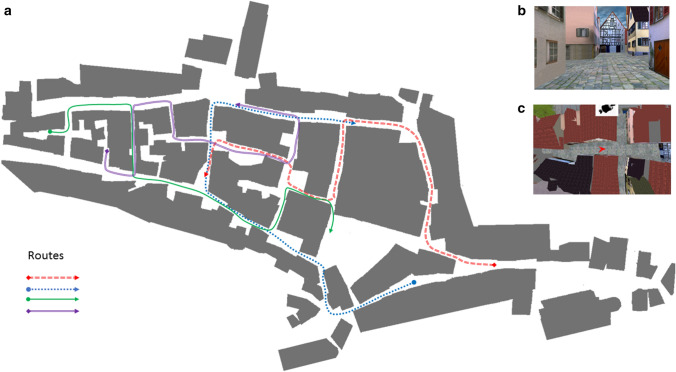
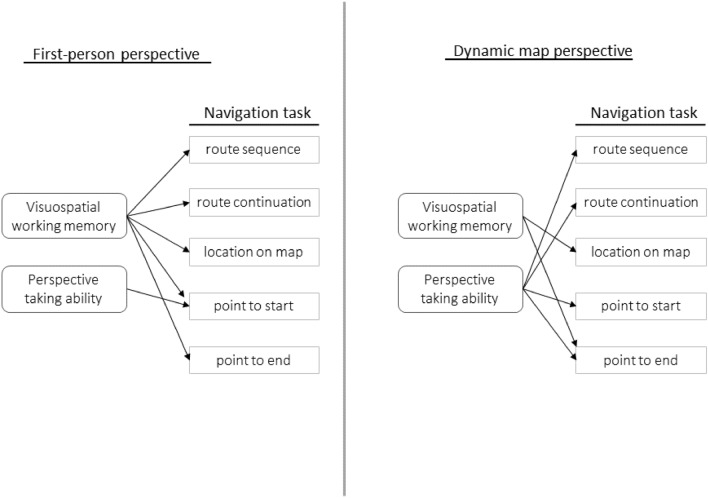
As we become familiar with an environment through navigation and map study, spatial information is encoded into a mental representation of space. It is currently unclear to what degree mental representations of space are determined by the perspective in which spatial information is acquired. The overlapping model of spatial knowledge argues that spatial information is encoded into a common spatial representation independent of learning perspective, whereas the partially independent model argues for dissociated spatial representations specific to the learning perspective. The goal of this study was to provide insight into this debate by investigating the cognitive functions underlying the formation of spatial knowledge obtained through different learning perspectives. Hundred participants studied an ecologically valid virtual environment via a first-person and map perspective. The map employed in the study was dynamic, allowing for the disentanglement of learning perspective and sequential information presentation. Spatial knowledge was examined using an array of navigation tasks that assessed both route and survey knowledge. Results show that distinct visuospatial abilities predict route knowledge depending on whether an environment is learned via a first-person or map perspective. Both shared and distinct visuospatial abilities predicted the formation of survey knowledge in the two perspective learning conditions. Additionally, sequential presentation of map information diminishes the perspective dependent performance differences on spatial tasks reported in earlier studies. Overall, the results provide further evidence for the partially dissociated model of spatial knowledge, as the perspective from which an environment is learned influences the spatial representation that is formed.
Overview
The claims and statistics of this paper haven’t been checked yet.
Free: it reads the open-access text and checks the first 5 claims that cite a source we can check. Create a free account to check every claim.
Integrity signals
Registry
Cites
Statistics
Figures
Verification
Claims the paper makes
The claims and statistics of this paper haven’t been checked yet.
Free: it reads the open-access text and checks the first 5 claims that cite a source we can check. Create a free account to check every claim.
Claims other papers make about this one
Each is checked against this paper’s own text: does it say what the citing paper says it does?
The source backs part of the claim, not all of it — or backs it for a different population, condition or comparison.
In the citing paper
“It is believed that spatial representation formed through direct navigation will initially be stored as route knowledge (egocentric representations), while spatial knowledge acquired through map learning will be developed into survey knowledge (allocentric representations) (Van der Kuil, 2021).”
From Does viewing a top-down map facilitate spatial learning from navigation in a virtual environment? (2026) · cites this paper as Van der Kuil, 2021
Experimental — accuracy not yet measured
Self-check
Percentages, sums and reported differences re-computed from the paper’s own numbers.
The self-check needs the paper’s full text.
Citations
Cites
(1978) · UA Campus Repository (The University of Arizona) · Cited by 8,010
Cognitive maps in rats and men
Tolman, E. C. (1948) · Psychological Review · doi:10.1037/h0061626 · Cited by 6,641
Mental Rotation of Three-Dimensional Objects
Shepard, R. N., & Metzler, J. (1971) · Science · doi:10.1126/science.171.3972.701 · Cited by 6,246
The hippocampus as a cognitive map
Passingham, R. E. (1979) · Neuroscience · doi:10.1016/0306-4522(79)90015-0 · Cited by 5,128
Wechsler Adult Intelligence Scale--Fourth Edition
Wechsler, D. (2012) · PsycTESTS Dataset · doi:10.1037/t15169-000 · Cited by 2,232
The Development of Spatial Representations of Large-Scale Environments
Siegel, A. W., & White, S. H. (1975) · Advances in Child Development and Behavior · doi:10.1016/s0065-2407(08)60007-5 · Cited by 1,830
Frontiers in Human Neuroscience
Avenanti, A. (2013) · Archivio istituzionale della ricerca (Alma Mater Studiorum Università di Bologna) · Cited by 1,572
Differences in spatial knowledge acquired from maps and navigation
Thorndyke, P. W., & Hayes-Roth, B. (1982) · Cognitive Psychology · doi:10.1016/0010-0285(82)90019-6 · Cited by 1,167
The Corsi Block-Tapping Task: Standardization and Normative Data
Kessels, R. P. C., van Zandvoort, M. J. E., Postma, A., Kappelle, L. J., & de Haan, E. H. F. (2000) · Applied Neuropsychology · doi:10.1207/s15324826an0704_8 · Cited by 1,015
A dissociation between mental rotation and perspective-taking spatial abilities
Hegarty, M. (2004) · Intelligence · doi:10.1016/j.intell.2003.12.001 · Cited by 855
Hegarty, M., Montello, D. R., Richardson, A. E., Ishikawa, T., & Lovelace, K. (2006) · Intelligence · doi:10.1016/j.intell.2005.09.005 · Cited by 820
Spatial knowledge acquisition from maps and from navigation in real and virtual environments
Richardson, A. E., Montello, D. R., & Hegarty, M. (1999) · Memory & Cognition · doi:10.3758/bf03211566 · Cited by 570
The Backward Span of the Corsi Block-Tapping Task and Its Association With the WAIS-III Digit Span
Kessels, R. P. C., van den Berg, E., Ruis, C., & Brands, A. M. A. (2008) · Assessment · doi:10.1177/1073191108315611 · Cited by 331
Ekstrom, A. D., Arnold, A. E. G. F., & Iaria, G. (2014) · Frontiers in Human Neuroscience · doi:10.3389/fnhum.2014.00803 · Cited by 263 · cited 1×
“Conversely, people are able to effectively navigate through an environment and point towards specific locations from a first-person perspective after studying an environment using a map (Allison & Head, 2017; Zhang, Zherdeva, & Ekstrom, 2014).”
BackgroundActive and passive contributions to spatial learning
Chrastil, E. R., & Warren, W. H. (2012) · Psychonomic Bulletin & Review · doi:10.3758/s13423-011-0182-x · Cited by 261
Kozhevnikov, M., Motes, M. A., Rasch, B., & Blajenkova, O. (2006) · Applied Cognitive Psychology · doi:10.1002/acp.1192 · Cited by 243
Neural Correlates of Encoding Space from Route and Survey Perspectives
Shelton, A. L., & Gabrieli, J. D. E. (2002) · The Journal of Neuroscience · doi:10.1523/jneurosci.22-07-02711.2002 · Cited by 224
Strategies of processing spatial information in survey and landmark-centred individuals
Pazzaglia, F., & De Beni, R. (2001) · The European Journal of Cognitive Psychology · doi:10.1080/09541440042000124 · Cited by 212
Orientation and Perspective Dependence in Route and Survey Learning.
Shelton, A. L., & McNamara, T. P. (2004) · Journal of Experimental Psychology: Learning, Memory, and Cognition · doi:10.1037/0278-7393.30.1.158 · Cited by 195
Computer-assisted navigation and the acquisition of route and survey knowledge
Münzer, S., Zimmer, H. D., Schwalm, M., Baus, J., & Aslan, I. (2006) · Journal of Environmental Psychology · doi:10.1016/j.jenvp.2006.08.001 · Cited by 187
Visuo‐spatial working memory in navigation
Garden, S., Cornoldi, C., & Logie, R. H. (2002) · Applied Cognitive Psychology · doi:10.1002/acp.746 · Cited by 184
Iglói, K., Zaoui, M., Berthoz, A., & Rondi‐Reig, L. (2009) · Hippocampus · doi:10.1002/hipo.20595 · Cited by 161
Maladaptive Bias for Extrahippocampal Navigation Strategies in Aging Humans
Wiener, J. M., de Condappa, O., Harris, M. A., & Wolbers, T. (2013) · The Journal of Neuroscience · doi:10.1523/jneurosci.0717-12.2013 · Cited by 159
Goal-specific influences on the representation of spatial perspective
Taylor, H. A., Naylor, S. J., & Chechile, N. A. (1999) · Memory & Cognition · doi:10.3758/bf03211414 · Cited by 158
Cogné, M., Taillade, M., N’Kaoua, B., Tarruella, A., Klinger, E., Larrue, F., Sauzéon, H., Joseph, P.-A., & Sorita, E. (2017) · Annals of Physical and Rehabilitation Medicine · doi:10.1016/j.rehab.2015.12.004 · Cited by 150
How Navigational Aids Impair Spatial Memory: Evidence for Divided Attention
Gardony, A. L., Brunyé, T. T., Mahoney, C. R., & Taylor, H. A. (2013) · Spatial Cognition & Computation · doi:10.1080/13875868.2013.792821 · Cited by 145
van Veen, H. A. H. C., Distler, H. K., Braun, S. J., & Bülthoff, H. (1998) · Future Generation Computer Systems · doi:10.1016/s0167-739x(98)00027-2 · Cited by 139
Individual skill differences and large-scale environmental learning.
Fields, A. W., & Shelton, A. L. (2006) · Journal of Experimental Psychology: Learning, Memory, and Cognition · doi:10.1037/0278-7393.32.3.506 · Cited by 116
The role of visuo-spatial working memory in map learning: new findings from a map drawing paradigm
Coluccia, E., Bosco, A., & Brandimonte, M. A. (2006) · Psychological Research · doi:10.1007/s00426-006-0090-2 · Cited by 89
Virtual reality in neurologic rehabilitation of spatial disorientation
Kober, S., Wood, G., Hofer, D., Kreuzig, W., Kiefer, M., & Neuper, C. (2013) · Journal of NeuroEngineering and Rehabilitation · doi:10.1186/1743-0003-10-17 · Cited by 86
Zhang, H., Zherdeva, K., & Ekstrom, A. D. (2014) · Memory & Cognition · doi:10.3758/s13421-014-0418-x · Cited by 80
Labate, E., Pazzaglia, F., & Hegarty, M. (2013) · Journal of Environmental Psychology · doi:10.1016/j.jenvp.2013.11.007 · Cited by 77
Wen, W., Ishikawa, T., & Sato, T. (2011) · Applied Cognitive Psychology · doi:10.1002/acp.1737 · Cited by 68
Route and survey processing of topographical memory during navigation
Corazzini, L. L., Nésa, M.-P., Ceccaldi, M. P., Guedj, É., Thinus‐Blanc, C., Cauda, F., D’Agata, F., & Péruch, P. (2010) · Psychological Research · doi:10.1007/s00426-010-0276-5 · Cited by 68
Differential effects of aging on spatial learning through exploratory navigation and map reading
Yamamoto, N., & DeGirolamo, G. J. (2012) · Frontiers in Aging Neuroscience · doi:10.3389/fnagi.2012.00014 · Cited by 67
de Rooij, N. K., Claessen, M. H. G., van der Ham, I. J. M., Post, M. W. M., & Visser‐Meily, J. M. A. (2017) · Neuropsychological Rehabilitation · doi:10.1080/09602011.2017.1347098 · Cited by 51
Self-citationZhang, H., Copara, M., & Ekstrom, A. D. (2012) · PLoS ONE · doi:10.1371/journal.pone.0044886 · Cited by 50
Learning a map of environment: The role of visuo‐spatial abilities in young and older adults
Meneghetti, C., Fiore, F., Borella, E., & Béni, R. D. (2011) · Applied Cognitive Psychology · doi:10.1002/acp.1788 · Cited by 50
Muffato, V., Meneghetti, C., & De Beni, R. (2020) · British Journal of Psychology · doi:10.1111/bjop.12384 · Cited by 44
Claessen, M. H. G., van der Ham, I. J. M., Jagersma, E., & Visser-Meily, J. M. A. (2016) · Neuropsychological Rehabilitation · doi:10.1080/09602011.2015.1045910 · Cited by 43
Self-citationWhen goals constrain: Eye movements and memory for goal‐Oriented map study
Brunyé, T. T., & Taylor, H. A. (2009) · Applied Cognitive Psychology · doi:10.1002/acp.1508 · Cited by 42
Meneghetti, C., Zancada-Menéndez, C., Sampedro‐Piquero, P., López, L., Martinelli, M., Ronconi, L., & Rossi, B. (2016) · Learning and Individual Differences · doi:10.1016/j.lindif.2016.07.002 · Cited by 41
Shelton, A. L., & Pippitt, H. A. (2006) · Psychological Research · doi:10.1007/s00426-006-0088-9 · Cited by 39
Reference frames in virtual spatial navigation are viewpoint dependent
Török, Ã., Nguyen, T. P., Kolozsvári, O., Buchanan, R. J., & Nadasdy, Z. (2014) · Frontiers in Human Neuroscience · doi:10.3389/fnhum.2014.00646 · Cited by 39
A Direct Comparison of Real-World and Virtual Navigation Performance in Chronic Stroke Patients
Claessen, M. H. G., Visser-Meily, J. M. A., de Rooij, N. K., Postma, A., & van der Ham, I. J. M. (2016) · Journal of the International Neuropsychological Society · doi:10.1017/s1355617715001228 · Cited by 39
Self-citationSpatial mental representations: the influence of age on route learning from maps and navigation
Muffato, V., Meneghetti, C., & Béni, R. D. (2018) · Psychological Research · doi:10.1007/s00426-018-1033-4 · Cited by 39
How do we get there? Effects of cognitive aging on route memory
O’Malley, M., Innes, A., & Wiener, J. M. (2017) · Memory & Cognition · doi:10.3758/s13421-017-0763-7 · Cited by 37
Gras, D., Gyselinck, V., Perrussel, M., Orriols, É., & Piolino, P. (2012) · Journal of Cognitive Psychology · doi:10.1080/20445911.2012.739154 · Cited by 33
Rehabilitation in a complex case of topographical disorientation
Bouwmeester, L., van de Wege, A., Haaxma, R., & Snoek, J. W. (2014) · Neuropsychological Rehabilitation · doi:10.1080/09602011.2014.923318 · Cited by 33
Route repetition and route reversal: Effects of age and encoding method.
Allison, S. L., & Head, D. M. (2017) · Psychology and Aging · doi:10.1037/pag0000170 · Cited by 32
Costs of switching perspectives in route and survey descriptions
Lee, P. U., & Tversky, B. (2002) · eScholarship (California Digital Library) · Cited by 20
Cited by
Binsch, O., Oudejans, N., van der Kuil, M. N. A., Landman, A., Smeets, M. M. J., Leers, M. P. G., & Smit, A. S. (2022) · Multimedia Tools and Applications · doi:10.1007/s11042-022-14110-5 · Cited by 30
Hsu, P.-C., Babu, S. V., & Chuang, J. (2025) · IEEE Conference on Virtual Reality and 3D User Interfaces (VR) · doi:10.1109/vr59515.2025.00076 · Cited by 7
Sex differences in direction giving: Are boys better than girls?
Yacoub, N., Lakusta, L., & Yang, Y. (2024) · Journal of Experimental Child Psychology · doi:10.1016/j.jecp.2024.105958 · Cited by 2
Does viewing a top-down map facilitate spatial learning from navigation in a virtual environment?
Ding, J., Chan, H. M., & Saunders, J. A. (2026) · Cognitive Research: Principles and Implications · doi:10.1186/s41235-026-00732-y
“It is believed that spatial representation formed through direct navigation will initially be stored as route knowledge (egocentric representations), while spatial knowledge acquired through map learning will be developed into survey knowledge (allocentric representations) (Van der Kuil, 2021).”
Dynamic map‐making technology and the application in geographic information science
Li, W., Liu, L., Zhang, H., & Li, J. (2024) · Computer Applications in Engineering Education · doi:10.1002/cae.22737 · Cited by 1
Metadata
- Authors
- van der Kuil, M. N. A., Evers, A. W. M., Visser-Meily, J. M. A., & van der Ham, I. J. M.
- Affiliations
- Leiden University (NL)
- Venue
- Psychological Research
- Published
- 2020-08-09
- Volume
- 85
- Issue
- 6
- Pages
- 2137-2150
- ISSN
- 0033-3026 (ISSN-L)
- 0340-0727
- 1430-2772
- PMC
- PMC8357693
- OpenAlex
- W3047884380
- Cited by
- 8
- References
- 51
- Citations by year
- 2026: 2 · 2025: 3 · 2024: 2 · 2022: 1
- FWCI
- 0.09
- Type
- journal article
- Language
- en
- Open access
- hybrid
- doi.org
- Licence
- cc-by
- creativecommons.org/licenses/by/4.0 (tdm)
- creativecommons.org/licenses/by/4.0 (vor)
- Locations
- Psychological Research (publishedVersion, cc-by)
- PubMed Central (publishedVersion, cc-by)
- PubMed (publishedVersion)
- Leiden Repository (Leiden University) (submittedVersion, cc-by)
- Utrecht University Repository (Utrecht University) (submittedVersion, other-oa)
- Data Archiving and Networked Services (DANS) (submittedVersion, cc-by)
- Funders
- Stichting voor de Technische Wetenschappen (14098)
- NWO-Veni 2012 (451.12.004)
- Topics
- Social Sciences › Psychology › Experimental and Cognitive Psychology › Spatial Cognition and Navigation
- Social Sciences › Geography, Planning and Development › Geography Education and Pedagogy
- Life Sciences › Neuroscience › Cognitive Neuroscience › Memory and Neural Mechanisms
- Keywords
- spatial knowledge, first-person perspective, dynamic maps, route knowledge, survey knowledge, visuospatial ability, virtual navigation
- MeSH terms
- Cognition, Humans, Learning, Space Perception, Spatial Navigation
About these checks
Registry, retraction, Cites and statistics results are computed, not judged, with one exception: a printed reference that no index lists is read once by a model before it counts as a citation error. Claims are extracted by a model and kept only when their quote appears verbatim in the text; each cited source is then checked, with a model’s help, for whether it says what the claim relies on. Those verdicts can be wrong — read the claim’s quote and the cited source before relying on one.
Statistics and arithmetic are recomputed, not judged.
Confidence bands are shown only for fields calibrated on our annotated test set. None is calibrated yet, so no band is shown.
What counts as a claim ›How we measure confidence ›How we check this ›
Are you an author, or do you see a problem with this page? Request a review
Data sources
Bibliographic data: Semantic Scholar, OpenAlex, Crossref.
Contains information from the Semantic Scholar Academic Graph Datasets, made available under the ODC Attribution License (ODC-BY 1.0).
Semantic Scholar’s data is described in: Kinney, R., et al. (2023). The Semantic Scholar Open Data Platform. arXiv:2301.10140.
