

Lab-scale photobioreactor systems: principles, applications, and scalability
Open accessThe DOI matches its Crossref record; 223 of the 225 references it cites were found in a registry or an index, and 1 are not checked yet; 56 of the 239 sources its claims cite were checked for support.
Abstract
Review of laboratory-scale photobioreactor designs including illuminated shake flasks, bubble columns, flat-plate and stirred-tank systems, with selection criteria for scale-up.
Verified 2026-11-22 · 1 reference not checked yet
Overview
CoChat Summary
TL;DR
This review surveys laboratory-scale photobioreactor designs for microalgae and cyanobacteria and evaluates their advantages, disadvantages, and scalability. It recommends matching lab reactors to the projected large-scale geometry and using light-dependent growth kinetics for model-based scale-up, while addressing contamination, temperature, shear, biofilm, and flashing-light effects.
Key findings
- Lab-scale photobioreactors span microliter to liter scales: microtiter plates have wells < 4000 µL and enable parallel batch experiments, but light attenuation is not comparable to industrial-scale reactors and continuous sampling is not possible.
- Bubble column photobioreactors commonly operate at 1–10 L (smallest described: 450 mL; up to 28 L with internal illumination), with gas flow rates of 0.1–1 vvm and incident light intensities of 15–220 µmol m⁻² s⁻¹; external illumination creates light gradients, while internal illumination gives more homogeneous light distribution.
- Flat plate photobioreactors often use 80–400 µmol m⁻² s⁻¹; reducing the light path from 30 to 15 mm increased *C. vulgaris* biomass productivity 2.5-fold, and increasing flow from 45 to 77 L min⁻¹ reduced biofilm-bound *C. vulgaris* cells from 70% to 19%.
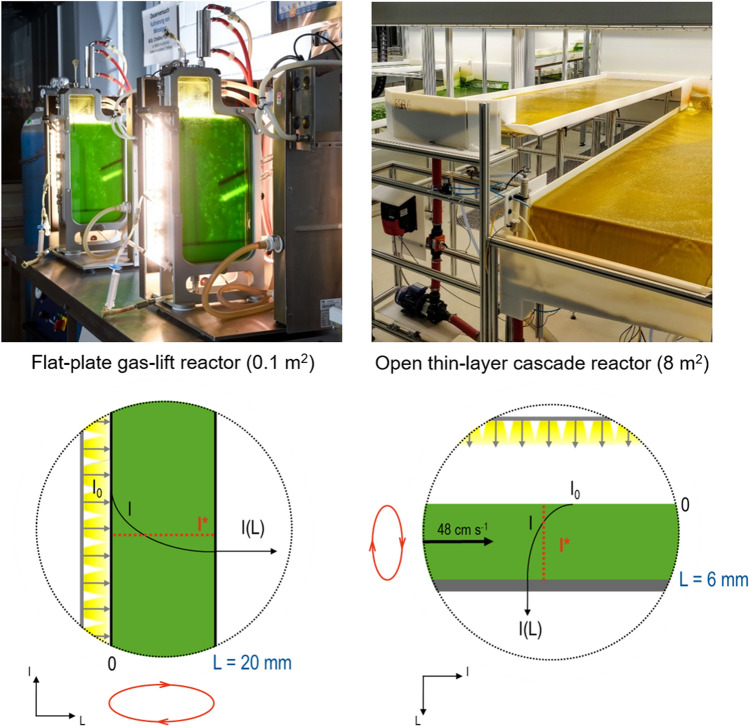
- For scale-up, a factor of 10 is generally recommended, though light-sensitive cyanobacteria may require a lower factor; open raceway ponds are typically 20–30 cm deep, thin-layer cascade reactors use 0.5–1 cm layers (lab-scale example: 8 m², 65 L, ~0.6 cm), and artificial LED lighting was estimated at $1.9 per kg of purple phototrophic bacteria biomass.
Methods
- Narrative review of laboratory-scale photobioreactor systems, covering microfluidic, shaken (microtiter plate and shake flask), bubble column, flat plate, stirred-tank, tubular, and other designs.
- No primary experimental dataset; the paper synthesizes published studies and examples, including reported volumes, light intensities, gas flow rates, and scale-up cases.
- Main analysis is qualitative comparison of reactor advantages/disadvantages and recommendations for reactor selection, operation, and scale-up, with emphasis on light-dependent microalgae growth kinetics as a basis for model-based scale-up.
Limitations
- The paper states system-specific limitations, including that microtiter plate light attenuation is not comparable to industrial scale, continuous sampling is not possible in low-volume systems, dead microalgae cells cannot be distinguished from living cells in microfluidic chips, and custom microfluidic designs may hinder experiment replication.
- The paper notes that flashing-light effects have not been unequivocally proven at pilot or production scale, and that most large-scale phototrophic cultivations give lower yields than expected from laboratory results.
- Evident from the text: as a narrative review, it does not report a systematic search strategy or quantitative meta-analysis, and its scale-up recommendations are largely qualitative and based on cited examples rather than a unified experimental validation.
Model-written summary. Check it against the paper before relying on it.
Integrity signals
Registry
Cites
Statistics
Figures
Verification
Claims the paper makes
41 Valid · 4 Not valid · 111 Not checked · 57 Own results and interpretations
At least one cited source doesn’t support this claim or points to a different paper, and none confirmed it — see the verdicts below.
In the paper
“In 1932, Emerson and Arnold first found that microalgae cells can exhibit the same maximum rates of oxygen production and carbon dioxide uptake under a sequence of short light flashes as under continuous light [217].”
§ Lab-scale photobioreactor systems: principles, applications, and scalability > Scalability of photobioreactor systems > Flashing light effects should be considered if positive effects on microalgae process performance has been observed
What the sources say
- Disputedcites [217] Emerson R Arnold W A separation of the reactions in photosynthesis by means of intermittent light J Gen Physiol 1932 15 391 420 10.1085/jgp.15.4.391 19872654 PMC2141175 sourceExperimental — accuracy not yet measured
Table IV (pp. 408–409) reports substantially lower oxygen-production rates under flashing light than under continuous light at the same carbon dioxide concentrations; the paper says the curves are similar in shape, not equal in height. Its comparison therefore contradicts the claimed equality of maximum rates, and it does not establish equal maximum carbon dioxide uptake rates. (LLM, conf=0.87)
Checked by a reasoning model — may be wrong.
plain- Asserted: passes — The authors put it forward as true.
- Checkable: passes — It can be checked against evidence.
- Load-bearing: unclear — It is unclear whether the paper’s conclusions depend on it.
- Based: passes — The paper gives a reason why it holds.
- Disputed
The cited sources support only part of this claim — read each source’s verdict below.
In the paper
“It is possible to reach higher biomass or product concentration with the light of a certain wavelength: white, red, and blue light have shown to be sufficient for laboratory-scale cultivation [27, 28].”
§ Lab-scale photobioreactor systems: principles, applications, and scalability > Introduction
What the sources say
- Partly supportedcites [27] Silva LML Santiago AF Silva GA Optimization and scale-up of an LED-illuminated microalgal photobioreactor for wastewater treatment Water Sci Technol 2019 80 2352 2361 10.2166/wst.2020.058 32245927 sourceExperimental — accuracy not yet measured
The Optimization procedures section (page unavailable) reports testing white, red, and blue LEDs in small-scale microalgal photobioreactors. But the comparison measured pollutant removal, not whether each wavelength was sufficient for cultivation or increased biomass or product concentration; the Optimization of photobioreactors section reports the best removal with blue light. (LLM, conf=0.82)
- Not checked — no full text of the sourcecites [28] Wang C-Y Fu C-C Liu Y-C Effects of using light-emitting diodes on the cultivation of Spirulina platensis Biochem Eng J 2007 37 21 25 10.1016/j.bej.2007.03.004 source
plainstates a cause- Asserted: passes — The authors put it forward as true.
- Checkable: passes — It can be checked against evidence.
- Load-bearing: unclear — It is unclear whether the paper’s conclusions depend on it.
- Based: passes — The paper gives a reason why it holds.
- Partly supported
The cited sources support only part of this claim — read each source’s verdict below.
In the paper
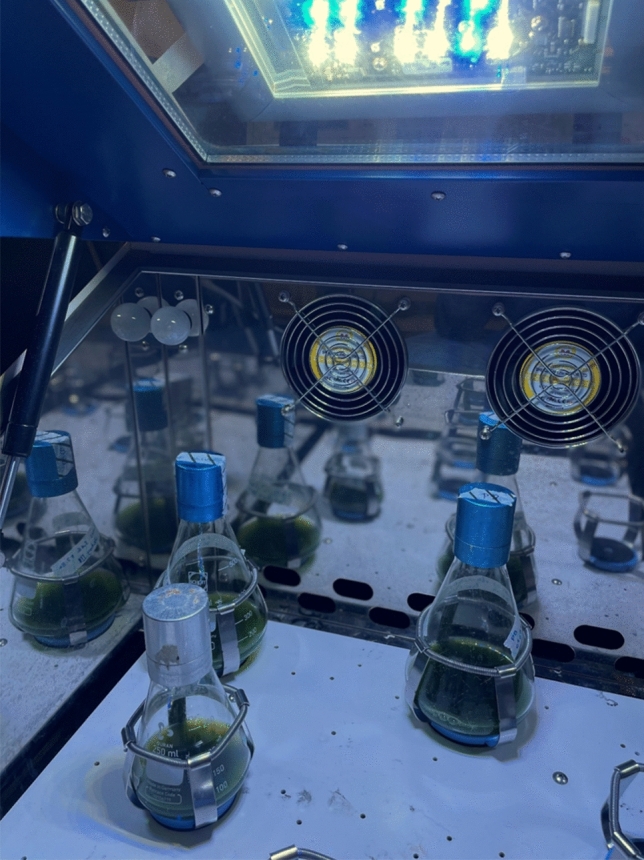
“In general, the biomass of photosynthetically active microalgae and cyanobacteria in shake flasks tends to be higher under higher light intensities in the range of 50 µmol m−2 s−1 to at least a few hundred µmol m−2 s−1 [24, 77].”
§ Lab-scale photobioreactor systems: principles, applications, and scalability > Lab-scale photobioreactor systems > Shaken photobioreactors
What the sources say
- Partly supportedcites [24] Nedbal J Gao L Suhling K Bottom-illuminated orbital shaker for microalgae cultivation HardwareX 2020 8 e00143 10.1016/j.ohx.2020.e00143 33442569 PMC7786639 sourceExperimental — accuracy not yet measured
The Microalgae cultivation section (page not available) reports faster growth for two microalgal species at 220 than at 26 µmol m−2 s−1. It does not report biomass comparisons across the claimed range starting at 50 µmol m−2 s−1, or results for cyanobacteria. (LLM, conf=0.87)
- Not checked — no full text of the sourcecites [77] Chang J Le K Song X Scale-up cultivation enhanced arachidonic acid accumulation by red microalgae Porphyridium purpureum Bioprocess Biosyst Eng 2017 40 1763 1773 10.1007/s00449-017-1831-x 28836004 source
hedgedstates an association- Asserted: passes — The authors put it forward as true.
- Checkable: passes — It can be checked against evidence.
- Load-bearing: unclear — It is unclear whether the paper’s conclusions depend on it.
- Based: passes — The paper gives a reason why it holds.
- Partly supported
The cited sources support only part of this claim — read each source’s verdict below.
In the paper
“Thin-layer cascade photobioreactors are able to achieve the highest biomass densities described in the literature [159, 163].”
§ Lab-scale photobioreactor systems: principles, applications, and scalability > Lab-scale photobioreactor systems > Other photobioreactor designs
What the sources say
- Not checked — no full text of the sourcecites [159] Apel AC Pfaffinger CE Basedahl N Open thin-layer cascade reactors for saline microalgae production evaluated in a physically simulated Mediterranean summer climate Algal Res 2017 25 381 390 10.1016/j.algal.2017.06.004 source
- Partly supportedcites [163] Schädler T Neumann-Cip A-C Wieland K High-density microalgae cultivation in open thin-layer cascade photobioreactors with water recycling Appl Sci 2020 10 3883 10.3390/app10113883 sourceExperimental — accuracy not yet measured
The Introduction (p. 2) reports that a thin-layer cascade reactor achieved 50 g/L cell dry weight and contrasts this with the 0.3–1.0 g/L concentrations typical of raceway ponds. The paper supports the ability of these reactors to achieve very high biomass densities, but it does not establish that they achieve the highest densities reported across the literature. (LLM, conf=0.86)
plainstates a cause- Asserted: passes — The authors put it forward as true.
- Checkable: passes — It can be checked against evidence.
- Load-bearing: unclear — It is unclear whether the paper’s conclusions depend on it.
- Based: passes — The paper gives a reason why it holds.
The cited sources support only part of this claim — read each source’s verdict below.
In the paper
“A critical factor is a fast-rising temperature in thin microalgae suspensions due to the illumination especially in non-controlled outdoor photobioreactors [155, 202].”
§ Lab-scale photobioreactor systems: principles, applications, and scalability > Scalability of photobioreactor systems > Active temperature control should be avoided by operating conditions and the selection of robust microalgae
What the sources say
- Partly supportedcites [155] Huang Q Jiang F Wang L Yang C Design of photobioreactors for mass cultivation of photosynthetic organisms Engineering 2017 3 318 329 10.1016/J.ENG.2017.03.020 sourceExperimental — accuracy not yet measured
Section 2.4 (Temperature; page unavailable) says temperature rise is significant on sunny summer days and that a photobioreactor without temperature control may reach 10–30 °C above ambient. Section 2.1 (Light; page unavailable) identifies solar radiation as a cause of warming and describes thin optical paths, but the paper does not establish how fast the temperature rises. (LLM, conf=0.83)
- Not checked — no full text of the sourcecites [202] Scott SA Davey MP Dennis JS Biodiesel from algae: challenges and prospects Curr Opin Biotechnol 2010 21 277 286 10.1016/j.copbio.2010.03.005 20399634 source
plainstates a cause- Asserted: passes — The authors put it forward as true.
- Checkable: passes — It can be checked against evidence.
- Load-bearing: passes — The paper’s conclusions depend on it.
- Based: passes — The paper gives a reason why it holds.
- Partly supported
111 more claims · 26 with their cited sources checked
Create a free account to see all 213 claims and to verify the 11 references still open.
- It may state two separate claims as one. 68
- Probably not a substantial claim. 42
Citations
Cites
Chisti, Y. (2007) · Biotechnology Advances · doi:10.1016/j.biotechadv.2007.02.001 · Cited by 9,524
Brennan, L., & Owende, P. (2010) · Renewable and Sustainable Energy Reviews · doi:10.1016/j.rser.2009.10.009 · Cited by 4,894 · cited 1×
“For large open cultivation volumes, many authors consider temperature control not economically feasible [190, 199, 207].”
BackgroundRodolfi, L., Chini Zittelli, G., Bassi, N., Padovani, G., Biondi, N., Bonini, G., & Tredici, M. R. (2009) · Biotechnology and Bioengineering · doi:10.1002/bit.22033 · Cited by 2,879
High-value products from microalgae—their development and commercialisation
Borowitzka, M. A. (2013) · Journal of Applied Phycology · doi:10.1007/s10811-013-9983-9 · Cited by 1,585 · cited 1×
“Therefore, open pond photo bioreactors are often preferred [208].”
BackgroundMicroalgae and wastewater treatment
Abdel-Raouf, N., Al-Homaidan, A. A., & Ibraheem, I. B. M. (2012) · Saudi Journal of Biological Sciences · doi:10.1016/j.sjbs.2012.04.005 · Cited by 1,579
The Potential of Sustainable Algal Biofuel Production Using Wastewater Resources
Pittman, J. K., Dean, A. P., & Osundeko, O. (2011) · Bioresource Technology · doi:10.1016/j.biortech.2010.06.035 · Cited by 1,526
Biodiesel from algae: challenges and prospects
Scott, S. A., Davey, M. P., Dennis, J. S., Horst, I., Howe, C. J., Lea-Smith, D. J., & Smith, A. G. (2010) · Current Opinion in Biotechnology · doi:10.1016/j.copbio.2010.03.005 · Cited by 1,183 · cited 2×
“Giving an example, the process can be made from shaken flasks with 100 mL to medium size reactors (1–10 L), followed by a transfer to photobioreactors on a pilot-scale (10–100 L) and an upscale to an industrial cultivation system up to 1 m3 [48, 132, 202].”
BackgroundMethodEffect of temperature and light on the growth of algae species: A review
Singh, S. P., & Singh, P. (2015) · Renewable and Sustainable Energy Reviews · doi:10.1016/j.rser.2015.05.024 · Cited by 1,017
Commercialization potential of microalgae for biofuels production
Singh, J., & Gu, S. (2010) · Renewable and Sustainable Energy Reviews · doi:10.1016/j.rser.2010.06.014 · Cited by 1,001 · cited 1×
“Besides the crucial light supply, the optimization of state variables such as pH, temperature, CO2 supply and O2 release, inoculum concentration in batch processes and nutrient composition is also required before any scale-up can be considered [39, 42].”
BackgroundBiodiesel from microalgae: A critical evaluation from laboratory to large scale production
Rawat, I., Ranjith Kumar, R., Mutanda, T., & Bux, F. (2013) · Applied Energy · doi:10.1016/j.apenergy.2012.10.004 · Cited by 977 · cited 3×
“Before cultivating at the production scale, the cultivation method needs to be chosen wisely by weighing the different cultivation systems against each other [40].”
BackgroundMethod
Research works printed but not linked: 1
- Burk MJ Sustainable production of industrial chemicals from sugars Int Sugar J 2010 112 6
Cited by
Items 101–200 of 215
Production and growth of microalgae in urine and wastewater: A review
Siddiqui, S. A., Wu, Y. S., Saikia, T., Uçak, İ., Afreen, M., Shah, M. A., & Ayivi, R. D. (2023) · Environmental Chemistry Letters · doi:10.1007/s10311-023-01622-1 · Cited by 3
Microalgal biorefinery and circular bioeconomy model for wastewater treatment
Gupta, R., Mishra, N., Mukherjee, T., Mishra, S., & Bhattacharya, S. (2025) · Elsevier eBooks · doi:10.1016/b978-0-443-23796-6.00016-x · Cited by 3
Fundamentals on bioreactors, operation modes and control system mechanisms
Kumar, K. S. P., Rishi, B., Sruthi, B., Garg, S., Gujjala, L. K. S., & Althuri, A. (2025) · Elsevier eBooks · doi:10.1016/b978-0-443-31476-6.00010-5 · Cited by 3
Ibrahimi, M. E., Khan, M. N., Ruiz‐Ruiz, P., Vrieze, J. D., & Dael, M. V. (2025) · Journal of environmental chemical engineering · doi:10.1016/j.jece.2025.120093 · Cited by 3
Saini, M., & Yash, R. (2025) · Journal of Applied Phycology · doi:10.1007/s10811-025-03723-6 · Cited by 5
Population Dynamics Analysis of Chromochloris zofingiensis: A Flow-Cytometry-Based Approach
Ihadjadene, Y., Wulff, A. S., Walther, T., Streif, S., & Krujatz, F. (2026) · Plants · doi:10.3390/plants15050724 · Cited by 1
Evaluation of photobioreactor designs for potential application as microalgal façade systems
Tekin, Z., Al-Hammadi, M. S., Çalışkan, G., DOĞU, D. I., Mengi, O., Deniz, D., & Güngörmüşler, M. (2026) · Scientific Reports · doi:10.1038/s41598-026-42461-8 · Cited by 3
“The latter is required to ensure uniform light distribution, nutrient mixing, and to prevent sedimentation and attachment of algal cells in the reactor 53 .”
From lab to outdoors: microalgal process perspective for a step to reality
Yarkent, Ç., Kliber, C. G., Masojídek, J., Štěrbová, K., Saurav, K., Faraloni, C., Zittelli, G. C., Touloupakis, E., Moia, I. C., Torzillo, G., et al. (2024) · Elsevier eBooks · doi:10.1016/b978-0-443-22127-9.00019-6 · Cited by 2
Tubular photobioreactors applied to algal production
Santos Corrêa, P., Galvão de Morais Júnior, W., & de Sá Caetano, N. (2025) · Algal Bioreactors · doi:10.1016/b978-0-443-14058-7.00040-3 · Cited by 2
Shokravi, Z., & Mehravar, N. (2025) · Elsevier eBooks · doi:10.1016/b978-0-443-24110-9.00003-7 · Cited by 9
Noonan, A. J. C., Cameron, P. M. N., Dofher, K., Sukkasam, N., Liu, T. X., Rönn, L., Monshupanee, T., & Hallam, S. (2025) · Communications Biology · doi:10.1038/s42003-025-07853-y · Cited by 2
Li, P., Yang, F., Sun, X., He, X., & Wan, H. (2025) · Bioresource Technology · doi:10.1016/j.biortech.2025.133129 · Cited by 2
Dalbanjan, N. P., Korgaonkar, K., Parvatkar, R. R., Tilvi, S., & Kumar, S. K. P. (2025) · Next research. · doi:10.1016/j.nexres.2025.100850 · Cited by 6
A custom 3D printed paddlewheel improves growth in flat panel photobioreactor
Meagher, M., Tamburro, J. M., & Boyle, N. R. (2024) · Biotechnology Progress · doi:10.1002/btpr.3430 · Cited by 2
Herrera, A., Martínez, I. M. G., & Kurmen, J. E. C. (2024) · Revista Mutis · doi:10.21789/22561498.2108 · Cited by 2
Diatoms as Tools for Aquaculture and Food Production
Mathew, J. T., Inobeme, A., Monday, M., Azeh, Y., Shaba, E. Y., Etsuyankpa, M. B., Adetunji, C. O., Mamman, A., & Tanko, M. S. (2024) · Springer eBooks · doi:10.1007/978-981-97-5057-3_4 · Cited by 2
Gupta, K., & Araji, M. T. (2024) · Algal Research · doi:10.1016/j.algal.2024.103822 · Cited by 1
Singkoon, P., Mahakhan, P., Punriboon, N., Bhuvaneswari, K., Wongcharee, S., Pannaracha, P., Punyauppa-path, S., Suwannahong, K., & Sawaengkaew, J. (2025) · Bioresource Technology · doi:10.1016/j.biortech.2025.133259 · Cited by 2
Advanced photobioreactor strategy for chromium phycoremediation with Spirulina platensis
Lopes, E. P. B., Falleiros, L. N. S. S., & Batista, F. R. X. (2025) · Bioresource Technology Reports · doi:10.1016/j.biteb.2025.102343 · Cited by 2
Kaga, R.-K. T., Yokoyama, S., Adachi, H., Kubo, A., Nimura, K., Hirose, Y., & Nagao, R. (2025) · Bioscience Biotechnology and Biochemistry · doi:10.1093/bbb/zbaf155 · Cited by 1
Commercialization of Algae‐Based Biofuels: The Case of Ghana
Sarkodie, W. O., Kissi, S. K., Takase, M., & Amankwah, E. (2025) · International Journal of Chemical Engineering · doi:10.1155/ijce/5704048 · Cited by 1
Scaling up the Production of Microalgal Pigments for Commercial Applications
Mutaf, T., İnam, A., FİLİZFİDANOĞLU, A., & Deniz, İ. (2026) · Springer eBooks · doi:10.1007/978-3-032-05438-8_2 · Cited by 1
Trejo-Caballero, M. E., Elizalde-Mata, A., Guardado-Ruiz, E., González-Reyna, M. A., & Estévez, M. (2026) · Separation and Purification Technology · doi:10.1016/j.seppur.2026.137431 · Cited by 2
Bioprocess Design and Optimization for Pharmaceutical Production Using Microalgae and Cyanobacteria
Barajas-Solano, A. F., Zuorro, A., Lavecchia, R., Garcia-Martinez, J. B., & Contreras-Ropero, J. E. (2026) · Processes · doi:10.3390/pr14071141 · Cited by 2
Yarkent, Ç., Mutaf, T., Cinar, O., Demir, A., Elibol, M., & Öncel, S. Ş. (2026) · Fibers and Polymers · doi:10.1007/s12221-026-01421-9 · Cited by 1
“Among various PBRs, tubular (e.g., Bubble column) and stirred panel (e.g., Roux-type) PBRs are well-known systems [26–28].”
Guerra, I., Cardoso, H., Costa, M., Trovão, M., Silva, J., & Varela, J. C. S. (2026) · Journal of Applied Phycology · doi:10.1007/s10811-026-03833-9 · Cited by 3
“However, these pumps often generate a substantial hydrodynamic shear stress that can affect cell integrity, unlike lower-shear alternatives, which are less effective in moving large volumes (Michels et al. 2016; Benner et al. 2022; Segura-Morales et al. 2024).”
Rezvani, F. (2026) · Journal of Applied Phycology · doi:10.1007/s10811-026-03868-y · Cited by 2
“These optical mechanisms have been previously shown to improve photosynthetic efficiency in attached-growth microalgal systems (Benner et al. 2022).”
InfluentialGarg, S., Kaur, P., Joshi, K., Gangola, S., Punetha, H., Devi, A., Dwibedi, V., & Vyas, A. (2026) · Preparative Biochemistry & Biotechnology · doi:10.1080/10826068.2026.2669845 · Cited by 2
Thajuddin, F., Rasheed, A. S., Rajendran, P. J., Palanivel, P., Nooruddin, T., & Dharumadurai, D. (2026) · Renewable and Sustainable Energy Reviews · doi:10.1016/j.rser.2026.117105 · Cited by 3
Malik, H. A., Abdullah, M., Shahid, A., Zhao, A., Solovchenko, A. E., Alessa, A. H., Alqahtani, H., Gull, M., Boopathy, R., Mehmood, M. A., et al. (2026) · Current Pollution Reports · doi:10.1007/s40726-026-00417-6 · Cited by 1
“In combination with this, the implementation of two-stage cultivation, first under satiated nutrients and then under stress (e.g., nitrogen or phosphorus limitation or controlled light/temperature stress), would positively impact lipid content and PUFA (Polyunsaturated Fatty acid) yields [82].”
Photobiological Hydrogen Production in Cyanobacteria: Advances, Challenges, and Perspectives
Tang, W., Cheng, Z., Li, W., Li, P., Chen, M., & Fu, Y. (2026) · Fermentation · doi:10.3390/fermentation12060273 · Cited by 1
“Moreover, during scale-up in photobioreactor systems, light heterogeneity and flocculation effects further reduce light utilization efficiency, making it difficult to translate laboratory-scale hydrogen production performance to practical applications [62,63].”
Microbial Hydrolysates as Amino Acid Source in Cell Culture Media for Cellular Agriculture
Hoek, J. C., Daran, J.-M. G., Klijn, M. E., & Vieira‐Lara, M. A. (2026) · Biotechnology and Bioengineering · doi:10.1002/bit.70290 · Cited by 2
Xu, H., Zhao, Y., Lv, Y., Zhang, B., El-Baz, F. K., Ali, S. I., Solovchenko, A. E., Bi, S., Zhao, A., & Xu, J. (2026) · Bioresource Technology · doi:10.1016/j.biortech.2026.135360 · Cited by 1
Adekanmi, A. A., Onilude, A. A., Garuba, E. O., Ajunwa, O. M., Muraina, T. A., & Okewole, A. M. (2026) · Next Chemical Engineering · doi:10.1016/j.nxcen.2026.100088 · Cited by 1
Dodangodage, C. A., Kasturiarachchi, J. C., Perera, T. A., Rajapakshe, D., Niyangoda, S. S., & Halwatura, R. U. (2026) · Frontiers in Microbiology · doi:10.3389/fmicb.2026.1872485 · Cited by 1
“In conventional photobioreactors, turbidity restricts the photic zone and induces photolimitation (Abdelfattah et al., 2023; Segredo-Morales et al., 2023; Otim et al., 2021; Benner et al., 2022).”
Nutritional Studies and Optimization of Biomass from Unicellular Microalgae Haematococcus sp.
Selvan, S. T., & Muthusamy, S. (2023) · Springer eBooks · doi:10.1007/978-981-99-2901-6_2 · Cited by 1
Algal Photo Bioreactors: A Promising Technology for Wastewater Treatment
Venkatachalam, C. D., Sengottian, M., Ravichandran, S. R., Bhuvaneshwaran, P., & Sekar, S. (2023) · Environmental science and engineering · doi:10.1007/978-3-031-46858-2_4 · Cited by 3
Laboratory System for Intensive Cultivation of Microalgae and Cyanobacteria
Gabrielyan, D. A., Sinetova, M. A., Gabrielyan, A. K., Bobrovnikova, L. A., Bedbenov, V. S., Starikov, A. Y., Zorina, A. A., Gabel, B. V., & Los, D. A. (2023) · Russian Journal of Plant Physiology · doi:10.31857/s0015330322600486 · Cited by 2
Bischoff, L.-S. (2024) · Environmental science and engineering · doi:10.1007/978-981-97-2371-3_22 · Cited by 1
Hernández-González, U. A., Mirelez-Delgado, F. D., Castro, A. S. M., Correa-Aguado, H. C., Alvarado, C. A. A., Fernandez, J., Castillo, D. O., & Flores‐Troncoso, J. (2024) · Journal of Physics Conference Series · doi:10.1088/1742-6596/2804/1/012015 · Cited by 1
Bottleneck and opportunities toward practical aspects of microalgae-based biorefineries
Ali, S. S., Kornaros, M. E., Al-Tohamy, R., Sun, J., El-Sheekh, M. M., & Lim, J. W. (2025) · Elsevier eBooks · doi:10.1016/b978-0-443-23967-0.00016-4 · Cited by 1
Algae as a potential source of biofuels and sustainable agriculture practice
Wahab, M. A., & Griffiths, G. J. (2025) · Elsevier eBooks · doi:10.1016/b978-0-443-23967-0.00006-1 · Cited by 1
Rizwan, K., Raza, A., Ansari, A. A., Khoja, A. H., Abbas, G., Din, I. U., Khan, B. A., & Qazi, U. Y. (2025) · Journal of environmental chemical engineering · doi:10.1016/j.jece.2025.116838 · Cited by 1
Bioprocessing of Biocolors for Large-Scale Production
Thakur, M., Tandon, D., Bhardwaj, S., & Gautam, N. (2025) · Springer eBooks · doi:10.1007/978-981-95-1738-1_8 · Cited by 1
Microbial Bioreactors for Biofuels
de Oliveira, P. R. S., Pereira, A. K. S., Carmona, I. N., & Júnior, A. F. D. (2023) · Wiley eBooks · doi:10.1002/9781119874096.ch9
Viruela, A. (2023) · RiuNet (Universitat Politècnica de València) · doi:10.4995/thesis/10251/195826 · Cited by 2
Urzı̀, C., Schiavo, S. L., Gulino, A., et al. (2024) · SSRN Electronic Journal · doi:10.2139/ssrn.4892041
Raceway ponds for microalgae production
Cadena-Ramírez, A., Orozco, M. D. L. A. B., & Reyes, M. A. A. (2024) · Elsevier eBooks · doi:10.1016/b978-0-443-14058-7.00036-1 · Cited by 1
Control of biological contamination in microalgae cultures
Flores-Tinoco, V., Brito-Bello, A. A., Le, V. P., & López-Arredondo, D. L. (2024) · Elsevier eBooks · doi:10.1016/b978-0-443-14058-7.00005-1 · Cited by 1
Oxygen outgassing and hydrodynamics analysis in microalgal photobioreactors
Touloupakis, E., Moia, I. C., Faraloni, C., & Carlozzi, P. (2024) · Elsevier eBooks · doi:10.1016/b978-0-443-14058-7.00024-5 · Cited by 1
Biodiesel production from algal bioreactors
Fattah, I. M. R., Rahman, M. A., Kusumo, F., Ogunkunle, O., Ahmed, A., Kalam, M. A., & Mahlia, T. M. I. (2024) · Elsevier eBooks · doi:10.1016/b978-0-443-14058-7.00002-6
Process intensification approaches applied to microalgae bioreactors
Caltzontzin-Rabell, V., Morales, J. M. V., Guzmán-Martínez, C. E., Hernández, S., Martínez-Guido, S. I., & Gutiérrez‐Antonio, C. (2024) · Elsevier eBooks · doi:10.1016/b978-0-443-14058-7.00038-5
Dbouk, H. M., Ezzeddine, M., Dbouk, N., Attieh, L., & Maalouf, N. (2024) · International Symposium on Innovative Approaches in Smart Technologies (ISAS) · doi:10.1109/isas64331.2024.10845612 · Cited by 1
“Examples of these lab-scale photobioreactors include bubble column [23], airlift column [25], stirred-tank [23], helical tubular [26], conical [27], torus [28], and seaweed-type designs [29].”
Cultivation of Seaweeds Using Photobioreactor for Enhanced Biomass Productivity and Quality
Prabha, S., Vijay, A. K., & George, B. (2025) · Springer eBooks · doi:10.1007/978-981-97-9427-0_9 · Cited by 1
Ihara, T., TAZUMI, R., & Kawano, S. (2024) · Japanese Journal of JSCE · doi:10.2208/jscejj.24-26017
Microalgae biotechnological potentials
Najafpour, G. D. (2025) · Elsevier eBooks · doi:10.1016/b978-0-443-33096-4.00007-7
López-Pacheco, I. Y., Moreno-Pascual, P., Ramírez-Gamboa, D., Meléndez-Sánchez, E. R., González-Meza, G. M., González-González, R. B., Melchor-Martínez, E. M., Iqbal, H. M. N., & Parra‐Saldívar, R. (2025) · Elsevier eBooks · doi:10.1016/b978-0-443-23967-0.00011-5
Microalgae Production Systems and Photobioreactor Designs: Recent Trends and Future Prospects
Franco-Nava, M. Á., & Franco-Herrera, L. M. (2025) · Developments in applied phycology. · doi:10.1007/978-3-031-86433-9_2 · Cited by 1
Technologies for microalgae production
Oliveira, C. M., Esteves, A. F., Salgado, E. M., Machado, C. A., Gonçalves, A. L., & Pires, J. C. M. (2025) · Elsevier eBooks · doi:10.1016/b978-0-443-22080-7.00028-4
Bioreactor Designs for Algal and Microbial Cultivation
Saggu, S. K., & Kumar, S. (2025) · Springer eBooks · doi:10.1007/978-981-96-8054-2_6 · Cited by 1
Carmona-Rosas, U., Sales-Pérez, R. E., Estrada-García, J., Hernández‐Aguilar, E., & Méndez-Contreras, J. M. (2025) · Renewable Energy Biomass & Sustainability · doi:10.56845/rebs.v7i2.566
“This result is a common phenomenon when scaling up biological systems and can be explained by several interrelated factors affecting the availability of light, gases, and nutrients (Benner et al ., 2022; Xu et al ., 2009).”
Hassan, H., Ansari, F. A., & Bux, F. (2025) · Elsevier eBooks · doi:10.1016/b978-0-443-33683-6.00005-x
Trends in cyanobacterial Phycobiliproteins - structure, function, and applications: A review
Mikkili, I., Borugadda, S., & Kanaparthy, A. (2025) · International Journal of Biological Macromolecules · doi:10.1016/j.ijbiomac.2025.148517 · Cited by 4
Gehring, T., Maurer, P., YILDIRIM, M. E., Lierse, M. S., & Ickes, R. (2025) · Sustainability & Circularity NOW · doi:10.1055/a-2727-4980 · Cited by 2
Adaptive Laboratory Evolution of Microorganisms: Methods and Applications in Biotechnology
Chernova, V. E., Aronova, E. B., Buslaeva, E. A., Mukhina, T. V., Yevreiskaia, E. A., & Хасаншина, З. Р. (2025) · Biology Bulletin Reviews · doi:10.1134/s207908642560050x · Cited by 1
“…(Rasul et al., 2024) species and strains of various microorganisms; the use of alternative sources of carbon and energy (Bala et al., 2023); automation of most processes (Benner et al., 2022); ease of maintaining multiple parallel experiments (Park et al., 2011) in laboratory conditions.”
Production of Lipids and Carotenoids in Coccomyxa onubensis Under Acidic Conditions in Raceway Ponds
Szotkowski, M., Robles, M., Fuentes, J. L., Holub, J., Cuaresma, M., Márová, I., Ruiz-Domínguez, M. C., Torronteras, R., Dávila, J., Garbayo, I., et al. (2025) · Processes · doi:10.3390/pr13124041
Singh, N., Chetty, M., & Rathilal, S. (2026) · SSRN Electronic Journal · doi:10.2139/ssrn.5999179
Growth Analysis of Chlorella vulgaris on Ceramic Tiles Using Vegetation Indices and Color Kinetics
Gupta, K., & Araji, M. T. (2025) · International Conference on Green Energy, Computing and Sustainable Technology (GECOST) · doi:10.1109/gecost66002.2025.11324766
Adekanmi, A. A., Onilude, A. A., Garuba, E. O., Muraina, T. A., Azeez, N. A., & Adegboye, M. A. (2026) · Research Square · doi:10.21203/rs.3.rs-8492335/v1
Algae-Driven Transition from Oil to Renewable Alternatives: Policy for Scale and Sustainability
Gehring, T., Choo, Y. S. L., Vidal, J. L., & Fung, F. M. (2026) · Sustainability & Circularity NOW · doi:10.1055/a-2778-9185 · Cited by 3
Photofermentation for biohydrogen generation
Berkani, M., Ousaadi, M. I., Merouane, F., et al. (2026) · Elsevier eBooks · doi:10.1016/b978-0-443-43970-4.00013-8
Atikah, M. S. N., Ya’acob, M. E., Ilyas, R. A., et al. (2026) · SSRN Electronic Journal · doi:10.2139/ssrn.6360778
Resource recovery from wastewater by phototrophic microorganisms
Allegue, L. D., Robles, Á., Rodero, M. D. R., Antón, S. E. A., Rueda, E., Sáenz‐Ceniceros, A., Ferrer, I., & Capson‐Tojo, G. (2026) · Elsevier eBooks · doi:10.1016/b978-0-443-40602-7.00005-x
Ahamefule, C. S., Osilo, C. B., Ahamefule, B. C., & Ogbonna, J. C. (2026) · Elsevier eBooks · doi:10.1016/b978-0-443-34082-6.00008-8
Gao, Y., Tong, T., Zeng, Z., Hou, K., Miao, D., Huang, C., & Xiong, R. (2026) · Journal of Bioresources and Bioproducts · doi:10.1016/j.jobab.2026.100249 · Cited by 5
Microalgae-derived industrial enzymes
Srimongkol, P., Sangtanoo, P., Watsuntorn, W., Chuengcharoenphanich, N., & Karnchanatat, A. (2026) · Elsevier eBooks · doi:10.1016/b978-0-443-34082-6.00055-6
Dupont-Thibert, C. M. (2023) · theses.fr (ABES) · doi:10.70675/de684ca1z4c8ez4009zb76cz361bd5926158
Dobrinčić, A., Komarec, K., Marđetko, N., Trontel, A., Novak, M., Pavlečić, M., Tominac, V. P., & Šantek, B. (2026) · Marine Drugs · doi:10.3390/md24050149 · Cited by 1
“Furthermore, the scale-up of photobioreactors introduces additional limitations related to heterogeneous light distribution and self-shading effects, which are recognized as key factors governing microalgal process performance [54].”
Lee, C., & Liorančas, V. (2026) · Elsevier eBooks · doi:10.1016/b978-0-12-819533-8.00004-x
Miniaturized Bioreactor Systems for Speeding Up the Development of Microbial Fermentation Processes
Uyar, B., Erol, E., & Uyar, G. E. Ö. (2026) · Cell engineering · doi:10.1007/978-3-032-17514-4_3
The Potential of Cyanobacteria as a Source of Bioenergy
Haddad, M. F., Abdullah, Y. J., Sultan, S. M., Abdullah, B. A., Saadi, A. M., Haddad, M. F. H., & AL-Shaheri, N. A. (2026) · Springer proceedings in earth and environmental sciences · doi:10.1007/978-3-032-18970-7_87
Formulating Algal Feeds: Techniques for Effective Integration and Nutrient Stabilities
Panda, S. K., & Rai, A. (2026) · Springer eBooks · doi:10.1007/978-3-032-22521-4_9
Atikah, M. S. N., Ya’acob, M. E., Ilyas, R. A., & Harun, M. R. (2026) · Algal Research · doi:10.1016/j.algal.2026.104755
Picknell, K. J., Poddar, N., Pernice, M., McCauley, J. I., McMahon, O., Adamson, R., & Ralph, P. J. (2026) · Bioresource Technology · doi:10.1016/j.biortech.2026.134944
Kang, S., Chansawang, N., Kim, K. J., Chung, N., Shin, H. H., & Li, Z. (2026) · Bioresource Technology · doi:10.1016/j.biortech.2026.134953
Kolajo, O. O., & Tola-Winjobi, B. T. (2026) · World water resources · doi:10.1007/978-3-032-22813-0_12
Construction Materials and Influencing Parameters for Closed Photobioreactors on an Industrial Scale
Goswami, R. K., Mehariya, S., Karthikeyan, O. P., & Verma, P. (2026) · Interdisciplinary biotechnological advances · doi:10.1007/978-981-95-8431-4_10
Membrane Bioreactor for Bioenergy Production and Resource Recovery
Mariappan, S., Muthan, K., Srinivasan, N., Kreedapathy, G. E., Priyadarshini, M., & Subramanian, V. (2026) · Interdisciplinary biotechnological advances · doi:10.1007/978-981-95-8431-4_5
Addressing Challenges in Harvesting Algal Biomass for Pharmaceutical Applications
Goel, N., Naaz, H., Gola, D., Saxena, M., & Choudhary, P. (2026) · Interdisciplinary biotechnological advances · doi:10.1007/978-981-95-8431-4_12
Overview of Bioreactors for Algal Biomass Harvesting
Aluna, L., Abdulkadir, A., & Singh, H. M. (2026) · Interdisciplinary biotechnological advances · doi:10.1007/978-981-95-8431-4_1
Kirubakaran, N., Shunmugam, S., Rashmi, V., Prabaharan, D., & Muralitharan, G. (2026) · Elsevier eBooks · doi:10.1016/b978-0-443-29269-9.00001-0
Kareri, T., Khan, A., Alhassan, M. K., Hassan, S. H. A., Jalalah, M., Almutairi, F. M., & Salama, E. (2026) · International Journal of Environmental Research · doi:10.1007/s41742-026-01127-z · Cited by 1
“A key advantage is the sterile conditions, which eliminate interference from unwanted microbes (Benner et al. 2022).”
Third-Generation Algal Lipid Synthesis, Extraction, and Regulation by Various Metabolic Approaches
Kumawat, G., Choudhary, S., Gupta, A. K., Nigam, S., Khatoon, H., & Mangesh, H. (2026) · Reference series in phytochemistry · doi:10.1007/978-3-031-80866-1_5-1
Integration of algal systems with traditional remediation technologies
Kumar, C., Kaur, M., Kaur, A., Arya, S. K., Puri, S., & Khatri, M. (2026) · Elsevier eBooks · doi:10.1016/b978-0-443-36656-7.00008-4
Algal bioreactors: Design, operation, and optimization
Shawky, E. M. (2026) · Elsevier eBooks · doi:10.1016/b978-0-443-36656-7.00012-6
Introduction to fermentation technology
Ali, A., Afzaal, M., Akram, N., Hailu, G. G., & Bhatia, S. (2026) · Elsevier eBooks · doi:10.1016/b978-0-12-817788-4.00003-3
Poduschnick, L., Mihaescu, D., Nakielski, A., Dienst, D. D., Beuel, A.-K., Voß, L. F. J. M., Axmann, I. M. I., & Magnus, J. B. (2026) · SSRN Electronic Journal · doi:10.2139/ssrn.7019805
Gupta, A., Bora, J., Rao, N. L., Joshi, M., & Nigam, S. (2026) · Springer eBooks · doi:10.1007/978-981-95-8785-8_9
Sarmiento, R. S. G., Osuna-Flores, I., & Armenta-López, A. R. (2026) · Revista Científica Arbitrada de la Fundación MenteClara · doi:10.32351/rca.v11.430
Metadata
- Authors
- Benner, P., Meier, L., Pfeffer, A., Krüger, K., Oropeza Vargas, J. E., & Weuster-Botz, D.
- Affiliations
- Technical University of Munich (DE)
- Venue
- Bioprocess and Biosystems Engineering
- Published
- 2022-03-18
- Volume
- 45
- Issue
- 5
- Pages
- 791-813
- ISSN
- 1615-7591 (ISSN-L)
- 1615-7605
- PMC
- PMC9033726
- OpenAlex
- W4220668937
- Cited by
- 215
- References
- 222
- Citations by year
- 2026: 70 · 2025: 60 · 2024: 51 · 2023: 29 · 2022: 5
- FWCI
- 2.30
- Type
- journal article
- Language
- en
- Open access
- hybrid
- doi.org
- Licence
- cc-by
- creativecommons.org/licenses/by/4.0 (tdm)
- creativecommons.org/licenses/by/4.0 (vor)
- Locations
- Bioprocess and Biosystems Engineering (publishedVersion, cc-by)
- PubMed Central (publishedVersion, cc-by)
- PubMed (publishedVersion)
- mediaTUM (Technical University of Munich) (submittedVersion)
- mediaTUM – the media and publications repository of the Technical University Munich (Technical University Munich) (submittedVersion, other-oa)
- Funders
- Technische Universität München
- Topics
- Physical Sciences › Energy › Renewable Energy, Sustainability and the Environment › Algal biology and biofuel production
- Physical Sciences › Chemical Engineering › Fluid Flow and Transfer Processes › Fluid Dynamics and Mixing
- Physical Sciences › Environmental Science › Environmental Chemistry › Aquatic Ecosystems and Phytoplankton Dynamics
- Keywords
- photobioreactors, microalgae, cyanobacteria, phototrophic cultivation, microplates, microfluidics, shake flask, bubble column, stirred tank bioreactor, raceway ponds, scale-up, scale-down model, CO2 fixation, bioactive compounds, bioprocess design
- MeSH terms
- Cyanobacteria, Carbon Dioxide, Humans, Biomass, Microalgae, Photobioreactors
About these checks
Registry, retraction, Cites and statistics results are computed, not judged, with one exception: a printed reference that no index lists is read once by a model before it counts as a citation error. Claims are extracted by a model and kept only when their quote appears verbatim in the text; each cited source is then checked, with a model’s help, for whether it says what the claim relies on. Those verdicts can be wrong — read the claim’s quote and the cited source before relying on one.
The claim verdicts this report counts are experimental: their accuracy is not yet measured.
A language model drew the claims from the paper on 2026-10-10, under version 3 of the claim definition (model deepseek-v4.1-flash, prompt extract-v3).
A second model labelled each claim on 2026-10-10 (model jev-1.13-20260917, definition revision gold-guideline-v0.2).
Cited sources are checked with a language model’s help (gpt-6-sol).
Statistics and arithmetic are recomputed, not judged.
Confidence bands are shown only for fields calibrated on our annotated test set. None is calibrated yet, so no band is shown.
What counts as a claim ›How we measure confidence ›How we check this ›
Are you an author, or do you see a problem with this page? Request a review
Data sources
Bibliographic data: Semantic Scholar, OpenAlex, Crossref.
Contains information from the Semantic Scholar Academic Graph Datasets, made available under the ODC Attribution License (ODC-BY 1.0).
Semantic Scholar’s data is described in: Kinney, R., et al. (2023). The Semantic Scholar Open Data Platform. arXiv:2301.10140.
