

Web-based self-help intervention for partners of cancer patients based on acceptance and commitment therapy and self-compassion training: a randomized controlled trial with automated versus personal feedback
Open accessThe DOI matches its Crossref record; 42 of the 43 references it cites were found in a registry or an index; 22 of the 36 sources its claims cite were checked for support.
Abstract
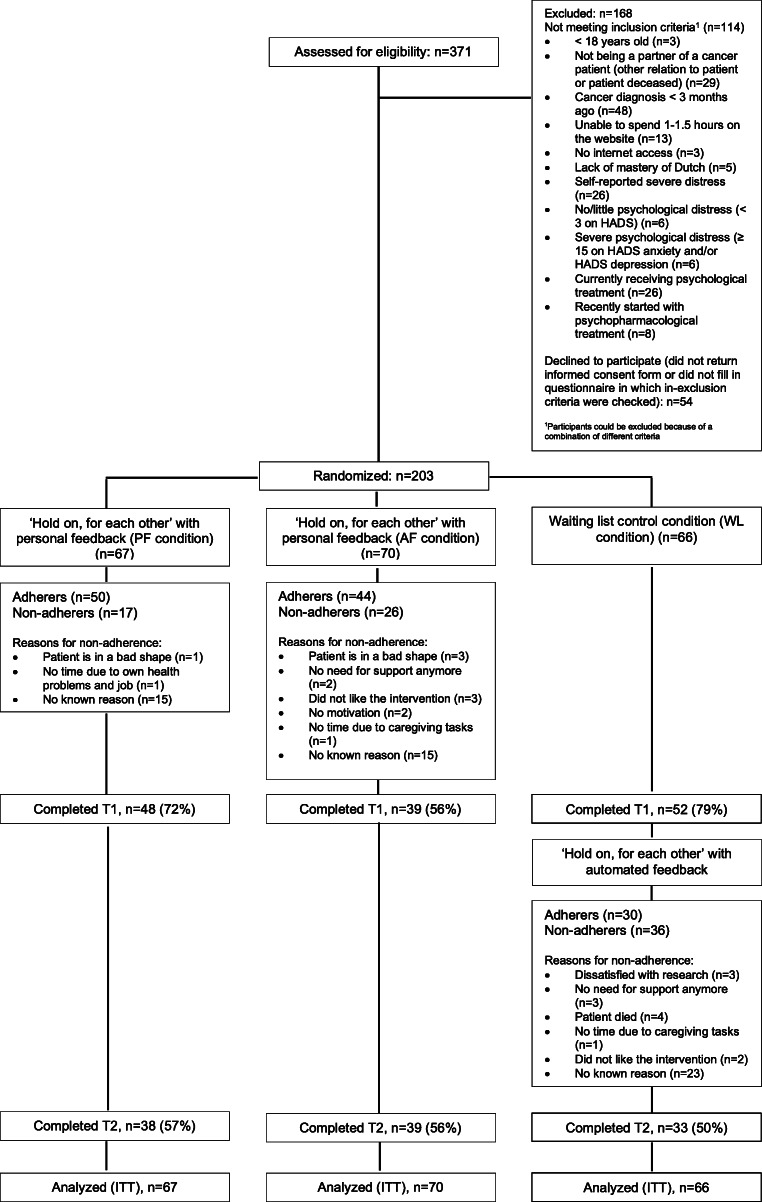
Purpose: To evaluate the effectiveness of two versions (personal or automated feedback) of a psychological Web-based self-help intervention targeting partners of cancer patients. The intervention was based on acceptance and commitment therapy (ACT) and self-compassion training. Participants’ adherence and their satisfaction were also studied. Methods: Two hundred three partners of patients with heterogeneous entities of cancer were randomized into three conditions: personal feedback (PF) (n = 67), automated feedback (AF) (n = 70), or waiting list (WL) control (n = 66). Participants completed measures at baseline (T0) and post-intervention (T1; 3 months after baseline) to assess psychological distress (HADS; primary outcome), positive mental health, caregiver strain, general health (secondary outcomes), posttraumatic growth, resilience, self-compassion, psychological flexibility, sense of mastery, and relational communication style (process measures). Participants in the two experimental conditions also completed these measures at follow-up (T2; 6 months after baseline). Results: There was no significant difference in change in psychological distress, positive mental health, caregiver strain and general health from T0 to T1 for either of the experimental conditions compared with the WL-condition. However, when compared to a WL-condition, the PF-condition was effective in increasing psychological flexibility (effect size d = 0.49) and resilience (d = 0.12) and decreasing overprotection (d = 0.25), and the AF-condition was effective in reducing overprotection (d = 0.36) and improving protective buffering (d = 0.36). At follow-up, the PF-condition was more effective than the AF-condition for improving mental health (d = 0.36), psychological flexibility (d = 0.60), mastery (d = 0.48), and protective buffering (d = 0.24). Participants positively appreciated the intervention and 69% participants were adherent. Conclusion: This study demonstrates that a Web-based intervention based on ACT and self-compassion training with automated or personal feedback does not seem to improve psychological distress; however, it may have the potential to support partners of cancer patients to cope with the difficult situation they are facing. The condition with personal feedback seemed to be more beneficial. © 2021, The Author(s).
Overview
CoChat Summary
TL;DR
This randomized controlled trial tested a web-based ACT/self-compassion self-help intervention for partners of cancer patients, comparing personal feedback, automated feedback, and a waiting-list control. It did not improve the primary outcome of psychological distress, but it did improve some process measures, with personal feedback generally performing better than automated feedback.
Key findings
- At T1 (3 months after baseline), there was no significant difference in change in psychological distress, positive mental health, caregiver strain, or general health for either intervention condition versus waiting list.
- Compared with waiting list at T1, the personal feedback condition improved psychological flexibility (d = 0.49) and resilience (d = 0.12) and decreased overprotection (d = 0.25); the automated feedback condition reduced overprotection (d = 0.36) and improved protective buffering (d = 0.36).
- At follow-up (T2; 6 months after baseline), personal feedback outperformed automated feedback on positive mental health (d = 0.36), psychological flexibility (d = 0.60), sense of mastery (d = 0.48), and protective buffering (d = 0.24).
- Adherence was 69% overall; satisfaction was generally positive, with a CSQ-8 mean of 3.0 (SD 0.6), 84.0% willing to recommend it, and 81.0% saying they received the support they wanted.
Methods
- Prospective randomized controlled trial with three conditions: personal feedback (n = 67), automated feedback (n = 70), and waiting list (n = 66); allocation ratio 1:1:1 and randomization stratified by gender and self-reported stage of disease.
- Participants: 203 partners of cancer patients/survivors recruited in the Netherlands (Feb 2014–June 2015); inclusion required age >18, partner status, Internet access, Dutch proficiency, and HADS > 3.
- Analysis: baseline group comparisons with ANOVA/χ²; outcomes analyzed with linear mixed models in intention-to-treat and per-protocol sensitivity analyses; between-group effect sizes reported as Cohen’s d.
Limitations
- The paper states the study was slightly underpowered.
- Baseline distress was relatively low, leaving less room for improvement in the primary outcome.
- The authors could not test PF/AF changes from T1 to T2 against the waiting-list group because the waiting list gained access to the intervention after T1.
- The study excluded partners with severe distress and those whose partner’s cancer diagnosis was < 3 months ago, so the findings may not generalize to those groups.
- The paper notes that, given the small sample size and exploratory secondary/process analyses, p-values were not corrected for multiple testing; this is a limitation stated in the paper.
Model-written summary. Check it against the paper before relying on it.
Integrity signals
Registry
Cites
Statistics
Figures
Verification
Claims the paper makes
16 Valid · 0 Not valid · 3 Not checked · 50 Own results and interpretations
The sources with a verdict support this claim; the rest weren’t checked yet, have no full text we could read, or their verdicts aren’t rated yet.
In the paper
“For many of such caregivers, it is difficult to disengage themselves from their caregiving situation, as they long to help the patient to feel better or feel a sense of duty to support the patient in every possible way [3, 4].”
§ Web-based self-help intervention for partners of cancer patients based on acceptance and commitment therapy and self-compassion training: a randomized controlled trial with automated versus personal feedback > Background
What the sources say
- Supportedcites [3] Köhle N Drossaert CHC Oosterik S Schreurs KM Hagedoorn M van Uden-Kraan CF Needs and preferences of partners of cancer patients regarding a web-based psychological intervention: a qualitative study JMIR Cancer 2015 1 2 e13 10.2196/cancer.4631 28410157 PMC5367664 source
The Results section describes partners who felt it was wrong to spend personal time while the patient was ill or focused on the patient’s needs instead of their own. The Discussion adds that many informal cancer caregivers do not seek help because they are focused on the patient’s well-being. Together, these passages support the claim’s account of difficulty stepping back from caregiving. (LLM, conf=0.85)
- Not checked — no full text of the sourcecites [4] Stenberg U Ruland C Miaskowski C Review of the literature on the effects of caring for a patient with cancer Psycho-Oncology 2010 19 10 1013 1025 10.1002/pon.1670 20014159 source
plain- Asserted: passes — The authors put it forward as true.
- Checkable: passes — It can be checked against evidence.
- Load-bearing: passes — The paper’s conclusions depend on it.
- Based: passes — The paper gives a reason why it holds.
- Supported
The cited sources support only part of this claim — read each source’s verdict below.
In the paper
“However, the Internet has rarely been used to deliver psychological interventions to partners of cancer patients [10, 12].”
§ Web-based self-help intervention for partners of cancer patients based on acceptance and commitment therapy and self-compassion training: a randomized controlled trial with automated versus personal feedback > Background
What the sources say
- Not checked — no full text of the sourcecites [10] Kaltenbaugh DJ Klem ML Hu L Turi E Haines AJ Hagerty LJ Using web-based interventions to support caregivers of patients with cancer: a systematic review Oncol Nurs Forum 2015 42 2 157 164 10.1188/15.ONF.156-164 25806882 source
- Partly supportedcites [12] Tang W, Chan C, So W, Leung D Web-based interventions for caregivers of cancer patients: a review of literatures. Asia Pac J Oncol Nurs 1(1):9–15 PMC5123453 27981077 sourceExperimental — accuracy not yet measured
The Introduction (page not provided) says that only a few studies of web-based interventions had been conducted with cancer caregivers, and the Abstract describes a review of their psychological outcomes. The paper does not establish how rarely such interventions have been delivered specifically to patients’ partners, rather than caregivers more broadly. (LLM, conf=0.82)
plain- Asserted: passes — The authors put it forward as true.
- Checkable: passes — It can be checked against evidence.
- Load-bearing: passes — The paper’s conclusions depend on it.
- Based: passes — The paper gives a reason why it holds.
The sources with a verdict support this claim; the rest weren’t checked yet, have no full text we could read, or their verdicts aren’t rated yet.
In the paper
“Research has shown that cancer caregivers frequently use the Internet to receive information and support [2, 13]”
§ Web-based self-help intervention for partners of cancer patients based on acceptance and commitment therapy and self-compassion training: a randomized controlled trial with automated versus personal feedback > Background
What the sources say
- Supportedcites [2] Heynsbergh N Botti M Heckel L Livingston PM Caring for the person with cancer: information and support needs and the role of technology Psychooncology 2018 27 6 1650 1655 10.1002/pon.4722 29624783 PMC6001456 source
The Introduction says carers commonly rely on the Internet, among other sources, to address unmet information needs. The section on access to support mechanisms also reports carers seeking information and reassurance online, supporting the broad paraphrase; no page numbers are available in our copy. (LLM, conf=0.87)
- Not checked — no full text of the sourcecites [13] Kinnane NA Milne DJ The role of the Internet in supporting and informing carers of people with cancer: a literature review Support Care Cancer 2010 18 9 1123 1136 10.1007/s00520-010-0863-4 20336326 source
plain- Asserted: passes — The authors put it forward as true.
- Checkable: passes — It can be checked against evidence.
- Load-bearing: passes — The paper’s conclusions depend on it.
- Based: passes — The paper gives a reason why it holds.
- Supported
The cited sources support only part of this claim — read each source’s verdict below.
In the paper
“We chose to examine two versions of feedback (personal versus automated feedback) because our previous studies indicated that partners have different needs regarding feedback [3, 15].”
§ Web-based self-help intervention for partners of cancer patients based on acceptance and commitment therapy and self-compassion training: a randomized controlled trial with automated versus personal feedback > Background
What the sources say
- Supportedcites [3] Köhle N Drossaert CHC Oosterik S Schreurs KM Hagedoorn M van Uden-Kraan CF Needs and preferences of partners of cancer patients regarding a web-based psychological intervention: a qualitative study JMIR Cancer 2015 1 2 e13 10.2196/cancer.4631 28410157 PMC5367664 source
The Results (Desired Functionalities of a Web-Based Intervention; page not provided) report that three participants wanted feedback tailored to their personal situation, while five were not interested in online psychological counseling. The Discussion (Desired Functionalities; page not provided) explicitly concludes that partners had different preferences regarding psychological guidance. (LLM, conf=0.93)
- Partly supportedcites [15] Köhle N Drossaert CHC Van Uden-Kraan CF Schreurs KMG Hagedoorn M Verdonck-de Leeuw IM Bohlmeijer ET Intent to use a web-based psychological intervention for partners of cancer patients: associated factors and preferences J Psychosoc Oncol 2018 36 2 203 221 10.1080/07347332.2017.1397831 29336704 sourceExperimental — accuracy not yet measured
The Results (p. 13) report that partners differed in whether they wanted online contact with a professional counselor, and the Introduction (p. 5) describes varied preferences for professional guidance. This supports differing needs for human support, but the paper does not establish differing needs for personal versus automated feedback. (LLM, conf=0.83)
hedged- Asserted: passes — The authors put it forward as true.
- Checkable: passes — It can be checked against evidence.
- Load-bearing: passes — The paper’s conclusions depend on it.
- Based: passes — The paper gives a reason why it holds.
- Supported
The cited sources support only part of this claim — read each source’s verdict below.
In the paper
“Our findings contradict previous research in which a Web-based intervention with automated feedback for people with depression and anxiety was as effective as the same intervention with personal feedback [22].”
§ Web-based self-help intervention for partners of cancer patients based on acceptance and commitment therapy and self-compassion training: a randomized controlled trial with automated versus personal feedback > Discussion
What the sources say
- Partly supportedcites [22] Kelders SM Bohlmeijer ET Pots WT van Gemert-Pijnen JE Comparing human and automated support for depression: fractional factorial randomized controlled trial Behav Res Ther 2015 72 72 80 10.1016/j.brat.2015.06.014 26196078 sourceExperimental — accuracy not yet measured
The Implications section reports that automated support may be as effective as human support at six-month follow-up, but calls for a larger study. Recruitment and participants (§2.2) shows that participants were selected for mild to moderate depressive symptoms, not for both diagnosed depression and anxiety; severe anxiety was an exclusion criterion. The claim captures the comparison but overstates its certainty and population. (LLM, conf=0.85)
plain- Asserted: passes — The authors put it forward as true.
- Checkable: passes — It can be checked against evidence.
- Load-bearing: passes — The paper’s conclusions depend on it.
- Based: passes — The paper gives a reason why it holds.
- Partly supported
40 more claims · 1 with their cited sources checked
Create a free account to see all 69 claims and every source verdict.
- Probably not a substantial claim. 8
- It may state two separate claims as one. 19
- The quote only partly states this claim. 1
Claims other papers make about this one
Each is checked against this paper’s own text: does it say what the citing paper says it does?
The cited source doesn’t support the claim as written.
In the citing paper
“The results of the intervention by Köhle et al. using a webpage indicate that the scores for positive mental health, psychological flexibility, self-compassion, sense of mastery, and relational communication style were higher than those for interventions involving personalized feedback via email [27].”
From Third-wave cognitive behavioral therapies for caregivers of cancer patients: a scoping review. (2023) · cites this paper as [27]
Checked by a reasoning model — may be wrong.
Experimental — accuracy not yet measuredThe source backs part of the claim, not all of it — or backs it for a different population, condition or comparison.
In the citing paper
“In line with previous research, ACT2COPE supports and provides further evidence that brief ACTbased eHealth interventions can effectively improve mental health outcomes in CHC populations (Graham et al., 2016; Köhle et al., 2021; Mikolasek et al., 2018).”
From ACT2COPE: A pilot randomised trial of a brief online acceptance and commitment therapy intervention for people living with chronic health conditions during the COVID-19 pandemic (2023) · cites this paper as Köhle et al., 2021
Experimental — accuracy not yet measuredThe source backs part of the claim, not all of it — or backs it for a different population, condition or comparison.
In the citing paper
“Only a single study calculated and secured the sample size for appropriate statistical power [27].”
From Third-wave cognitive behavioral therapies for caregivers of cancer patients: a scoping review. (2023) · cites this paper as [27]
Experimental — accuracy not yet measuredThe source backs part of the claim, not all of it — or backs it for a different population, condition or comparison.
In the citing paper
“The most common method was a weekly session for a total of 6 weeks [19, 20, 24, 27] or 8 weeks [25, 28, 29] with a length of approximately 60 min per session [21, 22, 27, 29, 30].”
From Third-wave cognitive behavioral therapies for caregivers of cancer patients: a scoping review. (2023) · cites this paper as [27]
Experimental — accuracy not yet measuredThe cited source says what the claim attributes to it.
In the citing paper
“Previous online ACT interventions vary in length, from 1 day to 12 weeks (Brown et al., 2016), with some having a time commitment of a full-day workshop or 60 minutes each week for multiple weeks (Köhle et al., 2021; Räsänen et al., 2016).”
From ACT2COPE: A pilot randomised trial of a brief online acceptance and commitment therapy intervention for people living with chronic health conditions during the COVID-19 pandemic (2023) · cites this paper as Köhle et al., 2021
1 more claim about this paper
Create a free account to see every claim other papers make about this one.
Statistics recomputed
Every reported test result, recomputed from its test statistic and degrees of freedom. A result shows as not adding up only once an independent check has confirmed it.
- Consistentχ²(530) = 385.47reported p = 1 · recomputed p = 1.000
“χ2 (530) = 385.47, p = 1.000”
Self-check
Percentages, sums and reported differences re-computed from the paper’s own numbers.
Self-check results appear here once an independent check has confirmed them.
Citations
Cites
Statistical Power Analysis for the Behavioral Sciences
Muller, K. (1989) · Technometrics · doi:10.1080/00401706.1989.10488618 · Cited by 99,167
Statistical power analysis for the behavioral sciences
(1990) · Computers, Environment and Urban Systems · doi:10.1016/0198-9715(90)90050-4 · Cited by 65,269
The Hospital Anxiety and Depression Scale
Zigmond, A. S., & Snaith, R. P. (1983) · Acta Psychiatrica Scandinavica · doi:10.1111/j.1600-0447.1983.tb09716.x · Cited by 47,139
(1992) · PubMed · Cited by 33,716
The MOS 36-ltem Short-Form Health Survey (SF-36): I. Conceptual Framework and Item Selection
Ware, J. E., & Sherbourne, C. D. (1992) · Medical Care · doi:10.1097/00005650-199206000-00002 · Cited by 30,033
Pearlin, L. I., & Schooler, C. (1978) · Journal of Health and Social Behavior · doi:10.2307/2136319 · Cited by 7,791 · cited 1×
“Sense of masterywasmeasuredwith the PearlinMastery Scale (PMS; 5 items; range 5–25) [33], with higher scores signifying that the individual perceives more control over his/her life.”
BackgroundAcceptance and commitment therapy: model, processes and outcomes
Hayes, S. C., Luoma, J. B., Bond, F. W., Masuda, A., & Lillis, J. (2006) · Behaviour Research and Therapy · doi:10.1016/j.brat.2005.06.006 · Cited by 6,587 · cited 1×
“ACT aims to increase people’s psychological flexibility, which can be defined as “the ability to contact the present moment more fully as a conscious human being, and to change or persist in behaviour when doing so serves valued ends” [18].”
BackgroundThe brief resilience scale: Assessing the ability to bounce back
Smith, B. W., Dalen, J., Wiggins, K., Tooley, E., Christopher, P., & Bernard, J. (2008) · International Journal of Behavioral Medicine · doi:10.1080/10705500802222972 · Cited by 6,439 · cited 1×
“Resilience—the ability to bounce back or recover from stress—was measured with the Brief Resilience Scale (BRS; 6 items) [31].”
MethodSelf-Compassion: An Alternative Conceptualization of a Healthy Attitude Toward Oneself
NEFF, K. (2003) · Self and Identity · doi:10.1080/15298860309032 · Cited by 5,440 · cited 1×
“Selfcompassion is the ability to act with kindness and understanding towards yourself whenever you are having a difficult time [19].”
BackgroundConstruction and factorial validation of a short form of the Self-Compassion Scale
Raes, F., Pommier, E., Neff, K. D., & Van Gucht, D. (2011) · Clinical Psychology & Psychotherapy · doi:10.1002/cpp.702 · Cited by 2,997 · cited 1×
“Self-compassion was assessed with the Self-Compassion Scale Short-Form (SCS-SF; 12 items; mean range 1–7) [30].”
Method
Research works printed but not linked: 1
- Jacobs N Kleen M De Groot F A-Tjak J Het meten van experientiele vermijding. De nederlandstalige versie van de Acceptance and Action Questionnaire-II (AAQ-II) Gedragstherapie 2008 41 349 361
Cited by
Sommers-Spijkerman, M., Austin, J., Bohlmeijer, E., & Pots, W. (2021) · JMIR Mental Health · doi:10.2196/28168 · Cited by 179
“Population, intervention, and methodological characteristics (Multimedia Appendix 1; Gao et al, unpublished data, 2021; [32-125]) as well as effect size data were extracted from the full-text papers by 3 raters (ie, MSS, JA, and WP) independently.”
BackgroundMethodSelf-citationHan, A., & Kim, T. H. (2022) · Journal of Medical Internet Research · doi:10.2196/39727 · Cited by 50
Zhang, Y., Liu, C., Chen, X., Zhang, Y., Li, Y., & Hu, X. (2024) · Psycho-Oncology · doi:10.1002/pon.70045 · Cited by 48
Kip, H., Jong, N. B.-D., van Gemert‐Pijnen, J. E. W. C., & Kelders, S. M. (2025) · Journal of Medical Internet Research · doi:10.2196/59601 · Cited by 62
“First, we used experiences, lessons learned, and points of improvement that were reported in studies that used parts of the original Roadmap [26,27,29-42].”
Atefi, G. L., de Vugt, M. E., van Knippenberg, R. J. M., Levin, M. E., Verhey, F. R. J., & Bartels, S. L. (2023) · Clinical Psychology Review · doi:10.1016/j.cpr.2023.102341 · Cited by 33
Zhang, Y., Tang, R., Bi, L., Wang, D., Li, X., Gu, F., Han, J., & Shi, M. (2023) · Supportive Care in Cancer · doi:10.1007/s00520-023-08053-2 · Cited by 48
“Furthermore, individuals can use their own resources to cope with threatening events, enhance their adaptability, and recover or improve their resilience [43].”
BackgroundYe, F., Lee, J. J., Xue, D., & Yu, D. S.-F. (2023) · JAMA Network Open · doi:10.1001/jamanetworkopen.2023.46216 · Cited by 23
Bodschwinna, D., Lorenz, I., Bauereiß, N., Gündel, H., Baumeister, H., & Hönig, K. (2022) · Psycho-Oncology · doi:10.1002/pon.5917 · Cited by 24
Han, A., & Kim, T. H. (2022) · Journal of Medical Internet Research · doi:10.2196/39182 · Cited by 20
Zhang, X., Ma, L., & Li, F. (2022) · Journal of Nursing Scholarship · doi:10.1111/jnu.12774 · Cited by 21
Coumoundouros, C., Mårtensson, E., Ferraris, G., Zuidberg, J. M., von Essén, L., Sanderman, R., & Woodford, J. (2022) · JMIR Mental Health · doi:10.2196/41891 · Cited by 24
“General mental health was measured in 2 RCTs. h Adjusted to exclude a dropped treatment arm. i Negative mood was based on a modified version of the Short Version Profile of Mood States. j Postintervention was defined as the primary end point measurement specified within the study (6 months). k Caregivers were followed…”
BackgroundMethodInfluentialBehr, S., Garcia, L. M., Lucas, J., Kohlhase, E., Puetz, M., Boettcher, J., Schaeuffele, C., & Knaevelsrud, C. (2025) · Internet Interventions · doi:10.1016/j.invent.2025.100821 · Cited by 27
Mechanisms of change in an Internet-Based ACT study for depression in China
Zhao, C., Ren, Z., Jiang, G., & Zhang, L. (2022) · Journal of Contextual Behavioral Science · doi:10.1016/j.jcbs.2022.03.004 · Cited by 14
Zhu, M., Lai, M., Chen, R., & Zhang, Q. (2024) · Journal of the American Medical Directors Association · doi:10.1016/j.jamda.2023.12.002 · Cited by 16
Third-wave cognitive behavioral therapies for caregivers of cancer patients: a scoping review.
Hong, B., Yang, S., Hyeon, S., Kim, S., & Lee, J. (2023) · BMC Complementary Medicine and Therapies · doi:10.1186/s12906-023-04186-3 · Cited by 7
“There were two 3-arm studies; Milbury et al. had two control groups [21], and Köhle et al. had two intervention groups [27] (Table 1).”
BackgroundMethodInfluentialZhang, Y., Tang, R., Wang, D., Li, X., Bi, L., Shi, M., & Han, J. (2025) · BMC Psychology · doi:10.1186/s40359-025-02632-0 · Cited by 10
“Indeed, previous studies have shown that giving cancer patients or caregivers positive psychological interventions significantly improves resilience and hope [14, 47, 48].”
Atefi, G., van Knippenberg, R. J. M., Bartels, S. L., Losada‐Baltar, A., Márquez‐González, M., Verhey, F. R. J., & de Vugt, M. E. (2025) · Cognitive Behaviour Therapy · doi:10.1080/16506073.2025.2477600 · Cited by 13
“…investigate whether relying solely on automated replies or combining them with personal contact can reduce the burden on healthcare professionals (Köhle et al., 2021), particularly as therapists’ workload can influence their availability and the quality of support they provide (Contreras et al.,…”
Self-Compassion-Based Interventions in Oncology: A Review of Current Practices
Grégoire, C., Paye, A., & Vanhaudenhuyse, A. (2024) · OBM Integrative and Complementary Medicine · doi:10.21926/obm.icm.2401007 · Cited by 13
Self-Compassion As A Mediator of The Relationship Between Psychological Inflexibility and Resilience
Büyüköksüz, E., & Tekin, I. (2023) · Spiritual Psychology and Counseling · doi:10.37898/spiritualpc.1276031 · Cited by 12
“…states instead of withdrawing from painful experiences and feeling disconnected from others by seeing oneself as the only person experiencing the pain and struggles, being aware that these experiences are characteristic of being human (Barnard & Curry, 2011; Köhle et al., 2021; Neff, 2011).”
BackgroundFadhil, A. A., Kadhim, Q. K., Shakir, A., Alaraji, M. K., Hussein, H. A., & Yousuf, L. M. (2023) · International journal of body, mind and culture · doi:10.22122/ijbmc.v9isp.422 · Cited by 7
Wang, S., Xia, W., Zhang, J., Wu, M., & Tian, L. (2025) · General Hospital Psychiatry · doi:10.1016/j.genhosppsych.2025.02.022 · Cited by 8
Gu, Y., Duan, M., Huang, Y., Hu, M., Bao, M., & Yang, F. (2025) · Scientific Reports · doi:10.1038/s41598-025-07280-3 · Cited by 11
Grapp, M., Ell, J., Kiermeier, S., Haun, M. W., Kübler, A., Friederich, H., & Maatouk, I. (2022) · Scientific Reports · doi:10.1038/s41598-022-21157-9 · Cited by 7
Goria, S., Girgis, A., Shaw, J., Przezdziecki, A., Levesque, J. V., Bamgboje‐Ayodele, A., & Care Assist Co‐Authorship Group (2022) · Psycho-Oncology · doi:10.1002/pon.5962 · Cited by 5
Øverup, C. S., & Hald, G. M. (2024) · Current Psychology · doi:10.1007/s12144-024-06351-4 · Cited by 6
“And more specifically, an ACT-based digital intervention has been found to help partners of cancer patients to develop greater psychological flexibility and resilience, to cope with the difficult situation they face (Köhle et al., 2021).”
Wallace-Boyd, K., Boggiss, A. L., Ellett, S., Booth, R., Slykerman, R., & Serlachius, A. S. (2023) · Cogent Psychology · doi:10.1080/23311908.2023.2208916 · Cited by 3
“In line with previous research, ACT2COPE supports and provides further evidence that brief ACT-based eHealth interventions can effectively improve mental health outcomes in CHC populations (Graham et al., 2016; Köhle et al., 2021; Mikolasek et al., 2018).”
BackgroundResultKim, M., Tan, K., & Coombs, L. A. (2025) · Palliative & Supportive Care · doi:10.1017/s1478951525100370 · Cited by 5
“Caregiver burden was measured using the Caregiver Strain Index (CSI) in 3 studies (Köhle et al. 2021; Schuit et al. 2022; Theiling 2016), Caregiver Reaction Assessment (CRA) in 2 studies (Applebaum et al. 2018; Boele et al. 2022), and the Zarit Caregiver Burden Scale in 2 studies (Reblin et al.…”
Wu, J., Wang, M., & Yan, H. (2023) · Psychology Health & Medicine · doi:10.1080/13548506.2023.2253510 · Cited by 4
“However, limited education and lack of professional knowledge and skills make caregivers have low awareness of the patients’ diseases and lack of care experience (Köhle et al., 2021; Ouyang, 2021).”
BackgroundInfluentialBehr, S., García, L. M., Lucas, J., Kohlhase, E., Puetz, M., Boettcher, J., Schaeuffele, C., & Knaevelsrud, C. (2024) · doi:10.31234/osf.io/28knb · Cited by 3
Ghavami, S. B., Zarani, F., Fata, L., Sharbafchi, M. R., & Bender, J. L. (2025) · Palliative & Supportive Care · doi:10.1017/s1478951525100618 · Cited by 2
“Unlike most studies of cancer caregivers, which have been limited to partners of cancer patients (Köhle et al. 2021), our study examines the views of a diverse range of caregivers with varying relationships to the patient (e.g., spouse, adult child, and extended family).”
Shishkova, A. M., Bocharov, V. V., Tsygankova, E. S., & Александровна, Г. Е. (2023) · V M BEKHTEREV REVIEW OF PSYCHIATRY AND MEDICAL PSYCHOLOGY · doi:10.31363/2313-7053-2023-874 · Cited by 2
A Review of Interventions to Improve Medication Adherence of Patients with Chronic Diseases in Asia
Dumo, E. D., Guzman, A. C. P., Marcon, C. M., Necesito, K. J., & Yson, H. (2023) · International Journal of Research Publication and Reviews · doi:10.55248/gengpi.2023.4103 · Cited by 1
Third-wave psychotherapy for caregivers of cancer patients: a scoping reviewPreprint
Hong, B., Yang, S., Hyeon, S., Kim, S., & Lee, J. (2023) · Research Square · doi:10.21203/rs.3.rs-1960441/v1 · Cited by 1
Structural Equation Modeling of Self-Compassion and Self-Care in Cancer Care in IranPreprint
Noori, M., Hanifi, N., Noori, M., Јаnkovic, S., & Jafarabadi, M. A. (2025) · Research Square · doi:10.21203/rs.3.rs-6837027/v1 · Cited by 1
Han, A., & Kim, T. H. (2022) · doi:10.2196/preprints.39182
Bagheri, I., Hojatollah, Y., Bahrami, M., & Shafie, D. (2023) · Research Square · doi:10.21203/rs.3.rs-2520015/v1
Shishkova, A. M., Bocharov, V. V., Tsygankova, E. S., & Александровна, Г. Е. (2024) · V M BEKHTEREV REVIEW OF PSYCHIATRY AND MEDICAL PSYCHOLOGY · doi:10.31363/2313-7053-2024-875
Mohammadifard, L., Zolfaghari, Z., Dastras, M., & Rezaee, N. (2023) · Medical - Surgical Nursing Journal · doi:10.5812/msnj-157482
Büyüköksüz, E., & Erözkan, A. (2025) · International Journal of Cognitive Behavioral Therapy · doi:10.1007/s41811-025-00267-y
“The current findings support previous research demonstrating that self-compassion is associated with enhanced emotional regulation, stress resilience, and self-acceptance (Köhle et al., 2021; Montero-Marin et al., 2020; Yadavaia, 2013).”
Lin, Y., Lv, S., Shostak, W. H., Lacroix, N. M., Kamel, E., Lyon, A. R., Wolchik, S. A., Gans, K. M., & Zhang, N. (2026) · doi:10.2196/preprints.93626
Calderone, A., Latella, D., Marafioti, G., Formica, C., Foti, A., Fauci, E. L., & Filippello, G. (2026) · Health Science Reports · doi:10.1002/hsr2.72525
Zhao, C., Ren, Z., Levin, M. E., Lai, L., & Chen, J. (2026) · European Journal of Psychotraumatology · doi:10.1080/20008066.2026.2702140
Rezaee, N., Mohammadifard, L., Khalilzadeh-Farsangi, Z., & Fallah-Karimi, S. (2026) · Supportive Care in Cancer · doi:10.1007/s00520-026-11054-6
“The results of their research showed that acceptance and commitment education on the web improved psychological distress in caregivers [27], which indicates the effect of web-based education in empowering caregivers and improving their psychological state.”
Metadata
- Authors
- Köhle, N., Drossaert, C. H. C., ten Klooster, P. M., Schreurs, K. M. G., Hagedoorn, M., Van Uden-Kraan, C. F., Verdonck-de Leeuw, I. M., & Bohlmeijer, E. T.
- Affiliations
- University of Twente (NL)
- Roessingh Research and Development (NL)
- University Medical Center Groningen (NL)
- Corresponding author
- Köhle, Nadine
- ORCID
- Venue
- Supportive Care in Cancer
- Published
- 2021-02-19
- Volume
- 29
- Issue
- 9
- Pages
- 5115-5125
- ISSN
- 0941-4355 (ISSN-L)
- 1433-7339
- PMC
- PMC8295082
- OpenAlex
- W3132522668
- Cited by
- 45
- References
- 43
- Citations by year
- 2026: 5 · 2025: 9 · 2024: 8 · 2023: 12 · 2022: 10 · 2021: 1
- FWCI
- 5.28
- Type
- journal article
- Language
- en
- Open access
- hybrid
- doi.org
- Licence
- cc-by
- creativecommons.org/licenses/by/4.0 (tdm)
- creativecommons.org/licenses/by/4.0 (vor)
- Locations
- Supportive Care in Cancer (publishedVersion, cc-by)
- PubMed Central (publishedVersion, cc-by)
- PubMed (publishedVersion)
- Pure Amsterdam UMC (publishedVersion, cc-by)
- Amsterdam UMC (VU Amsterdam) - Institutional Repository (publishedVersion, other-oa)
- University of Groningen research database (University of Groningen / Centre for Information Technology) (publishedVersion, cc-by)
- VU Research Portal (publishedVersion, other-oa)
- University of Twente Research Information (publishedVersion, cc-by)
- University of Groningen research database (University of Groningen / Centre for Information Technology) (submittedVersion, cc-by)
- University of Twente Research Information (submittedVersion, cc-by)
- Data Archiving and Networked Services (DANS) (submittedVersion, other-oa)
- Funders
- KWF Kankerbestrijding (5248)
- Topics
- Social Sciences › Psychology › Clinical Psychology › Mindfulness and Compassion Interventions
- Social Sciences › Psychology › Applied Psychology › Digital Mental Health Interventions
- Health Sciences › Medicine › Oncology › Cancer survivorship and care
- Keywords
- partners of cancer patients, acceptance and commitment therapy, self-compassion training, automated feedback, individual feedback, psychological distress, caregiver burden, psychological flexibility, resilience, overprotection, protective buffering, mastery, posttraumatic growth, intervention adherence, intervention satisfaction
- MeSH terms
- Empathy, Feedback, Humans, Neoplasms, Internet, Acceptance and Commitment Therapy
About these checks
Registry, retraction, Cites and statistics results are computed, not judged, with one exception: a printed reference that no index lists is read once by a model before it counts as a citation error. Claims are extracted by a model and kept only when their quote appears verbatim in the text; each cited source is then checked, with a model’s help, for whether it says what the claim relies on. Those verdicts can be wrong — read the claim’s quote and the cited source before relying on one.
The claim verdicts this report counts are experimental: their accuracy is not yet measured.
A language model drew the claims from the paper on 2026-10-11, under version 3 of the claim definition (model deepseek-v4.1-flash, prompt extract-v3).
A second model labelled each claim on 2026-10-11 (model jev-1.13-20260917, definition revision gold-guideline-v0.2).
Cited sources are checked with a language model’s help (gpt-6-sol).
Statistics and arithmetic are recomputed, not judged.
Confidence bands are shown only for fields calibrated on our annotated test set. None is calibrated yet, so no band is shown.
What counts as a claim ›How we measure confidence ›How we check this ›
Are you an author, or do you see a problem with this page? Request a review
Data sources
Bibliographic data: Semantic Scholar, OpenAlex, Crossref.
Contains information from the Semantic Scholar Academic Graph Datasets, made available under the ODC Attribution License (ODC-BY 1.0).
Semantic Scholar’s data is described in: Kinney, R., et al. (2023). The Semantic Scholar Open Data Platform. arXiv:2301.10140.
