

Efficacy of Internet-Based Acceptance and Commitment Therapy for Depressive Symptoms, Anxiety, Stress, Psychological Distress, and Quality of Life: Systematic Review and Meta-analysis.
Open accessThe DOI matches its Crossref record; 58 of the 58 references it cites were found in a registry or an index; 18 of the 50 sources its claims cite were checked for support.
Abstract
BACKGROUND: Acceptance and commitment therapy (ACT) is an empirically supported transdiagnostic approach that involves mindfulness processes and behavior change processes for valued living. OBJECTIVE: This systematic review and meta-analysis of randomized controlled trials (RCTs) aimed to assess the efficacy of internet-based ACT (iACT) for depressive symptoms, anxiety, stress, psychological distress, and quality of life (QoL). METHODS: PubMed, CINAHL, PsycINFO, and SCOPUS databases were searched to identify relevant RCTs published up to June 5, 2021. The included RCTs were assessed using the Cochrane Collaboration risk-of-bias tool. The use of either a random effects model or fixed effects model was determined using I2 statistic values for heterogeneity. Subgroup analyses were conducted according to the type of control group, the use of therapist guidance, delivery modes, and the use of targeted participants, when applicable. RESULTS: A total of 39 RCTs met the inclusion criteria. Meta-analyses found small effects of iACT on depressive symptoms, anxiety, stress, psychological distress, and QoL at the immediate posttest and follow-up. There was no significant effect of iACT on stress at follow-up. Subgroup analyses showed small to medium effects of iACT on all the outcomes at the immediate posttest and follow-up compared with the passive control groups. In contrast, subgroup analyses that compared iACT with active control groups found no differences between groups on stress, psychological distress, and QoL at the immediate posttest or on depressive symptoms, anxiety, and stress at follow-up. In addition, subgroup analyses conducted according to the use of therapist guidance, delivery modes, and the use of targeted participants found no statistically significant subgroup differences among studies in all the outcomes, except for the subgroup difference among studies according to the use of targeted participants for depressive symptoms at the immediate posttest (ie, a statistically significant, larger effect of iACT when studies targeted people with depressive symptoms). The overall risk of bias across the studies was unclear. CONCLUSIONS: The findings of this study contribute to the body of evidence regarding the effects of iACT on depressive symptoms, anxiety, stress, psychological distress, and QoL and may be applicable in any population, as ACT is a transdiagnostic approach. Few studies have compared iACT with active control conditions, especially for stress and psychological distress at the immediate posttest and follow-up. In addition, the active control conditions varied among the included studies. Further high-quality studies are needed to better understand whether iACT is comparable or superior to other evidence-based interventions, such as cognitive behavioral therapy, in decreasing depressive symptoms, anxiety, stress, and psychological distress and improving QoL.
Overview
CoChat Summary
## TL;DR
This systematic review and meta-analysis of 39 randomized controlled trials found that internet-based acceptance and commitment therapy (iACT) had small benefits for depressive symptoms, anxiety, stress, psychological distress, and quality of life. Effects were generally stronger versus passive controls than active controls, and there was no significant effect on stress at follow-up.
## Key findings
- The review included 39 RCTs; meta-analyses showed small effects of iACT on depressive symptoms, anxiety, stress, psychological distress, and QoL at immediate posttest and follow-up, except stress at follow-up, which was not significant.
- For depressive symptoms, the overall effect was SMD 0.35 at posttest (31 RCTs, N=4124) and SMD 0.39 at follow-up (13 RCTs, N=1645).
- For anxiety, the overall effect was SMD 0.30 at posttest (22 RCTs, N=2407) and SMD 0.23 at follow-up (10 RCTs, N=1483).
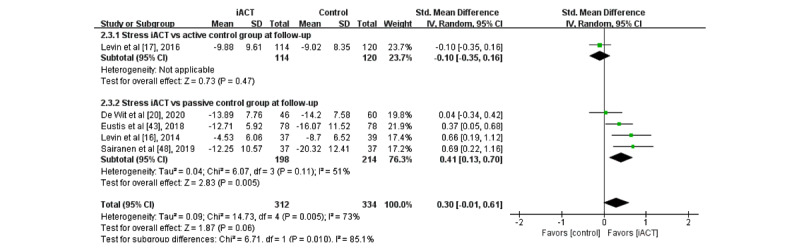
- Versus passive control groups, iACT showed small to medium effects across outcomes; versus active control groups, several comparisons were not significant (eg, stress, psychological distress, and QoL at posttest; depressive symptoms, anxiety, and stress at follow-up).
- The overall risk of bias across studies was unclear; among the 39 studies, 20 (51%) were unclear risk, 14 (36%) low risk, and 5 (13%) high risk.
## Methods
- Systematic review and meta-analysis of randomized controlled trials of internet-based ACT compared with non-ACT control conditions, following PRISMA and the Cochrane Handbook; the review was not preregistered.
- Searches were run in PubMed, CINAHL, PsycINFO, and SCOPUS up to June 5, 2021; 39 RCTs met inclusion criteria.
- Effects were pooled in RevMan 5.4 using SMDs with 95% CIs at immediate posttest and follow-up, with subgroup analyses by control type, therapist guidance, delivery mode, and targeted participants when applicable.
## Limitations
- The paper states that multiple comparisons may warrant Bonferroni correction; with that adjustment, most results stayed the same, but psychological distress at posttest and follow-up and QoL at follow-up would differ. It also notes RevMan could not accommodate the adjusted significance level.
- Only 4 electronic databases were searched and only English-language studies were included, so relevant studies may have been missed and publication bias may be possible.
- The review was done with one author handling search/data extraction/quality assessment, rather than two independent reviewers.
- The overall risk of bias across studies was unclear.
Model-written summary. Check it against the paper before relying on it.
Integrity signals
Registry
Cites
Statistics
Figures




Verification
Claims the paper makes
8 Valid · 1 Not valid · 13 Not checked · 68 Own results and interpretations
In the paper
“A total of 39 articles met the eligibility criteria [13-51].”
§ Efficacy of Internet-Based Acceptance and Commitment Therapy for Depressive Symptoms, Anxiety, Stress, Psychological Distress, and Quality of Life: Systematic Review and Meta-analysis > Results > Selection of Studies
What the sources say
- Not matchedcites [13-51]
Couldn’t be matched to a paper in Crossref, so it can’t be checked.
plain- Asserted: passes — The authors put it forward as true.
- Checkable: passes — It can be checked against evidence.
- Load-bearing: passes — The paper’s conclusions depend on it.
- Based: passes — The paper gives a reason why it holds.
- Not matched
A result the paper reports from its own data — it cites no other source for it, so there is none to check. The quote shows it is in the paper.
In the paper
“A meta-analysis of 10 RCTs with follow-up data (N=1483 participants) showed that iACT had a small effect on reducing anxiety at follow-up compared with control groups overall (SMD 0.23, 95% CI 0.13-0.33; Figure 5).”
§ Efficacy of Internet-Based Acceptance and Commitment Therapy for Depressive Symptoms, Anxiety, Stress, Psychological Distress, and Quality of Life: Systematic Review and Meta-analysis > Results > Effects of iACT on Reducing Anxiety
plainstates a causen = 1,483- Asserted: passes — The authors put it forward as true.
- Checkable: passes — It can be checked against evidence.
- Load-bearing: passes — The paper’s conclusions depend on it.
- Based: passes — The paper gives a reason why it holds.
A result the paper reports from its own data — it cites no other source for it, so there is none to check. The quote shows it is in the paper.
In the paper
“Meta-analyses found small effects of iACT on depressive symptoms, anxiety, stress, psychological distress, and QoL at the immediate posttest and follow-up.”
§ Efficacy of Internet-Based Acceptance and Commitment Therapy for Depressive Symptoms, Anxiety, Stress, Psychological Distress, and Quality of Life: Systematic Review and Meta-analysis > Abstract > Results
plainstates a cause- Asserted: passes — The authors put it forward as true.
- Checkable: passes — It can be checked against evidence.
- Load-bearing: passes — The paper’s conclusions depend on it.
- Based: passes — The paper gives a reason why it holds.
A result the paper reports from its own data — it cites no other source for it, so there is none to check. The quote shows it is in the paper.
In the paper
“A meta-analysis of 4 RCTs with follow-up data (N=314 participants) revealed that iACT had a small effect on reducing psychological distress at follow-up compared with control groups overall (SMD 0.31, 95% CI 0.09-0.54; Figure 9).”
§ Efficacy of Internet-Based Acceptance and Commitment Therapy for Depressive Symptoms, Anxiety, Stress, Psychological Distress, and Quality of Life: Systematic Review and Meta-analysis > Results > Effects of iACT on Reducing Psychological Distress
plainstates a causen = 314- Asserted: passes — The authors put it forward as true.
- Checkable: passes — It can be checked against evidence.
- Load-bearing: passes — The paper’s conclusions depend on it.
- Based: passes — The paper gives a reason why it holds.
A result the paper states — it cites no source for it, so there is none to check. The quote shows it is in the paper.
In the paper
“Few studies have compared iACT with active control conditions, especially for stress and psychological distress at the immediate posttest and follow-up.”
§ Efficacy of Internet-Based Acceptance and Commitment Therapy for Depressive Symptoms, Anxiety, Stress, Psychological Distress, and Quality of Life: Systematic Review and Meta-analysis > Abstract > Conclusions
plain- Asserted: passes — The authors put it forward as true.
- Checkable: passes — It can be checked against evidence.
- Load-bearing: passes — The paper’s conclusions depend on it.
- Based: passes — The paper gives a reason why it holds.
51 more claims
Create a free account to see all 90 claims and every source verdict.
- Probably not a substantial claim. 19
- It may state two separate claims as one. 19
Claims other papers make about this one
Each is checked against this paper’s own text: does it say what the citing paper says it does?
The source backs part of the claim, not all of it — or backs it for a different population, condition or comparison.
In the citing paper
“Thus, this study's result exceeded Han and Kim's (2022) meta‐analytic average effect of IACT for anxiety disorders (SMD = 0.39) using non‐active control conditions.”
From Internet‐Based Acceptance and Commitment Therapy With Interoceptive Exposure for Panic Disorder: A Randomized Controlled Trial and Working Alliance Analysis. (2026) · cites this paper as Han and Kim's (2022)
Experimental — accuracy not yet measuredThe cited source says what the claim attributes to it.
In the citing paper
“A growing body of evidence indicates that ACT can alleviate depressive symptoms, anxiety, stress, and emotional distress in various populations [31,33,34].”
The cited source says what the claim attributes to it.
In the citing paper
“Preliminary evidence further supports the efficacy of internet‐based ACT (IACT; Han and Kim 2022; Thompson et al. 2021).”
From Internet‐Based Acceptance and Commitment Therapy With Interoceptive Exposure for Panic Disorder: A Randomized Controlled Trial and Working Alliance Analysis. (2026) · cites this paper as Han and Kim 2022
The cited source says what the claim attributes to it.
In the citing paper
“This is consistent with meta‐analyses on both IACT (Han and Kim 2022) and ICBT (Maj et al. 2023), which demonstrate no or minor effects regarding the effect on quality of life.”
From Internet‐Based Acceptance and Commitment Therapy With Interoceptive Exposure for Panic Disorder: A Randomized Controlled Trial and Working Alliance Analysis. (2026) · cites this paper as Han and Kim 2022
Citations
Cites
The PRISMA 2020 statement: An updated guideline for reporting systematic reviews
Page, M. J., McKenzie, J. E., Bossuyt, P. M., Boutron, I., Hoffmann, T. C., Mulrow, C. D., Shamseer, L., Tetzlaff, J. M., Akl, E. A., Brennan, S. E., et al. (2021) · BMJ · doi:10.1136/bmj.n71 · Cited by 108,283
Cochrane Handbook for Systematic Reviews of Interventions
(2019) · doi:10.1002/9781119536604 · Cited by 14,828
Cumpston, M., Li, T., Page, M. J., Chandler, J., Welch, V. A., Higgins, J. P., & Thomas, J. (2019) · Cochrane Database of Systematic Reviews · doi:10.1002/14651858.ed000142 · Cited by 7,218
Acceptance and Commitment Therapy as a Unified Model of Behavior Change
Hayes, S. C., Pistorello, J., & Levin, M. E. (2012) · The Counseling Psychologist · doi:10.1177/0011000012460836 · Cited by 718 · cited 4×
“ACT is based on a psychological flexibility model involving six processes [2]: (1) acceptance (ie, being open to unwanted thoughts and emotions as they are), (2) cognitive defusion (ie, stepping back from unhelpful thoughts and emotions to reduce their dominance over behaviors), (3) being present…”
InfluentialWaffenschmidt, S., Knelangen, M., Sieben, W., Bühn, S., & Pieper, D. (2019) · BMC Medical Research Methodology · doi:10.1186/s12874-019-0782-0 · Cited by 626
Acceptance and Commitment Therapy (ACT) for Chronic Pain: A Systematic Review and Meta-Analyses
Hughes, L. S., Clark, J., Colclough, J. A., Dale, E., & McMillan, D. (2017) · The Clinical Journal of Pain · doi:10.1097/ajp.0000000000000425 · Cited by 611 · cited 1×
“A majority of previous meta-analyses regarding ACT were limited to specific populations, such as people with chronic pain [5] and people with psychosis [6], which led to a small number of included studies for meta-analysis.”
Dindo, L., Van Liew, J. R., & Arch, J. J. (2017) · Neurotherapeutics · doi:10.1007/s13311-017-0521-3 · Cited by 371 · cited 3×
“Acceptance and commitment therapy (ACT) is an empirically supported transdiagnostic approach that involves mindfulness and acceptance processes and behavior change processes for valued living [1,2].”
Acceptance and Commitment Therapy (ACT) to reduce depression: a systematic review and meta-analysis
Bai, Z., Luo, S., Zhang, L., Wu, S., & Chi, I. (2020) · Journal of Affective Disorders · doi:10.1016/j.jad.2019.09.040 · Cited by 321 · cited 2×
“For example, previous meta-analyses found that ACT had small to medium effects on reducing depressive symptoms and anxiety and improving QoL in family caregivers [4] and a medium effect on reducing depressive symptoms in people diagnosed with depression [3].”
Buhrman, M., Skoglund, A., Husell, J., Bergström, K., Gordh, T., Hursti, T., Bendelin, N., Furmark, T., & Andersson, G. (2013) · Behaviour Research and Therapy · doi:10.1016/j.brat.2013.02.010 · Cited by 285 · cited 1×
“More importantly, active control conditions varied among the included studies, including web-based discussion forums [35,37,41], web-based expressive writing [32,51], web-based mental health education [17], a web-based smoking cessation intervention [14], web-based CBT [13], in-person CBT [27], and…”
Rogers, M. A., Lemmen, K., Kramer, R., Mann, J., & Chopra, V. (2017) · Journal of Medical Internet Research · doi:10.2196/jmir.7111 · Cited by 259 · cited 1×
“Internet-based psychological interventions are easy to access and inexpensive; therefore, it is important to determine whether iACT is an effective alternative option for reducing depressive symptoms, anxiety, stress, and overall psychological distress and improving QoL [8].”
Cited by
Zhang, Y., Liu, C., Chen, X., Zhang, Y., Li, Y., & Hu, X. (2024) · Psycho-Oncology · doi:10.1002/pon.70045 · Cited by 48
Coping and emotion regulation: A conceptual and measurement scoping review.
Trudel-Fitzgerald, C., Boucher, G., Morin, C., Mondragon, P., Guimond, A.-J., Nishimi, K., Choi, K. W., & Denckla, C. (2024) · Canadian Psychology / Psychologie canadienne · doi:10.1037/cap0000377 · Cited by 44
Han, A., Yuen, H. K., & Jenkins, J. (2023) · Journal of Health Psychology · doi:10.1177/13591053221141131 · Cited by 30
“The ACT protocol was structured around the six processes of ACT strengthened by behavioral activation (BA) techniques (e.g. activity scheduling and monitoring) to add a structured format for action plans and to maximize benefits for mental health outcomes (Han and Kim, 2022a).”
BackgroundMethodSelf-citationCatella, S., Gendreau, R. M., Kraus, A. C., Vega, N., Rosenbluth, M. J., Soefje, S., Malhotra, S., Luciano, J. V., McCracken, L. M., Williams, D. A., et al. (2024) · Journal of Behavioral Medicine · doi:10.1007/s10865-023-00429-3 · Cited by 23
“…digital ACT programs have been shown to effectively decrease anxiety and depression, conditions commonly comorbid with FM (Dahlin et al., 2016 ; Han & Kim, 2022 ; Kelson et al., 2019 ; Lappalainen et al., 2014 ; Lappalainen et al., 2015 ; Pots et al., 2016 ; Rickardsson et al., 2021 ; Thompson…”
BackgroundPalmer, C. E., Marshall, E., Millgate, E., Warren, G., Ewbank, M., Cooper, E., Lawes, S., Bouazzaoui, M., Smith, A., Hutchins-Joss, C., et al. (2025) · Journal of Medical Internet Research · doi:10.2196/69351 · Cited by 46
Metadata
- Authors
- Han, A., & Kim, T. H.
- Affiliations
- University of Alabama at Birmingham (US)
- Yonsei University (KR)
- Corresponding author
- Kim, Tae Hui
- Venue
- Journal of Medical Internet Research
- Publisher
- JMIR Publications Inc.
- Published
- 2022-12-09
- Volume
- 24
- Issue
- 12
- Pages
- e39727
- ISSN
- 1438-8871 (ISSN-L)
- PMC
- PMC9789494
- OpenAlex
- W4311469551
- Cited by
- 50
- References
- 58
- Citations by year
- 2026: 12 · 2025: 18 · 2024: 13 · 2023: 7
- FWCI
- 1.58
- Type
- journal article
- Language
- en
- Open access
- gold
- doi.org
- Licence
- cc-by
- Locations
- Journal of Medical Internet Research (publishedVersion, cc-by)
- PubMed Central (publishedVersion, cc-by)
- PubMed (publishedVersion)
- DOAJ (DOAJ: Directory of Open Access Journals) (submittedVersion)
- Funders
- Korea Health Industry Development Institute
- Topics
- Social Sciences › Psychology › Clinical Psychology › Mindfulness and Compassion Interventions
- Social Sciences › Psychology › Applied Psychology › Digital Mental Health Interventions
- Social Sciences › Psychology › Experimental and Cognitive Psychology › Anxiety, Depression, Psychometrics, Treatment, Cognitive Processes
- Keywords
- acceptance and commitment therapy, online therapy, depressive symptoms, anxiety, stress, psychological distress, quality of life, transdiagnostic treatment, therapist guidance, active control, mindfulness, behavior change, valued living, digital mental health interventions
- MeSH terms
- Psychological Distress, Anxiety, Anxiety Disorders, Depression, Humans, Quality of Life, Stress, Psychological, Acceptance and Commitment Therapy
About these checks
Registry, retraction, Cites and statistics results are computed, not judged, with one exception: a printed reference that no index lists is read once by a model before it counts as a citation error. Claims are extracted by a model and kept only when their quote appears verbatim in the text; each cited source is then checked, with a model’s help, for whether it says what the claim relies on. Those verdicts can be wrong — read the claim’s quote and the cited source before relying on one.
The claim verdicts this report counts are experimental: their accuracy is not yet measured.
A language model drew the claims from the paper on 2026-10-11, under version 3 of the claim definition (model deepseek-v4.1-flash, prompt extract-v3).
A second model labelled each claim on 2026-10-11 (model jev-1.13-20260917, definition revision gold-guideline-v0.2).
Statistics and arithmetic are recomputed, not judged.
Confidence bands are shown only for fields calibrated on our annotated test set. None is calibrated yet, so no band is shown.
What counts as a claim ›How we measure confidence ›How we check this ›
Are you an author, or do you see a problem with this page? Request a review
How to cite
Cite CoChat for the checks on this page, and the paper for its own findings.
- This page
- CoChat. (2026). Citation check: Efficacy of Internet-Based Acceptance and Commitment Therapy for Depressive Symptoms, Anxiety, Stress, Psychological Distress, and Quality of Life: Systematic Review and Meta-analysis. https://app.cochat.ai/papers/10.2196/39727
- The paper
- Han, A., & Kim, T. H. (2022). Efficacy of Internet-Based Acceptance and Commitment Therapy for Depressive Symptoms, Anxiety, Stress, Psychological Distress, and Quality of Life: Systematic Review and Meta-analysis. Journal of Medical Internet Research. https://doi.org/10.2196/39727
Data sources
Bibliographic data: Semantic Scholar, OpenAlex, Crossref.
Contains information from the Semantic Scholar Academic Graph Datasets, made available under the ODC Attribution License (ODC-BY 1.0).
Semantic Scholar’s data is described in: Kinney, R., et al. (2023). The Semantic Scholar Open Data Platform. arXiv:2301.10140.
