

The DOI matches its Crossref record; 48 of the 48 references it cites were found in a registry or an index.
Mental health problems in Austrian adolescents: a nationwide, two-stage epidemiological study applying DSM-5 criteria
Open accessAbstract
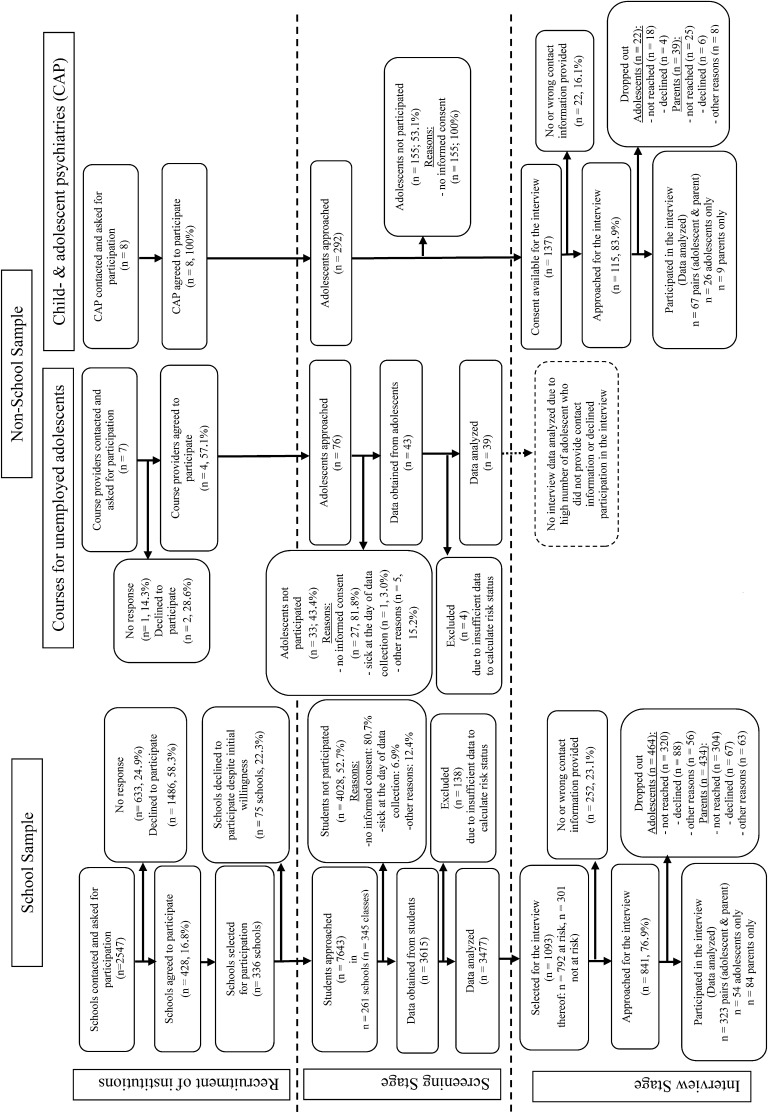
This is a nationwide epidemiological study using DSM-5 criteria to assess the prevalence of mental disorders in a large sample of Austrian adolescents between 10 and 18 years including hard-to-reach samples. A sample of 3615 adolescents from four cohorts (school grades 5, 7, 9, 11; age range 10-18 years) was recruited from 261 schools, samples of unemployed adolescents (n = 39) and adolescents from mental health institutions (n = 137) were added. The Youth Self-Report and SCOFF were used to screen for mental health problems. In a second phase, the Childrens' Diagnostic Interview for Mental Disorders was used to make point and lifetime psychiatric diagnoses. Mental health service use was also assessed. Point prevalence and lifetime prevalence rates for at least one psychiatric disorder were 23.9% and 35.8%. The highest lifetime prevalence rates were found for anxiety disorders (15.6%), neurodevelopmental disorders (9.3%; ADHD 5.2%) and depressive disorders (6.2%). Forty-seven percent of adolescents with a lifetime psychiatric disorder had a second diagnosis. Internalising disorders were more prevalent in girls, while neurodevelopmental disorders and disruptive, impulse control and conduct disorders were more prevalent in boys. Of those with a lifetime psychiatric disorder, 47.5% had contacted mental health services. Of the residual 52.5% who had not contacted mental health services, 18.1% expressed an interest in treatment. DSM-5 mental health disorders are highly prevalent among Austrian adolescents. Over 50% had or were interested in accessing treatment. Early access to effective interventions for these problems is needed to reduce burden due to mental health disorders.
Overview
The claims and statistics of this paper haven’t been checked yet.
Run the check — free, no account needed. It reads the open-access text and checks the sources it cites.
Integrity signals
Registry
Cites
Statistics
Figures
Verification
Claims the paper makes
The claims and statistics of this paper haven’t been checked yet.
Run the check — free, no account needed. It reads the open-access text and checks the sources it cites.
Claims other papers make about this one
Each is checked against this paper’s own text: does it say what the citing paper says it does?
The cited source says what the claim attributes to it.
In the citing paper
“Research consistently shows that anxiety disorders (ADs) are the most common mental health conditions during adolescence [2–8]”
From Acceptance and commitment therapy as a transdiagnostic approach to adolescents with different anxiety disorders: study protocol. (2025) · cites this paper as [8]
Self-check
Percentages, sums and reported differences re-computed from the paper’s own numbers.
The self-check needs the paper’s full text.
Citations
Cites
Diagnostic and Statistical Manual of Mental Disorders
Williams, J. B. W., & First, M. B. (2013) · Oxford University Press eBooks · doi:10.1093/acrefore/9780199975839.013.104 · Cited by 109,845
Merikangas, K. R., He, J.-P., Burstein, M., Swanson, S. A., Avenevoli, S., Cui, L., Benjet, C., Georgiades, K., & Swendsen, J. (2010) · Journal of the American Academy of Child & Adolescent Psychiatry · doi:10.1016/j.jaac.2010.05.017 · Cited by 6,278
Prevalence and development of psychiatric disorders in childhood and adolescence
Costello, E. J., Mustillo, S., Erkanli, A., Keeler, G., & Angold, A. (2003) · Archives of General Psychiatry · doi:10.1001/archpsyc.60.8.837 · Cited by 4,035
Polanczyk, G. V., Salum, G. A., Sugaya, L. S., Caye, A., & Rohde, L. A. (2015) · Journal of Child Psychology and Psychiatry · doi:10.1111/jcpp.12381 · Cited by 3,990 · cited 2×
“Functional impairment can be assessed from disorder-specific measures or a global measure such as the CGAS (Child Global Assessment Scale) [12].”
Background(1991) · Cited by 3,844
Mental health of young people: A global public-health challenge
Patel, V., Flisher, A. J., Hetrick, S., & McGorry, P. (2007) · The Lancet · doi:10.1016/s0140-6736(07)60368-7 · Cited by 3,126 · cited 1×
“A continuum of different treatment levels, from primary to tertiary prevention, from the community to specialist health services has been proposed, and appropriate interventions should be widely available to speed initial treatment contact [49, 50].”
BackgroundChild and adolescent mental health worldwide: evidence for action
Kieling, C., Baker-Henningham, H., Belfer, M., Conti, G., Ertem, I., Omigbodun, O., Rohde, L. A., Srinath, S., Ulkuer, N., & Rahman, A. (2011) · The Lancet · doi:10.1016/s0140-6736(11)60827-1 · Cited by 2,449
Merikangas, K. R., He, J.-P., Burstein, M., Swendsen, J., Avenevoli, S., Case, B., Georgiades, K., Heaton, L., Swanson, S., & Olfson, M. (2011) · Journal of the American Academy of Child & Adolescent Psychiatry · doi:10.1016/j.jaac.2010.10.006 · Cited by 1,579 · cited 1×
“The numbers are comparable to the study of Merikangas who found fewer than half of youth with current mental disorders receiving treatment within the mental health service and that health service use differed a lot between diagnoses with highest treatment use for neurodevelopmental disorders and lowest for internalisi…”
ResultThe SCOFF questionnaire: Assessment of a new screening tool for eating disorders
Morgan, J. F., Reid, F., & Lacey, J. H. (1999) · BMJ · doi:10.1136/bmj.319.7223.1467 · Cited by 1,416 · cited 1×
“As eating pathology is not covered in the Youth SelfReport, the SCOFF questionnaire [26] was used to assess a potential risk for eating disorders.”
MethodBoyce, W., Torsheim, T., Currie, C. E., & Zambon, A. (2006) · Social Indicators Research · doi:10.1007/s11205-005-1607-6 · Cited by 966
Research works printed but not linked: 2
- Bruneforth M, Herzog-Bunzenberger B, Lassnig L (eds) (2012) Nationaler Bildungsbericht Österreich: Indikatoren und Themen im Überblick. Leykam, Graz
- Schneider S, Unnewehr S, Margraf J (eds) (2009) Kinder-DIPS. Diagnostisches Interview bei psychischen Störungen im Kindes- und Jugendalter. Springer Medizin, Heidelberg
Cited by
Sorted by citations
Items 101–151 of 151
Adametz, L., Richter, F., Preußer, J., Mühleck, J., Wick, K., Strauss, B. M., & Berger, U. (2017) · Mental Health & Prevention · doi:10.1016/j.mhp.2017.08.004 · Cited by 3
Muris, P. (2019) · Elsevier eBooks · doi:10.1016/b978-0-12-813004-9.00023-2 · Cited by 3
Akutversorgung psychisch kranker Kinder und Jugendlicher: Eine Pilotstudie an 257 PatientInnen
Eichinger, T., Marte, E., Thun‐Hohenstein, L., Santner, F., & Plattner, B. (2021) · Neuropsychiatrie · doi:10.1007/s40211-021-00389-7 · Cited by 3
“Die Punktprävalenz psychischer Störungen bei Kindern und Jugendlichen wurde mit 24% als hoch eingestuft [3].”
BackgroundFigueiredo, D. V., Salvador, M. D. C., Rijo, D., & Vagos, P. (2025) · European Child & Adolescent Psychiatry · doi:10.1007/s00787-024-02608-2 · Cited by 2
Sobotka, M., Kern, T., Haider, K., Dale, R., Wöhrer, V., Pieh, C., Probst, T., Humer, E. C., & Jesser, A. (2024) · Frontiers in Public Health · doi:10.3389/fpubh.2024.1327999 · Cited by 2
Relación entre la enfermedad mental materna y la presencia de trastornos mentales en los hijos
Riego, V., Barrios, I., & Torales, J. C. (2024) · ScientiAmericana Revista Multidisciplinaria · doi:10.30545/scientiamericana.2023.set-dic.1 · Cited by 2
Forschungsschwerpunkte in der Österreichischen Kinder- und Jugendpsychiatrie – 2007 bis 2017
Karwautz, A. F. K., Lipuš, C. F., & Fuchs, M. (2017) · Neuropsychiatrie · doi:10.1007/s40211-017-0234-1 · Cited by 2
Self-citationThe Epidemiology of Psychiatric Disorders in Children and Adolescents in Mazandaran Province
Nasiri, M., Mohammadi, Ahmadi, N., Alavi, S., Rezazade, H., rostami, F. O., Naderi, H., moghadam, F. S., pashakolaei, Z. R., damadi, M. B., et al. (2019) · DOAJ (DOAJ: Directory of Open Access Journals) · Cited by 2
„Man will einfach nicht so ein Bild von sich haben“
Kaufmann, O., & Vriends, N. (2021) · Kindheit und Entwicklung · doi:10.1026/0942-5403/a000338 · Cited by 3
Edinger, A., Koenig, J., Bauer, S., Moessner, M., Fischer-Waldschmidt, G., Herpertz, S. C., Resch, F., In‐Albon, T., Kölch, M. G., Plener, P. L., et al. (2020) · Praxis der Kinderpsychologie und Kinderpsychiatrie · doi:10.13109/prkk.2020.69.2.141 · Cited by 2
Weindl, D., Peper-Bösenkopf, J., Mares, T., & Noske, J. (2022) · Neuropsychiatrie · doi:10.1007/s40211-022-00419-y · Cited by 2
Home Treatment in der Kinder- und Jugendpsychiatrie in Niederösterreich
Zauner, J., Dörfler, S., Schrank, B., Mittmann, G., Dorczok, M. C., Neumann, M., & Steiner‐Hofbauer, V. (2024) · psychopraxis neuropraxis · doi:10.1007/s00739-024-01013-3 · Cited by 1
Schmidt, P. P., Lindner, K., Pirker, A., Schwab, S., & Zurbriggen, C. (2025) · European Journal of Special Needs Education · doi:10.1080/08856257.2025.2474843 · Cited by 2
“In terms of emotional experiences and competencies, research suggests that female children and adolescents tend to exhibit more internalising behaviours than their male counterparts (Chaplin and Aldao 2013; Ihle and Esser 2002; Maurice-Stam et al. 2018; Wagner et al. 2017).”
Torales, J. C., Almirón‐Santacruz, J., Torres-Romero, A. D., O’Higgins, M. G., Caycho‐Rodríguez, T., Ventriglio, A., Castaldelli-Maia, J. M., Tribe, R., Mahon, A. M., Bhugra, D. K., et al. (2025) · International Review of Psychiatry · doi:10.1080/09540261.2025.2488766 · Cited by 1
“…mental health can lead to significant disorders, defined by the Diagnostic and Statistical Manual of Mental Disorders (DSM-5) as marked disturbances in emotional regulation, behaviour, or cognition, stemming from dysfunctions in mental, biological, or developmental processes (Wagner et al., 2017).”
Adolescence; A Bio-Psychosocial Maturational Stage or an ?Out of Control? Phase!!!
Zaky, E. A. (2017) · Clinical Depression · doi:10.4172/2572-0791.1000e105 · Cited by 1
Psyche und Soma – eine Einheit
Kerbl, R. (2018) · psychopraxis neuropraxis · doi:10.1007/s00739-018-0496-9 · Cited by 1
Corona, Kindergesundheit und Armut
Culen, C. (2023) · Springer eBooks · doi:10.1007/978-3-658-39304-5_7 · Cited by 1
Schweiger, G. (2023) · Techno:Phil · doi:10.1007/978-3-662-65868-0_8 · Cited by 1
RETRACTED ARTICLE: Analysis of Factors Affecting Mental Health in College English Teaching Courses
An, R. (2023) · Journal of Autism and Developmental Disorders · doi:10.1007/s10803-023-06087-3 · Cited by 1
RetractedPredictors of mental health during young people's transition from out-of-home care in Austria
Hagleitner, W., Sting, S., Berger, F., Groinig, M., Roßnagl, S., & Maran, T. K. (2024) · Child Abuse & Neglect · doi:10.1016/j.chiabu.2024.107139 · Cited by 1
Calvo, N., Amoretti, S., Lugo-Marín, J., Oriol, M., Perez, C., Ramos-Quiroga, J., & Ferrer, M. (2025) · European Journal of Psychiatry · doi:10.1016/j.ejpsy.2024.100288 · Cited by 1
Substanzbezogene Störungen bei Jugendlichen
Trabi, T., & Müller, C. (2018) · Monatsschrift Kinderheilkunde · doi:10.1007/s00112-018-0615-y · Cited by 1
Essstörungen – Prävalenz, Bedeutung und Implikationen für die Prävention und Gesundheitsförderung
Wälte, D. (2021) · Springer Reference Pflege, Therapie, Gesundheit · doi:10.1007/978-3-662-62426-5_64 · Cited by 1
Joshi, N., Shrestha, A., Karki, D., & Singh, P. M. (2021) · Journal of Nepal Medical Association · doi:10.31729/jnma.6448 · Cited by 1
(2022) · Pädiatrie & Pädologie · doi:10.1007/s00608-022-00965-2 · Cited by 1
“Das führt dazu, dass weniger als die Hälfte (47,5 %) jener Kinder und Jugendlicher, die über eine psychische Erkrankung in ihrer Lebenszeit berichten, irgendeine Form der Behandlung erhalten haben [11].”
BackgroundZechner, K. A., Wiesner, C., & Böckle, M. (2022) · schule verantworten | führungskultur_innovation_autonomie · doi:10.53349/sv.2022.i4.a278 · Cited by 1
Versorgungsituation der Kinder- und Jugendpsychiatrie in Österreich – Stand 2022 (Teil II)
Thun‐Hohenstein, L., & der ÖGKJP, D. A. „. (2023) · Neuropsychiatrie · doi:10.1007/s40211-023-00461-4 · Cited by 1
“Waren die Prävalenzzahlen psychischer Störungen vor der Pandemie über 20% [1], so gibt es”
BackgroundTherapie mit „bösen“ Jugendlichen
Taubner, S., & Gablonski, T. (2018) · PiD - Psychotherapie im Dialog · doi:10.1055/a-0556-1307
“[4] Wagner G, Zeiler M, Waldherr K et al.”
Kinder mit chronischen Erkrankungen leiden häufig auch an ADHS
Klier, C. M., & Berger, G. (2019) · Pädiatrie · doi:10.1007/s15014-019-1750-1
Steinmair, D., Prevendar, T., Milic, B., Hochgerner, M., & Löffler‐Stastka, H. (2021) · psychopraxis neuropraxis · doi:10.1007/s00739-021-00696-2
Komorbidität in der Kinder- und Jugendpsychiatrie und -psychotherapie
Legenbauer, T. (2021) · Springer Reference Medizin · doi:10.1007/978-3-662-49289-5_66-1
Zahra, S. T., & Saleem, S. (2021) · Pakistan Journal of Psychological Research · doi:10.33824/pjpr.2021.36.3.21
(2021) · Verlag Barbara Budrich eBooks · doi:10.3224/84742354
Essstörungen – Prävalenz, Bedeutung und Implikationen für die Prävention und Gesundheitsförderung
Wälte, D. (2019) · Springer Reference Pflege, Therapie, Gesundheit · doi:10.1007/978-3-662-55793-8_64-1
Mental Health Apps for Children - Support or Downside? A Scoping Review. (Preprint)Preprint
Käferböck, A.-S. (2022) · doi:10.2196/preprints.39877
Roncero, C. Í., Lázaro, P. M. R., & Hornero, J. P. (2022) · Nutrición Hospitalaria · doi:10.20960/nh.04185 · Cited by 1
Attitude to Body-Risk Factor or Health Factor in Psychopathology
Izydorczyk, B., Enea, V., Lipowski, M., & Sitnik‐Warchulska, K. (2022) · Frontiers research topics · doi:10.3389/978-2-88976-289-7
Medium Effect Size: Korelasi Internalisasi Bentuk Tubuh Ideal dari Media dan Drive for Thinness
Sugiarto, A. A., & Yudiarso, A. (2022) · Journal of Education Humaniora and Social Sciences (JEHSS) · doi:10.34007/jehss.v5i2.1416
Lichtenberger, H., & Ranftler, J. (2023) · Springer eBooks · doi:10.1007/978-3-658-39304-5_4
Kinder „böser“ Eltern: Eine Einführung
Jenull, B. B., & Hanfstingl, B. (2023) · Psychotherapie: Praxis · doi:10.1007/978-3-662-66914-3_1
Komorbidität in der Kinder- und Jugendpsychiatrie und -psychotherapie
Legenbauer, T. (2024) · Springer Reference Medizin · doi:10.1007/978-3-662-66744-6_66
Alumdalu, S. A., Nurhasanah, N., Larasati, W. P., & Nuradhi, M. A. (2024) · Sinergi International Journal of Psychology · doi:10.61194/psychology.v2i1.517
“Adolescent mental health has emerged as a critical area of research due to its profound implications for psychological well-being and societal health outcomes (Greger et al., 2016; Lawrence et al., 2021; Wagner et al., 2017).”
Ein Pilotprojekt zur Transitionspsychiatrie
Gamperl, A., & Haug, C. (2025) · psychopraxis neuropraxis · doi:10.1007/s00739-025-01099-3
Siegmund, C. B., Zink, J., Porst, P. T., Weniger, M., McDonald, M., Knappe, S., Roessner, V., & Beesdo‐Baum, K. (2025) · BMC Psychology · doi:10.1186/s40359-025-03392-7
“Co-occurring disorders are common to occur alongside DB disorders, and apart from co-occurrence between DB disorders, previous studies evidenced that anxiety and depression (together also referred to as internalizing/ emotional disorders) frequently co-occur [5–7].”
InfluentialThe Assessment of German and Austrian Teacher Trainees‘ Child-Sensitive Language Competence
Rotschild, T. (2025) · Discourse and Communication for Sustainable Education · doi:10.2478/dcse-2025-0020
Goreis, A., Pfeffer, B., Zesch, H. E., Klinger, D., Reiner, T., Bock, M. M., Ohmann, S., Sackl‐Pammer, P., Werneck‐Rohrer, S., Eder, H., et al. (2024) · Figshare · doi:10.6084/m9.figshare.26563893
Wittek, T., Truttmann, S., Zeiler, M. D., Philipp, J., Auer‐Welsbach, E., Koubek, D., Ohmann, S., Werneck‐Rohrer, S., Sackl‐Pammer, P., Schöfbeck, G., et al. (2021) · Figshare · doi:10.6084/m9.figshare.14183757
Self-citationDevelopment of Psychosomatic Medicine in Austria
Söllner, W., & Schratzberger-Vécsei, E. (2026) · Springer eBooks · doi:10.1007/978-3-032-11824-0_46
Legat, E., Rainer, L. J., Huber, F., Plattner, B., Kaiser, A., Schaffer, P. C., Gampe, H., & Winds, K. (2026) · Children · doi:10.3390/children13020172
Schmier, J., Plener, P. L., & Klinger, D. (2026) · European Child & Adolescent Psychiatry · doi:10.1007/s00787-026-03119-y
“Although adolescents of both genders in Austria are generally affected by psychiatric disorders to a similar extent [51], this pronounced female predominance should be considered within the broader pattern of mental health burden among girls during the pandemic.”
Li, Z., Zhang, J., Zhou, Y., Yang, T., & 冯正直 (2026) · Frontiers in Psychology · doi:10.3389/fpsyg.2026.1634755
“Population studies in different settings have documented substantial adolescent mental health needs (Wagner et al., 2017), and research using the Mental Health Test (MHT) in Chongqing has identified academic anxiety and self-blame as relevant concerns among school-age students (Ning et al., 2013).”
Metadata
- Authors
- Wagner, G., Zeiler, M., Waldherr, K., Philipp, J., Truttmann, S., Dür, W., Treasure, J. L., & Karwautz, A. F. K.
- Affiliations
- Medical University of Vienna (AT)
- Ludwig Boltzmann Institut Health Promotion Research (AT)
- King's College London (GB)
- Corresponding author
- Wagner, Gudrun
- Karwautz, Andreas F. K.
- ORCID
- Venue
- European Child & Adolescent Psychiatry
- Published
- 2017-05-24
- Volume
- 26
- Issue
- 12
- Pages
- 1483-1499
- ISSN
- 1018-8827 (ISSN-L)
- 1435-165X
- PMC
- PMC5701961
- OpenAlex
- W2619347777
- Cited by
- 151
- References
- 48
- Citations by year
- 2026: 4 · 2025: 11 · 2024: 20 · 2023: 21 · 2022: 31 · 2021: 26 · 2020: 10 · 2019: 9 · 2018: 12 · 2017: 6
- FWCI
- 14.48
- Type
- journal article
- Language
- en
- Open access
- hybrid
- doi.org
- Locations
- European Child & Adolescent Psychiatry (publishedVersion, cc-by)
- PubMed Central (publishedVersion, cc-by)
- PubMed (publishedVersion)
- Research Portal (King's College London) (submittedVersion, cc-by)
- Funders
- Gemeinsame Gesundheitsziele – Pharma Master Agreement (99901001300)
- Topics
- Health Sciences › Medicine › Psychiatry and Mental health › Mental Health Treatment and Access
- Social Sciences › Psychology › Clinical Psychology › Child and Adolescent Psychosocial and Emotional Development
- Health Sciences › Medicine › Public Health, Environmental and Occupational Health › Health and Medical Studies
- Keywords
- adolescent mental health, mental illness, prevalence, anxiety disorders, neurodevelopmental disorders, attention deficit hyperactivity disorder, depressive disorders, internalizing disorders, mental health service utilization, treatment seeking, sex differences
- MeSH terms
- Adolescent, Austria, Mental Disorders, Child, Female, Humans, Male, Mental Health, Epidemiologic Studies, Diagnostic and Statistical Manual of Mental Disorders
About these checks
Registry, retraction, Cites and statistics results are computed, not judged, with one exception: a printed reference that no index lists is read once by a model before it counts as a citation error. Claims are extracted by a model and kept only when their quote appears verbatim in the text; each cited source is then checked, with a model’s help, for whether it says what the claim relies on. Those verdicts can be wrong — read the claim’s quote and the cited source before relying on one.
Statistics and arithmetic are recomputed, not judged.
Confidence bands are shown only for fields calibrated on our annotated test set. None is calibrated yet, so no band is shown.
What counts as a claim ›How we measure confidence ›How we check this ›
Are you an author, or do you see a problem with this page? Request a review
