

The DOI matches its Crossref record; 48 of the 48 references it cites were found in a registry or an index.
Mental health problems in Austrian adolescents: a nationwide, two-stage epidemiological study applying DSM-5 criteria
Open accessAbstract
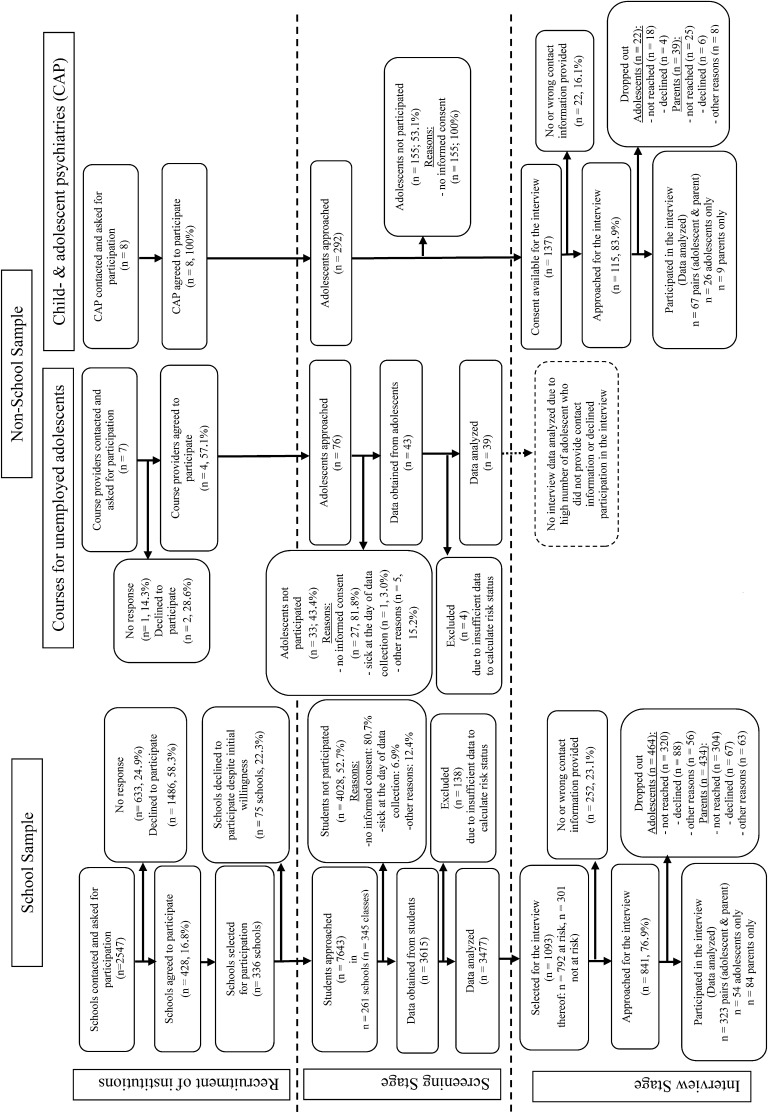
This is a nationwide epidemiological study using DSM-5 criteria to assess the prevalence of mental disorders in a large sample of Austrian adolescents between 10 and 18 years including hard-to-reach samples. A sample of 3615 adolescents from four cohorts (school grades 5, 7, 9, 11; age range 10-18 years) was recruited from 261 schools, samples of unemployed adolescents (n = 39) and adolescents from mental health institutions (n = 137) were added. The Youth Self-Report and SCOFF were used to screen for mental health problems. In a second phase, the Childrens' Diagnostic Interview for Mental Disorders was used to make point and lifetime psychiatric diagnoses. Mental health service use was also assessed. Point prevalence and lifetime prevalence rates for at least one psychiatric disorder were 23.9% and 35.8%. The highest lifetime prevalence rates were found for anxiety disorders (15.6%), neurodevelopmental disorders (9.3%; ADHD 5.2%) and depressive disorders (6.2%). Forty-seven percent of adolescents with a lifetime psychiatric disorder had a second diagnosis. Internalising disorders were more prevalent in girls, while neurodevelopmental disorders and disruptive, impulse control and conduct disorders were more prevalent in boys. Of those with a lifetime psychiatric disorder, 47.5% had contacted mental health services. Of the residual 52.5% who had not contacted mental health services, 18.1% expressed an interest in treatment. DSM-5 mental health disorders are highly prevalent among Austrian adolescents. Over 50% had or were interested in accessing treatment. Early access to effective interventions for these problems is needed to reduce burden due to mental health disorders.
Overview
The claims and statistics of this paper haven’t been checked yet.
Run the check — free, no account needed. It reads the open-access text and checks the sources it cites.
Integrity signals
Registry
Cites
Statistics
Figures
Verification
Claims the paper makes
The claims and statistics of this paper haven’t been checked yet.
Run the check — free, no account needed. It reads the open-access text and checks the sources it cites.
Claims other papers make about this one
Each is checked against this paper’s own text: does it say what the citing paper says it does?
The cited source says what the claim attributes to it.
In the citing paper
“Research consistently shows that anxiety disorders (ADs) are the most common mental health conditions during adolescence [2–8]”
From Acceptance and commitment therapy as a transdiagnostic approach to adolescents with different anxiety disorders: study protocol. (2025) · cites this paper as [8]
Self-check
Percentages, sums and reported differences re-computed from the paper’s own numbers.
The self-check needs the paper’s full text.
Citations
Cites
Diagnostic and Statistical Manual of Mental Disorders
Williams, J. B. W., & First, M. B. (2013) · Oxford University Press eBooks · doi:10.1093/acrefore/9780199975839.013.104 · Cited by 109,845
Merikangas, K. R., He, J.-P., Burstein, M., Swanson, S. A., Avenevoli, S., Cui, L., Benjet, C., Georgiades, K., & Swendsen, J. (2010) · Journal of the American Academy of Child & Adolescent Psychiatry · doi:10.1016/j.jaac.2010.05.017 · Cited by 6,278
Prevalence and development of psychiatric disorders in childhood and adolescence
Costello, E. J., Mustillo, S., Erkanli, A., Keeler, G., & Angold, A. (2003) · Archives of General Psychiatry · doi:10.1001/archpsyc.60.8.837 · Cited by 4,035
Polanczyk, G. V., Salum, G. A., Sugaya, L. S., Caye, A., & Rohde, L. A. (2015) · Journal of Child Psychology and Psychiatry · doi:10.1111/jcpp.12381 · Cited by 3,990 · cited 2×
“Functional impairment can be assessed from disorder-specific measures or a global measure such as the CGAS (Child Global Assessment Scale) [12].”
Background(1991) · Cited by 3,844
Mental health of young people: A global public-health challenge
Patel, V., Flisher, A. J., Hetrick, S., & McGorry, P. (2007) · The Lancet · doi:10.1016/s0140-6736(07)60368-7 · Cited by 3,126 · cited 1×
“A continuum of different treatment levels, from primary to tertiary prevention, from the community to specialist health services has been proposed, and appropriate interventions should be widely available to speed initial treatment contact [49, 50].”
BackgroundChild and adolescent mental health worldwide: evidence for action
Kieling, C., Baker-Henningham, H., Belfer, M., Conti, G., Ertem, I., Omigbodun, O., Rohde, L. A., Srinath, S., Ulkuer, N., & Rahman, A. (2011) · The Lancet · doi:10.1016/s0140-6736(11)60827-1 · Cited by 2,449
Merikangas, K. R., He, J.-P., Burstein, M., Swendsen, J., Avenevoli, S., Case, B., Georgiades, K., Heaton, L., Swanson, S., & Olfson, M. (2011) · Journal of the American Academy of Child & Adolescent Psychiatry · doi:10.1016/j.jaac.2010.10.006 · Cited by 1,579 · cited 1×
“The numbers are comparable to the study of Merikangas who found fewer than half of youth with current mental disorders receiving treatment within the mental health service and that health service use differed a lot between diagnoses with highest treatment use for neurodevelopmental disorders and lowest for internalisi…”
ResultThe SCOFF questionnaire: Assessment of a new screening tool for eating disorders
Morgan, J. F., Reid, F., & Lacey, J. H. (1999) · BMJ · doi:10.1136/bmj.319.7223.1467 · Cited by 1,416 · cited 1×
“As eating pathology is not covered in the Youth SelfReport, the SCOFF questionnaire [26] was used to assess a potential risk for eating disorders.”
MethodBoyce, W., Torsheim, T., Currie, C. E., & Zambon, A. (2006) · Social Indicators Research · doi:10.1007/s11205-005-1607-6 · Cited by 966
Achenbach, T. M., Ivanova, M. Y., Rescorla, L. A., Turner, L. V., & Althoff, R. R. (2016) · Journal of the American Academy of Child & Adolescent Psychiatry · doi:10.1016/j.jaac.2016.05.012 · Cited by 718
Adult mental health disorders and their age at onset
Jones, P. B. (2013) · British Journal of Psychiatry · doi:10.1192/bjp.bp.112.119164 · Cited by 701 · cited 1×
“A continuum of different treatment levels, from primary to tertiary prevention, from the community to specialist health services has been proposed, and appropriate interventions should be widely available to speed initial treatment contact [49, 50].”
BackgroundPrevalence of Psychopathology Among Children and Adolescents
ROBERTS, R. E., Attkisson, C. C., & Rosenblatt, A. (1998) · American Journal of Psychiatry · doi:10.1176/ajp.155.6.715 · Cited by 672
as the BELLA study group, Ravens‐Sieberer, U., Wille, N., Erhart, M., Bettge, S., Wïttchen, H., Rothenberger, A., Herpertz‐Dahlmann, B., Resch, F., Hölling, H., et al. (2008) · European Child & Adolescent Psychiatry · doi:10.1007/s00787-008-1003-2 · Cited by 303
Cohort Profile: The Dutch 'TRacking Adolescents' Individual Lives' Survey'; TRAILS
Huisman, M. A., Oldehinkel, A. J., de Winter, A., Minderaa, R. B., de Bildt, A. A., Huizink, A. C., Verhulst, F. C., & Ormel, J. (2008) · International Journal of Epidemiology · doi:10.1093/ije/dym273 · Cited by 302
School Mental Health Resources and Adolescent Mental Health Service Use
Green, J. G., McLaughlin, K. A., Alegria, M. M., Costello, E. J., Gruber, M. J., Hoagwood, K., Leaf, P. J., Olin, S.-C. S., Sampson, N. A., & Kessler, R. C. (2013) · Journal of the American Academy of Child & Adolescent Psychiatry · doi:10.1016/j.jaac.2013.03.002 · Cited by 288 · cited 1×
“Such interventions could be developed in youth-friendly ways and disseminated through communitybased channels such as educational settings in schools and be provided by Internet platforms or smart-phone applications [52].”
BackgroundOrmel, J., Raven, D., van Oort, F., Hartman, C. A., Reijneveld, S. A., Veenstra, R., Vollebergh, W. A. M., Buitelaar, J., Verhulst, F. C., & Oldehinkel, A. J. (2015) · Psychological Medicine · doi:10.1017/s0033291714001469 · Cited by 276 · cited 2×
“The use of information from multiple sources has been considered as important for obtaining a complete picture of behaviour and functioning of adolescents in epidemiologic mental health studies and reducing mono-informant information bias [11, 14].”
BackgroundRescorla, L. A., Achenbach, T. M., Ivanova, M. Y., Dumenci, L., Almqvist, F., Bilenberg, N., Bird, H., Broberg, A. G., Dobrean, A., Döpfner, M., et al. (2007) · Journal of Consulting and Clinical Psychology · doi:10.1037/0022-006x.75.2.351 · Cited by 259 · cited 2×
“(2007) who found no association between YSR-scores with ethnicity, religion or geography in a worldwide survey of 24 countries [34, 35].”
BackgroundResultEpidemiologie psychischer Störungen im Kindes- und Jugendalter:
Ihle, W., & Esser, G. (2002) · Psychologische Rundschau · doi:10.1026//0033-3042.53.4.159 · Cited by 248 · cited 1×
“For example, adolescent boys suffer more often from externalising and substance use disorders, while female adolescents are more often affected by internalising disorders, such as eating disorders and depressive disorders [3].”
BackgroundMental health research priorities for Europe
Wykes, T., Haro, J. M., Belli, S. R., Obradors-Tarragó, C., Arango, C., Ayuso-Mateos, J. L., Bitter, I., Brunn, M., Chevreul, K., Demotes-Mainard, J., et al. (2015) · The Lancet Psychiatry · doi:10.1016/s2215-0366(15)00332-6 · Cited by 218
Hafeman, D. M., Merranko, J., Axelson, D., Goldstein, B. I., Goldstein, T., Monk, K., Hickey, M. B., Sakolsky, D., Diler, R., Iyengar, S., et al. (2016) · American Journal of Psychiatry · doi:10.1176/appi.ajp.2015.15040414 · Cited by 212 · cited 2×
“The differential diagnostic pattern found between genders is in line with other surveys [2, 30].”
BackgroundResultRescorla, L., Ivanova, M., Achenbach, T., Begovac, I., Chahed, M., Drugli, M., Emerich, D. R., Fung, D., Haider, M., Hansson, K., et al. (2012) · Journal of the American Academy of Child and Adolescent Psychiatry · doi:10.1016/j.jaac.2012.09.012 · Cited by 183 · cited 1×
“(2007) who found no association between YSR-scores with ethnicity, religion or geography in a worldwide survey of 24 countries [34, 35].”
BackgroundHow Can Epidemiology Improve Mental Health Services for Children and Adolescents?
Costello, E. J., Burns, B. J., Angold, A. C., & Leaf, P. J. (1993) · Journal of the American Academy of Child & Adolescent Psychiatry · doi:10.1097/00004583-199311000-00002 · Cited by 162 · cited 1×
“Information about prevalence and incidence is useful for planning primary, secondary and tertiary prevention and treatment services [1].”
BackgroundPrevalence and correlates of mental disorders among adolescents in Italy: the PrISMA study
Frigerio, A., Rucci, P., Goodman, R., Ammaniti, M., Carlet, O., Cavolina, P., de Girolamo, G., Lenti, C., Lucarelli, L., Mani, E., et al. (2009) · European Child & Adolescent Psychiatry · doi:10.1007/s00787-008-0720-x · Cited by 154 · cited 1×
“This is a higher treatment rate compared with the rate of 20–25% service use by young people with mental health problems reported for the USA and European countries [38, 39].”
ResultScreening for eating disorders and high‐risk behavior: Caution
Jacobi, C., Abascal, L. B., & Taylor, C. B. (2004) · International Journal of Eating Disorders · doi:10.1002/eat.20048 · Cited by 145 · cited 1×
“The second stage, using structured clinical interview is intended to overcome limitations of exclusively using screening instruments [29].”
MethodRyan, S., Jorm, A. F., Toumbourou, J. W., & Lubman, D. I. (2015) · Early Intervention in Psychiatry · doi:10.1111/eip.12211 · Cited by 143 · cited 1×
“This is a higher treatment rate compared with the rate of 20–25% service use by young people with mental health problems reported for the USA and European countries [38, 39].”
ResultSayal, K. S., Tischler, V., Coope, C., Robotham, S., Ashworth, M. J., Day, C., Tylee, A. T., & Simonoff, E. A. (2010) · The British Journal of Psychiatry · doi:10.1192/bjp.bp.110.081448 · Cited by 139 · cited 1×
“The first is related to parental factors such as their recognition of the problem as an entity that can possibly be treated and the resource (time and financial resources) involved in seeking treatment [45].”
BackgroundThe BELLA study group, Ravens‐Sieberer, U., Otto, C., Kriston, L., Rothenberger, A., Döpfner, M., Herpertz‐Dahlmann, B., Barkmann, C., Schön, G., Hölling, H., et al. (2014) · European Child & Adolescent Psychiatry · doi:10.1007/s00787-014-0638-4 · Cited by 132 · cited 1×
“9% with persistent mental health problems [13].”
Eating disorders in a multi-ethnic inner-city UK sample: prevalence, comorbidity and service use
Solmi, F., Hotopf, M. H., Hatch, S. L., Treasure, J. L., & Micali, N. (2015) · Social Psychiatry and Psychiatric Epidemiology · doi:10.1007/s00127-015-1146-7 · Cited by 96
Self-citationWagner, G., Penelo, E., Wanner, C., Gwinner, P., Trofaier, M., Imgart, H., Waldherr, K., Wöber, C., & Karwautz, A. F. K. (2012) · The British Journal of Psychiatry · doi:10.1192/bjp.bp.111.098582 · Cited by 86 · cited 1×
“Milder but potentially serious mental disorders might respond to measures such as psychosocial support, self-help programs and non-clinical settings in an early stage [51].”
BackgroundSelf-citationA Meta-Analysis of the Diagnostic Accuracy of the SCOFF
Botella, J., Sepúlveda, A. R., Huang, H., & Gambara, H. (2013) · The Spanish Journal of Psychology · doi:10.1017/sjp.2013.92 · Cited by 85 · cited 1×
“93 have been found in a meta-analysis of diagnostic accuracy of the SCOFF across several countries [27].”
BackgroundProvision of mental healthcare for children and adolescents: a worldwide view
Rocha, T. B.-M., Graeff-Martins, A. S., Kieling, C., & Rohde, L. A. (2015) · Current Opinion in Psychiatry · doi:10.1097/yco.0000000000000169 · Cited by 84 · cited 1×
“Third, there is an enormous discrepancy between needs and resource availability [47].”
BackgroundFlament, M. F., Buchholz, A., Henderson, K. A., Obeid, N., Maras, D., Schubert, N., Paterniti, S., & Goldfield, G. S. (2014) · European Eating Disorders Review · doi:10.1002/erv.2339 · Cited by 78
The BELLA study group, Hintzpeter, B., Klasen, F., Schön, G., Voss, C., Hölling, H., & Ravens-Sieberer, U. (2015) · European Child & Adolescent Psychiatry · doi:10.1007/s00787-015-0676-6 · Cited by 77 · cited 1×
“This is in line with a recent study of mental health care use in Germany (longitudinal BELLA study) and in the Netherlands, showing the highest treatment rates within specialist centres for attention-deficit/hyperactivity disorders [10, 41].”
ResultBarkmann, C., & Schulte‐Markwort, M. (2004) · Psychiatrische Praxis · doi:10.1055/s-2003-814855 · Cited by 75 · cited 1×
“Barkmann and Schulte-Markwort (2004) suggest that additional quotas should be sampled from hard-to-reach groups such as inhabitants of youth welfare institutions or the offspring of migrants [15].”
BackgroundFord, T. J., Macdiarmid, F., Russell, A. E., Racey, D. N., & Goodman, R. (2016) · Psychological Medicine · doi:10.1017/s0033291716003214 · Cited by 50
From DSM-IV-TR to DSM-5: Analysis of some changes
Testal, J. F. R., Senín‐Calderón, C., & Garcelán, S. P. (2014) · International Journal of Clinical and Health Psychology · doi:10.1016/j.ijchp.2014.05.002 · Cited by 44 · cited 14×
“The current published CDI-MD version for the diagnostics of psychiatric disorders according to the classification of DSM-IV-TR and ICD-10 has been adapted for the classification of DSM-5 by the authors of the CDI-MD.”
BackgroundInfluentialLipari, R. N., Hedden, S. L., Blau, G. M., & Rubenstein, L. V. (2016) · Substance Abuse and Mental Health Services Administration (US) eBooks · Cited by 41
«The Child is Father of the Man»
Fuchs, M., Bösch, A., Hausmann, A., & Steiner, H. (2012) · Zeitschrift für Kinder- und Jugendpsychiatrie und Psychotherapie · doi:10.1024/1422-4917/a000209 · Cited by 39 · cited 1×
“The differential diagnostic pattern found between genders is in line with other surveys [2, 30].”
ResultFour-year follow-up of teacher-reported problem behaviours
Verhulst, F. C., & van der Ende, J. (1991) · Psychological Medicine · doi:10.1017/s0033291700029950 · Cited by 38
Mental health care use in adolescents with and without mental disorders
Jörg, F., Visser, E., Ormel, J., Reijneveld, S. A., Hartman, C. A., & Oldehinkel, A. J. (2015) · European Child & Adolescent Psychiatry · doi:10.1007/s00787-015-0754-9 · Cited by 37 · cited 3×
“1 3 Fourth, egosyntonicity and stigma are further factors that have an impact on treatment seeking [10].”
BackgroundResultNicht-suizidales selbstverletzendes Verhalten (NSSV) und Suizidale Verhaltensstörung (SVS) im DSM-5
Plener, P. L., Kapusta, N. D., Brunner, R. M., & Kaess, M. (2014) · Zeitschrift für Kinder- und Jugendpsychiatrie und Psychotherapie · doi:10.1024/1422-4917/a000319 · Cited by 35 · cited 1×
“1% for adolescents between 13 and 18 years were reported) [32].”
BackgroundLongitudinal Research in Child and Adolescent Psychiatry
Verhulst, F. C., & Koot, H. M. (1991) · Journal of the American Academy of Child & Adolescent Psychiatry · doi:10.1097/00004583-199105000-00002 · Cited by 31
Castagnini, A. C., Foldager, L., Caffo, E., & Thomsen, P. H. (2016) · European Psychiatry · doi:10.1016/j.eurpsy.2016.04.005 · Cited by 29
The Mental Health in Austrian Teenagers (MHAT)-Study: preliminary results from a pilot study
Philipp, J., Zeiler, M. D., Waldherr, K., Nitsch, M., Dür, W., Karwautz, A. F. K., & Wagner, G. (2014) · Neuropsychiatrie · doi:10.1007/s40211-014-0131-9 · Cited by 26 · cited 1×
“The feasibility and acceptability of the screening phase procedure was evaluated in a pilot study [21].”
MethodSelf-citationRijlaarsdam, J., Stevens, G. W. J. M., van der Ende, J., Albert Hofman, D., Jaddoe, V. W. V., Verhulst, F. C., & Tiemeier, H. W. (2015) · European Child & Adolescent Psychiatry · doi:10.1007/s00787-015-0684-6 · Cited by 23 · cited 1×
“It has been discussed that many children with psychiatric symptoms and mild impairment seeking mental health care will be undiagnosed and might therefore not be treated [42].”
BackgroundZeiler, M. D., Wagner, G., Philipp, J., Nitsch, M., Truttmann, S., Dür, W., Karwautz, A. F. K., & Waldherr, K. (2018) · Neuropsychiatrie · doi:10.1007/s40211-018-0273-2 · Cited by 11
Self-citationChild and adolescent psychiatry in Austria
Karwautz, A. F. K., Purtscher-Penz, A.-K., Hochgatterer, P., & Kienbacher, C. (2014) · European Child & Adolescent Psychiatry · doi:10.1007/s00787-014-0657-1 · Cited by 7 · cited 1×
“For Austria, a shortage of inpatient, outpatient and day patient facilities by around 50% of mental health care needed and a shortage of specialists (child and adolescent psychiatrists) have been reported [48].”
BackgroundSelf-citation
Research works printed but not linked: 2
- Bruneforth M, Herzog-Bunzenberger B, Lassnig L (eds) (2012) Nationaler Bildungsbericht Österreich: Indikatoren und Themen im Überblick. Leykam, Graz
- Schneider S, Unnewehr S, Margraf J (eds) (2009) Kinder-DIPS. Diagnostisches Interview bei psychischen Störungen im Kindes- und Jugendalter. Springer Medizin, Heidelberg
Cited by
Sorted by citations
Worldwide prevalence of DSM-5 eating disorders among young people
Silén, Y., & Keski‐Rahkonen, A. (2022) · Current Opinion in Psychiatry · doi:10.1097/yco.0000000000000818 · Cited by 464
Kien, C., Sommer, I., Faustmann, A., Gibson, L., Schneider, M., Krczal, E., Jank, R., Klerings, I., Szeląg, M., Kerschner, B., et al. (2018) · European Child & Adolescent Psychiatry · doi:10.1007/s00787-018-1215-z · Cited by 333
Sacco, R., Camilleri, N., Eberhardt, J., Umla‐Runge, K., & Newbury‐Birch, D. (2022) · European Child & Adolescent Psychiatry · doi:10.1007/s00787-022-02131-2 · Cited by 341
“( Source : Lithuania [47], Austria [45], Turkey [44], Denmark [43], England [46]) Fig.”
InfluentialPhilipp, J., Zeiler, M. D., Wöber, C., Wagner, G., Karwautz, A. F. K., Steiner, T. J., & Wöber, C. (2019) · The Journal of Headache and Pain · doi:10.1186/s10194-019-1050-8 · Cited by 129
Self-citationKurz, M., Rosendahl, J., Rodeck, J., Muehleck, J., & Berger, U. (2022) · Journal of Prevention · doi:10.1007/s10935-021-00660-1 · Cited by 110
Metadata
- Authors
- Wagner, G., Zeiler, M., Waldherr, K., Philipp, J., Truttmann, S., Dür, W., Treasure, J. L., & Karwautz, A. F. K.
- Affiliations
- Medical University of Vienna (AT)
- Ludwig Boltzmann Institut Health Promotion Research (AT)
- King's College London (GB)
- Corresponding author
- Wagner, Gudrun
- Karwautz, Andreas F. K.
- ORCID
- Venue
- European Child & Adolescent Psychiatry
- Published
- 2017-05-24
- Volume
- 26
- Issue
- 12
- Pages
- 1483-1499
- ISSN
- 1018-8827 (ISSN-L)
- 1435-165X
- PMC
- PMC5701961
- OpenAlex
- W2619347777
- Cited by
- 151
- References
- 48
- Citations by year
- 2026: 4 · 2025: 11 · 2024: 20 · 2023: 21 · 2022: 31 · 2021: 26 · 2020: 10 · 2019: 9 · 2018: 12 · 2017: 6
- FWCI
- 14.48
- Type
- journal article
- Language
- en
- Open access
- hybrid
- doi.org
- Locations
- European Child & Adolescent Psychiatry (publishedVersion, cc-by)
- PubMed Central (publishedVersion, cc-by)
- PubMed (publishedVersion)
- Research Portal (King's College London) (submittedVersion, cc-by)
- Funders
- Gemeinsame Gesundheitsziele – Pharma Master Agreement (99901001300)
- Topics
- Health Sciences › Medicine › Psychiatry and Mental health › Mental Health Treatment and Access
- Social Sciences › Psychology › Clinical Psychology › Child and Adolescent Psychosocial and Emotional Development
- Health Sciences › Medicine › Public Health, Environmental and Occupational Health › Health and Medical Studies
- Keywords
- adolescent mental health, mental illness, prevalence, anxiety disorders, neurodevelopmental disorders, attention deficit hyperactivity disorder, depressive disorders, internalizing disorders, mental health service utilization, treatment seeking, sex differences
- MeSH terms
- Adolescent, Austria, Mental Disorders, Child, Female, Humans, Male, Mental Health, Epidemiologic Studies, Diagnostic and Statistical Manual of Mental Disorders
About these checks
Registry, retraction, Cites and statistics results are computed, not judged, with one exception: a printed reference that no index lists is read once by a model before it counts as a citation error. Claims are extracted by a model and kept only when their quote appears verbatim in the text; each cited source is then checked, with a model’s help, for whether it says what the claim relies on. Those verdicts can be wrong — read the claim’s quote and the cited source before relying on one.
Statistics and arithmetic are recomputed, not judged.
Confidence bands are shown only for fields calibrated on our annotated test set. None is calibrated yet, so no band is shown.
What counts as a claim ›How we measure confidence ›How we check this ›
Are you an author, or do you see a problem with this page? Request a review
