

Medical comorbidities in children and adolescents with autism spectrum disorders and attention deficit hyperactivity disorders: a systematic review
Open accessThe DOI matches its Crossref record; 68 of the 68 references it cites were found in a registry or an index.
Abstract
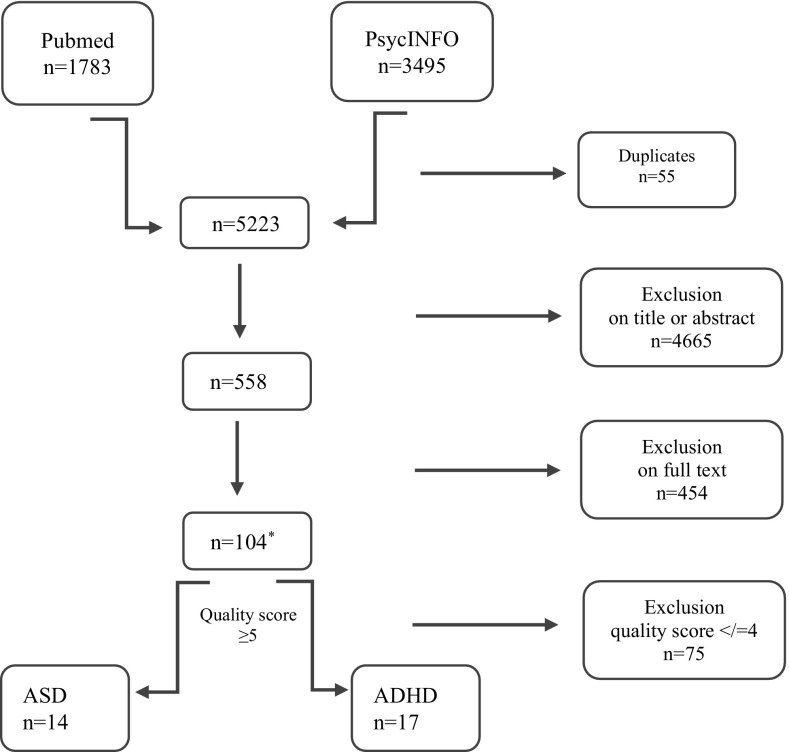
Somatic disorders occur more often in adult psychiatric patients than in the general adult population. However, in child and adolescent psychiatry this association is unclear, mainly due to a lack of integration of existing data. To address this issue, we here present a systematic review on medical comorbidity in the two major developmental disorders autism spectrum disorder (ASD) and attention deficit hyperactivity disorder (ADHD) and formulate clinical recommendations. The literature was searched using the PubMed and PsycINFO databases (2000-1 May 2016) with the keywords "[((child and adolescent) AND (Autism OR Attention Deficit Hyperactivity Disorder* OR ADHD)) AND ("Cardiovascular Diseases" [Mesh] OR "Endocrine System Diseases" [Mesh] OR "Immune System Diseases" [Mesh] OR "Neurobehavioral Manifestations" [Mesh] OR "Gastrointestinal Disorders" [Mesh] OR Somatic OR Autoimmune disease OR Nervous system disease OR Infection OR Infectious disease)]. Two raters independently assessed the quality of the eligible studies. The initial search identified 5278 articles. Based on inclusion and exclusion criteria 104 papers were selected and subsequently subjected to a quality control. This quality was assessed according to a standardized and validated set of criteria and yielded 29 studies for inclusion. This thorough literature search provides an overview of relevant articles on medical comorbidity in ADHD and/or ASD, and shows that medical disorders in these children and adolescents appear to be widespread. Those who work with children with ASD and/or ADHD should be well aware of this and actively promote routine medical assessment. Additionally, case-control studies and population-based studies are needed to provide reliable prevalence estimates. Future studies should furthermore focus on a broader evaluation of medical disorders in children and adolescents with ADHD and/or ASD to improve treatment algorithm in this vulnerable group.
Overview
The claims and statistics of this paper haven’t been checked yet.
Free: it reads the open-access text and checks the first 5 claims that cite a source we can check. Create a free account to check every claim.
Integrity signals
Registry
Cites
Statistics
Figures
Verification
Claims the paper makes
The claims and statistics of this paper haven’t been checked yet.
Free: it reads the open-access text and checks the first 5 claims that cite a source we can check. Create a free account to check every claim.
Claims other papers make about this one
Each is checked against this paper’s own text: does it say what the citing paper says it does?
The source backs part of the claim, not all of it — or backs it for a different population, condition or comparison.
In the citing paper
“The most common co-occurring psychiatric conditions are anxiety disorders, attention-deficit/hyperactivity disorder (ADHD), depressive disorders, and oppositional defiant and conduct disorders (Simonoff et al. 2008), while the most common co-occurring medical conditions include gastro-intestinal problems, sleep difficulties, and seizures (Muskens et al. 2017).”
From The Diagnosis of Autism: From Kanner to DSM-III to DSM-5 and Beyond (2021) · cites this paper as Muskens et al. 2017
Experimental — accuracy not yet measuredThe source backs part of the claim, not all of it — or backs it for a different population, condition or comparison.
In the citing paper
“Co-occurring psychiatric and medical disorders are common among individuals with ASD, with estimates suggesting that 63–78% of individuals with ASD have at least one co-occurring psychiatric condition (Simonoff et al. 2008; Strang et al. 2012), and approximately 10–77% have at least one co-occurring medical condition (Muskens et al. 2017; Betancur 2011).”
From The Diagnosis of Autism: From Kanner to DSM-III to DSM-5 and Beyond (2021) · cites this paper as Muskens et al. 2017
Experimental — accuracy not yet measuredIn the citing paper
“potential pathological sources of pain such as neurologic disorders (seizures and epilepsy) and gastrointestinal problems are known to be frequent in ASD (13, 14).”
From Autism, joint hypermobility-related disorders and pain (2018) · cites this paper as [14]
Self-check
Percentages, sums and reported differences re-computed from the paper’s own numbers.
The self-check needs the paper’s full text.
Citations
Cites
Diagnostic and Statistical Manual of Mental Disorders
American Psychiatric Association (2013) · doi:10.1176/appi.books.9780890425596 · Cited by 116,369
Diagnostic and Statistical Manual of Mental Disorders
Williams, J. B. W., & First, M. (2013) · Encyclopedia of Social Work · doi:10.1093/acrefore/9780199975839.013.104 · Cited by 109,519
(2013) · The Lancet · doi:10.1016/s0140-6736(12)62129-1 · Cited by 3,010
Subclinical Thyroid Disease: Scientific Review and Guidelines for Diagnosis and Management
Surks, M. I., Ortiz, E., Daniels, G. H., Sawin, C. T., Col, N. F., Cobin, R. H., Franklyn, J. A., Hershman, J. M., Burman, K. D., Denke, M. A., et al. (2004) · JAMA · doi:10.1001/jama.291.2.228 · Cited by 1,800 · cited 1×
“For example, adults with hypothyroidism are at risk for mood disorders [6, 7], and patients with schizophrenia and bipolar disorder have an increased risk of developing metabolic syndrome, due to their psychiatric disease as well as the use of antipsychotic drugs [8, 9].”
BackgroundBuie, T., Campbell, D. B., Fuchs, G. J., Furuta, G. T., Levy, J., VandeWater, J., Whitaker, A. H., Atkins, D., Bauman, M. L., Beaudet, A. L., et al. (2010) · Pediatrics · doi:10.1542/peds.2009-1878c · Cited by 872 · cited 2×
“concluded that medical disorders, such as gastro-intestinal problems, occur commonly in individuals with ASD [26].”
BackgroundIsle of Wight Studies, 1964–1974
Rutter, M., Tizard, J., Yule, W., Graham, P., & Whitmore, K. (1976) · Psychological Medicine · doi:10.1017/s003329170001388x · Cited by 812
Konrad, K., & Eickhoff, S. B. (2010) · Human Brain Mapping · doi:10.1002/hbm.21058 · Cited by 670 · cited 1×
“This association between neurologic disorders that affect brain systems and behavioral disorders is in line with other studies examining developmental disorders such as autism, ADHD, and neurobehavioral problems [29, 30].”
ResultAdverse effects of antipsychotic medications.
Muench, J., & Hamer, A. M. (2010) · PubMed · Cited by 589
Talkowski, M. E., Rosenfeld, J. A., Blumenthal, I., Pillalamarri, V., Chiang, C., Heilbut, A., Ernst, C., Hanscom, C., Rossin, E., Lindgren, A. M., et al. (2012) · Cell · doi:10.1016/j.cell.2012.03.028 · Cited by 577
Cadman, D., Boyle, M., Szatmari, P., & Offord, D. R. (1987) · Pediatrics · doi:10.1542/peds.79.5.805 · Cited by 575 · cited 1×
“In conclusion, medical comorbidity in children and adolescents with ASD and ADHD appears to occur in numerous medical areas [27, 70].”
Background
Research works printed but not linked: 1
- Diagnostic and Statistical Manual of Mental Disorders (1994) 4th edition, Text Revision (DSM-IV-TR). American Psychiatric Association, Washington, DC
Cited by
Items 201–258 of 258
Messaoud, K. B., Khachadourian, V., Arildskov, E. S., Hansen, S. N., Gardner, R. M., Ramlau‐Hansen, C. H., Kahn, L. G., & Janecka, M. (2024) · medRxiv · doi:10.1101/2024.09.17.24313638 · Cited by 1
“9 – 12 Additionally, maternal psychiatric, metabolic, and reproductive conditions, including depression 13 , obesity, 12,14 and polycystic ovarian syndrome (PCOS), 15,16 have also been associated with autism in offspring.”
BackgroundTroubles du spectre de l’autisme et simulation : un outil au service du soin
Descrettes, V., Boissel, L., Vasselin, I., Jalmaut, B., Malpart, A., Gignon, M., Mille, C., & Ammirati, C. (2018) · Enfances & Psy · doi:10.3917/ep.080.0152
Hypopriors in autism spectrum disorder
Utzerath, C. (2020) · Radboud Repository (Radboud University)
(2020) · Archivos Argentinos de Pediatria · doi:10.5546/aap.2020.e271 · Cited by 2
Discursos de la hiperactividad: biopoder y vida cotidiana de niños y niñas con diagnóstico de TDAH
Rodríguez, V., & María, Á. (2021)
van Andel, D. M. (2021) · Utrecht University Repository (Utrecht University) · doi:10.33540/943
Davenport, M. (2021) · MOspace Institutional Repository (University of Missouri) · doi:10.32469/10355/88048
Substance Use Problems/Disorders in Individuals with ASD
Øien, R. A., Nordahl‐Hansen, A., & Chawarski, M. C. (2019) · Springer eBooks · doi:10.1007/978-1-4614-6435-8_102122-1
Substance Use Problems/Disorders in Individuals with ASD
Øien, R. A., Nordahl‐Hansen, A., & Chawarski, M. C. (2021) · Springer eBooks · doi:10.1007/978-3-319-91280-6_102122
Bundgaard‐Nielsen, C. (2021) · VBN Forskningsportal (Aalborg Universitet) · doi:10.54337/aau466210133
Мелащенко, О. І., Kaliuzhka, O. O., Фастовець, М. М., Ziuzina, L. S., & Kozakevіch, V. K. (2022) · Актуальні проблеми сучасної медицини Вісник Української медичної стоматологічної академії · doi:10.31718/2077-1096.22.3.4.8
Conrad, C. E., Ziegler, S. M. T., Bilenberg, N., Christiansen, J. H., Fagerlund, B., Hermann, R., Jeppesen, P., Kamp, C. B., Thomsen, P. H., Jakobsen, J. C., et al. (2023) · Research Square · doi:10.21203/rs.3.rs-2404235/v1
Prevalence of Asthma in Children with Autism and Attention Deficit Hyperactivity Disorder
Lateef, A. G. A. E., Arafa, S. G., Darwish, M., Zaki, M. S., & Atta, H. A. (2023) · International Journal of Medical Arts · doi:10.21608/ijma.2023.194142.1625 · Cited by 1
Neurodevelopmental disorders in people with intellectual disability across cultures
Shankar, R., Barrett, M., Kommu, J. V. S., & Biswas, A. B. (2023) · Oxford University Press eBooks · doi:10.1093/med/9780198857600.003.0003 · Cited by 1
Derkman, M., Roos, S., & van Tetering, E. M. A. (2024) · Kind en adolescent praktijkreeks · doi:10.1007/978-90-368-2923-6_2
Physical and Medical Conditions Associated with Autism
(2024) · Frontiers research topics · doi:10.3389/978-2-8325-5106-6
Laaraje, A., Radi, A., Abdelhakim, O., Amal, H., & Abilkassem, R. (2024) · Pediatrics Sciences Journal · doi:10.51559/pedscij.v5i2.106
“%) reported by Muskens et al 4 underscores the need for increased vigilance.”
ten Hoopen, L. W., de Nijs, P. F. A., Greaves‐Lord, K., Hillegers, M. H. J., Brouwer, W. B. F., & Roijen, L. H. (2025) · Journal of Autism and Developmental Disorders · doi:10.1007/s10803-025-06760-9
“Frequently, children with autism have co-occurring emotional, behavioral, and somatic problems (Lai et al., 2019; Muskens et al., 2017).”
Sri, A. S., Smith, J. G., Sandiford, M. A., Moran, D., Ross-Michaelides, A., Benn, C., Curtis, E., & Hales, H. (2025) · Research in Autism · doi:10.1016/j.reia.2025.202580
“Another cause of violence in the home are interception needs; Muskens et al. (2017) observed that CYP with ASC who struggled to verbally express their symptoms of pain and medical co-morbidities, tend to exhibit disruptive behaviours.”
Лекарственные средства, применяемые при расстройстве аутистического спектра
Касабов, К. А., Тачилович, И. О., Харламова, А. А., Lashch, N. Y., Петровна, Б. Н., Крылова, И. Н., & Аршинова, О. Ю. (2025) · Экспериментальная и клиническая фармакология · doi:10.30906/0869-2092-2025-88-4-39-44
Nobile, E., Cicinelli, G., Bartolo, E. D., Brambilla, R., Brighenti, S., & Keller, R. (2025) · PubMed Central · doi:10.36131/cnfioritieditore20250303 · Cited by 2
“%) are commonly observed, consistent with studies reporting a higher prevalence of gastrointestinal symptoms in autistic individuals, possibly due to altered gut-brain axis interactions or food sensitivities (Coury et al., 2012; Muskens et al., 2017).”
Vasconcelos, C., Grokoski, K. C., & Riesgo, R. D. S. (2025) · Dietetics · doi:10.3390/dietetics4030037
MODULATION OF AUTISM SYMPTOMS IN A 13-YEAR-OLD BOY BY FOOD SUPPLEMENT JUVENIL
Hrnčiarová, J., Hanusova, A., Horakova, T., Fusek, J., Kubelková, K., & Macela, A. (2025) · Military Medical Science Letters · doi:10.31482/mmsl.2025.006
ADHD comorbidity in adolescents: A thematic analysis of systematic and narrative reviews
Giannakopoulos, G., & Prassou, A. (2025) · doi:10.70462/acim.2025.1.002
Additional file 1 of Celiac disease in autism spectrum disorder: data from an Italian child cohort
Zambrano, S., Parma, B., Morabito, V., Borini, S., Romaniello, R., Molteni, M., Mani, E., & Selicorni, A. (2023) · Figshare · doi:10.6084/m9.figshare.23621548
Sprouse, A. (2023) · Carolina Digital Repository (University of North Carolina at Chapel Hill) · doi:10.17615/rf4q-8j05
Additional file 1 of Physical health of autistic girls and women: a scoping review
Kassee, C., Babinski, S., Tint, A., Lunsky, Y., Brown, H. K., Ameis, S. H., Szatmári, P., Lai, M., & Einstein, G. (2020) · Figshare · doi:10.6084/m9.figshare.13151886
Brito, A., Franco, F., Brentani, H., & Beltrão-Braga, P. C. B. (2024) · Figshare · doi:10.6084/m9.figshare.26582351
Wang, H., Lee, P. M. Y., Zhang, J., Svendsen, K., Li, F., & Li, J. (2023) · Figshare · doi:10.6084/m9.figshare.22599184
Spinazzi, N. A., Santoro, J. D., Pawlowski, K. G., Anzueto, G., Howe, Y. J., Patel, L., & Baumer, N. T. (2023) · Figshare · doi:10.6084/m9.figshare.22607582
Lebeña, A., Faresjö, Å., Faresjö, T., & Ludvigsson, J. (2024) · Figshare · doi:10.6084/m9.figshare.26641339
Janfada Balo, S., & Herceg, G. (2025) · Lund University Publications Student Papers (Lund University)
Queiser, K. (2020) · Publication Server of Goethe University Frankfurt am Main (Goethe University Frankfurt)
Mansour, H. (2024) · UCL Discovery (University College London)
Associations between health literacy, ADHD, and eating behaviour
Wolmar, A. (2023) · Publications (Mid Sweden University) · Cited by 1
O papel da GPRASP2 na sinalização dos mGluR5
Laranjo, M. (2018) · Portuguese National Funding Agency for Science, Research and Technology (RCAAP Project by FCT)
Ehlenberger, T., & Genelle Exbrayat--Juventy, J. (2023) · HAL
Buckhannon, M. (2021) · ScholarsArchive (Brigham Young University)
Varied presentations of undiagnosed ADHD in adolescents: A case series
Usmani, S. B., Khanna, P., & Timothy, A. (2026) · Industrial Psychiatry Journal · doi:10.4103/ipj.ipj_318_25
Campbell, A. A., Barroso, J., Weitlauf, A. S., Karp, S. M., Darcy-Mahoney, A., & Mogos, M. F. (2026) · Research in Developmental Disabilities · doi:10.1016/j.ridd.2026.105274
Chiesa, M. (2018) · theses.fr (ABES) · doi:10.70675/6ef32b4fzb74az4b06zb8edz92268c28d542
Slim, L., & Strömberg, D. (2026) · Springer eBooks · doi:10.1007/978-981-95-2889-9_13
Li, T. (2021) · Radboud Repository (Radboud University)
Strosberg, D. B., Moura, M., Ferreira, J., Oliveira, M., Fonseca, E., & Oliveira, M. (2026) · Residência Pediátrica · doi:10.25060/residpediatr-2026-1453
Luo, L., Gao, X., Pang, T., Pang, K., Wang, T., Guo, H., Yang, L., & Chang, S. (2026) · Journal of Translational Medicine · doi:10.1186/s12967-026-08364-y
Autism Spectrum Disorder Classification using a Multimodal 3D-ResNet50 and Late Fusion Framework
Yugander, P., & Jagannath, M. (2026) · International Conference on Trends in Electronics and Informatics (ICOEI) · doi:10.1109/icoei68323.2026.11541844
“These problems point to the need to develop more effective diagnostic methods, including biomarker-based approaches [3].”
McGrath, K., Franco, M., Morales-Lara, A., Bonuck, K. A., & Siegel, J. (2026) · Developmental Disabilities Network Journal · doi:10.59620/2694-1104.1151
Szigethi, Z., & Kollár, K. N. (2026) · Fogyatékosság és társadalom. · doi:10.31287/ft.hu.2026.1.4
Bragantini, D., Hegemann, L., Pedersen, J. H., Bazezew, M. M., Dardani, C., Shakeshaft, A., Andreassen, O. A., Ask, H., Havdahl, A., & Hannigan, L. J. (2026) · Research Square · doi:10.21203/rs.3.rs-10080990/v1
Zhong, Q., Chen, L., Ji, Y., Zhu, F.-L., & Zou, X. (2026) · medRxiv · doi:10.64898/2026.07.14.26358066
Sobreposição de sintomas entre TDAH e TEA : desafios diagnósticos e implicações clínicas
Martins, M. C. (2025) · Lume (Universidade Federal do Rio Grande do Sul)
DEVELOPMENT OF A FEMINIST BIOPSYCHOSOCIAL THEORY OF ADHD
Leaney, V. (2026) · Lancaster EPrints (Lancaster University) · doi:10.17635/lancaster/thesis/3326
Estes, M. L., Ryan, M., Early, S., Amador, K., Bloom, N. L., Ahmed, A., Momin, A., Ram, T. R., Forkert, N. D., & MacEachern, S. J. (2026) · Frontiers in Psychiatry · doi:10.3389/fpsyt.2026.1739597
Ferreira, J. P. (2026) · Portuguese National Funding Agency for Science, Research and Technology (RCAAP Project by FCT)
Sanabria, F. (2026) · Cureus · doi:10.7759/cureus.118440
“It is not a binary division between organic and psychological illness and does not imply that every behavioral difficulty has an identifiable medical cause [7,8].”
Narzisi, A., Pizzino, F., Cioni, G., Annarita, M., & Masi, G. (2026) · Frontiers in Psychiatry · doi:10.3389/fpsyt.2026.1897948
Metadata
- Authors
- Muskens, J. B., Velders, F. P., & Staal, W. G.
- Affiliations
- Radboud University Medical Center (NL)
- University Medical Center Utrecht (NL)
- Corresponding author
- Muskens, Jet B.
- Venue
- European Child & Adolescent Psychiatry
- Published
- 2017-07-03
- Volume
- 26
- Issue
- 9
- Pages
- 1093-1103
- ISSN
- 1018-8827 (ISSN-L)
- 1435-165X
- PMC
- PMC5591355
- OpenAlex
- W2730169795
- Semantic Scholar
- 3a8ea1df741372156a9071ebd4916a41ba0c8e81
- Cited by
- 232
- References
- 68
- Citations by year
- 2026: 13 · 2025: 21 · 2024: 27 · 2023: 37 · 2022: 23 · 2021: 35 · 2020: 31 · 2019: 28 · 2018: 15 · 2017: 2
- FWCI
- 2.32
- Type
- journal article
- Language
- en
- Open access
- hybrid
- doi.org
- Locations
- European Child & Adolescent Psychiatry (publishedVersion, cc-by)
- PubMed Central (publishedVersion, cc-by)
- PubMed (publishedVersion)
- Utrecht University Repository (Utrecht University) (submittedVersion, other-oa)
- Radboud Repository (Radboud University) (submittedVersion)
- Radboud Repository (Radboud University) (submittedVersion, other-oa)
- Topics
- Life Sciences › Neuroscience › Cognitive Neuroscience › Autism Spectrum Disorder Research
- Health Sciences › Medicine › Psychiatry and Mental health › Attention Deficit Hyperactivity Disorder
- Health Sciences › Medicine › Psychiatry and Mental health › Child Nutrition and Feeding Issues
- Keywords
- comorbidities, autism spectrum disorder, attention deficit hyperactivity disorder, children and adolescents, somatic diseases, cardiovascular disease, endocrine disorders, immune system diseases, gastrointestinal diseases, autoimmune disease, infectious diseases, prevalence estimates
- MeSH terms
- Autism Spectrum Disorder, Adolescent, Attention Deficit Disorder with Hyperactivity, Child, Child, Preschool, Cross-Sectional Studies, Female, Humans, Male, Comorbidity
About these checks
Registry, retraction, Cites and statistics results are computed, not judged, with one exception: a printed reference that no index lists is read once by a model before it counts as a citation error. Claims are extracted by a model and kept only when their quote appears verbatim in the text; each cited source is then checked, with a model’s help, for whether it says what the claim relies on. Those verdicts can be wrong — read the claim’s quote and the cited source before relying on one.
Statistics and arithmetic are recomputed, not judged.
Confidence bands are shown only for fields calibrated on our annotated test set. None is calibrated yet, so no band is shown.
What counts as a claim ›How we measure confidence ›How we check this ›
Are you an author, or do you see a problem with this page? Request a review
Data sources
Bibliographic data: Semantic Scholar, OpenAlex, Crossref.
Contains information from the Semantic Scholar Academic Graph Datasets, made available under the ODC Attribution License (ODC-BY 1.0).
Semantic Scholar’s data is described in: Kinney, R., et al. (2023). The Semantic Scholar Open Data Platform. arXiv:2301.10140.
