

The DOI matches its Crossref record; 48 of the 48 references it cites were found in a registry or an index.
A systematic review of the mental health changes of children and young people before and during the COVID-19 pandemic.
Open accessAbstract
There is increasing knowledge that the COVID-19 pandemic has had an impact on mental health of children and young people. However, the global evidence of mental health changes before compared to during the COVID-19 pandemic focusing on children and young people has not been systematically reviewed. This systematic review examined longitudinal and repeated cross-sectional studies comparing before and during COVID-19 pandemic data to determine whether the mental health of children and young people had changed before and during the COVID-19 pandemic. The Web of Science, PubMed, Embase and PsycINFO databases were searched to identify peer-reviewed studies that had been published in English and focused on children and young people between 0 and 24 years of age. This identified 21 studies from 11 countries, covering more than 96,000 subjects from 3 to 24 years of age. Pre-pandemic and pandemic data were compared. Most studies reported longitudinal deterioration in the mental health of adolescents and young people, with increased depression, anxiety and psychological distress after the pandemic started. Other findings included deteriorated negative affect, mental well-being and increased loneliness. Comparing data for pandemic and pre-pandemic periods showed that the COVID-19 pandemic may negatively impact the mental health of children and young people. There is an urgent need for high-quality research to address the impact, risks and protective factors of the pandemic on their mental health, as this will provide a good foundation for dealing with future health emergencies and other crises.
Overview
The claims and statistics of this paper haven’t been checked yet.
Run the check — free, no account needed. It reads the open-access text and checks the sources it cites.
Integrity signals
Registry
Cites
Statistics
Figures
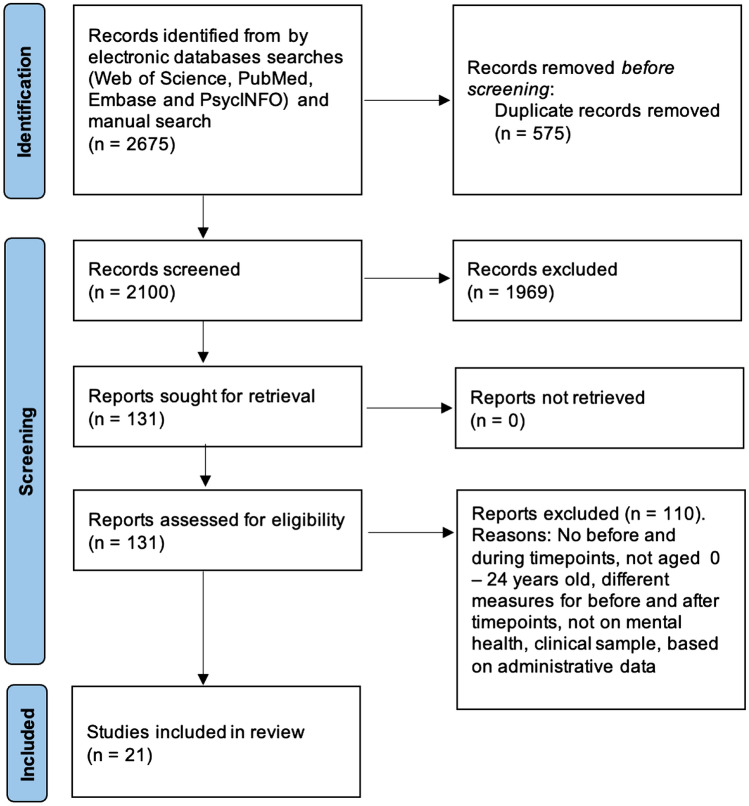
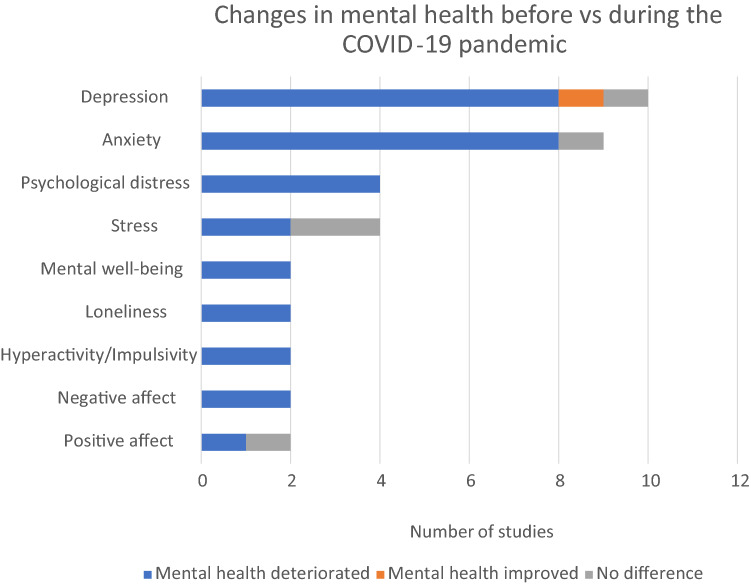
Verification
Claims the paper makes
The claims and statistics of this paper haven’t been checked yet.
Run the check — free, no account needed. It reads the open-access text and checks the sources it cites.
Claims other papers make about this one
Each is checked against this paper’s own text: does it say what the citing paper says it does?
The source backs part of the claim, not all of it — or backs it for a different population, condition or comparison.
In the citing paper
“A systematic review comparing the prepandemic and pandemic periods found that youth experienced higher levels of isolation, depression, and anxiety during the pandemic [7].”
From Psychological Interventions and Those With Elements of Positive Psychology for Child and Youth Mental Health During the COVID-19 Pandemic: Literature Review, Lessons Learned, and Areas for Future Knowledge Dissemination (2024) · cites this paper as [7]
Experimental — accuracy not yet measuredThe source backs part of the claim, not all of it — or backs it for a different population, condition or comparison.
In the citing paper
“Data used in this study spanned the COVID-19 pandemic which created changes in children’s need for mental health care and practices in mental health service delivery (Kauhanen et al., 2023; Palinkas et al., 2021; Purtle et al., 2022; Sklar et al., 2021; Zablotsky et al., 2022)”
From Adequate Care Coordination is Associated with Reduced Unmet Mental Health Needs for Children (2026) · cites this paper as Kauhanen et al., 2023
Experimental — accuracy not yet measured
Self-check
Percentages, sums and reported differences re-computed from the paper’s own numbers.
The self-check needs the paper’s full text.
Citations
Cites
Page, M. J., Moher, D., Bossuyt, P. M., Boutron, I., Hoffmann, T. C., Mulrow, C. D., Shamseer, L., Tetzlaff, J. M., Akl, E. A., Brennan, S. E., et al. (2021) · BMJ · doi:10.1136/bmj.n160 · Cited by 13,262
Wohlin, C. (2014) · Proceedings of the 18th International Conference on Evaluation and Assessment in Software Engineering · doi:10.1145/2601248.2601268 · Cited by 4,234 · cited 1×
“We also used the backward snowballing technique to search for other relevant papers [17], by looking at the reference lists of the selected papers.”
MethodSawyer, S. M., Azzopardi, P. S., Wickremarathne, D., & Patton, G. C. (2018) · The Lancet Child & Adolescent Health · doi:10.1016/s2352-4642(18)30022-1 · Cited by 3,666
Racine, N., McArthur, B. A., Cooke, J. E., Eirich, R., Zhu, J., & Madigan, S. (2021) · JAMA Pediatrics · doi:10.1001/jamapediatrics.2021.2482 · Cited by 2,805 · cited 3×
“It has been argued that ongoing social isolation, family financial difficulties, missed milestones and school disruption, due to COVID 19 pandemic, will have cumulative adverse effects on the mental health of young people [11].”
BackgroundResultSalk, R. H., Hyde, J. S., & Abramson, L. Y. (2017) · Psychological Bulletin · doi:10.1037/bul0000102 · Cited by 2,622 · cited 1×
“Depression and anxiety are increasing during puberty especially among girls [50, 51], which may be one possible explanation for this gender differences.”
BackgroundPierce, M., Hope, H., Ford, T., Hatch, S., Hotopf, M., John, A., Kontopantelis, E., Webb, R., Wessely, S., McManus, S., et al. (2020) · The Lancet Psychiatry · doi:10.1016/s2215-0366(20)30308-4 · Cited by 2,621
Thapar, A., Collishaw, S., Pine, D. S., & Thapar, A. K. (2012) · The Lancet · doi:10.1016/s0140-6736(11)60871-4 · Cited by 2,365
Magson, N. R., Freeman, J. Y. A., Rapee, R. M., Richardson, C. E., Oar, E. L., & Fardouly, J. (2021) · Journal of Youth and Adolescence · doi:10.1007/s10964-020-01332-9 · Cited by 1,498
Impact of the COVID-19 Pandemic on Quality of Life and Mental Health in Children and Adolescents
Ravens‐Sieberer, U., Kaman, A., Erhart, M., Devine, J., Schlack, R., & Otto, C. (2020) · European Child & Adolescent Psychiatry · doi:10.1007/s00787-021-01726-5 · Cited by 1,189
The impact of COVID-19 lockdown on child and adolescent mental health: systematic review
Panchal, U., Salazar de Pablo, G., Franco, M., Moreno, C., Parellada, M., Arango, C., & Fusar-Poli, P. (2023) · European Child & Adolescent Psychiatry · doi:10.1007/s00787-021-01856-w · Cited by 1,028
Research works printed but not linked: 2
- Smith DJ, and Rutter, M (1995) Psychosocial disorders in young people: time trends and their causes. Academia Europaea/John Wiley
- Manjareeka M, Pathak M (2020) COVID-19 lockdown anxieties: is student a vulnerable group? J Indian Assoc Child Adolesc Ment Health 17:72–80
Cited by
Sorted by citations
Mental health in Europe during the COVID-19 pandemic: a systematic review
Ahmed, N., Barnett, P., Greenburgh, A., Pemovska, T., Stefanidou, T., Lyons, N., Ikhtabi, S., Talwar, S., Francis, E., Harris, S., et al. (2023) · The Lancet Psychiatry · doi:10.1016/s2215-0366(23)00113-x · Cited by 166
Farrell, A. H., Vitoroulis, I., Eriksson, M., & Vaillancourt, T. (2023) · Children · doi:10.3390/children10020279 · Cited by 130
The Lancet Psychiatry Commission: transforming mental health implementation research
McGinty, E. E., Alegria, M. M., Beidas, R. S., Braithwaite, J., Kola, L., LESLIE, D. L., Moise, N., Mueller, B., Pincus, H. A., Shidhaye, R. R., et al. (2024) · The Lancet Psychiatry · doi:10.1016/s2215-0366(24)00040-3 · Cited by 137
Orban, E., Li, L. Y., Gilbert, M., Napp, A.-K., Kaman, A., Topf, S., Boecker, M., Devine, J., Reiß, F., Wendel, F., et al. (2024) · Frontiers in Public Health · doi:10.3389/fpubh.2023.1275917 · Cited by 116
Mason, A., Rapsey, C. M., Sampson, N. A., Lee, S., Albor, Y., AlHadi, A. N., Alonso, J., Al-Saud, N. K., Altwaijri, Y. A., Andersson, C. R., et al. (2025) · Journal of Psychiatric Research · doi:10.1016/j.jpsychires.2025.02.016 · Cited by 76
Metadata
- Authors
- Kauhanen, L., Wan Mohd Yunus, W. M. A., Lempinen, L., Peltonen, K., Gyllenberg, D., Mishina, K., Gilbert, S., Bastola, K., Brown, J. S. L., & Sourander, A.
- Affiliations
- University of Turku (FI)
- Finnish Institute for Health and Welfare (FI)
- King's College London (GB)
- ORCID
- Venue
- European Child & Adolescent Psychiatry
- Published
- 2022-08-12
- Volume
- 32
- Issue
- 6
- Pages
- 995-1013
- ISSN
- 1018-8827 (ISSN-L)
- 1435-165X
- PMC
- PMC9373888
- OpenAlex
- W4290861006
- Cited by
- 544
- References
- 48
- Citations by year
- 2026: 87 · 2025: 129 · 2024: 206 · 2023: 112 · 2022: 9
- FWCI
- 19.01
- Type
- journal article
- Language
- en
- Open access
- hybrid
- doi.org
- Locations
- European Child & Adolescent Psychiatry (publishedVersion, cc-by)
- PubMed Central (publishedVersion, cc-by)
- PubMed (publishedVersion)
- UTUPub (University of Turku) (submittedVersion, cc-by)
- Työväentutkimus Vuosikirja (submittedVersion)
- Research Portal (King's College London) (submittedVersion, other-oa)
- STM:n Hallinnonalan avoin julkaisuarkisto (Julkari) (submittedVersion)
- Funders
- Academy of Finland (335690, 320162)
- Juho Vainion Säätiö
- Topics
- Social Sciences › Psychology › Clinical Psychology › COVID-19 and Mental Health
- Social Sciences › Psychology › Clinical Psychology › Child and Adolescent Psychosocial and Emotional Development
- Health Sciences › Medicine › Public Health, Environmental and Occupational Health › Maternal Mental Health During Pregnancy and Postpartum
- Keywords
- COVID-19 pandemic, child mental health, adolescent mental health, depression, anxiety, psychological distress, loneliness, negative affect, psychological well-being, pre-pandemic comparison
- MeSH terms
- COVID-19, Adolescent, Anxiety, Child, Cross-Sectional Studies, Depression, Humans, Mental Health, Pandemics
About these checks
Registry, retraction, Cites and statistics results are computed, not judged, with one exception: a printed reference that no index lists is read once by a model before it counts as a citation error. Claims are extracted by a model and kept only when their quote appears verbatim in the text; each cited source is then checked, with a model’s help, for whether it says what the claim relies on. Those verdicts can be wrong — read the claim’s quote and the cited source before relying on one.
Statistics and arithmetic are recomputed, not judged.
Confidence bands are shown only for fields calibrated on our annotated test set. None is calibrated yet, so no band is shown.
What counts as a claim ›How we measure confidence ›How we check this ›
Are you an author, or do you see a problem with this page? Request a review
