

The DOI matches its Crossref record, with a small difference in title or year; 89 of the 89 references it cites were found in a registry or an index.
Longitudinal associations between digital media use and ADHD symptoms in children and adolescents: a systematic literature review
Open accessAbstract
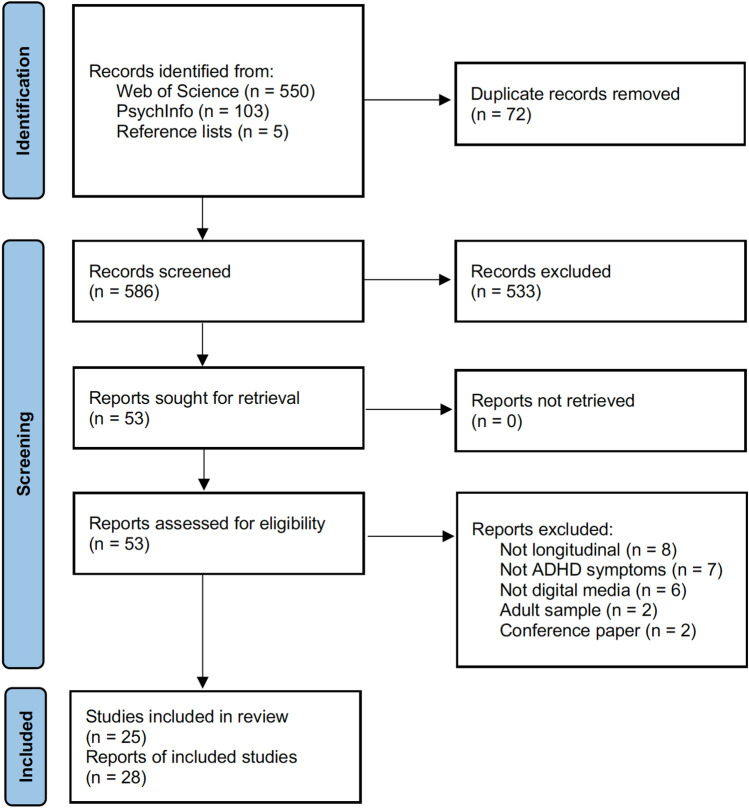
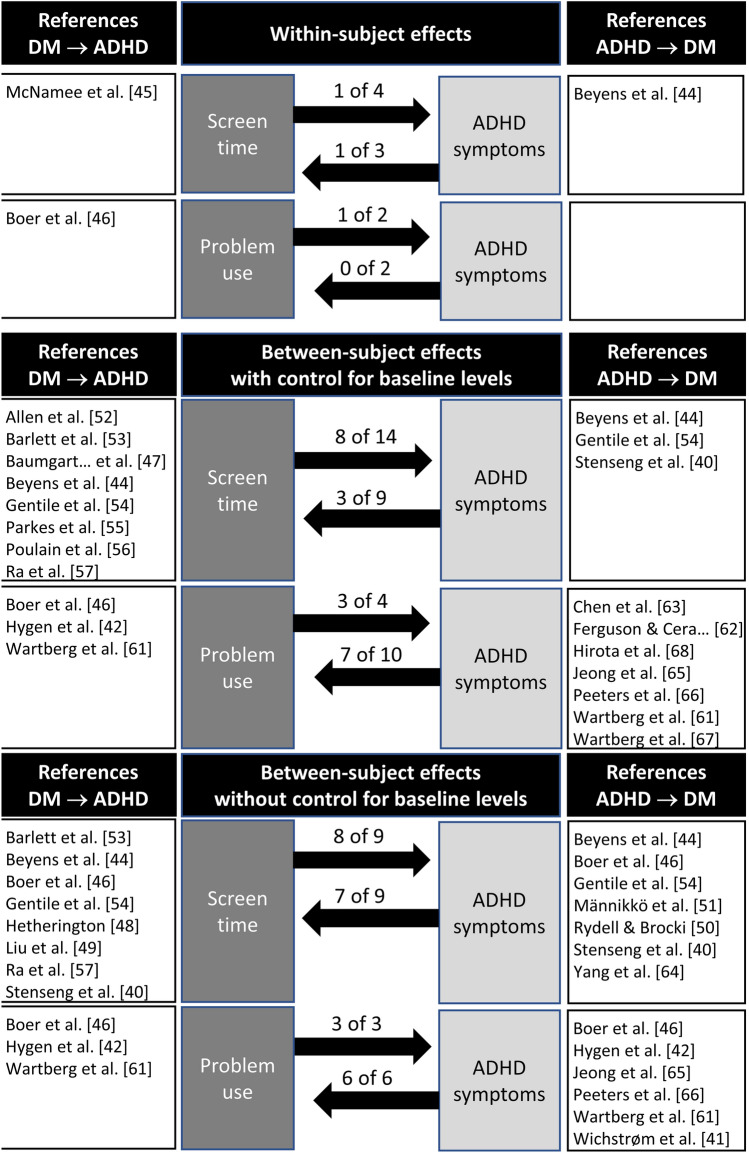
Previous reviews have often shown a link between digital media ADHD symptom levels. However, longitudinal studies are needed to find stronger evidence of a causal effect as well as to determine the direction of effects. The aim of the present review (PROSPERO CRD42021262695) was therefore to provide a systematic review of studies meeting the following inclusion criteria: (1) include longitudinal data investigating associations between digital media (i.e., gaming and social media) and later ADHD symptoms or vice versa, (2) be published within the past 10 years (i.e., 2011 until June 2021), (3) be published in a peer-reviewed journal in English, and (4) include children or adolescents (age 0-17 years). After a systematic search in the Web of Science and PsycInfo databases, we included 28 studies, all with adequate or high quality. Results showed support for reciprocal associations between digital media and ADHD symptoms, with associations being more consistent for problematic use of digital media than for screen time. Thus, children with ADHD symptoms appear more vulnerable to developing high or problematic use of digital media (i.e., selection effects), and digital media also have effects on later ADHD symptom levels, either because of specific characteristics of digital media or because of indirect effects on, for example, sleep and social relations (i.e., media effects). However, it should be emphasized that further studies investigating potential moderators and mediators are needed if we are to better understand the complex associations between digital media and ADHD symptom levels.
Overview
The claims and statistics of this paper haven’t been checked yet.
Run the check — free, no account needed. It reads the open-access text and checks the sources it cites.
Integrity signals
Registry
Cites
Statistics
Figures
Verification
Claims the paper makes
The claims and statistics of this paper haven’t been checked yet.
Run the check — free, no account needed. It reads the open-access text and checks the sources it cites.
Claims other papers make about this one
Each is checked against this paper’s own text: does it say what the citing paper says it does?
In the citing paper
“A more recent review evaluating the longitudinal associations between digital media use and ADHD symptoms found reciprocal associations between digital media use and ADHD symptoms [57].”
From Screen time and mental health: a prospective analysis of the Adolescent Brain Cognitive Development (ABCD) Study (2024) · cites this paper as [57]
Self-check
Percentages, sums and reported differences re-computed from the paper’s own numbers.
The self-check needs the paper’s full text.
Citations
Cites
Diagnostic and Statistical Manual of Mental Disorders
American Psychiatric Association (2013) · doi:10.1176/appi.books.9780890425596 · Cited by 116,369
The PRISMA 2020 statement: An updated guideline for reporting systematic reviews
Page, M. J., McKenzie, J. E., Bossuyt, P. M., Boutron, I., Hoffmann, T. C., Mulrow, C. D., Shamseer, L., Tetzlaff, J. M., Akl, E. A., Brennan, S. E., et al. (2021) · BMJ · doi:10.1136/bmj.n71 · Cited by 108,283
International Statistical Classification of Diseases and Related Health Problems 10th Revision
(2013) · Oxford University Press eBooks · doi:10.1093/med/9780199669493.005.0005 · Cited by 2,069
Screen time and sleep among school-aged children and adolescents: a systematic literature review
Hale, L., & Guan, S. (2015) · Sleep Medicine Reviews · doi:10.1016/j.smrv.2014.07.007 · Cited by 1,468 · cited 2×
“Two of the most important activities commonly affected by extensive use of digital media are physical activity [e.g., reviews 30, 31] and sleep [e.g., 32].”
BackgroundResultThe Differential Susceptibility to Media Effects Model
Valkenburg, P. M., & Peter, J. (2013) · Journal of Communication · doi:10.1111/jcom.12024 · Cited by 1,340
Online Social Network Site Addiction: A Comprehensive Review
Andreassen, C. S. (2015) · Current Addiction Reports · doi:10.1007/s40429-015-0056-9 · Cited by 1,212 · cited 1×
“However, it has been argued that criteria similar to those described above for IGD can also be applied to social media use [13–16].”
BackgroundCharacterizing cognition in ADHD: beyond executive dysfunction
Castellanos, F. X., Sonuga-Barke, E. J. S., Milham, M. P., & Tannock, R. (2006) · Trends in Cognitive Sciences · doi:10.1016/j.tics.2006.01.011 · Cited by 1,170 · cited 1×
“…such as executive functions (i.e., working memory, inhibitory con-trol, and planning), delay aversion and emotion regulation, given that these functions have been linked to digital media use [81–83], other types of additions such as alcohol/drug addiction or gambling [84, 85], and ADHD [86].”
BackgroundInternet Gaming Addiction: A Systematic Review of Empirical Research
Kuss, D. J., & Griffiths, M. D. (2012) · International Journal of Mental Health and Addiction · doi:10.1007/s11469-011-9318-5 · Cited by 1,113 · cited 1×
“There are now several reviews and meta-analyses investigating the link between digital media in general and ADHD [4, 5], as well as more specific reviews focusing on the link between gaming and ADHD [6, 7] or ADHD symptom levels for individuals diagnosed with Internet gaming disorder [8, 9].”
BackgroundDelayed reward discounting and addictive behavior: a meta-analysis
MacKillop, J., Amlung, M. T., Few, L. R., Ray, L. A., Sweet, L. H., & Munafò, M. R. (2011) · Psychopharmacology · doi:10.1007/s00213-011-2229-0 · Cited by 1,021 · cited 1×
“…such as executive functions (i.e., working memory, inhibitory con-trol, and planning), delay aversion and emotion regulation, given that these functions have been linked to digital media use [81–83], other types of additions such as alcohol/drug addiction or gambling [84, 85], and ADHD [86].”
BackgroundProblematic social media use: Results from a large-scale nationally representative adolescent sample
Bányai, F., Zsila, Á., Király, O., Maraz, A., Elekes, Z., Griffiths, M. D., Andreassen, C. S., & Demetrovics, Z. (2017) · PLOS ONE · doi:10.1371/journal.pone.0169839 · Cited by 984
Cited by
Sorted by citations
Items 101–132 of 132
Romano, S., Esposito, D., Iorio, G. D., Panvino, F., Altomonte, B., Calderoni, D., Conte, G., Casini, M. P., & Terrinoni, A. (2026) · Psychiatry International · doi:10.3390/psychiatryint7030125
“Their content preferences supported this interpretation: they showed strong interest in comic-themed content, consistent with evidence that neurodivergent youth gravitate toward fast-paced, visually stimulating, and reward-oriented materials [43,44].”
Screen time and autism-like symptoms in early childhood: Examining the concept of virtual autism
Özyazıcı, K. (2026) · Acta Psychologica · doi:10.1016/j.actpsy.2026.107285
Kim, S.-C., Kong, N.-Y., Lee, S., & Lee, S. (2026) · Frontiers in Psychiatry · doi:10.3389/fpsyt.2026.1794425
Fakiha, S. (2026) · ACM International Conference on Interaction Design and Children (IDC) · doi:10.1145/3773077.3813784
Association of media use with sleep of children and adolescents: an umbrella review
Brozatus, M., Ordnung, M., Sidhu, N., & Genuneit, J. (2026) · Sleep Medicine Reviews · doi:10.1016/j.smrv.2026.102327 · Cited by 1
Social and digital media use in children and adolescents: a perspective focused on risks
Domoff, S. E. (2026) · Frontiers in Developmental Psychology · doi:10.3389/fdpys.2026.1814457
Lee, Y. J., Hwang, I. C., & Ahn, H. Y. (2026) · Frontiers in Psychiatry · doi:10.3389/fpsyt.2026.1843287
Karakoç, Ü. F., & Jaicks, Ç. C. D. (2026) · Journal of Dependence · doi:10.51982/bagimli.615
Todorović, L., Bogaerts, A., & Larsen, H. (2026) · Journal of Adolescence · doi:10.1002/jad.70220
“…digital media use over time: research points to both unidirectional effects of digital media use on increased ADHD symptoms among adolescents (Boer et al. 2019; Wallace et al. 2023), as well as bidirectional effects between ADHD symptoms and problematic digital media use (Thorell et al. 2022).”
Xiang, K., Huang, S., Lai, X., Li, K., Wang, H., Zhang, Y., Yang, Z., Tian, F., & Wang, Y. (2026) · Journal of Affective Disorders · doi:10.1016/j.jad.2026.122230
Varmış, D. A., Binokay, H., Güneş, S., YÜKSEKKAYA, C., ANTEPÜZÜMÜ, E. G. Y., Cilogulları, E., Atay, G., Sefik, P., & İNCE, N. (2026) · BMC Psychology · doi:10.1186/s40359-026-05200-2
“Baseline ADHD symptoms have been prospectively associated with later high or problematic digital-media use, whereas baseline digital-media use has also been prospectively associated with later ADHD symptom levels [4].”
InfluentialMarano, G., Giacomi, O. D., Hasaj, S., Traversi, G., Mazza, O., Cangini, A., & Mazza, M. (2026) · Children · doi:10.3390/children13070940
“In children with ADHD, digital media may interact with impulsivity, sleep problems, and attentional dysregulation, while handwriting difficulties may require targeted psychomotor support [7,78].”
InfluentialA librarian's lens on reading decline: Insights into school library engagement in the UAE
Khan, Z. I., & Khan, Z. (2026) · IFLA Journal · doi:10.1177/03400352261470841
Machado, J. A. L., & Morales, D. I. E. (2026) · Research Square · doi:10.21203/rs.3.rs-10484582/v1
Park, J. L., Plamondon, A., Al-Jbouri, E., Moreno, M. A., Tough, S., & Madigan, S. L. (2026) · JAACAP Open · doi:10.1016/j.jaacop.2026.07.005
Park, J. J., Lee, G., Huh, S., & Potenza, M. N. (2026) · Brain and Environment · doi:10.1016/j.braen.2026.100031
Hu, J., Wang, J.-Y., Zhao, Y., Xuan, X., Ma, J.-Y., & Chen, J. (2026) · Journal of Child Neurology · doi:10.1177/08830738261464418
Wu, Y.-J., Hsu, J., & Liu, T. (2026) · European Journal of Psychotraumatology · doi:10.1080/20008066.2026.2697559
“Moreover, familiarity with digital media among individuals with ADHD may reduce their perception of graphic media content as threatening (Thorell et al., 2024).”
Rogayan, D. V., & Yektie Nurprayoga, L. M. (2026) · International Journal of Education Reports · doi:10.62503/ijer.1.1.45-58
“…time is associated with adolescent mental-health disorders has been supported by a systematic review (Santos et al., 2023), a longitudinal review of attention-deficit/hyperactivity disorder (ADHD) symptoms (Thorell et al., 2024), and a rapid review of executive function (Maeneja et al., 2025).”
Barbini, C. M., Merino, D., Manera, V., Fabre, R., Quaderi, A., Askenazy-Gittard, F., & Thümmler, S. (2026) · L Encéphale · doi:10.1016/j.encep.2026.06.007
The Great ADHD Myth documentary is misleading and misinformed
Eccles, J., Phillips, H., & Thapar, A. (2026) · BMJ · doi:10.1136/bmj-2026-100727
White matter integrity buffers the impact of screen time on inhibitory control in youth
Jang, M., Choi, S. Y., Min, J. J., Lee, K. H., Han, S., Choi, K., Kim, J. Y., Chung, G. H., Chung, D., Lee, S. A., et al. (2026) · Developmental Cognitive Neuroscience · doi:10.1016/j.dcn.2026.101824
Christidis, N., Lärfars, M., Khattar, P., Markus, D., Canales, G. D. L. T., & Christidis, M. (2026) · BMC Medical Education · doi:10.1186/s12909-026-10445-x
“The relationship between ADHD symptoms and digital media use appears bidirectional and remains incompletely understood, with individuals reporting ADHD symptoms appearing more susceptible to problematic media use, while excessive media use may in turn influence symptom severity [61].”
Navarro-Vitoria, A., Camacho-Ruiz, J. A., Gras, R. M. L., & Galvez-Sánchez, C. M. (2026) · Psychiatry International · doi:10.3390/psychiatryint7050216
Gür, Ç., Aykut, P., Parlakyıldız, B., & Özgem, K. (2026) · Education Sciences · doi:10.3390/educsci16101625
“Similarly, longitudinal evidence reviewed by Thorell et al. (2024) suggests that associations between digital-media use and ADHD-related symptoms may operate in both directions and appear to be more consistent for problematic digital-media use than for screen time considered as a single exposure…”
InfluentialPadmapriya, N., Chandrasekaran, M., Khan, S. A., Nishika, R., Huiyun, G. L., Chong, D., Sanabria, A. S., Raeside, R., Holly, L., Chia, A., et al. (2026) · EClinicalMedicine · doi:10.1016/j.eclinm.2026.104225
Lesigang, J., Vetter, M., Voracek, M., & Pietschnig, J. (2026) · Intelligence & Cognitive Abilities · doi:10.65550/001c.171910
Digital behavior patterns and ADHD symptoms in late adolescents and young adults
Chen, S., He, G., & Zhao, J. (2026) · Frontiers in Psychiatry · doi:10.3389/fpsyt.2026.1968257
Kaba, D., & Çelik, S. (2026) · Clinical Child Psychology and Psychiatry · doi:10.1177/13591045261495392
Park, J., ten Hoor, G. A., Hwang, G., Lee, W., Baek, S., Ryu, S., & Lau, S. T. (2026) · Journal of Pediatric Nursing · doi:10.1016/j.pedn.2026.09.040
Subject agency in the context of digital childhood: Possibilities for its emergence and suppression
Gromyko, Y. V., & Pudenko, S. P. (2026) · Cultural-Historical Psychology · doi:10.17759/chp.2026220302
Bediou, B., Cekic, S., Gentile, D. A., & Bavelier, D. (2026) · PLoS ONE · doi:10.1371/journal.pone.0356080
“This would also align with PG symptoms being correlated with greater ADHD symptomatology [10,58].”
Metadata
- Authors
- Thorell, L. B., Burén, J., Ström Wiman, J., Sandberg, D., & Nutley, S. B.
- Affiliations
- Karolinska Institutet (SE)
- Corresponding author
- Thorell, Lisa B.
- Venue
- European Child & Adolescent Psychiatry
- Published
- 2022-12-23
- Volume
- 33
- Issue
- 8
- Pages
- 2503-2526
- ISSN
- 1018-8827 (ISSN-L)
- 1435-165X
- PMC
- PMC11272698
- OpenAlex
- W4312115048
- Cited by
- 132
- References
- 88
- Citations by year
- 2026: 55 · 2025: 55 · 2024: 19 · 2023: 3
- FWCI
- 3.31
- Type
- journal article
- Language
- en
- Open access
- hybrid
- doi.org
- Locations
- European Child & Adolescent Psychiatry (publishedVersion, cc-by)
- PubMed Central (publishedVersion, cc-by)
- PubMed (publishedVersion)
- Funders
- Forskningsrådet om Hälsa, Arbetsliv och Välfärd (2020-00630)
- Karolinska Institute
- Topics
- Health Sciences › Medicine › Psychiatry and Mental health › Attention Deficit Hyperactivity Disorder
- Social Sciences › Education › Child Development and Digital Technology
- Social Sciences › Sociology and Political Science › Impact of Technology on Adolescents
- Keywords
- ADHD symptoms, digital media use, video gaming, social media, problematic media use, screen time, children, adolescents, bidirectional relationship, selection effects, sleep, interpersonal relationships, causal effects
- MeSH terms
- Screen Time, Adolescent, Attention Deficit Disorder with Hyperactivity, Child, Humans, Longitudinal Studies, Video Games, Social Media
About these checks
Registry, retraction, Cites and statistics results are computed, not judged, with one exception: a printed reference that no index lists is read once by a model before it counts as a citation error. Claims are extracted by a model and kept only when their quote appears verbatim in the text; each cited source is then checked, with a model’s help, for whether it says what the claim relies on. Those verdicts can be wrong — read the claim’s quote and the cited source before relying on one.
Statistics and arithmetic are recomputed, not judged.
Confidence bands are shown only for fields calibrated on our annotated test set. None is calibrated yet, so no band is shown.
What counts as a claim ›How we measure confidence ›How we check this ›
Are you an author, or do you see a problem with this page? Request a review
