

A review on digital twins for power generation and distribution
Open accessThe DOI matches its Crossref record; 118 of the 118 references it cites were found in a registry or an index; none of the 104 sources its claims cite is checked for support yet.
Abstract
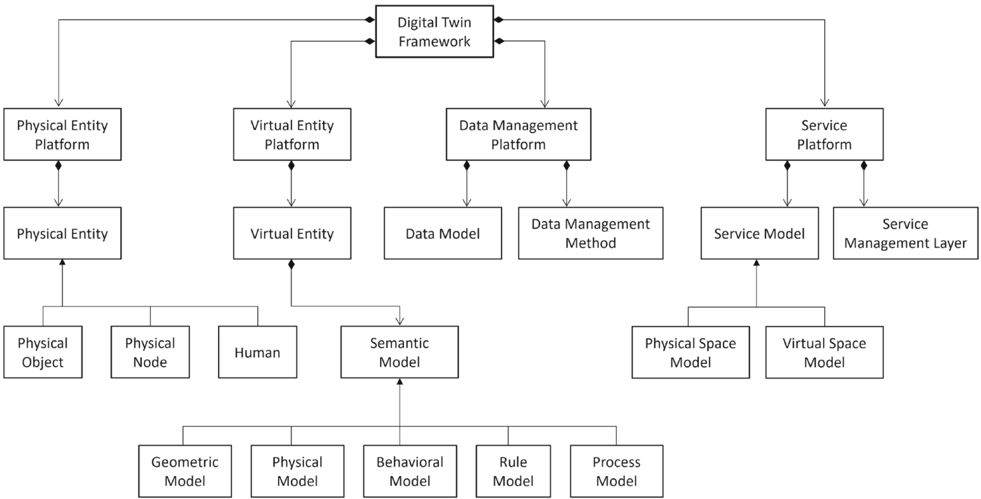
This paper presents a systematic literature review on the application of digital twins in the energy sector. Initially, we generated an overview through a survey of prior reviews, independent of market vertical, then followed by a more detailed review concentrating on the power production and distribution domains, as per the NIST (National Institute of Standards and Technology) smart grid standard. We implemented a rigorous method, which included seven stages, beginning with the collection of 2238 articles. We observed that the energy sector range was too broad and filtered by generation and distribution during the practical screening, resulting in 275 for further screening. This amount was then condensed to 81 papers that matched the quality screening criteria for synthesis and examination. In summary, digital twin architectures and frameworks include five components: the physical entity, bidirectional communication, the virtual entity (with modeling and simulation), data management, and services. Our study contributed by determining that distribution management is the most pertinent application of digital twins in the distribution domain and fault diagnosis in the generation domain. Furthermore, we found that digital twins involve multiple stakeholders whose role is rarely discussed in studies, and we identified a similar absence of emphasis for security. Research on security often presents the digital twin as an additional layer of protection, yet rarely investigates the security of the digital twin by itself. The potential limitations of our study to answer some of the technical research questions may be because of the criteria for the selection of papers. However, as the emphasis of this study is on the energy sector, it enabled domain-specific findings for generation and distribution.
Overview
CoChat Summary
TL;DR
This systematic literature review examines digital twins in the energy sector, narrowing to the NIST smart-grid generation and distribution domains after screening 2,238 articles down to 81. It finds distribution management and fault diagnosis as the most relevant use cases for distribution and generation respectively, while stakeholder roles and security of the digital twin itself remain under-addressed.
Key findings
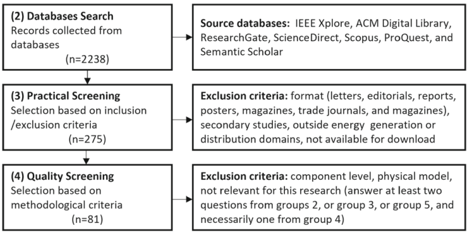
- The review screened 2,238 articles after duplicate removal, reduced them to 275 via practical screening, and then to 81 via quality screening. Digital twin architectures and frameworks are described as including five components: the physical entity, bidirectional communication, the virtual entity (with modeling and simulation), data management, and services.
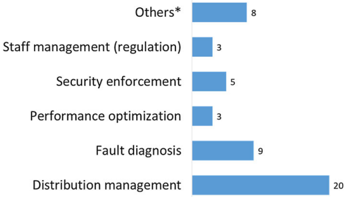
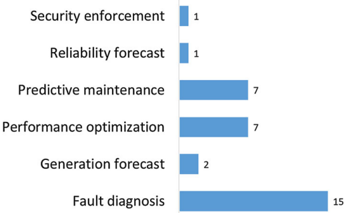
- Distribution management is the most pertinent application in the distribution domain, while fault diagnosis is most relevant in the generation domain; for generation, fault diagnosis is followed by performance optimization and predictive maintenance.
- Only 8 of the studies (9.8%) approached stakeholders and their roles. AI/ML terms appeared in 76 of 81 studies (93.8%), with 16 (19.7%) approaching AI/ML directly as a key part of the study.
- Security is rarely a main topic: only three papers approach security directly, and security is often presented as an additional layer of protection rather than investigating the security of the digital twin itself. The term “binding” appears in only 4 of 81 papers, while “synchronization” appears in 41 of 81; none of the studies stated an autonomous feedback that impacted the system automatically.
Methods
- Design: a systematic literature review following seven stages: identify purpose, draft searching protocol, apply practical screen, apply quality screen, extract data, synthesize studies, and write the review.
- Data/sample: searches used IEEE Xplore, ACM Digital Library, ResearchGate, ScienceDirect, Scopus, ProQuest, and Semantic Scholar with a title/abstract query combining “digital twin*” and energy/electric*/power/smart grid* terms; 3,675 papers were retrieved including duplicates, leaving 2,238 after duplicate removal. Practical screening reduced this to 275, and quality screening left 81 papers for synthesis.
- Analysis: practical and quality screening were conducted by the main author (70%) and a laboratory assistant at IIK, NTNU (30%); data extraction used NVIVO and Excel, and synthesis was based on interpretation and explanation given the qualitative nature of most papers.
Limitations
- The paper states that potential limitations in answering some technical research questions may be due to the criteria for paper selection. It also states that considering only energy-sector studies that followed a combination of the research questions may have limited or excluded papers detailing digital twins in architecture, framework, stakeholders, network, and security.
- The paper states that if the query had focused on security, many other studies would have appeared, but the energy restriction limited results; it also notes that implementation details were not always explained, limiting understanding of tools and techniques, and that its network/binding contribution was limited.
- Evident from the text: the quality screening required papers to mention communication and answer specific research-question groups, which may bias the sample toward studies with certain technical details and away from security-only or component-level work.
Model-written summary. Check it against the paper before relying on it.
Integrity signals
Registry
Cites
Statistics
Figures
Verification
Claims the paper makes
0 Valid · 9 Not valid · 60 Not checked · 84 Own results and interpretations
A result the paper reports from its own data — it cites no other source for it, so there is none to check. The quote shows it is in the paper.
In the paper
“Our study contributed by determining that distribution management is the most pertinent application of digital twins in the distribution domain and fault diagnosis in the generation domain.”
§ A review on digital twins for power generation and distribution > Abstract
plain- Asserted: passes — The authors put it forward as true.
- Checkable: passes — It can be checked against evidence.
- Load-bearing: passes — The paper’s conclusions depend on it.
- Based: passes — The paper gives a reason why it holds.
A result the paper reports from its own data — it cites no other source for it, so there is none to check. The quote shows it is in the paper.
In the paper
“Furthermore, we found that digital twins involve multiple stakeholders whose role is rarely discussed in studies, and we identified a similar absence of emphasis for security.”
§ A review on digital twins for power generation and distribution > Abstract
plain- Asserted: passes — The authors put it forward as true.
- Checkable: passes — It can be checked against evidence.
- Load-bearing: passes — The paper’s conclusions depend on it.
- Based: passes — The paper gives a reason why it holds.
A result the paper reports from its own data — it cites no other source for it, so there is none to check. The quote shows it is in the paper.
In the paper
“Our study contributed by determining that distribution management is the most pertinent application of digital twins in the distribution domain and fault diagnosis in the generation domain.”
§ A review on digital twins for power generation and distribution > Abstract
plain- Asserted: passes — The authors put it forward as true.
- Checkable: passes — It can be checked against evidence.
- Load-bearing: passes — The paper’s conclusions depend on it.
- Based: passes — The paper gives a reason why it holds.
A result the paper states — it cites no source for it, so there is none to check. The quote shows it is in the paper.
In the paper
“However, no common definition has been accepted by both academic and industrial communities.”
§ A review on digital twins for power generation and distribution > 2.1 Definition considerations
plain- Asserted: passes — The authors put it forward as true.
- Checkable: passes — It can be checked against evidence.
- Load-bearing: unclear — It is unclear whether the paper’s conclusions depend on it.
- Based: passes — The paper gives a reason why it holds.
35 more claims
Create a free account to see all 153 claims and to verify the 98 references still open.
- Probably not a substantial claim. 91
- It may state two separate claims as one. 52
- The quote only partly states this claim. 3
Self-check
Percentages, sums and reported differences re-computed from the paper’s own numbers.
Each contradiction between two passages listed here was confirmed by an independent check.
Rated minor: it would not touch a result — a value no result rests on, a p-value that stays on the same side of the significance level, or a conflict that is clerical, resolved elsewhere in the paper, or outside its own findings.
In the paper
§ A review on digital twins for power generation and distribution > 1.3 Structure of the paper
“Section 7 outlines some possibilities for future work, and Sect.8 is dedicated to discussion, concluding our analysis.”
§ A review on digital twins for power generation and distribution > 6 Discussion and contributions
“## 6 Discussion and contributions”
Rated minor: it would not touch a result — a value no result rests on, a p-value that stays on the same side of the significance level, or a conflict that is clerical, resolved elsewhere in the paper, or outside its own findings.
In the paper
§ A review on digital twins for power generation and distribution > 6 Discussion and contributions
“the progress of digital twins in the energy sector regarding distribution and generation domains are, respectively, fault diagnosis, and distribution management.”
§ A review on digital twins for power generation and distribution > 5.1 NIST domains and use cases
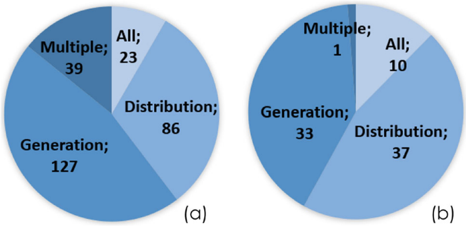
“The first scenario in Fig. 8 groups the categories of "distribution," "multiple," and "all" NIST domains, resulting in "distribution management" as the most relevant use case, followed by "fault diagnosis."But in Fig. 9, only use cases from "generation" domain papers were categorized, changing the most relevant use case to "fault diagnosis"”
Rated minor: it would not touch a result — a value no result rests on, a p-value that stays on the same side of the significance level, or a conflict that is clerical, resolved elsewhere in the paper, or outside its own findings.
In the paper
§ A review on digital twins for power generation and distribution > 5.1.1 Studies design overview and stakeholders
“Regarding stakeholders, only 8 (9,8%) of the studies approached them and their roles.”
§ A review on digital twins for power generation and distribution > 7 Challenges and future work
“who are the stakeholders, what are their roles, and how each of them have access to the information is commonly discussed.”
Citations
Cites
Digital Twin in Industry: State-of-the-Art
Tao, F., Zhang, H., Liu, A., & Nee, A. Y. C. (2019) · IEEE Transactions on Industrial Informatics · doi:10.1109/tii.2018.2873186 · Cited by 5,871 · cited 2×
“Although some authors have stated that digital twins require an additional security strategy due to the introduction of new vulnerabilities [18, 22], most reviews have only mentioned it as a challenge [15, 23, 29, 32, 42].”
Digital Twin: Mitigating Unpredictable, Undesirable Emergent Behavior in Complex Systems
Grieves, M., & Vickers, J. (2017) · Transdisciplinary Perspectives on Complex Systems · doi:10.1007/978-3-319-38756-7_4 · Cited by 5,644
Digital Twin in manufacturing: A categorical literature review and classification
Kritzinger, W., Karner, M., Traar, G., Henjes, J., & Sihn, W. (2018) · IFAC-PapersOnLine · doi:10.1016/j.ifacol.2018.08.474 · Cited by 3,612 · cited 1×
“In an effort to address this issue, a classification based on the level of data integration was proposed in [30], with the data flow exchange between the digital and physical objects serving as the principal criterion.”
The Digital Twin Paradigm for Future NASA and U.S. Air Force Vehicles
Glaessgen, E., & Stargel, D. (2012) · 53rd AIAA/ASME/ASCE/AHS/ASC Structures, Structural Dynamics and Materials Conference 20th AIAA/ASME/AHS Adaptive Structures Conference 14th AIAA · doi:10.2514/6.2012-1818 · Cited by 3,395
Digital twin: Enabling technologies, challenges and open research
Fuller, A., Fan, Z., Day, C., & Barlow, C. (2020) · IEEE Access · doi:10.1109/access.2020.2998358 · Cited by 2,965 · cited 3×
“In [23], they classified the technologies according to domains (application, middleware, network, and object), but in [17], the enablers were listed without association do domains or building blocks.”
Characterising the Digital Twin: A systematic literature review
Jones, D., Snider, C., Nassehi, A., Yon, J., & Hicks, B. (2020) · CIRP Journal of Manufacturing Science and Technology · doi:10.1016/j.cirpj.2020.02.002 · Cited by 2,422
Review of digital twin about concepts, technologies, and industrial applications
Liu, M., Fang, S., Dong, H., & Xu, C. (2021) · Journal of Manufacturing Systems · doi:10.1016/j.jmsy.2020.06.017 · Cited by 1,875
A Review of the Roles of Digital Twin in CPS-based Production Systems
Negri, E., Fumagalli, L., & Macchi, M. (2017) · Procedia Manufacturing · doi:10.1016/j.promfg.2017.07.198 · Cited by 1,669
A survey on digital twin: definitions, characteristics, applications, and design implications
Barricelli, B. R., Casiraghi, E., & Fogli, D. (2019) · IEEE Access · doi:10.1109/access.2019.2953499 · Cited by 1,480
A Guide to Conducting a Standalone Systematic Literature Review
Okoli, C. (2015) · Communications of the Association for Information Systems · doi:10.17705/1cais.03743 · Cited by 1,413
Research works printed but not linked: 7
- Vasiljevska, J., Gangale, F., Covrig, L., Mengolini, A.: Smart grids and beyond ? An EU research and innovation perspective, Scientific analysis or review KJ-NA-30786-EN-N (online), Lux- embourg (Luxembourg) (2021). https://doi.org/10.2760/705655 (online) · doi:10.2760/705655
- Digital twin (dt) in smart energy systems -systematic literature review of dt as a growing solution for energy internet of the things (eiot) (2021) https://doi.org/10.1051/e3sconf/202131209002 · DOI · Paper page
- Balijepalli, V. M., Sielker, F., Karmakar, G.: Evolution of power system cim to digital twins -a comprehensive review and analysis, In 2021 IEEE PES Innovative Smart Grid Technolo- gies Europe (ISGT Europe), pp. 1-6. https://doi.org/10.1109/ ISGTEurope52324.2021.9640174 · DOI · Paper page
- Brosinsky, C., Kummerow, A., Richter, M., Naumann, A., Wiest, P., Nicolai, S., Westermann, D.: The role of digital twins in power system automation and control: necessity, requirements, and ben- efits. In ETG Congress, pp. 1-6 (2021) · DOI · Paper page
- Fink, A.: Conducting Research Literature Reviews: From the Internet to Paper. Sage publications, Thousand Oaks (2014)
- Seo, D., Huh, T., Kim, M., Oh, J.W., Cho, S.G., Jeong, S.C.: A pre- dictive model for oscillating water column wave energy converters based on machine learning. ICIC Express Lett. Part B Appl. 12(8), 733-740 (2021). https://doi.org/10.24507/icicelb.12.08.733 · doi:10.24507/icicelb.12.08.733
- Wagner, T., Mehlmann, G., Richter, M.: Application of the dig- ital twin concept for a distribution network. In IEEE Power and Energy Student Summit, pp. 1-5 (2020) 121.
Cited by
Al-Shetwi, A. Q., Atawi, I. E., El‐Hameed, M. A., & Abuelrub, A. (2025) · IET Smart Grid · doi:10.1049/stg2.70026 · Cited by 182
Abdessadak, A., Ghennioui, H., Thirion‐Moreau, N., Elbhiri, B., Abraim, M., & Merzouk, S. (2025) · Energy Reports · doi:10.1016/j.egyr.2025.04.060 · Cited by 141
Digital Twins in Critical Infrastructure
Λαμπρόπουλος, Γ., Larrucea, X., & Colomo‐Palacios, R. (2024) · Information · doi:10.3390/info15080454 · Cited by 47
Deep Neural Networks in Smart Grid Digital Twins: Evolution, Challenges, and Future Outlooks
Tsegaye, S., Heyi, K. G., Endaylalu, M. T., Melaku, Z. A., & Turufi, K. T. (2025) · IEEE Access · doi:10.1109/access.2025.3585967 · Cited by 40
Potentials of digital twin system for analyzing travel behavior decisions
Aghaabbasi, M., & Sabri, S. (2024) · Travel Behaviour and Society · doi:10.1016/j.tbs.2024.100902 · Cited by 33
Metadata
- Authors
- Heluany, J. B., & Gkioulos, V.
- Affiliations
- Norwegian University of Science and Technology (NO)
- Corresponding author
- Heluany, Jessica B.
- Venue
- International Journal of Information Security
- Published
- 2023-12-01
- Volume
- 23
- Issue
- 2
- Pages
- 1171-1195
- ISSN
- 1615-5262 (ISSN-L)
- 1615-5270
- OpenAlex
- W4389233730
- Semantic Scholar
- 9b7423b74c1bdda7741ea785326200656c5713f8
- Cited by
- 122
- References
- 117
- Citations by year
- 2026: 81 · 2025: 29 · 2024: 12
- FWCI
- 11.05
- Type
- journal article
- Language
- en
- Open access
- hybrid
- doi.org
- Licence
- cc-by
- creativecommons.org/licenses/by/4.0 (tdm)
- creativecommons.org/licenses/by/4.0 (vor)
- Locations
- International Journal of Information Security (publishedVersion, cc-by)
- NVA (Nasjonalt vitenarkiv) (submittedVersion, cc-by)
- Funders
- NTNU Norwegian University of Science and Technology
- Topics
- Physical Sciences › Engineering › Industrial and Manufacturing Engineering › Digital Transformation in Industry
- Physical Sciences › Engineering › Electrical and Electronic Engineering › Smart Grid and Power Systems
- Physical Sciences › Engineering › Control and Systems Engineering › Smart Grid Security and Resilience
- Keywords
- digital twin, electricity generation, power distribution, smart grid, distribution management, fault diagnosis, digital twin architecture, digital twin security, energy sector, stakeholder roles, data management
About these checks
Registry, retraction, Cites and statistics results are computed, not judged, with one exception: a printed reference that no index lists is read once by a model before it counts as a citation error. Claims are extracted by a model and kept only when their quote appears verbatim in the text; each cited source is then checked, with a model’s help, for whether it says what the claim relies on. Those verdicts can be wrong — read the claim’s quote and the cited source before relying on one.
A language model drew the claims from the paper on 2026-11-29, under version 3 of the claim definition (model deepseek-v4.1-flash, prompt extract-v3).
A second model labelled each claim on 2026-11-29 (model jev-1.13-20260917, definition revision gold-guideline-v0.2).
Statistics and arithmetic are recomputed, not judged.
Confidence bands are shown only for fields calibrated on our annotated test set. None is calibrated yet, so no band is shown.
What counts as a claim ›How we measure confidence ›How we check this ›
Are you an author, or do you see a problem with this page? Request a review
Data sources
Bibliographic data: Semantic Scholar, OpenAlex, Crossref.
Contains information from the Semantic Scholar Academic Graph Datasets, made available under the ODC Attribution License (ODC-BY 1.0).
Semantic Scholar’s data is described in: Kinney, R., et al. (2023). The Semantic Scholar Open Data Platform. arXiv:2301.10140.
