

Circulating Bone morphogenetic protein 9 (BMP9) as a new biomarker for noninvasive stratification of nonalcoholic fatty liver disease and metabolic syndrome
Open accessPublished version of a preprint
The DOI matches its Crossref record; 35 of the 35 references it cites were found in a registry or an index.
Abstract
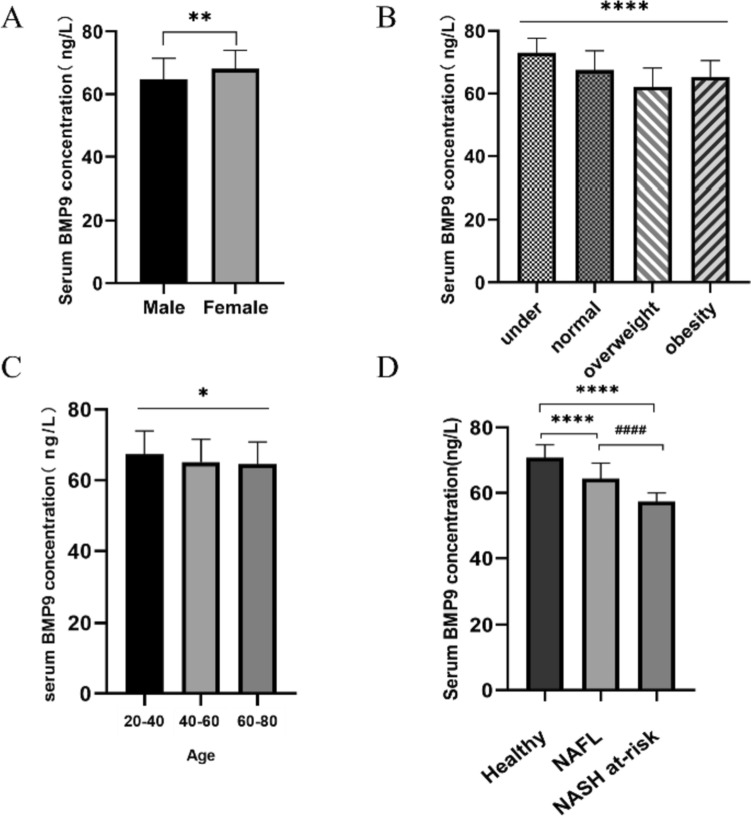
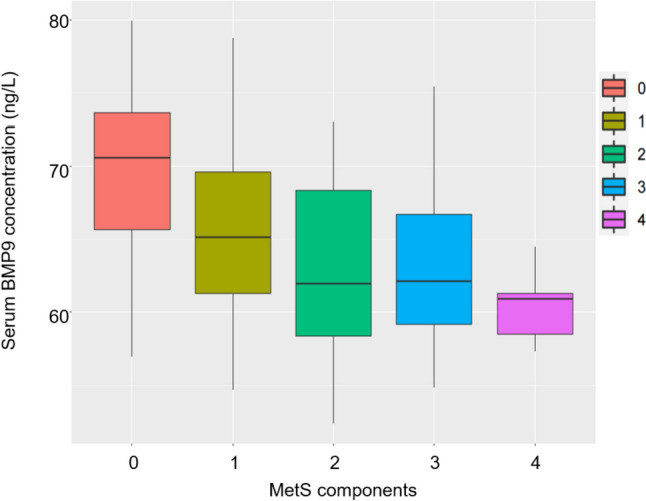
Nonalcoholic fatty liver disease (NAFLD) is closely related to metabolic syndrome (MetS). Bone morphogenetic protein 9 (BMP9) is an essential factor in glucose, lipid and energy metabolism. This study aims to investigate whether BMP9 can serve as a serological marker for the severity of NAFLD or MetS. Blood samples, clinical data and FibroTouch test were collected from consecutively recruited 263 individuals in Shanghai East hospital. All the participants were divided into three groups: the healthy controls, nonalcoholic fatty liver (NAFL) group and nonalcoholic steatohepatitis (NASH) at-risk group according to the results of FibroTouch test and liver function. Serum BMP9 levels were measured by enzyme-linked immunosorbent assay. Serum BMP9 levels were positively correlated with transaminase, triglyceride, fasting plasma glucose, glycated hemoglobin (HbA1c) and uric acid while it showed a downward trend as the increasing number of MetS components. Furthermore, it differentiated NASH at-risk (58.13 ± 2.82 ng/L) from the other groups: healthy control (70.32 ± 3.70 ng/L) and NAFL (64.34 ± 4.76 ng/L) (p < 0.0001). Controlled attenuation parameter of liver fat and liver stiffness measurement were negatively correlated with BMP9 levels, while high-density lipoprotein levels were positively correlated. The risk of developing NAFLD increased along with elevated serum BMP9 and BMI, and a significantly higher risk was observed in men compared to women. BMP9 should be considered a protective factor for the onset and development of NAFLD, as well as a promising biomarker for the severity of the NAFLD and MetS.
Overview
The claims and statistics of this paper haven’t been checked yet.
Free: it reads the open-access text and checks the first 5 claims that cite a source we can check. Create a free account to check every claim.
Integrity signals
Registry
Cites
Statistics
Figures
Verification
Claims the paper makes
The claims and statistics of this paper haven’t been checked yet.
Free: it reads the open-access text and checks the first 5 claims that cite a source we can check. Create a free account to check every claim.
Self-check
Percentages, sums and reported differences re-computed from the paper’s own numbers.
The self-check needs the paper’s full text.
Citations
Cites
(2000) · PubMed · Cited by 13,173
Eslam, M., Newsome, P. N., Sarin, S. K., Anstee, Q. M., Targher, G., Romero-Gomez, M., Zelber-Sagi, S., Wai-Sun Wong, V., Dufour, J.-F., Schattenberg, J. M., et al. (2020) · Journal of Hepatology · doi:10.1016/j.jhep.2020.03.039 · Cited by 4,472 · cited 1×
“Recently, NAFLD with metabolic disorders has been redefined as metabolic-associated fatty liver disease (MAFLD) [4].”
BackgroundEvolution of inflammation in nonalcoholic fatty liver disease: The multiple parallel hits hypothesis
Tilg, H., & Moschen, A. R. (2010) · Hepatology · doi:10.1002/hep.24001 · Cited by 2,548 · cited 1×
“…the historical two-hit hypothesis is now replaced by a multiple parallel hits hypothesis also considering the impact of an altered adipokine secretory pattern, inflammation, gut microbiota, nutritional factors, genetic and epigenetic factors, and IR on the development and progression of NAFLD [20].”
BackgroundGlobal perspectives on nonalcoholic fatty liver disease and nonalcoholic steatohepatitis
Younossi, Z., Tacke, F., Arrese, M., Chander Sharma, B., Mostafa, I., Bugianesi, E., Wai‐Sun Wong, V., Yilmaz, Y., George, J., Fan, J., et al. (2019) · Hepatology · doi:10.1002/hep.30251 · Cited by 1,858 · cited 1×
“In our study, we discovered the risk of developing NAFLD increased along with elevated serum BMP9 and BMI, which is consistent with Younossi et al [26].”
ResultNonalcoholic Fatty Liver Disease 2020: The State of the Disease
Cotter, T. G., & Rinella, M. (2020) · Gastroenterology · doi:10.1053/j.gastro.2020.01.052 · Cited by 1,198 · cited 1×
“NAFLD has become the most common chronic liver disease in the world, with a global comprehensive prevalence of 25% and an increasing trend year by year [1].”
BackgroundLonardo, A., Nascimbeni, F., Ballestri, S., Fairweather, D., Win, S., Than, T. A., Abdelmalek, M. F., & Suzuki, A. (2019) · Hepatology · doi:10.1002/hep.30626 · Cited by 1,050 · cited 1×
“Despite tremendous research advancements in NAFLD, our understanding of sex differences in NAFLD remains insufficient [18].”
BackgroundDietrich, C., Bamber, J., Berzigotti, A., Bota, S., Cantisani, V., Castera, L., Cosgrove, D., Ferraioli, G., Friedrich-Rust, M., Gilja, O., et al. (2017) · Ultraschall in der Medizin - European Journal of Ultrasound · doi:10.1055/s-0043-103952 · Cited by 1,011 · cited 1×
“All the participants were divided into NAFLD group and healthy controls according to the controlled attenuation parameter (CAP) of liver fat (CAP ≥ 240 dB/m indicated liver steatosis) by the FibroTouch detected diagnostic system and ultrasound [15, 16].”
MethodHyperuricemia and incident hypertension: A systematic review and meta‐analysis
Grayson, P. C., Kim, S. Y., LaValley, M., & Choi, H. K. (2011) · Arthritis Care & Research · doi:10.1002/acr.20344 · Cited by 756 · cited 1×
“In addition, another meta-analysis of prospective studies concluded that there is an independent linear relationship between increased UA levels and the occurrence of MetS [35, 36].”
BackgroundHypertension, diabetes, atherosclerosis and NASH: Cause or consequence?
Lonardo, A., Nascimbeni, F., Mantovani, A., & Targher, G. (2018) · Journal of Hepatology · doi:10.1016/j.jhep.2017.09.021 · Cited by 736 · cited 1×
“NAFLD may be both the liver manifestation and the cause of MetS [3], and there is an interplay between these two diseases.”
BackgroundBallestri, S., Nascimbeni, F., Baldelli, E., Marrazzo, A., Romagnoli, D., & Lonardo, A. (2017) · Advances in Therapy · doi:10.1007/s12325-017-0556-1 · Cited by 545 · cited 1×
“This has been confirmed in other studies that the prevalence of NAFLD is higher in men compared to women, and in women, the prevalence tends to increase after menopause, potentially due to the possible protective role of estrogen [27].”
Result
Research works printed but not linked: 2
- Metabolic Syndrome Research Collaborative Group of the Chinese Medical Association Diabetes Branch. Recommendations of the Chinese Medical Association's Division of Diabetes regarding the metabolic syndrome. Chin J Diabetes. 2004; 12(3): 156–161. 10.3321/j.issn:1006-6187.2004.03.002 · doi:10.3321/j.issn:1006-6187.2004.03.002
- Xie X, Liu T, Dong ZX, et al. Value of controlled attenuation parameter in diagnosis of individuals with liver steatosis by using Fibrotouch. J Prac Hepatol. 2019;22(4):526–9. 10.3969/j.issn.1672-5069.2019.04.019. · doi:10.3969/j.issn.1672-5069.2019.04.019
Cited by
Chaudhary, R., Weiskirchen, R., Ehrlich, M., & Henis, Y. I. (2025) · Frontiers in Pharmacology · doi:10.3389/fphar.2025.1580500 · Cited by 28
Tilorone attenuates high-fat diet-induced hepatic steatosis by enhancing BMP9-Smad1/5/8 signaling
Horvath, B., Halász, J., Tanner, N., Köhler, Z. M., Trencsényi, G., Juhász, L., Rovó, L., Kiss, A., & Keller-Pintér, A. (2025) · GeroScience · doi:10.14232/phd.13074 · Cited by 6
Huang, Y., Liu, B., Hu, C., & Lu, Y. (2025) · Protein & Cell · doi:10.1093/procel/pwaf027 · Cited by 6
“Some studies demonstrate its hepatoprotective activity (Yang et al., 2024).”
Rana-Seyfert, D., Grab, A. L., & Breitkopf‐Heinlein, K. (2025) · Bioscience Reports · doi:10.1042/bsr20253294 · Cited by 2
Gan, D., Qin, L., & Xiao, G. (2026) · Research · doi:10.34133/research.1319 · Cited by 1
“Circulating bone morphogenetic protein 9 (BMP9) has been proposed as a biomarker for noninvasive stratification of non-alcoholic fatty liver disease [ 16 ].”
Metadata
- Authors
- Yang, Y., Gu, M., Wang, W., Li, S., Lu, J., Sun, Q., Hu, M., & Zhong, L.
- Affiliations
- Tongji University (CN)
- Corresponding author
- Zhong, Lan
- Venue
- Clinical and Experimental Medicine
- Published
- 2024-03-16
- Volume
- 24
- Issue
- 1
- Pages
- 55-55
- ISSN
- 1591-8890 (ISSN-L)
- 1591-9528
- PMC
- PMC10944389
- OpenAlex
- W4392880152
- Cited by
- 10
- References
- 35
- Citations by year
- 2026: 6 · 2025: 4
- FWCI
- 3.05
- Type
- journal article
- Language
- en
- Open access
- hybrid
- doi.org
- Licence
- cc-by
- creativecommons.org/licenses/by/4.0 (tdm)
- creativecommons.org/licenses/by/4.0 (vor)
- Locations
- Clinical and Experimental Medicine (publishedVersion, cc-by)
- Research Square (acceptedVersion, cc-by)
- PubMed Central (publishedVersion, cc-by)
- PubMed (publishedVersion)
- Funders
- General Program of National Natural Science Foundation of China (82270639)
- Scientific research project of Shanghai Municipal Health Committee (202240001)
- Technology Development Project of Pudong Science, Technology and Economic Commission of Shanghai (PKJ2021-Y08)
- Specialty Feature Construction Project of ShanghaiPudong New Area Health Commission (PWZzb2022-05)
- Key Disciplines Group Construction Project of Shanghai Pudong New Area Health Commission (PWZxq2022-06)
- Medical discipline Construction Project of Pudong Health Committee of Shanghai (PWYgf2021-02)
- Topics
- Health Sciences › Medicine › Hepatology › Liver Disease Diagnosis and Treatment
- Health Sciences › Medicine › Endocrinology, Diabetes and Metabolism › Diabetes, Cardiovascular Risks, and Lipoproteins
- Health Sciences › Medicine › Hepatology › Liver physiology and pathology
- Keywords
- BMP9, non-alcoholic fatty liver disease, nonalcoholic steatohepatitis, metabolic syndrome, serum biomarkers, disease severity classification, liver fat, liver stiffness, triglycerides, uric acid, sex differences, body mass index
- MeSH terms
- China, Female, Humans, Liver, Male, Biomarkers, Metabolic Syndrome, Growth Differentiation Factor 2, Non-alcoholic Fatty Liver Disease
About these checks
Registry, retraction, Cites and statistics results are computed, not judged, with one exception: a printed reference that no index lists is read once by a model before it counts as a citation error. Claims are extracted by a model and kept only when their quote appears verbatim in the text; each cited source is then checked, with a model’s help, for whether it says what the claim relies on. Those verdicts can be wrong — read the claim’s quote and the cited source before relying on one.
Statistics and arithmetic are recomputed, not judged.
Confidence bands are shown only for fields calibrated on our annotated test set. None is calibrated yet, so no band is shown.
What counts as a claim ›How we measure confidence ›How we check this ›
Are you an author, or do you see a problem with this page? Request a review
How to cite
Cite CoChat for the checks on this page, and the paper for its own findings.
- This page
- CoChat. (2026). Citation check: Circulating Bone morphogenetic protein 9 (BMP9) as a new biomarker for noninvasive stratification of nonalcoholic fatty liver disease and metabolic syndrome. https://app.cochat.ai/papers/10.1007/s10238-024-01316-0
- The paper
- Yang, Y., Gu, M., Wang, W., Li, S., Lu, J., Sun, Q., Hu, M., & Zhong, L. (2024). Circulating Bone morphogenetic protein 9 (BMP9) as a new biomarker for noninvasive stratification of nonalcoholic fatty liver disease and metabolic syndrome. Clinical and Experimental Medicine. https://doi.org/10.1007/s10238-024-01316-0
Data sources
Bibliographic data: Semantic Scholar, OpenAlex, Crossref.
Contains information from the Semantic Scholar Academic Graph Datasets, made available under the ODC Attribution License (ODC-BY 1.0).
Semantic Scholar’s data is described in: Kinney, R., et al. (2023). The Semantic Scholar Open Data Platform. arXiv:2301.10140.
