

Neuropilin 1 (NRP1) conveys SEMA3A signals to restrict physiological angiogenesis
Open accessPublished version of a preprint
The DOI matches its Crossref record; 52 of the 52 references it cites were found in a registry or an index; none of the 82 sources its claims cite is checked for support yet.
Abstract
The class 3 semaphorin SEMA3A is a secreted glycoprotein that serves as an evolutionary conserved axon repellent with proposed vascular functions. In mice, SEMA3A is dispensable for developmental brain, limb or trunk blood vessel patterning, but restricts vessel branching in the zebrafish embryo trunk. Whereas neuropilin 1 (NRP1) is thought to be the SEMA3A receptor in the mouse, prior reports identified Plexin D1 as the Sema3a receptor in zebrafish trunk vessel patterning, with previous knockdown and knockout studies yielding contradictory results on Nrp1 requirement for vessel patterning in zebrafish. To resolve these discrepancies, we have refined the prior knockdown strategy to limit off target effects and generated mutant zebrafish embryos lacking both Nrp1a and Nrp1b paralogues to show that Nrp1 restricts trunk vessel patterning in a Sema3a-dependent manner. In agreement, we found that NRP1 is required in human endothelial cells for SEMA3A-induced repulsion. Moreover, we show that SEMA3A action via NRP1 does not involve the splicing regulation of FLT1 , previously proposed to act downstream of Plexin D1. Instead, sustained NRP1 activation independent of SEMA3A increases the expression of the anti-angiogenic soluble FLT1 (sFLT1), establishing a feedback mechanism to limit endothelial proliferation. Together, these findings demonstrate a dual role for NRP1 in shaping physiological vascular morphogenesis. Thus, NRP1 mediates repulsive SEMA3A cues in endothelial cells, in analogy to its role in axon guidance, and further restricts angiogenesis by promoting the release of sFLT1 in a SEMA3A-independent manner.
Overview
CoChat Summary
TL;DR
Refined Nrp1a/Nrp1b knockdown and double mutants show that Nrp1 restricts zebrafish trunk intersomitic vessel sprouting by mediating Sema3a repulsion, and NRP1 is required for SEMA3A-induced repulsion of human endothelial cells. NRP1 also promotes sFLT1 expression independently of SEMA3A, suggesting a dual role in limiting physiological angiogenesis.
Key findings
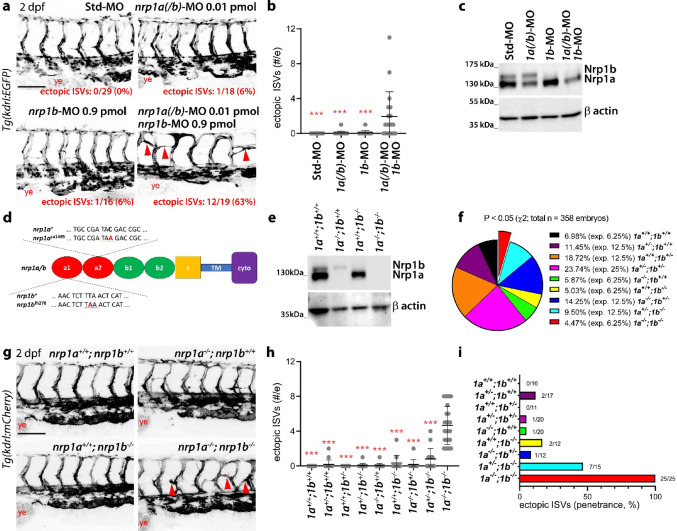
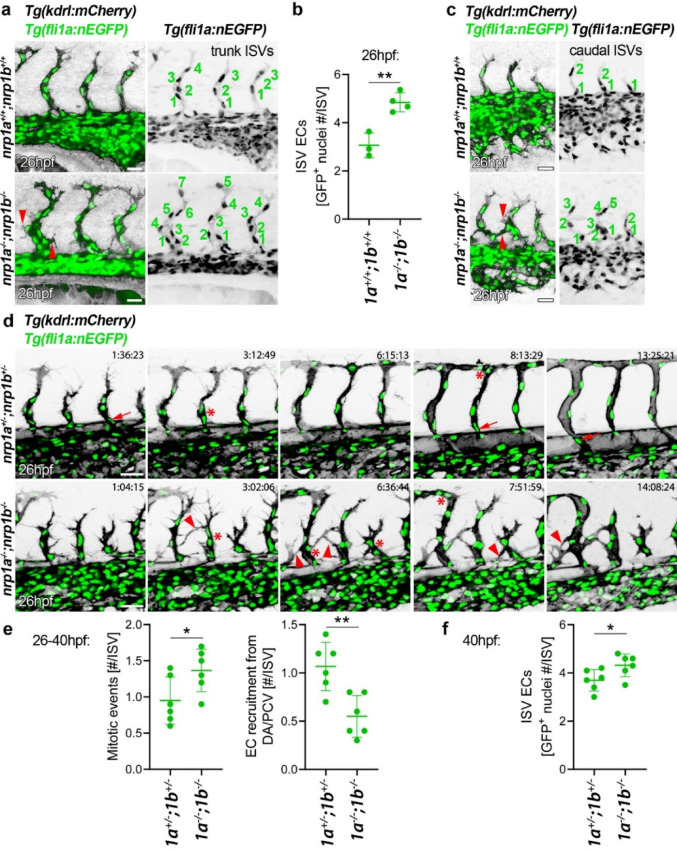
- Double Nrp1a/Nrp1b knockdown or knockout caused ectopic intersomitic vessel (ISV) sprouts that crossed the somite region; double mutants showed complete penetrance, and double mutants from heterozygous incrosses were present at slightly lower than expected frequency (P < 0.05, Chi square test, n = 358 embryos).
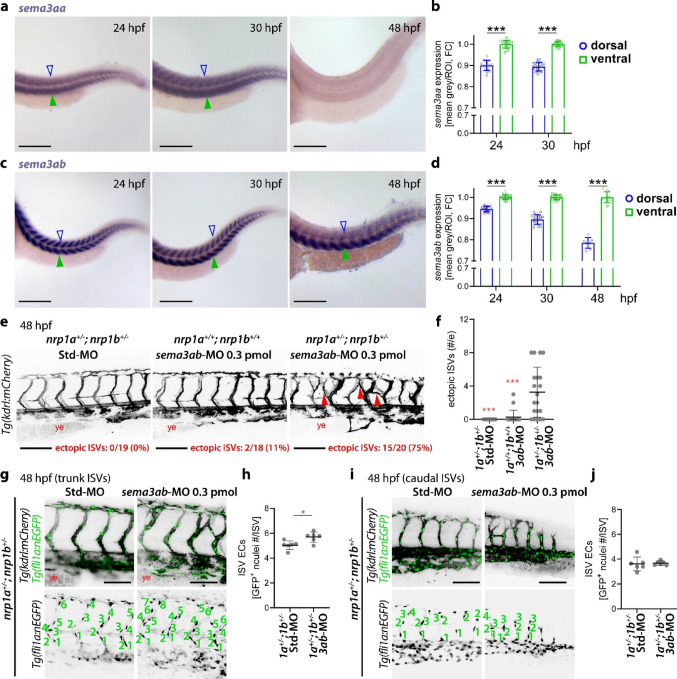
- Nrp1 and Sema3a genetically interact: a subcritical 0.3 pmol/embryo sema3ab-MO dose caused ectopic ISVs with 75% penetrance in double nrp1a/nrp1b heterozygous mutants, and co-injection with subcritical nrp1a(/b)-MO plus nrp1b-MO caused ectopic ISVs with 72% penetrance.
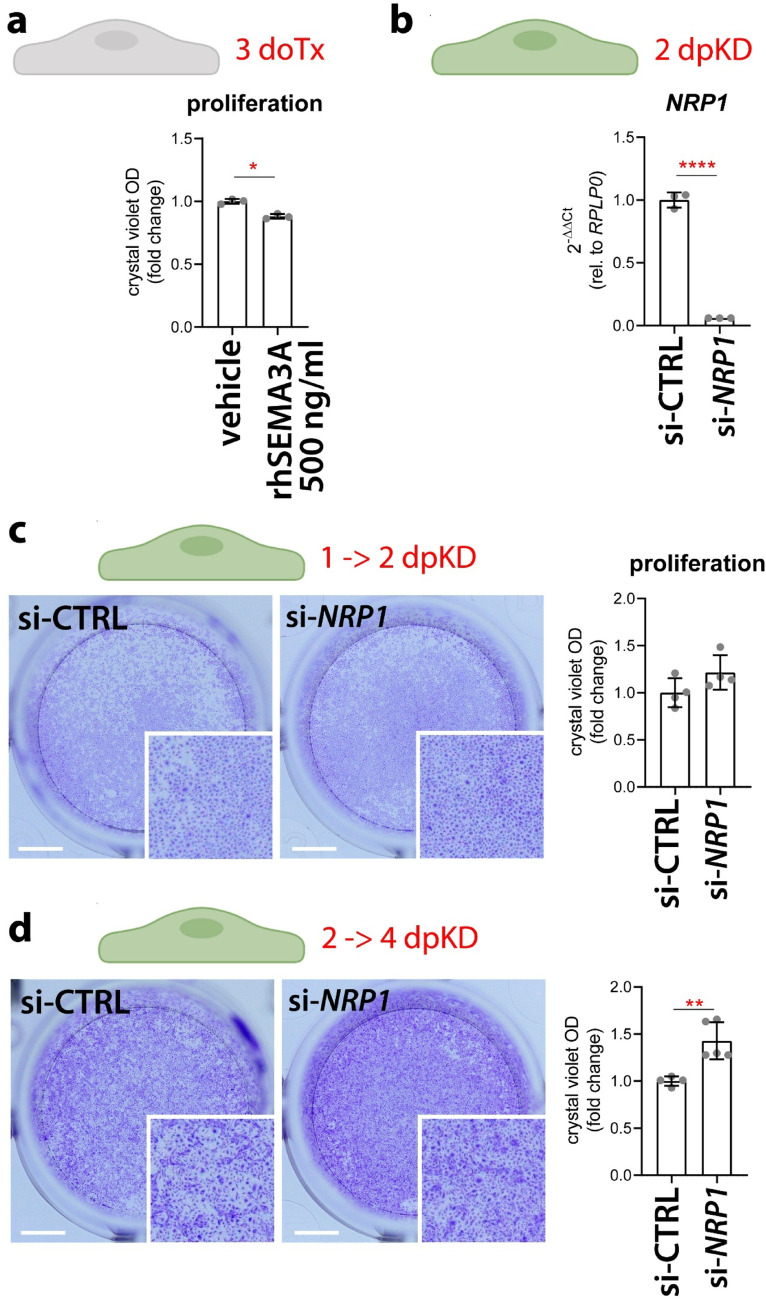
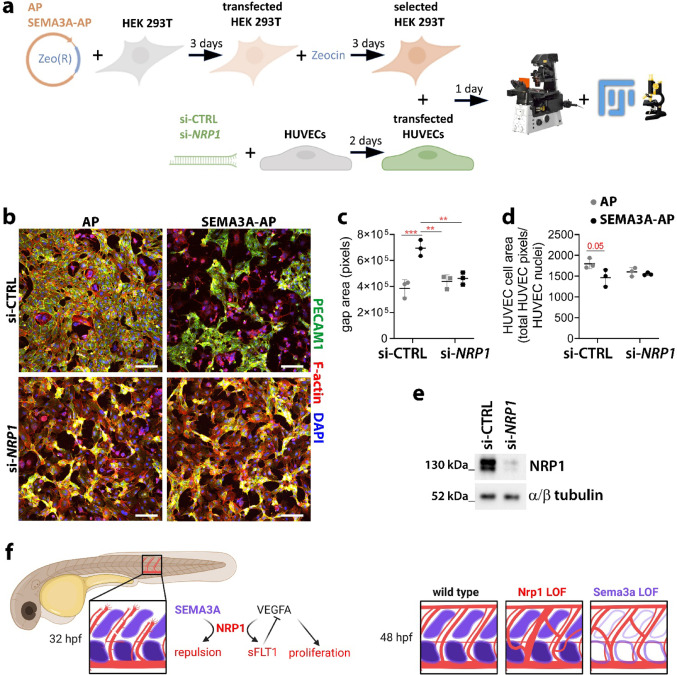
- NRP1 mediates SEMA3A repulsion in human ECs: SEMA3A-expressing HEK 293T cells repelled HUVECs, and NRP1 knockdown suppressed this repulsion; 500 ng/ml recombinant human SEMA3A reduced HUVEC proliferation over 3 days, while NRP1 silencing increased proliferation at 4 days post knockdown but not at 2 days.
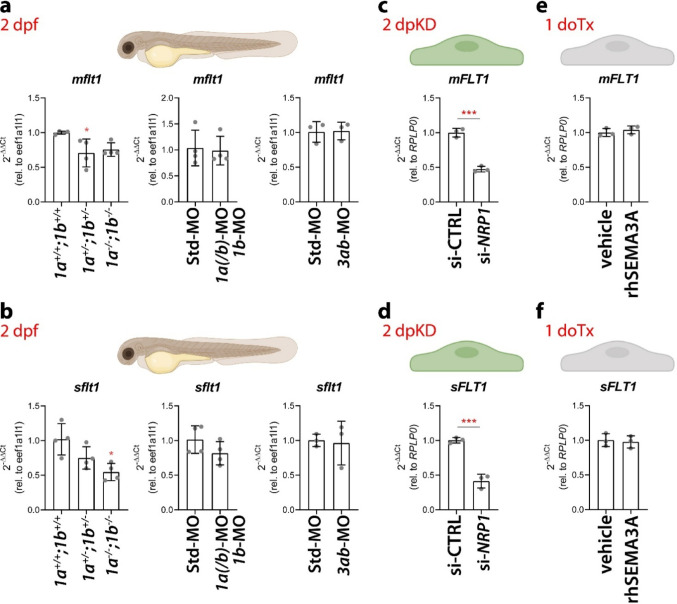
- SEMA3A and NRP1 differentially regulate FLT1: sema3ab loss or SEMA3A treatment did not alter sFLT1/mFLT1 transcripts, whereas double nrp1a/nrp1b mutants showed a dose-dependent decrease in sflt1 (significant in homozygotes), and NRP1-depleted HUVECs showed reduced sFLT1 and mFLT1 at 2 days post knockdown.
Methods
- Zebrafish experiments used Tg(fli1a:EGFP), Tg(kdrl:mCherry), and Tg(fli1a:nEGFP) lines; chimeric embryos with mosaic morpholino knockdown; refined subcritical morpholino doses; and double mutants combining nrp1asa1485 and nrp1bfh278 alleles. Analyses included confocal imaging, time-lapse imaging, whole-mount in situ hybridisation for sema3aa/sema3ab, RT-qPCR, and Western blotting.
- Human cell experiments used HUVECs transfected with scramble or NRP1 siRNA for proliferation and RT-qPCR assays, and HUVEC co-cultures with SEMA3A-AP– or AP-only–expressing HEK 293T cells for repulsion assays; recombinant human SEMA3A was used at 500 ng/ml.
- Statistical tests included Kruskal–Wallis, unpaired/paired Student-t, one-way or two-way ANOVA with Tukey’s or Sidak’s multiple comparisons, and Chi square tests, as indicated in figure legends.
Limitations
- The paper has no dedicated limitations section. The Discussion states that further investigation might address whether increased EC proliferation in double Nrp1 mutant or morphant zebrafish is accompanied by raised proangiogenic factors such as VEGFA, and notes that it remains possible that PLXND1 activation regulates sFLT1 despite the data.
- Evident from the text: the in vivo work is a zebrafish developmental model, and the human data rely on HUVEC and HEK 293T in vitro assays; morpholino-based knockdown is still used alongside mutants, although the authors refine doses and use chimeric embryos to limit off-target effects.
- Evident from the text: the study does not report direct SEMA3A–NRP1 binding assays or rescue experiments, and the proposed sFLT1 feedback mechanism is supported by transcript and proliferation data rather than direct in vivo manipulation of sFLT1.
Model-written summary. Check it against the paper before relying on it.
Integrity signals
Registry
Cites
Statistics
Figures
Verification
Claims the paper makes
0 Valid · 2 Not valid · 43 Not checked · 85 Own results and interpretations
A result the paper reports from its own data — it cites no other source for it, so there is none to check. The quote shows it is in the paper.
In the paper
“Although this was accompanied by reduced EC recruitment from either the dorsal aorta or posterior cardinal vein”
§ Neuropilin 1 (NRP1) conveys SEMA3A signals to restrict physiological angiogenesis > Results > Genetic Nrp1a and Nrp1b targeting causes ectopic ISV sprouting in the zebrafish embryo trunk
plainstates an association- Asserted: passes — The authors put it forward as true.
- Checkable: passes — It can be checked against evidence.
- Load-bearing: passes — The paper’s conclusions depend on it.
- Based: passes — The paper gives a reason why it holds.
A result the paper reports from its own data — it cites no other source for it, so there is none to check. The quote shows it is in the paper.
In the paper
“we found that NRP1 is required in human endothelial cells for SEMA3A-induced repulsion”
§ Neuropilin 1 (NRP1) conveys SEMA3A signals to restrict physiological angiogenesis > Abstract
plainstates a cause- Asserted: passes — The authors put it forward as true.
- Checkable: passes — It can be checked against evidence.
- Load-bearing: passes — The paper’s conclusions depend on it.
- Based: passes — The paper gives a reason why it holds.
A result the paper reports from its own data — it cites no other source for it, so there is none to check. The quote shows it is in the paper.
In the paper
“we found that ISVs in double morphants and double mutants were composed of a significantly higher number of ECs”
§ Neuropilin 1 (NRP1) conveys SEMA3A signals to restrict physiological angiogenesis > Results > Genetic Nrp1a and Nrp1b targeting causes ectopic ISV sprouting in the zebrafish embryo trunk
plainstates an association- Asserted: passes — The authors put it forward as true.
- Checkable: passes — It can be checked against evidence.
- Load-bearing: passes — The paper’s conclusions depend on it.
- Based: passes — The paper gives a reason why it holds.
A result the paper reports from its own data — it cites no other source for it, so there is none to check. The quote shows it is in the paper.
In the paper
“Compared to controls, double mutants showed a significantly increased number of EC mitotic events (Fig. 2d, e, Movie M4).”
§ Neuropilin 1 (NRP1) conveys SEMA3A signals to restrict physiological angiogenesis > Results > Genetic Nrp1a and Nrp1b targeting causes ectopic ISV sprouting in the zebrafish embryo trunk
plainstates an association- Asserted: passes — The authors put it forward as true.
- Checkable: passes — It can be checked against evidence.
- Load-bearing: passes — The paper’s conclusions depend on it.
- Based: passes — The paper gives a reason why it holds.
A check of a cited source is scheduled, or we don’t hold its full text yet; the claim is checked once it runs.
In the paper
“The above complementary loss-of-function strategies all showed that the ISV expansion and ectopic sprouting caused by the combined loss of Nrp1a and Nrp1b was similar to the previously described phenotype caused by loss of Sema3ab [13].”
§ Neuropilin 1 (NRP1) conveys SEMA3A signals to restrict physiological angiogenesis > Results > Sema3a expression during ISV sprouting in the zebrafish embryo trunk
What the sources say
- Not checked yetcites [13] Torres-Vazquez J et al (2004) Semaphorin-plexin signaling guides patterning of the developing vasculature. Dev Cell 7(1):117–123 15239959 source
A check is scheduled.
boostedstates a cause- Asserted: passes — The authors put it forward as true.
- Checkable: passes — It can be checked against evidence.
- Load-bearing: passes — The paper’s conclusions depend on it.
- Based: passes — The paper gives a reason why it holds.
- Not checked yet
65 more claims
Create a free account to see all 130 claims and to verify the 82 references still open.
- It may state two separate claims as one. 42
- Probably not a substantial claim. 30
Self-check
Percentages, sums and reported differences re-computed from the paper’s own numbers.
Each contradiction between two passages listed here was confirmed by an independent check.
Rated minor: it would not touch a result — a value no result rests on, a p-value that stays on the same side of the significance level, or a conflict that is clerical, resolved elsewhere in the paper, or outside its own findings.
In the paper
§ Neuropilin 1 (NRP1) conveys SEMA3A signals to restrict physiological angiogenesis > Results > Nrp1a and Nrp1b knockdown causes ectopic ISV sprouting in the zebrafish embryo trunk
“Then, we identified non-toxic doses for both MOs that did not alter ISV morphogenesis when injected singularly (subcritical doses) and co-injected them into 2 dpf Tg(kdrl:EGFP) embryos (Fig. 1a, all tested combinations are shown in Fig. S2c, d).”
§ Neuropilin 1 (NRP1) conveys SEMA3A signals to restrict physiological angiogenesis > Results > Nrp1a and Nrp1b knockdown causes ectopic ISV sprouting in the zebrafish embryo trunk
“a–c Analysis of Tg(kdrl:EGFP) zebrafish embryos that were injected at 1–4 cell stage with control standard (Std)-MO versus nrp1a(/b)-MO, nrp1b-MO and combined nrp1a(/b)-MO/nrp1b-MO at the indicated doses.”
Citations
Cites
Basic and Therapeutic Aspects of Angiogenesis
Potente, M., Gerhardt, H., & Carmeliet, P. (2011) · Cell · doi:10.1016/j.cell.2011.08.039 · Cited by 2,771
Kok, F. O., Shin, M., Ni, C.-W., Gupta, A., Grosse, A. S., van Impel, A., Kirchmaier, B. C., Peterson-Maduro, J., Kourkoulis, G., Male, I., et al. (2015) · Developmental Cell · doi:10.1016/j.devcel.2014.11.018 · Cited by 755
Neuropilin-1 Conveys Semaphorin and VEGF Signaling during Neural and Cardiovascular Development
Gu, C., Rodriguez, E. R., Reimert, D. V., Shu, T., Fritzsch, B., Richards, L. J., Kolodkin, A. L., & Ginty, D. D. (2003) · Developmental Cell · doi:10.1016/s1534-5807(03)00169-2 · Cited by 712
Class 3 semaphorins control vascular morphogenesis by inhibiting integrin function
Serini, G., Valdembri, D., Zanivan, S., Morterra, G., Burkhardt, C., Caccavari, F., Zammataro, L., Primo, L., Tamagnone, L., Logan, M., et al. (2003) · Nature · doi:10.1038/nature01784 · Cited by 576
Semaphorin-Plexin Signaling Guides Patterning of the Developing Vasculature
Torres-Vázquez, J., Gitler, A. D., Fraser, S. D., Berk, J. D., Pham, V. N., Fishman, M. C., Childs, S., Epstein, J. A., & Weinstein, B. M. (2004) · Developmental Cell · doi:10.1016/j.devcel.2004.06.008 · Cited by 367 · cited 7×
“Nevertheless, Sema3a was reported to prevent ectopic trunk vessel sprouting in the zebrafish embryo [ 13].”
InfluentialNeuropilin‐1 is required for endothelial tip cell guidance in the developing central nervous system
Gerhardt, H., Ruhrberg, C., Abramsson, A., Fujisawa, H., Shima, D., & Betsholtz, C. (2004) · Developmental Dynamics · doi:10.1002/dvdy.20148 · Cited by 267
Self-citationGuttmann-Raviv, N., Shraga-Heled, N., Varshavsky, A., Guimaraes-Sternberg, C., Kessler, O., & Neufeld, G. (2007) · Journal of Biological Chemistry · doi:10.1074/jbc.m609711200 · Cited by 233
Semaphorin 3A suppresses VEGF-mediated angiogenesis yet acts as a vascular permeability factor
Acevedo, L. M., Barillas, S., Weis, S. M., Göthert, J. R., & Cheresh, D. A. (2008) · Blood · doi:10.1182/blood-2007-08-110205 · Cited by 232
Analysis of a Zebrafish VEGF Receptor Mutant Reveals Specific Disruption of Angiogenesis
Habeck, H., Odenthal, J., Walderich, B., Maischein, H.-M., & Schulte-Merker, S. (2002) · Current Biology · doi:10.1016/s0960-9822(02)01044-8 · Cited by 229
Maione, F., Molla, F., Meda, C., Latini, R., Zentilin, L., Giacca, M., Seano, G., Serini, G., Bussolino, F., & Giraudo, E. (2009) · Journal of Clinical Investigation · doi:10.1172/jci36308 · Cited by 219
Kim, J., Oh, W.-J., Gaiano, N., Yoshida, Y., & Gu, C. (2011) · Genes & Development · doi:10.1101/gad.2042011 · Cited by 219
Lee, P., Goishi, K., Davidson, A. J., Mannix, R., Zon, L., & Klagsbrun, M. (2002) · Proceedings of the National Academy of Sciences · doi:10.1073/pnas.162366299 · Cited by 215
Fukushima, Y., Okada, M., Kataoka, H., Hirashima, M., Yoshida, Y., Mann, F., Gomi, F., Nishida, K., Nishikawa, S.-I., & Uemura, A. (2011) · Journal of Clinical Investigation · doi:10.1172/jci44900 · Cited by 207
Endometrial VEGF induces placental sFLT1 and leads to pregnancy complications
Fan, X., Rai, A., Kambham, N., Sung, J. F., Singh, N., Petitt, M., Dhal, S., Agrawal, R., Sutton, R. E., Druzin, M. L., et al. (2014) · Journal of Clinical Investigation · doi:10.1172/jci76864 · Cited by 189
Schwarz, Q., Gu, C., Fujisawa, H., Sabelko, K., Gertsenstein, M., Nagy, A., Taniguchi, M., Kolodkin, A. L., Ginty, D. D., Shima, D. T., et al. (2004) · Genes & Development · doi:10.1101/gad.322904 · Cited by 178
Self-citationFantin, A., Vieira, J. M., Plein, A., Denti, L., Fruttiger, M., Pollard, J. W., & Ruhrberg, C. (2013) · Blood · doi:10.1182/blood-2012-05-424713 · Cited by 177
Self-citationAlk1 and Alk5 inhibition by Nrp1 controls vascular sprouting downstream of Notch
Aspalter, I. M., Gordon, E., Dubrac, A., Ragab, A., Narloch, J., Vizán, P., Geudens, I., Collins, R. T., Franco, C. A., Abrahams, C. L., et al. (2015) · Nature Communications · doi:10.1038/ncomms8264 · Cited by 170
Semaphorin-PlexinD1 Signaling Limits Angiogenic Potential via the VEGF Decoy Receptor sFlt1
Zygmunt, T., Gay, C. M., Blondelle, J., Singh, M. K., Flaherty, K. M., Means, P. C., Herwig, L., Krudewig, A., Belting, H.-G., Affolter, M., et al. (2011) · Developmental Cell · doi:10.1016/j.devcel.2011.06.033 · Cited by 168
How to Plumb a Pisces: Understanding Vascular Development and Disease Using Zebrafish Embryos
Hogan, B. M., & Schulte-Merker, S. (2017) · Developmental Cell · doi:10.1016/j.devcel.2017.08.015 · Cited by 163
Gelfand, M. V., Hagan, N., Tata, A., Oh, W.-J., Lacoste, B., Kang, K.-T., Kopycinska, J., Bischoff, J., Wang, J.-H., & Gu, C. (2014) · eLife · doi:10.7554/elife.03720 · Cited by 148
Semaphorin3A, Neuropilin-1, and PlexinA1 Are Required for Lymphatic Valve Formation
Bouvrée, K., Brunet, I., del Toro, R., Gordon, E., Prahst, C., Cristofaro, B., Mathivet, T., Xu, Y., Soueid, J., Fortuna, V., et al. (2012) · Circulation Research · doi:10.1161/circresaha.112.269316 · Cited by 140
Self-citationRaimondi, C., Fantin, A., Lampropoulou, A., Denti, L., Chikh, A., & Ruhrberg, C. (2014) · Journal of Experimental Medicine · doi:10.1084/jem.20132330 · Cited by 127
Self-citationSelective requirements for NRP1 ligands during neurovascular patterning
Vieira, J. M., Schwarz, Q., & Ruhrberg, C. (2007) · Development · doi:10.1242/dev.002402 · Cited by 125
Self-citationFantin, A., Herzog, B., Mahmoud, M., Yamaji, M., Plein, A., Denti, L., Ruhrberg, C., & Zachary, I. (2014) · Development · doi:10.1242/dev.103028 · Cited by 122
Self-citationCasazza, A., Fu, X., Johansson, I., Capparuccia, L., Andersson, F., Giustacchini, A., Squadrito, M. L., Venneri, M. A., Mazzone, M., Larsson, E., et al. (2011) · Arteriosclerosis, Thrombosis, and Vascular Biology · doi:10.1161/atvbaha.110.211920 · Cited by 112
Schwarz, Q., Maden, C. H., Vieira, J. M., & Ruhrberg, C. (2009) · Proceedings of the National Academy of Sciences · doi:10.1073/pnas.0811521106 · Cited by 111
Self-citationNRP1 Regulates CDC42 Activation to Promote Filopodia Formation in Endothelial Tip Cells
Fantin, A., Lampropoulou, A., Gestri, G., Raimondi, C., Senatore, V., Zachary, I., & Ruhrberg, C. (2015) · Cell Reports · doi:10.1016/j.celrep.2015.05.018 · Cited by 107
Self-citationWang, L., Mukhopadhyay, D., Xu, X., Wang, L., Mukhopadhyay, D., & Xu, X. (2006) · The FASEB Journal · doi:10.1096/fj.05-5504fje · Cited by 107
Transcriptional adaptation: a mechanism underlying genetic robustness
Sztal, T. E., & Stainier, D. Y. R. (2020) · Development · doi:10.1242/dev.186452 · Cited by 96
NRP1 function and targeting in neurovascular development and eye disease
Raimondi, C., Brash, J. T., Fantin, A., & Ruhrberg, C. (2016) · Progress in Retinal and Eye Research · doi:10.1016/j.preteyeres.2016.02.003 · Cited by 91
Self-citationZebrafish Semaphorin Z1a collapses specific growth cones and alters their pathway in vivo
Shoji, W., Yee, C. S., & Kuwada, J. Y. (1998) · Development · doi:10.1242/dev.125.7.1275 · Cited by 90
Reidy, K. J., Villegas, G., Teichman, J., Veron, D., Shen, W., Jimenez, J., Thomas, D., & Tufro, A. (2009) · Development · doi:10.1242/dev.037267 · Cited by 88
Sema3d controls collective endothelial cell migration by distinct mechanisms via Nrp1 and PlxnD1
Hamm, M. J., Kirchmaier, B. C., & Herzog, W. (2016) · Journal of Cell Biology · doi:10.1083/jcb.201603100 · Cited by 85
Radial glia regulate vascular patterning around the developing spinal cord
Matsuoka, R. L., Marass, M., Avdesh, A., Helker, C. S., Maischein, H.-M., Grosse, A. S., Kaur, H., Lawson, N. D., Herzog, W., & Stainier, D. Y. (2016) · eLife · doi:10.7554/elife.20253 · Cited by 84
Neuronal sFlt1 and Vegfaa determine venous sprouting and spinal cord vascularization
Wild, R., Klems, A., Takamiya, M., Hayashi, Y., Strähle, U., Ando, K., Mochizuki, N., van Impel, A., Schulte-Merker, S., Krueger, J., et al. (2017) · Nature Communications · doi:10.1038/ncomms13991 · Cited by 82
Neuropilins are positive regulators of Hedgehog signal transduction
Hillman, R. T., Feng, B. Y., Ni, J., Woo, W.-M., Milenkovic, L., Hayden Gephart, M. G., Teruel, M. N., Oro, A. E., Chen, J. K., & Scott, M. P. (2011) · Genes & Development · doi:10.1101/gad.173054.111 · Cited by 76
Carrer, A., Moimas, S., Zacchigna, S., Pattarini, L., Zentilin, L., Ruozi, G., Mano, M., Sinigaglia, M., Maione, F., Serini, G., et al. (2012) · Cancer Research · doi:10.1158/0008-5472.can-12-0762 · Cited by 69
Regulation of Vegf signaling by natural and synthetic ligands
Rossi, A., Gauvrit, S., Marass, M., Pan, L., Moens, C. B., & Stainier, D. Y. R. (2016) · Blood · doi:10.1182/blood-2016-04-711192 · Cited by 68
Autocrine activity of soluble Flt-1 controls endothelial cell function and angiogenesis
Ahmad, S., Hewett, P. W., Al-Ani, B., Sissaoui, S., Fujisawa, T., Cudmore, M. J., & Ahmed, A. (2011) · Vascular Cell · doi:10.1186/2045-824x-3-15 · Cited by 62
Martyn, U., & Schulte‐Merker, S. (2004) · Developmental Dynamics · doi:10.1002/dvdy.20048 · Cited by 59
Endothelial cell-derived semaphorin 3A inhibits filopodia formation by blood vascular tip cells
Ochsenbein, A. M., Karaman, S., Proulx, S. T., Berchtold, M., Jurisic, G., Stoeckli, E. T., & Detmar, M. (2016) · Development · doi:10.1242/dev.127670 · Cited by 47
cAMP-Induced Expression of Neuropilin1 Promotes Retinal Axon Crossing in the Zebrafish Optic Chiasm
Dell, A. L., Fried-Cassorla, E., Xu, H. A., & Raper, J. A. (2013) · Journal of Neuroscience · doi:10.1523/jneurosci.0197-13.2013 · Cited by 42
Molecular cloning, expression, and activity of zebrafish semaphorin Z1a
Yee, C. S., Chandrasekhar, A., Halloran, M. C., Shoji, W., Warren, J. T., & Kuwada, J. Y. (1999) · Brain Research Bulletin · doi:10.1016/s0361-9230(99)00038-6 · Cited by 34
Delcourt, N., Quevedo, C., Nonne, C., Fons, P., O'Brien, D., Loyaux, D., Diez, M., Autelitano, F., Guillemot, J.-C., Ferrara, P., et al. (2015) · Journal of Biological Chemistry · doi:10.1074/jbc.m114.618611 · Cited by 31
SEMA6A drives GnRH neuron-dependent puberty onset by tuning median eminence vascular permeability
Lettieri, A., Oleari, R., van den Munkhof, M. H., van Battum, E. Y., Verhagen, M. G., Tacconi, C., Spreafico, M., Paganoni, A. J. J., Azzarelli, R., Andre’, V., et al. (2023) · Nature Communications · doi:10.1038/s41467-023-43820-z · Cited by 26
Self-citationLowe, V., Wisniewski, L., Sayers, J., Evans, I., Frankel, P., Mercader-Huber, N., Zachary, I. C., & Pellet-Many, C. (2019) · Development · doi:10.1242/dev.174482 · Cited by 26
Self-citationLange, M., Ohnesorge, N., Hoffmann, D., Rocha, S. F., Benedito, R., & Siekmann, A. F. (2022) · Developmental Biology · doi:10.1016/j.ydbio.2022.03.006 · Cited by 26
fused‐somites–like mutants exhibit defects in trunk vessel patterning
Shaw, K. M., Castranova, D. A., Pham, V. N., Kamei, M., Kidd, K. R., Lo, B. D., Torres‐Vasquez, J., Ruby, A., & Weinstein, B. M. (2006) · Developmental Dynamics · doi:10.1002/dvdy.20814 · Cited by 23
Taku, A. A., Marcaccio, C. L., Ye, W., Krause, G. J., & Raper, J. A. (2016) · Development · doi:10.1242/dev.127985 · Cited by 17
Lowe, V., Wisniewski, L., Fernando-Sayers, J., Frankel, P., Mercader, N., Zachary, I. C., & Pellet‐Many, C. (2018) · bioRxiv (Cold Spring Harbor Laboratory) · doi:10.1101/468504 · Cited by 5
Self-citationWu, L.-F., Zhang, J.-J., Zhang, X., Wang, D.-P., Zheng, Z.-F., Shen, J., Zhou, Y., Gao, L.-J., Shang, X., Ning, J.-Y., et al. (2025) · Angiogenesis · doi:10.1007/s10456-025-09992-6 · Cited by 4
(2013) · PubMed Central
Research works printed but not linked: 1
- Moore KH et al (2019) sFlt-1 production in endothelial cells is regulated in part by VEGF receptor signaling. FASEB J 33(IssueS1):865.11
Cited by
Still being checked.
Metadata
- Authors
- Spreafico, M., Guzzolino, E., Fanuele, F., Gestri, G., Tacconi, C., Palermo, S., Tricco, M., Catroppa, V., Aiypova, A., Denti, L., Pellet-Many, C., Ruhrberg, C., & Fantin, A.
- Affiliations
- University of Milan (IT)
- University College London (GB)
- Vita-Salute San Raffaele University (IT)
- Royal Veterinary College (GB)
- Corresponding author
- Fantin, Alessandro
- ORCID
- Venue
- Angiogenesis
- Published
- 2026-05-03
- Volume
- 29
- Issue
- 3
- Pages
- 31
- ISSN
- 0969-6970 (ISSN-L)
- 1573-7209
- PMC
- PMC13136202
- OpenAlex
- W4410831685
- Cited by
- 3
- References
- 52
- Citations by year
- 2026: 3
- FWCI
- 3.67
- Type
- journal article
- Language
- en
- Open access
- hybrid
- doi.org
- Licence
- cc-by
- creativecommons.org/licenses/by/4.0 (tdm)
- creativecommons.org/licenses/by/4.0 (vor)
- Locations
- Angiogenesis (publishedVersion, cc-by)
- Research Square (submittedVersion, cc-by)
- PubMed Central (publishedVersion, cc-by)
- PubMed (publishedVersion)
- Archivio Istituzionale della Ricerca (Universita Degli Studi Di Milano) (submittedVersion, cc-by)
- Archivio Istituzionale della Ricerca (Universita Degli Studi Di Milano) (submittedVersion, other-oa)
- Funders
- Università degli Studi di Milano
- Topics
- Life Sciences › Neuroscience › Cellular and Molecular Neuroscience › Axon Guidance and Neuronal Signaling
- Life Sciences › Biochemistry, Genetics and Molecular Biology › Molecular Biology › Angiogenesis and VEGF in Cancer
- Life Sciences › Biochemistry, Genetics and Molecular Biology › Molecular Biology › Developmental Biology and Gene Regulation
- Keywords
- neuropilin-1, semaphorin 3A, semaphorin signaling, vascular morphogenesis, soluble Flt-1, PlexinD1, axon guidance, endothelial cell proliferation
- MeSH terms
- Animals, Humans, Zebrafish, Signal Transduction, Neovascularization, Physiologic, Zebrafish Proteins, Neuropilin-1, Semaphorin-3A, Endothelial Cells
About these checks
Registry, retraction, Cites and statistics results are computed, not judged, with one exception: a printed reference that no index lists is read once by a model before it counts as a citation error. Claims are extracted by a model and kept only when their quote appears verbatim in the text; each cited source is then checked, with a model’s help, for whether it says what the claim relies on. Those verdicts can be wrong — read the claim’s quote and the cited source before relying on one.
A language model drew the claims from the paper on 2026-11-25, under version 3 of the claim definition (model deepseek-v4.1-flash, prompt extract-v3).
A second model labelled each claim on 2026-11-25 (model jev-1.13-20260917, definition revision gold-guideline-v0.2).
Statistics and arithmetic are recomputed, not judged.
Confidence bands are shown only for fields calibrated on our annotated test set. None is calibrated yet, so no band is shown.
What counts as a claim ›How we measure confidence ›How we check this ›
Are you an author, or do you see a problem with this page? Request a review
Data sources
Bibliographic data: Semantic Scholar, OpenAlex, Crossref.
Contains information from the Semantic Scholar Academic Graph Datasets, made available under the ODC Attribution License (ODC-BY 1.0).
Semantic Scholar’s data is described in: Kinney, R., et al. (2023). The Semantic Scholar Open Data Platform. arXiv:2301.10140.
