

The DOI matches its Crossref record; 87 of the 87 references it cites were found in a registry or an index; 27 of the 102 sources its claims cite were checked for support.
Deepfakes: current and future trends
Open accessAbstract
Advances in Deep Learning (DL), Big Data and image processing have facilitated online disinformation spreading through Deepfakes. This entails severe threats including public opinion manipulation, geopolitical tensions, chaos in financial markets, scams, defamation and identity theft among others. Therefore, it is imperative to develop techniques to prevent, detect, and stop the spreading of deepfake content. Along these lines, the goal of this paper is to present a big picture perspective of the deepfake paradigm, by reviewing current and future trends.
Overview
CoChat Summary
TL;DR
This paper is a broad review of deepfakes, covering deep learning foundations, generation vs. detection, blockchain-based authentication, application scenarios, and future research directions. Its central message is that detection alone is insufficient; progress depends on better datasets, robustness/generalization, authentication, and integrated systems.
Key findings
- The paper frames deepfakes as a growing threat to online disinformation, with harms including “public opinion manipulation, geopolitical tensions, chaos in financial markets, scams, defamation and identity theft.”
- For deepfake generation, it highlights that current models need large data volumes, struggle with pose variation, illumination changes, occlusions, and temporal coherence, and that existing datasets often lack sufficient diversity and ultra-high-resolution images.
- For detection, the paper states that current methods are “not yet ready for realworld applications” and still face scalability, generalization, robustness, and time-efficiency problems.
- In the social-media case studies, it reports that in one Twitter study, journalists and media organizations made up “half of those participating in disseminating deep fakes,” and in another, politically interested people with poor cognitive ability were more likely to unintentionally spread deepfakes.
- The paper argues blockchain can help provide proof of authenticity, but notes that “most of the current proposals lack practical implementations” and that many cryptographic-hash approaches are sensitive to noise and vulnerable to quantum attacks.
Methods
- Narrative review / survey paper synthesizing literature on deepfake generation, detection, authentication, application scenarios, and future trends.
- It organizes the discussion around deep learning architectures, a state-of-the-art review of prior surveys, blockchain-based authentication, social-network scenarios, IoT scenarios, open challenges, and future directions.
- The analysis is qualitative and comparative, drawing on prior surveys, reported datasets, and example methods rather than presenting new experimental results.
Limitations
- The paper explicitly says it is not a comprehensive survey of every deepfake work; it focuses on “highest-impact reviews” in image, video, and audio.
- It also states that some sections, especially on authentication and IoT, are not exhaustive and are meant to highlight key references and open challenges rather than cover the entire literature.
- Evident from the text: it is a review article with no new dataset, benchmark, or original experimental evaluation, so its conclusions depend on the coverage and quality of the cited literature.
Model-written summary. Check it against the paper before relying on it.
Integrity signals
Registry
Cites
Statistics
Figures

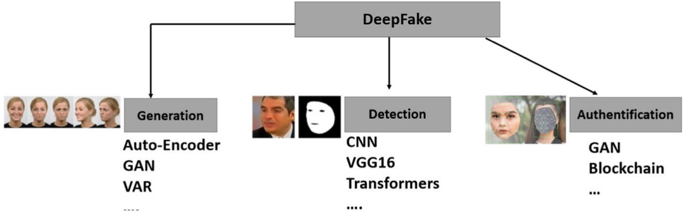
Verification
Claims the paper makes
25 Valid · 23 Not valid · 75 Not checked · 75 Own results and interpretations
Every source the paper cites for this claim was checked and supports it.
In the paper
“The authors emphasize that deepfakes extend beyond human visuals, impacting domains such as healthcare, social media, and finances, highlighting the need to address a wide range of potential risks.”
§ Deepfakes: current and future trends > 3.1 State of the art
What the sources say
- Supportedcites Mirsky and Lee 2021 source
Section 7.3 (p. 32) explicitly says deepfakes extend beyond human visuals and gives examples involving medical scans, financial records, and tweets and news articles. It also describes risks including fraud, scams, and sabotage. (LLM, conf=0.94)
plainstates an association- Asserted: passes — The authors put it forward as true.
- Checkable: passes — It can be checked against evidence.
- Load-bearing: unclear — It is unclear whether the paper’s conclusions depend on it.
- Based: passes — The paper gives a reason why it holds.
- Supported
Every source the paper cites for this claim was checked and supports it.
In the paper
“Remarkably, deepfakes can even be employed to generate counterfeit satellite earth images with military implications (Nguyen et al. 2019).”
§ Deepfakes: current and future trends > 1 Introduction
What the sources say
- Supportedcites Nguyen et al. 2019 source
The Introduction states that deepfakes can be used to generate fake satellite images of Earth containing nonexistent objects to confuse military analysts. It gives a fictitious bridge that could mislead troops as an example, directly supporting the claimed military implications. (LLM, conf=0.95)
plainstates a cause- Asserted: passes — The authors put it forward as true.
- Checkable: passes — It can be checked against evidence.
- Load-bearing: unclear — It is unclear whether the paper’s conclusions depend on it.
- Based: passes — The paper gives a reason why it holds.
- Supported
Every source the paper cites for this claim was checked and supports it.
In the paper
“According to their findings, a wide range of detectors based on ML or DL approaches and transformer-based utilizing transfer learning) had more trouble successfully identifying a deepfake tweet than a tweet that was actually produced by a human.”
§ Deepfakes: current and future trends > 5.1 Online social networks
What the sources say
- Supportedcites Fagni et al. 2021 source
The Discussion directly states that the tested machine-learning, deep-learning, and transfer-learning transformer detectors had greater difficulty correctly detecting deepfake tweets than human-written tweets. It notes that this was especially true for GPT-2-generated tweets. (LLM, conf=0.95)
plain- Asserted: passes — The authors put it forward as true.
- Checkable: passes — It can be checked against evidence.
- Load-bearing: passes — The paper’s conclusions depend on it.
- Based: passes — The paper gives a reason why it holds.
- Supported
Every source the paper cites for this claim was checked and supports it.
In the paper
“Their findings demonstrate that Botometer ratings are inaccurate for estimating bots, particularly when used in an alternate language.”
§ Deepfakes: current and future trends > 6.1 Concluding remarks
What the sources say
- Supportedcites Rauchfleisch and Kaiser 2020 source
The paper reports that Botometer scores are imprecise for estimating bots, especially in a different language (Abstract). Its Results also find poorer performance for mainly non-English accounts and a higher false-positive rate for German accounts. (LLM, conf=0.94)
boosted- Asserted: passes — The authors put it forward as true.
- Checkable: passes — It can be checked against evidence.
- Load-bearing: unclear — It is unclear whether the paper’s conclusions depend on it.
- Based: passes — The paper gives a reason why it holds.
- Supported
Every source the paper cites for this claim was checked and supports it.
In the paper
“They also demonstrate that Botometer's limits, even when applied very conservatively, are subject to fluctuation, which can result in both false positives and false negatives (i.e., the classification of humans as bots) and false negatives (i.e., the classification of bots as humans).”
§ Deepfakes: current and future trends > 6.1 Concluding remarks
What the sources say
- Supportedcites Rauchfleisch and Kaiser 2020 source
The Results report that Botometer scores changed substantially over time. The Discussion says that false-positive and false-negative rates at specific thresholds, along with vulnerability to temporal changes, call its classifications into question. The citing sentence appears to mislabel humans classified as bots as “false negatives,” but the attributed finding is supported. (LLM, conf=0.92)
plainstates a cause- Asserted: passes — The authors put it forward as true.
- Checkable: passes — It can be checked against evidence.
- Load-bearing: passes — The paper’s conclusions depend on it.
- Based: passes — The paper gives a reason why it holds.
- Supported
44 more claims · 1 with their cited sources checked
Create a free account to see all 198 claims and to verify the 12 references still open.
- Probably not a substantial claim. 134
- It may state two separate claims as one. 38
- The quote only partly states this claim. 1
Claims other papers make about this one
Each is checked against this paper’s own text: does it say what the citing paper says it does?
The cited source says what the claim attributes to it.
In the citing paper
“Model training requires large, high-quality datasets, and very often high computational complexity [17].”
From Deepfake-Enabled Infiltration: The Threat of Synthetic Identities in Corporate Environments (2026) · cites this paper as [17]
Self-check
Percentages, sums and reported differences re-computed from the paper’s own numbers.
Each contradiction between two passages listed here was confirmed by an independent check.
Rated minor: it would not touch a result — a value no result rests on, a p-value that stays on the same side of the significance level, or a conflict that is clerical, resolved elsewhere in the paper, or outside its own findings.
In the paper
§ Deepfakes: current and future trends > 2.1 Deep learning architectures
“General Adversarial Networks (GANs) were the first used to build up deepfakes.”
§ Deepfakes: current and future trends > 2.1.5 General adversarial networks
“The concept of a General Adversarial Network was first introduced in 2014 Goodfellow et al. (2014), inspired by the zero-sum game from game theory.A GAN consists of two (deep) ANNs pitting one against the other: a generator and a discriminator, learning at the same time.”
Citations
Cites
Hochreiter, S., & Schmidhuber, J. (1997) · Neural Computation · doi:10.1162/neco.1997.9.8.1735 · Cited by 102,318
Learning Phrase Representations using RNN Encoder–Decoder for Statistical Machine Translation
Cho, K., van Merrienboer, B., Gulcehre, C., Bahdanau, D., Bougares, F., Schwenk, H., & Bengio, Y. (2014) · Proceedings of the 2014 Conference on Empirical Methods in Natural Language Processing (EMNLP) · doi:10.3115/v1/d14-1179 · Cited by 25,545
A survey on Image Data Augmentation for Deep Learning
Shorten, C., & Khoshgoftaar, T. M. (2019) · Journal of Big Data · doi:10.1186/s40537-019-0197-0 · Cited by 13,203 · cited 2×
“It encompasses a suite of techniques that enhance the size and quality of training datasets (Shorten and Khoshgoftaar 2019).”
Peeking Inside the Black-Box: A Survey on Explainable Artificial Intelligence (XAI)
Adadi, A., & Berrada, M. (2018) · IEEE Access · doi:10.1109/access.2018.2870052 · Cited by 6,294
Deep learning and process understanding for data-driven Earth system science
Reichstein, M., Camps-Valls, G., Stevens, B., Jung, M., Denzler, J., Carvalhais, N., & Prabhat (2019) · Nature · doi:10.1038/s41586-019-0912-1 · Cited by 5,673
Generative Adversarial Networks
Goodfellow, I. J., Pouget-Abadie, J., Mirza, M., Xu, B., Warde-Farley, D., Ozair, S., Courville, A., & Bengio, Y. (2014) · arXiv · doi:10.48550/arxiv.1406.2661 · Cited by 4,477
A review on the attention mechanism of deep learning
Niu, Z., Zhong, G., & Yu, H. (2021) · Neurocomputing · doi:10.1016/j.neucom.2021.03.091 · Cited by 3,379
The Effectiveness of Data Augmentation in Image Classification using Deep Learning
Perez, L., & Wang, J. (2017) · arXiv · doi:10.48550/arxiv.1712.04621 · Cited by 2,499
Edge Intelligence: Paving the Last Mile of Artificial Intelligence With Edge Computing
Zhou, Z., Chen, X., Li, E., Zeng, L., Luo, K., & Zhang, J. (2019) · Proceedings of the IEEE · doi:10.1109/jproc.2019.2918951 · Cited by 2,455 · cited 2×
“Edge Intelligence (EI) Zhou et al. (2019) proposes a new paradigm combining AI and edge computing, with the goal of performing distributed computing of DL models.”
Knowledge vault: a web-scale approach to probabilistic knowledge fusion
Dong, X., Gabrilovich, E., Heitz, G., Horn, W., Lao, N., Murphy, K., Strohmann, T., Sun, S., & Zhang, W. (2014) · Proceedings of the 20th ACM SIGKDD international conference on Knowledge discovery and data mining · doi:10.1145/2623330.2623623 · Cited by 1,533
Research works printed but not linked: 8
- Gallwitz F, Kreil M (2021) The rise and fall of ‘social bot’research. SSRN: https://ssrn.com/abstract, vol 3814191
- Goodfellow I, Bengio Y, Courville A, Bengio Y (2016) Deep learning. MIT press, Cambridge, p 2
- Hasanaj E, Aveler A, Söder W (2021) Cooperative edge deepfake detection. Master’s thesis, Jönköping University, School of Engineering
- Mjaaland H (2020) Detecting fake news and rumors in twitter using deep neural networks. Master’s thesis, University of Stavanger, Norway
- Ryabchuk N (2020) Artificial intelligence technologies using in social engineering attacks. In: CEUR workshop proceedings, vol 2654. Kiev, Ukraine, pp 546–555
- Sadr MM et al (2021) The use of LSTM neural network to detect fake news on persian Twitter. Tur J Comput Math Educ 12(11):6658–6668
- Van Lent M, Fisher W, Mancuso M (2004) An explainable artificial intelligence system for small-unit tactical behavior. In: Proceedings of the national conference on artificial intelligence. minus. Menlo Park, San Jose; MIT Press, Cambridge; AAAI Press, London, pp 900–907
- Vaswani A, Shazeer N, Parmar N, Uszkoreit J, Jones L, Gomez AN, Kaiser Ł, Polosukhin I (2017) Attention is all you need. In: Advances in neural information processing systems, Long Beach, CA, USA, pp 5998–6008
Cited by
Deepfake video detection: challenges and opportunities
Kaur, A., Noori Hoshyar, A., Saikrishna, V., Firmin, S., & Xia, F. (2024) · Artificial Intelligence Review · doi:10.1007/s10462-024-10810-6 · Cited by 214
“Gambín et al. (2024) emphasises that collaboration among researchers, governments, and business organisations is essential to create and implement successful deepfake detection and prevention strategies.”
Digital deception: generative artificial intelligence in social engineering and phishing
Schmitt, M., & Flechais, I. (2024) · Artificial Intelligence Review · doi:10.1007/s10462-024-10973-2 · Cited by 198
Achuthan, K., Ramanathan, S., Srinivas, S., & Raghu Raman, R. (2024) · Frontiers in Big Data · doi:10.3389/fdata.2024.1497535 · Cited by 192
Jabir, R. M., Le, J., & Nguyen, C. (2025) · AI · doi:10.3390/ai6080174 · Cited by 84
Managing deepfakes with artificial intelligence: Introducing the business privacy calculus
Vecchietti, G., Liyanaarachchi, G., & Viglia, G. (2024) · Journal of Business Research · doi:10.1016/j.jbusres.2024.115010 · Cited by 52
Metadata
- Authors
- Gambín, Á. F., Yazidi, A., Vasilakos, A., Haugerud, H., & Djenouri, Y.
- Affiliations
- OsloMet – Oslo Metropolitan University (NO)
- University of Agder (NO)
- University of South-Eastern Norway (NO)
- Corresponding author
- Djenouri, Youcef
- Venue
- Artificial Intelligence Review
- Published
- 2024-02-19
- Volume
- 57
- Issue
- 3
- ISSN
- 0269-2821 (ISSN-L)
- 1573-7462
- OpenAlex
- W4391931465
- Cited by
- 145
- References
- 76
- Citations by year
- 2026: 61 · 2025: 57 · 2024: 27
- FWCI
- 20.20
- Type
- journal article
- Language
- en
- Open access
- hybrid
- doi.org
- Licence
- cc-by
- creativecommons.org/licenses/by/4.0 (tdm)
- creativecommons.org/licenses/by/4.0 (vor)
- Locations
- Artificial Intelligence Review (publishedVersion, cc-by)
- NORA - Norwegian Open Research Archives (submittedVersion, cc-by)
- Funders
- University Of South-Eastern Norway
- Topics
- Physical Sciences › Computer Science › Computer Vision and Pattern Recognition › Digital Media Forensic Detection
- Social Sciences › Sociology and Political Science › Misinformation and Its Impacts
- Physical Sciences › Computer Science › Computer Vision and Pattern Recognition › Generative Adversarial Networks and Image Synthesis
- Keywords
- deepfakes, disinformation, deepfake detection, deepfake generation, deep learning, blockchain, distributed ledger technology, cybersecurity, digital deception, social engineering attacks, Internet of Things, public opinion manipulation, identity theft, defamation
About these checks
Registry, retraction, Cites and statistics results are computed, not judged, with one exception: a printed reference that no index lists is read once by a model before it counts as a citation error. Claims are extracted by a model and kept only when their quote appears verbatim in the text; each cited source is then checked, with a model’s help, for whether it says what the claim relies on. Those verdicts can be wrong — read the claim’s quote and the cited source before relying on one.
The claim verdicts this report counts are experimental: their accuracy is not yet measured.
A language model drew the claims from the paper on 2026-10-10, under version 3 of the claim definition (model deepseek-v4.1-flash, prompt extract-v3).
A second model labelled each claim on 2026-10-10 (model jev-1.13-20260917, definition revision gold-guideline-v0.2).
Cited sources are checked with a language model’s help (gpt-6-sol).
Statistics and arithmetic are recomputed, not judged.
Confidence bands are shown only for fields calibrated on our annotated test set. None is calibrated yet, so no band is shown.
What counts as a claim ›How we measure confidence ›How we check this ›
Are you an author, or do you see a problem with this page? Request a review
How to cite
Cite CoChat for the checks on this page, and the paper for its own findings.
- This page
- CoChat. (2026). Citation check: Deepfakes: current and future trends. https://app.cochat.ai/papers/10.1007/s10462-023-10679-x
- The paper
- Gambín, Á. F., Yazidi, A., Vasilakos, A., Haugerud, H., & Djenouri, Y. (2024). Deepfakes: current and future trends. Artificial Intelligence Review. https://doi.org/10.1007/s10462-023-10679-x
Data sources
Bibliographic data: Semantic Scholar, OpenAlex, Crossref.
Contains information from the Semantic Scholar Academic Graph Datasets, made available under the ODC Attribution License (ODC-BY 1.0).
Semantic Scholar’s data is described in: Kinney, R., et al. (2023). The Semantic Scholar Open Data Platform. arXiv:2301.10140.
