

Deepfakes: current and future trends
Open accessThe DOI matches its Crossref record; 80 of the 87 references it cites were found in a registry or an index, and 6 are not checked yet; 27 of the 102 sources its claims cite were checked for support.
Abstract
Advances in Deep Learning (DL), Big Data and image processing have facilitated online disinformation spreading through Deepfakes. This entails severe threats including public opinion manipulation, geopolitical tensions, chaos in financial markets, scams, defamation and identity theft among others. Therefore, it is imperative to develop techniques to prevent, detect, and stop the spreading of deepfake content. Along these lines, the goal of this paper is to present a big picture perspective of the deepfake paradigm, by reviewing current and future trends.
Verified 2026-11-25 · 6 references not checked yet
Overview
CoChat Summary
TL;DR
This paper is a broad review of deepfakes, covering deep learning foundations, generation vs. detection, blockchain-based authentication, application scenarios, and future research directions. Its central message is that detection alone is insufficient; progress depends on better datasets, robustness/generalization, authentication, and integrated systems.
Key findings
- The paper frames deepfakes as a growing threat to online disinformation, with harms including “public opinion manipulation, geopolitical tensions, chaos in financial markets, scams, defamation and identity theft.”
- For deepfake generation, it highlights that current models need large data volumes, struggle with pose variation, illumination changes, occlusions, and temporal coherence, and that existing datasets often lack sufficient diversity and ultra-high-resolution images.
- For detection, the paper states that current methods are “not yet ready for realworld applications” and still face scalability, generalization, robustness, and time-efficiency problems.
- In the social-media case studies, it reports that in one Twitter study, journalists and media organizations made up “half of those participating in disseminating deep fakes,” and in another, politically interested people with poor cognitive ability were more likely to unintentionally spread deepfakes.
- The paper argues blockchain can help provide proof of authenticity, but notes that “most of the current proposals lack practical implementations” and that many cryptographic-hash approaches are sensitive to noise and vulnerable to quantum attacks.
Methods
- Narrative review / survey paper synthesizing literature on deepfake generation, detection, authentication, application scenarios, and future trends.
- It organizes the discussion around deep learning architectures, a state-of-the-art review of prior surveys, blockchain-based authentication, social-network scenarios, IoT scenarios, open challenges, and future directions.
- The analysis is qualitative and comparative, drawing on prior surveys, reported datasets, and example methods rather than presenting new experimental results.
Limitations
- The paper explicitly says it is not a comprehensive survey of every deepfake work; it focuses on “highest-impact reviews” in image, video, and audio.
- It also states that some sections, especially on authentication and IoT, are not exhaustive and are meant to highlight key references and open challenges rather than cover the entire literature.
- Evident from the text: it is a review article with no new dataset, benchmark, or original experimental evaluation, so its conclusions depend on the coverage and quality of the cited literature.
Model-written summary. Check it against the paper before relying on it.
Integrity signals
Registry
Cites
Statistics
Figures

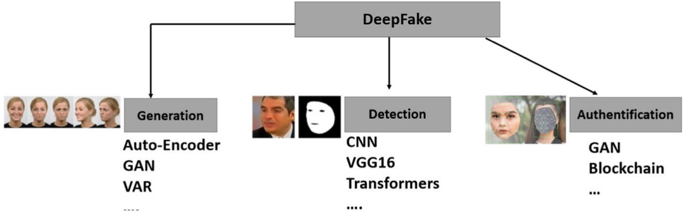
Verification
Claims the paper makes
25 Valid · 23 Not valid · 75 Not checked · 75 Own results and interpretations
Every source the paper cites for this claim was checked and supports it.
In the paper
“The authors emphasize that deepfakes extend beyond human visuals, impacting domains such as healthcare, social media, and finances, highlighting the need to address a wide range of potential risks.”
§ Deepfakes: current and future trends > 3.1 State of the art
What the sources say
- Supportedcites Mirsky and Lee 2021 matched to “The Creation and Detection of Deepfakes: A Survey” (2022) source
Section 7.3 (p. 32) explicitly says deepfakes extend beyond human visuals and gives examples involving medical scans, financial records, and tweets and news articles. It also describes risks including fraud, scams, and sabotage. (LLM, conf=0.94)
plainstates an association- Asserted: passes — The authors put it forward as true.
- Checkable: passes — It can be checked against evidence.
- Load-bearing: unclear — It is unclear whether the paper’s conclusions depend on it.
- Based: passes — The paper gives a reason why it holds.
- Supported
Every source the paper cites for this claim was checked and supports it.
In the paper
“Remarkably, deepfakes can even be employed to generate counterfeit satellite earth images with military implications (Nguyen et al. 2019).”
§ Deepfakes: current and future trends > 1 Introduction
What the sources say
- Supportedcites Nguyen et al. 2019 matched to “Deep Learning for Deepfakes Creation and Detection: A Survey” (2019) source
The Introduction states that deepfakes can be used to generate fake satellite images of Earth containing nonexistent objects to confuse military analysts. It gives a fictitious bridge that could mislead troops as an example, directly supporting the claimed military implications. (LLM, conf=0.95)
plainstates a cause- Asserted: passes — The authors put it forward as true.
- Checkable: passes — It can be checked against evidence.
- Load-bearing: unclear — It is unclear whether the paper’s conclusions depend on it.
- Based: passes — The paper gives a reason why it holds.
- Supported
Every source the paper cites for this claim was checked and supports it.
In the paper
“According to their findings, a wide range of detectors based on ML or DL approaches and transformer-based utilizing transfer learning) had more trouble successfully identifying a deepfake tweet than a tweet that was actually produced by a human.”
§ Deepfakes: current and future trends > 5.1 Online social networks
What the sources say
- Supportedcites Fagni et al. 2021 matched to “TweepFake: about detecting deepfake tweets” (2021) source
The Discussion directly states that the tested machine-learning, deep-learning, and transfer-learning transformer detectors had greater difficulty correctly detecting deepfake tweets than human-written tweets. It notes that this was especially true for GPT-2-generated tweets. (LLM, conf=0.95)
plain- Asserted: passes — The authors put it forward as true.
- Checkable: passes — It can be checked against evidence.
- Load-bearing: passes — The paper’s conclusions depend on it.
- Based: passes — The paper gives a reason why it holds.
- Supported
Every source the paper cites for this claim was checked and supports it.
In the paper
“Their findings demonstrate that Botometer ratings are inaccurate for estimating bots, particularly when used in an alternate language.”
§ Deepfakes: current and future trends > 6.1 Concluding remarks
What the sources say
- Supportedcites Rauchfleisch and Kaiser 2020 matched to “The False positive problem of automatic bot detection in social science research” (2020) source
The paper reports that Botometer scores are imprecise for estimating bots, especially in a different language (Abstract). Its Results also find poorer performance for mainly non-English accounts and a higher false-positive rate for German accounts. (LLM, conf=0.94)
boosted- Asserted: passes — The authors put it forward as true.
- Checkable: passes — It can be checked against evidence.
- Load-bearing: unclear — It is unclear whether the paper’s conclusions depend on it.
- Based: passes — The paper gives a reason why it holds.
- Supported
Every source the paper cites for this claim was checked and supports it.
In the paper
“They also demonstrate that Botometer's limits, even when applied very conservatively, are subject to fluctuation, which can result in both false positives and false negatives (i.e., the classification of humans as bots) and false negatives (i.e., the classification of bots as humans).”
§ Deepfakes: current and future trends > 6.1 Concluding remarks
What the sources say
- Supportedcites Rauchfleisch and Kaiser 2020 matched to “The False positive problem of automatic bot detection in social science research” (2020) source
The Results report that Botometer scores changed substantially over time. The Discussion says that false-positive and false-negative rates at specific thresholds, along with vulnerability to temporal changes, call its classifications into question. The citing sentence appears to mislabel humans classified as bots as “false negatives,” but the attributed finding is supported. (LLM, conf=0.92)
plainstates a cause- Asserted: passes — The authors put it forward as true.
- Checkable: passes — It can be checked against evidence.
- Load-bearing: passes — The paper’s conclusions depend on it.
- Based: passes — The paper gives a reason why it holds.
- Supported
44 more claims · 1 with their cited sources checked
Create a free account to see all 198 claims and to verify the 35 references still open.
- Probably not a substantial claim. 134
- It may state two separate claims as one. 38
- The quote only partly states this claim. 1
Claims other papers make about this one
Each is checked against this paper’s own text: does it say what the citing paper says it does?
The cited source says what the claim attributes to it.
In the citing paper
“Model training requires large, high-quality datasets, and very often high computational complexity [17].”
From Deepfake-Enabled Infiltration: The Threat of Synthetic Identities in Corporate Environments (2026) · cites this paper as [17]
Self-check
Percentages, sums and reported differences re-computed from the paper’s own numbers.
Each contradiction between two passages listed here was confirmed by an independent check.
Rated minor: it would not touch a result — a value no result rests on, a p-value that stays on the same side of the significance level, or a conflict that is clerical, resolved elsewhere in the paper, or outside its own findings.
In the paper
§ Deepfakes: current and future trends > 2.1 Deep learning architectures
“General Adversarial Networks (GANs) were the first used to build up deepfakes.”
§ Deepfakes: current and future trends > 2.1.5 General adversarial networks
“The concept of a General Adversarial Network was first introduced in 2014 Goodfellow et al. (2014), inspired by the zero-sum game from game theory.A GAN consists of two (deep) ANNs pitting one against the other: a generator and a discriminator, learning at the same time.”
Citations
Cites
Hochreiter, S., & Schmidhuber, J. (1997) · Neural Computation · doi:10.1162/neco.1997.9.8.1735 · Cited by 102,318
Learning Phrase Representations using RNN Encoder–Decoder for Statistical Machine Translation
Cho, K., van Merrienboer, B., Gulcehre, C., Bahdanau, D., Bougares, F., Schwenk, H., & Bengio, Y. (2014) · Proceedings of the 2014 Conference on Empirical Methods in Natural Language Processing (EMNLP) · doi:10.3115/v1/d14-1179 · Cited by 25,545
A survey on Image Data Augmentation for Deep Learning
Shorten, C., & Khoshgoftaar, T. M. (2019) · Journal of Big Data · doi:10.1186/s40537-019-0197-0 · Cited by 13,203 · cited 2×
“It encompasses a suite of techniques that enhance the size and quality of training datasets (Shorten and Khoshgoftaar 2019).”
Peeking Inside the Black-Box: A Survey on Explainable Artificial Intelligence (XAI)
Adadi, A., & Berrada, M. (2018) · IEEE Access · doi:10.1109/access.2018.2870052 · Cited by 6,294
Deep learning and process understanding for data-driven Earth system science
Reichstein, M., Camps-Valls, G., Stevens, B., Jung, M., Denzler, J., Carvalhais, N., & Prabhat (2019) · Nature · doi:10.1038/s41586-019-0912-1 · Cited by 5,673
Generative Adversarial Networks
Goodfellow, I. J., Pouget-Abadie, J., Mirza, M., Xu, B., Warde-Farley, D., Ozair, S., Courville, A., & Bengio, Y. (2014) · arXiv · doi:10.48550/arxiv.1406.2661 · Cited by 4,477
A review on the attention mechanism of deep learning
Niu, Z., Zhong, G., & Yu, H. (2021) · Neurocomputing · doi:10.1016/j.neucom.2021.03.091 · Cited by 3,379
The Effectiveness of Data Augmentation in Image Classification using Deep Learning
Perez, L., & Wang, J. (2017) · arXiv · doi:10.48550/arxiv.1712.04621 · Cited by 2,499 · cited 1×
“Further Further information can be found in Shorten and Khoshgoftaar (2019) and Perez and Wang (2017).”
Edge Intelligence: Paving the Last Mile of Artificial Intelligence With Edge Computing
Zhou, Z., Chen, X., Li, E., Zeng, L., Luo, K., & Zhang, J. (2019) · Proceedings of the IEEE · doi:10.1109/jproc.2019.2918951 · Cited by 2,455 · cited 2×
“Edge Intelligence (EI) Zhou et al. (2019) proposes a new paradigm combining AI and edge computing, with the goal of performing distributed computing of DL models.”
Knowledge vault: a web-scale approach to probabilistic knowledge fusion
Dong, X., Gabrilovich, E., Heitz, G., Horn, W., Lao, N., Murphy, K., Strohmann, T., Sun, S., & Zhang, W. (2014) · Proceedings of the 20th ACM SIGKDD international conference on Knowledge discovery and data mining · doi:10.1145/2623330.2623623 · Cited by 1,533
A Survey of Machine and Deep Learning Methods for Internet of Things (IoT) Security
Al-Garadi, M. A., Mohamed, A., Al-Ali, A. K., Du, X., Ali, I., & Guizani, M. (2020) · IEEE Communications Surveys & Tutorials · doi:10.1109/comst.2020.2988293 · Cited by 1,392 · cited 3×
“A comprehensive survey of Machine Learning (ML) methods and recent advances in DL used to develop enhanced security within IoT systems is presented in Al-Garadi et al. (2020).”
InfluentialDeepFakes and Beyond: A Survey of Face Manipulation and Fake Detection
Tolosana, R., Vera-Rodríguez, R., Fierrez, J., Morales, A., & Ortega-García, J. (2020) · Information Fusion · doi:10.48550/arxiv.2001.00179 · Cited by 1,252
Shi, W., & Dustdar, S. (2016) · Computer · doi:10.1109/mc.2016.145 · Cited by 1,241
Deepfakes and beyond: A Survey of face manipulation and fake detection
Tolosana, R., Vera-Rodriguez, R., Fierrez, J., Morales, A., & Ortega-Garcia, J. (2020) · Information Fusion · doi:10.1016/j.inffus.2020.06.014 · Cited by 1,237
Nofer, M., Gomber, P., Hinz, O., & Schiereck, D. (2017) · Business & Information Systems Engineering · doi:10.1007/s12599-017-0467-3 · Cited by 1,212 · cited 1×
“A blockchain provides a distributed database of transactions that every node on the network can access, also referred to as a digital ledger (Nofer et al. 2017).”
A Survey of Fake News: Fundamental Theories, Detection Methods, and Opportunities
Zhou, X., & Zafarani, R. (2021) · ACM Computing Surveys · doi:10.1145/3395046 · Cited by 1,184
Explainable artificial intelligence: A survey
Dosilovic, F. K., Brcic, M., & Hlupic, N. (2018) · 2018 41st International Convention on Information and Communication Technology, Electronics and Microelectronics (MIPRO) · doi:10.23919/mipro.2018.8400040 · Cited by 1,147 · cited 1×
“Further information can be found in Došilović et al. (2018) and Adadi and Berrada (2018).”
The Emergence of Deepfake Technology: A Review
Westerlund, M. (2019) · Technology Innovation Management Review · doi:10.22215/timreview/1282 · Cited by 1,138 · cited 2×
“Deepfake technology itself is neutral, and can be applied for good purposes in many fields including education, entertainment, online social media, healthcare, fashion, and marketing (Westerlund 2019).”
BotOrNot: A System to Evaluate Social Bots
Davis, C. A., Varol, O., Ferrara, E., Flammini, A., & Menczer, F. (2016) · Proceedings of the 25th International Conference Companion on World Wide Web - WWW 16 Companion · doi:10.1145/2872518.2889302 · Cited by 909 · cited 3×
“The authors analyze the fake bot classifier Botometer (Davis et al. 2016).”
InfluentialThe Creation and Detection of Deepfakes: A Survey
Mirsky, Y., & Lee, W. (2022) · ACM Computing Surveys · doi:10.1145/3425780 · Cited by 863 · cited 3×
“Variational AEs are usually better at generating content than standard ones, due to the fact that the concepts in the latent space, i.e., feature representation, are disentangled, and, thus, encodings respond better to interpolation and modification (Mirsky and Lee 2021).”
InfluentialThe Creation and Detection of Deepfakes: A Survey
Mirsky, Y., & Lee, W. (2020) · arXiv · doi:10.48550/arxiv.2004.11138 · Cited by 863 · cited 3×
“Variational AEs are usually better at generating content than standard ones, due to the fact that the concepts in the latent space, i.e., feature representation, are disentangled, and, thus, encodings respond better to interpolation and modification (Mirsky and Lee 2021).”
InfluentialBall, J. E., Anderson, D. T., & Chan, C. S. (2017) · Journal of Applied Remote Sensing · doi:10.1117/1.jrs.11.042609 · Cited by 746
A comprehensive review of deep learning applications in hydrology and water resources
Sit, M., Demiray, B. Z., Xiang, Z., Ewing, G. J., Sermet, Y., & Demir, I. (2020) · Water Science and Technology · doi:10.2166/wst.2020.369 · Cited by 618
Advanced social engineering attacks
Krombholz, K., Hobel, H., Huber, M., & Weippl, E. (2015) · Journal of Information Security and Applications · doi:10.1016/j.jisa.2014.09.005 · Cited by 575 · cited 1×
“Further, insights on these matters can be found in Krombholz et al. (2015) and Salahdine and Kaabouch (2019).”
A Survey of Deep Learning Methods for Cyber Security
Berman, D. S., Buczak, A. L., Chavis, J. S., & Corbett, C. L. (2019) · Information · doi:10.3390/info10040122 · Cited by 569 · cited 1×
“Indeed, DL has demonstrated advantages over conventional signature-based, rule-based, and classic ML solutions (Berman et al. 2019).”
Variational Autoencoder for Deep Learning of Images, Labels and Captions
Pu, Y., Gan, Z., Henao, R., Yuan, X., Li, C., Stevens, A., & Carin, L. (2016) · arXiv (Cornell University) · doi:10.48550/arxiv.1609.08976 · Cited by 562
Masood, M., Nawaz, M., Malik, K. M., Javed, A., Irtaza, A., & Malik, H. (2023) · Applied Intelligence · doi:10.1007/s10489-022-03766-z · Cited by 543
A Comprehensive Review of Deep Learning Applications in Hydrology and Water ResourcesPreprint
Sit, M., Demiray, B., Xiang, Z., Ewing, G., Sermet, Y., & Demir, I. (2020) · Water Science and Technology · doi:10.31223/osf.io/xs36g · Cited by 537
Social Engineering Attacks: A Survey
Salahdine, F., & Kaabouch, N. (2019) · Future Internet · doi:10.3390/fi11040089 · Cited by 509 · cited 3×
“Social engineering attacks can be used by hostile persons to access communication networks (Salahdine and Kaabouch 2019).”
Deep Learning for Deepfakes Creation and Detection: A Survey
Nguyen, T. T., Nguyen, Q. V. H., Nguyen, D. T., Nguyen, D. T., Huynh-The, T., Nahavandi, S., Nguyen, T. T., Pham, Q.-V., & Nguyen, C. M. (2019) · arXiv · doi:10.48550/arxiv.1909.11573 · Cited by 464
One-Shot Free-View Neural Talking-Head Synthesis for Video Conferencing
Wang, T.-C., Mallya, A., & Liu, M.-Y. (2021) · 2021 IEEE/CVF Conference on Computer Vision and Pattern Recognition (CVPR) · doi:10.1109/cvpr46437.2021.00991 · Cited by 444
Sahoo, S. R., & Gupta, B. B. (2021) · Applied Soft Computing · doi:10.1016/j.asoc.2020.106983 · Cited by 441
A brief survey on anonymization techniques for privacy preserving publishing of social network data
Zhou, B., Pei, J., & Luk, W. (2008) · ACM SIGKDD Explorations Newsletter · doi:10.1145/1540276.1540279 · Cited by 420
Asharf, J., Moustafa, N., Khurshid, H., Debie, E., Haider, W., & Wahab, A. (2020) · Electronics · doi:10.3390/electronics9071177 · Cited by 378 · cited 2×
“The authors in Asharf et al. (2020) provides a summary of intrusion detection meth-ods and reviews IoT technologies, protocols, topologies, and hazards arising from compromised IoT devices.”
M2TR: Multi-modal Multi-scale Transformers for Deepfake Detection
Wang, J., Wu, Z., Ouyang, W., Han, X., Chen, J., Jiang, Y.-G., & Li, S.-N. (2022) · Proceedings of the 2022 International Conference on Multimedia Retrieval · doi:10.1145/3512527.3531415 · Cited by 368
DeepCoin: A Novel Deep Learning and Blockchain-Based Energy Exchange Framework for Smart Grids
Ferrag, M. A., & Maglaras, L. (2020) · IEEE Transactions on Engineering Management · doi:10.1109/tem.2019.2922936 · Cited by 358
Combating Deepfake Videos Using Blockchain and Smart Contracts
Hasan, H. R., & Salah, K. (2019) · IEEE Access · doi:10.1109/access.2019.2905689 · Cited by 339 · cited 1×
“A scheme using BC-based Ethereum technology, the second largest BC network, specifically Ethereum smart contracts, to track the provenance and history of digital content to its original source, even if it is copied multiple times, is presented in Hasan and Salah (2019).”
A Survey on Deepfake Video Detection
Yu, P., Xia, Z., Fei, J., & Lu, Y. (2021) · IET Biometrics · doi:10.1049/bme2.12031 · Cited by 253 · cited 4×
“A thorough review is presented in Yu et al. (2021) with a focus on deepfake video detection, specifically addressing the generation process, various detection methods, and existing benchmarks.”
InfluentialMaddocks, S. (2020) · Porn Studies · doi:10.1080/23268743.2020.1757499 · Cited by 203 · cited 2×
“Using Twitter as a source, the piece in Maddocks (2020) investigates the connection between sociopolitical and pornographic deepfakes and discovers that they both attempt to restrict dissenting expression.”
Chung, Y.-A., Wu, C.-C., Shen, C.-H., Lee, H.-Y., & Lee, L.-S. (2016) · Interspeech 2016 · doi:10.21437/interspeech.2016-82 · Cited by 202
Scalable Deep Learning on Distributed Infrastructures: Challenges, Techniques, and Tools
Mayer, R., & Jacobsen, H.-A. (2021) · ACM Computing Surveys · doi:10.1145/3363554 · Cited by 192
Countering Malicious DeepFakes: Survey, Battleground, and Horizon
Juefei-Xu, F., Wang, R., Huang, Y., Guo, Q., Ma, L., & Liu, Y. (2022) · International Journal of Computer Vision · doi:10.1007/s11263-022-01606-8 · Cited by 191
Towards a deep learning-driven intrusion detection approach for Internet of Things
Ge, M., Syed, N. F., Fu, X., Baig, Z., & Robles-Kelly, A. (2021) · Computer Networks · doi:10.1016/j.comnet.2020.107784 · Cited by 190
Deep Learning Algorithms for Detecting Fake News in Online Text
Girgis, S., Amer, E., & Gadallah, M. (2018) · 2018 13th International Conference on Computer Engineering and Systems (ICCES) · doi:10.1109/icces.2018.8639198 · Cited by 186 · cited 2×
“In order to achieve this, a publicly accessible collection of deepfake messages is offered in the Twitter data for deepfake detection Girgis et al. (2018) Disinformation spreading DL-based fake news detection mechanism Kaliyar et al. (2020) Disinformation spreading DL-based fake news detection…”
TweepFake: about detecting deepfake tweets
Fagni, T., Falchi, F., Gambini, M., Martella, A., & Tesconi, M. (2021) · PLOS ONE · doi:10.1371/journal.pone.0251415 · Cited by 185 · cited 1×
“…et al. (2018) Disinformation spreading DL-based fake news detection mechanism Kaliyar et al. (2020) Disinformation spreading DL-based fake news detection mechanism Maddocks (2020) Misinformation spreading Political and pornographic deepfakes analysis Mjaaland (2020 reference (Fagni et al. 2021).”
The False positive problem of automatic bot detection in social science research
Rauchfleisch, A., & Kaiser, J. (2020) · PLOS ONE · doi:10.1371/journal.pone.0241045 · Cited by 184 · cited 2×
“These tools could also be enhanced through descriptive digital forensic analysis (Rauchfleisch and Kaiser 2020).”
DeepFakE: improving fake news detection using tensor decomposition-based deep neural network
Kaliyar, R. K., Goswami, A., & Narang, P. (2021) · The Journal of Supercomputing · doi:10.1007/s11227-020-03294-y · Cited by 180
Massive Social Network Analysis: Mining Twitter for Social Good
Ediger, D., Jiang, K., Riedy, J., Bader, D. A., & Corley, C. (2010) · 2010 39th International Conference on Parallel Processing · doi:10.1109/icpp.2010.66 · Cited by 162
DeepFake video detection using convolutional vision transformer
Wodajo, D., & Atnafu, S. (2021) · arXiv · doi:10.48550/arxiv.2102.11126 · Cited by 147
Deepfakes Detection Techniques Using Deep Learning: A Survey
Almars, A. M. (2021) · Journal of Computer and Communications · doi:10.4236/jcc.2021.95003 · Cited by 143 · cited 1×
“In Almars (2021), a survey on deepfake creation and detection techniques using Deep Learning (DL) is provided.”
Deepfake: a social construction of technology perspective
Kwok, A. O. J., & Koh, S. G. M. (2021) · Current Issues in Tourism · doi:10.1080/13683500.2020.1738357 · Cited by 138
Cryptocurrency malware hunting: A deep Recurrent Neural Network approach
Yazdinejad, A., HaddadPajouh, H., Dehghantanha, A., Parizi, R. M., Srivastava, G., & Chen, M.-Y. (2020) · Applied Soft Computing · doi:10.1016/j.asoc.2020.106630 · Cited by 132
Generative Adversarial Networks (GANs) in networking: A comprehensive survey & evaluation
Navidan, H., Moshiri, P. F., Nabati, M., Shahbazian, R., Ghorashi, S. A., Shah-Mansouri, V., & Windridge, D. (2021) · Computer Networks · doi:10.1016/j.comnet.2021.108149 · Cited by 131
Machine Learning in IoT Security: Current Solutions and Future Challenges
Hussain, F., Hussain, R., Hassan, S. A., & Hossain, E. (2020) · IEEE Communications Surveys & Tutorials · doi:10.1109/comst.2020.2986444 · Cited by 129 · cited 2×
“The term “things” refers to various items from our daily lives, including intelligent household gadgets and more advanced ones like RFID gadgets, pulse sensors, accelerometers, and every form of sensor (Hussain et al. 2020).”
Aggregate Characterization of User Behavior in Twitter and Analysis of the Retweet Graph
Bild, D. R., Liu, Y., Dick, R. P., Mao, Z. M., & Wallach, D. S. (2015) · ACM Transactions on Internet Technology · doi:10.1145/2700060 · Cited by 124
FReTAL: Generalizing Deepfake Detection using Knowledge Distillation and Representation Learning
Kim, M., Tariq, S., & Woo, S. S. (2021) · 2021 IEEE/CVF Conference on Computer Vision and Pattern Recognition Workshops (CVPRW) · doi:10.1109/cvprw53098.2021.00111 · Cited by 118
Fighting Deepfakes by Detecting GAN DCT Anomalies
Giudice, O., Guarnera, L., & Battiato, S. (2021) · Journal of Imaging · doi:10.3390/jimaging7080128 · Cited by 118
Deep Learning and Blockchain-Empowered Security Framework for Intelligent 5G-Enabled IoT
Rathore, S., Park, J. H., & Chang, H. (2021) · IEEE Access · doi:10.1109/access.2021.3077069 · Cited by 112 · cited 1×
“4.2, a 5 G-enabled IoT security framework combining DL and BC technology is proposed in Rathore et al. (2021).”
InfluentialFraga-Lamas, P., & Fernandez-Carames, T. M. (2020) · IT Professional · doi:10.1109/mitp.2020.2977589 · Cited by 111
Ahmed, S. (2021) · Telematics and Informatics · doi:10.1016/j.tele.2020.101508 · Cited by 105 · cited 2×
“Besides, the main misinformation spreading actors within social media networks are people with low education and/or strong affiliation to certain institutions or school of thought, easily manipulated (Ahmed 2021).”
Generalization of Deep Learning for Cyber-Physical System Security: A Survey
Wickramasinghe, C. S., Marino, D. L., Amarasinghe, K., & Manic, M. (2018) · IECON 2018 - 44th Annual Conference of the IEEE Industrial Electronics Society · doi:10.1109/iecon.2018.8591773 · Cited by 99
A Comprehensive Survey on Passive Techniques for Digital Video Forgery Detection
Shelke, N. A., & Kasana, S. S. (2021) · Multimedia Tools and Applications · doi:10.1007/s11042-020-09974-4 · Cited by 87 · cited 1×
“Shelke and Kasana (2020) review video forgery detection using passive techniques.”
Performance analysis of Ensemble methods on Twitter sentiment analysis using NLP techniques
Kanakaraj, M., & Guddeti, R. M. R. (2015) · Proceedings of the 2015 IEEE 9th International Conference on Semantic Computing (IEEE ICSC 2015) · doi:10.1109/icosc.2015.7050801 · Cited by 82
Sustainable Marine Ecosystems: Deep Learning for Water Quality Assessment and Forecasting
Gambin, A. F., Angelats, E., Gonzalez, J. S., Miozzo, M., & Dini, P. (2021) · IEEE Access · doi:10.1109/access.2021.3109216 · Cited by 82
Self-citationVideo Transformer for Deepfake Detection with Incremental Learning
Khan, S. A., & Dai, H. (2021) · Proceedings of the 29th ACM International Conference on Multimedia · doi:10.1145/3474085.3475332 · Cited by 79 · cited 1×
“Khan and Dai (2021) employ a video transformer with incremental learning.”
Graph Deep Learning Based Anomaly Detection in Ethereum Blockchain Network
Patel, V., Pan, L., & Rajasegarar, S. (2020) · Lecture notes in computer science · doi:10.1007/978-3-030-65745-1_8 · Cited by 73
Explainable Deep-Fake Detection Using Visual Interpretability Methods
Malolan, B., Parekh, A., & Kazi, F. (2020) · 2020 3rd International Conference on Information and Computer Technologies (ICICT) · doi:10.1109/icict50521.2020.00051 · Cited by 70
Explainable artificial intelligence for digital forensics
Hall, S. W., Sakzad, A., & Choo, K. R. (2022) · WIREs Forensic Science · doi:10.1002/wfs2.1434 · Cited by 66
The False Positive Problem of Automatic Bot Detection in Social Science ResearchPreprint
Rauchfleisch, A., & Kaiser, J. (2020) · SSRN Electronic Journal · doi:10.2139/ssrn.3565233 · Cited by 61
Don't trust your eyes: image manipulation in the age of DeepFakes
Langguth, J., Pogorelov, K., Brenner, S., Filkuková, P., & Schroeder, D. T. (2021) · Frontiers in Communication · doi:10.3389/fcomm.2021.632317 · Cited by 51 · cited 1×
“Effective measures to combat 64 Page 4 of 32 deepfakes include: (i) implementing legislation and regulations (Langguth et al. 2021), (ii) adopting corporate policies and voluntary initiatives, (iii) promoting education and awareness, and (iv) advancing countermeasures technology (Westerlund 2019).”
“Combating deepfakes: multi-LSTM and blockchain as proof of authenticity for digital media,”
Ki Chan, C. C., Kumar, V., Delaney, S., & Gochoo, M. (2020) · 2020 IEEE / ITU International Conference on Artificial Intelligence for Good (AI4G) · doi:10.1109/ai4g50087.2020.9311067 · Cited by 48 · cited 1×
“A similar idea is discussed in Chan et al. (2020), where permissioned BC is coupled with LSTM.”
Making Sense of Blockchain for AI Deepfakes Technology
Yazdinejad, A., Parizi, R. M., Srivastava, G., & Dehghantanha, A. (2020) · 2020 IEEE Globecom Workshops (GC Wkshps · doi:10.1109/gcwkshps50303.2020.9367545 · Cited by 47
Deepfakes for the Good: A Beneficial Application of Contentious Artificial Intelligence Technology
Caporusso, N. (2020) · Advances in intelligent systems and computing · doi:10.1007/978-3-030-51328-3_33 · Cited by 47
Scalable Deep Learning on Distributed Infrastructures: Challenges, Techniques and ToolsPreprint
Mayer, R., & Jacobsen, H. (2019) · arXiv (Cornell University) · doi:10.48550/arxiv.1903.11314 · Cited by 42
A Review on Application of GANs in Cybersecurity Domain
Arora, A., & Shantanu, S. (2020) · IETE Technical Review · doi:10.1080/02564602.2020.1854058 · Cited by 40
Trinh, H. D., Fernandez Gambin, A., Giupponi, L., Rossi, M., & Dini, P. (2021) · IEEE Transactions on Network and Service Management · doi:10.1109/tnsm.2020.3028197 · Cited by 40
Deepfakes on Twitter: Which Actors Control Their Spread?
Pérez Dasilva, J., Meso Ayerdi, K., & Mendiguren Galdospin, T. (2021) · Media and Communication · doi:10.17645/mac.v9i1.3433 · Cited by 38 · cited 2×
“Academic research on digital misinformation on social media has just lately started, despite the significant efforts of huge tech corporations (Pérez Dasilva et al. 2021).”
Deepfake Detection Scheme Based on Vision Transformer and Distillation
Heo, Y. J., Choi, Y. J., Lee, Y., & Kim, B. (2021) · arXiv (Cornell University) · doi:10.48550/arxiv.2104.01353 · Cited by 38
Deep Learning for Multimedia Forensics
Amerini, I., Anagnostopoulos, A., Maiano, L., & Celsi, L. R. (2021) · Foundations and Trends® in Computer Graphics and Vision · doi:10.1561/0600000096 · Cited by 35
Bitcoin Mixing Detection Using Deep Autoencoder
Nan, L., & Tao, D. (2018) · 2018 IEEE Third International Conference on Data Science in Cyberspace (DSC) · doi:10.1109/dsc.2018.00047 · Cited by 35
NoiseScope: Detecting Deepfake Images in a Blind Setting
Pu, J., Mangaokar, N., Wang, B., Reddy, C. K., & Viswanath, B. (2020) · Annual Computer Security Applications Conference · doi:10.1145/3427228.3427285 · Cited by 30
Suratkar, S., Johnson, E., Variyambat, K., Panchal, M., & Kazi, F. (2020) · 2020 11th International Conference on Computing, Communication and Networking Technologies (ICCCNT) · doi:10.1109/icccnt49239.2020.9225400 · Cited by 27
Exposing DeepFakes Using Convolutional Neural Networks and Transfer Learning Approaches
Suratkar, S., Kazi, F., Sakhalkar, M., Abhyankar, N., & Kshirsagar, M. (2020) · 2020 IEEE 17th India Council International Conference (INDICON) · doi:10.1109/indicon49873.2020.9342252 · Cited by 25
“Deepfake detection approaches using deep learning: A systematic review,”
Deshmukh, A., & Wankhade, S. B. (2021) · Lecture Notes in Networks and Systems · doi:10.1007/978-981-15-7421-4_27 · Cited by 24
EasyDeep: An IoT Friendly Robust Detection Method for GAN Generated Deepfake Images in Social Media
Mitra, A., Mohanty, S. P., Corcoran, P., & Kougianos, E. (2022) · IFIP advances in information and communication technology · doi:10.1007/978-3-030-96466-5_14 · Cited by 19
Deep Learning for Multimedia Forensics
Amerini, I., Anagnostopoulos, A., Maiano, L., & Celsi, L. R. (2021) · doi:10.1561/9781680838558 · Cited by 10
Research works printed but not linked: 8
- 27. Gallwitz F, Kreil M (2021) The rise and fall of 'social bot'research. SSRN: https:// ssrn. com/ abstr act, vol 3814191
- 33. Goodfellow I, Bengio Y, Courville A, Bengio Y (2016) Deep learning. MIT press, Cambridge, p 2
- 36. Hasanaj E, Aveler A, Söder W (2021) Cooperative edge deepfake detection. Master's thesis, Jönköping Uni- versity, School of Engineering
- 54. Mjaaland H (2020) Detecting fake news and rumors in twitter using deep neural networks. Master's thesis, University of Stavanger, Norway
- 68. Ryabchuk N (2020) Artificial intelligence technologies using in social engineering attacks. In: CEUR work- shop proceedings, vol 2654. Kiev, Ukraine, pp 546-555
- 70. Sadr MM et al (2021) The use of LSTM neural network to detect fake news on persian Twitter. Tur J Com- put Math Educ 12(11):6658-6668
- 81. Van Lent M, Fisher W, Mancuso M (2004) An explainable artificial intelligence system for small-unit tacti- cal behavior. In: Proceedings of the national conference on artificial intelligence. minus. Menlo Park, San Jose; MIT Press, Cambridge; AAAI Press, London, pp 900-907
- 82. Vaswani A, Shazeer N, Parmar N, Uszkoreit J, Jones L, Gomez AN, Kaiser Ł, Polosukhin I (2017) Atten- tion is all you need. In: Advances in neural information processing systems, Long Beach, CA, USA, pp 5998-6008
Cited by
Deepfake video detection: challenges and opportunities
Kaur, A., Noori Hoshyar, A., Saikrishna, V., Firmin, S., & Xia, F. (2024) · Artificial Intelligence Review · doi:10.1007/s10462-024-10810-6 · Cited by 214
“Gambín et al. (2024) emphasises that collaboration among researchers, governments, and business organisations is essential to create and implement successful deepfake detection and prevention strategies.”
Digital deception: generative artificial intelligence in social engineering and phishing
Schmitt, M., & Flechais, I. (2024) · Artificial Intelligence Review · doi:10.1007/s10462-024-10973-2 · Cited by 198
“The impact of AI/ML is increasingly felt in various domains, including healthcare, finance, and cybersecurity (Cutillo et al. 2020; Kaur et al. 2023 ).”
InfluentialAchuthan, K., Ramanathan, S., Srinivas, S., & Raman, R. (2024) · Frontiers in Big Data · doi:10.3389/fdata.2024.1497535 · Cited by 197
Jabir, R. M., Le, J., & Nguyen, C. (2025) · AI · doi:10.3390/ai6080174 · Cited by 89
Managing deepfakes with artificial intelligence: Introducing the business privacy calculus
Vecchietti, G., Liyanaarachchi, G., & Viglia, G. (2024) · Journal of Business Research · doi:10.1016/j.jbusres.2024.115010 · Cited by 72
Metadata
- Authors
- Gambín, Á. F., Yazidi, A., Vasilakos, A., Haugerud, H., & Djenouri, Y.
- Affiliations
- OsloMet – Oslo Metropolitan University (NO)
- University of Agder (NO)
- University of South-Eastern Norway (NO)
- Corresponding author
- Djenouri, Youcef
- Venue
- Artificial Intelligence Review
- Published
- 2024-02-19
- Volume
- 57
- Issue
- 3
- ISSN
- 0269-2821 (ISSN-L)
- 1573-7462
- OpenAlex
- W4391931465
- Cited by
- 145
- References
- 76
- Citations by year
- 2026: 61 · 2025: 57 · 2024: 27
- FWCI
- 20.20
- Type
- journal article
- Language
- en
- Open access
- hybrid
- doi.org
- Licence
- cc-by
- creativecommons.org/licenses/by/4.0 (tdm)
- creativecommons.org/licenses/by/4.0 (vor)
- Locations
- Artificial Intelligence Review (publishedVersion, cc-by)
- NORA - Norwegian Open Research Archives (submittedVersion, cc-by)
- Funders
- University Of South-Eastern Norway
- Topics
- Physical Sciences › Computer Science › Computer Vision and Pattern Recognition › Digital Media Forensic Detection
- Social Sciences › Sociology and Political Science › Misinformation and Its Impacts
- Physical Sciences › Computer Science › Computer Vision and Pattern Recognition › Generative Adversarial Networks and Image Synthesis
- Keywords
- deepfakes, disinformation, deepfake detection, deepfake generation, deep learning, blockchain, distributed ledger technology, cybersecurity, digital deception, social engineering attacks, Internet of Things, public opinion manipulation, identity theft, defamation
About these checks
Registry, retraction, Cites and statistics results are computed, not judged, with one exception: a printed reference that no index lists is read once by a model before it counts as a citation error. Claims are extracted by a model and kept only when their quote appears verbatim in the text; each cited source is then checked, with a model’s help, for whether it says what the claim relies on. Those verdicts can be wrong — read the claim’s quote and the cited source before relying on one.
The claim verdicts this report counts are experimental: their accuracy is not yet measured.
A language model drew the claims from the paper on 2026-10-10, under version 3 of the claim definition (model deepseek-v4.1-flash, prompt extract-v3).
A second model labelled each claim on 2026-10-10 (model jev-1.13-20260917, definition revision gold-guideline-v0.2).
Cited sources are checked with a language model’s help (gpt-6-sol).
Statistics and arithmetic are recomputed, not judged.
Confidence bands are shown only for fields calibrated on our annotated test set. None is calibrated yet, so no band is shown.
What counts as a claim ›How we measure confidence ›How we check this ›
Are you an author, or do you see a problem with this page? Request a review
Data sources
Bibliographic data: Semantic Scholar, OpenAlex, Crossref.
Contains information from the Semantic Scholar Academic Graph Datasets, made available under the ODC Attribution License (ODC-BY 1.0).
Semantic Scholar’s data is described in: Kinney, R., et al. (2023). The Semantic Scholar Open Data Platform. arXiv:2301.10140.
