

Advancing a Conceptual Model of Evidence-Based Practice Implementation in Public Service Sectors
Open accessThe DOI matches its Crossref record; 159 of the 171 references it cites were found in a registry or an index; 18 of the 120 sources its claims cite were checked for support.
Abstract
Implementation science is a quickly growing discipline. Lessons learned from business and medical settings are being applied but it is unclear how well they translate to settings with different historical origins and customs (e.g., public mental health, social service, alcohol/drug sectors). The purpose of this paper is to propose a multi-level, four phase model of the implementation process (i.e., Exploration, Adoption/Preparation, Implementation, Sustainment), derived from extant literature, and apply it to public sector services. We highlight features of the model likely to be particularly important in each phase, while considering the outer and inner contexts (i.e., levels) of public sector service systems.
Overview
CoChat Summary
TL;DR
This conceptual paper proposes a multi-level, four-phase model of evidence-based practice (EBP) implementation — Exploration, Adoption/Preparation, Implementation, and Sustainment — derived from extant literature and applied specifically to public sector services such as child welfare and specialty mental health. It argues that different outer-context (sociopolitical/funding, interorganizational networks, leadership) and inner-context (organizational characteristics, culture/climate, individual adopter characteristics) factors matter differentially across phases, and that sustainment can recursively inform future implementation efforts.
Key findings
- The model divides implementation into four phases (Exploration, Adoption/Preparation, Active Implementation, Sustainment) and holds that "different aspects of the outer and inner context may be more prominent or manifest differently during different phases" — a feature the authors say few prior models explicitly recognize.
- Exploration is shaped by outer-context forces (sociopolitical/funding, client advocacy, interorganizational networks) and inner-context factors including absorptive capacity, readiness for change, and receptive context; the authors note child welfare agencies often have "varied levels of education and considerable workloads" and few venues for knowledge sharing.
- Sustainment is described as under-studied: "there has been little empirical work examining factors that either facilitate or limit sustainability of EBPs in public sector social services," and the authors state "we currently lack comprehensive models of factors that support maintenance or sustainment."
- Sustainment factors discussed include ongoing fidelity monitoring and support, a critical mass of EBP use, staffing/selection practices, leadership and culture-embedding mechanisms, and funding; the paper cites turnover rates in public sector service organizations "range from 20% to 50% annually" as a sustainment challenge.
Methods
- Design: conceptual/theoretical paper advancing a framework, not an empirical study; the model is "derived from extant literature" and illustrated with examples primarily from child welfare and specialty mental health, with the claim that many factors are "common to public sector services in general."
- Data/sample: none — the paper synthesizes prior implementation models and literature (e.g., RE-AIM, ORC, ARC, QUERI, CDT, IHI collaborative) rather than collecting data.
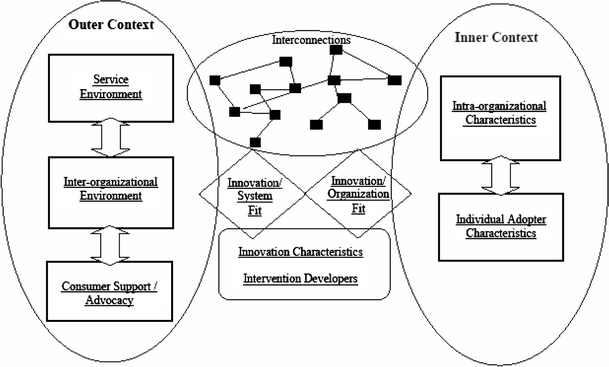
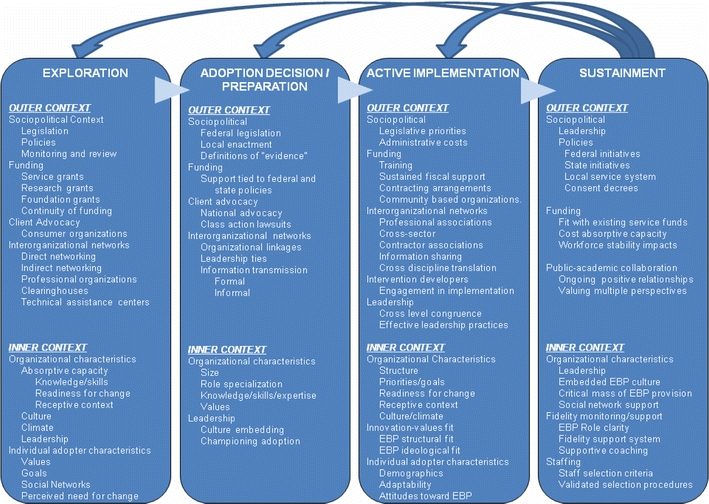
- Analysis: narrative synthesis organized by implementation phase and by outer vs. inner context levels, presented in two conceptual figures (Fig. 1 global factors; Fig. 2 phases and factors).
Limitations
- Stated: the authors note "few, if any, good measures of the process or progression through the phases" exist, and that process-based measures would be needed to assess status, progression, milestones, and speed of phase traversal.
- Stated: the paper repeatedly acknowledges thin empirical support — "there are few data supporting the importance of the other drivers of EBP exploration suggested by the literature," and consensus on core implementation drivers exists but "the body of concrete research evidence for each core driver in many cases remains to be developed."
- Evident from the text: the model is explicitly a hypothesis-generating framework ("variables hypothesized to play important roles"), its emphasis is skewed toward child welfare with mental health examples, and it offers no empirical test of the proposed phase-specific relationships.
Model-written summary. Check it against the paper before relying on it.
Integrity signals
Registry
Cites
Statistics
Figures
Verification
Claims the paper makes
16 Valid · 9 Not valid · 60 Not checked · 33 Own results and interpretations
The cited sources support only part of this claim — read each source’s verdict below.
In the paper
“Federal and state agencies may fund implementation demonstration projects and research studies to facilitate the implementation of EBPs, however, there has been little empirical work examining factors that either facilitate or limit sustainability of EBPs in public sector social services (Greenhalgh et al. 2004).”
§ Advancing a Conceptual Model of Evidence-Based Practice Implementation in Public Service Sectors > Sustainment Phase
What the sources say
- Partly supportedcites Greenhalgh et al. 2004 matched to “Diffusion of Innovations in Service Organizations: Systematic Review and Recommendations” (2004) sourceExperimental — accuracy not yet measured
The review says the literature on the sustainability of service innovations was very sparse (passage 1, page unavailable). It focused particularly on health care, however, and does not establish that empirical work on factors affecting sustainability of evidence-based practices was scarce specifically in public-sector social services. (LLM, conf=0.88)
plain- Asserted: passes — The authors put it forward as true.
- Checkable: passes — It can be checked against evidence.
- Load-bearing: passes — The paper’s conclusions depend on it.
- Based: passes — The paper gives a reason why it holds.
- Partly supported
The cited sources support only part of this claim — read each source’s verdict below.
In the paper
“The policies and funding needed for sustained use of practices typically follow from leaders who develop initiatives or set visions that can be maintained over time (Hoagwood et al. 2006).”
§ Advancing a Conceptual Model of Evidence-Based Practice Implementation in Public Service Sectors > Sustainment Phase > Outer Context
What the sources say
- Partly supportedcites Hoagwood et al. 2006 matched to “Implementation of evidence-based practices for children in four countries: a project of the World Psychiatric Association” (2006) sourceExperimental — accuracy not yet measured
The Discussion (page unavailable) says innovative leaders aided implementation and that all site Directors made plans for sustainability. The paper does not say that policies and funding typically follow from leaders’ initiatives or visions; it instead notes that continuation in Israel depended on securing funding. (LLM, conf=0.83)
plainstates a cause- Asserted: passes — The authors put it forward as true.
- Checkable: passes — It can be checked against evidence.
- Load-bearing: unclear — It is unclear whether the paper’s conclusions depend on it.
- Based: passes — The paper gives a reason why it holds.
- Partly supported
The cited sources support only part of this claim — read each source’s verdict below.
In the paper
“Conversely, severe budget restrictions discourage the exploration of innovations since exploration demands staff time, which may be limited when work forces are cut due to funding restrictions”
§ Advancing a Conceptual Model of Evidence-Based Practice Implementation in Public Service Sectors > Exploration Phase1 > The Outer Context
What the sources say
- Partly supportedcites Greenhalgh et al. 2004 matched to “Diffusion of Innovations in Service Organizations: Systematic Review and Recommendations” (2004) sourceExperimental — accuracy not yet measured
The paper’s discussion of organizational innovativeness (section labeled Abstract; page unavailable) associates slack resources with innovation, and its ‘Dedicated Time and Resources’ passage says adequate, continuing resources make assimilation more likely. It does not specifically say that severe budget restrictions lead to workforce cuts that leave staff too little time to explore innovations. (LLM, conf=0.86)
hedgedstates a cause- Asserted: passes — The authors put it forward as true.
- Checkable: passes — It can be checked against evidence.
- Load-bearing: unclear — It is unclear whether the paper’s conclusions depend on it.
- Based: passes — The paper gives a reason why it holds.
- Partly supported
The cited sources support only part of this claim — read each source’s verdict below.
In the paper
“Interorganizational forces, which focus on how individual organizations relate to, partner with, and compete with one another also play a potentially powerful role in adoption decisions.”
§ Advancing a Conceptual Model of Evidence-Based Practice Implementation in Public Service Sectors > Adoption Decision/Preparation Phase > Outer Context
What the sources say
- Partly supportedcites Chamberlain et al. 2008 matched to “Engaging and Recruiting Counties in an Experiment on Implementing Evidence-based Practice in California” (2008) sourceExperimental — accuracy not yet measured
The conceptual-model passage (Abstract; page unavailable) identifies prior cross-agency collaboration and positive relationships between counties and the California Institute for Mental Health as factors expected to influence adoption. This supports the claim about relationships and partnerships, but our copy does not address competition between organizations as an adoption influence. (LLM, conf=0.84)
- Not checked — no full text of the sourcecites Glisson and Schoenwald 2005 matched to “The ARC Organizational and Community Intervention Strategy for Implementing Evidence-Based Children's Mental Health Treatments” (2005) source
- Not matchedcites Institute for Healthcare Improvement [IHI] 2003
An author–year citation the paper’s reference list doesn’t settle. We don’t search these by name.
hedgedstates a possible cause- Asserted: passes — The authors put it forward as true.
- Checkable: passes — It can be checked against evidence.
- Load-bearing: unclear — It is unclear whether the paper’s conclusions depend on it.
- Based: passes — The paper gives a reason why it holds.
- Partly supported
The cited sources support only part of this claim — read each source’s verdict below.
In the paper
“Organizations that start with good knowledge/skills, can incorporate new knowledge, are highly specialized, and have mechanisms in place to spread knowledge throughout the organization, are much more likely to explore EBPs and eventually initiate them”
§ Advancing a Conceptual Model of Evidence-Based Practice Implementation in Public Service Sectors > Exploration Phase1 > The Inner Context
What the sources say
- Not checked — no full text of the sourcecites Damanpour 1991 matched to “Organizational innovation: A meta-analysis of effects of determinants and moderators” (1991) source
- Not checked — no full text of the sourcecites Ferlie and Shortell 2001 matched to “Improving the Quality of Health Care in the United Kingdom and the United States: A Framework for Change” (2001) source
- Partly supportedcites Greenhalgh et al. 2004 matched to “Diffusion of Innovations in Service Organizations: Systematic Review and Recommendations” (2004) sourceExperimental — accuracy not yet measured
The passages on structural determinants and absorptive capacity (indexed as Abstract; page unavailable) link specialization, an existing knowledge base, and knowledge sharing to greater organizational innovativeness and assimilation. They do not establish that organizations with these features are *much* more likely to explore and then initiate evidence-based practices specifically; the paper also describes assimilation as a process that can move back and forth between stages. (LLM, conf=0.84)
hedgedstates an association- Asserted: passes — The authors put it forward as true.
- Checkable: passes — It can be checked against evidence.
- Load-bearing: passes — The paper’s conclusions depend on it.
- Based: passes — The paper gives a reason why it holds.
57 more claims · 2 with their cited sources checked
Create a free account to see all 118 claims and to verify the 1 reference still open.
- Probably not a substantial claim. 31
- It may state two separate claims as one. 35
Claims other papers make about this one
Each is checked against this paper’s own text: does it say what the citing paper says it does?
The source backs part of the claim, not all of it — or backs it for a different population, condition or comparison.
In the citing paper
“Specifically, unlike traditional feasibility and pilot studies that may include the preliminary testing of interventions on individual clinical or public health outcomes, implementation feasibility and pilot studies that explore strategies to improve intervention implementation often require assessing changes across multiple levels including individuals (e.g. service providers or clinicians) and”
From Guidance for conducting feasibility and pilot studies for implementation trials (2020) · cites this paper as [21]
Experimental — accuracy not yet measuredThe source backs part of the claim, not all of it — or backs it for a different population, condition or comparison.
In the citing paper
“we propose that the concept of the individual might incorporate: capability, capacity, motivation (including recognising a need for change), resilience, acceptability, feelings, knowledge and beliefs (including self efficacy) about the intervention/evidence, position and fit within the organization/social system, and approach to decision-making (e.g., experimentation, use of information).”
From The role of evidence, context, and facilitation in an implementation trial: implications for the development of the PARIHS framework (2013) · cites this paper as [8]
Experimental — accuracy not yet measuredThe source backs part of the claim, not all of it — or backs it for a different population, condition or comparison.
In the citing paper
“Implementation strategies are too often designed in an unsystematic manner and fail to address key contextual determinants (13–16).”
From Enhancing the Impact of Implementation Strategies in Healthcare: A Research Agenda (2019) · cites this paper as [13]
Experimental — accuracy not yet measuredThe source backs part of the claim, not all of it — or backs it for a different population, condition or comparison.
In the citing paper
“Even if strategies are meticulously described in a study protocol or trial registry, it is often unrealistic to expect that they will not need to be altered as determinants emerge across implementation phases (13, 93, 94).”
From Enhancing the Impact of Implementation Strategies in Healthcare: A Research Agenda (2019) · cites this paper as [13]
Experimental — accuracy not yet measuredThe source backs part of the claim, not all of it — or backs it for a different population, condition or comparison.
In the citing paper
“Extent, quality, and timeliness of the completion of activities related to specific implementation process strategies”
From Beyond “implementation strategies”: classifying the full range of strategies used in implementation science and practice (2017) · cites this paper as [30]
Experimental — accuracy not yet measured
34 more claims about this paper
Create a free account to see every claim other papers make about this one.
Self-check
Percentages, sums and reported differences re-computed from the paper’s own numbers.
Each contradiction between two passages listed here was confirmed by an independent check.
Rated minor: it would not touch a result — a value no result rests on, a p-value that stays on the same side of the significance level, or a conflict that is clerical, resolved elsewhere in the paper, or outside its own findings.
In the paper
§ Advancing a Conceptual Model of Evidence-Based Practice Implementation in Public Service Sectors > References
“Data Path Design. (2010). ASWB projects.”
§ Advancing a Conceptual Model of Evidence-Based Practice Implementation in Public Service Sectors > References
“Retrieved June 10, 2009”
Citations
Cites
Rogers, E. M., Singhal, A., & Quinlan, M. M. (2019) · An Integrated Approach to Communication Theory and Research · doi:10.4324/9780203710753-35 · Cited by 37,322
The fifth discipline, the art and practice of the learning organization
Senge, P. M. (1991) · Performance + Instruction · doi:10.1002/pfi.4170300510 · Cited by 20,060
Organizational culture and leadership
(1993) · Long Range Planning · doi:10.1016/0024-6301(93)90120-5 · Cited by 16,462
Damschroder, L. J., Aron, D. C., Keith, R. E., Kirsh, S. R., Alexander, J. A., & Lowery, J. C. (2009) · Implementation Science · doi:10.1186/1748-5908-4-50 · Cited by 14,496
Valente, T. W. (2003) · Genetics in Medicine · doi:10.1097/01.gim.0000061743.67794.c4 · Cited by 13,723
(1994) · Cited by 13,126
Proctor, E., Silmere, H., Raghavan, R., Hovmand, P., Aarons, G., Bunger, A., Griffey, R., & Hensley, M. (2011) · Administration and Policy in Mental Health and Mental Health Services Research · doi:10.1007/s10488-010-0319-7 · Cited by 8,721
Self-citationDiffusion of Innovations in Service Organizations: Systematic Review and Recommendations
GREENHALGH, T., ROBERT, G., MACFARLANE, F., BATE, P., & KYRIAKIDOU, O. (2004) · The Milbank Quarterly · doi:10.1111/j.0887-378x.2004.00325.x · Cited by 7,448 · cited 11×
“Beginning at the broadest level, the state and federal sociopolitical and funding contexts influence the exploration of innovative interventions or practices (Davies and Nutley 2008; Ganju 2003; Hoagwood 2003).”
BackgroundInfluentialEvaluating the public health impact of health promotion interventions: the RE-AIM framework.
Glasgow, R. E., Vogt, T. M., & Boles, S. M. (1999) · American Journal of Public Health · doi:10.2105/ajph.89.9.1322 · Cited by 7,217 · cited 2×
“The RE-AIM model (Glasgow et al. 1999; Glasgow et al. 2006) explicitly identifies the ‘‘maintenance’’ phase of implementation as critical in sustaining effective health interventions.”
MethodOrganizational innovation: A meta-analysis of effects of determinants and moderators
Damanpour, F. (1991) · Academy of Management Journal · doi:10.2307/256406 · Cited by 6,542 · cited 9×
“Because the implementation literature has been developed in areas where the adoption of innovation is driven by profit or science, there is little attention to this first phase in the extant literature (Damanpour 1991).”
BackgroundMethodInfluential
Research works printed but not linked: 9
- Aos S Intensive family preservation programs: program fidelity influences effectiveness revised (No. 06-02-3901) 2006 Olympia Washington State Institute for Public Policy
- Backer T The failure of success: Challenges of disseminating effective substance abuse prevention programs Journal of Community Psychology 2000 28 3 363 373 · DOI · Paper page
- California Institute for Mental Health [CIMH] Community Development Team model: Supporting the model adherent implementation of programs and practices 2006 Sacramento California Institute for Mental Health
- Chadwick Center Closing the quality chasm in child abuse treatment: Identifying and disseminating best practices 2004 San Diego, CA Children’s Hospital-San Diego, Chadwich Center for Children and Families
- Davies HTO Nutley SM Learning more about how research-based knowledge gets used: Guidance in the development of new empirical research 2008 New York, NY William T. Grant Foundation
- Institute of Medicine [IOM] The state of quality improvement and implementation research: Expert views. Workshop summary 2007 Washington, DC The National Academies Press
- National Association of Public Child Welfare Administrators [NAPCWA] Guide for child welfare administrators on evidence based practice 2005 Washington DC APHSA
- National Institute of Mental Health [NIMH] Blueprint for change: Research on child and adolescent mental health 2001 Bethesda, MD National Institutes of Health
- Srivastava SK Bathla A Correlational study of organizational climate and work adjustment among industrial workers Social Science International 1996 12 1 52 60
Cited by
Items 2,001–2,100 of 3,223
Classroom Carrying Capacity: A Resource and Limiting Factors Framework
Granger, K. L., & Chow, J. C. (2025) · Educational Psychology Review · doi:10.1007/s10648-025-09999-x · Cited by 7
“To ensure high-quality implementation of classroom-based intervention programs, it is critically important to increase our abilities to adapt interventions to fit the context of the classroom (e.g., Aarons et al., 2011).”
Wang, W., van Wijngaarden, J. D. H., Buljac‐Samardžić, M., & van de Klundert, J. J. (2025) · BMC Health Services Research · doi:10.1186/s12913-025-12541-y · Cited by 4
“Partnerships and connections with outer entities (known as cosmopolite: interpersonal influence from outside) can be beneficial to effectively acquiring knowledge and promoting learning in health service innovation [4, 39].”
Katomski, A.-S., Pachicano, A. M., Zamantakis, A., Benbow, N., Willging, C. E., Rosen, J. G., Rosenberg-Carlson, E. P., Gomez, W., Hamilton, A. B., Kassanits, J. E., et al. (2025) · JAIDS Journal of Acquired Immune Deficiency Syndromes · doi:10.1097/qai.0000000000003619 · Cited by 7
Christian, H. E., McLaughlin, M. J., Nathan, A., Adams, E., Bauman, A. E., Naylor, P., Shilton, T., Maher, C. A., Trost, S. G., & Schipperijn, J. (2025) · Health Promotion International · doi:10.1093/heapro/daaf145 · Cited by 5
“2018); Exploration, Preparation, Implementation, Sustainment framework (Aarons et al .”
Schoeneman, A. C. (2015) · VCU Scholars Compass (Virginia Commonwealth University) · doi:10.25772/emfz-3463 · Cited by 4
Akça, M., & Yavuz, M. (2018) · Anemon Muş Alparslan Üniversitesi Sosyal Bilimler Dergisi · doi:10.18506/anemon.452617 · Cited by 2
Advancing Implementation: Toward an Inclusive View of Research in Behavioral Medicine
Fixsen, D. L., Boothroyd, R. I., Blasé, K. A., Fixsen, A. A. M., & Metz, A. J. R. (2018) · Springer eBooks · doi:10.1007/978-0-387-93826-4_8 · Cited by 5
Collins, C. B., Baack, B. N., Tomlinson, H. L., Lyles, C., Cleveland, J. C., Purcell, D. W., Ortiz-Ricard, A., & Mermin, J. (2019) · AIDS and Behavior · doi:10.1007/s10461-019-02433-8 · Cited by 3
Gupta, B., Li, D., Dong, P., & Acri, M. C. (2021) · Journal of Evaluation in Clinical Practice · doi:10.1111/jep.13547 · Cited by 4
Brooke‐Sumner, C., Williams, P. P., Wagener, E., Sorsdahl, K. R., Aarons, G. A., & MYERS, B. J. (2021) · BMJ Open · doi:10.1136/bmjopen-2020-047320 · Cited by 5
Self-citationBhuiya, A. R., Makarski, J., Hayden, L., Perrier, L., Munce, S., Lewis, I., Graham, I. D., Holroyd-Leduc, J. M., Straus, S. E., Stelfox, H. T., et al. (2022) · JBI Evidence Synthesis · doi:10.11124/jbies-22-00055 · Cited by 3
Kang, S. K., & Gold, H. T. (2023) · Journal of the American College of Radiology · doi:10.1016/j.jacr.2022.11.018 · Cited by 3
El-Mallakh, P. L., Howard, P. B., Rayens, M. K., Roque, A. P., & Adkins, S. (2013) · Journal of Psychosocial Nursing and Mental Health Services · doi:10.3928/02793695-20130809-01 · Cited by 5
Fazel, M. S., Patel, V., Thomas, S., & Tol, W. A. (2014) · Cited by 3
Howard, E. C. (2012) · Cited by 3
Toward a transformed system to address child abuse and family violence in New Zealand
Foote, J., Taylor, A., Nicholas, G., Carswell, S., Wood, D., Winstanley, A., & Hepi, M. (2014) · Cited by 8
Humphrey, A., Eastwood, L., Atkins, H., Vainre, M., & Lea-Cox, C. (2016) · Journal of Integrated Care · doi:10.1108/jica-08-2015-0033 · Cited by 4
Izmirian, S. C., Nakamura, B. J., Hill, K. A., Higa-McMillan, C. K., & Slavin, L. A. (2016) · Professional Psychology Research and Practice · doi:10.1037/pro0000081 · Cited by 7
Approaches to evidence synthesis in international development: a research agenda
Oliver, S. R., Gough, D., Copestake, J., & Thomas, J. (2018) · Journal of Development Effectiveness · doi:10.1080/19439342.2018.1478875 · Cited by 3
Livet, M., & Easter, J. C. (2019) · Journal of the American Pharmacists Association · doi:10.1016/j.japh.2018.12.013 · Cited by 4
Bezard, G., & Rouquette, A. (2019) · L Encéphale · doi:10.1016/j.encep.2019.02.007 · Cited by 8
Acri, M. C., Bornheimer, L. A., Hamovitch, E., & Lambert, K. (2019) · Research on Social Work Practice · doi:10.1177/1049731519841439 · Cited by 5
“Another possible reason for the mixed findings speaks to the limitations of the study, in that barriers and facilitators are interactional across and within levels (e.g., provider attitudes have been linked to and are influenced by other factors such as provider demographics and aspects of the organization; Aarons et…”
BackgroundResultInfluentialCritical reflections on quality standards within drug demand reduction
Graf, N., & Stöver, H. (2019) · Drugs and Alcohol Today · doi:10.1108/dat-12-2018-0070 · Cited by 3
Quality Improvement and Patient Safety: How Leadership Can Create a Culture of Safety
Samora, J. B., Shea, K. G., Chen, A. F., Turner, P., & Frick, S. L. (2019) · Journal of Bone and Joint Surgery · doi:10.2106/jbjs.19.01006 · Cited by 4
Molina, A. P., Palinkas, L. A., Monro, W. L., & Mennen, F. E. (2020) · Administration and Policy in Mental Health and Mental Health Services Research · doi:10.1007/s10488-020-01012-7 · Cited by 3
Loughran, T., Scharer, J. L., Rodriguez, L., Víta, M., Maisto, S. A., & Funderburk, J. S. (2021) · Journal of Substance Abuse Treatment · doi:10.1016/j.jsat.2021.108456 · Cited by 3
Dissemination and Implementation Research
Barnett, M. L., Dickson, K. S., Becker‐Haimes, E. M., & Stadnick, N. A. (2021) · Elsevier eBooks · doi:10.1016/b978-0-12-818697-8.00170-9 · Cited by 4
Data Velocity in HIV-Related Implementation Research: Estimating Time From Funding to Publication
Schwartz, S., Ortiz, J. L. C., Smith, J. D., Beres, L. K., Mody, A., Eshun‐Wilson, I., Benbow, N., Mallela, D. P., Tan, S., Baral, S., et al. (2022) · JAIDS Journal of Acquired Immune Deficiency Syndromes · doi:10.1097/qai.0000000000002963 · Cited by 4
O’Donnell, R., Savaglio, M., Halfpenny, N., Morris, H., Dunbar, A., Sharman, C., Williams, R., MILLER, R. M., & Skouteris, H. (2022) · Child Abuse & Neglect · doi:10.1016/j.chiabu.2022.105855 · Cited by 3
The Use of Dissemination and Implementation to Improve Multimodal Analgesia in Head and Neck Surgery
Shnayder, Y., Baumanis, M. M., Brown, A. P., Reese, A., Bur, A. M., Kakarala, K., & Sykes, K. J. (2022) · The Laryngoscope · doi:10.1002/lary.30469 · Cited by 3
“Aarons et al described a framework for a strong implementation process operationalized along four phases: Exploration, Adoption/Preparation, Implementation and Sustainment, abbreviated EPIS.22 We hypothesized applying the EPIS framework in conjunction with a clinical trial would significantly reduce variability in opi…”
MethodMiller, J. E., Maloney, C., Harding, C. S., Palmer, K., Brey, J. T., & Sandoval, J. R. (2021) · The Prison Journal · doi:10.1177/0032885521991109 · Cited by 3
“Additionally, we did not see a tidy distinction between initial implementation and a “full implementation” (Bertram et al., 2015) or “sustainment” phase (e.g. Aarons et al., 2011), as highlighted in the literature.”
BackgroundEvidence‐based Management and Leadership
Briner, R. B., & Walshe, N. D. (2013) · Wiley eBooks · doi:10.1002/9781118326404.ch3 · Cited by 4
“It appears that the organization whose leaders display a willingness to make psychological and tangible space for training on the use and benefits of evidence-based practice shows a greater degree of success in adoption and implementation (Aarons et al., 2011).”
BackgroundProcess evaluation of Alcohol Brief Interventions in wider settings (Young People and Social Work)
Stead, M., Eadie, D. R., McKell, J., Bauld, L., Parkes, T., Nicoll, A., Wilson, S. E., & Burgess, C. A. (2014) · Stirling Online Research Repository (University of Stirling) · Cited by 4
Jafer, M. (2019) · Research Publications (Maastricht University) · doi:10.26481/dis.20190830mj · Cited by 6
Approaches to evidence synthesis in international development
Oliver, S. R., Gough, D., & Copestake, J. (2017) · doi:10.51744/cpip3 · Cited by 3
del Pozo, B., Belenko, S., Pivovarova, E., et al. (2024) · CrimRxiv · doi:10.21428/cb6ab371.b062237a · Cited by 3
Pham, T. N. D., Hoang, L. B., Dao, D. V. B., et al. (2024) · medRxiv · doi:10.1101/2024.08.29.24312788 · Cited by 3
Tyack, Z. F., McPhail, S., Aarons, G. A., McGrath, K., Barron, A., Carter, H. E., Larkins, S., Barnett, A. G., Hummell, E., Tulleners, R., et al. (2024) · Implementation Science · doi:10.1186/s13012-024-01391-7 · Cited by 4
“…bridging factors, innovation factors, interconnections, linkages, and relationships) were used to identify barriers and facilitators (determinants) to implementation, core components of the intervention, and need for local tailoring as an implementation strategy prior to implementation [16].”
BackgroundMethodSelf-citationFlaherty, H. B. (2025) · Journal of Social Work Practice in the Addictions · doi:10.1080/1533256x.2025.2477097 · Cited by 4
Be, M. S. Y. (2015) · Utrecht University Repository (Utrecht University) · Cited by 7
Aarons, G. A. (2022) · Implementation Science · doi:10.1186/s13012-022-01198-4 · Cited by 2
“Attitudes operate across multiple phases in complex implementation processes and contexts [5].”
BackgroundSelf-citationDid COVID-19 Change the Availability and Use of Clean Energy for Cooking? Evidence From Ghana
Prah, R., Jack, D. W., Tawiah, T. A. S., Iddrisu, S., Abubakari, S. W., Mujtaba, M. N., Tetteh, R. J., Gyaase, S., Twumasi, M. F., Saah, J., et al. (2023) · Environmental Health Insights · doi:10.1177/11786302231198854 · Cited by 2
Sklar, M., Kenneally, R., Aarons, G. A., & Fettes, D. L. (2023) · Implementation Science Communications · doi:10.1186/s43058-023-00479-3 · Cited by 4
“…knowledge from team effectiveness research to improve outcomes associated with the services intervention currently used in CWS CFTs. Guided by the Exploration, Preparation, Implementation, Sustainment (EPIS) framework [49] and the Center’s Team Effectiveness for Implementation Science model (Fig.”
MethodSelf-citationProviding Clinical Psychology Training and Trauma-Focused Treatment via Telehealth During COVID-19
Rancher, C. E., Wallace, M. M., McGuire, A., Smith, D. W., & Rheingold, A. A. (2024) · Child Maltreatment · doi:10.1177/10775595241238987 · Cited by 3
“The EPIS framework consists of four phases (Exploration, Preparation, Implementation, and Sustainment) and allows for examination of a change process across multiple, successive levels (Aarons et al., 2011).”
Provider attitudes toward evidence-based practice in autism: a mini-review
DeLucia, E. A., Harden, S. M., & Scarpa, A. (2024) · Frontiers in Child and Adolescent Psychiatry · doi:10.3389/frcha.2024.1363532 · Cited by 2
“DIS has fi rmly established the importance of contextual factors when implementing interventions (41 – 44), and a wide range of contexts are at play in autism intervention due to the interdisciplinary nature of autism services.”
Public Health Ambassadors: A Novel Participatory Community Health Awareness Program in Abu Dhabi
Elbarazi, I., Al-Balushi, J., Al-Dhaheri, A., Meeran, M., Peyroteo, M., Paulo, M. S., & Grivna, M. (2024) · INQUIRY The Journal of Health Care Organization Provision and Financing · doi:10.1177/00469580241241268 · Cited by 4
“17,18 According to Villalobos Dintrans et al, 17 an intervention can be described as time-based or component-based.”
MethodBrinkman, G., Molenveld, A., Voorberg, W., & van Buuren, A. (2024) · Public Management Review · doi:10.1080/14719037.2024.2436614 · Cited by 3
“Connective efforts may reduce the risk of margin-alization and increase the likelihood of the adoption of innovation (Aarons, Hurlburt, and Horwitz 2011; Greenhalgh et al. 2004).”
InfluentialOser, C. B., McGladrey, M., Oyler, D. R., Knudsen, H. K., WALSH, S. L., Stitzer, S., Goetz, M., Booty, M. D., Hargis, E., Johnson, S., et al. (2024) · Journal of Substance Use and Addiction Treatment · doi:10.1016/j.josat.2024.209618 · Cited by 5
Decker, S. E., Kroll‐Desrosiers, A., Mattocks, K. M., Aunon, F. M., Galliford, E., DeRycke, E. C., Doran, N., Baird, S. O., Rielage, J. K., Ridley, J., et al. (2025) · Contemporary Clinical Trials · doi:10.1016/j.cct.2025.107828 · Cited by 3
van der Smissen, D., Schreijer, M. A., van Gemert‐Pijnen, J. E. W. C., Verdaasdonk, R. M., van der Heide, A., Korfage, I. J., & Rietjens, J. A. C. (2025) · JMIR Aging · doi:10.2196/49507 · Cited by 3
“Overall, the analysis showed that the program has good potential for sustainable implementation, as it is expected to be continuously used in practice [8,38,39], will be updated if necessary, and will be maintained long-term.”
Kumar, S., Walker, A., Leech, C., Powell, E., Varrall, R., Ramsay, S., Searle, R., & Jensen, S. (2025) · Australian Journal of Rural Health · doi:10.1111/ajr.70014 · Cited by 3
Rollinson, R., Ewing, B., Reeve, S., Graham, A., Lyons, J., Gee, B., Wilson, J., Tofan, I., Semper, K., & Clarke, T. (2025) · British Journal of Clinical Psychology · doi:10.1111/bjc.12531 · Cited by 4
Crable, E. L., Meffert, S. M., Kenneally, R. G., Ongeri, L., Bukusi, D. E., Burger, R. L., Rota, G., Otieno, A., Rotai, R., Mathai, M., et al. (2025) · Implementation Science Communications · doi:10.1186/s43058-025-00744-7 · Cited by 3
“…between entities in the local implementation context (inner context) and the multilevel sociopolitical and service delivery environments (outer context) can change across the four phases of implementation and influence implementation outcomes and sustainment of evidence-based practices [30, 31].”
Self-citationA Health System–Wide Approach to Addressing Unmet Social Needs Among Children With Asthma
Margolis, R. H. F., Stringfield, S., Brewer, T., Williams, A. L., Dean, T., Latimer, G., Call, S., Jepson, A. J., Tate, M., Wai, K., et al. (2025) · Hospital Pediatrics · doi:10.1542/hpeds.2024-008023 · Cited by 2
Aijaz, J., Raza, M. R., Sajid, K. N., Naseer, F., Jawaid, N., Jamal, S., Bhakta, N. H., Alexander, T., & Roberts, M. C. (2025) · PLoS ONE · doi:10.1371/journal.pone.0321316 · Cited by 2
“Process frameworks such as Exploration, Planning, Implementation, Sustainment (EPIS) [6] can guide the implementation of an evidence-based program, such as a cancer biobank, while published change strategies such as Expert Recommendations for Implementing Change (ERIC) [7] can inform execution…”
Curreri, N. A., Corna, L., Poncin, E., Grootven, B. V., Huang, J., Osinska, M., Sibilio, S., Kästner, L., Thuillard, S., Vittoz, L., et al. (2025) · INQUIRY The Journal of Health Care Organization Provision and Financing · doi:10.1177/00469580251328101 · Cited by 2
“21 These 4 phases guide especially work package 1 and 2, each starting with the exploration of the literature and context to understand the issues at hand and possible solutions, followed by the preparation phase with the development and contextualizing of fitting interventions.”
Ishii, K., Takemura, Y., & Kitamura, A. (2025) · BMC Nursing · doi:10.1186/s12912-025-03271-x · Cited by 3
“Previous studies show that support from the government [43] and federal/state initiatives [44] influence the sustainment of EBPs.”
Lee, K. A., Pisciotta, C., & Gopalan, G. (2025) · Journal of Public Child Welfare · doi:10.1080/15548732.2025.2518370 · Cited by 2
Wong, L.-Y., Hussain, S. J., Labib, M., Henker, R., Efobi, C., Mokogwu, N., Igunma, J. A., Minas, S. M., Laeke, T., Ferguson, M. K., et al. (2025) · Frontiers in Health Services · doi:10.3389/frhs.2025.1423429 · Cited by 2
Paschen-Wolff, M. M., Campbell, A. N. C., Vásquez, Á., Kessler, J., Jansen, K. J., Arnatt, C. P., Rosa, C., Hebden, H. M., Radin, S. M., Stately, A. L., et al. (2025) · Contemporary Clinical Trials · doi:10.1016/j.cct.2025.107992 · Cited by 2
Haga, S. M., Jacobsen, H., & Engell, T. (2025) · BMC Health Services Research · doi:10.1186/s12913-025-12937-w · Cited by 3
Portfolio analysis of NCI-funded policy implementation science grants (fiscal years 2014–2023)
Haidar, A., Villalobos, A. V. K., Vinson, C., & Neta, G. I. (2025) · Implementation Science Communications · doi:10.1186/s43058-025-00755-4 · Cited by 2
Evaluation of Implementation: A Taxonomy of Implementation Science Theories, Models, and Frameworks
Nilsén, P. (2025) · Springer eBooks · doi:10.1007/978-3-031-87869-5_9 · Cited by 4
Pecora, P. J., Maldonado, A., Dumont, K. A., Weaver, C., & O’Brien, K. (2025) · Journal of Public Child Welfare · doi:10.1080/15548732.2025.2538016 · Cited by 3
Hassett, L. M., Johnson, L. G., Williams, G. P., Ashpole, R., Bauman, A. E., Carty, C. I., Chagpar, S., Clanchy, K., Haynes, A. S., Heine, K., et al. (2025) · Clinical and Public Health Guidelines · doi:10.1002/gin2.70035 · Cited by 2
Calloway, E. E., Houghtaling, B., Mitchell, E., Talavera, G. E., Zigmont, V. A., Seligman, H. K., Yaroch, A. L., Summerlee, E., & Long, C. R. (2025) · Current Developments in Nutrition · doi:10.1016/j.cdnut.2025.107530 · Cited by 3
“The Exploration, Preparation, Implementation, Sustainment (EPIS) Framework [10,11] is used as a process and determinant framework to better explain factors relevant to the adoption, implementation, and sustainment of evidence-based interventions, such as produce prescription programs, and is one of…”
Norman, M. Z., Torres, K. A., Saldana, L., Spiro, K., Naranjo, D. M., Wong, J. C., Reed, A., Bensen, R., Barry, S., Harris, M. A., et al. (2025) · Global Implementation Research and Applications · doi:10.1007/s43477-025-00182-6 · Cited by 3
“…of implementation including Pre-Implementa-tion (Stages 1–3), Implementation (Stages 4–7), and Sustain-ment (Stage 8; See Table 1), similar to other phased-based frameworks of implementation such as the Exploration, Preparation, Implementation, Sustainment (EPIS) framework (Aarons et al., 2011).”
Exploring Fit in a Mobile Health Intervention for Alcohol Use Disorder: Qualitative Study
Jacobson, N. A., Park, L., Pulvermacher, A., Voelker, S., Herzog, M., & Quanbeck, A. (2025) · JMIR mhealth and uhealth · doi:10.2196/65218 · Cited by 2
“…interventions: exploration to consider target population needs, preparation to assess barriers and facilitators to implementation, implementation to assess progress and determine adjustments, and sustainment to assess how to maintain the context structures and supports of the intervention [12].”
Measuring family-important outcomes in large neonatal networks: where we are and where we need to go
Demers, C., Luu, T. M., Glegg, S., Afifi, J. K., Pearce, R., Thivierge, É., & Janvier, A. (2025) · Seminars in Perinatology · doi:10.1016/j.semperi.2025.152149 · Cited by 2
Matson, T. E., Navarro, M. A., Idu, A., Bobb, J. F., Patrick, B. M., Phillips, R., Barrett, T. D., Rossi, F. S., Krawczyk, N., Doud, R., et al. (2025) · Addiction Science & Clinical Practice · doi:10.1186/s13722-025-00605-7 · Cited by 3
“The Exploration, Preparation, Implementation, Sustainment (EPIS) [59, 60] framework guides decisions and processes across the lifecycle of the study, as detailed in Additional file 7.”
Takada, S., Wali, S., Park, N. J., Sadia, A., Weldon, A. R., Liang, L.-J. F., Vassar, S. D., Carson, S. L., Dopp, A. R., Korn, A. R., et al. (2025) · Implementation Science · doi:10.1186/s13012-025-01452-5 · Cited by 2
“We use the EPIS framework to further guide the implementation process [26, 40].”
InfluentialHerman, F., Verhaeghe, S. T. L., Geboes, K., Martha, G., Rammant, E., & Daem, M. (2025) · European Journal of Oncology Nursing · doi:10.1016/j.ejon.2025.103004 · Cited by 2
Vonderheide, C. C., Kilduff, C., McDermott, K. A., Greenberg, J., Camera, D. E. L., Giraldo‐Santiago, N., Kurkul, A., Alvarez-Frank, N. A., Kim, Y., Pasinski, R., et al. (2025) · Contemporary Clinical Trials · doi:10.1016/j.cct.2025.108116 · Cited by 2
(Not so) universal literacy screening: a survey of educators reveals variability in implementation
Ozernov‐Palchik, O., Elizee, Z., Catania, F., Hacikamiloglu, M., Shattuck‐Hufnagel, S., Petscher, Y., Ghosh, S., & Gabrieli, J. D. E. (2025) · Annals of Dyslexia · doi:10.1007/s11881-025-00342-1 · Cited by 7
“Originally developed for healthcare settings and subsequently adapted for educational contexts (Aarons et al., 2011; Sanetti & Luh, 2019), the EPIS framework provides a structured approach to examining the acceptability, execution, and sustainment of educational practices within complex systems,…”
Implementation science in Africa—whose epistemology counts?
Eboreime, E., Ibisomi, L., Itanyi, I. U., Kanya, L., Wamuti, B., Ohanyido, F., Ncayiyana, J. R., Habonimana, D., Kagura, J., Anjorin, O., et al. (2025) · The Lancet Global Health · doi:10.1016/s2214-109x(25)00414-0 · Cited by 3
Al-Kalaf, H., Jenks, C. J., Mösko, M., Sanders, T., & Schouten, B. C. (2025) · PLoS ONE · doi:10.1371/journal.pone.0338040 · Cited by 2
“The program champion is a staff member who supports the implementation of the intervention by promoting engagement, coordinating logistics, and offering on-site support during the training [69].”
Stahmer, A. C., Lau, A. S., Roesch, S. C., Rangel, E., Aarons, G. A., & Brookman-Frazee, L. I. (2025) · Implementation Science · doi:10.1186/s13012-025-01466-z · Cited by 3
“Guided by the Exploration, Preparation, Implementation, Sus-tainment (EPIS) framework [13, 14], mixed methods findings indicated that two inner context implementation determinants appeared to affect EBI implementation in both settings: leadership support and provider motivation [12].”
Self-citationEssig, C., Latus‐Olaifa, O., Monaco, D., Tocco, J. U., Ault-Brutus, A., Kubow, S., Badrinath, T., Adelman, N. E., Sapra, M., Young, J. Q., et al. (2025) · Journal of Poverty · doi:10.1080/10875549.2025.2610607 · Cited by 2
“This observation aligns with implementation science principles regarding the importance of assessing and building readiness for change (Aarons et al., 2011).”
InfluentialEstablishing usable innovations
Fixsen, D. L., Dyke, M. K. V., & Blasé, K. A. (2026) · Frontiers in Health Services · doi:10.3389/frhs.2025.1745148 · Cited by 2
“Operational definitions are advocated by Aarons, Hurlburt (105) who point to the need for a “high degree of procedural specificity in work activities.””
Economic Evaluation of Tobacco Treatments From the Screen ASSIST Lung Cancer Screening Trial
Levy, D. E., Hassan, S., Wint, A. J., Marotta, C. J., Gonzalez, I., Chang, Y., Rigotti, N. A., Haas, J. S., & Park, E. R. (2026) · JAMA Network Open · doi:10.1001/jamanetworkopen.2025.55332 · Cited by 3
Barbee, A. P., Winters, A. M., Graef, M. I., Purdy, L. M., Antle, B. F., Cunningham, M. R., Taylor, J., Henry, K., & Putnam-Collins, P. (2026) · Children and Youth Services Review · doi:10.1016/j.childyouth.2026.108799 · Cited by 2
Landes, S. J., Walker, J. A., Bekman, N. M., Kumpula, M. J., Lhermitte, S. L., Hoff, R. A., van Engelen, L., Betthauser, L. M., Beaudreau, S. A., Batdorf, W. H., et al. (2026) · Frontiers in Psychiatry · doi:10.3389/fpsyt.2025.1668417 · Cited by 3
Hybrid type 1 effectiveness-implementation studies: why and how to do them
Baloh, J., Landes, S. J., Smith, J. L., & Curran, G. M. (2026) · Frontiers in Health Services · doi:10.3389/frhs.2026.1678257 · Cited by 4
“Additionally, determinant frameworks such as CFIR (5) or EPIS (42) can guide systematic investigation of a broad range of factors (determinants) that can influence implementation, particularly at levels of inner context (e.g., leadership support, available resources) and individuals (e.g.,…”
School Meals as a Strategy to Prevent Childhood Obesity and Advance Food Equity: A Narrative Review
McLoughlin, G. M., & Cohen, J. F. W. (2026) · Current Obesity Reports · doi:10.1007/s13679-026-00697-5 · Cited by 3
“This work centers on implementation science and health equity frameworks [39, 40] to understand key determinants to equitable implementation and impact of USM and to guide the development of equity-focused strategies for implementation; these strategies are currently being tested through a hybrid…”
Alexander, S. P., Shelton, E., Lee, M., Tharp, G., McNeil, M. P., Bernitz, M., Graves, K., Metsch, L. R., & Shelton, R. C. (2026) · Harm Reduction Journal · doi:10.1186/s12954-025-01379-6 · Cited by 3
“Specifically, we found meaningful differences between two implementation phases, broadly informed by the Exploration, Preparation, Implementation, Sus-tainability (EPIS) Framework [69, 70].”
A call to action for pharmacogenomics stewardship in South Africa
Keuler, N. L., Leuschner, M., Hurrell, T., Coetzee, R., Jordaan, B., Breedt, W., & Schellack, N. (2026) · Frontiers in Pharmacology · doi:10.3389/fphar.2026.1764125 · Cited by 3
Meffert, S. M., Mathai, M., Ongeri, L., Neylan, T. C., Mwai, D., Onyango, D., Akena, D. H., Rota, G., Otieno, A., Mbwayo, A., et al. (2026) · The Lancet Primary Care · doi:10.1016/j.lanprc.2026.100117 · Cited by 3
Self-citationImplementing Digital Respiratory Technologies for People With Respiratory Conditions: Scoping Review
Hui, C. Y., Condon, K., Kolekar, S., Roberts, N., Sreter, K. B., Simons, S. O., Figueiredo, C. L., McKeough, Z. J., Salim, H. S., Gawlik‐Lipinski, A., et al. (2026) · Journal of Medical Internet Research · doi:10.2196/88325 · Cited by 2
“EPIS is a process model and determinant framework that outlines the domains and sequential steps involved in translating interventions into routine practice [14].”
Kumar, V., Vyas, N., Godinho, M. A., Raj, S. E. A., & Govindan, S. (2026) · Discover Public Health · doi:10.1186/s12982-026-02352-9 · Cited by 3
“Alternative frameworks such as RE-AIM and EPIS, while valuable, focus respectively on implementation outcomes and temporal phases, and are less suited for detailed cross-study synthesis of underlying barriers [14, 15].”
Peterson, M. R., & Silverman, M. J. (2018) · Voices A World Forum for Music Therapy · doi:10.15845/voices.v18i2.960 · Cited by 4
Management Practices to Enhance the Effectiveness of Substance Use Disorder Treatment
Frimpong, J. A., & Guerrero, E. G. (2020) · IntechOpen eBooks · doi:10.5772/intechopen.91054 · Cited by 2
The Scale-Up of Linked Multilevel Interventions: A Case Study
Wulczyn, F., & Feldman, S. W. (2020) · Springer eBooks · doi:10.1007/978-3-030-03874-8_11 · Cited by 2
Practice Responses to Climigration
Palinkas, L. A. (2020) · Springer eBooks · doi:10.1007/978-3-030-41890-8_9 · Cited by 3
Kellogg, E. (2020) · Journal of Youth Development · doi:10.5195/jyd.2020.950 · Cited by 2
“Effectively implementing a program on a broad scale is a process that takes time and requires ongoing evaluation and adaptation to local circumstance (Aarons et al., 2011; Metz & Bartley, 2012; Meyers et al., 2012).”
BackgroundUsing Research within Child Welfare: Reactions to a Training Initiative
Stenason, L., Romano, E., & Cheung, C. (2020) · Journal of Evidence-Based Social Work · doi:10.1080/26408066.2020.1820413 · Cited by 2
Applying an Implementation Science Framework to Surgical Research and Practice in Tanzania
Sam-Agudu, N. A. (2021) · Journal of the American College of Surgeons · doi:10.1016/j.jamcollsurg.2021.04.024 · Cited by 2
Klein, C. C., Sanchez, B. E. L., & Barnett, M. L. (2021) · Administration and Policy in Mental Health and Mental Health Services Research · doi:10.1007/s10488-021-01156-0 · Cited by 5
Vroom, E. B., Massey, O. T., Akbari, Z., Bristol, S. C., Cook, B., Green, A. L., Levin, B. L., Tyson, D. M., & Johnson, M. E. (2021) · Journal of Community Psychology · doi:10.1002/jcop.22749 · Cited by 4
Codding, R. S., Nelson, P. M., Parker, D. C., Edmunds, R., & Klaft, J. (2021) · Journal of School Psychology · doi:10.1016/j.jsp.2021.11.002 · Cited by 9
Saavedra, R. Q., Alfaro, J., Rodríguez‐Rivas, M. E., & Lastra, V. (2022) · Journal of Child and Family Studies · doi:10.1007/s10826-022-02331-z · Cited by 4
“Diverse models of multi-level analysis have been created to examine the implementation of collaborative processes using an ecological perspective (Aarons et al., 2011; Chaudoir et al., 2013; Damschroder et al., 2015).”
Background
Metadata
- Authors
- Aarons, G. A., Hurlburt, M., & Horwitz, S. M.
- Affiliations
- University of California San Diego (US)
- University of Southern California (US)
- Rady Children's Hospital-San Diego (US)
- Corresponding author
- Aarons, Gregory A.
- Venue
- Administration and Policy in Mental Health and Mental Health Services Research
- Published
- 2010-12-14
- Volume
- 38
- Issue
- 1
- Pages
- 4-23
- ISSN
- 0894-587X (ISSN-L)
- 1573-3289
- PMC
- PMC3025110
- OpenAlex
- W2044858486
- Cited by
- 3,240
- References
- 171
- Citations by year
- 2026: 306 · 2025: 331 · 2024: 333 · 2023: 311 · 2022: 307 · 2021: 274 · 2020: 251 · 2019: 257 · 2018: 170 · 2017: 168 · 2016: 111 · 2015: 143 · 2014: 107 · 2013: 96 · 2012: 48
- FWCI
- 93.26
- Type
- journal article
- Language
- en
- Open access
- hybrid
- doi.org
- Licence
- cc-by-nc
- Locations
- Administration and Policy in Mental Health and Mental Health Services Research (publishedVersion, cc-by-nc)
- PubMed Central (publishedVersion, cc-by-nc)
- PubMed (publishedVersion)
- Funders
- National Institute of Mental Health (P30MH074678, R01MH072961)
- Topics
- Health Sciences › Health Professions › General Health Professions › Health Policy Implementation Science
- Health Sciences › Health Professions › General Health Professions › Health Sciences Research and Education
- Social Sciences › Public Administration › Evaluation and Performance Assessment
- Keywords
- evidence-based practice implementation, implementation science, public service sector, conceptual model, multi-level model, implementation stages, exploration, adoption, implementation, program sustainability, public mental health services, social services, drug and alcohol services, organizational context
- MeSH terms
- Child, Child Welfare, Diffusion of Innovation, Health Plan Implementation, Humans, Mental Health Services, Social Work, United States, Models, Organizational, Evidence-Based Practice
About these checks
Registry, retraction, Cites and statistics results are computed, not judged, with one exception: a printed reference that no index lists is read once by a model before it counts as a citation error. Claims are extracted by a model and kept only when their quote appears verbatim in the text; each cited source is then checked, with a model’s help, for whether it says what the claim relies on. Those verdicts can be wrong — read the claim’s quote and the cited source before relying on one.
The claim verdicts this report counts are experimental: their accuracy is not yet measured.
A language model drew the claims from the paper on 2026-10-10, under version 3 of the claim definition (model deepseek-v4.1-flash, prompt extract-v3).
A second model labelled each claim on 2026-10-10 (model jev-1.13-20260917, definition revision gold-guideline-v0.2).
Cited sources are checked with a language model’s help (gpt-6-sol).
Statistics and arithmetic are recomputed, not judged.
Confidence bands are shown only for fields calibrated on our annotated test set. None is calibrated yet, so no band is shown.
What counts as a claim ›How we measure confidence ›How we check this ›
Are you an author, or do you see a problem with this page? Request a review
Data sources
Bibliographic data: Semantic Scholar, OpenAlex, Crossref.
Contains information from the Semantic Scholar Academic Graph Datasets, made available under the ODC Attribution License (ODC-BY 1.0).
Semantic Scholar’s data is described in: Kinney, R., et al. (2023). The Semantic Scholar Open Data Platform. arXiv:2301.10140.
