

Advancing a Conceptual Model of Evidence-Based Practice Implementation in Public Service Sectors
Open accessThe DOI matches its Crossref record; 159 of the 171 references it cites were found in a registry or an index; 18 of the 120 sources its claims cite were checked for support.
Abstract
Implementation science is a quickly growing discipline. Lessons learned from business and medical settings are being applied but it is unclear how well they translate to settings with different historical origins and customs (e.g., public mental health, social service, alcohol/drug sectors). The purpose of this paper is to propose a multi-level, four phase model of the implementation process (i.e., Exploration, Adoption/Preparation, Implementation, Sustainment), derived from extant literature, and apply it to public sector services. We highlight features of the model likely to be particularly important in each phase, while considering the outer and inner contexts (i.e., levels) of public sector service systems.
Overview
CoChat Summary
TL;DR
This conceptual paper proposes a multi-level, four-phase model of evidence-based practice (EBP) implementation — Exploration, Adoption/Preparation, Implementation, and Sustainment — derived from extant literature and applied specifically to public sector services such as child welfare and specialty mental health. It argues that different outer-context (sociopolitical/funding, interorganizational networks, leadership) and inner-context (organizational characteristics, culture/climate, individual adopter characteristics) factors matter differentially across phases, and that sustainment can recursively inform future implementation efforts.
Key findings
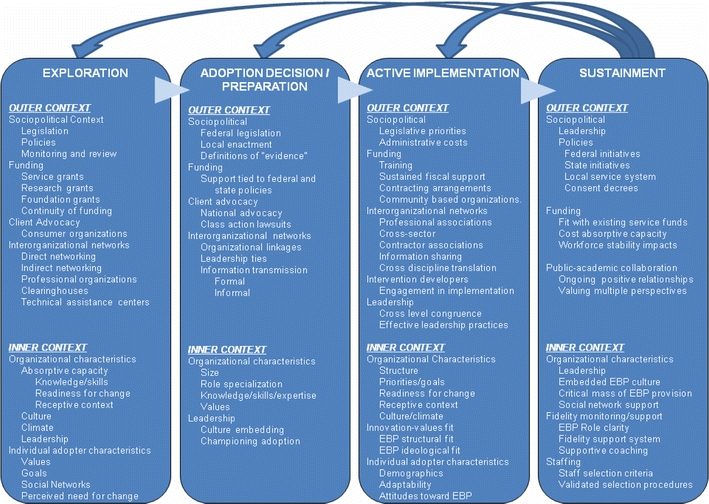
- The model divides implementation into four phases (Exploration, Adoption/Preparation, Active Implementation, Sustainment) and holds that "different aspects of the outer and inner context may be more prominent or manifest differently during different phases" — a feature the authors say few prior models explicitly recognize.
- Exploration is shaped by outer-context forces (sociopolitical/funding, client advocacy, interorganizational networks) and inner-context factors including absorptive capacity, readiness for change, and receptive context; the authors note child welfare agencies often have "varied levels of education and considerable workloads" and few venues for knowledge sharing.
- Sustainment is described as under-studied: "there has been little empirical work examining factors that either facilitate or limit sustainability of EBPs in public sector social services," and the authors state "we currently lack comprehensive models of factors that support maintenance or sustainment."
- Sustainment factors discussed include ongoing fidelity monitoring and support, a critical mass of EBP use, staffing/selection practices, leadership and culture-embedding mechanisms, and funding; the paper cites turnover rates in public sector service organizations "range from 20% to 50% annually" as a sustainment challenge.
Methods
- Design: conceptual/theoretical paper advancing a framework, not an empirical study; the model is "derived from extant literature" and illustrated with examples primarily from child welfare and specialty mental health, with the claim that many factors are "common to public sector services in general."
- Data/sample: none — the paper synthesizes prior implementation models and literature (e.g., RE-AIM, ORC, ARC, QUERI, CDT, IHI collaborative) rather than collecting data.
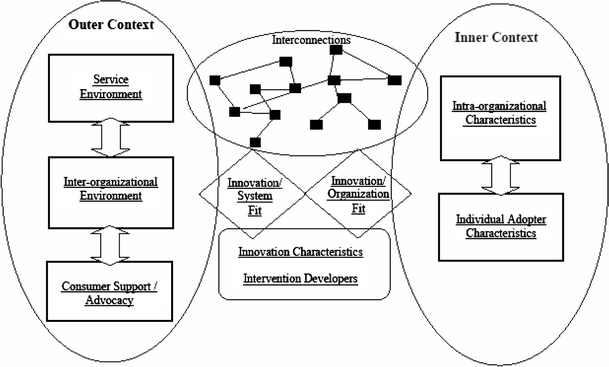
- Analysis: narrative synthesis organized by implementation phase and by outer vs. inner context levels, presented in two conceptual figures (Fig. 1 global factors; Fig. 2 phases and factors).
Limitations
- Stated: the authors note "few, if any, good measures of the process or progression through the phases" exist, and that process-based measures would be needed to assess status, progression, milestones, and speed of phase traversal.
- Stated: the paper repeatedly acknowledges thin empirical support — "there are few data supporting the importance of the other drivers of EBP exploration suggested by the literature," and consensus on core implementation drivers exists but "the body of concrete research evidence for each core driver in many cases remains to be developed."
- Evident from the text: the model is explicitly a hypothesis-generating framework ("variables hypothesized to play important roles"), its emphasis is skewed toward child welfare with mental health examples, and it offers no empirical test of the proposed phase-specific relationships.
Model-written summary. Check it against the paper before relying on it.
Integrity signals
Registry
Cites
Statistics
Figures
Verification
Claims the paper makes
16 Valid · 9 Not valid · 60 Not checked · 33 Own results and interpretations
The cited sources support only part of this claim — read each source’s verdict below.
In the paper
“Federal and state agencies may fund implementation demonstration projects and research studies to facilitate the implementation of EBPs, however, there has been little empirical work examining factors that either facilitate or limit sustainability of EBPs in public sector social services (Greenhalgh et al. 2004).”
§ Advancing a Conceptual Model of Evidence-Based Practice Implementation in Public Service Sectors > Sustainment Phase
What the sources say
- Partly supportedcites Greenhalgh et al. 2004 matched to “Diffusion of Innovations in Service Organizations: Systematic Review and Recommendations” (2004) sourceExperimental — accuracy not yet measured
The review says the literature on the sustainability of service innovations was very sparse (passage 1, page unavailable). It focused particularly on health care, however, and does not establish that empirical work on factors affecting sustainability of evidence-based practices was scarce specifically in public-sector social services. (LLM, conf=0.88)
plain- Asserted: passes — The authors put it forward as true.
- Checkable: passes — It can be checked against evidence.
- Load-bearing: passes — The paper’s conclusions depend on it.
- Based: passes — The paper gives a reason why it holds.
- Partly supported
The cited sources support only part of this claim — read each source’s verdict below.
In the paper
“The policies and funding needed for sustained use of practices typically follow from leaders who develop initiatives or set visions that can be maintained over time (Hoagwood et al. 2006).”
§ Advancing a Conceptual Model of Evidence-Based Practice Implementation in Public Service Sectors > Sustainment Phase > Outer Context
What the sources say
- Partly supportedcites Hoagwood et al. 2006 matched to “Implementation of evidence-based practices for children in four countries: a project of the World Psychiatric Association” (2006) sourceExperimental — accuracy not yet measured
The Discussion (page unavailable) says innovative leaders aided implementation and that all site Directors made plans for sustainability. The paper does not say that policies and funding typically follow from leaders’ initiatives or visions; it instead notes that continuation in Israel depended on securing funding. (LLM, conf=0.83)
plainstates a cause- Asserted: passes — The authors put it forward as true.
- Checkable: passes — It can be checked against evidence.
- Load-bearing: unclear — It is unclear whether the paper’s conclusions depend on it.
- Based: passes — The paper gives a reason why it holds.
- Partly supported
The cited sources support only part of this claim — read each source’s verdict below.
In the paper
“Conversely, severe budget restrictions discourage the exploration of innovations since exploration demands staff time, which may be limited when work forces are cut due to funding restrictions”
§ Advancing a Conceptual Model of Evidence-Based Practice Implementation in Public Service Sectors > Exploration Phase1 > The Outer Context
What the sources say
- Partly supportedcites Greenhalgh et al. 2004 matched to “Diffusion of Innovations in Service Organizations: Systematic Review and Recommendations” (2004) sourceExperimental — accuracy not yet measured
The paper’s discussion of organizational innovativeness (section labeled Abstract; page unavailable) associates slack resources with innovation, and its ‘Dedicated Time and Resources’ passage says adequate, continuing resources make assimilation more likely. It does not specifically say that severe budget restrictions lead to workforce cuts that leave staff too little time to explore innovations. (LLM, conf=0.86)
hedgedstates a cause- Asserted: passes — The authors put it forward as true.
- Checkable: passes — It can be checked against evidence.
- Load-bearing: unclear — It is unclear whether the paper’s conclusions depend on it.
- Based: passes — The paper gives a reason why it holds.
- Partly supported
The cited sources support only part of this claim — read each source’s verdict below.
In the paper
“Interorganizational forces, which focus on how individual organizations relate to, partner with, and compete with one another also play a potentially powerful role in adoption decisions.”
§ Advancing a Conceptual Model of Evidence-Based Practice Implementation in Public Service Sectors > Adoption Decision/Preparation Phase > Outer Context
What the sources say
- Partly supportedcites Chamberlain et al. 2008 matched to “Engaging and Recruiting Counties in an Experiment on Implementing Evidence-based Practice in California” (2008) sourceExperimental — accuracy not yet measured
The conceptual-model passage (Abstract; page unavailable) identifies prior cross-agency collaboration and positive relationships between counties and the California Institute for Mental Health as factors expected to influence adoption. This supports the claim about relationships and partnerships, but our copy does not address competition between organizations as an adoption influence. (LLM, conf=0.84)
- Not checked — no full text of the sourcecites Glisson and Schoenwald 2005 matched to “The ARC Organizational and Community Intervention Strategy for Implementing Evidence-Based Children's Mental Health Treatments” (2005) source
- Not matchedcites Institute for Healthcare Improvement [IHI] 2003
An author–year citation the paper’s reference list doesn’t settle. We don’t search these by name.
hedgedstates a possible cause- Asserted: passes — The authors put it forward as true.
- Checkable: passes — It can be checked against evidence.
- Load-bearing: unclear — It is unclear whether the paper’s conclusions depend on it.
- Based: passes — The paper gives a reason why it holds.
- Partly supported
The cited sources support only part of this claim — read each source’s verdict below.
In the paper
“Organizations that start with good knowledge/skills, can incorporate new knowledge, are highly specialized, and have mechanisms in place to spread knowledge throughout the organization, are much more likely to explore EBPs and eventually initiate them”
§ Advancing a Conceptual Model of Evidence-Based Practice Implementation in Public Service Sectors > Exploration Phase1 > The Inner Context
What the sources say
- Not checked — no full text of the sourcecites Damanpour 1991 matched to “Organizational innovation: A meta-analysis of effects of determinants and moderators” (1991) source
- Not checked — no full text of the sourcecites Ferlie and Shortell 2001 matched to “Improving the Quality of Health Care in the United Kingdom and the United States: A Framework for Change” (2001) source
- Partly supportedcites Greenhalgh et al. 2004 matched to “Diffusion of Innovations in Service Organizations: Systematic Review and Recommendations” (2004) sourceExperimental — accuracy not yet measured
The passages on structural determinants and absorptive capacity (indexed as Abstract; page unavailable) link specialization, an existing knowledge base, and knowledge sharing to greater organizational innovativeness and assimilation. They do not establish that organizations with these features are *much* more likely to explore and then initiate evidence-based practices specifically; the paper also describes assimilation as a process that can move back and forth between stages. (LLM, conf=0.84)
hedgedstates an association- Asserted: passes — The authors put it forward as true.
- Checkable: passes — It can be checked against evidence.
- Load-bearing: passes — The paper’s conclusions depend on it.
- Based: passes — The paper gives a reason why it holds.
57 more claims · 2 with their cited sources checked
Create a free account to see all 118 claims and to verify the 1 reference still open.
- Probably not a substantial claim. 31
- It may state two separate claims as one. 35
Claims other papers make about this one
Each is checked against this paper’s own text: does it say what the citing paper says it does?
The source backs part of the claim, not all of it — or backs it for a different population, condition or comparison.
In the citing paper
“Specifically, unlike traditional feasibility and pilot studies that may include the preliminary testing of interventions on individual clinical or public health outcomes, implementation feasibility and pilot studies that explore strategies to improve intervention implementation often require assessing changes across multiple levels including individuals (e.g. service providers or clinicians) and”
From Guidance for conducting feasibility and pilot studies for implementation trials (2020) · cites this paper as [21]
Experimental — accuracy not yet measuredThe source backs part of the claim, not all of it — or backs it for a different population, condition or comparison.
In the citing paper
“we propose that the concept of the individual might incorporate: capability, capacity, motivation (including recognising a need for change), resilience, acceptability, feelings, knowledge and beliefs (including self efficacy) about the intervention/evidence, position and fit within the organization/social system, and approach to decision-making (e.g., experimentation, use of information).”
From The role of evidence, context, and facilitation in an implementation trial: implications for the development of the PARIHS framework (2013) · cites this paper as [8]
Experimental — accuracy not yet measuredThe source backs part of the claim, not all of it — or backs it for a different population, condition or comparison.
In the citing paper
“Implementation strategies are too often designed in an unsystematic manner and fail to address key contextual determinants (13–16).”
From Enhancing the Impact of Implementation Strategies in Healthcare: A Research Agenda (2019) · cites this paper as [13]
Experimental — accuracy not yet measuredThe source backs part of the claim, not all of it — or backs it for a different population, condition or comparison.
In the citing paper
“Even if strategies are meticulously described in a study protocol or trial registry, it is often unrealistic to expect that they will not need to be altered as determinants emerge across implementation phases (13, 93, 94).”
From Enhancing the Impact of Implementation Strategies in Healthcare: A Research Agenda (2019) · cites this paper as [13]
Experimental — accuracy not yet measuredThe source backs part of the claim, not all of it — or backs it for a different population, condition or comparison.
In the citing paper
“Extent, quality, and timeliness of the completion of activities related to specific implementation process strategies”
From Beyond “implementation strategies”: classifying the full range of strategies used in implementation science and practice (2017) · cites this paper as [30]
Experimental — accuracy not yet measured
34 more claims about this paper
Create a free account to see every claim other papers make about this one.
Self-check
Percentages, sums and reported differences re-computed from the paper’s own numbers.
Each contradiction between two passages listed here was confirmed by an independent check.
Rated minor: it would not touch a result — a value no result rests on, a p-value that stays on the same side of the significance level, or a conflict that is clerical, resolved elsewhere in the paper, or outside its own findings.
In the paper
§ Advancing a Conceptual Model of Evidence-Based Practice Implementation in Public Service Sectors > References
“Data Path Design. (2010). ASWB projects.”
§ Advancing a Conceptual Model of Evidence-Based Practice Implementation in Public Service Sectors > References
“Retrieved June 10, 2009”
Citations
Cites
Rogers, E. M., Singhal, A., & Quinlan, M. M. (2019) · An Integrated Approach to Communication Theory and Research · doi:10.4324/9780203710753-35 · Cited by 37,322
The fifth discipline, the art and practice of the learning organization
Senge, P. M. (1991) · Performance + Instruction · doi:10.1002/pfi.4170300510 · Cited by 20,060
Organizational culture and leadership
(1993) · Long Range Planning · doi:10.1016/0024-6301(93)90120-5 · Cited by 16,462
Damschroder, L. J., Aron, D. C., Keith, R. E., Kirsh, S. R., Alexander, J. A., & Lowery, J. C. (2009) · Implementation Science · doi:10.1186/1748-5908-4-50 · Cited by 14,496
Valente, T. W. (2003) · Genetics in Medicine · doi:10.1097/01.gim.0000061743.67794.c4 · Cited by 13,723
(1994) · Cited by 13,126
Proctor, E., Silmere, H., Raghavan, R., Hovmand, P., Aarons, G., Bunger, A., Griffey, R., & Hensley, M. (2011) · Administration and Policy in Mental Health and Mental Health Services Research · doi:10.1007/s10488-010-0319-7 · Cited by 8,721
Self-citationDiffusion of Innovations in Service Organizations: Systematic Review and Recommendations
GREENHALGH, T., ROBERT, G., MACFARLANE, F., BATE, P., & KYRIAKIDOU, O. (2004) · The Milbank Quarterly · doi:10.1111/j.0887-378x.2004.00325.x · Cited by 7,448 · cited 11×
“Beginning at the broadest level, the state and federal sociopolitical and funding contexts influence the exploration of innovative interventions or practices (Davies and Nutley 2008; Ganju 2003; Hoagwood 2003).”
BackgroundInfluentialEvaluating the public health impact of health promotion interventions: the RE-AIM framework.
Glasgow, R. E., Vogt, T. M., & Boles, S. M. (1999) · American Journal of Public Health · doi:10.2105/ajph.89.9.1322 · Cited by 7,217 · cited 2×
“The RE-AIM model (Glasgow et al. 1999; Glasgow et al. 2006) explicitly identifies the ‘‘maintenance’’ phase of implementation as critical in sustaining effective health interventions.”
MethodOrganizational innovation: A meta-analysis of effects of determinants and moderators
Damanpour, F. (1991) · Academy of Management Journal · doi:10.2307/256406 · Cited by 6,542 · cited 9×
“Because the implementation literature has been developed in areas where the adoption of innovation is driven by profit or science, there is little attention to this first phase in the extant literature (Damanpour 1991).”
BackgroundMethodInfluential
Research works printed but not linked: 9
- Aos S Intensive family preservation programs: program fidelity influences effectiveness revised (No. 06-02-3901) 2006 Olympia Washington State Institute for Public Policy
- Backer T The failure of success: Challenges of disseminating effective substance abuse prevention programs Journal of Community Psychology 2000 28 3 363 373 · DOI · Paper page
- California Institute for Mental Health [CIMH] Community Development Team model: Supporting the model adherent implementation of programs and practices 2006 Sacramento California Institute for Mental Health
- Chadwick Center Closing the quality chasm in child abuse treatment: Identifying and disseminating best practices 2004 San Diego, CA Children’s Hospital-San Diego, Chadwich Center for Children and Families
- Davies HTO Nutley SM Learning more about how research-based knowledge gets used: Guidance in the development of new empirical research 2008 New York, NY William T. Grant Foundation
- Institute of Medicine [IOM] The state of quality improvement and implementation research: Expert views. Workshop summary 2007 Washington, DC The National Academies Press
- National Association of Public Child Welfare Administrators [NAPCWA] Guide for child welfare administrators on evidence based practice 2005 Washington DC APHSA
- National Institute of Mental Health [NIMH] Blueprint for change: Research on child and adolescent mental health 2001 Bethesda, MD National Institutes of Health
- Srivastava SK Bathla A Correlational study of organizational climate and work adjustment among industrial workers Social Science International 1996 12 1 52 60
Cited by
Items 1,501–1,600 of 3,223
Youth care workers' perspectives on and adoption of evidence-based practice
Stroobants, T., Vanderfaeillie, J., Andries, C., & Holen, F. V. (2016) · Children and Youth Services Review · doi:10.1016/j.childyouth.2016.11.017 · Cited by 11
Parent-Child Interaction Therapy in Child Welfare
Wilsie, C. C., Campbell, C., Chaffin, M. J., & Funderburk, B. W. (2016) · Child maltreatment solutions network · doi:10.1007/978-3-319-40920-7_7 · Cited by 10
Lau, G., Meredith, P. J., Bennett, S. H., Crompton, D., & Dark, F. L. (2017) · International Journal of Public Leadership · doi:10.1108/ijpl-08-2016-0030 · Cited by 7
Implementation of Evidence-Based Practices in Forensic Mental Health Services
Müller‐Isberner, R., Born, P., Eucker, S., et al. (2017) · Routledge eBooks · doi:10.4324/9781315627823-16 · Cited by 8
Furtado, K. S., Budd, E. L., Ying, X., deRuyter, A. J., Armstrong, R., Pettman, T. L., Reis, R. S., Sung‐Chan, P., Wang, Z., Saunders, T. L., et al. (2018) · Health Education Research · doi:10.1093/her/cyy005 · Cited by 11
“However, there is a dearth, globally, of research on how political contextual factors impact the implementation of EBNCDP [10, 16].”
BackgroundDistel, L. M. L., Torres, S. A., Ros, A. M., Brewer, S. K., Raviv, T., Coyne, C. A., Baker, S., Kolski, C., Smith, M. L., & Santiago, C. D. (2019) · Evidence-Based Practice in Child and Adolescent Mental Health · doi:10.1080/23794925.2019.1565501 · Cited by 10
“More specifically, Domitrovich et al.’s (2008) ecological model of implementation and the EPIS (Aarons et al., 2011) active implementation phase were used to create a predetermined set of codes (deductive approach).”
BackgroundMethodInfluentialMeza, R. D., Beidas, R. S., Ehrhart, M. G., Mandell, D. S., Dorsey, S., Frederick, L., Oh, C., & Locke, J. J. (2019) · Administration and Policy in Mental Health and Mental Health Services Research · doi:10.1007/s10488-019-00932-3 · Cited by 9
Elkington, K. S., Spaulding, A. C., Gardner, S. K., Knight, D. K., Belenko, S. R., Becan, J. E., Robertson, A. A., Oser, C. B., & DiClemente, R. J. (2020) · AIDS Education and Prevention · doi:10.1521/aeap.2020.32.4.337 · Cited by 9
Goldhaber‐Fiebert, J. D., Babiarz, K. S., Garfield, R. L., Wulczyn, F., Landsverk, J. A., & Horwitz, S. M. (2013) · Children and Youth Services Review · doi:10.1016/j.childyouth.2013.10.002 · Cited by 9
Self-citationIntegrating Science and Engineering to Implement Evidence-Based Practices in Health Care Settings
Wu, S., Duan, N., Wisdom, J. P., Kravitz, R. L., Owen, R. R., Sullivan, J. G., Wu, A. W., Capua, P. D., & Hoagwood, K. (2014) · Administration and Policy in Mental Health and Mental Health Services Research · doi:10.1007/s10488-014-0593-x · Cited by 9
“…approaches to build an evidence base on effective interventions in health care (Bowling 2009; Fixsen et al. 2005), there has been slow progress in implementing these evidence-based practices (EBPs; Aarons et al. 2011; Bickman 2013; Hoagwood et al. 2013; Proctor et al. 2009; Wandersman 2003).”
Bumbarger, B. K. (2015) · Prevention Science · doi:10.1007/s11121-015-0591-6 · Cited by 10
Common and Specific Factors Approaches to Home-Based Treatment: I-FAST and MST
Lee, M. Y., Greene, G. J., Fraser, J., Edwards, S. G., Grove, D. R., Solovey, A. D., & Scott, P. (2013) · Research on Social Work Practice · doi:10.1177/1049731513483181 · Cited by 10
Endogenous Technology Adoption and Medical CostsPreprint
Lamiraud, K., & Lhuillery, S. (2015) · SSRN Electronic Journal · doi:10.2139/ssrn.2676621 · Cited by 8
Malone, P., & Canavan, J. (2018) · ARAN (University of Galway Research Repository) (Ollscoil na Gaillimhe – University of Galway) · doi:10.13025/20757 · Cited by 9
Estrada, Y. A., Lozano, A., Boga, D. J., Tapia, M. I., Perrino, T., Velázquez, M. R., Forster, L., Torres, N. S., Morales, C. V., Gwynn, L. A., et al. (2023) · PLoS ONE · doi:10.1371/journal.pone.0283987 · Cited by 10
AVIVA: a telehealth tool to improve cervical cancer screening in resource-constrained settings
Ogunsola, O. O., Olawepo, J. O., Ajayi, O. A., Osayi, E. O., Akinro, Y., Ifechelobi, C., Chigbu, C. O., Okonkwo, P., & Ezeanolue, E. E. (2023) · BMJ Global Health · doi:10.1136/bmjgh-2023-012311 · Cited by 12
Falb, K., Kullenberg, S., Yuan, C. T., & Blackwell, A. (2024) · Conflict and Health · doi:10.1186/s13031-024-00597-2 · Cited by 10
“…Implementation, and Sustainment) and the Consoli-dated Framework for Implementation Research (CFIR) that consider the outer and inner context when examining implementation across multiple domains and stages could be used to assess the environment of the humanitarian context, specifically [14, 15].”
BackgroundBerg, K. E. C., Lundgren, J. S., & Bernhardsson, S. (2024) · Scandinavian Journal of Psychology · doi:10.1111/sjop.13045 · Cited by 11
Idemili-Aronu, N., Onyeka, T. C., Okenwa, U. J., Jemisenia, J. O., Okoli, I. A., Olawepo, J. O., & Ezeanolue, E. E. (2024) · BMC Palliative Care · doi:10.1186/s12904-024-01558-5 · Cited by 7
“The study followed the Exploration, Preparation, Implementation, and Sustainment (EPIS) Framework [55, 56].”
MethodWilliams, N. J., Aarons, G. A., Ehrhart, M. G., Esp, S. M., Vega, N. R., Sklar, M., Carandang, K. M., Brookman-Frazee, L. I., & Marcus, S. C. (2025) · Psychiatric Services · doi:10.1176/appi.ps.20240302 · Cited by 9
Self-citationAn, Q., Sandlund, M., Lundell, S., Kuenen, S., CHASTIN, S. F. M., Helleday, R., Messiha, K., Loisel, Q. E. A., & Wadell, K. (2025) · Design Studies · doi:10.1016/j.destud.2025.101297 · Cited by 8
Perez, L. G., Merle, J. L., Smith, J. D., Dopp, A. R., & Huebschmann, A. G. (2025) · BMC Health Services Research · doi:10.1186/s12913-025-12537-8 · Cited by 9
“…used frameworks that consider multilevel determinants include the Consolidated Framework for Implementation Research (CFIR) [10, 11]; Exploration, Preparation, Implementation, and Sustain-ment (EPIS) framework [12, 13]; and Practical, Robust Implementation and Sustainability Model (PRISM) [14– 16].”
Benhayoun, I., & Zejjari, I. (2025) · Journal of Accounting in Emerging Economies · doi:10.1108/jaee-06-2024-0283 · Cited by 10
Atzmon, O., Crowther, M. E., Bei, B., & O’Connor, D. A. (2025) · Implementation Science · doi:10.1186/s13012-025-01435-6 · Cited by 14
Kruis, R. D., Johnson, E., Guille, C., Sprouse-McClam, C., Alkis, A., McElligott, J. T., & Harvey, J. (2025) · BMC Family Practice · doi:10.1186/s12875-025-02839-5 · Cited by 9
“DAP follows the phased steps of Exploration, Preparation, Implementation, and Sustainment (EPIS)—a related implementation science model also developed by Aarons and colleagues—encouraging data collection and feedback processes across these EPIS phases to inform implementation [32, 33].”
Can we predict the future of respiratory failure prediction?
Pearce, A. K., Nemati, S., Goligher, E. C., Hough, C. L., Holder, A. L., Wardi, G., Yang, P., Boussina, A. E., Lyons, P. G., Sahetya, S. K., et al. (2025) · Critical Care · doi:10.1186/s13054-025-05484-7 · Cited by 11
“For example, approaches such as the Exploration, Preparation, Implementation, Sustainment (EPIS) framework can be used to facilitate implementation of ML in the clinical setting [65, 66].”
Tuteja, S., Cayabyab, M. A. S., Hoffecker, G., Varughese, L. A., Ndayishimiye, J. D. D., Wittner, V. A., Wang, X., Hatch, R., Capozzi, D. L., Harr, M. H., et al. (2025) · JCO Precision Oncology · doi:10.1200/po-25-00086 · Cited by 11
Fontaine, G., Ramos, J., Mooney, M., Perron, M.-È., Crump, L., & Lambert, S. (2026) · Journal of Patient-Reported Outcomes · doi:10.1186/s41687-026-01006-3 · Cited by 10
“…Implementation–Sustainment (EPIS) framework is a widely cited process model that provides a temporal lens on implementation (Exploration, Preparation, Implementation, Sustainment), highlighting that optimal strategies shift as programmes move from planning to routine use [23].”
Williams, J. R., Tregear, S., Dusablon, T., Caceda-Castro, L. E., Miller, K. J., Hill, G., & Hennessy, K. D. (2014) · The Journal of Behavioral Health Services & Research · doi:10.1007/s11414-013-9367-6 · Cited by 8
Hanratty, J., Miller, S. J., Keenan, C., Cowman, J., Hamilton, J., & Mackie, P. (2020) · Campbell Systematic Reviews · doi:10.1002/cl2.1109 · Cited by 7
Lidchi, V., & Wiener, A. (2020) · Child Abuse & Neglect · doi:10.1016/j.chiabu.2020.104648 · Cited by 10
Mbwayo, A., Kumar, M., Mathai, M., Mutavi, T. N., Nungari, J., Gathara, R., McKay, M. M., Ssewamala, F. M., Hoagwood, K., Petersen, I., et al. (2021) · Global Social Welfare · doi:10.1007/s40609-021-00204-9 · Cited by 9
Owens, J. S., Lee, M., Eackles, K., Medina, D., Evans, S. W., & Reid, J. (2022) · Frontiers in Education · doi:10.3389/feduc.2022.981916 · Cited by 9
“There are several implementation science frameworks for assessing and interpreting data related to intervention adoption, adaptation, and implementation (e.g., Damschroder et al., 2009; Aarons et al., 2011; Glasgow et al., 2019).”
MethodPreventing Suicide in Health Systems: How Can Implementation Science Help?
Larkin, C., Arensman, E., & Boudreaux, E. D. (2022) · Archives of Suicide Research · doi:10.1080/13811118.2022.2131490 · Cited by 10
“We have selected one of the most highly cited and widely used of the recent implementation science frameworks to review here, the Exploration, Preparation, Implementation, Sustainment or “ EPIS ” framework (Aarons, Hurlburt, & Horwitz, 2011).”
MethodThomas, F. C., Loskot, T., Mutschler, C., Burdo, J., Lagdamen, J., Sijercic, I., Lane, J. E. M., Liebman, R. E., Finley, E. P., Monson, C. M., et al. (2022) · Administration and Policy in Mental Health and Mental Health Services Research · doi:10.1007/s10488-022-01229-8 · Cited by 10
“Research suggests there are many factors involved in the adoption and delivery of EBPs generally, which may be a combination of therapist, client, and organizational factors (Aarons et al., 2011; Asgary-Eden & Lee, 2012; Moore, 2002).”
BackgroundGarner, B. R. (2022) · Frontiers in Health Services · doi:10.3389/frhs.2022.1007750 · Cited by 7
Yu, S. H., Kodish, T., Bear, L. M., O’Neill, J. C., Asarnow, J. R., Goldston, D. B., Cheng, K. K., Wang, X., Vargas, S. M., & Lau, A. S. (2023) · School Mental Health · doi:10.1007/s12310-023-09572-3 · Cited by 8
Larson, M. F., & Cook, C. R. (2023) · Issues in clinical child psychology · doi:10.1007/978-3-031-20006-9_28 · Cited by 10
Danielson, E. C., Smith, M. J., Ross, B., Sherwood, K. L., Smith, J. D., Atkins, M. S., & Jordan, N. (2023) · Journal of Special Education Technology · doi:10.1177/01626434231175372 · Cited by 9
“The fi eld of implementation science de fi nes the “ preparation ” phase as the period between when a setting (i.e., school) chooses to adopt a new intervention and when that intervention becomes available within the school (Aarons et al., 2011).”
BackgroundHiggins, E., & Booker, R. (2023) · International Journal of Wellbeing · doi:10.5502/ijw.v13i2.2833 · Cited by 18
Sharma, D., Agrawal, V., Sam-Agudu, N. A., Agarwal, P., Yadav, S. K., & Bajaj, J. (2023) · BMJ Innovations · doi:10.1136/bmjinnov-2022-001077 · Cited by 7
Organizational supports for evidence use in child welfare
Chuang, E., Collins‐Camargo, C., McBeath, B., & Jolles, M. P. (2023) · Children and Youth Services Review · doi:10.1016/j.childyouth.2023.107186 · Cited by 12
“Due to their formal roles and authority, agency leaders are essential catalysts of evidence use (Aarons et al., 2011).”
BackgroundEisman, A. B., Whitman, J., Palinkas, L. A., Fridline, J., Harvey, C., Kilbourne, A. M., & Hutton, D. W. (2023) · Implementation Science Communications · doi:10.1186/s43058-023-00511-6 · Cited by 9
“…constructs in the outer context (e.g., intervention recipient needs/characteristics), innovation factors (the MMH intervention and fit with the context), the inner context (i.e., school setting), and multi-level constructs such as barriers and facilitators and resources needed and utilized [40].”
BackgroundMethodSustaining health obesity prevention programs: Lessons from real-world population settings
Crane, M. A., Lee, K., Bohn-Goldbaum, E. E., Nathan, N., & Bauman, A. E. (2024) · Evaluation and Program Planning · doi:10.1016/j.evalprogplan.2024.102404 · Cited by 9
Huda, F. A., Mathewos, K., Mahmood, H. R., Faruk, O., Hirschhorn, L. R., & Binagwaho, A. (2024) · BMC Pediatrics · doi:10.1186/s12887-023-04389-0 · Cited by 9
“We used Aarons et al’s Exploration, Preparation, Implementation, and Sustain-ment (EPIS) framework to understand the implementation process, [14] the Consolidated Framework for Implementation Research (CFIR) to identify contextual factors that facilitated or hindered implementation, [15] and…”
MethodThe Role of Organizational Processes in Dissemination and Implementation Research
Aarons, G. A., Ehrhart, M. G., Lengnick‐Hall, R., & Moullin, J. C. (2023) · Oxford University Press eBooks · doi:10.1093/oso/9780197660690.003.0009 · Cited by 11
Self-citationLocke, J. J., Michael, O. G., Holt, T., Drahota, A., & Dickson, K. S. (2024) · School Mental Health · doi:10.1007/s12310-024-09657-7 · Cited by 7
“…developed in collaboration with a community–academic partnership, guided by the Exploration, Preparation, Implementation, and Sustainment (EPIS) framework that specifies multiple phases (identified in the framework’s name) of the implementation process (Aarons et al., 2011; Moullin et al., 2019).”
Hoyt, C. R., Luo, L., Rice, H. E., Shivakumar, N., Housten, A. J., Picinich, A., Qashou, N., Harris, K. M., Varughese, T. E., & King, A. A. (2024) · Pediatric Blood & Cancer · doi:10.1002/pbc.31060 · Cited by 8
McKinnon, K. M., Lentz, C. L., Boccher‐Lattimore, D., Cournos, F., Pather, A., Sukumaran, S., Thompson, A., DeLorenzo, L., Hager, M., Remien, R. H., et al. (2024) · AIDS Care · doi:10.1080/09540121.2024.2354897 · Cited by 10
Delgado, D., Crowley, S., Simmons, G. L., Heinly, J. M., Shepherd, W. S., Kiernan, B., Brookman-Frazee, L. I., Storch, E. A., & Maddox, B. B. (2024) · Journal of Autism and Developmental Disorders · doi:10.1007/s10803-024-06574-1 · Cited by 11
Harkness, A., Soulliard, Z. A., Layland, E. K., Behari, K., Rogers, B. G., Bharat, B., Safren, S. A., & Pachankis, J. E. (2024) · Implementation Science Communications · doi:10.1186/s43058-024-00657-x · Cited by 11
Day, E., Steinka‐Fry, K. T., Shimmel, L., Grant, S., & Tanner‐Smith, E. E. (2024) · Psychology in the Schools · doi:10.1002/pits.23358 · Cited by 9
The wide-angle lens of implementation science to improve health outcomes in criminal legal settings
Taxman, F. S., & Belenko, S. R. (2025) · Health & Justice · doi:10.1186/s40352-025-00323-x · Cited by 7
“JJ-TRIALS was organized around the Exploration, Preparation, Implementation, Sustain-ment (EPIS) framework (Aarons et al., 2011; Becan et al., 2018; Moullin et al., 2019), but JJ-TRIALS further elaborated the EPIS framework by considering a circular approach to implementation that can account for…”
Palinkas, L. A., Bazzi, A. R., Syvertsen, J. L., Hernandez, D. O., Ulibarri, M. D., Rangel, G., Martinex, G., & Strathdee, S. A. (2014) · AIDS and Behavior · doi:10.1007/s10461-014-0715-1 · Cited by 8
Williams, J. R., Caceda-Castro, L. E., Dusablon, T., & Stipa, M. (2016) · International Journal of Evidence-Based Healthcare · doi:10.1097/xeb.0000000000000072 · Cited by 13
“In practice settings, the decision to adopt an EBP is complicated with multiple factors converging at various levels, including system, organizational, staff, and program.(8) Several studies in dissemination and implementation (D&I) research have evaluated individuals factors such as staff attitudes, and organizationa…”
BackgroundStanhope, V., Choy-Brown, M., Barrenger, S. L., Manuel, J. I., Mercado, M., McKay, M. M., & Marcus, S. C. (2017) · Implementation Science · doi:10.1186/s13012-017-0549-0 · Cited by 11
Cognitive Enhancement in Schizophrenia and Related Disorders
Keshavan, M. S., & Eack, S. M. (2019) · Cambridge University Press eBooks · doi:10.1017/9781108163682 · Cited by 8
Mensuração da fidelidade de intervenções em saúde mental baseadas na escola
García, D., Schneider, D. R., & Cruz, R. M. (2019) · SMAD Revista Eletrônica Saúde Mental Álcool e Drogas (Edição em Português) · doi:10.11606/issn.1806-6976.smad.2019.150238 · Cited by 6
Olin, S.-C. S., Hemmelgarn, A. L., Madenwald, K., & Hoagwood, K. (2015) · Journal of Child and Family Studies · doi:10.1007/s10826-015-0220-9 · Cited by 8
Lebina, L., Kawonga, M., Alaba, O. A., Khamisa, N., Otwombe, K. N., & Oni, T. (2020) · BMJ Open · doi:10.1136/bmjopen-2019-036683 · Cited by 13
Innovation in child welfare: Factors affecting adoption of empirically supported interventions
Agner, J., Barile, J. P., Chandler, S. M., & Berry, M. (2020) · Children and Youth Services Review · doi:10.1016/j.childyouth.2020.105580 · Cited by 8
Snell‐Rood, C., Jaramillo, E. T., Gunderson, L. M., Hagadone, S., Fettes, D. L., Aarons, G. A., & Willging, C. E. (2020) · Critical Public Health · doi:10.1080/09581596.2020.1834075 · Cited by 7
“relationships that enable organizations to sustain these EBIs as funding fluctuates (Aarons et al., 2011).”
BackgroundSelf-citationO’Grady, M. A., Lincourt, P., Greenfield, B., Manseau, M. W., Hussain, S., Greene, K., & Neighbors, C. J. (2021) · Implementation Science · doi:10.1186/s13012-020-01076-x · Cited by 10
Ametaj, A. A., Wilner Tirpak, J., Cassiello-Robbins, C., Snow, R., Rassaby, M. M., Beer, K., & Sauer-Zavala, S. (2021) · Administration and Policy in Mental Health and Mental Health Services Research · doi:10.1007/s10488-020-01101-7 · Cited by 7
Fettes, D. L., Sklar, M., Green, A. E., Sandhu, A., Hurlburt, M. S., & Aarons, G. A. (2021) · Psychiatric Services · doi:10.1176/appi.ps.201900256 · Cited by 8
Self-citationPatient Decision Aid Selection for Shared Decision Making: A Multicase Qualitative Study
LeRouge, C., Nguyen, A. M., & Bowen, D. J. (2021) · Medical Care Research and Review · doi:10.1177/10775587211012995 · Cited by 7
“To conceptualize PDA selection domains and subdomains, we identified four models and frameworks relevant to our study: the SDM evaluation framework created by the Centers for Medicare and Medicaid Services (Deleire et al., 2014); the Consolidated Framework for Implementation Research (Damschroder et al., 2009); the Co…”
BackgroundLeedham-Green, K. E., Knight, A., & Reedy, G. B. (2021) · BMJ Open · doi:10.1136/bmjopen-2020-047943 · Cited by 14
Camilleri, L. J., Maras, K., & Brosnan, M. (2021) · Research in Developmental Disabilities · doi:10.1016/j.ridd.2021.104104 · Cited by 12
Vroom, E. B., Massey, O. T., Tyson, D. M., Levin, B. L., & Green, A. L. (2021) · Global Implementation Research and Applications · doi:10.1007/s43477-021-00024-1 · Cited by 8
“Leadership can often set the culture and climate of an organization, which research has shown to affect open communication and buy-in to adopting and implementing an EBP (Aarons et al., 2011).”
BackgroundAugustsson, H., Costea, V.-A., Eriksson, L., Hasson, H., Bäck, A., Åhström, M., & Bergström, A. (2021) · Implementation Science Communications · doi:10.1186/s43058-021-00233-7 · Cited by 9
“, the behavior change wheel [BCW] [37]), strategies that were tailored to contextual barriers [38], and models for the implementation stages [39].”
BackgroundDickson, K. S., Kenworthy, L. E., Anthony, L. G., & Brookman-Frazee, L. I. (2022) · Evidence-Based Practice in Child and Adolescent Mental Health · doi:10.1080/23794925.2021.2013142 · Cited by 8
Ihsaniyati, H., Setyowati, N., & Pardono (2022) · International Journal of Business and Society · doi:10.33736/ijbs.4609.2022 · Cited by 12
Michaud, T. L., Hill, J. L., Heelan, K. A., Bartee, R. T., Abbey, B. M., Malmkar, A., Masker, J., Golden, C. A., Porter, G. C., Glasgow, R. E., et al. (2022) · Implementation Science Communications · doi:10.1186/s43058-022-00287-1 · Cited by 9
Kelly, J., & McAllister, M. (2013) · Contemporary Nurse · doi:10.5172/conu.2013.3408 · Cited by 7
Corcuff, M., Routhier, F., Raynard, E. P., Gagnon, M., Battalova, A., Mwaka, C. R., & Lamontagne, M. (2022) · JMIR Research Protocols · doi:10.2196/33641 · Cited by 12
“To the best of our knowledge, little research has documented the effectiveness and nature of implementation strategies used specifically by public organizations in creating accessible environments [9,12,34,47,48].”
BackgroundSperber, N. R., Boucher, N. A., Hughes, J. M., Bruening, R., Zullig, L. L., Decosimo, K. P., Tucker, M., Christensen, L., Allen, K. D., Hastings, S. N., et al. (2022) · The Gerontologist · doi:10.1093/geront/gnac162 · Cited by 9
Yore, M. A., Fockele, C. E., Duber, H. C., Doran, K. M., Cooper, R. J., Lin, M., Campbell, S., Eswaran, V., Hong, H., Gbenedio, K., et al. (2023) · Western Journal of Emergency Medicine · doi:10.5811/westjem.2022.10.57368 · Cited by 7
A policy implementation study of earmarked taxes for mental health services: study protocol
Purtle, J., Stadnick, N. A., Wynecoop, M., Bruns, E. J., Crane, M. E., & Aarons, G. A. (2023) · Implementation Science Communications · doi:10.1186/s43058-023-00408-4 · Cited by 12
“The project uses the Exploration, Preparation, Implementation, Sustainment (EPIS) framework [10] to inform data collection about the determinants and processes of tax implementation and Leeman et al.”
MethodSelf-citationTiyyagura, G. K., Clayton, N., Schaeffer, P., Gawel, M., Leventhal, J. M., Hammel, K., Jubanyik, K. J., Crawley, D., Frechette, A., Lindberg, D. M., et al. (2023) · The Journal of Pediatrics · doi:10.1016/j.jpeds.2023.113519 · Cited by 6
Duffy, D. J., Richards, D., Earley, C., & Timulák, L. (2023) · Frontiers in Digital Health · doi:10.3389/fdgth.2023.1139125 · Cited by 10
Wilson, C. A. (2012) · Child Maltreatment · doi:10.1177/1077559512436680 · Cited by 11
Molfenter, T. D., Kim, J.-S., Quanbeck, A., Patel-Porter, T., Starr, S., & McCarty, D. W. (2013) · Implementation Science · doi:10.1186/1748-5908-8-50 · Cited by 8
“Discussion Conceptual multi-level models of EBP adoption are present in the literature and are based on correlates of EBP adoption discovered at the larger systems/environment, organizational, and individual levels [13,17,29].”
BackgroundSantens, T., Levy, S. A., Diamond, G. S., Braet, C., Vyvey, M., Heylboeck, E., & Bosmans, G. (2017) · Psychologica Belgica · doi:10.5334/pb.338 · Cited by 7
Lengnick‐Hall, R., Fenwick, K. M., Hurlburt, M. S., Green, A. C., Askew, R. A., & Aarons, G. A. (2019) · Journal of Children s Services · doi:10.1108/jcs-05-2018-0010 · Cited by 9
Self-citationCulph, J., Clemson, L. M., Scanlan, J. N., Craven, L. K., Jeon, Y., & Laver, K. (2020) · Brain Impairment · doi:10.1017/brimp.2020.2 · Cited by 7
Mazzucca, S., Valko, C., Eyler, A. A., Macchi, M., Lau, A., Alongi, J., Robitscher, J. W., & Brownson, R. C. (2020) · Implementation Science Communications · doi:10.1186/s43058-020-00003-x · Cited by 7
Ten simple rules to facilitate evidence implementation in the environmental sciences
Lortie, C. J., & Owen, M. (2020) · FACETS · doi:10.1139/facets-2020-0021 · Cited by 9
Mundey, P., Slemaker, A., Dopp, A. R., Beasley, L. O., & Silovsky, J. F. (2020) · The Journal of Behavioral Health Services & Research · doi:10.1007/s11414-020-09726-0 · Cited by 9
“Similarly, the theme of workforce and workplace issues parallels the inclusion of “organizational characteristics,” “fidelity monitoring,” and “staffing” in the Sustainment phase.(32)(p.”
BackgroundInfluentialPartnered innovation to implement timely and personalized care: A case study
Proctor, E. K., McKay, V., Toker, E., Maddox, T. M., Hooley, C., Lengnick‐Hall, R., MacGibbon, S., & Evanoff, B. (2021) · Journal of Clinical and Translational Science · doi:10.1017/cts.2021.778 · Cited by 18
Long-Term Evaluation of a Course on Evidence-Based Public Health in the U.S. and Europe
Jacob, R. R., Brownson, C. A., Deshpande, A. D., Eyler, A. A., Gillespie, K. N., Hefelfinger, J., Erwin, P. C., Macchi, M., & Brownson, R. C. (2021) · American Journal of Preventive Medicine · doi:10.1016/j.amepre.2021.03.003 · Cited by 7
Louie, E., Giannopoulos, V., Baillie, A., Guajardo, M. G. U., Wood, K., Teesson, M., Childs, S. J., Rogers, D., Haber, P., & Morley, K. C. (2021) · Frontiers in Health Services · doi:10.3389/frhs.2021.785391 · Cited by 6
“, the Exploration, Preparation, Implementation, Sustainment framework) (54), it was considered to be the most appropriate framework at the time this study was designed.”
Haruyama, R., Okawa, S., Akaba, H., Obara, H., & Fujita, N. (2021) · Vaccines · doi:10.3390/vaccines9111355 · Cited by 9
Lau, A. S., Lind, T., Motamedi, M., Lui, J. H. L., Kuckertz, M., Innes-Gomberg, D., Pesanti, K., & Brookman-Frazee, L. I. (2021) · Implementation Research and Practice · doi:10.1177/26334895211057884 · Cited by 9
Friday, P. J., Beemer, L. R., Martindale, D., Wassmann, A., Eisman, A. B., Templin, T. J., Zernicke, R. F., Malinoff, L., Schwartz, A. J., Ajibewa, T. A., et al. (2023) · International Journal of Environmental Research and Public Health · doi:10.3390/ijerph20031791 · Cited by 8
Shifting the intervention paradigm from individuals to families living with parental mental illness
Biebel, K., Nicholson, J., & Wolf, T. (2015) · Cambridge University Press eBooks · doi:10.1017/cbo9781107707559.033 · Cited by 7
MYERS, B. J., Williams, P. P., Johnson, K., Govender, R., Manderscheid, R., & Koch, J. R. (2017) · South African Medical Journal · doi:10.7196/samj.2017.v107i2.11331 · Cited by 7
Psychoeducation Responsive to Families (PERF): Translation of a Multifamily Group Model
Pollio, D. E., North, C. S., Hudson, A. M., Hong, B. A., Osborne, V. A., & McClendon, J. (2012) · Psychiatric Annals · doi:10.3928/00485713-20120606-06 · Cited by 8
A Survey Study Examining Teachers' Perceptions in Teaching Refugee and Immigrant Students.
Kurbegovic, D. (2016) · ResearchWorks at the University of Washington (University of Washington) · Cited by 25
Contextual Influences and Strategies for Dissemination and Implementation in Mental Health
Benjamin Wolk, C., Powell, B. J., & Beidas, R. S. (2015) · Oxford Handbook Topics in Psychology · doi:10.1093/oxfordhb/9780199935291.013.12 · Cited by 6
“Contextual aspects of the inner setting (i.e., internal to the provider) and the outer setting (i.e., external to the provider—the system level) may vary in their prominence and manifestation within each of the EPIS model’s phases.”
BackgroundInfluentialSystems Approach to Suicide Prevention: Strengthening Culture, Practice, and Education
Pisani, A. R., & Boudreaux, E. D. (2023) · FOCUS The Journal of Lifelong Learning in Psychiatry · doi:10.1176/appi.focus.20220081 · Cited by 11
Metadata
- Authors
- Aarons, G. A., Hurlburt, M., & Horwitz, S. M.
- Affiliations
- University of California San Diego (US)
- University of Southern California (US)
- Rady Children's Hospital-San Diego (US)
- Corresponding author
- Aarons, Gregory A.
- Venue
- Administration and Policy in Mental Health and Mental Health Services Research
- Published
- 2010-12-14
- Volume
- 38
- Issue
- 1
- Pages
- 4-23
- ISSN
- 0894-587X (ISSN-L)
- 1573-3289
- PMC
- PMC3025110
- OpenAlex
- W2044858486
- Cited by
- 3,240
- References
- 171
- Citations by year
- 2026: 306 · 2025: 331 · 2024: 333 · 2023: 311 · 2022: 307 · 2021: 274 · 2020: 251 · 2019: 257 · 2018: 170 · 2017: 168 · 2016: 111 · 2015: 143 · 2014: 107 · 2013: 96 · 2012: 48
- FWCI
- 93.26
- Type
- journal article
- Language
- en
- Open access
- hybrid
- doi.org
- Licence
- cc-by-nc
- Locations
- Administration and Policy in Mental Health and Mental Health Services Research (publishedVersion, cc-by-nc)
- PubMed Central (publishedVersion, cc-by-nc)
- PubMed (publishedVersion)
- Funders
- National Institute of Mental Health (P30MH074678, R01MH072961)
- Topics
- Health Sciences › Health Professions › General Health Professions › Health Policy Implementation Science
- Health Sciences › Health Professions › General Health Professions › Health Sciences Research and Education
- Social Sciences › Public Administration › Evaluation and Performance Assessment
- Keywords
- evidence-based practice implementation, implementation science, public service sector, conceptual model, multi-level model, implementation stages, exploration, adoption, implementation, program sustainability, public mental health services, social services, drug and alcohol services, organizational context
- MeSH terms
- Child, Child Welfare, Diffusion of Innovation, Health Plan Implementation, Humans, Mental Health Services, Social Work, United States, Models, Organizational, Evidence-Based Practice
About these checks
Registry, retraction, Cites and statistics results are computed, not judged, with one exception: a printed reference that no index lists is read once by a model before it counts as a citation error. Claims are extracted by a model and kept only when their quote appears verbatim in the text; each cited source is then checked, with a model’s help, for whether it says what the claim relies on. Those verdicts can be wrong — read the claim’s quote and the cited source before relying on one.
The claim verdicts this report counts are experimental: their accuracy is not yet measured.
A language model drew the claims from the paper on 2026-10-10, under version 3 of the claim definition (model deepseek-v4.1-flash, prompt extract-v3).
A second model labelled each claim on 2026-10-10 (model jev-1.13-20260917, definition revision gold-guideline-v0.2).
Cited sources are checked with a language model’s help (gpt-6-sol).
Statistics and arithmetic are recomputed, not judged.
Confidence bands are shown only for fields calibrated on our annotated test set. None is calibrated yet, so no band is shown.
What counts as a claim ›How we measure confidence ›How we check this ›
Are you an author, or do you see a problem with this page? Request a review
Data sources
Bibliographic data: Semantic Scholar, OpenAlex, Crossref.
Contains information from the Semantic Scholar Academic Graph Datasets, made available under the ODC Attribution License (ODC-BY 1.0).
Semantic Scholar’s data is described in: Kinney, R., et al. (2023). The Semantic Scholar Open Data Platform. arXiv:2301.10140.
