

Advancing a Conceptual Model of Evidence-Based Practice Implementation in Public Service Sectors
Open accessThe DOI matches its Crossref record; 159 of the 171 references it cites were found in a registry or an index; 18 of the 120 sources its claims cite were checked for support.
Abstract
Implementation science is a quickly growing discipline. Lessons learned from business and medical settings are being applied but it is unclear how well they translate to settings with different historical origins and customs (e.g., public mental health, social service, alcohol/drug sectors). The purpose of this paper is to propose a multi-level, four phase model of the implementation process (i.e., Exploration, Adoption/Preparation, Implementation, Sustainment), derived from extant literature, and apply it to public sector services. We highlight features of the model likely to be particularly important in each phase, while considering the outer and inner contexts (i.e., levels) of public sector service systems.
Overview
CoChat Summary
TL;DR
This conceptual paper proposes a multi-level, four-phase model of evidence-based practice (EBP) implementation — Exploration, Adoption/Preparation, Implementation, and Sustainment — derived from extant literature and applied specifically to public sector services such as child welfare and specialty mental health. It argues that different outer-context (sociopolitical/funding, interorganizational networks, leadership) and inner-context (organizational characteristics, culture/climate, individual adopter characteristics) factors matter differentially across phases, and that sustainment can recursively inform future implementation efforts.
Key findings
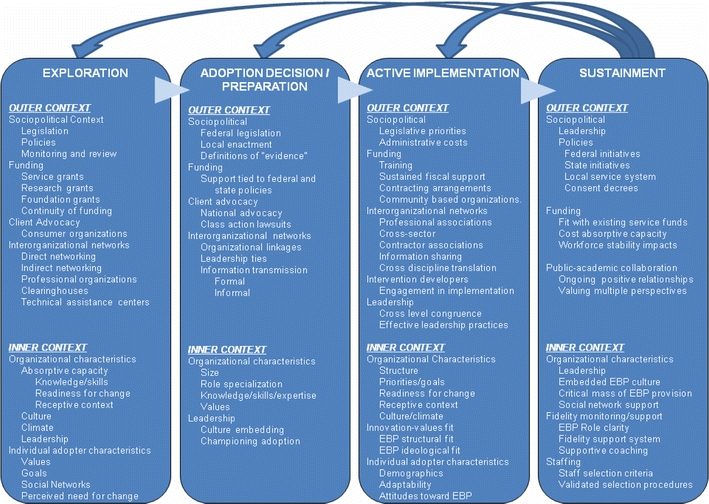
- The model divides implementation into four phases (Exploration, Adoption/Preparation, Active Implementation, Sustainment) and holds that "different aspects of the outer and inner context may be more prominent or manifest differently during different phases" — a feature the authors say few prior models explicitly recognize.
- Exploration is shaped by outer-context forces (sociopolitical/funding, client advocacy, interorganizational networks) and inner-context factors including absorptive capacity, readiness for change, and receptive context; the authors note child welfare agencies often have "varied levels of education and considerable workloads" and few venues for knowledge sharing.
- Sustainment is described as under-studied: "there has been little empirical work examining factors that either facilitate or limit sustainability of EBPs in public sector social services," and the authors state "we currently lack comprehensive models of factors that support maintenance or sustainment."
- Sustainment factors discussed include ongoing fidelity monitoring and support, a critical mass of EBP use, staffing/selection practices, leadership and culture-embedding mechanisms, and funding; the paper cites turnover rates in public sector service organizations "range from 20% to 50% annually" as a sustainment challenge.
Methods
- Design: conceptual/theoretical paper advancing a framework, not an empirical study; the model is "derived from extant literature" and illustrated with examples primarily from child welfare and specialty mental health, with the claim that many factors are "common to public sector services in general."
- Data/sample: none — the paper synthesizes prior implementation models and literature (e.g., RE-AIM, ORC, ARC, QUERI, CDT, IHI collaborative) rather than collecting data.
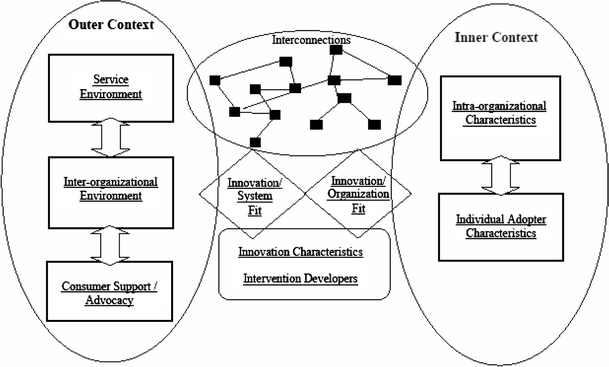
- Analysis: narrative synthesis organized by implementation phase and by outer vs. inner context levels, presented in two conceptual figures (Fig. 1 global factors; Fig. 2 phases and factors).
Limitations
- Stated: the authors note "few, if any, good measures of the process or progression through the phases" exist, and that process-based measures would be needed to assess status, progression, milestones, and speed of phase traversal.
- Stated: the paper repeatedly acknowledges thin empirical support — "there are few data supporting the importance of the other drivers of EBP exploration suggested by the literature," and consensus on core implementation drivers exists but "the body of concrete research evidence for each core driver in many cases remains to be developed."
- Evident from the text: the model is explicitly a hypothesis-generating framework ("variables hypothesized to play important roles"), its emphasis is skewed toward child welfare with mental health examples, and it offers no empirical test of the proposed phase-specific relationships.
Model-written summary. Check it against the paper before relying on it.
Integrity signals
Registry
Cites
Statistics
Figures
Verification
Claims the paper makes
16 Valid · 9 Not valid · 60 Not checked · 33 Own results and interpretations
The cited sources support only part of this claim — read each source’s verdict below.
In the paper
“Federal and state agencies may fund implementation demonstration projects and research studies to facilitate the implementation of EBPs, however, there has been little empirical work examining factors that either facilitate or limit sustainability of EBPs in public sector social services (Greenhalgh et al. 2004).”
§ Advancing a Conceptual Model of Evidence-Based Practice Implementation in Public Service Sectors > Sustainment Phase
What the sources say
- Partly supportedcites Greenhalgh et al. 2004 matched to “Diffusion of Innovations in Service Organizations: Systematic Review and Recommendations” (2004) sourceExperimental — accuracy not yet measured
The review says the literature on the sustainability of service innovations was very sparse (passage 1, page unavailable). It focused particularly on health care, however, and does not establish that empirical work on factors affecting sustainability of evidence-based practices was scarce specifically in public-sector social services. (LLM, conf=0.88)
plain- Asserted: passes — The authors put it forward as true.
- Checkable: passes — It can be checked against evidence.
- Load-bearing: passes — The paper’s conclusions depend on it.
- Based: passes — The paper gives a reason why it holds.
- Partly supported
The cited sources support only part of this claim — read each source’s verdict below.
In the paper
“The policies and funding needed for sustained use of practices typically follow from leaders who develop initiatives or set visions that can be maintained over time (Hoagwood et al. 2006).”
§ Advancing a Conceptual Model of Evidence-Based Practice Implementation in Public Service Sectors > Sustainment Phase > Outer Context
What the sources say
- Partly supportedcites Hoagwood et al. 2006 matched to “Implementation of evidence-based practices for children in four countries: a project of the World Psychiatric Association” (2006) sourceExperimental — accuracy not yet measured
The Discussion (page unavailable) says innovative leaders aided implementation and that all site Directors made plans for sustainability. The paper does not say that policies and funding typically follow from leaders’ initiatives or visions; it instead notes that continuation in Israel depended on securing funding. (LLM, conf=0.83)
plainstates a cause- Asserted: passes — The authors put it forward as true.
- Checkable: passes — It can be checked against evidence.
- Load-bearing: unclear — It is unclear whether the paper’s conclusions depend on it.
- Based: passes — The paper gives a reason why it holds.
- Partly supported
The cited sources support only part of this claim — read each source’s verdict below.
In the paper
“Conversely, severe budget restrictions discourage the exploration of innovations since exploration demands staff time, which may be limited when work forces are cut due to funding restrictions”
§ Advancing a Conceptual Model of Evidence-Based Practice Implementation in Public Service Sectors > Exploration Phase1 > The Outer Context
What the sources say
- Partly supportedcites Greenhalgh et al. 2004 matched to “Diffusion of Innovations in Service Organizations: Systematic Review and Recommendations” (2004) sourceExperimental — accuracy not yet measured
The paper’s discussion of organizational innovativeness (section labeled Abstract; page unavailable) associates slack resources with innovation, and its ‘Dedicated Time and Resources’ passage says adequate, continuing resources make assimilation more likely. It does not specifically say that severe budget restrictions lead to workforce cuts that leave staff too little time to explore innovations. (LLM, conf=0.86)
hedgedstates a cause- Asserted: passes — The authors put it forward as true.
- Checkable: passes — It can be checked against evidence.
- Load-bearing: unclear — It is unclear whether the paper’s conclusions depend on it.
- Based: passes — The paper gives a reason why it holds.
- Partly supported
The cited sources support only part of this claim — read each source’s verdict below.
In the paper
“Interorganizational forces, which focus on how individual organizations relate to, partner with, and compete with one another also play a potentially powerful role in adoption decisions.”
§ Advancing a Conceptual Model of Evidence-Based Practice Implementation in Public Service Sectors > Adoption Decision/Preparation Phase > Outer Context
What the sources say
- Partly supportedcites Chamberlain et al. 2008 matched to “Engaging and Recruiting Counties in an Experiment on Implementing Evidence-based Practice in California” (2008) sourceExperimental — accuracy not yet measured
The conceptual-model passage (Abstract; page unavailable) identifies prior cross-agency collaboration and positive relationships between counties and the California Institute for Mental Health as factors expected to influence adoption. This supports the claim about relationships and partnerships, but our copy does not address competition between organizations as an adoption influence. (LLM, conf=0.84)
- Not checked — no full text of the sourcecites Glisson and Schoenwald 2005 matched to “The ARC Organizational and Community Intervention Strategy for Implementing Evidence-Based Children's Mental Health Treatments” (2005) source
- Not matchedcites Institute for Healthcare Improvement [IHI] 2003
An author–year citation the paper’s reference list doesn’t settle. We don’t search these by name.
hedgedstates a possible cause- Asserted: passes — The authors put it forward as true.
- Checkable: passes — It can be checked against evidence.
- Load-bearing: unclear — It is unclear whether the paper’s conclusions depend on it.
- Based: passes — The paper gives a reason why it holds.
- Partly supported
The cited sources support only part of this claim — read each source’s verdict below.
In the paper
“Organizations that start with good knowledge/skills, can incorporate new knowledge, are highly specialized, and have mechanisms in place to spread knowledge throughout the organization, are much more likely to explore EBPs and eventually initiate them”
§ Advancing a Conceptual Model of Evidence-Based Practice Implementation in Public Service Sectors > Exploration Phase1 > The Inner Context
What the sources say
- Not checked — no full text of the sourcecites Damanpour 1991 matched to “Organizational innovation: A meta-analysis of effects of determinants and moderators” (1991) source
- Not checked — no full text of the sourcecites Ferlie and Shortell 2001 matched to “Improving the Quality of Health Care in the United Kingdom and the United States: A Framework for Change” (2001) source
- Partly supportedcites Greenhalgh et al. 2004 matched to “Diffusion of Innovations in Service Organizations: Systematic Review and Recommendations” (2004) sourceExperimental — accuracy not yet measured
The passages on structural determinants and absorptive capacity (indexed as Abstract; page unavailable) link specialization, an existing knowledge base, and knowledge sharing to greater organizational innovativeness and assimilation. They do not establish that organizations with these features are *much* more likely to explore and then initiate evidence-based practices specifically; the paper also describes assimilation as a process that can move back and forth between stages. (LLM, conf=0.84)
hedgedstates an association- Asserted: passes — The authors put it forward as true.
- Checkable: passes — It can be checked against evidence.
- Load-bearing: passes — The paper’s conclusions depend on it.
- Based: passes — The paper gives a reason why it holds.
57 more claims · 2 with their cited sources checked
Create a free account to see all 118 claims and to verify the 1 reference still open.
- Probably not a substantial claim. 31
- It may state two separate claims as one. 35
Claims other papers make about this one
Each is checked against this paper’s own text: does it say what the citing paper says it does?
The source backs part of the claim, not all of it — or backs it for a different population, condition or comparison.
In the citing paper
“Specifically, unlike traditional feasibility and pilot studies that may include the preliminary testing of interventions on individual clinical or public health outcomes, implementation feasibility and pilot studies that explore strategies to improve intervention implementation often require assessing changes across multiple levels including individuals (e.g. service providers or clinicians) and”
From Guidance for conducting feasibility and pilot studies for implementation trials (2020) · cites this paper as [21]
Experimental — accuracy not yet measuredThe source backs part of the claim, not all of it — or backs it for a different population, condition or comparison.
In the citing paper
“we propose that the concept of the individual might incorporate: capability, capacity, motivation (including recognising a need for change), resilience, acceptability, feelings, knowledge and beliefs (including self efficacy) about the intervention/evidence, position and fit within the organization/social system, and approach to decision-making (e.g., experimentation, use of information).”
From The role of evidence, context, and facilitation in an implementation trial: implications for the development of the PARIHS framework (2013) · cites this paper as [8]
Experimental — accuracy not yet measuredThe source backs part of the claim, not all of it — or backs it for a different population, condition or comparison.
In the citing paper
“Implementation strategies are too often designed in an unsystematic manner and fail to address key contextual determinants (13–16).”
From Enhancing the Impact of Implementation Strategies in Healthcare: A Research Agenda (2019) · cites this paper as [13]
Experimental — accuracy not yet measuredThe source backs part of the claim, not all of it — or backs it for a different population, condition or comparison.
In the citing paper
“Even if strategies are meticulously described in a study protocol or trial registry, it is often unrealistic to expect that they will not need to be altered as determinants emerge across implementation phases (13, 93, 94).”
From Enhancing the Impact of Implementation Strategies in Healthcare: A Research Agenda (2019) · cites this paper as [13]
Experimental — accuracy not yet measuredThe source backs part of the claim, not all of it — or backs it for a different population, condition or comparison.
In the citing paper
“Extent, quality, and timeliness of the completion of activities related to specific implementation process strategies”
From Beyond “implementation strategies”: classifying the full range of strategies used in implementation science and practice (2017) · cites this paper as [30]
Experimental — accuracy not yet measured
34 more claims about this paper
Create a free account to see every claim other papers make about this one.
Self-check
Percentages, sums and reported differences re-computed from the paper’s own numbers.
Each contradiction between two passages listed here was confirmed by an independent check.
Rated minor: it would not touch a result — a value no result rests on, a p-value that stays on the same side of the significance level, or a conflict that is clerical, resolved elsewhere in the paper, or outside its own findings.
In the paper
§ Advancing a Conceptual Model of Evidence-Based Practice Implementation in Public Service Sectors > References
“Data Path Design. (2010). ASWB projects.”
§ Advancing a Conceptual Model of Evidence-Based Practice Implementation in Public Service Sectors > References
“Retrieved June 10, 2009”
Citations
Cites
Rogers, E. M., Singhal, A., & Quinlan, M. M. (2019) · An Integrated Approach to Communication Theory and Research · doi:10.4324/9780203710753-35 · Cited by 37,322
The fifth discipline, the art and practice of the learning organization
Senge, P. M. (1991) · Performance + Instruction · doi:10.1002/pfi.4170300510 · Cited by 20,060
Organizational culture and leadership
(1993) · Long Range Planning · doi:10.1016/0024-6301(93)90120-5 · Cited by 16,462
Damschroder, L. J., Aron, D. C., Keith, R. E., Kirsh, S. R., Alexander, J. A., & Lowery, J. C. (2009) · Implementation Science · doi:10.1186/1748-5908-4-50 · Cited by 14,496
Valente, T. W. (2003) · Genetics in Medicine · doi:10.1097/01.gim.0000061743.67794.c4 · Cited by 13,723
(1994) · Cited by 13,126
Proctor, E., Silmere, H., Raghavan, R., Hovmand, P., Aarons, G., Bunger, A., Griffey, R., & Hensley, M. (2011) · Administration and Policy in Mental Health and Mental Health Services Research · doi:10.1007/s10488-010-0319-7 · Cited by 8,721
Self-citationDiffusion of Innovations in Service Organizations: Systematic Review and Recommendations
GREENHALGH, T., ROBERT, G., MACFARLANE, F., BATE, P., & KYRIAKIDOU, O. (2004) · The Milbank Quarterly · doi:10.1111/j.0887-378x.2004.00325.x · Cited by 7,448 · cited 11×
“Beginning at the broadest level, the state and federal sociopolitical and funding contexts influence the exploration of innovative interventions or practices (Davies and Nutley 2008; Ganju 2003; Hoagwood 2003).”
BackgroundInfluentialEvaluating the public health impact of health promotion interventions: the RE-AIM framework.
Glasgow, R. E., Vogt, T. M., & Boles, S. M. (1999) · American Journal of Public Health · doi:10.2105/ajph.89.9.1322 · Cited by 7,217 · cited 2×
“The RE-AIM model (Glasgow et al. 1999; Glasgow et al. 2006) explicitly identifies the ‘‘maintenance’’ phase of implementation as critical in sustaining effective health interventions.”
MethodOrganizational innovation: A meta-analysis of effects of determinants and moderators
Damanpour, F. (1991) · Academy of Management Journal · doi:10.2307/256406 · Cited by 6,542 · cited 9×
“Because the implementation literature has been developed in areas where the adoption of innovation is driven by profit or science, there is little attention to this first phase in the extant literature (Damanpour 1991).”
BackgroundMethodInfluential
Research works printed but not linked: 9
- Aos S Intensive family preservation programs: program fidelity influences effectiveness revised (No. 06-02-3901) 2006 Olympia Washington State Institute for Public Policy
- Backer T The failure of success: Challenges of disseminating effective substance abuse prevention programs Journal of Community Psychology 2000 28 3 363 373 · DOI · Paper page
- California Institute for Mental Health [CIMH] Community Development Team model: Supporting the model adherent implementation of programs and practices 2006 Sacramento California Institute for Mental Health
- Chadwick Center Closing the quality chasm in child abuse treatment: Identifying and disseminating best practices 2004 San Diego, CA Children’s Hospital-San Diego, Chadwich Center for Children and Families
- Davies HTO Nutley SM Learning more about how research-based knowledge gets used: Guidance in the development of new empirical research 2008 New York, NY William T. Grant Foundation
- Institute of Medicine [IOM] The state of quality improvement and implementation research: Expert views. Workshop summary 2007 Washington, DC The National Academies Press
- National Association of Public Child Welfare Administrators [NAPCWA] Guide for child welfare administrators on evidence based practice 2005 Washington DC APHSA
- National Institute of Mental Health [NIMH] Blueprint for change: Research on child and adolescent mental health 2001 Bethesda, MD National Institutes of Health
- Srivastava SK Bathla A Correlational study of organizational climate and work adjustment among industrial workers Social Science International 1996 12 1 52 60
Cited by
Items 2,501–2,600 of 3,223
McGovern, M. P. (2014) · Journal of Addictive Behaviors Therapy & Rehabilitation · doi:10.4172/2324-9005.1000127
“Given ongoing implementation challenges, newly developed treatments should not only be effective, but also fit with the existing approaches and be designed for relative ease of implementation by the existing workforce [45,50-52].”
BackgroundFacilitating Dissemination of Innovations in Public University Hospitals
Blomqvist, I., & Mattsson, M. (2016) · KTH Publication Database DiVA (KTH Royal Institute of Technology)
Peer-Assisted Social Learning In Urban After-School Programs
Helseth, S. A. (2016) · FIU - Digital Commons (Florida International University) · doi:10.25148/etd.fidc000692
Job perceptions following statewide evidence-based treatment implementation
Green, A. E., Cafri, G., & Aarons, G. A. (2016) · Journal of Children s Services · doi:10.1108/jcs-07-2016-0013 · Cited by 1
Self-citationKilbourne, A. M., Goodrich, D. E., Nord, K. M., Poppelen, C. V., Kyle, J., Kim, L. H. M., Bauer, M. S., Waxmonsky, J. A., Thomas, M. R., & Eisenberg, D. (2015)
Sherlock-Storey, M. (2016) · Northumbria Research Link (Northumbria University) · Cited by 1
Karich, A. C. (2016) · University of Minnesota Digital Conservancy (University of Minnesota)
Becoming an Evidence-based Organization: Demonstrating Leadership and Organizational Growth
Myers, D. L. (2013) · Digital Commons - New Heaven (University of New Haven)
Hunt, T. (2017) · Columbia Academic Commons (Columbia University) · doi:10.7916/d8m04hr6
“New models guiding implementation research are emerging (Aarons et al., 2011; Nilsen, 2015) as efforts have been ramped up to address the lagging utilization of evidence-based interventions and practice.”
Kusworo, K. (2017) · International Journal of u- and e- Service Science and Technology · doi:10.14257/ijunesst.2017.10.8.18
“Implementation is largely considered as law implementation in which various actors, organizations, procedures, and techniques work together to execute a policy in order to achieve its objectives and run the programs [11].”
BackgroundStrand, V. C., & Walsh, C. R. (2017) · Springer eBooks · doi:10.1007/978-3-319-64602-2_13
Csac, W., & Izaak, L. (2017) · Index of Texas Archaeology Open Access Grey Literature from the Lone Star State
Virtanen, P. J., & Stenvall, J. (2017) · Springer eBooks · doi:10.1007/978-3-319-69596-9_7
An Overview of Implementation Fidelity
Patterson, G. T. (2018) · Elsevier eBooks · doi:10.1016/b978-0-12-811381-3.00003-2 · Cited by 1
Translation of Science to Practice and Policy
Brownson, R. C., & Cardick, L. (2012) · Oxford University Press eBooks · doi:10.1093/obo/9780199756797-0022
Lengnick‐Hall, R., Fenwick, K. M., & Henwood, B. F. (2018) · Community Mental Health Journal · doi:10.1007/s10597-018-0312-2 · Cited by 1
PERCIEVED BARRIERS TO DEVELOPING A SUCCESSFUL SCHOOL-BASED MENTAL HEALTH PROGRAM
Peterson, D. C. (2018)
Castro, F. G., Barrera, M., & Bautista, T. G. (2018) · Springer eBooks · doi:10.1007/978-3-319-93003-9_6 · Cited by 1
Dymnicki, A. B., Bzura, R., Osher, D. M., Wandersman, A., Duplantier, D., Boyd, M. J., Cash, A. J., & Hutchison, L. A. (2019) · Evidence & Policy · doi:10.1332/174426418x15409834211096
Implementation of complex interventions in UK General Practice
Lau, W. K. R. (2018) · UCL Discovery (University College London) · Cited by 3
A Qualitative Analysis of Innovation Adoption in the Olive Oil Extraction Process
Zoccali, D., & Gadanakis, Y. (2019) · International Journal of Food and Beverage Manufacturing and Business Models · doi:10.4018/ijfbmbm.2019010103
Intervention Fidelity Within the Clinical Service Delivery Setting
Sokolowski, K. L. (2018) · Routledge eBooks · doi:10.4324/9781315175799-15
Dissemination and Implementation
Cox, J. R., & Southam‐Gerow, M. A. (2019) · Elsevier eBooks · doi:10.1016/b978-0-12-813004-9.00019-0
Shklarski, L. (2019) · CUNY Academic Works (City University of New York)
Crosby, H. (2018) · White Rose eTheses Online (University of Leeds, The University of Sheffield, University of York)
The Effects of a Systematic Tier 2 Intervention on Kindergartners' Dibels Benchmarks
Abernathy, R. K. (2019) · Digital Commons (Liberty University)
Walsh, C., & Best, P. (2019) · Journal of Family Social Work · doi:10.1080/10522158.2019.1616240 · Cited by 1
mHealth Collaboration for Social Good: Lessons on Adaptability
Koch, H., Green, G., Mahid, Z., Garner, S. L., Hitchcock, J., George, C. E., & Young, P. (2019) · Advances in medical technologies and clinical practice book series · doi:10.4018/978-1-7998-0047-7.ch016 · Cited by 1
Emotieregulatie trainen binnen een schoolse context
Volkaert, B., Wante, L., Weymeis, H., & Braet, C. (2019) · Bohn Stafleu van Loghum eBooks · doi:10.1007/978-90-368-2308-1_7
White, J. (2019) · Cronfa (Swansea University) · doi:10.23889/suthesis.51971 · Cited by 1
Annunciating Teachers’ Continuous Professional Development
Suson, R., & Poligrates, E. (2019) · International Journal of Trend in Scientific Research and Development
Spector, A. Y., & Infante, K. (2019) · Index of Texas Archaeology Open Access Grey Literature from the Lone Star State
Innovations to transform probation supervision
Marmolejo, L., Byrne, J. M., & Taxman, F. S. (2019) · Routledge eBooks · doi:10.4324/9781315102832-88
McMillin, S. E. (2020) · Journal of Policy Practice and Research · doi:10.1007/s42972-020-00004-z
Linking Trauma-Informed Screening and Assessment Practices Across Child-Serving Systems
Conradi, L., Kisiel, C., & Pinkerton, L. M. (2020) · Springer eBooks · doi:10.1007/978-3-319-62122-7_273-1
Implementing Research into Everyday Systemic Family Therapy Practice
Withers, M. C., & Duncan, J. M. (2020) · Wiley eBooks · doi:10.1002/9781119438519.ch22
Pinto, R. M., & Park, S. (2020) · Routledge eBooks · doi:10.4324/9781003041191-11
Implementation of the self-management of well-being interventions: determinants and effects
Kuiper, D. (2020) · University of Groningen research database (University of Groningen / Centre for Information Technology) · doi:10.33612/diss.127415575
Implementation and evaluation of pharmacy services
Painter, J. T., & Curran, G. M. (2020) · Elsevier eBooks · doi:10.1016/b978-0-12-820007-0.00050-7
Implementation of evidence-based substance misuse prevention and treatment interventions
Bunger, A. C., Lange, J., & Magier, E. (2020) · Routledge eBooks · doi:10.4324/9780429203121-41
Beyond Crisis Response: Characterizing First Responder Interest in Mental Health Services
Sutton, S. (2020) · ResearchWorks at the University of Washington (University of Washington)
Exploring Disruptive Thinking Possibilities in Construction and Engineering
Kanjanabootra, S. (2021) · Engineering Project Organization Journal · doi:10.25219/epoj.2021.00105
Implementing patient: Reported outcomes in a medical oncology setting
Roberts, N. A. (2021) · Queensland University of Technology · doi:10.5204/thesis.eprints.208324 · Cited by 2
Service Design for Data Lineage in Financial Services
Gomes, M. S. (2020) · Portuguese National Funding Agency for Science, Research and Technology (RCAAP Project by FCT) · doi:10.34626/y5gt-f541
Kho, K. L. (2020) · Murdoch University Research Portal · Cited by 2
Hohmeier, K. C., Renfro, C. P., Turner, K. L., et al. (2021) · Research Square · doi:10.21203/rs.3.rs-384434/v1
Computer-based Approaches to Cognitive Enhancement
Keshavan, M. S., & Eack, S. M. (2019) · Cambridge University Press eBooks · doi:10.1017/9781108163682.007
Cognition and Its Impairment in Schizophrenia and Related Psychotic Disorders
Keshavan, M. S., & Eack, S. M. (2019) · Cambridge University Press eBooks · doi:10.1017/9781108163682.003 · Cited by 1
Integration of Services in Child and Youth Mental Health: A Case Study
Sloos, R. (2019) · TSpace (University of Toronto) · Cited by 1
Purinton, K. A. (2020) · FIU - Digital Commons (Florida International University) · doi:10.25148/etd.fidc008907 · Cited by 1
La tematización como singularidad
Solé, J. (2008) · Gestión en H: cuadernos de gestión y dirección de hoteles y restaurantes
Who Responds Best? Predictors and Moderators of Cognitive Enhancement
Keshavan, M. S., & Eack, S. M. (2019) · Cambridge University Press eBooks · doi:10.1017/9781108163682.010
Individual and Group Approaches to Cognitive Enhancement
Keshavan, M. S., & Eack, S. M. (2019) · Cambridge University Press eBooks · doi:10.1017/9781108163682.008
Harrison, M. S., Yarinbab, T. E., Holliman, B. D., Aarons, G. A., Betrán, A. P., Goldenberg, R. L., & Muldrow, M. E. (2021) · Research Square · doi:10.21203/rs.3.rs-421743/v1
Self-citationUniversal Factors and Tier 1 Interventions Associated with Quality Student-Teacher Relationships
Kincade, L. (2020) · University of Minnesota Digital Conservancy (University of Minnesota)
Implementation Science: Developing a Common Understanding for Use in Mental Health
Gutner, C. A., & Wells, S. Y. (2021) · Elsevier eBooks · doi:10.1016/b978-0-12-818697-8.00086-8
Research in Cognitive Enhancement: Challenges and Opportunities
Keshavan, M. S., & Eack, S. M. (2019) · Cambridge University Press eBooks · doi:10.1017/9781108163682.013
Lindholm, L. H., Komulainen, J., Lassila, A., & Kampman, O. (2021) · Research Square · doi:10.21203/rs.3.rs-1015976/v1
Harun, D. R., Priyanto, S. H., & Suharti, L. (2021) · Technium Social Sciences Journal · doi:10.47577/tssj.v25i1.4928 · Cited by 2
5677 環境共生型集合住宅団地におけるベランダ緑化状況の経年変化に関する研究 : 大阪府営河内長野木戸住宅を対象に(環境共生住宅,建築計画II)
上田, 規., 横田, 隆., 飯田, 匡., et al. (2009) · 学術講演梗概集. E-2, 建築計画II, 住居・住宅地, 農村計画, 教育
How Much Ethanol, Ultimately?Preprint
Perrin, R. K., & Sesmero, J. (2007) · RePEc: Research Papers in Economics · doi:10.22004/ag.econ.306526
Baeza‐Hernandez, K., Lasecke, M., Herman, A. M., et al. (2021) · doi:10.31234/osf.io/mwv3k
Harrison, M. S., Yarinbab, T. E., Holliman, B. D., Aarons, G. A., Betrán, A. P., Goldenberg, R. L., & Muldrow, M. E. (2021) · Pilot and Feasibility Studies · doi:10.1186/s40814-021-00955-4
“These Hospitainers have already been used to provide emergency obstetrical care in Sudan, Congo, Sierra Leone, Somalia, and Gabon with success (as well as in other regions, including the Middle East, Europe, and Americas).”
BackgroundMethodInfluentialSelf-citationAI-Sallami, T. Y., & Khudair, F. W. (2021) · Indian Journal of Forensic Medicine & Toxicology · doi:10.37506/ijfmt.v16i1.17608
COVID-19 Testing in K–12 Schools: Insights from Early Adopters
Faherty, L. J., Master, B. K., Steiner, E. D., Kaufman, J. H., Predmore, Z., Stelitano, L., Leschitz, J. T., Phillips, B. N., Schwartz, H. L., & Wolfe, R. L. (2021) · RAND Corporation eBooks · doi:10.7249/rra1103-1
MacDonald, J. R., Doyle, L. A., Moore, J. L., & Rafferty, M. R. (2021) · Research Square · doi:10.21203/rs.3.rs-143443/v1
Approaches to Assessment and Monitoring Treatment Response
Keshavan, M. S., & Eack, S. M. (2019) · Cambridge University Press eBooks · doi:10.1017/9781108163682.012
Choosing the Right Treatment for the Right Patient
Keshavan, M. S., & Eack, S. M. (2019) · Cambridge University Press eBooks · doi:10.1017/9781108163682.011
Naar, S., MacDonell, K. K., & Cockern, S. N. (2020) · Elsevier eBooks · doi:10.1016/b978-0-12-816000-8.00012-8
Getting Ready for Cognitive Enhancement: Patient Engagement, Stabilization, and Integration
Keshavan, M. S., & Eack, S. M. (2019) · Cambridge University Press eBooks · doi:10.1017/9781108163682.006
Cognitive Enhancement: Historical Overview and Principles
Keshavan, M. S., & Eack, S. M. (2019) · Cambridge University Press eBooks · doi:10.1017/9781108163682.005
Keshavan, M. S., & Eack, S. M. (2019) · Cambridge University Press eBooks · doi:10.1017/9781108163682.014
Dame, T. W. (2019) · Cambridge University Press eBooks · doi:10.1017/9781108163682.001
Keshavan, M. S., & Eack, S. M. (2019) · Cambridge University Press eBooks · doi:10.1017/9781108163682.015
Keshavan, M. S., & Eack, S. M. (2019) · Cambridge University Press eBooks · doi:10.1017/9781108163682.002
Epilogue: Implementation Science in CSD and Starting Where You Are
Davidson, M. M., & Morris, M. A. (2022) · American Journal of Speech-Language Pathology · doi:10.1044/2022_ajslp-22-00010 · Cited by 1
Stanton, M. C., McCormick, K. A., & Ali, S. (2022) · Research Square · doi:10.21203/rs.3.rs-1573899/v1
Safadi, H., Lám, J., Baranyi, I., et al. (2022) · medRxiv · doi:10.1101/2022.04.27.22274383
Role of Mental Health Professionals in Extending Professional Support to People in Need
Lidchi, V., Androvik, M., Bradley, C. E., Charlemagne-Odle, S. Z., Elmer, J., Goodman, E., & Roberts, S. (2022) · Springer eBooks · doi:10.1007/978-981-16-8263-6_24
Zbukvic, I., Rheinberger, D., Rosebrock, H., Lim, J., McGillivray, L., Mok, K., Stamate, E., McGill, K., Shand, F., Torok, M. H., et al. (2021) · Research Square · doi:10.21203/rs.3.rs-142115/v1
Malo, T. L., Correa, S. Y., Moore, A., et al. (2021) · Research Square · doi:10.21203/rs.3.rs-711241/v1
Naar, S., Parsons, J. T., & STANTON, B. F. (2018) · doi:10.2196/preprints.11204
Improving Mental Health on College Campuses: Perspectives of Indian College StudentsPreprint
Wasil, A. R., Malhotra, T., Nandakumar, N., et al. (2021) · doi:10.31234/osf.io/pmuth
Strengthening the Implementation of Health Service Delivery Reform
Bank, W. (2019) · World Bank, Washington, DC eBooks · doi:10.1596/978-1-4648-1263-7_ch10
Siegle, A., zu Sayn-Wittgenstein-Hohenstein, F., & Roes, M. (2020) · Implementation Science · doi:10.1186/s13012-020-01033-8 · Cited by 2
Implementing Research into Everyday Systemic Family Therapy Practice
Withers, M. C., & Duncan, J. M. (2020) · Wiley eBooks · doi:10.1002/9781119790181.ch22
Beretta, V. (2021) · Contributions to management science · doi:10.1007/978-3-030-70308-0_1
MacDonald, J. R., Doyle, L. A., Moore, J. L., & Rafferty, M. R. (2021) · Research Square · doi:10.21203/rs.3.rs-143443/v2
Metadata
- Authors
- Aarons, G. A., Hurlburt, M., & Horwitz, S. M.
- Affiliations
- University of California San Diego (US)
- University of Southern California (US)
- Rady Children's Hospital-San Diego (US)
- Corresponding author
- Aarons, Gregory A.
- Venue
- Administration and Policy in Mental Health and Mental Health Services Research
- Published
- 2010-12-14
- Volume
- 38
- Issue
- 1
- Pages
- 4-23
- ISSN
- 0894-587X (ISSN-L)
- 1573-3289
- PMC
- PMC3025110
- OpenAlex
- W2044858486
- Cited by
- 3,240
- References
- 171
- Citations by year
- 2026: 306 · 2025: 331 · 2024: 333 · 2023: 311 · 2022: 307 · 2021: 274 · 2020: 251 · 2019: 257 · 2018: 170 · 2017: 168 · 2016: 111 · 2015: 143 · 2014: 107 · 2013: 96 · 2012: 48
- FWCI
- 93.26
- Type
- journal article
- Language
- en
- Open access
- hybrid
- doi.org
- Licence
- cc-by-nc
- Locations
- Administration and Policy in Mental Health and Mental Health Services Research (publishedVersion, cc-by-nc)
- PubMed Central (publishedVersion, cc-by-nc)
- PubMed (publishedVersion)
- Funders
- National Institute of Mental Health (P30MH074678, R01MH072961)
- Topics
- Health Sciences › Health Professions › General Health Professions › Health Policy Implementation Science
- Health Sciences › Health Professions › General Health Professions › Health Sciences Research and Education
- Social Sciences › Public Administration › Evaluation and Performance Assessment
- Keywords
- evidence-based practice implementation, implementation science, public service sector, conceptual model, multi-level model, implementation stages, exploration, adoption, implementation, program sustainability, public mental health services, social services, drug and alcohol services, organizational context
- MeSH terms
- Child, Child Welfare, Diffusion of Innovation, Health Plan Implementation, Humans, Mental Health Services, Social Work, United States, Models, Organizational, Evidence-Based Practice
About these checks
Registry, retraction, Cites and statistics results are computed, not judged, with one exception: a printed reference that no index lists is read once by a model before it counts as a citation error. Claims are extracted by a model and kept only when their quote appears verbatim in the text; each cited source is then checked, with a model’s help, for whether it says what the claim relies on. Those verdicts can be wrong — read the claim’s quote and the cited source before relying on one.
The claim verdicts this report counts are experimental: their accuracy is not yet measured.
A language model drew the claims from the paper on 2026-10-10, under version 3 of the claim definition (model deepseek-v4.1-flash, prompt extract-v3).
A second model labelled each claim on 2026-10-10 (model jev-1.13-20260917, definition revision gold-guideline-v0.2).
Cited sources are checked with a language model’s help (gpt-6-sol).
Statistics and arithmetic are recomputed, not judged.
Confidence bands are shown only for fields calibrated on our annotated test set. None is calibrated yet, so no band is shown.
What counts as a claim ›How we measure confidence ›How we check this ›
Are you an author, or do you see a problem with this page? Request a review
Data sources
Bibliographic data: Semantic Scholar, OpenAlex, Crossref.
Contains information from the Semantic Scholar Academic Graph Datasets, made available under the ODC Attribution License (ODC-BY 1.0).
Semantic Scholar’s data is described in: Kinney, R., et al. (2023). The Semantic Scholar Open Data Platform. arXiv:2301.10140.
