

Large language models for chemistry robotics
Open accessThe DOI matches its Crossref record; 108 of the 109 references it cites were found in a registry or an index, and 1 are not checked yet.
Abstract
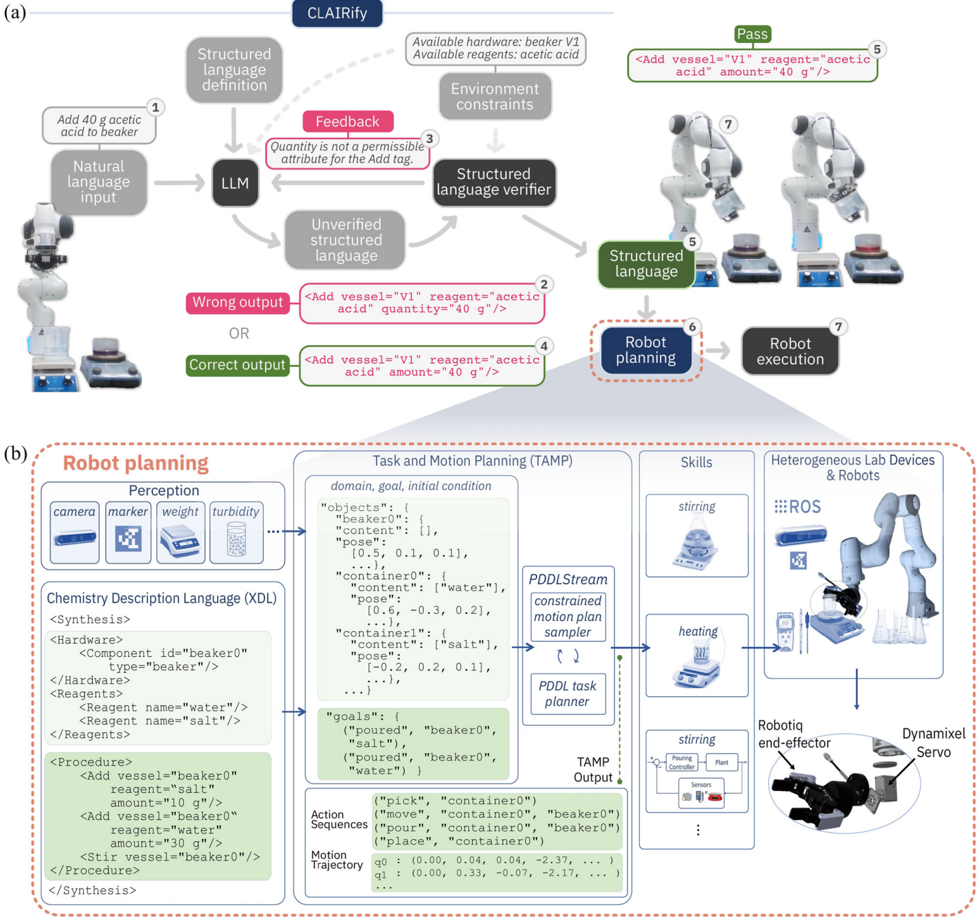
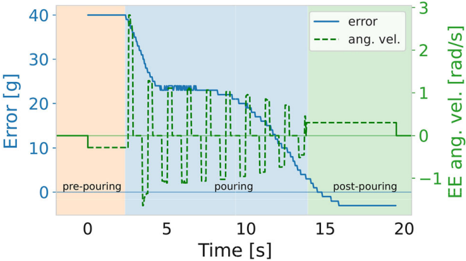
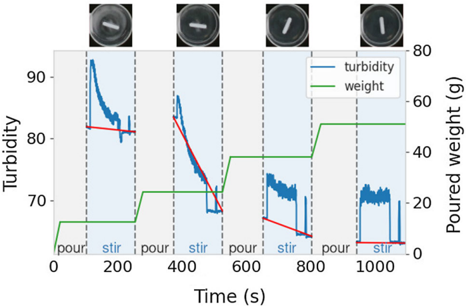
This paper proposes an approach to automate chemistry experiments using robots by translating natural language instructions into robot-executable plans, using large language models together with task and motion planning. Adding natural language interfaces to autonomous chemistry experiment systems lowers the barrier to using complicated robotics systems and increases utility for non-expert users, but translating natural language experiment descriptions from users into low-level robotics languages is nontrivial. Furthermore, while recent advances have used large language models to generate task plans, reliably executing those plans in the real world by an embodied agent remains challenging. To enable autonomous chemistry experiments and alleviate the workload of chemists, robots must interpret natural language commands, perceive the workspace, autonomously plan multi-step actions and motions, consider safety precautions, and interact with various laboratory equipment. Our approach, CLAIRify , combines automatic iterative prompting with program verification to ensure syntactically valid programs in a data-scarce domain-specific language that incorporates environmental constraints. The generated plan is executed through solving a constrained task and motion planning problem using PDDLStream solvers to prevent spillages of liquids as well as collisions in chemistry labs. We demonstrate the effectiveness of our approach in planning chemistry experiments, with plans successfully executed on a real robot using a repertoire of robot skills and lab tools. Specifically, we showcase the utility of our framework in pouring skills for various materials and two fundamental chemical experiments for materials synthesis: solubility and recrystallization. Further details about CLAIRify can be found at https://ac-rad.github.io/clairify/ .
Overview
The claims and statistics of this paper haven’t been checked yet.
Free: it reads the open-access text and checks the first 5 claims that cite a source we can check. Create a free account to check every claim.
Integrity signals
Registry
Cites
Statistics
Figures









Verification
Claims the paper makes
The claims and statistics of this paper haven’t been checked yet.
Free: it reads the open-access text and checks the first 5 claims that cite a source we can check. Create a free account to check every claim.
Claims other papers make about this one
Each is checked against this paper’s own text: does it say what the citing paper says it does?
The source backs part of the claim, not all of it — or backs it for a different population, condition or comparison.
In the citing paper
“In parallel, chemistry-oriented reviews have shown that large language models can move beyond text generation toward tool use, retrieval, planning, code execution, and multi-agent coordination [5-10].”
From From Scientific Copilots to Tool-Grounded Autonomy: AI Agents in Simulation-Driven Materials Discovery (2026) · cites this paper as [6]
Experimental — accuracy not yet measuredThe source backs part of the claim, not all of it — or backs it for a different population, condition or comparison.
In the citing paper
“The central challenge is not only to predict a property, but to manage the sequence of reasoning and action that connects a scientific objective to executable computational or experimental steps [2-10].”
From From Scientific Copilots to Tool-Grounded Autonomy: AI Agents in Simulation-Driven Materials Discovery (2026) · cites this paper as [6]
Experimental — accuracy not yet measuredThe check wasn’t confident either way, so it gives no verdict — never disputed.
In the citing paper
“To the best of our knowledge, no prior review has isolated simulation-driven, toolorchestrating AI agent workflows for materials discovery as a distinct evidence base with study-level extraction of autonomy, validation, and reproducibility [3-14].”
From From Scientific Copilots to Tool-Grounded Autonomy: AI Agents in Simulation-Driven Materials Discovery (2026) · cites this paper as [6]
Experimental — accuracy not yet measured
Self-check
Percentages, sums and reported differences re-computed from the paper’s own numbers.
The self-check needs the paper’s full text.
Citations
Cites
BERT: Pre-training of Deep Bidirectional Transformers for Language Understanding
Devlin, J., Chang, M.-W., Lee, K., & Toutanova, K. (2018) · arXiv · doi:10.48550/arxiv.1810.04805 · Cited by 73,173 · cited 1×
“LLMs have been used to generate structured outputs (Devlin et al., 2019; Brown et al., 2020; Chowdhery et al., 2022), including code generation (Chen et al., 2021; Wang et al., 2021; Li et al., 2022) and robot programming (Liang et al., 2022).”
MethodLanguage Models are Few-Shot Learners
Brown, T. B., Mann, B., Ryder, N., Subbiah, M., Kaplan, J., Dhariwal, P., Neelakantan, A., Shyam, P., Sastry, G., Askell, A., et al. (2020) · arXiv · doi:10.48550/arxiv.2005.14165 · Cited by 23,372 · cited 3×
“Error:HardwarecanonlycontainComponenttags Error:Stepsattri-butenotdefined Error:"beaker1" Structuredlanguagegenerationwithoutiterativeprompting <XDL><Hardware> <Component id="beaker"> </Hardware> ... <Procedure> ...”
BackgroundMethodAdvances in Neural Information Processing Systems 14: Proceedings of the 2001 Conference
(2002) · The MIT Press eBooks · doi:10.7551/mitpress/1120.001.0001 · Cited by 8,890
Probabilistic roadmaps for path planning in high-dimensional configuration spaces
Kavraki, L. E., Svestka, P., Latombe, J.-C., & Overmars, M. H. (1996) · IEEE Transactions on Robotics and Automation · doi:10.1109/70.508439 · Cited by 6,343 · cited 1×
“We use probabilistic roadmap methods (PRM ⋆ ) to plan efficiently in the 8-DoF configuration space found in our chemistry laboratory domain (Karaman and Frazzoli, 2011; Kavraki et al., 1996).”
MethodSampling-based algorithms for optimal motion planning
Karaman, S., & Frazzoli, E. (2011) · The International Journal of Robotics Research · doi:10.1177/0278364911406761 · Cited by 5,275 · cited 2×
“We use probabilistic roadmap methods (PRM ⋆ ) to plan efficiently in the 8-DoF configuration space found in our chemistry laboratory domain (Karaman and Frazzoli, 2011; Kavraki et al., 1996).”
BackgroundMethodPaLM: Scaling Language Modeling with Pathways
Chowdhery, A., Narang, S., Devlin, J., Bosma, M., Mishra, G., Roberts, A., Barham, P., Chung, H. W., Sutton, C., Gehrmann, S., et al. (2022) · arXiv · doi:10.48550/arxiv.2204.02311 · Cited by 2,590 · cited 1×
“Error:HardwarecanonlycontainComponenttags Error:Stepsattri-butenotdefined Error:"beaker1" Structuredlanguagegenerationwithoutiterativeprompting <XDL><Hardware> <Component id="beaker"> </Hardware> ... <Procedure> ...”
Manipulability of Robotic Mechanisms
Yoshikawa, T. (1985) · The International Journal of Robotics Research · doi:10.1177/027836498500400201 · Cited by 2,582 · cited 1×
“Second, depending on the robot task, the objective function is extended to maximize the manipulability ellipsoid as described in (Yoshikawa, 1985), which is applied for more complicated maneuvers, such as transferring liquids across the workspace.”
MethodDomain-specific language model pretraining for biomedical natural language processing
Gu, Y., Tinn, R., Cheng, H., Lucas, M., Usuyama, N., Liu, X., Naumann, T., Gao, J., & Poon, H. (2022) · ACM Transactions on Computing for Healthcare · doi:10.1145/3458754 · Cited by 2,170 · cited 1×
“Second, LLMs may perform poorly in generating task plans in a zero-shot manner for data-scarce domain-specific languages, such as chemistry (Gu et al., 2021; Liu et al., 2022).”
MethodAprilTag: A robust and flexible visual fiducial system
Olson, E. (2011) · 2011 IEEE International Conference on Robotics and Automation · doi:10.1109/icra.2011.5979561 · Cited by 1,770 · cited 2×
“To detect fiducial markers, we use the AprilTag library (Olson, 2011).”
MethodSparks of Artificial General Intelligence: Early experiments with GPT-4
Bubeck, S., Chandrasekaran, V., Eldan, R., Gehrke, J., Horvitz, E., Kamar, E., Lee, P., Lee, Y. T., Li, Y., Lundberg, S., et al. (2023) · arXiv · doi:10.48550/arxiv.2303.12712 · Cited by 1,526 · cited 1×
“The limitation in task planning abilities has been highlighted in a recent study (Bubeck et al., 2023) as well.”
Background
Research works printed but not linked: 1
- Yoshikawa, N., Li, A. Z., Darvish, K., Zhao, Y., Xu, H., Kuramshin, A., Aspuru-Guzik, A., Garg, A., & Shkurti, F. (2023). Chemistry lab automation via constrained task and motion planning. arXiv preprint. https://doi.org/10.48550/arXiv.2212.09672 · DOI
Cited by
Self-Driving Laboratories for Chemistry and Materials Science
Tom, G., Schmid, S. P., Baird, S. G., Cao, Y., Darvish, K., Hao, H., Lo, S., Pablo-García, S., Rajaonson, E. M., Skreta, M., et al. (2024) · Chemical Reviews · doi:10.1021/acs.chemrev.4c00055 · Cited by 707
Self-citationORGANA: A robotic assistant for automated chemistry experimentation and characterization
Darvish, K., Skreta, M., Zhao, Y., Yoshikawa, N., Som, S., Bogdanović, M., Cao, Y., Hao, H., Xu, H., Aspuru‐Guzik, A., et al. (2024) · Matter · doi:10.1016/j.matt.2024.10.015 · Cited by 250
Self-citationAn automatic end-to-end chemical synthesis development platform powered by large language models
Ruan, Y., Lu, C., Xu, N., He, Y., Chen, Y., Zhang, J., Xuan, J., Pan, J., Fang, Q., Gao, H., et al. (2024) · Nature Communications · doi:10.1038/s41467-024-54457-x · Cited by 116
A Multiagent-Driven Robotic AI Chemist Enabling Autonomous Chemical Research On Demand
Song, T., Luo, M., Zhang, X., Chen, L., Huang, Y., Cao, J., Zhu, Q., Liu, D., Zhang, B., Zou, G., et al. (2025) · Journal of the American Chemical Society · doi:10.1021/jacs.4c17738 · Cited by 171
“Naturally, the integration of automated robotic hardware with LLM techniques 48-54 has emerged as a new research direction in autonomous chemistry research 1,55,56 .”
Risks of AI scientists: prioritizing safeguarding over autonomy
Tang, X., Jin, Q., Zhu, K., Yuan, T., Zhang, Y., Zhou, W., Qu, M., Zhao, Y., Tang, J., Zhang, Z., et al. (2025) · Nature Communications · doi:10.1038/s41467-025-63913-1 · Cited by 51
“However, current efforts remain incomplete.”
Self-citation
Metadata
- Authors
- Yoshikawa, N., Skreta, M., Darvish, K., Arellano-Rubach, S., Ji, Z., Bjørn Kristensen, L., Li, A. Z., Zhao, Y., Xu, H., Kuramshin, A., Aspuru-Guzik, A., Shkurti, F., & Garg, A.
- Affiliations
- University of Toronto (CA)
- University of Waterloo (CA)
- Corresponding author
- Darvish, Kourosh
- ORCID
- Venue
- Autonomous Robots
- Published
- 2023-10-25
- Volume
- 47
- Issue
- 8
- Pages
- 1057-1086
- ISSN
- 0929-5593 (ISSN-L)
- 1573-7527
- OpenAlex
- W4387937021
- Cited by
- 112
- References
- 94
- Citations by year
- 2026: 39 · 2025: 43 · 2024: 30
- FWCI
- 9.91
- Type
- journal article
- Language
- en
- Open access
- hybrid
- doi.org
- Licence
- cc-by
- creativecommons.org/licenses/by/4.0 (tdm)
- creativecommons.org/licenses/by/4.0 (vor)
- Locations
- Autonomous Robots (publishedVersion, cc-by)
- Funders
- Carlsberg Foundation (CF21-0669)
- Topics
- Physical Sciences › Computer Science › Artificial Intelligence › AI-based Problem Solving and Planning
- Physical Sciences › Engineering › Control and Systems Engineering › Robot Manipulation and Learning
- Physical Sciences › Engineering › Control and Systems Engineering › Robotics and Automated Systems
- Keywords
- large language models, natural language interfaces, task and motion planning, iterative prompting, program verification, embodied agents, laboratory automation, recrystallization, collision avoidance
About these checks
Registry, retraction, Cites and statistics results are computed, not judged, with one exception: a printed reference that no index lists is read once by a model before it counts as a citation error. Claims are extracted by a model and kept only when their quote appears verbatim in the text; each cited source is then checked, with a model’s help, for whether it says what the claim relies on. Those verdicts can be wrong — read the claim’s quote and the cited source before relying on one.
Statistics and arithmetic are recomputed, not judged.
Confidence bands are shown only for fields calibrated on our annotated test set. None is calibrated yet, so no band is shown.
What counts as a claim ›How we measure confidence ›How we check this ›
Are you an author, or do you see a problem with this page? Request a review
How to cite
Cite CoChat for the checks on this page, and the paper for its own findings.
- This page
- CoChat. (2026). Citation check: Large language models for chemistry robotics. https://app.cochat.ai/papers/10.1007/s10514-023-10136-2
- The paper
- Yoshikawa, N., Skreta, M., Darvish, K., Arellano-Rubach, S., Ji, Z., Bjørn Kristensen, L., Li, A. Z., Zhao, Y., Xu, H., Kuramshin, A., Aspuru-Guzik, A., Shkurti, F., & Garg, A. (2023). Large language models for chemistry robotics. Autonomous Robots. https://doi.org/10.1007/s10514-023-10136-2
Data sources
Bibliographic data: Semantic Scholar, OpenAlex, Crossref.
Contains information from the Semantic Scholar Academic Graph Datasets, made available under the ODC Attribution License (ODC-BY 1.0).
Semantic Scholar’s data is described in: Kinney, R., et al. (2023). The Semantic Scholar Open Data Platform. arXiv:2301.10140.
