

Large language models for chemistry robotics
Open accessThe DOI matches its Crossref record; 109 of the 109 references it cites were found in a registry or an index.
Abstract
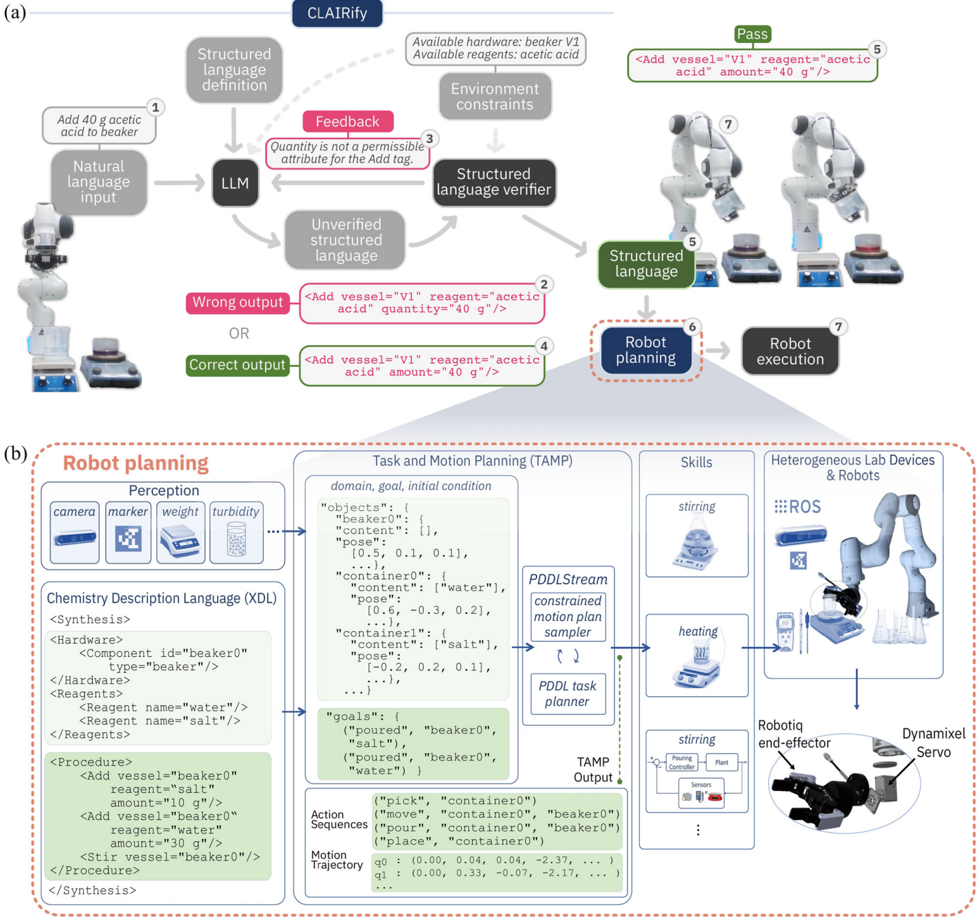
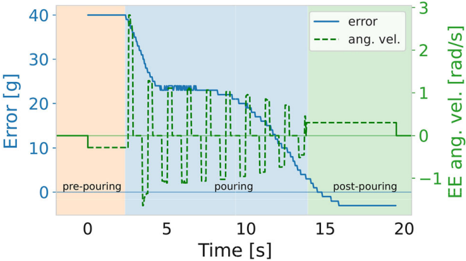
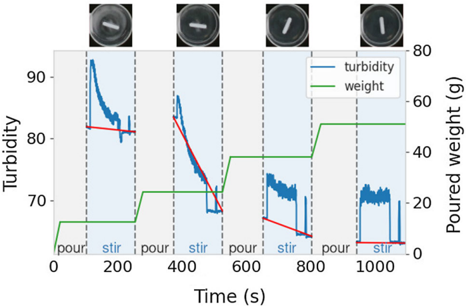
This paper proposes an approach to automate chemistry experiments using robots by translating natural language instructions into robot-executable plans, using large language models together with task and motion planning. Adding natural language interfaces to autonomous chemistry experiment systems lowers the barrier to using complicated robotics systems and increases utility for non-expert users, but translating natural language experiment descriptions from users into low-level robotics languages is nontrivial. Furthermore, while recent advances have used large language models to generate task plans, reliably executing those plans in the real world by an embodied agent remains challenging. To enable autonomous chemistry experiments and alleviate the workload of chemists, robots must interpret natural language commands, perceive the workspace, autonomously plan multi-step actions and motions, consider safety precautions, and interact with various laboratory equipment. Our approach, CLAIRify , combines automatic iterative prompting with program verification to ensure syntactically valid programs in a data-scarce domain-specific language that incorporates environmental constraints. The generated plan is executed through solving a constrained task and motion planning problem using PDDLStream solvers to prevent spillages of liquids as well as collisions in chemistry labs. We demonstrate the effectiveness of our approach in planning chemistry experiments, with plans successfully executed on a real robot using a repertoire of robot skills and lab tools. Specifically, we showcase the utility of our framework in pouring skills for various materials and two fundamental chemical experiments for materials synthesis: solubility and recrystallization. Further details about CLAIRify can be found at https://ac-rad.github.io/clairify/ .
Overview
The claims and statistics of this paper haven’t been checked yet.
Free: it reads the open-access text and checks the first 5 claims that cite a source we can check. Create a free account to check every claim.
Integrity signals
Registry
Cites
Statistics
Figures










Verification
Claims the paper makes
The claims and statistics of this paper haven’t been checked yet.
Free: it reads the open-access text and checks the first 5 claims that cite a source we can check. Create a free account to check every claim.
Claims other papers make about this one
Each is checked against this paper’s own text: does it say what the citing paper says it does?
The source backs part of the claim, not all of it — or backs it for a different population, condition or comparison.
In the citing paper
“In parallel, chemistry-oriented reviews have shown that large language models can move beyond text generation toward tool use, retrieval, planning, code execution, and multi-agent coordination [5-10].”
From From Scientific Copilots to Tool-Grounded Autonomy: AI Agents in Simulation-Driven Materials Discovery (2026) · cites this paper as [6]
Experimental — accuracy not yet measuredThe source backs part of the claim, not all of it — or backs it for a different population, condition or comparison.
In the citing paper
“The central challenge is not only to predict a property, but to manage the sequence of reasoning and action that connects a scientific objective to executable computational or experimental steps [2-10].”
From From Scientific Copilots to Tool-Grounded Autonomy: AI Agents in Simulation-Driven Materials Discovery (2026) · cites this paper as [6]
Experimental — accuracy not yet measuredThe check wasn’t confident either way, so it gives no verdict — never disputed.
In the citing paper
“To the best of our knowledge, no prior review has isolated simulation-driven, toolorchestrating AI agent workflows for materials discovery as a distinct evidence base with study-level extraction of autonomy, validation, and reproducibility [3-14].”
From From Scientific Copilots to Tool-Grounded Autonomy: AI Agents in Simulation-Driven Materials Discovery (2026) · cites this paper as [6]
Experimental — accuracy not yet measured
Self-check
Percentages, sums and reported differences re-computed from the paper’s own numbers.
The self-check needs the paper’s full text.
Citations
Cites
BERT: Pre-training of Deep Bidirectional Transformers for Language Understanding
Devlin, J., Chang, M.-W., Lee, K., & Toutanova, K. (2018) · arXiv · doi:10.48550/arxiv.1810.04805 · Cited by 73,173 · cited 1×
“LLMs have been used to generate structured outputs (Devlin et al., 2019; Brown et al., 2020; Chowdhery et al., 2022), including code generation (Chen et al., 2021; Wang et al., 2021; Li et al., 2022) and robot programming (Liang et al., 2022).”
MethodLanguage Models are Few-Shot Learners
Brown, T. B., Mann, B., Ryder, N., Subbiah, M., Kaplan, J., Dhariwal, P., Neelakantan, A., Shyam, P., Sastry, G., Askell, A., et al. (2020) · arXiv · doi:10.48550/arxiv.2005.14165 · Cited by 23,372 · cited 3×
“Error:HardwarecanonlycontainComponenttags Error:Stepsattri-butenotdefined Error:"beaker1" Structuredlanguagegenerationwithoutiterativeprompting <XDL><Hardware> <Component id="beaker"> </Hardware> ... <Procedure> ...”
BackgroundMethodAdvances in Neural Information Processing Systems 14: Proceedings of the 2001 Conference
(2002) · The MIT Press eBooks · doi:10.7551/mitpress/1120.001.0001 · Cited by 8,890
Probabilistic roadmaps for path planning in high-dimensional configuration spaces
Kavraki, L. E., Svestka, P., Latombe, J.-C., & Overmars, M. H. (1996) · IEEE Transactions on Robotics and Automation · doi:10.1109/70.508439 · Cited by 6,343 · cited 1×
“We use probabilistic roadmap methods (PRM ⋆ ) to plan efficiently in the 8-DoF configuration space found in our chemistry laboratory domain (Karaman and Frazzoli, 2011; Kavraki et al., 1996).”
MethodSampling-based algorithms for optimal motion planning
Karaman, S., & Frazzoli, E. (2011) · The International Journal of Robotics Research · doi:10.1177/0278364911406761 · Cited by 5,275 · cited 2×
“We use probabilistic roadmap methods (PRM ⋆ ) to plan efficiently in the 8-DoF configuration space found in our chemistry laboratory domain (Karaman and Frazzoli, 2011; Kavraki et al., 1996).”
BackgroundMethodPaLM: Scaling Language Modeling with Pathways
Chowdhery, A., Narang, S., Devlin, J., Bosma, M., Mishra, G., Roberts, A., Barham, P., Chung, H. W., Sutton, C., Gehrmann, S., et al. (2022) · arXiv · doi:10.48550/arxiv.2204.02311 · Cited by 2,590 · cited 1×
“Error:HardwarecanonlycontainComponenttags Error:Stepsattri-butenotdefined Error:"beaker1" Structuredlanguagegenerationwithoutiterativeprompting <XDL><Hardware> <Component id="beaker"> </Hardware> ... <Procedure> ...”
Manipulability of Robotic Mechanisms
Yoshikawa, T. (1985) · The International Journal of Robotics Research · doi:10.1177/027836498500400201 · Cited by 2,582 · cited 1×
“Second, depending on the robot task, the objective function is extended to maximize the manipulability ellipsoid as described in (Yoshikawa, 1985), which is applied for more complicated maneuvers, such as transferring liquids across the workspace.”
MethodDomain-specific language model pretraining for biomedical natural language processing
Gu, Y., Tinn, R., Cheng, H., Lucas, M., Usuyama, N., Liu, X., Naumann, T., Gao, J., & Poon, H. (2022) · ACM Transactions on Computing for Healthcare · doi:10.1145/3458754 · Cited by 2,170 · cited 1×
“Second, LLMs may perform poorly in generating task plans in a zero-shot manner for data-scarce domain-specific languages, such as chemistry (Gu et al., 2021; Liu et al., 2022).”
MethodAprilTag: A robust and flexible visual fiducial system
Olson, E. (2011) · 2011 IEEE International Conference on Robotics and Automation · doi:10.1109/icra.2011.5979561 · Cited by 1,770 · cited 2×
“To detect fiducial markers, we use the AprilTag library (Olson, 2011).”
MethodSparks of Artificial General Intelligence: Early experiments with GPT-4
Bubeck, S., Chandrasekaran, V., Eldan, R., Gehrke, J., Horvitz, E., Kamar, E., Lee, P., Lee, Y. T., Li, Y., Lundberg, S., et al. (2023) · arXiv · doi:10.48550/arxiv.2303.12712 · Cited by 1,526 · cited 1×
“The limitation in task planning abilities has been highlighted in a recent study (Bubeck et al., 2023) as well.”
BackgroundBurger, B., Maffettone, P. M., Gusev, V. V., Aitchison, C. M., Bai, Y., Wang, X., Li, X., Alston, B. M., Li, B., Clowes, R., et al. (2020) · Nature · doi:10.1038/s41586-020-2442-2 · Cited by 1,516 · cited 2×
“An example of lab automation is the usage of mobile robots for improving photocatalysts for hydrogen production from water (Burger et al., 2020).”
BackgroundWang, Y., Wang, W., Joty, S., & Hoi, S. C. H. (2021) · arXiv · doi:10.48550/arxiv.2109.00859 · Cited by 1,495 · cited 3×
“One promising technique is iterative prompting, which has an advantage over fine-tuning LLMs, as the latter requires large training datasets to learn domain-specific languages reasonably well and incurs high computational costs (Mishra et al., 2021; Wang et al., 2021; Wu et al., 2022).”
BackgroundMethodWang, Y., Wang, W., Joty, S., & Hoi, S. C. H. (2021) · Proceedings of the 2021 Conference on Empirical Methods in Natural Language Processing · doi:10.18653/v1/2021.emnlp-main.685 · Cited by 1,495 · cited 3×
“One promising technique is iterative prompting, which has an advantage over fine-tuning LLMs, as the latter requires large training datasets to learn domain-specific languages reasonably well and incurs high computational costs (Mishra et al., 2021; Wang et al., 2021; Wu et al., 2022).”
BackgroundMethodEvaluating Large Language Models Trained on Code
Chen, M., Tworek, J., Jun, H., Yuan, Q., Pinto, H. P. D. O., Kaplan, J., Edwards, H., Burda, Y., Joseph, N., Brockman, G., et al. (2021) · arXiv · doi:10.48550/arxiv.2107.03374 · Cited by 1,436 · cited 2×
“LLMs have been used to generate structured outputs (Devlin et al., 2019; Brown et al., 2020; Chowdhery et al., 2022), including code generation (Chen et al., 2021; Wang et al., 2021; Li et al., 2022) and robot programming (Liang et al., 2022).”
MethodImpact of high-throughput screening in biomedical research
Macarron, R., Banks, M. N., Bojanic, D., Burns, D. J., Cirovic, D. A., Garyantes, T., Green, D. V. S., Hertzberg, R. P., Janzen, W. P., Paslay, J. W., et al. (2011) · Nature Reviews Drug Discovery · doi:10.1038/nrd3368 · Cited by 1,364 · cited 1×
“Once the program has been verified, it is passed on to a task and motion planner (TAMP) for execution by a robot. executed by the robot, requiring task-plan verification (Garrett et al., 2020; Ahn et al., 2022).”
MethodToolformer: Language Models Can Teach Themselves to Use Tools
Schick, T., Dwivedi-Yu, J., Dessì, R., Raileanu, R., Lomeli, M., Zettlemoyer, L., Cancedda, N., & Scialom, T. (2023) · arXiv · doi:10.48550/arxiv.2302.04761 · Cited by 1,150 · cited 1×
“Toolformer (Schick et al., 2023) incorporates API calls into the language model to improve a downstream task, such as question answering, by fine-tuning the model to learn how to call the API.”
MethodAutonomous chemical research with large language models
Boiko, D. A., MacKnight, R., Kline, B., & Gomes, G. (2023) · Nature · doi:10.1038/s41586-023-06792-0 · Cited by 1,050
Competition-level code generation with AlphaCode
Li, Y., Choi, D., Chung, J., Kushman, N., Schrittwieser, J., Leblond, R., Eccles, T., Keeling, J., Gimeno, F., Dal Lago, A., et al. (2022) · Science · doi:10.1126/science.abq1158 · Cited by 1,043 · cited 4×
“Error:HardwarecanonlycontainComponenttags Error:Stepsattri-butenotdefined Error:"beaker1" Structuredlanguagegenerationwithoutiterativeprompting <XDL><Hardware> <Component id="beaker"> </Hardware> ... <Procedure> ...”
BackgroundMethodInfluentialCompetition-Level Code Generation with AlphaCode
Li, Y., Choi, D., Chung, J., Kushman, N., Schrittwieser, J., Leblond, R., Eccles, T., Keeling, J., Gimeno, F., Lago, A. D., et al. (2022) · arXiv · doi:10.48550/arxiv.2203.07814 · Cited by 1,043 · cited 4×
“Error:HardwarecanonlycontainComponenttags Error:Stepsattri-butenotdefined Error:"beaker1" Structuredlanguagegenerationwithoutiterativeprompting <XDL><Hardware> <Component id="beaker"> </Hardware> ... <Procedure> ...”
BackgroundMethodInfluentialSelf-driving laboratory for accelerated discovery of thin-film materials
MacLeod, B. P., Parlane, F. G. L., Morrissey, T. D., Häse, F., Roch, L. M., Dettelbach, K. E., Moreira, R., Yunker, L. P. E., Rooney, M. B., Deeth, J. R., et al. (2020) · Science Advances · doi:10.1126/sciadv.aaz8867 · Cited by 809
Self-citationAugmenting large language models with chemistry tools
M. Bran, A., Cox, S., Schilter, O., Baldassari, C., White, A. D., & Schwaller, P. (2024) · Nature Machine Intelligence · doi:10.1038/s42256-024-00832-8 · Cited by 794
Code as Policies: Language Model Programs for Embodied Control
Liang, J., Huang, W., Xia, F., Xu, P., Hausman, K., Ichter, B., Florence, P., & Zeng, A. (2022) · arXiv · doi:10.48550/arxiv.2209.07753 · Cited by 767 · cited 4×
“For example, Inner Monologue (Huang et al., 2022) uses LLMs in conjunction with environment feedback from various perception models and state monitoring.”
BackgroundMethodInfluentialCode as Policies: Language Model Programs for Embodied Control
Liang, J., Huang, W., Xia, F., Xu, P., Hausman, K., Ichter, B., Florence, P., & Zeng, A. (2023) · 2023 IEEE International Conference on Robotics and Automation (ICRA) · doi:10.1109/icra48891.2023.10160591 · Cited by 767 · cited 4×
“For example, Inner Monologue (Huang et al., 2022) uses LLMs in conjunction with environment feedback from various perception models and state monitoring.”
BackgroundMethodInfluentialUnderstanding Natural Language Commands for Robotic Navigation and Mobile Manipulation
Tellex, S., Kollar, T., Dickerson, S., Walter, M., Banerjee, A., Teller, S., & Roy, N. (2011) · Proceedings of the AAAI Conference on Artificial Intelligence · doi:10.1609/aaai.v25i1.7979 · Cited by 650 · cited 1×
“Natural language has been used in the literature to can overcome the communication barrier between humans and robots, for example in navigation tasks (Tellex et al., 2011).”
MethodDo As I Can, Not As I Say: Grounding Language in Robotic Affordances
Ahn, M., Brohan, A., Brown, N., Chebotar, Y., Cortes, O., David, B., Finn, C., Fu, C., Gopalakrishnan, K., Hausman, K., et al. (2022) · arXiv · doi:10.48550/arxiv.2204.01691 · Cited by 624 · cited 5×
“Our work focuses on increasing the reliability of the output of LLMs without further training by introducing iterative prompting and low-level planning through a task and motion planning framework.”
BackgroundMethodInfluentialOrganic synthesis in a modular robotic system driven by a chemical programming language
Steiner, S., Wolf, J., Glatzel, S., Andreou, A., Granda, J. M., Keenan, G., Hinkley, T., Aragon-Camarasa, G., Kitson, P. J., Angelone, D., et al. (2019) · Science · doi:10.1126/science.aav2211 · Cited by 622 · cited 1×
“XDL (Steiner et al., 2019) was used as the robot programming language.”
MethodCodeRL: Mastering Code Generation through Pretrained Models and Deep Reinforcement Learning
Le, H., Wang, Y., Gotmare, A. D., Savarese, S., & Hoi, S. (2022) · Neural Information Processing Systems · doi:10.48550/arxiv.2207.01780 · Cited by 614 · cited 2×
“Our work focuses on increasing the reliability of the output of LLMs without further training by introducing iterative prompting and low-level planning through a task and motion planning framework.”
BackgroundMethodProgPrompt: Generating Situated Robot Task Plans using Large Language Models
Singh, I., Blukis, V., Mousavian, A., Goyal, A., Xu, D., Tremblay, J., Fox, D., Thomason, J., & Garg, A. (2023) · 2023 IEEE International Conference on Robotics and Automation (ICRA) · doi:10.1109/icra48891.2023.10161317 · Cited by 613 · cited 6×
“Our work focuses on increasing the reliability of the output of LLMs without further training by introducing iterative prompting and low-level planning through a task and motion planning framework.”
BackgroundMethodInfluentialSelf-citationGalactica: A Large Language Model for Science
Taylor, R., Kardas, M., Cucurull, G., Scialom, T., Hartshorn, A., Saravia, E., Poulton, A., Kerkez, V., & Stojnic, R. (2022) · arXiv · doi:10.48550/arxiv.2211.09085 · Cited by 605 · cited 1×
“Several language models specialized for the chemistry or science domain have been proposed, such as MolT5 (Edwards et al., 2022), Chemformer (Irwin et al., 2022), and Galactica (Taylor et al., 2022).”
BackgroundPaLM-E: An Embodied Multimodal Language Model
Driess, D., Xia, F., Sajjadi, M. S. M., Lynch, C., Chowdhery, A., Ichter, B., Wahid, A., Tompson, J., Vuong, Q., Yu, T., et al. (2023) · arXiv · doi:10.48550/arxiv.2303.03378 · Cited by 591
The rise of self-driving labs in chemical and materials sciences
Abolhasani, M., & Kumacheva, E. (2023) · Nature Synthesis · doi:10.1038/s44160-022-00231-0 · Cited by 570 · cited 1×
“Second, LLMs may perform poorly in generating task plans in a zero-shot manner for data-scarce domain-specific languages, such as chemistry (Gu et al., 2021; Liu et al., 2022).”
MethodThe Fast Downward Planning System
Helmert, M. (2006) · Journal of Artificial Intelligence Research · doi:10.1613/jair.1705 · Cited by 510 · cited 2×
“Users can access it via a web browser (Figure 4) and CLAIRify is called by the Python backend implemented in Flask (Grinberg, 2018).”
MethodHierarchical task and motion planning in the now
Kaelbling, L. P., & Lozano-Perez, T. (2011) · 2011 IEEE International Conference on Robotics and Automation · doi:10.1109/icra.2011.5980391 · Cited by 467
Next-Generation Experimentation with Self-Driving Laboratories
Häse, F., Roch, L. M., & Aspuru-Guzik, A. (2019) · Trends in Chemistry · doi:10.1016/j.trechm.2019.02.007 · Cited by 426 · cited 1×
“Once the program has been verified, it is passed on to a task and motion planner (TAMP) for execution by a robot. executed by the robot, requiring task-plan verification (Garrett et al., 2020; Ahn et al., 2022).”
MethodSelf-citationIntegrated Task and Motion Planning
Garrett, C. R., Chitnis, R., Holladay, R., Kim, B., Silver, T., Kaelbling, L. P., & Lozano-Pérez, T. (2021) · Annual Review of Control, Robotics, and Autonomous Systems · doi:10.1146/annurev-control-091420-084139 · Cited by 409
Sustainable AI: Environmental Implications, Challenges and Opportunities
Wu, C.-J., Raghavendra, R., Gupta, U., Acun, B., Ardalani, N., Maeng, K., Chang, G., Behram, F. A., Huang, J., Bai, C., et al. (2021) · arXiv · doi:10.48550/arxiv.2111.00364 · Cited by 405 · cited 1×
“One promising technique is iterative prompting, which has an advantage over fine-tuning LLMs, as the latter requires large training datasets to learn domain-specific languages reasonably well and incurs high computational costs (Mishra et al., 2021; Wang et al., 2021; Wu et al., 2022).”
BackgroundTask Space Regions: A framework for pose-constrained manipulation planning
Berenson, D., Srinivasa, S., & Kuffner, J. (2011) · The International Journal of Robotics Research · doi:10.1177/0278364910396389 · Cited by 368 · cited 1×
“For this purpose, sampling-based motion constraint adherence (Berenson et al., 2011) or model-based motion planning (Muchacho et al., 2022) are possible stream choices.”
MethodOrigin and evolution of high throughput screening
Pereira, D. A., & Williams, J. A. (2007) · British Journal of Pharmacology · doi:10.1038/sj.bjp.0707373 · Cited by 364
TRAC-IK: An open-source library for improved solving of generic inverse kinematics
Beeson, P., & Ames, B. (2015) · 2015 IEEE-RAS 15th International Conference on Humanoid Robots (Humanoids) · doi:10.1109/humanoids.2015.7363472 · Cited by 355 · cited 2×
“First, a multi-threaded IK solver with both iterative and random-based techniques is executed, and the solution that minimizes an objective function ϕ is returned with TRAC-IK, proposed in (Beeson and Ames, 2015).”
BackgroundMethodTranslation between Molecules and Natural LanguagePreprint
Edwards, C. N., Lai, T., Ros, K., et al. (2022) · Conference on Empirical Methods in Natural Language Processing · doi:10.48550/arxiv.2204.11817 · Cited by 344 · cited 2×
“This section describes recent advancements in lab automation, specifically focusing on robotics and the methods through which large language models (LLMs) can be incorporated into these systems.”
BackgroundChemformer: a pre-trained transformer for computational chemistry
Irwin, R., Dimitriadis, S., He, J., & Bjerrum, E. J. (2022) · Machine Learning: Science and Technology · doi:10.1088/2632-2153/ac3ffb · Cited by 343 · cited 1×
“Several language models specialized for the chemistry or science domain have been proposed, such as MolT5 (Edwards et al., 2022), Chemformer (Irwin et al., 2022), and Galactica (Taylor et al., 2022).”
BackgroundArtificial Chemist: An Autonomous Quantum Dot Synthesis Bot
Epps, R. W., Bowen, M. S., Volk, A. A., Abdel‐Latif, K., Han, S., Reyes, K. G., Amassian, A., & Abolhasani, M. (2020) · Advanced Materials · doi:10.1002/adma.202001626 · Cited by 323
Reducing the Barrier to Entry of Complex Robotic Software: a MoveIt! Case Study
Coleman, D., Sucan, I. A., Chitta, S., & Correll, N. (2014) · arXiv (Cornell University) · doi:10.48550/arxiv.1404.3785 · Cited by 318 · cited 1×
“We use the MoveIt motion planning framework (Coleman et al., 2014) for our TAMP solver and its streams.”
MethodLanguage Models as Zero-Shot Planners: Extracting Actionable Knowledge for Embodied Agents
Huang, W., Abbeel, P., Pathak, D., & Mordatch, I. (2022) · arXiv · doi:10.48550/arxiv.2201.07207 · Cited by 304
Autonomous Chemical Experiments: Challenges and Perspectives on Establishing a Self-Driving Lab
Seifrid, M., Pollice, R., Aguilar-Granda, A., Morgan Chan, Z., Hotta, K., Ser, C. T., Vestfrid, J., Wu, T. C., & Aspuru-Guzik, A. (2022) · Accounts of Chemical Research · doi:10.1021/acs.accounts.2c00220 · Cited by 294 · cited 2×
“To address these obstacles, the concept of self-driving labs (SDLs) has emerged (Seifrid et al., 2022).”
BackgroundMethodSelf-citationInner Monologue: Embodied Reasoning through Planning with Language Models
Huang, W., Xia, F., Xiao, T., Chan, H., Liang, J., Florence, P., Zeng, A., Tompson, J., Mordatch, I., Chebotar, Y., et al. (2022) · arXiv · doi:10.48550/arxiv.2207.05608 · Cited by 287
A universal system for digitization and automatic execution of the chemical synthesis literature
Mehr, S. H. M., Craven, M., Leonov, A. I., Keenan, G., & Cronin, L. (2020) · Science · doi:10.1126/science.abc2986 · Cited by 270
Cross-Task Generalization via Natural Language Crowdsourcing Instructions
Mishra, S., Khashabi, D., Baral, C., & Hajishirzi, H. (2021) · arXiv · doi:10.48550/arxiv.2104.08773 · Cited by 269 · cited 2×
“One promising technique is iterative prompting, which has an advantage over fine-tuning LLMs, as the latter requires large training datasets to learn domain-specific languages reasonably well and incurs high computational costs (Mishra et al., 2021; Wang et al., 2021; Wu et al., 2022).”
BackgroundCross-Task Generalization via Natural Language Crowdsourcing Instructions
Mishra, S., Khashabi, D., Baral, C., & Hajishirzi, H. (2022) · Proceedings of the 60th Annual Meeting of the Association for Computational Linguistics (Volume 1: Long Papers) · doi:10.18653/v1/2022.acl-long.244 · Cited by 269 · cited 2×
“One promising technique is iterative prompting, which has an advantage over fine-tuning LLMs, as the latter requires large training datasets to learn domain-specific languages reasonably well and incurs high computational costs (Mishra et al., 2021; Wang et al., 2021; Wu et al., 2022).”
BackgroundDifferentiable Physics and Stable Modes for Tool-Use and Manipulation Planning
Toussaint, M., Allen, K., Smith, K., & Tenenbaum, J. (2018) · Robotics: Science and Systems XIV · doi:10.15607/rss.2018.xiv.044 · Cited by 251
A review and critique of academic lab safety research
Ménard, A. D., & Trant, J. F. (2020) · Nature Chemistry · doi:10.1038/s41557-019-0375-x · Cited by 234 · cited 1×
“Ensuring safety during experiments and interactions is another challenge (M´enard and Trant, 2020).”
BackgroundLogic-geometric programming: an optimization-based approach to combined task and motion planning
Toussaint, M. (2015) · Cited by 217
Text2Motion: from natural language instructions to feasible plans
Lin, K., Agia, C., Migimatsu, T., Pavone, M., & Bohg, J. (2023) · Autonomous Robots · doi:10.1007/s10514-023-10131-7 · Cited by 215 · cited 1×
“Text2Motion (Lin et al., 2023) combines LLM with skill feasibility heuristics to guide task planning.”
MethodSampling-Based Methods for Motion Planning with Constraints
Kingston, Z., Moll, M., & Kavraki, L. E. (2018) · Annual Review of Control, Robotics, and Autonomous Systems · doi:10.1146/annurev-control-060117-105226 · Cited by 193 · cited 1×
“Following the constrained motion planning framework developed in (Kingston et al., 2019, 2018), our framework integrates the projection-based method for finding constraint-satisfying configurations during sampling as described in Alg.”
MethodPDDLStream: Integrating Symbolic Planners and Blackbox Samplers via Optimistic Adaptive Planning
Garrett, C. R., Lozano-Pérez, T., & Kaelbling, L. P. (2020) · Proceedings of the International Conference on Automated Planning and Scheduling · doi:10.1609/icaps.v30i1.6739 · Cited by 191 · cited 21×
“Another TAMP solver, PDDLStream (Garrett et al., 2020), extends PDDL (Aeronautiques et al., 1998), a common language to describe a planning problem mainly targeting discrete actions and states, by introducing streams, a declarative procedure via sampling procedures.”
BackgroundMethodInfluentialA review of the principles of turbidity measurement
Kitchener, B. G., Wainwright, J., & Parsons, A. J. (2017) · Progress in Physical Geography: Earth and Environment · doi:10.1177/0309133317726540 · Cited by 175 · cited 2×
“In our work, we use the turbidity measure (Shiri et al., 2021), which is based on optical properties of light scattering and absorption by suspended sediment (Kitchener et al., 2017).”
BackgroundMethodLi, J., Li, J., Liu, R., Tu, Y., Li, Y., Cheng, J., He, T., & Zhu, X. (2020) · Nature Communications · doi:10.1038/s41467-020-15728-5 · Cited by 171
An incremental constraint-based framework for task and motion planning
Dantam, N. T., Kingston, Z. K., Chaudhuri, S., & Kavraki, L. E. (2018) · The International Journal of Robotics Research · doi:10.1177/0278364918761570 · Cited by 168 · cited 1×
“Our method does not require fine-tuning any models or prior knowledge on the target language within the language model.”
MethodTranslation between Molecules and Natural Language
Edwards, C., Lai, T., Ros, K., Honke, G., Cho, K., & Ji, H. (2022) · Proceedings of the 2022 Conference on Empirical Methods in Natural Language Processing · doi:10.18653/v1/2022.emnlp-main.26 · Cited by 165
A heuristic search approach to planning with temporally extended preferences
Baier, J. A., Bacchus, F., & McIlraith, S. A. (2008) · Artificial Intelligence · doi:10.1016/j.artint.2008.11.011 · Cited by 162 · cited 1×
“One approach to do task planning is using rule-based meth-ods (Mehr et al., 2020; Baier et al., 2009).”
Augmented Language Models: a Survey
Mialon, G., Dessì, R., Lomeli, M., Nalmpantis, C., Pasunuru, R., Raileanu, R., Rozière, B., Schick, T., Dwivedi-Yu, J., Celikyilmaz, A., et al. (2023) · arXiv · doi:10.48550/arxiv.2302.07842 · Cited by 160 · cited 1×
“Our framework resolves these gaps through using large language models to generate long horizon machine-readable instructions and passing it to a constraint satisfaction and scene-aware planning system with a variety of skills.”
MethodExploring implicit spaces for constrained sampling-based planning
Kingston, Z. K., Moll, M., & Kavraki, L. E. (2019) · The International Journal of Robotics Research · doi:10.1177/0278364919868530 · Cited by 157 · cited 3×
“Following the constrained motion planning framework developed in (Kingston et al., 2019, 2018), our framework integrates the projection-based method for finding constraint-satisfying configurations during sampling as described in Alg.”
BackgroundMethodPeng, B., Galley, M., He, P., Cheng, H., Xie, Y., Hu, Y., Huang, Q., Liden, L., Yu, Z., Chen, W., et al. (2023) · arXiv · doi:10.48550/arxiv.2302.12813 · Cited by 156 · cited 1×
“Our idea is perhaps closest to LLM-A ugmenter (Peng et al., 2023), which improves LLM outputs by giving it access to exter-nal knowledge and automatically revising prompts in natural language question-answering tasks.”
BackgroundNeural Task Programming: Learning to Generalize Across Hierarchical Tasks
Xu, D., Nair, S., Zhu, Y., Gao, J., Garg, A., Fei-Fei, L., & Savarese, S. (2018) · 2018 IEEE International Conference on Robotics and Automation (ICRA) · doi:10.1109/icra.2018.8460689 · Cited by 156
Self-citationSkill Induction and Planning with Latent LanguagePreprint
Sharma, P., Torralba, A., & Andreas, J. (2021) · Annual Meeting of the Association for Computational Linguistics · doi:10.48550/arxiv.2110.01517 · Cited by 133 · cited 2×
“The abilities to do Bayesian optimization (Ramos et al., 2023), to use external chemistry tools (Bran et al., 2023), and to synthesize molecules by reading documentation (Boiko et al., 2023) were explored.”
BackgroundWant To Reduce Labeling Cost? GPT-3 Can Help
Wang, S., Liu, Y., Xu, Y., Zhu, C., & Zeng, M. (2021) · Findings of the Association for Computational Linguistics: EMNLP 2021 · doi:10.18653/v1/2021.findings-emnlp.354 · Cited by 123
Search on the Replay Buffer: Bridging Planning and Reinforcement Learning
Eysenbach, B., Salakhutdinov, R., & Levine, S. (2019) · arXiv · doi:10.48550/arxiv.1906.05253 · Cited by 123 · cited 1×
“…can learn task plans from input task specifications (Sharma et al., 2021; Mirchandani et al., 2021; Shah et al., 2021), for example using hierarchical learning (Xu et al., 2018; Huang et al., 2019), regression based planning (Xu et al., 2019), or reinforcement learning (Eysenbach et al., 2019).”
BackgroundChemCrow: Augmenting large-language models with chemistry tools
Bran, A. M., Cox, S., Schilter, O., Baldassari, C., White, A. D., & Schwaller, P. (2023) · arXiv · doi:10.48550/arxiv.2304.05376 · Cited by 122
CodeRL: Mastering Code Generation Through Pretrained Models and Deep Reinforcement Learning
Le, H., Wang, Y., Gotmare, A. D., Savarese, S., & Hoi, S. C. H. (2022) · neural information processing systems · doi:10.52202/068431-1549 · Cited by 121
Neural Task Graphs: Generalizing to Unseen Tasks From a Single Video Demonstration
Huang, D.-A., Nair, S., Xu, D., Zhu, Y., Garg, A., Fei-Fei, L., Savarese, S., & Niebles, J. C. (2019) · 2019 IEEE/CVF Conference on Computer Vision and Pattern Recognition (CVPR) · doi:10.1109/cvpr.2019.00876 · Cited by 118 · cited 1×
“…can learn task plans from input task specifications (Sharma et al., 2021; Mirchandani et al., 2021; Shah et al., 2021), for example using hierarchical learning (Xu et al., 2018; Huang et al., 2019), regression based planning (Xu et al., 2019), or reinforcement learning (Eysenbach et al., 2019).”
BackgroundSelf-citationDriess, D., Ha, J.-S., & Toussaint, M. (2020) · Robotics: Science and Systems · doi:10.15607/rss.2020.xvi.003 · Cited by 114
Seeing Glass: Joint Point Cloud and Depth Completion for Transparent ObjectsPreprint
Xu, H., Wang, Y. R., Eppel, S., Aspuru‐Guzik, A., Shkurti, F., & Garg, A. (2021) · arXiv (Cornell University) · doi:10.48550/arxiv.2110.00087 · Cited by 98 · cited 3×
“…must possess both general and chemistry domain-specific perception and manipulation skills, including recognizing transparent and opaque objects (Xu et al., 2021; Wang et al., 2023), estimating object poses, and monitoring the state of materials synthesis, for example, detection of a solution…”
BackgroundSelf-citationHiggins, K., Ziatdinov, M. A., Kalinin, S. V., & Ahmadi, M. (2021) · Journal of the American Chemical Society · doi:10.1021/jacs.1c10045 · Cited by 88
Automated solubility screening platform using computer vision
Shiri, P., Lai, V., Zepel, T., Griffin, D. J., Reifman, J., Clark, S., Grunert, S., Yunker, L. P. E., Steiner, S., Situ, H., et al. (2021) · iScience · doi:10.1016/j.isci.2021.102176 · Cited by 77 · cited 4×
“In our work, we use the turbidity measure (Shiri et al., 2021), which is based on optical properties of light scattering and absorption by suspended sediment (Kitchener et al., 2017).”
BackgroundMethodInfluentialEppel, S., Xu, H., Bismuth, M., & Aspuru-Guzik, A. (2020) · ACS Central Science · doi:10.1021/acscentsci.0c00460 · Cited by 74 · cited 2×
“The results show that the IK and constrained motion planning have higher success rates in 8-DoF compared with the 7-DoF robot.”
BackgroundResultSelf-citationEmergent autonomous scientific research capabilities of large language models
Boiko, D. A., MacKnight, R., & Gomes, G. (2023) · arXiv · doi:10.48550/arxiv.2304.05332 · Cited by 72
Is GPT-3 all you need for low-data discovery in chemistry?Preprint
Jablonka, K. M., Schwaller, P., Ortega‐Guerrero, A., & Smit, B. (2023) · ChemRxiv · doi:10.26434/chemrxiv-2023-fw8n4 · Cited by 64
A Modular Robotic Arm Control Stack for Research: Franka-Interface and FrankaPyPreprint
Zhang, K., Sharma, M., Liang, J., & Kroemer, O. (2020) · arXiv (Cornell University) · doi:10.48550/arxiv.2011.02398 · Cited by 62 · cited 1×
“The robot is controlled using FrankaPy (Zhang et al., 2020).”
MVTrans: Multi-View Perception of Transparent Objects
Wang, Y. R., Zhao, Y., Xu, H., Eppel, S., Aspuru‐Guzik, A., Shkurti, F., & Garg, A. (2023) · Proceedings - IEEE International Conference on Robotics and Automation/Proceedings · doi:10.1109/icra48891.2023.10161089 · Cited by 57 · cited 2×
“StructuredlanguagegenerationbyCLAIRify”
BackgroundSelf-citationELLA: Exploration through Learned Language AbstractionPreprint
Mirchandani, S., Karamcheti, S., & Sadigh, D. (2021) · arXiv (Cornell University) · doi:10.48550/arxiv.2103.05825 · Cited by 53 · cited 2×
“The abilities to do Bayesian optimization (Ramos et al., 2023), to use external chemistry tools (Bran et al., 2023), and to synthesize molecules by reading documentation (Boiko et al., 2023) were explored.”
BackgroundAutonomous Precision Pouring From Unknown Containers
Kennedy, M., Schmeckpeper, K., Thakur, D., Jiang, C., Kumar, V., & Daniilidis, K. (2019) · IEEE Robotics and Automation Letters · doi:10.1109/lra.2019.2902075 · Cited by 48 · cited 6×
“However, to effectively plan tasks using learning-based techniques, large datasets are required that are hard to collect in many real-world domains.”
BackgroundMethodResultInfluentialARChemist: Autonomous Robotic Chemistry System Architecture
Fakhruldeen, H., Pizzuto, G., Glowacki, J., & Cooper, A. I. (2022) · 2022 International Conference on Robotics and Automation (ICRA) · doi:10.1109/icra46639.2022.9811996 · Cited by 47 · cited 4×
“Dexterous manipulation and handling is also necessary, such as constrained motion for picking and transporting objects without spilling their contents, pouring skills, and manipulation of tools and objects.”
BackgroundMethodInfluentialLEVER: Learning to Verify Language-to-Code Generation with Execution
Ni, A., Iyer, S., Radev, D., Stoyanov, V., Yih, W.-T., Wang, S. I., & Lin, X. V. (2023) · arXiv · doi:10.48550/arxiv.2302.08468 · Cited by 46 · cited 2×
“Although these major steps towards chemistry lab automation have been made, their dependence on predefined tasks and on motion plans without constraint satisfaction guarantees limits their flexibility in new and dynamic workspaces.”
BackgroundMethodRegression Planning NetworksPreprint
Xu, D., Martín-Martín, R., Huang, D.-A., Zhu, Y., Savarese, S., & Fei-Fei, L. (2019) · arXiv (Cornell University) · doi:10.48550/arxiv.1909.13072 · Cited by 46 · cited 2×
“…can learn task plans from input task specifications (Sharma et al., 2021; Mirchandani et al., 2021; Shah et al., 2021), for example using hierarchical learning (Xu et al., 2018; Huang et al., 2019), regression based planning (Xu et al., 2019), or reinforcement learning (Eysenbach et al., 2019).”
BackgroundProgPrompt: Generating Situated Robot Task Plans using Large Language ModelsPreprint
Singh, I., Blukis, V., Mousavian, A., et al. (2022) · arXiv (Cornell University) · doi:10.48550/arxiv.2209.11302 · Cited by 44 · cited 6×
“Our work focuses on increasing the reliability of the output of LLMs without further training by introducing iterative prompting and low-level planning through a task and motion planning framework.”
BackgroundMethodInfluentialA Solution to Slosh-free Robot Trajectory Optimization
Muchacho, R. I. C., Laha, R., Figueredo, L., & Haddadin, S. (2022) · IEEE/RSJ International Conference on Intelligent Robots and Systems (IROS) · doi:10.1109/iros47612.2022.9981173 · Cited by 40 · cited 1×
“For this purpose, sampling-based motion constraint adherence (Berenson et al., 2011) or model-based motion planning (Muchacho et al., 2022) are possible stream choices.”
MethodSkill Induction and Planning with Latent Language
Sharma, P., Torralba, A., & Andreas, J. (2022) · Proceedings of the 60th Annual Meeting of the Association for Computational Linguistics (Volume 1: Long Papers) · doi:10.18653/v1/2022.acl-long.120 · Cited by 39
Bayesian Optimization of Catalysis with In-Context Learning
Ramos, M. C., Michtavy, S. S., White, A. D., & Porosoff, M. D. (2026) · ACS Central Science · doi:10.1021/acscentsci.5c02418 · Cited by 37
Development of a Robotic System for Automatic Organic Chemistry Synthesis
Lim, J. X.-Y., Leow, D., Pham, Q., & Tan, C. (2020) · IEEE Transactions on Automation Science and Engineering · doi:10.1109/tase.2020.3036055 · Cited by 36
Representation, learning, and planning algorithms for geometric task and motion planning
Kim, B., Shimanuki, L., Kaelbling, L. P., & Lozano‐Pérez, T. (2021) · The International Journal of Robotics Research · doi:10.1177/02783649211038280 · Cited by 35 · cited 1×
“Our idea is perhaps closest to LLM-A ugmenter (Peng et al., 2023), which improves LLM outputs by giving it access to exter-nal knowledge and automatically revising prompts in natural language question-answering tasks.”
BackgroundRobot gaining accurate pouring skills through self-supervised learning and generalization
Huang, Y., Wilches, J., & Sun, Y. (2020) · Robotics and Autonomous Systems · doi:10.1016/j.robot.2020.103692 · Cited by 34 · cited 4×
“Recent work (Kennedy et al., 2019; Huang et al., 2021) used vision and weight feedback to pour liquid with manipulators.”
MethodResultInfluentialBayesian Optimization of Catalysis With In-Context LearningPreprint
Ramos, M. C., Michtavy, S. S., Porosoff, M. D., et al. (2023) · arXiv (Cornell University) · doi:10.48550/arxiv.2304.05341 · Cited by 33
Inagaki, T., Kato, A., Takahashi, K., Ozaki, H., & Kanda, G. N. (2023) · arXiv (Cornell University) · doi:10.48550/arxiv.2304.10267 · Cited by 32 · cited 2×
“Inagaki et al. (2023) generated Python code for an automated liquid-handling robot from natu-ral language instructions.”
BackgroundMethodDigital pipette: open hardware for liquid transfer in self-driving laboratories
Yoshikawa, N., Darvish, K., Vakili, M. G., Garg, A., & Aspuru‐Guzik, A. (2023) · Digital Discovery · doi:10.1039/d3dd00115f · Cited by 29
Self-citationLightTag: Text Annotation Platform
Perry, T. (2021) · Conference on Empirical Methods in Natural Language Processing: System Demonstrations (EMNLP) · doi:10.18653/v1/2021.emnlp-demo.3 · Cited by 29 · cited 1×
“The annotations were performed using the LightTag Text Annotation Tool (Perry, 2021).”
MethodChemistry Lab Automation via Constrained Task and Motion PlanningPreprint
Yoshikawa, N., Li, A. Z., Darvish, K., Zhao, Y., Xu, H., Kuramshin, A., Aspuru‐Guzik, A., Garg, A., & Shkurti, F. (2022) · arXiv (Cornell University) · doi:10.48550/arxiv.2212.09672 · Cited by 29
Self-citationValue Function Spaces: Skill-Centric State Abstractions for Long-Horizon ReasoningPreprint
Shah, D., Xu, P., Lu, Y., Xiao, T. G., Toshev, A., Levine, S., & Ichter, B. (2021) · arXiv (Cornell University) · doi:10.48550/arxiv.2111.03189 · Cited by 29 · cited 3×
“The abilities to do Bayesian optimization (Ramos et al., 2023), to use external chemistry tools (Bran et al., 2023), and to synthesize molecules by reading documentation (Boiko et al., 2023) were explored.”
BackgroundLearning to Search in Task and Motion Planning With Streams
Khodeir, M., Agro, B., & Shkurti, F. (2023) · IEEE Robotics and Automation Letters · doi:10.1109/lra.2023.3242201 · Cited by 28 · cited 2×
“Our idea is perhaps closest to LLM-A ugmenter (Peng et al., 2023), which improves LLM outputs by giving it access to exter-nal knowledge and automatically revising prompts in natural language question-answering tasks.”
BackgroundResultSelf-citationChemformer: A Pre-Trained Transformer for Computational ChemistryPreprint
Irwin, R., Dimitriadis, S., He, J., et al. (2021) · doi:10.33774/chemrxiv-2021-v2pnn · Cited by 26
Accelerating Laboratory Automation Through Robot Skill Learning For Sample Scraping*
Pizzuto, G., Wang, H., Fakhruldeen, H., Peng, B., Luck, K. S., & Cooper, A. I. (2024) · IEEE International Conference on Automation Science and Engineering (CASE) · doi:10.1109/case59546.2024.10711291 · Cited by 25
Mind's Eye: Grounded Language Model Reasoning through Simulation
Liu, R., Wei, J., Gu, S. S., Wu, T.-Y., Vosoughi, S., Cui, C., Zhou, D., & Dai, A. M. (2022) · arXiv · doi:10.48550/arxiv.2210.05359 · Cited by 24 · cited 3×
“One promising technique is iterative prompting, which has an advantage over fine-tuning LLMs, as the latter requires large training datasets to learn domain-specific languages reasonably well and incurs high computational costs (Mishra et al., 2021; Wang et al., 2021; Wu et al., 2022).”
BackgroundMethodCore Processes in Intelligent Robotic Lab Assistants: Flexible Liquid Handling
Knobbe, D., Zwirnmann, H., Eckhoff, M., & Haddadin, S. (2022) · IEEE/RSJ International Conference on Intelligent Robots and Systems (IROS) · doi:10.1109/iros47612.2022.9981636 · Cited by 23 · cited 1×
“…domain-specific perception and manipulation skills, including recognizing transparent and opaque objects (Xu et al., 2021; Wang et al., 2023), estimating object poses, and monitoring the state of materials synthesis, for example, detection of a solution when fully dissolved (Shiri et al., 2021).”
BackgroundDemonstrations with red cabbage indicator
Fortman, J. J., & Stubbs, K. M. (1992) · Journal of Chemical Education · doi:10.1021/ed069p66.1 · Cited by 17 · cited 1×
“This is a popular introductory demonstration in chemistry education, as the anthocyanin pigment in red cabbage can be used as a pH indicator (Fortman and Stubbs, 1992).”
BackgroundPolicy-Guided Lazy Search with Feedback for Task and Motion Planning
Khodeir, M., Sonwane, A., Hari, R., & Shkurti, F. (2023) · Proceedings - IEEE International Conference on Robotics and Automation/Proceedings · doi:10.1109/icra48891.2023.10161109 · Cited by 11 · cited 17×
“Another TAMP solver, PDDLStream (Garrett et al., 2020), extends PDDL (Aeronautiques et al., 1998), a common language to describe a planning problem mainly targeting discrete actions and states, by introducing streams, a declarative procedure via sampling procedures.”
MethodInfluentialSelf-citationJapan, N. A. O. O. (2018) · WORLD SCIENTIFIC eBooks · doi:10.1142/11218 · Cited by 10
Determination of solubility: A laboratory experiment
Wolthuis, E., Pruiksma, A. B., & Heerema, R. P. (1960) · Journal of Chemical Education · doi:10.1021/ed037p137 · Cited by 8 · cited 2×
“We finally measured the solubility of household solutes as an example of basic educational chemistry experiments for students (Wolthuis et al., 1960).”
MethodMVTrans: Multi-View Perception of Transparent ObjectsPreprint
Wang, Y. R., Zhao, Y., Xu, H., et al. (2023) · arXiv (Cornell University) · doi:10.48550/arxiv.2302.11683 · Cited by 6 · cited 2×
“StructuredlanguagegenerationbyCLAIRify”
BackgroundSelf-citationAccelerating Laboratory Automation Through Robot Skill Learning For Sample ScrapingPreprint
Pizzuto, G., Wang, H., Fakhruldeen, H., et al. (2022) · arXiv (Cornell University) · doi:10.48550/arxiv.2209.14875 · Cited by 5
Text2Motion: From Natural Language Instructions to Feasible Plans
Lin, K., Agia, C., Migimatsu, T., Pavone, M., & Bohg, J. (2023) · arXiv · doi:10.48550/arxiv.2303.12153 · cited 1×
“Text2Motion (Lin et al., 2023) combines LLM with skill feasibility heuristics to guide task planning.”
Method
Research works printed but not linked: 2
- Grinberg, M. (2018). Flask web development: Developing web appli- cations with python. " O'Reilly Media, Inc.".
- Yoshikawa, N., Li, A. Z., Darvish, K., Zhao, Y., Xu, H., Kuramshin, A., Aspuru-Guzik, A., Garg, A., & Shkurti, F. (2023). Chemistry lab automation via constrained task and motion planning. arXiv preprint. https://doi.org/10.48550/arXiv.2212.09672 · DOI
Cited by
Self-Driving Laboratories for Chemistry and Materials Science
Tom, G., Schmid, S. P., Baird, S. G., Cao, Y., Darvish, K., Hao, H., Lo, S., Pablo-García, S., Rajaonson, E. M., Skreta, M., et al. (2024) · Chemical Reviews · doi:10.1021/acs.chemrev.4c00055 · Cited by 707
Self-citationORGANA: A robotic assistant for automated chemistry experimentation and characterization
Darvish, K., Skreta, M., Zhao, Y., Yoshikawa, N., Som, S., Bogdanović, M., Cao, Y., Hao, H., Xu, H., Aspuru‐Guzik, A., et al. (2024) · Matter · doi:10.1016/j.matt.2024.10.015 · Cited by 251
Self-citationAn automatic end-to-end chemical synthesis development platform powered by large language models
Ruan, Y., Lu, C., Xu, N., He, Y., Chen, Y., Zhang, J., Xuan, J., Pan, J., Fang, Q., Gao, H., et al. (2024) · Nature Communications · doi:10.1038/s41467-024-54457-x · Cited by 116
A Multiagent-Driven Robotic AI Chemist Enabling Autonomous Chemical Research On Demand
Song, T., Luo, M., Zhang, X., Chen, L., Huang, Y., Cao, J., Zhu, Q., Liu, D., Zhang, B., Zou, G., et al. (2025) · Journal of the American Chemical Society · doi:10.1021/jacs.4c17738 · Cited by 171
“Naturally, the integration of automated robotic hardware with LLM techniques 48-54 has emerged as a new research direction in autonomous chemistry research 1,55,56 .”
Risks of AI scientists: prioritizing safeguarding over autonomy
Tang, X., Jin, Q., Zhu, K., Yuan, T., Zhang, Y., Zhou, W., Qu, M., Zhao, Y., Tang, J., Zhang, Z., et al. (2025) · Nature Communications · doi:10.1038/s41467-025-63913-1 · Cited by 51
“However, current efforts remain incomplete.”
Self-citation
Metadata
- Authors
- Yoshikawa, N., Skreta, M., Darvish, K., Arellano-Rubach, S., Ji, Z., Bjørn Kristensen, L., Li, A. Z., Zhao, Y., Xu, H., Kuramshin, A., Aspuru-Guzik, A., Shkurti, F., & Garg, A.
- Affiliations
- University of Toronto (CA)
- University of Waterloo (CA)
- Corresponding author
- Darvish, Kourosh
- ORCID
- Venue
- Autonomous Robots
- Published
- 2023-10-25
- Volume
- 47
- Issue
- 8
- Pages
- 1057-1086
- ISSN
- 0929-5593 (ISSN-L)
- 1573-7527
- OpenAlex
- W4387937021
- Cited by
- 112
- References
- 94
- Citations by year
- 2026: 39 · 2025: 43 · 2024: 30
- FWCI
- 9.91
- Type
- journal article
- Language
- en
- Open access
- hybrid
- doi.org
- Licence
- cc-by
- creativecommons.org/licenses/by/4.0 (tdm)
- creativecommons.org/licenses/by/4.0 (vor)
- Locations
- Autonomous Robots (publishedVersion, cc-by)
- Funders
- Carlsberg Foundation (CF21-0669)
- Topics
- Physical Sciences › Computer Science › Artificial Intelligence › AI-based Problem Solving and Planning
- Physical Sciences › Engineering › Control and Systems Engineering › Robot Manipulation and Learning
- Physical Sciences › Engineering › Control and Systems Engineering › Robotics and Automated Systems
- Keywords
- large language models, natural language interfaces, task and motion planning, iterative prompting, program verification, embodied agents, laboratory automation, recrystallization, collision avoidance
About these checks
Registry, retraction, Cites and statistics results are computed, not judged, with one exception: a printed reference that no index lists is read once by a model before it counts as a citation error. Claims are extracted by a model and kept only when their quote appears verbatim in the text; each cited source is then checked, with a model’s help, for whether it says what the claim relies on. Those verdicts can be wrong — read the claim’s quote and the cited source before relying on one.
Statistics and arithmetic are recomputed, not judged.
Confidence bands are shown only for fields calibrated on our annotated test set. None is calibrated yet, so no band is shown.
What counts as a claim ›How we measure confidence ›How we check this ›
Are you an author, or do you see a problem with this page? Request a review
Data sources
Bibliographic data: Semantic Scholar, OpenAlex, Crossref.
Contains information from the Semantic Scholar Academic Graph Datasets, made available under the ODC Attribution License (ODC-BY 1.0).
Semantic Scholar’s data is described in: Kinney, R., et al. (2023). The Semantic Scholar Open Data Platform. arXiv:2301.10140.
