

Large language models for chemistry robotics
Open accessThe DOI matches its Crossref record; 109 of the 109 references it cites were found in a registry or an index.
Abstract
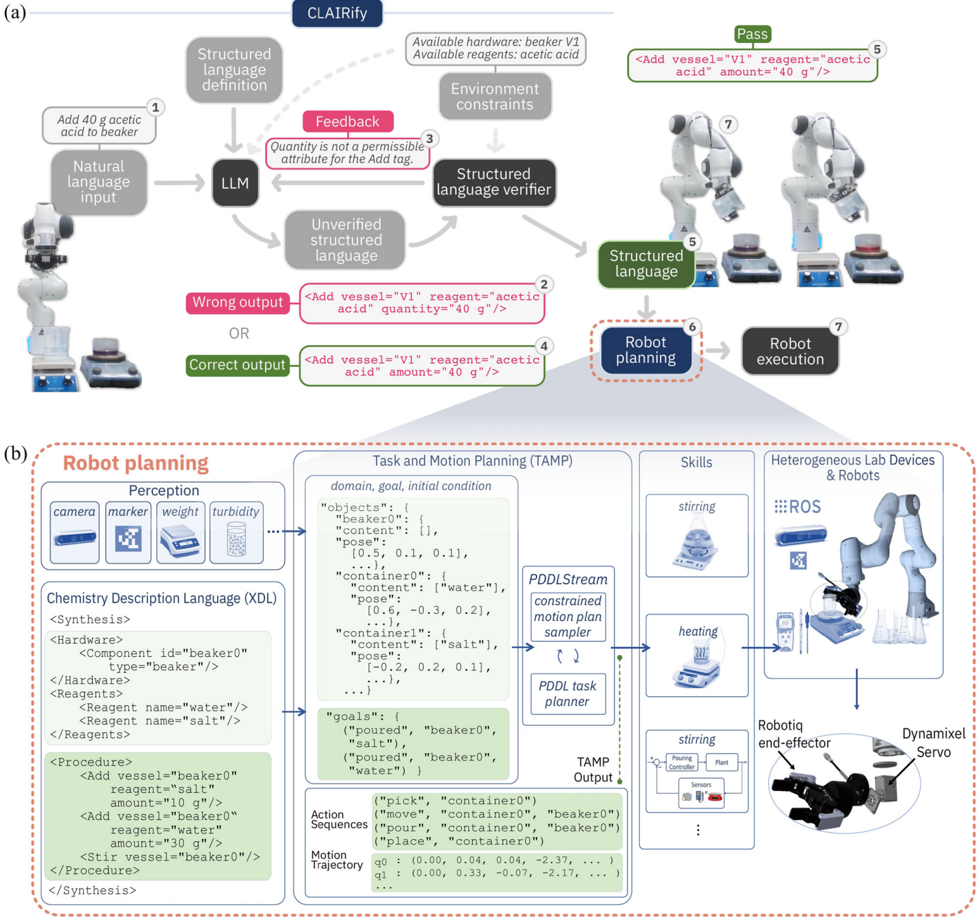
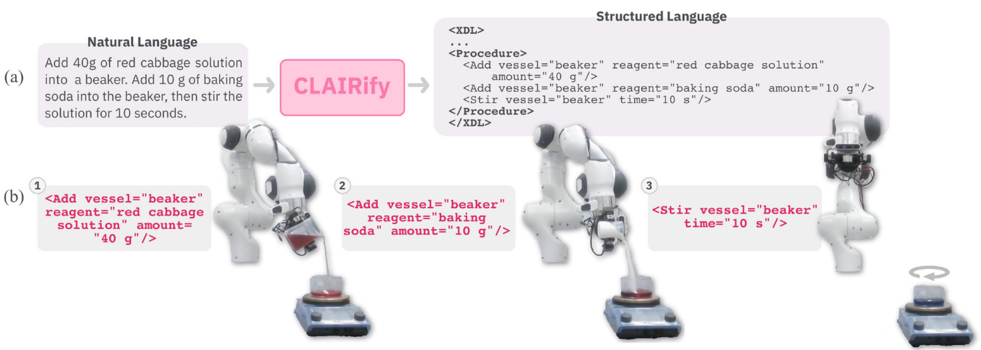
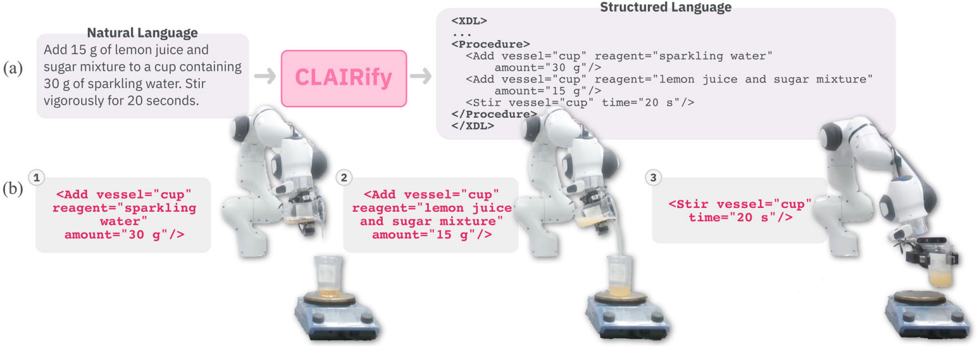
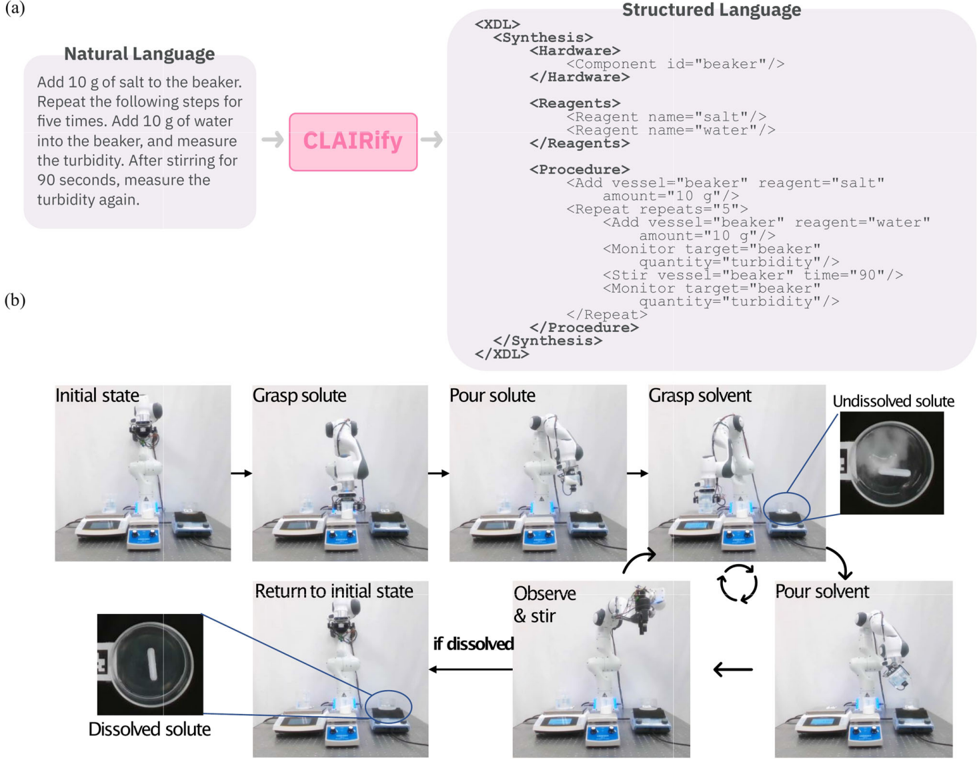
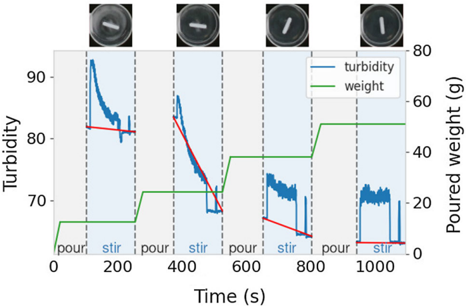
This paper proposes an approach to automate chemistry experiments using robots by translating natural language instructions into robot-executable plans, using large language models together with task and motion planning. Adding natural language interfaces to autonomous chemistry experiment systems lowers the barrier to using complicated robotics systems and increases utility for non-expert users, but translating natural language experiment descriptions from users into low-level robotics languages is nontrivial. Furthermore, while recent advances have used large language models to generate task plans, reliably executing those plans in the real world by an embodied agent remains challenging. To enable autonomous chemistry experiments and alleviate the workload of chemists, robots must interpret natural language commands, perceive the workspace, autonomously plan multi-step actions and motions, consider safety precautions, and interact with various laboratory equipment. Our approach, CLAIRify , combines automatic iterative prompting with program verification to ensure syntactically valid programs in a data-scarce domain-specific language that incorporates environmental constraints. The generated plan is executed through solving a constrained task and motion planning problem using PDDLStream solvers to prevent spillages of liquids as well as collisions in chemistry labs. We demonstrate the effectiveness of our approach in planning chemistry experiments, with plans successfully executed on a real robot using a repertoire of robot skills and lab tools. Specifically, we showcase the utility of our framework in pouring skills for various materials and two fundamental chemical experiments for materials synthesis: solubility and recrystallization. Further details about CLAIRify can be found at https://ac-rad.github.io/clairify/ .
Overview
The claims and statistics of this paper haven’t been checked yet.
Free: it reads the open-access text and checks the first 5 claims that cite a source we can check. Create a free account to check every claim.
Integrity signals
Registry
Cites
Statistics
Figures





Verification
Claims the paper makes
The claims and statistics of this paper haven’t been checked yet.
Free: it reads the open-access text and checks the first 5 claims that cite a source we can check. Create a free account to check every claim.
Claims other papers make about this one
Each is checked against this paper’s own text: does it say what the citing paper says it does?
The source backs part of the claim, not all of it — or backs it for a different population, condition or comparison.
In the citing paper
“In parallel, chemistry-oriented reviews have shown that large language models can move beyond text generation toward tool use, retrieval, planning, code execution, and multi-agent coordination [5-10].”
From From Scientific Copilots to Tool-Grounded Autonomy: AI Agents in Simulation-Driven Materials Discovery (2026) · cites this paper as [6]
Experimental — accuracy not yet measuredThe source backs part of the claim, not all of it — or backs it for a different population, condition or comparison.
In the citing paper
“The central challenge is not only to predict a property, but to manage the sequence of reasoning and action that connects a scientific objective to executable computational or experimental steps [2-10].”
From From Scientific Copilots to Tool-Grounded Autonomy: AI Agents in Simulation-Driven Materials Discovery (2026) · cites this paper as [6]
Experimental — accuracy not yet measuredThe check wasn’t confident either way, so it gives no verdict — never disputed.
In the citing paper
“To the best of our knowledge, no prior review has isolated simulation-driven, toolorchestrating AI agent workflows for materials discovery as a distinct evidence base with study-level extraction of autonomy, validation, and reproducibility [3-14].”
From From Scientific Copilots to Tool-Grounded Autonomy: AI Agents in Simulation-Driven Materials Discovery (2026) · cites this paper as [6]
Experimental — accuracy not yet measured
Self-check
Percentages, sums and reported differences re-computed from the paper’s own numbers.
The self-check needs the paper’s full text.
Citations
Cites
BERT: Pre-training of Deep Bidirectional Transformers for Language Understanding
Devlin, J., Chang, M.-W., Lee, K., & Toutanova, K. (2018) · arXiv · doi:10.48550/arxiv.1810.04805 · Cited by 73,173 · cited 1×
“LLMs have been used to generate structured outputs (Devlin et al., 2019; Brown et al., 2020; Chowdhery et al., 2022), including code generation (Chen et al., 2021; Wang et al., 2021; Li et al., 2022) and robot programming (Liang et al., 2022).”
MethodLanguage Models are Few-Shot Learners
Brown, T. B., Mann, B., Ryder, N., Subbiah, M., Kaplan, J., Dhariwal, P., Neelakantan, A., Shyam, P., Sastry, G., Askell, A., et al. (2020) · arXiv · doi:10.48550/arxiv.2005.14165 · Cited by 23,372 · cited 3×
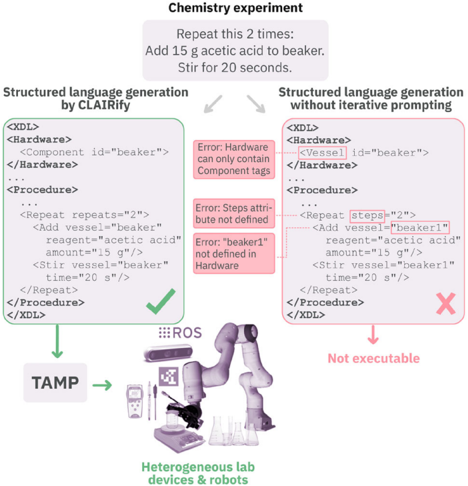
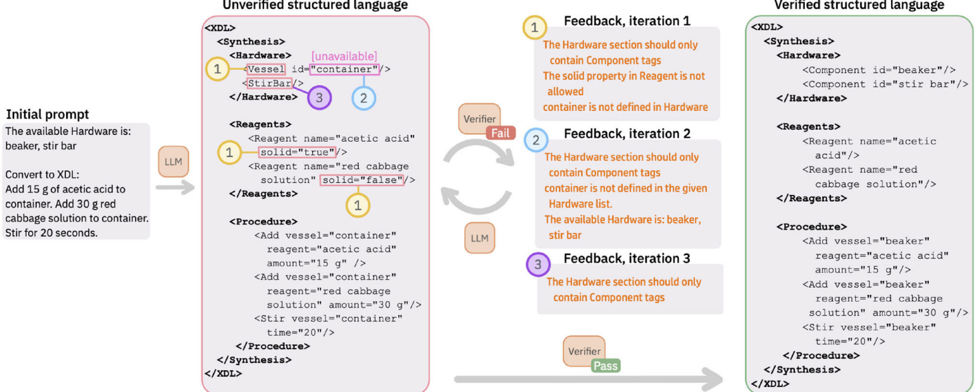
“Error:HardwarecanonlycontainComponenttags Error:Stepsattri-butenotdefined Error:"beaker1" Structuredlanguagegenerationwithoutiterativeprompting <XDL><Hardware> <Component id="beaker"> </Hardware> ... <Procedure> ...”
BackgroundMethodAdvances in Neural Information Processing Systems 14: Proceedings of the 2001 Conference
(2002) · The MIT Press eBooks · doi:10.7551/mitpress/1120.001.0001 · Cited by 8,890
Probabilistic roadmaps for path planning in high-dimensional configuration spaces
Kavraki, L. E., Svestka, P., Latombe, J.-C., & Overmars, M. H. (1996) · IEEE Transactions on Robotics and Automation · doi:10.1109/70.508439 · Cited by 6,343 · cited 1×
“We use probabilistic roadmap methods (PRM ⋆ ) to plan efficiently in the 8-DoF configuration space found in our chemistry laboratory domain (Karaman and Frazzoli, 2011; Kavraki et al., 1996).”
MethodSampling-based algorithms for optimal motion planning
Karaman, S., & Frazzoli, E. (2011) · The International Journal of Robotics Research · doi:10.1177/0278364911406761 · Cited by 5,275 · cited 2×
“We use probabilistic roadmap methods (PRM ⋆ ) to plan efficiently in the 8-DoF configuration space found in our chemistry laboratory domain (Karaman and Frazzoli, 2011; Kavraki et al., 1996).”
BackgroundMethodPaLM: Scaling Language Modeling with Pathways
Chowdhery, A., Narang, S., Devlin, J., Bosma, M., Mishra, G., Roberts, A., Barham, P., Chung, H. W., Sutton, C., Gehrmann, S., et al. (2022) · arXiv · doi:10.48550/arxiv.2204.02311 · Cited by 2,590 · cited 1×
“Error:HardwarecanonlycontainComponenttags Error:Stepsattri-butenotdefined Error:"beaker1" Structuredlanguagegenerationwithoutiterativeprompting <XDL><Hardware> <Component id="beaker"> </Hardware> ... <Procedure> ...”
Manipulability of Robotic Mechanisms
Yoshikawa, T. (1985) · The International Journal of Robotics Research · doi:10.1177/027836498500400201 · Cited by 2,582 · cited 1×
“Second, depending on the robot task, the objective function is extended to maximize the manipulability ellipsoid as described in (Yoshikawa, 1985), which is applied for more complicated maneuvers, such as transferring liquids across the workspace.”
MethodDomain-specific language model pretraining for biomedical natural language processing
Gu, Y., Tinn, R., Cheng, H., Lucas, M., Usuyama, N., Liu, X., Naumann, T., Gao, J., & Poon, H. (2022) · ACM Transactions on Computing for Healthcare · doi:10.1145/3458754 · Cited by 2,170 · cited 1×
“Second, LLMs may perform poorly in generating task plans in a zero-shot manner for data-scarce domain-specific languages, such as chemistry (Gu et al., 2021; Liu et al., 2022).”
MethodAprilTag: A robust and flexible visual fiducial system
Olson, E. (2011) · 2011 IEEE International Conference on Robotics and Automation · doi:10.1109/icra.2011.5979561 · Cited by 1,770 · cited 2×
“To detect fiducial markers, we use the AprilTag library (Olson, 2011).”
MethodSparks of Artificial General Intelligence: Early experiments with GPT-4
Bubeck, S., Chandrasekaran, V., Eldan, R., Gehrke, J., Horvitz, E., Kamar, E., Lee, P., Lee, Y. T., Li, Y., Lundberg, S., et al. (2023) · arXiv · doi:10.48550/arxiv.2303.12712 · Cited by 1,526 · cited 1×
“The limitation in task planning abilities has been highlighted in a recent study (Bubeck et al., 2023) as well.”
Background
Research works printed but not linked: 2
- Grinberg, M. (2018). Flask web development: Developing web appli- cations with python. " O'Reilly Media, Inc.".
- Yoshikawa, N., Li, A. Z., Darvish, K., Zhao, Y., Xu, H., Kuramshin, A., Aspuru-Guzik, A., Garg, A., & Shkurti, F. (2023). Chemistry lab automation via constrained task and motion planning. arXiv preprint. https://doi.org/10.48550/arXiv.2212.09672 · DOI
Cited by
Self-Driving Laboratories for Chemistry and Materials Science
Tom, G., Schmid, S. P., Baird, S. G., Cao, Y., Darvish, K., Hao, H., Lo, S., Pablo-García, S., Rajaonson, E. M., Skreta, M., et al. (2024) · Chemical Reviews · doi:10.1021/acs.chemrev.4c00055 · Cited by 707
Self-citationORGANA: A robotic assistant for automated chemistry experimentation and characterization
Darvish, K., Skreta, M., Zhao, Y., Yoshikawa, N., Som, S., Bogdanović, M., Cao, Y., Hao, H., Xu, H., Aspuru‐Guzik, A., et al. (2024) · Matter · doi:10.1016/j.matt.2024.10.015 · Cited by 256
Self-citationAn automatic end-to-end chemical synthesis development platform powered by large language models
Ruan, Y., Lu, C., Xu, N., He, Y., Chen, Y., Zhang, J., Xuan, J., Pan, J., Fang, Q., Gao, H., et al. (2024) · Nature Communications · doi:10.1038/s41467-024-54457-x · Cited by 116
A Multiagent-Driven Robotic AI Chemist Enabling Autonomous Chemical Research On Demand
Song, T., Luo, M., Zhang, X., Chen, L., Huang, Y., Cao, J., Zhu, Q., Liu, D., Zhang, B., Zou, G., et al. (2025) · Journal of the American Chemical Society · doi:10.1021/jacs.4c17738 · Cited by 171
“Naturally, the integration of automated robotic hardware with LLM techniques 48-54 has emerged as a new research direction in autonomous chemistry research 1,55,56 .”
Risks of AI scientists: prioritizing safeguarding over autonomy
Tang, X., Jin, Q., Zhu, K., Yuan, T., Zhang, Y., Zhou, W., Qu, M., Zhao, Y., Tang, J., Zhang, Z., et al. (2025) · Nature Communications · doi:10.1038/s41467-025-63913-1 · Cited by 51
“However, current efforts remain incomplete.”
Self-citationAccelerated end-to-end chemical synthesis development with large language models
Ruan, Y., Lu, C., Xu, N., Zhang, J., Xuan, J., Pan, J., Fang, Q., Gao, H., Shen, X., Ye, N., et al. (2024) · doi:10.26434/chemrxiv-2024-6wmg4 · Cited by 140
Enabling large language models for real-world materials discovery
Miret, S., & Krishnan, N. M. A. (2025) · Nature Machine Intelligence · doi:10.1038/s42256-025-01058-y · Cited by 166
“Hence, while proposing an IUPAC-style naming convention might seem like a natural solution to aid the deployment of LLMs in materials science, many proposals of such conventions have previously fallen short, given the vast diversity of the field.”
Developing ChemDFM as a large language foundation model for chemistry
Zhao, Z., Ma, D., Chen, L., Sun, L., Li, Z., Xia, Y., Chen, B., Xu, H., Zhu, Z., Su, Z., et al. (2025) · Cell Reports Physical Science · doi:10.1016/j.xcrp.2025.102523 · Cited by 197
“…exploits LLMs’ strong natural language understanding and reasoning abilities, using them directly to handle complex chemical tasks described in natural language [Hatakeyama-Sato et al., 2023, Cao et al., 2023b, Boiko et al., 2023, Yoshikawa et al., 2023, M. Bran et al., 2024, Ruan et al., 2024].”
Self-citationORGANA: A Robotic Assistant for Automated Chemistry Experimentation and Characterization
Darvish, K., Skreta, M., Zhao, Y., Yoshikawa, N., Som, S., Bogdanovic, M., Cao, Y., Hao, H., Xu, H., Aspuru-Guzik, A., et al. (2024) · arXiv · doi:10.48550/arxiv.2401.06949 · Cited by 133
Self-citationLarge language models for drug discovery and development
Zheng, Y., Koh, H. Y., Ju, J., Yang, M., May, L. T., Webb, G. I., Li, L., Pan, S., & Church, G. M. (2025) · Patterns · doi:10.1016/j.patter.2025.101346 · Cited by 134
“A notable example is CLARify, 81 which leverages GPT-3 82 to generate task plans in a specialized chemistry description language (XDL) based on user instructions.”
Automation and machine learning augmented by large language models in a catalysis study
Su, Y., Wang, X., Ye, Y., Xie, Y., Xu, Y., Jiang, Y., & Wang, C. (2024) · Chemical Science · doi:10.1039/d3sc07012c · Cited by 107
“42,43,126,127 As pointed out by Francesco Stella et al. , 125 LLMs can be the creator for designing the automating system, be the mentor and copilot for domain scientists who do not have the necessary educational background to implement automation in their research, and be an assistant to…”
BackgroundMethodReal-world robot applications of foundation models: a review
Kawaharazuka, K., Matsushima, T., Gambardella, A., Guo, J.-X., Paxton, C., & Zeng, A. (2024) · Adv. Robotics · doi:10.1080/01691864.2024.2408593 · Cited by 141
“Additionally, the research often takes place in everyday environments, including kitchens and tabletops, although some studies focus on laboratory automation [218].”
El Agente: An autonomous agent for quantum chemistry
Zou, Y., Cheng, A., Aldossary, A., Bai, J., Leong, S. X., Campos-Gonzalez-Angulo, J. A., Choi, C., Ser, C. T., Tom, G., Wang, A., et al. (2025) · Matter · doi:10.1016/j.matt.2025.102263 · Cited by 193
Self-citationAli, R. S. A. E., Meng, J., Khan, M. E. I., & Jiang, X. (2024) · Artificial Intelligence Chemistry · doi:10.1016/j.aichem.2024.100049 · Cited by 123
The Future of Material Scientists in an Age of Artificial Intelligence
Maqsood, A., Chen, C., & Jacobsson, T. J. (2024) · Advanced Science · doi:10.1002/advs.202401401 · Cited by 89
Computational and Machine Learning Methods for CO 2 Capture Using Metal–Organic Frameworks
Mashhadimoslem, H., Abdol, M. A., Karimi, P., Zanganeh, K. E., Shafeen, A., Elkamel, A., & Kamkar, M. (2024) · ACS Nano · doi:10.1021/acsnano.3c13001 · Cited by 87
Steering towards safe self-driving laboratories
Leong, S. X., Griesbach, C. E., Zhang, R., Darvish, K., Zhao, Y., Mandal, A., Zou, Y., Hao, H., Bernales, V., & Aspuru‐Guzik, A. (2025) · Nature Reviews Chemistry · doi:10.1038/s41570-025-00747-x · Cited by 96
“LLMs are also increasingly used to convert chemical protocols into machine-executable scripts 44,69,71–73 .”
Self-citationTransforming science labs into automated factories of discovery
Angelopoulos, A., Cahoon, J. F., & Alterovitz, R. (2024) · Science Robotics · doi:10.1126/scirobotics.adm6991 · Cited by 85
“Generative AI may make programming laboratories faster and easier by allowing scientists to communicate with the lab via natural language ( 34 ) to specify experiments and monitor experiment progress in real time.”
BackgroundCross-disciplinary perspectives on the potential for artificial intelligence across chemistry
Mroz, A. M., Basford, A. R., Hastedt, F., Jayasekera, I. S., Mosquera‐Lois, I., Sedgwick, R., Ballester, P. J., Bocarsly, J. D., del Rio‐Chanona, E. A., Evans, M. L., et al. (2025) · Chemical Society Reviews · doi:10.1039/d5cs00146c · Cited by 73
Automating quantum computing laboratory experiments with an agent-based AI framework
Cao, S., Zhang, Z., Alghadeer, M., Fasciati, S. D., Piscitelli, M., Bakr, M. S., Leek, P., & Aspuru‐Guzik, A. (2025) · Patterns · doi:10.1016/j.patter.2025.101372 · Cited by 78
“Prior works 31–34 have limitations in scalability, which constrain their ability to manage complex tool sets and finish tasks that require many steps.”
Self-citationShi, H., Fang, L.-R., Chen, X.-Y., Gu, C.-H., Ma, K., Zhang, X.-S., Zhang, Z., Gu, J.-P., & Lim, E.-G. (2024) · IET Smart Grid · doi:10.1049/stg2.12191 · Cited by 47
Developing ChemDFM as a large language foundation model for chemistry
Zhao, Z., Ma, D., Chen, L., Sun, L., Li, Z., Xia, Y., Chen, B., Xu, H., Zhu, Z., Zhu, S., et al. (2024) · arXiv · doi:10.48550/arxiv.2401.14818 · Cited by 48
Self-citationLeading artificial intelligence–driven drug discovery platforms: 2025 landscape and global outlook
Dharmasivam, M., Kaya, B., Akinware, A., Azad, M. G., & Richardson, D. R. (2025) · Pharmacological Reviews · doi:10.1016/j.pharmr.2025.100102 · Cited by 51
Empowering Generalist Material Intelligence with Large Language Models
Yuan, W., Chen, G., Wang, Z., & You, F. (2025) · Advanced Materials · doi:10.1002/adma.202502771 · Cited by 55
Reproducibility in automated chemistry laboratories using computer science abstractions
Canty, R. B., & Abolhasani, M. (2024) · Nature Synthesis · doi:10.1038/s44160-024-00649-8 · Cited by 45
“In this regard, the success of machine learning for programming language translation 5,12,88–90 presents a tantalizing opportunity for learning the mappings between batch and flow chemistry, solid-and solution-phase processes or local and decentralized orchestration.”
Digital materials ecosystem: from databases to AI agents for autonomous discovery
Zhang, D., Jia, X., Wang, Y., Liu, H., Wang, Q., Jang, S., Shah, D., Ye, S., Tran, H. B., & Li, H. (2026) · Chemical Science · doi:10.1039/d5sc09229a · Cited by 40
AutoLabs: cognitive multi-agent systems with self-correction for autonomous chemical experimentation
Panapitiya, G., Saldanha, E., Job, H., & Hess, O. (2026) · Scientific Reports · doi:10.1038/s41598-026-45593-z · Cited by 44
“Additionally, the precise chemical quantities are provided in Tables S1–S5 within the Supporting Information.”
Evolving Roles of LLMs in Scientific Innovation: Assistant, Collaborator, Scientist, and EvaluatorPreprint
Zhang, H., Li, R.-C., Zhang, Y., Xiao, T., Chen, J., Ding, J.-H., & Chen, H.-H. (2025) · arXiv (Cornell University) · doi:10.48550/arxiv.2507.11810 · Cited by 15
Chemspyd : an open-source python interface for Chemspeed robotic chemistry and materials platforms
Seifrid, M. T., Strieth‐Kalthoff, F., Haddadnia, M., Wu, T., Alca, E., Bodo, L., Arellano-Rubach, S., Yoshikawa, N., Skreta, M., Keunen, R., et al. (2024) · Digital Discovery · doi:10.1039/d4dd00046c · Cited by 36
Self-citationHuang, L. J., Zhang, C., Fu, Y. Z., Jiang, Y., He, E., Qi, M., Du, M., Kong, X., Cheng, J., Cronin, L., et al. (2025) · Journal of the American Chemical Society · doi:10.1021/jacs.5c05916 · Cited by 35
Toward Making Polymer Chemistry Autonomous
Basak, S., & Bandyopadhyay, A. (2024) · ACS Applied Engineering Materials · doi:10.1021/acsaenm.4c00214 · Cited by 33
Sun, Z., Ting, Y.-S., Liang, Y., Duan, N., Huang, S., & Cai, Z. (2026) · The Astrophysical Journal Supplement Series · doi:10.3847/1538-4365/ae5d3a · Cited by 35
“The recent emergence of large language models offers new avenues for scientific research (e.g., Yoshikawa et al. 2023; Birhane et al. 2023; Lei et al. 2024; Jablonka et al. 2024a; Research AI4Science & Azure Quantum 2023).”
Oyekan, J. O., Turner, C. J., Bax, M., & Graf, E. W. (2025) · Computers in Industry · doi:10.1016/j.compind.2025.104329 · Cited by 38
Toward self-driving laboratory 2.0 for chemistry and materials discovery
Lee, H., Yoo, H. J., Jang, H. S., Park, B., Park, Y. J., & Han, S. S. (2026) · Materials Horizons · doi:10.1039/d5mh01984b · Cited by 38
Yoo, H. J., Lee, K., Kim, D.-H., & Han, S. S. (2024) · Nature Communications · doi:10.1038/s41467-024-54067-7 · Cited by 30
Self-driving laboratories in Japan
Yoshikawa, N., Asano, Y., Futaba, D. N., Harada, K., Hitosugi, T., Kanda, G. N., Matsuda, S., Nagata, Y., Nagato, K., Naito, M., et al. (2025) · Digital Discovery · doi:10.1039/d4dd00387j · Cited by 24
Self-citationGeneral-Purpose Models for the Chemical Sciences: LLMs and Beyond
Alampara, N., Aneesh, A., Ríos-García, M., Mirza, A., Schilling-Wilhelmi, M., Aghajani, A. A., Sun, M., Prastalo, G., & Jablonka, K. M. (2026) · Chemical Reviews · doi:10.1021/acs.chemrev.5c00583 · Cited by 37
Kim, Y.-H., Doo, H., Shin, D., Lee, S. Y., Roh, Y., Park, S., Song, H., Jung, Y., Yoo, H. J., Han, S. S., et al. (2025) · Computers & Chemical Engineering · doi:10.1016/j.compchemeng.2025.109266 · Cited by 25
Pagel, S., Jirásek, M., & Cronin, L. (2026) · Communications Chemistry · doi:10.1038/s42004-026-01993-w · Cited by 27
“Whereas syntax errors have been used before to iterativelyimproveuponpreviouslygenerated X DLinstructions 23 ,wefound that a substantial proportion of translated procedures remained syntactically erroneous, had missing steps, and were not suf fi ciently validated on a realistic robotic setup.”
Cheng, A., Ser, C. T., Skreta, M., Guzmán-Cordero, A., Thiede, L., Burger, A., Aldossary, A., Leong, S. X., Pablo‐García, S., Strieth‐Kalthoff, F., et al. (2025) · Faraday Discussions · doi:10.1039/d4fd00153b · Cited by 29
Self-citationToward Full Autonomous Laboratory Instrumentation Control with Large Language Models
Xie, Y. J., He, K., & Castellanos-Gómez, A. (2025) · Small Structures · doi:10.1002/sstr.202500173 · Cited by 25
LLM-Enabled Cyber-Physical Systems: Survey, Research Opportunities, and Challenges
Xu, W., Liu, M., Sokolsky, O. V., Lee, I., & Kong, F. (2024) · doi:10.1109/fmsys62467.2024.00013 · Cited by 32
“…SayPlan [1] Dilu [16], DriveGPT4 [15], Talk2BEV [20], Cui et al. [21], Cui et al. [19], Talk2Drive [2] Xia et al [22] Inagaki et al [23], CLAIRIFY [24], Boiko et al [25], Coscientist [26] Smart cities & homes GPT-in-the-Loop [27], PromptGAT [28], LL-Mind [17] down complex problems into smaller…”
BackgroundMethodKhoo, T. L., Lee, T. S., Bee, S., Ma, C., & Zhang, Y.-Y. (2025) · Processes · doi:10.3390/pr13092680 · Cited by 23
Lu, M., Gao, F., Tang, X., & Chen, L. (2024) · iScience · doi:10.1016/j.isci.2024.109451 · Cited by 23
“19 Looking ahead, advanced LLM techniques like Retrieval Augmented Generation (RAG) 20 will continue to enhance human-LLM collaboration on user-defined tasks.”
Jing, W., He, G., Bai, S., Wang, F., Liu, Y., & Guo, L. (2024) · ACS Materials Letters · doi:10.1021/acsmaterialslett.4c00066 · Cited by 20
Yang, Z., Du, Y., Liu, D., Zhao, K., & Cong, M. (2025) · Engineering Applications of Artificial Intelligence · doi:10.1016/j.engappai.2025.110226 · Cited by 21
AI and automation: democratizing automation and the evolution towards true AI-autonomous robotics
Takahashi, L., Kuwahara, M., & TAKAHASHI, K. G. (2025) · Chemical Science · doi:10.1039/d5sc03183d · Cited by 26
The ADePT framework for assessing autonomous laboratory robotics
Villacis, P. J. S., & Benyahia, B. (2026) · Communications Chemistry · doi:10.1038/s42004-026-01932-9 · Cited by 21
“LLMs have been used to generate symbolic representations of chemical procedures, enabling robots to perform varied tasks such as solubility screening and sample preparation through natural language prompts 16,37 (Fig.”
Naderi, H., Shojaei, A., & Huang, L. (2026) · Eng—Advances in Engineering · doi:10.3390/eng7070358 · Cited by 18
Democratising real-world drug discovery through agentic AI
He, J., Lai, H., Saigiridharan, L., Ghiandoni, G. M., Jenei, K., Gokalp, U., Nuković, A., Engkvist, O., Janet, J. P., & Genheden, S. (2026) · Drug Discovery Today · doi:10.1016/j.drudis.2026.104605 · Cited by 17
Knowledge-driven autonomous materials research via collaborative multi-agent and robotic system
Shi, T., Li, Y., Wang, Z., Xu, W., Jiang, G., Dai, D., Zhou, J., Huang, H., He, R., Ramakrishna, S., et al. (2026) · Matter · doi:10.1016/j.matt.2025.102577 · Cited by 16
Jin, Z., Gu, D., Li, P., Ye, G., Zhu, H., Wei, K., Li, C., Zhong, W., Du, W., & Zhu, Q. J. (2025) · Sustainable Chemistry for Energy Materials · doi:10.1016/j.scenem.2025.100010 · Cited by 26
Chemputer and chemputation—A universal chemical compound synthesis machine
Cronin, L., Pagel, S., & Sharma, A. (2026) · Proceedings of the National Academy of Sciences · doi:10.1073/pnas.2511080123 · Cited by 18
“In addition, the architecture and the use of χ DL has been achieved on at least 12 different platforms with many different types of robotic modules across our (6, 11, 54, 56, 60–63) and collaborative research teams (28, 55, 64, 65).”
MATTERIX: toward a digital twin for robotics-assisted chemistry laboratory automation
Darvish, K., Sohal, A., Mandal, A., Fakhruldeen, H., Radulov, N., Zhou, Z., Veeramani, S., Choi, J., Han, S., Zhang, B., et al. (2025) · Nature Computational Science · doi:10.1038/s43588-025-00924-4 · Cited by 19
Self-citationijlessjournal (2026) · مجلة القانون والأعمال الدولية · doi:10.63585/ozsp2793 · Cited by 15
Leveraging GPT-4 to transform chemistry from paper to practice
Zhang, W., Guy, M. A., Yang, J., Hao, L., Liu, J., Hawkins, J. M., Mustakis, J., Monfette, S., & Hein, J. E. (2024) · Digital Discovery · doi:10.1039/d4dd00248b · Cited by 18
Nasruddin, N. A., Islam, N., Vernuccio, S., & Oyekan, J. O. (2025) · Chemical Engineering Journal Advances · doi:10.1016/j.ceja.2025.100775 · Cited by 13
“This enables chemical reactions to be modelled as text-like sequences, allowing transformers to translate sequences of reactants and reagents into corresponding product structures [53].”
A bridge between trust and control: computational workflows meet automated battery cycling
Kraus, P., Bainglass, E., Ramirez, F., Svaluto‐Ferro, E., Ercole, L., Kunz, B., Huber, S. P., Plainpan, N., Marzari, N., Battaglia, C., et al. (2024) · Journal of Materials Chemistry A · doi:10.1039/d3ta06889g · Cited by 13
Yadav, S., Chandra, H., Tiwari, K. S., Bharty, M. K., Chandravanshi, R., Chauhan, D., & Quraishi, M. (2025) · Discover Chemical Engineering · doi:10.1007/s43938-025-00104-w · Cited by 6
“(c) Robotic laboratories Self-driving labs, guided by AI, can plan and perform experiments automatically, creating a feedback loop that speeds up sustainable discovery [118].”
Umer, M. S., Nabeel, M., Athar, U., Lynch, I., Afantitis, A., Ullah, S., & Fraz, M. M. (2025) · Archives of Computational Methods in Engineering · doi:10.1007/s11831-025-10437-y · Cited by 15
“Coscientist and ChemCrow integrate robotic platforms and APIs for multi-step synthesis [272, 283], while CLAIRify augments lab safety via risk-aware protocols [307].”
AstroMLab 2: AstroLLaMA-2-70B Model and Benchmarking Specialised LLMs for Astronomy
Pan, R., Nguyen, T. D., Arora, H., Accomazzi, A., Ghosal, T., & Ting, Y.-S. (2024) · International Conference for High Performance Computing, Networking, Storage and Analysis (SC) · doi:10.1109/scw63240.2024.00019 · Cited by 20
Gaidimas, M. A., Bai, J., Kang, Y., Kirlikovali, K. O., Bernales, V., Aspuru‐Guzik, A., & Farha, O. K. (2026) · Chem · doi:10.1016/j.chempr.2025.102921 · Cited by 11
Self-citationAutonomous Droplet Microfluidic Design Framework with Large Language Models
Nguyen, D.-N., Tong, R. K., & Dinh, N. (2025) · ACS Omega · doi:10.1021/acsomega.5c06253 · Cited by 9
He, W., Takezawa, H., & Fujita, M. (2026) · Angewandte Chemie International Edition · doi:10.1002/anie.202524615 · Cited by 9
A multi-agent-driven robotic AI chemist enabling autonomous chemical research on demandPreprint
Song, T., Luo, M., Chen, L., Huang, Y. H., Zhu, Q. J., Liu, D., Zhang, B., Zou, G., Zhang, F., Shang, W., et al. (2024) · ChemRxiv · doi:10.26434/chemrxiv-2024-w953h-v2 · Cited by 10
Large property models: a new generative machine-learning formulation for molecules
Jin, T., Singla, V., Hsu, H., & Savoie, B. M. (2025) · Faraday Discussions · doi:10.1039/d4fd00113c · Cited by 10
An Overview On Large Language Models Across Key Domains: A Systematic Review
Bruscia, M., Manduzio, G. A., Galatolo, F. A., Cimino, M. G. C. A., Greco, A., Cominelli, L., & Scilingo, E. P. (2024) · IEEE International Conference on Metrology for eXtended Reality, Artificial Intelligence and Neural Engineering (MetroXRAINE) · doi:10.1109/metroxraine62247.2024.10797032 · Cited by 11
“Similarly, Yoshikawa et al. demonstrated how LLMs can automate complex chemical experiments, translating natural language into robotic commands and improving lab operations for non-experts [13].”
Large Language Models Transform Organic Synthesis From Reaction Prediction to AutomationPreprint
Kumar, K., Kumar, R., & Lagun, N. (2025) · arXiv (Cornell University) · doi:10.48550/arxiv.2508.05427 · Cited by 8
“Yoshikawa et al. combined LLM-based translation of natural-language instructions with a domain-specific representation, program verification, constrained task and motion planning, perception, and robotic execution [11].”
From AI for Science to Agentic Science: A Survey on Autonomous Scientific Discovery
Wei, J., Yang, Y., Zhang, X., Chen, Y., Zhuang, X., Gao, Z., Zhou, D., Wang, G., Gao, Z., Cao, J., et al. (2025) · arXiv · doi:10.48550/arxiv.2508.14111 · Cited by 7
Ruehle, B. (2025) · Digital Discovery · doi:10.1039/d5dd00063g · Cited by 7
Li, C., Ran, N., & Liu, J. (2026) · Journal of Materials Informatics · doi:10.20517/jmi.2025.87 · Cited by 9
Gemadzie, G., McPike, P., & Boika, A. (2025) · Current Opinion in Electrochemistry · doi:10.1016/j.coelec.2025.101724 · Cited by 8
Sirisha, U., Kumar, C. K., Durgam, R., Eswaraiah, P., & Nagamani, G. M. (2025) · Computers, materials & continua/Computers, materials & continua (Print) · doi:10.32604/cmc.2025.063721 · Cited by 7
Chong, X., Li, L., Zhang, C., Zhao, Y., Kraft, M., & Wang, X. (2025) · Technology Review for Carbon Neutrality · doi:10.26599/trcn.2025.9550005 · Cited by 6
Self-citationZsoldos, P., Wolf, Á., Széll, K., & Galambos, P. (2025) · SLAS TECHNOLOGY · doi:10.1016/j.slast.2025.100251 · Cited by 5
Machi, K., Akiyama, S., Nagata, Y., & Yoshioka, M. (2025) · Digital Discovery · doi:10.1039/d4dd00335g · Cited by 9
Gangwal, A., & Lavecchia, A. (2026) · Medicinal Research Reviews · doi:10.1002/med.70074 · Cited by 4
Zeng, K., Liu, X., Zhang, Z., Yang, X., Jin, Y., & Xu, Y. (2026) · Journal of Cheminformatics · doi:10.1186/s13321-026-01201-w · Cited by 5
“Reaction conditions exhibit significant variability across datasets and may involve multiple modalities, such as reagent molecules or textual procedural descriptions [45, 50].”
Wu, D., Zhang, R., Zucchelli, E. M., Chen, Y., & Linares, R. (2025) · Scientific Reports · doi:10.1038/s41598-025-91150-5 · Cited by 9
Yang, S., Liu, J., Jin, F., & Lu, Y. (2024) · Chinese Science Bulletin (Chinese Version) · doi:10.1360/tb-2024-0404 · Cited by 5
Machine learning-based design of electrocatalysts and catalytic mechanism research
Guo, K., Fan, X., Chen, L., Zhang, X., & Zhou, Z. (2025) · Scientia Sinica Chimica · doi:10.1360/ssc-2025-0052 · Cited by 4
Key technologies and applications of large language models for materials science
Danyu, L. U. O., Liyang, W. E. N., Chen, B., Sijia, G. U. O., Wang, H., Ziping, W. A. N., Chen, L., & Chen, X. (2025) · Scientia Sinica Informationis · doi:10.1360/ssi-2025-0169 · Cited by 5
“CLAIRify [ 110] 则利用领域专用语言 (domain-specific language, DSL) 编译器 , 将自然语言指令转化 为实验设备可执行代码 , 并在实验过程中结合环境约束动态调整 .”
A multi-agent-driven robotic AI chemist enabling autonomous chemical research on demandPreprint
Song, T., Luo, M., Chen, L., Huang, Y. H., Zhu, Q., Liu, D., Zhang, B., Zou, G., Zhang, F., Shang, W., et al. (2024) · ChemRxiv · doi:10.26434/chemrxiv-2024-w953h · Cited by 10
Sasaki, H., Komeno, N., Hachimine, T., Takahashi, K., Ohnishi, Y., Sugawara, T., Wakiuchi, A., Hatanaka, M., Miyao, T., Ajiro, H., et al. (2025) · International Journal of Intelligent Robotics and Applications · doi:10.1007/s41315-025-00492-w · Cited by 5
Machine Learning and Autonomous Systems for Accelerated Synthesis
McDonald, M. A., & Jensen, K. F. (2026) · Annual Review of Analytical Chemistry · doi:10.1146/annurev-anchem-071924-103847 · Cited by 4
Song, Z., Cai, Y., Yu, Y., Xiang, P., Li, M., Liu, Z., & Dai, M. (2026) · Materials Genome Engineering Advances · doi:10.1002/mgea.70042 · Cited by 3
Schilling, M., Bresch, H., Bayerlein, B., & Ruehle, B. (2026) · Digital Discovery · doi:10.1039/d6dd00058d · Cited by 3
Agentic AI systems for scientific discovery
Feng, B., Walther, P., Zhang, L.-L., Coyle, R., Kim, S., Mandal, A., Zhang, Z.-J., Papidocha, S. M., Kelmanson, A., Segura, D. M., et al. (2026) · Nature Reviews Methods Primers · doi:10.1038/s43586-026-00534-y · Cited by 1
“Instrument control 36,243 , robotic platforms 244 , subagent delegation 126 , NL-to-XDL conversion 245 , safety shutdowns 171,246 Tools are classified by their predominant function, although many support more than one stage of a scientific workflow.”
Self-citationLarge Language Models for Robotics: A Systematic Literature Review on Prompt Engineering
Wolber, J., Lv, M., Koch, D., Bretz, L., Lanza, G., & Baer, F. (2025) · Lecture notes in production engineering · doi:10.1007/978-3-031-84744-8_17 · Cited by 3
HUANG, Y., Wanjun, X. I. A., Junmei, D., JIANG, Y., Xin, W. A. N. G., Yuanzheng, C. H. E. N., Hongyan, W. A. N. G., Jijun, Z., & Chunsheng, G. U. O. (2025) · Acta Physica Sinica · doi:10.7498/aps.74.20250497 · Cited by 2
Shan, G., Ding, Z., Xi, L., Zhao, H., Zhang, J., & Xu, F. (2025) · Rare Metals · doi:10.1007/s12598-025-03617-z · Cited by 2
“…Yoshikawa et al. proposed an automated chemical laboratory framework that combines a general-purpose robot with an LLM, which translates linguistic commands from the researcher into motion planning for the robot, thereby enabling the robot to autonomously conduct recrystallization experiments [84].”
Reasoning-Driven Design of Single-Atom Catalysts via a Multiagent Large Language Model Framework
Mok, D. H., Back, S., Fung, V., & Hu, G. (2026) · ACS Central Science · doi:10.1021/acscentsci.6c01260 · Cited by 3
“In chemistry and materials science, LLMs have begun to move beyond simple data mining toward roles involving experimental planning 30 , synthesis guidance 31 , simulation tool orchestration 32 and chemically informed decision-making tasks that were previously exclusive to human experts 33-36 .”
He, W., Takezawa, H., & Fujita, M. (2026) · Angewandte Chemie · doi:10.1002/ange.202524615 · Cited by 2
ChatMat: a multi-agent chemist for autonomous material prediction and exploration
Lv, S., Peng, L., Jiao, S., Yao, Y., Wu, W., & Hu, W. (2026) · Digital Discovery · doi:10.1039/d5dd00582e · Cited by 3
The rise of robotics in self-driving labs
Moran, C. H. J., Xu, J., & Abolhasani, M. (2026) · npj Robotics · doi:10.1038/s44182-026-00094-z · Cited by 2
Navigating the landscape of modular reconfigurable laboratory automation in chemistry
Moreno, R., Jensen, J., Faíña, A., & Støy, K. (2026) · Digital Discovery · doi:10.1039/d5dd00330j · Cited by 2
Ma, B., Wang, Y., Li, X., Shen, C., Lin, H., Du, C., Yang, S., Zeng, R., Tang, X., Hu, J., et al. (2024) · Pharmaceutical Fronts · doi:10.1055/s-0044-1796647 · Cited by 3
PRISM: protocol refinement through intelligent simulation modeling
Hsu, B., Setty, P. V., Butler, R. M., Lewis, R., Stone, C. R., Weinberg, R., Brettin, T. S., Stevens, R. L., Foster, I. T., & Ramanathan, A. (2026) · Digital Discovery · doi:10.1039/d6dd00004e · Cited by 3
A language model assistant for biocatalysisPreprint
Teukam, Y. G. N., Grisoni, F., & Manica, M. (2024) · bioRxiv (Cold Spring Harbor Laboratory) · doi:10.1101/2024.11.15.623739 · Cited by 2
Self-Building LabsPreprint
Bai, J., Zhao, Y., Hao, H., Hao, H., Savino, E., Bogdanović, M., Xie, G., Guo, X., ten Klooster, D. H. W., Pilon, S., et al. (2026) · arXiv (Cornell University) · doi:10.48550/arxiv.2610.23826 · Cited by 2
“Large language model (LLM)-based agents have demonstrated the ability to plan experiments, generate instrument control code, and interact with laboratory hardware (23; 24; 25; 26; 27; 28; 29; 30), while physics-based simulation enables developing digital twins of laboratory environments (31; 32).”
Self-citation
Metadata
- Authors
- Yoshikawa, N., Skreta, M., Darvish, K., Arellano-Rubach, S., Ji, Z., Bjørn Kristensen, L., Li, A. Z., Zhao, Y., Xu, H., Kuramshin, A., Aspuru-Guzik, A., Shkurti, F., & Garg, A.
- Affiliations
- University of Toronto (CA)
- University of Waterloo (CA)
- Corresponding author
- Darvish, Kourosh
- ORCID
- Venue
- Autonomous Robots
- Published
- 2023-10-25
- Volume
- 47
- Issue
- 8
- Pages
- 1057-1086
- ISSN
- 0929-5593 (ISSN-L)
- 1573-7527
- OpenAlex
- W4387937021
- Cited by
- 112
- References
- 94
- Citations by year
- 2026: 39 · 2025: 43 · 2024: 30
- FWCI
- 9.91
- Type
- journal article
- Language
- en
- Open access
- hybrid
- doi.org
- Licence
- cc-by
- creativecommons.org/licenses/by/4.0 (tdm)
- creativecommons.org/licenses/by/4.0 (vor)
- Locations
- Autonomous Robots (publishedVersion, cc-by)
- Funders
- Carlsberg Foundation (CF21-0669)
- Topics
- Physical Sciences › Computer Science › Artificial Intelligence › AI-based Problem Solving and Planning
- Physical Sciences › Engineering › Control and Systems Engineering › Robot Manipulation and Learning
- Physical Sciences › Engineering › Control and Systems Engineering › Robotics and Automated Systems
- Keywords
- large language models, natural language interfaces, task and motion planning, iterative prompting, program verification, embodied agents, laboratory automation, recrystallization, collision avoidance
About these checks
Registry, retraction, Cites and statistics results are computed, not judged, with one exception: a printed reference that no index lists is read once by a model before it counts as a citation error. Claims are extracted by a model and kept only when their quote appears verbatim in the text; each cited source is then checked, with a model’s help, for whether it says what the claim relies on. Those verdicts can be wrong — read the claim’s quote and the cited source before relying on one.
Statistics and arithmetic are recomputed, not judged.
Confidence bands are shown only for fields calibrated on our annotated test set. None is calibrated yet, so no band is shown.
What counts as a claim ›How we measure confidence ›How we check this ›
Are you an author, or do you see a problem with this page? Request a review
Data sources
Bibliographic data: Semantic Scholar, OpenAlex, Crossref.
Contains information from the Semantic Scholar Academic Graph Datasets, made available under the ODC Attribution License (ODC-BY 1.0).
Semantic Scholar’s data is described in: Kinney, R., et al. (2023). The Semantic Scholar Open Data Platform. arXiv:2301.10140.
