

Large language models for chemistry robotics
Open accessThe DOI matches its Crossref record; 109 of the 109 references it cites were found in a registry or an index.
Abstract
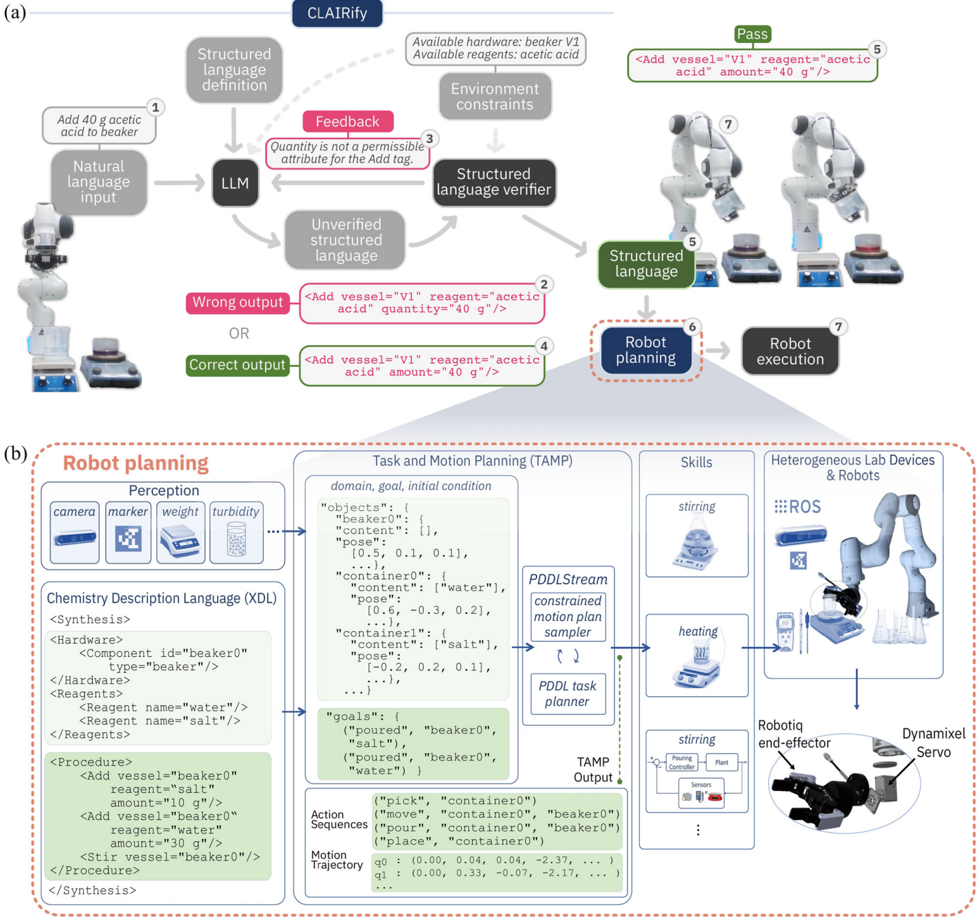
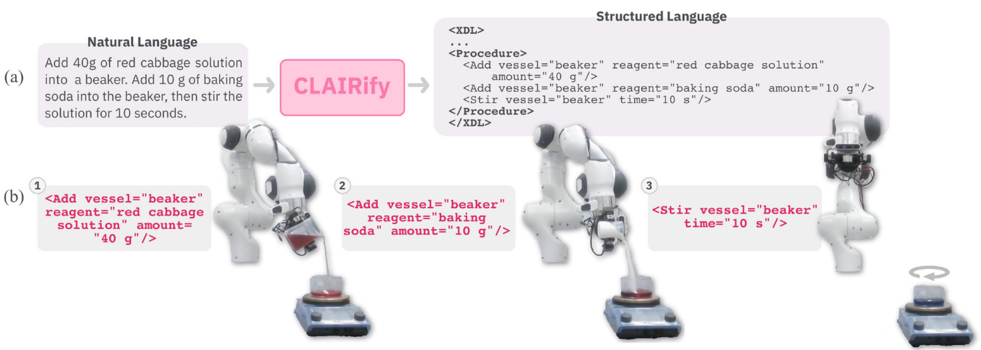
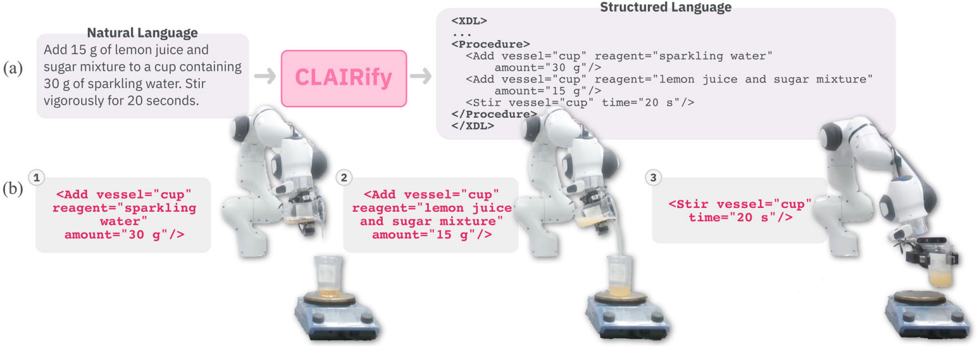
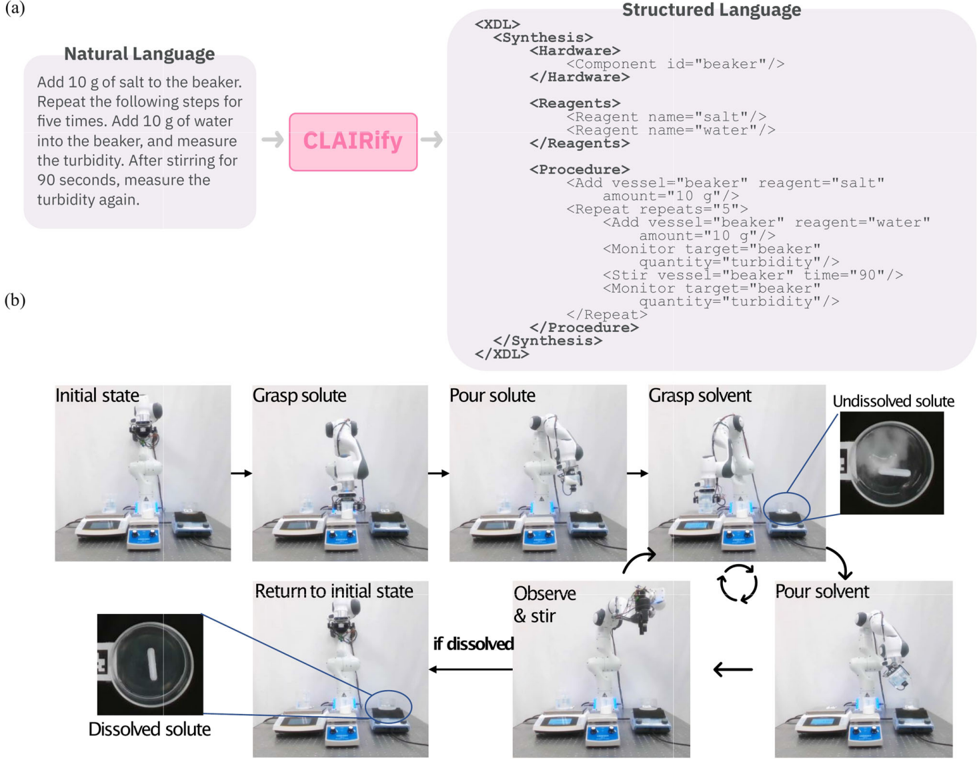
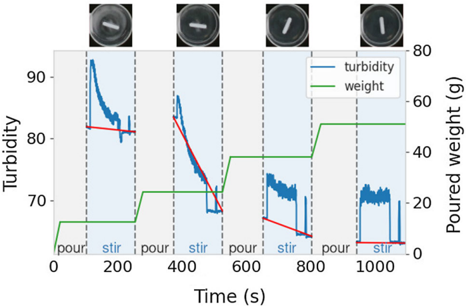
This paper proposes an approach to automate chemistry experiments using robots by translating natural language instructions into robot-executable plans, using large language models together with task and motion planning. Adding natural language interfaces to autonomous chemistry experiment systems lowers the barrier to using complicated robotics systems and increases utility for non-expert users, but translating natural language experiment descriptions from users into low-level robotics languages is nontrivial. Furthermore, while recent advances have used large language models to generate task plans, reliably executing those plans in the real world by an embodied agent remains challenging. To enable autonomous chemistry experiments and alleviate the workload of chemists, robots must interpret natural language commands, perceive the workspace, autonomously plan multi-step actions and motions, consider safety precautions, and interact with various laboratory equipment. Our approach, CLAIRify , combines automatic iterative prompting with program verification to ensure syntactically valid programs in a data-scarce domain-specific language that incorporates environmental constraints. The generated plan is executed through solving a constrained task and motion planning problem using PDDLStream solvers to prevent spillages of liquids as well as collisions in chemistry labs. We demonstrate the effectiveness of our approach in planning chemistry experiments, with plans successfully executed on a real robot using a repertoire of robot skills and lab tools. Specifically, we showcase the utility of our framework in pouring skills for various materials and two fundamental chemical experiments for materials synthesis: solubility and recrystallization. Further details about CLAIRify can be found at https://ac-rad.github.io/clairify/ .
Overview
The claims and statistics of this paper haven’t been checked yet.
Free: it reads the open-access text and checks the first 5 claims that cite a source we can check. Create a free account to check every claim.
Integrity signals
Registry
Cites
Statistics
Figures




Verification
Claims the paper makes
The claims and statistics of this paper haven’t been checked yet.
Free: it reads the open-access text and checks the first 5 claims that cite a source we can check. Create a free account to check every claim.
Claims other papers make about this one
Each is checked against this paper’s own text: does it say what the citing paper says it does?
The source backs part of the claim, not all of it — or backs it for a different population, condition or comparison.
In the citing paper
“In parallel, chemistry-oriented reviews have shown that large language models can move beyond text generation toward tool use, retrieval, planning, code execution, and multi-agent coordination [5-10].”
From From Scientific Copilots to Tool-Grounded Autonomy: AI Agents in Simulation-Driven Materials Discovery (2026) · cites this paper as [6]
Experimental — accuracy not yet measuredThe source backs part of the claim, not all of it — or backs it for a different population, condition or comparison.
In the citing paper
“The central challenge is not only to predict a property, but to manage the sequence of reasoning and action that connects a scientific objective to executable computational or experimental steps [2-10].”
From From Scientific Copilots to Tool-Grounded Autonomy: AI Agents in Simulation-Driven Materials Discovery (2026) · cites this paper as [6]
Experimental — accuracy not yet measuredThe check wasn’t confident either way, so it gives no verdict — never disputed.
In the citing paper
“To the best of our knowledge, no prior review has isolated simulation-driven, toolorchestrating AI agent workflows for materials discovery as a distinct evidence base with study-level extraction of autonomy, validation, and reproducibility [3-14].”
From From Scientific Copilots to Tool-Grounded Autonomy: AI Agents in Simulation-Driven Materials Discovery (2026) · cites this paper as [6]
Experimental — accuracy not yet measured
Self-check
Percentages, sums and reported differences re-computed from the paper’s own numbers.
The self-check needs the paper’s full text.
Citations
Cites
BERT: Pre-training of Deep Bidirectional Transformers for Language Understanding
Devlin, J., Chang, M.-W., Lee, K., & Toutanova, K. (2018) · arXiv · doi:10.48550/arxiv.1810.04805 · Cited by 73,173 · cited 1×
“LLMs have been used to generate structured outputs (Devlin et al., 2019; Brown et al., 2020; Chowdhery et al., 2022), including code generation (Chen et al., 2021; Wang et al., 2021; Li et al., 2022) and robot programming (Liang et al., 2022).”
MethodLanguage Models are Few-Shot Learners
Brown, T. B., Mann, B., Ryder, N., Subbiah, M., Kaplan, J., Dhariwal, P., Neelakantan, A., Shyam, P., Sastry, G., Askell, A., et al. (2020) · arXiv · doi:10.48550/arxiv.2005.14165 · Cited by 23,372 · cited 3×
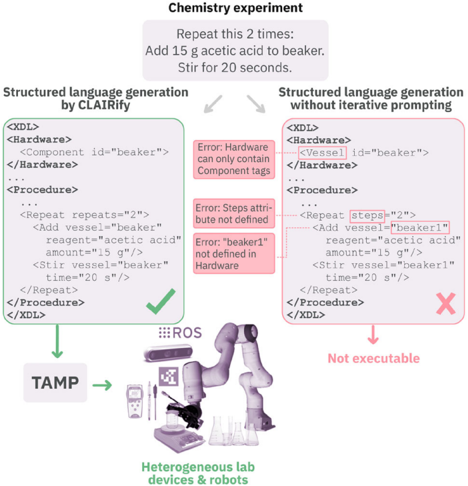
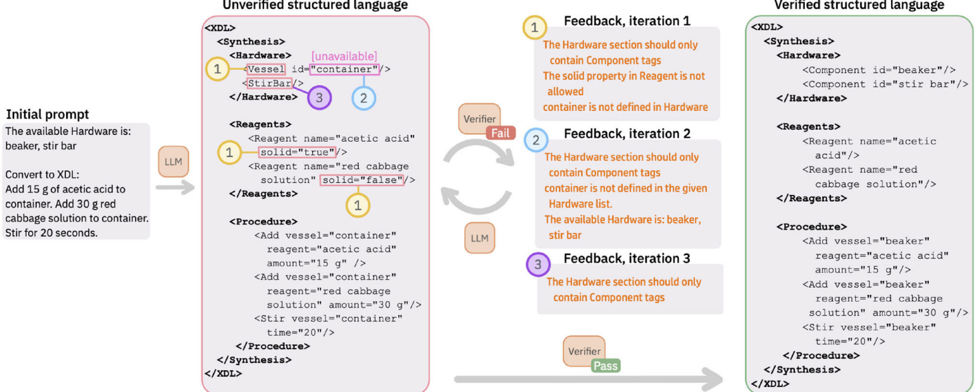
“Error:HardwarecanonlycontainComponenttags Error:Stepsattri-butenotdefined Error:"beaker1" Structuredlanguagegenerationwithoutiterativeprompting <XDL><Hardware> <Component id="beaker"> </Hardware> ... <Procedure> ...”
BackgroundMethodAdvances in Neural Information Processing Systems 14: Proceedings of the 2001 Conference
(2002) · The MIT Press eBooks · doi:10.7551/mitpress/1120.001.0001 · Cited by 8,890
Probabilistic roadmaps for path planning in high-dimensional configuration spaces
Kavraki, L. E., Svestka, P., Latombe, J.-C., & Overmars, M. H. (1996) · IEEE Transactions on Robotics and Automation · doi:10.1109/70.508439 · Cited by 6,343 · cited 1×
“We use probabilistic roadmap methods (PRM ⋆ ) to plan efficiently in the 8-DoF configuration space found in our chemistry laboratory domain (Karaman and Frazzoli, 2011; Kavraki et al., 1996).”
MethodSampling-based algorithms for optimal motion planning
Karaman, S., & Frazzoli, E. (2011) · The International Journal of Robotics Research · doi:10.1177/0278364911406761 · Cited by 5,275 · cited 2×
“We use probabilistic roadmap methods (PRM ⋆ ) to plan efficiently in the 8-DoF configuration space found in our chemistry laboratory domain (Karaman and Frazzoli, 2011; Kavraki et al., 1996).”
BackgroundMethodPaLM: Scaling Language Modeling with Pathways
Chowdhery, A., Narang, S., Devlin, J., Bosma, M., Mishra, G., Roberts, A., Barham, P., Chung, H. W., Sutton, C., Gehrmann, S., et al. (2022) · arXiv · doi:10.48550/arxiv.2204.02311 · Cited by 2,590 · cited 1×
“Error:HardwarecanonlycontainComponenttags Error:Stepsattri-butenotdefined Error:"beaker1" Structuredlanguagegenerationwithoutiterativeprompting <XDL><Hardware> <Component id="beaker"> </Hardware> ... <Procedure> ...”
Manipulability of Robotic Mechanisms
Yoshikawa, T. (1985) · The International Journal of Robotics Research · doi:10.1177/027836498500400201 · Cited by 2,582 · cited 1×
“Second, depending on the robot task, the objective function is extended to maximize the manipulability ellipsoid as described in (Yoshikawa, 1985), which is applied for more complicated maneuvers, such as transferring liquids across the workspace.”
MethodDomain-specific language model pretraining for biomedical natural language processing
Gu, Y., Tinn, R., Cheng, H., Lucas, M., Usuyama, N., Liu, X., Naumann, T., Gao, J., & Poon, H. (2022) · ACM Transactions on Computing for Healthcare · doi:10.1145/3458754 · Cited by 2,170 · cited 1×
“Second, LLMs may perform poorly in generating task plans in a zero-shot manner for data-scarce domain-specific languages, such as chemistry (Gu et al., 2021; Liu et al., 2022).”
MethodAprilTag: A robust and flexible visual fiducial system
Olson, E. (2011) · 2011 IEEE International Conference on Robotics and Automation · doi:10.1109/icra.2011.5979561 · Cited by 1,770 · cited 2×
“To detect fiducial markers, we use the AprilTag library (Olson, 2011).”
MethodSparks of Artificial General Intelligence: Early experiments with GPT-4
Bubeck, S., Chandrasekaran, V., Eldan, R., Gehrke, J., Horvitz, E., Kamar, E., Lee, P., Lee, Y. T., Li, Y., Lundberg, S., et al. (2023) · arXiv · doi:10.48550/arxiv.2303.12712 · Cited by 1,526 · cited 1×
“The limitation in task planning abilities has been highlighted in a recent study (Bubeck et al., 2023) as well.”
Background
Research works printed but not linked: 2
- Grinberg, M. (2018). Flask web development: Developing web appli- cations with python. " O'Reilly Media, Inc.".
- Yoshikawa, N., Li, A. Z., Darvish, K., Zhao, Y., Xu, H., Kuramshin, A., Aspuru-Guzik, A., Garg, A., & Shkurti, F. (2023). Chemistry lab automation via constrained task and motion planning. arXiv preprint. https://doi.org/10.48550/arXiv.2212.09672 · DOI
Cited by
Items 101–132 of 132
Yoo, H. J., Kim, D., Yim, S., Lee, H., Kim, N., Kwak, S. K., & Han, S. S. (2026) · Chemical Engineering Journal · doi:10.1016/j.cej.2026.183157 · Cited by 1
Fang, X., Tao, L., & Li, Z. (2025) · IEEE/RSJ International Conference on Intelligent Robots and Systems (IROS) · doi:10.1109/iros60139.2025.11247170 · Cited by 1
“Some methods, including research using large language models (LLMs), have shown a certain level of competence in pouring tasks [6].”
LLM‐Powered AI Agents in Materials Science: From Autonomous Design to Autonomous Experimentation
Jiang, T., Zhang, Z., Nie, M., Zhu, D., Meng, E., Wu, H., & Mao, X. (2026) · Advanced Functional Materials · doi:10.1002/adfm.78275 · Cited by 1
“For example, the liquid dispensing error reported for CLAIRify [ 130 ] (8.1%–8.8”
InfluentialZhang, H., Kang, L. I., Chen, B., Liu, L., Jiang, Y., & Wang, Y. (2025) · Scientia Sinica Technologica · doi:10.1360/sst-2025-0047 · Cited by 3
Semantic Representation for Agentic Self-Play in Automated LaboratoriesPreprint
Delley, Y., Coller, J., Cutts, Z., Daryin, A., Bellaiche, M. M. J., Kim, J. W., Donosa, O., Seshadri, S. B., Clary, T., Klemm, S., et al. (2026) · arXiv (Cornell University) · doi:10.48550/arxiv.2610.32755 · Cited by 1
“Recent systems such as CLAIRify [23] and ORGANA [24] pair LLMs with compiler verifiers or task-and-motion planning to validate symbolic task plans, while open-source interfaces such as PyLabRobot [25] provide programmatic hardware control and in-memory volume and tip tracking within a single script.”
Alviz-Meza, A., Valencia-Arias, A., Rojas-Flores, S., & Diaz, F. (2026) · Data · doi:10.3390/data11070180
Integrating Action Robot Ontology for Enhanced Human-Robot Interaction: A NAO Robot Case Study
Recupero, D. R., & Boi, L. (2025) · Lecture notes in computer science · doi:10.1007/978-3-031-78952-6_47
“One notable application of LLMs in robotics involves natural language understanding, enabling robots to interpret and respond to human commands with unprecedented accuracy [3,4].”
BackgroundUnified Language of Operation Units for Robot-Executable Synthesis Protocols
Fu, Y. Z., & Liu, X. (2025) · Communications in computer and information science · doi:10.1007/978-3-031-95130-5_19
Dual-Arm Hierarchical Planning for Laboratory Automation: Vibratory Sieve Shaker Operations
Xiao, H., Wang, X., Lu, H., Zeng, Z., Guo, Z., Ni, Z., Ye, Y., & Dai, W. (2025) · IEEE/RSJ International Conference on Intelligent Robots and Systems (IROS) · doi:10.1109/iros60139.2025.11247197
“While some works, such as [5], have explored obstacle avoidance for dual-arm robots, they do not address the high-precision requirements of complex and constrained laboratory environments.”
Leveraging Large Language Models for Nanomaterials Discovery and Synthesis
Xie, T. (2025) · UNSWorks (University of New South Wales, Sydney, Australia) · doi:10.26190/unsworks/30859
Task Parsing and Verification for Laboratory Automation via Large Language Models
Zheng, W., Yuan, X., Wu, L., Wang, J., Lou, S., & Li, Z. (2025) · International Conference on Intelligent Informatics and Biomedical Sciences (ICIIBMS) · doi:10.1109/iciibms66230.2025.11316749
“[1] proposed the XDL (eXperimental Description Language) for enabling automatic execution and digitization of chemical literature; [2,4,5,10] demonstrated the feasibility and application prospects of large language models across various domains; [3] introduced the OCTOPUS system, which supports…”
Large Language Models in Drug Discovery
Gangwal, A., & Lavecchia, A. (2026) · Springer eBooks · doi:10.1007/978-3-031-98022-0_14
Advancing Improvisation in Human-Robot Construction Collaboration: Taxonomy and Research RoadmapPreprint
Atibila, D. W., Kamat, V. R., & Menassa, C. C. (2026) · arXiv (Cornell University) · doi:10.48550/arxiv.2601.17219
Risk Mitigation Strategies for Artificial Intelligence-Enabled Self-Driving Laboratories
Haro, L. P. D. (2026) · Applied Biosafety · doi:10.1177/15356760251412428 · Cited by 1
Environment-Aware Multi-Agent Framework for Self-Driving Laboratories
Xue, H., Zheng, W., Lin, S., Wang, Y., Bao, L., & Wang, X. (2026) · IEEE Transactions on Automation Science and Engineering · doi:10.1109/tase.2026.3659028
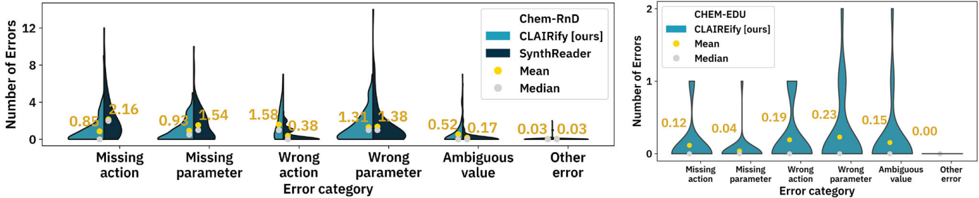
“To evaluate the performance of the proposed Synthesis Plan Generation Agent, we conducted experiments on the Chem-RnD [32] and Chem-EDU [33] datasets, and compared our method with two representative baselines: CLAIRify [33] and SynthReader [32].”
Guiding Generative AI Solution for Fundamental Astrodynamics Problems
Wu, D., Shah, R., & Rodríguez-Fernández, V. (2026) · AIAA SciTech Forum · doi:10.2514/6.2026-2377
An Automated Extraction System for Material Chemistry Experimental Protocols
Yang, F., Xu, F., Liang, H., Fan, X., Chen, L., Zhang, K., Li, X., Wu, L., & Wang, S. (2026) · Lecture notes in computer science · doi:10.1007/978-981-95-7144-4_14
Robotic Nanoparticle Synthesis Via Solution-Based Processes
Mahalingam, D., Gallagher, M., Chakraborty, N., & Wong, S. S. (2026) · ASME Letters in Translational Robotics · doi:10.1115/1.4072587
“[12,19] discusses a robotic assistant that utilizes LLMs to translate natural language into long-horizon task plans for execution using a constrained task and motion planner.”
Wang, Z., Zhang, S., Shao, L., Yin, L., Sun, N., & Li, X. (2026) · SLAS TECHNOLOGY · doi:10.1016/j.slast.2026.100418
Liu, C.-L., Yang, Y., & Wang, J. (2026) · Proceedings of the 2026 Asia-Pacific Intelligent Educational Technologies Conference · doi:10.1145/3796114.3796118
Yang, Z., Du, Y., Liu, D., & Cong, M. (2026) · Industrial Robot the international journal of robotics research and application · doi:10.1108/ir-12-2025-0466
Dynamic Pipeline Scheduling for Hybrid Edge Collaboration in Multi‐Modal LLM Inference
Li, H. (2026) · Artificial Intelligence for Engineering · doi:10.1049/aie2.70020
Lin, Z., Li, H., & Du, J. (2026) · The Electronic Library · doi:10.1108/el-11-2025-0438
Nagata, Y., Machi, K., Akiyama, S., & Yoshioka, M. (2026) · Digital Discovery · doi:10.1039/d6dd00301j
A Hybrid Control Framework With Learning-Based Overshoot Compensation for Accurate Robotic Pouring
Wang, Y., Su, J., Liu, D., Gong, Z., Yang, J., Ye, J., Tian, Y., Huang, J., Liu, X., & Sun, Y. (2026) · IEEE Robotics and Automation Letters · doi:10.1109/lra.2026.3726381
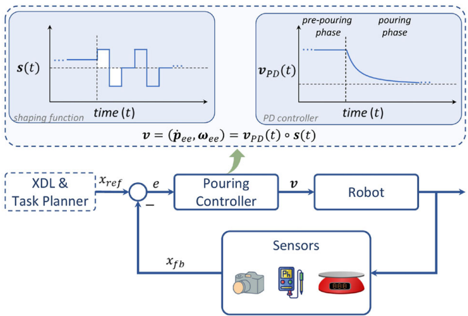
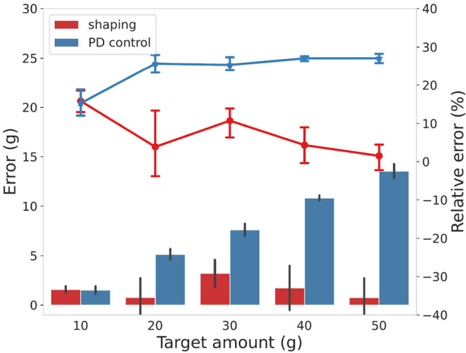
“Inothermethods,pouringwasformulated asafeedbackcontrolproblemusingaPDcontrolmethodbased onreal-timeweightmeasurements[19].”
Robotic safety in self-driving laboratories
Mariano, E., Löwensberg, M., Bloesch, T., Costanzo, G. T., & Miéville, P. (2026) · SLAS TECHNOLOGY · doi:10.1016/j.slast.2026.100463
Zuo, Y., Hou, X., Zhu, K., Wang, X., & Wu, K. (2026) · Chemical Engineering Science · doi:10.1016/j.ces.2026.125075
Martins, B., & Pereira, L. (2026) · Journal of Artificial Intelligence for Materials Science · doi:10.68159/w460057148
From literature to lab: LLM-powered catalyst synthesis protocol generation
Zhang, Y., Luo, S., Liu, D., Vlachos, D. G., & Fang, H. (2026) · Digital Discovery · doi:10.1039/d6dd00229c
Hashimoto, Y., Muramoto, T., 寺田光, Song, H., Wang, Y., & Tomai, T. (2026) · Science and Technology of Advanced Materials Methods · doi:10.1080/27660400.2026.2756911
الابتكار في البحث العلمي المدعوم بالذكاء الاصطناعي الوكيل: الاتجاهات والتطبيقات والتحديات الناشئة
اللنجاوي, خ. م. (2026) · مجلة القانون والأعمال الدولية · doi:10.63585/wyli0668
Mufleh, A. S. S., Abunamous, M. A. E., Alajmi, L. H. R., Alshraah, S. M., Jwair, A. B., & Waleed, A. (2026) · Social Sciences & Humanities Open · doi:10.1016/j.ssaho.2026.103836
Metadata
- Authors
- Yoshikawa, N., Skreta, M., Darvish, K., Arellano-Rubach, S., Ji, Z., Bjørn Kristensen, L., Li, A. Z., Zhao, Y., Xu, H., Kuramshin, A., Aspuru-Guzik, A., Shkurti, F., & Garg, A.
- Affiliations
- University of Toronto (CA)
- University of Waterloo (CA)
- Corresponding author
- Darvish, Kourosh
- ORCID
- Venue
- Autonomous Robots
- Published
- 2023-10-25
- Volume
- 47
- Issue
- 8
- Pages
- 1057-1086
- ISSN
- 0929-5593 (ISSN-L)
- 1573-7527
- OpenAlex
- W4387937021
- Cited by
- 112
- References
- 94
- Citations by year
- 2026: 39 · 2025: 43 · 2024: 30
- FWCI
- 9.91
- Type
- journal article
- Language
- en
- Open access
- hybrid
- doi.org
- Licence
- cc-by
- creativecommons.org/licenses/by/4.0 (tdm)
- creativecommons.org/licenses/by/4.0 (vor)
- Locations
- Autonomous Robots (publishedVersion, cc-by)
- Funders
- Carlsberg Foundation (CF21-0669)
- Topics
- Physical Sciences › Computer Science › Artificial Intelligence › AI-based Problem Solving and Planning
- Physical Sciences › Engineering › Control and Systems Engineering › Robot Manipulation and Learning
- Physical Sciences › Engineering › Control and Systems Engineering › Robotics and Automated Systems
- Keywords
- large language models, natural language interfaces, task and motion planning, iterative prompting, program verification, embodied agents, laboratory automation, recrystallization, collision avoidance
About these checks
Registry, retraction, Cites and statistics results are computed, not judged, with one exception: a printed reference that no index lists is read once by a model before it counts as a citation error. Claims are extracted by a model and kept only when their quote appears verbatim in the text; each cited source is then checked, with a model’s help, for whether it says what the claim relies on. Those verdicts can be wrong — read the claim’s quote and the cited source before relying on one.
Statistics and arithmetic are recomputed, not judged.
Confidence bands are shown only for fields calibrated on our annotated test set. None is calibrated yet, so no band is shown.
What counts as a claim ›How we measure confidence ›How we check this ›
Are you an author, or do you see a problem with this page? Request a review
Data sources
Bibliographic data: Semantic Scholar, OpenAlex, Crossref.
Contains information from the Semantic Scholar Academic Graph Datasets, made available under the ODC Attribution License (ODC-BY 1.0).
Semantic Scholar’s data is described in: Kinney, R., et al. (2023). The Semantic Scholar Open Data Platform. arXiv:2301.10140.
