

Born to be Happy? The Etiology of Subjective Well-Being
Open accessThe DOI matches its Crossref record; 60 of the 61 references it cites were found in a registry or an index, and 1 are not checked yet.
Abstract
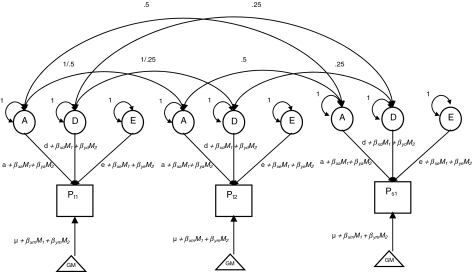
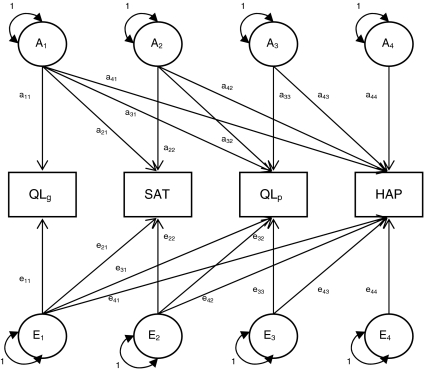
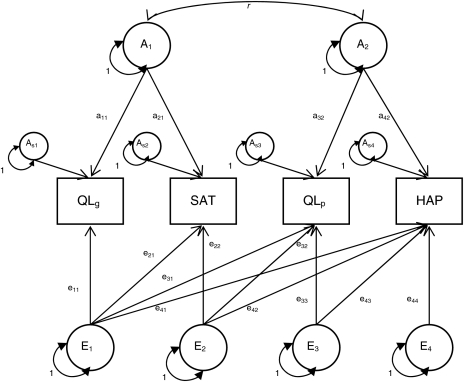
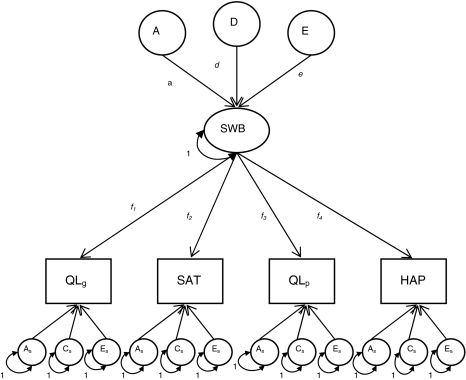
Subjective Wellbeing (SWB) can be assessed with distinct measures that have been hypothesized to represent different domains of SWB. The current study assessed SWB with four different measures in a genetically informative sample of adolescent twins and their siblings aged 13-28 years (N = 5,024 subjects from 2,157 families). Multivariate genetic modeling was applied to the data to explore the etiology of individual differences in SWB measures and the association among them. Developmental trends and sex differences were examined for mean levels and the variance-covariance structure. Mean SWB levels were equal in men and women. A small negative effect of age on mean levels of SWB was found. Individual differences in SWB were accounted for by additive and non-additive genetic influences, and non-shared environment. The broad-sense heritabilities were estimated between 40 and 50%. The clustering of the four different measures (quality of life in general, satisfaction with life, quality of life at present, and subjective happiness) was explained by an underlying additive genetic factor and an underlying non-additive genetic factor. The effect of these latent genetic factors on the phenotypes was not moderated by either age or sex.
Overview
The claims and statistics of this paper haven’t been checked yet.
Free: it reads the open-access text and checks the first 5 claims that cite a source we can check. Create a free account to check every claim.
Integrity signals
Registry
Cites
Statistics
Figures
Verification
Claims the paper makes
The claims and statistics of this paper haven’t been checked yet.
Free: it reads the open-access text and checks the first 5 claims that cite a source we can check. Create a free account to check every claim.
Claims other papers make about this one
Each is checked against this paper’s own text: does it say what the citing paper says it does?
The cited source says what the claim attributes to it.
In the citing paper
“Five studies, all extended twin designs, report significant non-additive genetic effects (Bartels and Boomsma 2009; Hahn et al. 2013; Nes et al. 2010a; Stubbe et al. 2005; Tellegen et al. 1988)”
From Genetics of Wellbeing and Its Components Satisfaction with Life, Happiness, and Quality of Life: A Review and Meta-analysis of Heritability Studies (2015) · cites this paper as Bartels and Boomsma 2009
Self-check
Percentages, sums and reported differences re-computed from the paper’s own numbers.
The self-check needs the paper’s full text.
Citations
Cites
The satisfaction with life scale
Diener, E., Emmons, R. A., Larsen, R. J., & Griffin, S. (1985) · Journal of Personality Assessment · doi:10.1207/s15327752jpa4901_13 · Cited by 31,768 · cited 1×
“This aspect of time fluctuation is also captured in the time-sequential framework of subjective well-being as proposed by Kim-Prieto, Diener (2005).”
MethodSubjective well-being: Three decades of progress.
Diener, E., Suh, E. M., Lucas, R. E., & Smith, H. L. (1999) · Psychological Bulletin · doi:10.1037/0033-2909.125.2.276 · Cited by 12,910
Взаимосвязь статуса занятости и пола с уровнем психологического благополучия
М.Р., Н., & С.И., Б. (2026) · Cifra LLC Journals · doi:10.60797/irj.2026.170.43 · Cited by 7,950
A Measure of Subjective Happiness: Preliminary Reliability and Construct Validation
Lyubomirsky, S., & Lepper, H. S. (1999) · Social Indicators Research · doi:10.1023/a:1006824100041 · Cited by 4,071 · cited 2×
“Subjective Happiness (HAP) was assessed with the 4-item Subjective Happiness Scale (Lyubomirsky and Lepper 1999).”
MethodResilient Individuals Use Positive Emotions to Bounce Back From Negative Emotional Experiences.
Tugade, M. M., & Fredrickson, B. L. (2004) · Journal of Personality and Social Psychology · doi:10.1037/0022-3514.86.2.320 · Cited by 3,947 · cited 2×
“If happiness of these people could be slightly increased it could result in better mental and physical health, more effective coping and in the longer end longevity (Tugade and Fredrickson 2004; Cohn et al. 2009).”
BackgroundSocial Indicators of Well-Being
Andrews, F. M., & Withey, S. B. (1976) · Springer eBooks · doi:10.1007/978-1-4684-2253-5 · Cited by 3,653 · cited 2×
“Andrews and Withey (1976) found, for example, that life satisfaction formed a separate factor form positive affect and this finding was replicated 20 years later (Lucas et al. 1996).”
BackgroundPersonality, Culture, and Subjective Well-Being: Emotional and Cognitive Evaluations of Life
Diener, E., Oishi, S., & Lucas, R. E. (2003) · Annual Review of Psychology · doi:10.1146/annurev.psych.54.101601.145056 · Cited by 3,434 · cited 1×
“One of the growing topics within this field is the cross-cultural comparison of wellbeing (Diener et al. 2003).”
BackgroundRelative Income, Happiness, and Utility: An Explanation for the Easterlin Paradox and Other Puzzles
Clark, A. E., Frijters, P., & Shields, M. A. (2008) · Journal of Economic Literature · doi:10.1257/jel.46.1.95 · Cited by 3,159 · cited 1×
“Obvious factors of importance are income (Clark et al. 2008; Stutzer 2004), education (Blanchflower and Oswald 2004; Bukenya et al. 2003), unemployment (Clark and Oswald 1994; Lucas et al. 2004), religion (Ciarrochi and Deneke 2005; Francis and Kaldor 2002), exercise (Stubbe et al. 2007; Biddle and…”
BackgroundWell-Being Over Time in Britain and the USA
Oswald, A. J., & Blanchflower, D. G. (1999) · Cited by 2,808
Clark, A. E., & Oswald, A. J. (1994) · The Economic Journal · doi:10.2307/2234639 · Cited by 2,562 · cited 2×
“2003), unemployment (Clark and Oswald 1994; Lucas et al. 2004), religion (Ciarrochi and Deneke 2005; Francis and Kaldor 2002), exercise (Stubbe et al.”
Background
Research works printed but not linked: 2
- Ciarrochi JW Deneke E Happiness and the varieties of religious experience: religious support, practices, and spirituality as predictors of well-being Res Soc Sci Study Relig 2005 15 209 223
- Neale MC Boker SM Xie G Maes HH Mx: statistical modeling 2006 7 Richmond VCU Department of Psychiatry
Cited by
Items 201–242 of 242
The Nature and Nurture of Wellbeing
Haworth, C. M. A. (2016) · Palgrave Macmillan UK eBooks · doi:10.1057/9781137437327_7
Glück in der Sozialpsychologie. Subjektive Gesundheit und gesundheitsbezogene Lebensqualität
Bullinger, M. (2011) · J.B. Metzler eBooks · doi:10.1007/978-3-476-00372-0_72 · Cited by 1
Magee, C. (2016) · cIRcle (University of British Columbia) · doi:10.14288/1.0308715
“%) which cannot be attributed to genes (Bartels & Boomsma, 2009; Bouchard & McGue, 2003; Jang et al., 1996; Vernon et al., 2008).”
Person-environmental interactions in psychosis
Pos, K. (2018) · Data Archiving and Networked Services (DANS)
Exploring Happiness of Participants in Middle Class Express: A Q Methodological Study.
Ray, T. B. (2018) · NCSU Libraries Repository (North Carolina State University Libraries)
Disability-Based Disparities in Adolescent Subjective Well-Being
Savage, A. (2017) · ERA: Education and Research Archive (University of Alberta) · doi:10.7939/r3p55dv4s · Cited by 1
Flom, M., & Saudino, K. J. (2019) · Oxford University Press eBooks · doi:10.1093/oso/9780198793014.003.0002
Persistência, bem-estar subjetivo e personalidade
da Costa, M. A. B. N. (2015) · Lusophone University Repository · Cited by 1
Subjective well-being and its relationship to personality in animals
Weiß, A., & Robinson, L. M. (2020)
Gupta, A. (2020) · OpenCommons - UConn (University of Connecticut)
Gupta, A. (2020) · OpenCommons at University of Connecticut (University of Connecticut)
Rech, D. L. (2020) · LA Referencia (Red Federada de Repositorios Institucionales de Publicaciones Científicas) · Cited by 1
Protocol paper Aging & Autism Geurts eaPreprint
Geurts, H. M., van Rentergem, J. A. A., Radhoe, T. A., Torenvliet, C., van der Putten, W., & Groenman, A. P. (2021) · PsyArXiv (OSF Preprints) · doi:10.31234/osf.io/cfkzw
Körmeling, J. (2010) · Pasajes de arquitectura y crítica
Howlin, P. (2021) · Faculty Opinions – Post-Publication Peer Review of the Biomedical Literature · doi:10.3410/f.739863163.793585597
Genetic Influences on Quality of Life
Thong, M. S. Y., Sprangers, M. A. G., Sloan, J. A., & Ordoñana, J. R. (2021) · Springer eBooks · doi:10.1007/978-3-319-69909-7_1154-2
Happiness Studies in the Biological and Medical Sciences
Freeze, R. A. (2022) · Social indicators research series · doi:10.1007/978-3-031-10913-3_5
Layard, R., & Neve, J.-E. D. (2023) · Cambridge University Press eBooks · doi:10.1017/9781009298957.026
Review Article on “Importance of Behavioral Genetics on the Psychological Development of the Person”
Chakrala, B. (2023) · The Journal of Neurobehavioral Sciences · doi:10.4103/jnbs.jnbs_10_23
Consumption, value and response: An interdisciplinary thesis on Australian women's wellbeing
Godwin, M. (2023) · Queensland University of Technology · doi:10.5204/thesis.eprints.243150
Conceptualising Behavioural Differences
Stevenson, J. (2023) · Springer eBooks · doi:10.1007/978-3-031-45787-6_5
Genetic Influences on Quality of Life
Thong, M. S. Y., Sprangers, M. A. G., Sloan, J. A., & Ordoñana, J. R. (2023) · Springer eBooks · doi:10.1007/978-3-031-17299-1_1154
Ipatyuk, O. V., & Kozunova, G. L. (2025) · S S Korsakov Journal of Neurology and Psychiatry · doi:10.17116/jnevro20251250517
Alrouh, H., Zijlmans, J., Luijten, M. A. J., van Oers, H. A., Tieskens, J. M., Middeldorp, C. M., Popma, A., Polderman, T. J. C., & Bartels, M. (2025) · Behavior Genetics · doi:10.1007/s10519-025-10223-3
“Previous studies have shown that differences in wellbeing are influenced by both genetic and environmental factors, which respectively explain about 30-40-and 60–70% of individual differences in wellbeing (Bartels and Boomsma 2009; Baselmans et al. 2018; van de Weijer et al. 2022b).”
Self-citationHappiness and Personality in Animals
Robinson, L. M., & Weiß, A. (2025) · CABI eBooks · doi:10.1079/9781800624313.0005
Biopsychosocial Factors Associated with the Mental Health of University Students
Suresh, S. M. (2025) · Queensland University of Technology · doi:10.5204/thesis.eprints.258284
Living happily ever after: longitudinal insights into enduring mental health and wellbeing
de Vries, L. P., Middeldorp, C. M., & Bartels, M. (2026) · Social Psychiatry and Psychiatric Epidemiology · doi:10.1007/s00127-026-03134-z
“These indicators of wellbeing are strongly related, both phenotypically and genetically [4, 7, 30, 35 ].”
Self-citationΜπισμπίκη, Ι. (2018) · University of Thessaly Institutional Repository (University of Thessaly) · doi:10.26253/heal.uth.4936 · Cited by 1
Bem-estar subjectivo e envolvimento escolar em adolescentes de etnia cigana
Lopes, S. R. D. S. (2012) · Portuguese National Funding Agency for Science, Research and Technology (RCAAP Project by FCT)
Hufer, A. (2020) · PUB – Publications at Bielefeld University (Bielefeld University)
Funcionamento positivo em praticantes de dança
César, F. S. B. (2017) · Lusophone University Repository
Elsamani, Y., & Elsamani, Y. (2024) · Institutional Repositories DataBase (IRDB)
Heritability of Life Satisfaction
Suontama, A. (2025) · UTUPub (University of Turku)
Factors Influencing Subjective Well-Being: Key Dimensions and Research Evolution
Li, H., & Shen, G. (2026) · Springer eBooks · doi:10.1007/978-981-95-4937-5_4
Bekmezci, M. (2024) · Dspace Repository (Marmara Üniversitesi) · Cited by 1
Azcona-Granada, N., Geijsen, A. J. M. R., de Vries, L. P., Pelt, D. H. M., & Bartels, M. (2026) · bioRxiv (Cold Spring Harbor Laboratory) · doi:10.64898/2026.03.27.714768
Self-citationCalvet, B. (2015) · theses.fr (ABES) · doi:10.70675/5514aea7z3407z42a5zb1a7z18e0051409d0 · Cited by 1
Social comparison and segregation reveal well-being traps
Dignum, E., Geerlofs, A., Gerrits, L., & Roy, D. (2026) · Humanities and Social Sciences Communications · doi:10.1057/s41599-026-07875-9
“The variance in SWB between individuals is largely determined by genetic and personality factors (Bartels and Boomsma, 2009; Diener et al., 2018; Pelt et al., 2024).”
Autism and wellbeing: A preliminary investigation of ‘Flourishing Autism’.
Taylor, R. (2022) · UBIR (University of Greater Manchester)
Cai, Y., Mao, J., Yang, C., Gao, P., Ji, H., Zhao, Y., Chen, H., Xiang, J., & Xu, X. (2026) · Frontiers in Psychology · doi:10.3389/fpsyg.2026.1962283
“General well-being reflects individuals’ life satisfaction and serves as an important psychological resource for nurses and a key determinant of workforce stability and clinical practice (Bartels and Boomsma, 2009; Chen et al., 2024).”
Psychosocial risks and their connection to employee well-being - a comparison between organizations
Gričnik, A. M. (2025) · University of Maribor digital library (University of Maribor)
Metadata
- Authors
- Bartels, M., & Boomsma, D. I.
- Affiliations
- Vrije Universiteit Amsterdam (NL)
- Corresponding author
- Bartels, Meike
- Venue
- Behavior Genetics
- Published
- 2009-09-03
- Volume
- 39
- Issue
- 6
- Pages
- 605-615
- ISSN
- 0001-8244 (ISSN-L)
- 1573-3297
- PMC
- PMC2780680
- OpenAlex
- W1980406651
- Semantic Scholar
- d66321a79b719ffd4a1dddfc5e69be56a98ad958
- Cited by
- 217
- References
- 60
- Citations by year
- 2026: 6 · 2025: 8 · 2024: 11 · 2023: 14 · 2022: 10 · 2021: 14 · 2020: 7 · 2019: 12 · 2018: 12 · 2017: 11 · 2016: 14 · 2015: 22 · 2014: 20 · 2013: 15 · 2012: 17
- FWCI
- 17.84
- Type
- journal article
- Language
- en
- Open access
- hybrid
- doi.org
- Licence
- cc-by-nc
- Locations
- Behavior Genetics (publishedVersion, cc-by-nc)
- PubMed Central (publishedVersion, cc-by-nc)
- PubMed (publishedVersion)
- Digital Academic REpository of VU University Amsterdam (Vrije Universiteit Amsterdam) (submittedVersion)
- VU Research Portal (submittedVersion, other-oa)
- Data Archiving and Networked Services (DANS) (submittedVersion, other-oa)
- Topics
- Social Sciences › Psychology › Social Psychology › Psychological Well-being and Life Satisfaction
- Life Sciences › Neuroscience › Cellular and Molecular Neuroscience › Neurotransmitter Receptor Influence on Behavior
- Life Sciences › Biochemistry, Genetics and Molecular Biology › Genetics › Genetic Associations and Epidemiology
- Keywords
- subjective well-being, heritability, genetic factors, non-additive genetic effects, nonshared environment, life satisfaction, subjective happiness, quality of life, individual differences, age differences, sex differences, twins and siblings
- MeSH terms
- Adolescent, Adult, Female, Genotype, Happiness, Humans, Individuality, Male, Models, Genetic, Netherlands, Personality Inventory, Phenotype, Psychometrics, Quality of Life, Social Environment, Temperament, Twins, Dizygotic, Twins, Monozygotic, Multivariate Analysis, Siblings, Young Adult
About these checks
Registry, retraction, Cites and statistics results are computed, not judged, with one exception: a printed reference that no index lists is read once by a model before it counts as a citation error. Claims are extracted by a model and kept only when their quote appears verbatim in the text; each cited source is then checked, with a model’s help, for whether it says what the claim relies on. Those verdicts can be wrong — read the claim’s quote and the cited source before relying on one.
Statistics and arithmetic are recomputed, not judged.
Confidence bands are shown only for fields calibrated on our annotated test set. None is calibrated yet, so no band is shown.
What counts as a claim ›How we measure confidence ›How we check this ›
Are you an author, or do you see a problem with this page? Request a review
Data sources
Bibliographic data: Semantic Scholar, OpenAlex, Crossref.
Contains information from the Semantic Scholar Academic Graph Datasets, made available under the ODC Attribution License (ODC-BY 1.0).
Semantic Scholar’s data is described in: Kinney, R., et al. (2023). The Semantic Scholar Open Data Platform. arXiv:2301.10140.
