

Born to be Happy? The Etiology of Subjective Well-Being
Open accessThe DOI matches its Crossref record; 60 of the 61 references it cites were found in a registry or an index, and 1 are not checked yet.
Abstract
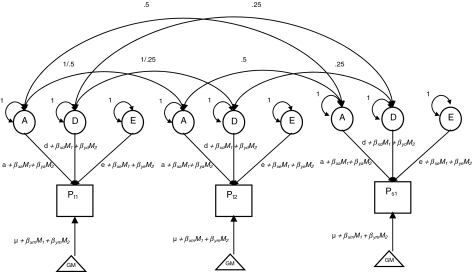
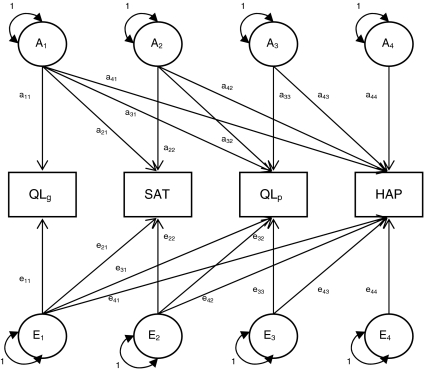
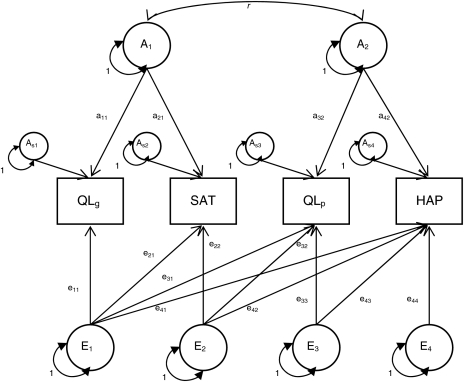
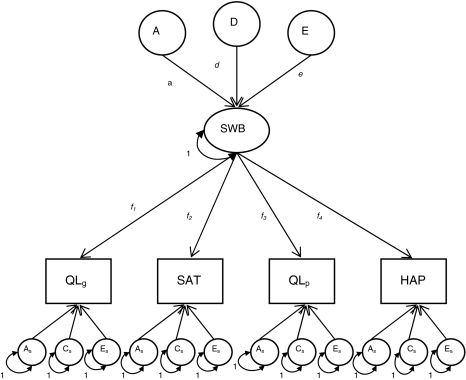
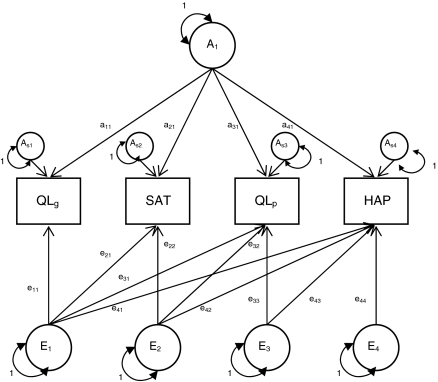
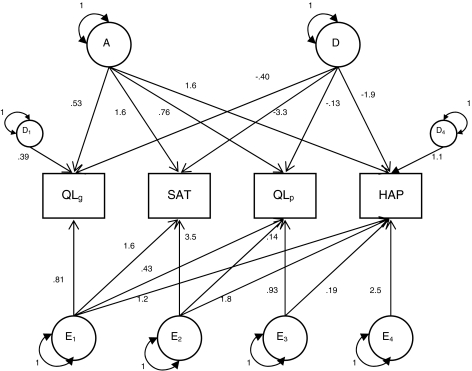
Subjective Wellbeing (SWB) can be assessed with distinct measures that have been hypothesized to represent different domains of SWB. The current study assessed SWB with four different measures in a genetically informative sample of adolescent twins and their siblings aged 13-28 years (N = 5,024 subjects from 2,157 families). Multivariate genetic modeling was applied to the data to explore the etiology of individual differences in SWB measures and the association among them. Developmental trends and sex differences were examined for mean levels and the variance-covariance structure. Mean SWB levels were equal in men and women. A small negative effect of age on mean levels of SWB was found. Individual differences in SWB were accounted for by additive and non-additive genetic influences, and non-shared environment. The broad-sense heritabilities were estimated between 40 and 50%. The clustering of the four different measures (quality of life in general, satisfaction with life, quality of life at present, and subjective happiness) was explained by an underlying additive genetic factor and an underlying non-additive genetic factor. The effect of these latent genetic factors on the phenotypes was not moderated by either age or sex.
Overview
The claims and statistics of this paper haven’t been checked yet.
Free: it reads the open-access text and checks the first 5 claims that cite a source we can check. Create a free account to check every claim.
Integrity signals
Registry
Cites
Statistics
Figures
Verification
Claims the paper makes
The claims and statistics of this paper haven’t been checked yet.
Free: it reads the open-access text and checks the first 5 claims that cite a source we can check. Create a free account to check every claim.
Claims other papers make about this one
Each is checked against this paper’s own text: does it say what the citing paper says it does?
The cited source says what the claim attributes to it.
In the citing paper
“Five studies, all extended twin designs, report significant non-additive genetic effects (Bartels and Boomsma 2009; Hahn et al. 2013; Nes et al. 2010a; Stubbe et al. 2005; Tellegen et al. 1988)”
From Genetics of Wellbeing and Its Components Satisfaction with Life, Happiness, and Quality of Life: A Review and Meta-analysis of Heritability Studies (2015) · cites this paper as Bartels and Boomsma 2009
Self-check
Percentages, sums and reported differences re-computed from the paper’s own numbers.
The self-check needs the paper’s full text.
Citations
Cites
The satisfaction with life scale
Diener, E., Emmons, R. A., Larsen, R. J., & Griffin, S. (1985) · Journal of Personality Assessment · doi:10.1207/s15327752jpa4901_13 · Cited by 31,768 · cited 1×
“This aspect of time fluctuation is also captured in the time-sequential framework of subjective well-being as proposed by Kim-Prieto, Diener (2005).”
MethodSubjective well-being: Three decades of progress.
Diener, E., Suh, E. M., Lucas, R. E., & Smith, H. L. (1999) · Psychological Bulletin · doi:10.1037/0033-2909.125.2.276 · Cited by 12,910
Взаимосвязь статуса занятости и пола с уровнем психологического благополучия
М.Р., Н., & С.И., Б. (2026) · Cifra LLC Journals · doi:10.60797/irj.2026.170.43 · Cited by 7,950
A Measure of Subjective Happiness: Preliminary Reliability and Construct Validation
Lyubomirsky, S., & Lepper, H. S. (1999) · Social Indicators Research · doi:10.1023/a:1006824100041 · Cited by 4,071 · cited 2×
“Subjective Happiness (HAP) was assessed with the 4-item Subjective Happiness Scale (Lyubomirsky and Lepper 1999).”
MethodResilient Individuals Use Positive Emotions to Bounce Back From Negative Emotional Experiences.
Tugade, M. M., & Fredrickson, B. L. (2004) · Journal of Personality and Social Psychology · doi:10.1037/0022-3514.86.2.320 · Cited by 3,947 · cited 2×
“If happiness of these people could be slightly increased it could result in better mental and physical health, more effective coping and in the longer end longevity (Tugade and Fredrickson 2004; Cohn et al. 2009).”
BackgroundSocial Indicators of Well-Being
Andrews, F. M., & Withey, S. B. (1976) · Springer eBooks · doi:10.1007/978-1-4684-2253-5 · Cited by 3,653 · cited 2×
“Andrews and Withey (1976) found, for example, that life satisfaction formed a separate factor form positive affect and this finding was replicated 20 years later (Lucas et al. 1996).”
BackgroundPersonality, Culture, and Subjective Well-Being: Emotional and Cognitive Evaluations of Life
Diener, E., Oishi, S., & Lucas, R. E. (2003) · Annual Review of Psychology · doi:10.1146/annurev.psych.54.101601.145056 · Cited by 3,434 · cited 1×
“One of the growing topics within this field is the cross-cultural comparison of wellbeing (Diener et al. 2003).”
BackgroundRelative Income, Happiness, and Utility: An Explanation for the Easterlin Paradox and Other Puzzles
Clark, A. E., Frijters, P., & Shields, M. A. (2008) · Journal of Economic Literature · doi:10.1257/jel.46.1.95 · Cited by 3,159 · cited 1×
“Obvious factors of importance are income (Clark et al. 2008; Stutzer 2004), education (Blanchflower and Oswald 2004; Bukenya et al. 2003), unemployment (Clark and Oswald 1994; Lucas et al. 2004), religion (Ciarrochi and Deneke 2005; Francis and Kaldor 2002), exercise (Stubbe et al. 2007; Biddle and…”
BackgroundWell-Being Over Time in Britain and the USA
Oswald, A. J., & Blanchflower, D. G. (1999) · Cited by 2,808
Clark, A. E., & Oswald, A. J. (1994) · The Economic Journal · doi:10.2307/2234639 · Cited by 2,562 · cited 2×
“2003), unemployment (Clark and Oswald 1994; Lucas et al. 2004), religion (Ciarrochi and Deneke 2005; Francis and Kaldor 2002), exercise (Stubbe et al.”
Background
Research works printed but not linked: 2
- Ciarrochi JW Deneke E Happiness and the varieties of religious experience: religious support, practices, and spirituality as predictors of well-being Res Soc Sci Study Relig 2005 15 209 223
- Neale MC Boker SM Xie G Maes HH Mx: statistical modeling 2006 7 Richmond VCU Department of Psychiatry
Cited by
Items 101–200 of 242
Wiese, C. W., Dormann, C., Vaziri, H., Tay, L., Wille, B., Chen, J., Moran, L. H., & Li, Y. (2025) · Journal of Organizational Behavior · doi:10.1002/job.2861 · Cited by 22
Is teleworking at odds with social sustainability and organizational learning?
Mosquera, P., Soares, M. E., & Alvadia, T. (2022) · The Learning Organization · doi:10.1108/tlo-01-2022-0002 · Cited by 33
Molenaar, D., van der Sluis, S., Boomsma, D. I., & Dolan, C. V. (2011) · Behavior Genetics · doi:10.1007/s10519-011-9522-x · Cited by 21
Self-citationCauses of individual differences in adolescent optimism: a study in Dutch twins and their siblings
Mavioğlu, R. N., Boomsma, D. I., & Bartels, M. (2015) · European Child & Adolescent Psychiatry · doi:10.1007/s00787-015-0680-x · Cited by 22
“The finding of a heritability estimate of about 38 % for the full scale (6 items) and 29 % for the Optimism_3 items subscale is in accordance with estimates for other positive psychology measures, such as subjective wellbeing and its components, happiness, satisfaction with life, and quality of life [46, 47].”
ResultSelf-citationAndersen, N. K., Wimmelmann, C. L., Mortensen, E. L., & Flensborg‐Madsen, T. (2021) · Journal of Psychosomatic Research · doi:10.1016/j.jpsychores.2021.110529 · Cited by 21
On the link of self‐esteem, life satisfaction, and Neuroticism
Hufer, A., & Riemann, R. (2021) · Journal of Personality · doi:10.1111/jopy.12632 · Cited by 20
The happiness of people with a mental disorder in modern society
Bergsma, A., & Veenhoven, R. (2011) · Psychology of Well-Being Theory Research and Practice · doi:10.1186/2211-1522-1-2 · Cited by 24
“Aspects of well-being, such as satisfaction with life, positive moods, happiness and meaning in life, appear to be closely linked and seem to have a common genetic basis (Bartels and Boomsma 2009).”
BEHAVIORAL GENETICS FOUNDATIONS OF RELATIONS BETWEEN PERSONALITY TRAITS AND SATISFACTION WITH LIFE
Sadiković, S., Smederevac, S., Mitrović, D., & Milovanović, I. Z. (2019) · Primenjena psihologija · doi:10.19090/pp.2018.4.487-502 · Cited by 19
“…predisposition, or it is associated with the process of learning and/or adopting a specific life philosophy (Archontaki, Lewis, & Bates, 2013; Bartels & Boomsma, 2009; Gigantesco et al., 2011; Hahn, Johnson, & Spinath, 2013; Kendler, Myers, & Keyes, 2011; Keyes, Myers, & Kendler, 2010; Nes,…”
Kim, S., Kim, K., Hwang, M. Y., Ko, H., Jung, S.-H., Shim, I., Cha, S., Lee, H., Kim, B., Yoon, J., et al. (2022) · Nature Human Behaviour · doi:10.1038/s41562-022-01343-5 · Cited by 18
An, L., Liu, C., Zhang, N., Chen, Z., Ren, D., Yuan, F., Yuan, R., Bi, Y., Ji, L., Guo, Z., et al. (2019) · Emerging Science Journal · doi:10.28991/esj-2019-01171 · Cited by 19
What are people saying when they report they are happy or life satisfied
Baptista, A., Camilo, C., Santos, I. F., Brites, J. D. A., Rosa, J. B., & Fernández-Abascal, E. G. (2016) · Anales de Psicología · doi:10.6018/analesps.32.3.229121 · Cited by 25
Genetic Factors, Cultural Predispositions, Happiness and Gender Equality
Inglehart, R., Borinskaya, S., Anna, C., Jaanus, H., Inglehart, R. C., Eduard, P., & Welzel, C. (2014) · Multilingual Matters (Channel View Publications) · Cited by 22
Archambault, I., Pascal, S., Olivier, É., Tardif‐Grenier, K., Dupéré, V., & Janosz, M. (2024) · Learning and Instruction · doi:10.1016/j.learninstruc.2024.101930 · Cited by 18
National intelligence, basic human needs, and their effect on economic growth
Burhan, N. A. S., Mohamad, M. R., Kurniawan, Y., & Sidek, A. H. (2014) · Intelligence · doi:10.1016/j.intell.2014.03.007 · Cited by 19
Dealing with work overload in the IT industry
Mosquera, P., & Soares, M. E. (2024) · Management Decision · doi:10.1108/md-06-2023-0970 · Cited by 18
Legacy, Leisure and the ‘Work Hard – Play Hard’ Hypothesis
Aarssen, L. W., & Crimi, L. (2016) · The Open Psychology Journal · doi:10.2174/1874350101609010007 · Cited by 27
Fagnani, C., Medda, E., Alessandri, G., Delfino, D., D’Ippolito, C., Eisenberg, N., & Stazi, M. A. (2017) · Journal of Research in Personality · doi:10.1016/j.jrp.2017.03.003 · Cited by 17
Li, S., Meng, J., Liu, Q., Huo, T., Zhu, X., Li, Y., Ren, Z., Wang, X., & Qiu, J. (2019) · Neuroscience · doi:10.1016/j.neuroscience.2019.05.055 · Cited by 20
Overestimated relationships with subjective well-being.
Stones, M. J., Worobetz, S., & Brink, P. (2011) · Canadian Psychology/Psychologie canadienne · doi:10.1037/a0020694 · Cited by 28
What We Have Learnt About Happiness: Classic Qualms in the Light of Recent Research
Veenhoven, R. (2015) · Social indicators research series · doi:10.1007/978-3-319-20568-7_10 · Cited by 20
Heritability estimates of individual psychological distress symptoms from genetic variation
Kim, S., Jang, H.-J., Myung, W., Kim, K., Cha, S., Lee, H., Cho, S. K., Kim, B., Ha, T. H., Kim, J., et al. (2019) · Journal of Affective Disorders · doi:10.1016/j.jad.2019.04.011 · Cited by 17
Lachmann, B., Doebler, A., Sindermann, C., Sariyska, R., Cooper, A. J., Haas, H., & Montag, C. (2020) · Journal of Happiness Studies · doi:10.1007/s10902-020-00231-x · Cited by 16
“2008) and the highest at 47% (Bartels and Boomsma 2009).”
What Determines Emotional Well-Being? The Role of Adverse Experiences: Evidence Using Twin Data
Misheva, V. (2015) · Journal of Happiness Studies · doi:10.1007/s10902-015-9678-9 · Cited by 16
“Relying on a sample of Dutch adolescent twins and four different measures of well-being, Bartels and Boomsma (2009) found that there are underlying additive genetic and non-genetic factors that cause clustering in the measures of well-being.”
BackgroundLamash, L., Sagie, D., Selanikyo, E., Meyer, S., & Gal, E. (2024) · Research in Autism · doi:10.1016/j.rasd.2023.102311 · Cited by 20
Genes, Environments and Core Features of Eudaimonic Wellbeing
Røysamb, E., & Nes, R. B. (2016) · International handbooks of quality-of-life · doi:10.1007/978-3-319-42445-3_16 · Cited by 17
van de Weijer, M. P., Pelt, D. H. M., de Vries, L. P., Huider, F., van der Zee, M. D., Helmer, Q., Ligthart, L., Willemsen, G. A. H. M., Boomsma, D. I., de Geus, E. J. C., et al. (2022) · Genes Brain & Behavior · doi:10.1111/gbb.12796 · Cited by 18
“This is in line with our earlier work where we also report stronger evidence for dominant genetic effects on happiness versus quality of line.(35) A striking finding was the large increase in unique environmental variance—estimates of E more than doubled—during the pandemic, which resulted in a decreased heritability,…”
ResultSelf-citationMoreno, F. P. H., & Hernández, R. L. (2014) · Psicooncología · doi:10.5209/rev_psic.2014.v11.n2-3.47394 · Cited by 24
A Re-evaluation of Candidate Gene Studies for Well-Being in Light of Genome-Wide Evidence
van de Weijer, M. P., Pelt, D. H. M., de Vries, L. P., Baselmans, B. M. L., & Bartels, M. (2022) · Journal of Happiness Studies · doi:10.1007/s10902-022-00538-x · Cited by 16
“…gene studies, we assume that the genetic architecture of different well-being constructs is largely similar, which is confirmed in earlier work reporting high genetic correlations between measures of subjective and psychological well-being (Bartels & Boomsma, 2009; Baselmans & Bartels, 2018).”
ResultSelf-citationThe stability and change of wellbeing across the lifespan: a longitudinal twin-sibling study
de Vries, L. P., Pelt, D. H. M., & Bartels, M. (2024) · Psychological Medicine · doi:10.1017/s0033291724000692 · Cited by 18
“We used quality of life as measure, which is strongly related to life satisfaction (Bartels & Boomsma, 2009; Pavot, 2008), and showed a similar trajectory.”
MethodSelf-citation“Genes of Happiness and Well Being” in the Context of Search Activity Concept
Rotenberg, V. S. (2013) · Activitas Nervosa Superior · doi:10.1007/bf03379593 · Cited by 19
“Bartels and Boomsma (2009) showed the high heritability (40%-50”
BackgroundSchool Children's Happiness Inventory: The Validity and Reliability Study
Telef, B. B. (2014) · International Online Journal of Educational Sciences · doi:10.15345/iojes.2014.01.013 · Cited by 19
Association of MAOA-uVNTR Polymorphism with Subjective Well-Being in Men
Сергеевич, Г. А., Ананьева, Е. Д., Rubanovich, A. V., Inglehart, R., Понарин, Э. Д., & Borinskaya, S. A. (2018) · Russian Journal of Genetics · doi:10.1134/s1022795418050058 · Cited by 14
“In twin and family studies of factors influencing happiness and well-being, the evaluation of the contribution of heredity varies, accounting for 30–50% in most studies [2, 6, 7].”
BackgroundGenetic Associations with Subjective Well-Being Also Implicate Depression and NeuroticismPreprint
Okbay, A., Baselmans, B. M. L., Neve, J.-E. D., Turley, P., Nivard, M. G., Fontana, M. A., Meddens, S. F. W., Linnér, R. K., Rietveld, C. A., Derringer, J. L., et al. (2015) · bioRxiv (Cold Spring Harbor Laboratory) · doi:10.1101/032789 · Cited by 15
Self-citationHedonic possibilities and heritability statistics
Sosis, C. L. (2013) · Philosophical Psychology · doi:10.1080/09515089.2013.764563 · Cited by 12
Unraveling the Relation Between Personality and Well-Being in a Genetically Informative Design
Pelt, D. H. M., de Vries, L. P., & Bartels, M. (2022) · European Journal of Personality · doi:10.1177/08902070221134878 · Cited by 13
“Finally, at the genetic level, high levels of pleiotropy (i.e., the same genes in fl uencing multiple traits) are found between different measures of well-being, both within and across the SWB and PWB domains (Bartels & Boomsma, 2009; Baselmans & Bartels, 2018).”
BackgroundMethodResultInfluentialSelf-citationThe use of the classical twin method in the social and behavioral sciences: The fallacy continues.
Joseph, J. (2013) · Cited by 17
Connecting the dots: using a network approach to study the wellbeing spectrum
Landvreugd, A., van de Weijer, M. P., Pelt, D. H. M., & Bartels, M. (2024) · Current Psychology · doi:10.1007/s12144-024-06363-0 · Cited by 11
“It is also in line with other stud - ies emphasizing that different wellbeing phenotypes are highly interconnected (Bartels & Boomsma, 2009; Kim et al., 2016; Kokko et al., 2013).”
Self-citationMatteson, L. K., McGue, M. K., & Iacono, W. G. (2013) · Journal of Individual Differences · doi:10.1027/1614-0001/a000103 · Cited by 13
“Even so, the correlations are lower than those usually observed in research on SWB (Bookwala & Schulz, 1996; Dyrenforth, Kashy, Donnellan, & Lucas, 2010).”
BackgroundInfluentialThe genetics and evolution of covitality
Weiß, A., & Luciano, M. (2015) · Oxford University Press eBooks · doi:10.1093/acprof:oso/9780199686674.003.0009 · Cited by 12
“However, in the case of SWB for humans (Nes et al., 2010; Hahn et al., 2013; Lykken and Tellegen, 1996; Bartels and Boomsma, 2009; Weiss et al., 2008) and for orangutans (Adams et al., 2012), the fact that a considerable amount of variance is due to non-additive genetic effects is inconsistent with…”
BackgroundResultvan de Weijer, M. P., Pelt, D. H. M., van Beijsterveldt, C. E. M., Willemsen, G. A. H. M., & Bartels, M. (2021) · European Child & Adolescent Psychiatry · doi:10.1007/s00787-021-01798-3 · Cited by 11
“This does not have to come as a surprise, since it has been shown that several well-being domains, such as satisfaction with life, satisfaction with friendship, and happiness are significantly associated both phenotypically as well as genetically [28, 43].”
BackgroundResultSelf-citationBergmann, J. (2023) · Studien zur Migrations- und Integrationspolitik · doi:10.1007/978-3-658-42298-1 · Cited by 13
Pelt, D. H. M., Schwabe, I., & Bartels, M. (2023) · Behavior Genetics · doi:10.1007/s10519-023-10137-y · Cited by 10
“With respect to non-additive genetic variance, evidence is mixed at best for well-being (Stubbe et al. 2005; Bartels and Boomsma 2009; Hahn et al. 2013) and absent for social support (Coventry et al.”
BackgroundResultSelf-citationSaunders, G., Elkins, I. J., Christensen, K., & McGue, M. K. (2018) · Psychology and Aging · doi:10.1037/pag0000248 · Cited by 10
“Moreover, phenotypic correlations between different measures of SWB appear largely due to common underlying genes as well (Bartels & Boomsma, 2009).”
Genes, Security, Tolerance and HappinessPreprint
Inglehart, R., Borinskaya, S. A., Cotter, A., Harro, J., Inglehart, R., Понарин, Э. Д., & Welzel, C. (2014) · SSRN Electronic Journal · doi:10.2139/ssrn.2373161 · Cited by 12
Liu, F., Begeer, S., Hoekstra, R. A., Wang, C., & Scheeren, A. M. (2024) · Autism · doi:10.1177/13623613241258182 · Cited by 10
“The Cantril ladder has been found to be a culturally sensitive measure that can be used internationally (Bartels & Boomsma, 2009).”
de Vries, L. P., & Bartels, M. (2024) · Personality and Individual Differences · doi:10.1016/j.paid.2024.112996 · Cited by 9
Self-citationDurón-Ramos, M. F., Tapia-Fonllem, C. O., Corral-Verdugo, V., & Fraijo-Sing, B. (2019) · Revista Costarricense de Psicología · doi:10.22544/rcps.v38i02.06 · Cited by 13
Flom, M., Wang, M., Uccello, K. J., & Saudino, K. J. (2018) · Behavior Genetics · doi:10.1007/s10519-018-9924-0 · Cited by 9
Zhang, H., Dai, Y., & Liu, H. (2021) · SAGE Open · doi:10.1177/21582440211054482 · Cited by 8
“…institution (Rode, 2013) at the macro level, organizational size and autonomy (Veenhoven, 2015) at the meso level, and social status (Veenhoven & Choi, 2012) and social participation (Bartels & Boomsma, 2009) at the micro level, no previous study has ever focused on the “English-happiness” linkage.”
BackgroundThe Genetic and the Sociological: Exploring the Possibility of Consilience
Bell, E., & Kandler, C. (2016) · Sociology · doi:10.1177/0038038516629908 · Cited by 8
“Low levels of life satisfaction and self-esteem, for instance, might be more likely to be found among poor people, but there is probably considerable variance on those characteristics between individuals and some of it may be attributable to genetic factors (Bartels and Boomsma, 2009; Neiss et al., 2002).”
BackgroundWei, R., & Zhang, L. (2023) · Asia Pacific Journal of Education · doi:10.1080/02188791.2023.2285704 · Cited by 9
“These close-knit relationships serve as wellsprings of emotional and social support, equipping adolescents with essential tools to navigate stressors and setbacks, consequently elevating their levels of happiness (Bartels & Boomsma, 2009).”
Sametoğlu, S., Pelt, D., Eichstaedt, J., Kulkarni, P. V., & Bartels, M. (2023) · Applied Psychology: Health and Well-Being · doi:10.1111/aphw.12451 · Cited by 5
“Despite their unique features, most wellbeing measures at least moderately correlate with each other, suggesting an underlying common, broad wellbeing factor (Bartels & Boomsma, 2009; Baselmans & Bartels, 2018; Disabato et al., 2016; Longo et al., 2016).”
BackgroundSelf-citationCramm, J. M., & Nieboer, A. P. (2012) · International Journal of Wellbeing · doi:10.5502/ijw.v2i1.4 · Cited by 7
Hossaini, S. S., Boogar, I. R., & Najafi, M. (2017) · International Journal of School Health · doi:10.5812/intjsh.44811 · Cited by 8
“Well-being as a multidimensional phenomenon has integrated bio-psycho-socialspiritual dimensions (7-9).”
BackgroundGenetic distance and differences in happiness across nations: Some preliminary evidence
Burger, M., Veenhoven, R., Kakar, L., & Commandeur, H. R. (2015) · EUR Research Repository (Erasmus University Rotterdam) · Cited by 7
Hearon, B. V. (2017) · Digital Commons - University of South Florida (University of South Florida) · Cited by 10
Pos, K., de Wit, I. E., van Dijk, F. A., Bartels‐Velthuis, A. A., Bruggeman, R., Meijer, C. J., de Haan, L., Alizadeh, B. Z., van Beveren, N. J. M., Cahn, W., et al. (2017) · Psychiatry Research · doi:10.1016/j.psychres.2017.08.017 · Cited by 6
“, 2012), and SWB is found to be for 40–50% heritable (Bartels and Boomsma, 2009).”
GENETSKI DOPRINOS INDIVIDUALNIM RAZLIKAMA U SUBJEKTIVNOJ DOBROBITI: METAANALIZA
Hlupić, T. V., Bratko, D., & Butković, A. (2012) · Drustvena istrazivanja · doi:10.5559/di.21.1.01 · Cited by 6
Jung, J. Y., Ahn, Y., Park, J.-W., Jung, K., Kim, S., Lim, S., Jung, S., Kim, H., Kim, B., Hwang, M. Y., et al. (2025) · Nature Human Behaviour · doi:10.1038/s41562-025-02155-z · Cited by 5
“The PWI-SF constitutes a self-administered screening tool developed to discern prevalent psychiatric health conditions encompassing depression, anxiety, somatic symptoms and social withdrawal 47 .”
Crocker, T., & Padilla, Y. C. (2016) · Families in Society The Journal of Contemporary Social Services · doi:10.1606/1044-3894.2016.97.16 · Cited by 5
“…importance of including measures of subjective wellbeing as part of a comprehensive understanding of individual well-being (Barrington-Leigh & Helliwell, 2010; Bartels & Boomsma, 2009; Diener et al., 1999; Krueger & Schkade, 2008; Pontin, Schwannauer, Tai, & Kinderman, 2013; Tay & Diener, 2011).”
BackgroundRashid, T., Summers, R. F., & Seligman, M. E. P. (2015) · Wiley eBooks · doi:10.1002/9781118753378.ch30 · Cited by 36
Honingh, A., Veerman, L. K. M., Bartels, M., & Sterkenburg, P. S. (2025) · Journal of Developmental and Physical Disabilities · doi:10.1007/s10882-025-10013-z · Cited by 6
“Well-being can be assessed with measures representing concepts such as quality of life, happiness, satisfaction with life, and life fulfillment, which represent the affective and cognitive evaluation of one’s life (Bartels & Boomsma, 2009).”
Self-citationHosie, P. J., & El-Rakhawy, N. (2014) · Well Being · doi:10.1002/9781118539415.wbwell022 · Cited by 4
Montag, C., Hahn, E., Reuter, M., Spinath, F. M., Davis, K., & Panksepp, J. (2016) · PLoS ONE · doi:10.1371/journal.pone.0157200 · Cited by 4
“Also, combined independent pathway and cholesky specifications were applied to the data (for similar implementations of these models, see [31]).”
MethodEvolutionary Perspective on Improving Mental Health
Grinde, B. (2022) · Encyclopedia · doi:10.3390/encyclopedia2030099 · Cited by 4
“The mental health and happiness of an individual depends on three factors: for one, roughly half of the variation in well-being, as well as the disposition for disorders such as anxiety and depression, is due to genetic inheritance [55,56]; two, the environment counts for the remaining disposition; but three, it is po…”
BackgroundBehavior Genetics Association 47th Annual Meeting Abstracts
Verweij, K. J. H., Treur, J. L., Vreeker, A., Abdellaoui, A., Hottenga, J., Willemsen, G. A. H. M., Brunt, T. M., Boomsma, D. I., & Vink, J. M. (2017) · Behavior Genetics · doi:10.1007/s10519-017-9879-6 · Cited by 3
Self-citationThe subjective well-being of paralympic athletes
Hammond, T. (2014) · Cited by 6
Transportation and Quality of Life: An Annotated Bibliography
Guo, T., & Schneider, I. E. (2010) · University of Minnesota Digital Conservancy (University of Minnesota) · Cited by 3
Baselmans, B. M. L., Willems, Y. E., van Beijsterveldt, T., Ligthart, L., Willemsen, G. A. H. M., Dolan, C. V., Boomsma, D. I., & Bartels, M. (2018) · PsyArXiv (OSF Preprints) · doi:10.31234/osf.io/r7uqv · Cited by 3
Self-citationGeijsen, A. J. M. R., & Bartels, M. (2026) · Nature Communications · doi:10.1038/s41467-026-72459-9 · Cited by 2
“Many ofthesemeasures of wellbeing correlate moderately to strongly, suggesting an underlying broad wellbeing factor 11 – 13 .”
Self-citationAslanyürek, D., & Demircioğlu, H. (2024) · Current Psychology · doi:10.1007/s12144-024-06394-7 · Cited by 2
“Well-being is defined as a multifaceted phenomenon that combines psychological, biological, social and spiritual factors (Bartels & Boomsma, 2009; Cloninger, 2004 ; Lyu - bomirsky et al., 2005; McDowell, 2010; Moreira et al., 2015 ; Widiger et al., 2007).”
IGF-I, IGF-BP3, and GH serum levels after stimulation tests in prepubertal allergic boys.
Hauache, A. G., Spinola‐Castro, A. M., Lourenzi, V., Tufík, S., Naspitz, C. K., & Solé, D. (2003) · PubMed · Cited by 3
Individual Differences and the “Selfish” Connection Between Empathy and Disgust
White, T. L., Cunningham, C., & Herz, R. S. (2018) · The American Journal of Psychology · doi:10.5406/amerjpsyc.131.4.0439 · Cited by 2
Bem-estar subjetivo e personalidade: um estudo com irmãos gêmeos
Fernandes, E. D. S. (2021) · Digital Library of Theses and Dissertations (Universidade de São Paulo) · doi:10.11606/d.47.2021.tde-13092021-153444 · Cited by 3
A report of two cases of type 2 diabetes mellitus (T2DM): happy and longevity
Sinorita, H., Sutarni, S., & Gofir, A. (2022) · Journal of the Medical Sciences (Berkala Ilmu Kedokteran) · doi:10.19106/jmedsci005404202211 · Cited by 1
WELL-BEING AND PERSONALITY AS A FUNCTION OF GENETIC AND ENVIRONMENTAL INFLUENCES
Fernandes, E. D. S., & Otta, E. (2024) · Psicologia e Saúde em Debate · doi:10.22289/2446-922x.v10n1a40 · Cited by 1
The parental and family correlates of the child’s subjective well-being (SWB)
Kućar, M., Džida, M., Brajša‐Žganec, A., Brkljačić, T., & Lipovčan, L. K. (2024) · Polish Psychological Bulletin · doi:10.24425/ppb.2024.150362 · Cited by 1
“There is a substantial amount of evidence confirming that SWB has a genetic component and is partially heritable (Bartels & Boomsma, 2009; Røysamb et al., 2002; Nes & Røysamb, 2015).”
The Emotional Climate of Academia: Exploring Social Media Data as an Indicator of Well-Being
Müller, S. M., & Bittermann, A. (2025) · Journal of Happiness Studies · doi:10.1007/s10902-025-00902-7 · Cited by 1
Understanding Well-Being: An Interdisciplinary Synthesis
Li, H., & Shen, G. (2026) · Springer eBooks · doi:10.1007/978-981-95-4937-5_2 · Cited by 1
The impact of happiness on income inequality: evidence from China
Zhang, J. (2026) · Humanities and Social Sciences Communications · doi:10.1057/s41599-026-06808-w · Cited by 1
“Although measures of positive affect and life satisfaction are related, they show varying salience in different circumstances of people ’ s lives (Bartels and Boomsma, 2009; Isham, 2020; Krekel et al., 2019; Neve et al., 2017; Oswald et al., 2015; Proto, 2016), including in their relationship with…”
Exploring patient incivility impact on nurse retention: the mediating role of well-being
Mosquera, P., & Soares, M. E. (2026) · Journal of Health Organization and Management · doi:10.1108/jhom-11-2024-0451 · Cited by 1
An Investigation of the Big Five and Narrow Personality Traits in Relation to Life Satisfaction
Patel, H. R. (2011) · Cited by 6
Experimenting in the Biosocial: The Strange Case of Twin Research
Viney, W. (2017) · Palgrave Macmillan UK eBooks · doi:10.1057/978-1-137-52879-7_7 · Cited by 2
Why some people are not as happy as they could be: the role of unobservable subjective factors
Amendola, A., Dell’Anno, R., Anno, N. A., & Parisi, L. (2022) · International Journal of Happiness and Development · doi:10.1504/ijhd.2022.10048753 · Cited by 1
Subjektivna dobrobit i osobine ličnosti
Pocrnić, M., & Bratko, D. (2021) · Psihologijske teme · doi:10.31820/pt.30.3.7 · Cited by 2
Exome‐wide screening identifies novel susceptibility genes for subjective well‐being
Cai, Q., Pan, C., Shi, S., Chu, X., Qin, X., He, D., Zhang, N., Zhao, Y., Wei, W., & Zhang, F. (2023) · Psychiatry and Clinical Neurosciences · doi:10.1111/pcn.13562 · Cited by 1
“The individual differences of SWB have been explained by genetic effects and nonshared environmental influences.(3) However, few studies have systematically evaluated the contribution of coding variation in SWB.”
BackgroundLam, S. C., Chan, S., Tsui, K. Y., & Odetayo, A. (2025) · BMC Research Notes · doi:10.1186/s13104-025-07399-6 · Cited by 1
“Happiness conceptualized is related to Hedonic well-being (experiencing positive affect and avoiding negative affect, as well as subjective evaluations of life) and Eudai-monia well-being (subjective experiences associated with living a life of virtue in the pursuit of human excellence) [5, 6].”
Gender Differences (in Quality of Life)
(2023) · Springer eBooks · doi:10.1007/978-3-031-17299-1_301649 · Cited by 1
Happiness and Behavior Genetics
Nes, R. B. (2023) · Springer eBooks · doi:10.1007/978-3-031-17299-1_4122 · Cited by 1
Gene-Environment Interplay for Well-Being
van de Weijer, M. P. (2023) · doi:10.5463/thesis.236 · Cited by 1
O processo ensino-aprendizagem para o candidato ao transplante de fígado
Mendes, K. D. S. (2010) · Digital Library of Theses and Dissertations (Universidade de São Paulo) · doi:10.11606/t.22.2010.tde-04082010-134001 · Cited by 1
Grinde, B. (2012) · SpringerBriefs in well-being and quality of life research · doi:10.1007/978-94-007-4393-9_3
Transformative effects of a postmodern group-based leadership coaching programme
Potgieter, T. E. (2013) · Unisa Institutional Repository (University of South Africa)
Measuring Indices of Happiness in Adults with Profound Multiple Disabilities
Darling, J. A. (2014) · ProQuest Demo Repository · Cited by 1
Matos, M. I. P. D. A. A. (2014) · Portuguese National Funding Agency for Science, Research and Technology (RCAAP Project by FCT)
Understanding the Links between Positive Wellbeing and Health
Brown, J. (2015) · UCL Discovery (University College London) · Cited by 2
Nielsen, B., & Mork, L. (2012) · NORA - Norwegian Open Research Archives
Affect dynamics : a focus on genes, stress, and an opportunity for change
Menne‐Lothmann, C. (2015) · Research Publications (Maastricht University) · doi:10.26481/dis.20150129cm
Sucesso escolar, felicidade, perseverança e bem-estar em adolescentes
Caeiro, H. M. D. S. (2015) · Portuguese National Funding Agency for Science, Research and Technology (RCAAP Project by FCT)
Metadata
- Authors
- Bartels, M., & Boomsma, D. I.
- Affiliations
- Vrije Universiteit Amsterdam (NL)
- Corresponding author
- Bartels, Meike
- Venue
- Behavior Genetics
- Published
- 2009-09-03
- Volume
- 39
- Issue
- 6
- Pages
- 605-615
- ISSN
- 0001-8244 (ISSN-L)
- 1573-3297
- PMC
- PMC2780680
- OpenAlex
- W1980406651
- Semantic Scholar
- d66321a79b719ffd4a1dddfc5e69be56a98ad958
- Cited by
- 217
- References
- 60
- Citations by year
- 2026: 6 · 2025: 8 · 2024: 11 · 2023: 14 · 2022: 10 · 2021: 14 · 2020: 7 · 2019: 12 · 2018: 12 · 2017: 11 · 2016: 14 · 2015: 22 · 2014: 20 · 2013: 15 · 2012: 17
- FWCI
- 17.84
- Type
- journal article
- Language
- en
- Open access
- hybrid
- doi.org
- Licence
- cc-by-nc
- Locations
- Behavior Genetics (publishedVersion, cc-by-nc)
- PubMed Central (publishedVersion, cc-by-nc)
- PubMed (publishedVersion)
- Digital Academic REpository of VU University Amsterdam (Vrije Universiteit Amsterdam) (submittedVersion)
- VU Research Portal (submittedVersion, other-oa)
- Data Archiving and Networked Services (DANS) (submittedVersion, other-oa)
- Topics
- Social Sciences › Psychology › Social Psychology › Psychological Well-being and Life Satisfaction
- Life Sciences › Neuroscience › Cellular and Molecular Neuroscience › Neurotransmitter Receptor Influence on Behavior
- Life Sciences › Biochemistry, Genetics and Molecular Biology › Genetics › Genetic Associations and Epidemiology
- Keywords
- subjective well-being, heritability, genetic factors, non-additive genetic effects, nonshared environment, life satisfaction, subjective happiness, quality of life, individual differences, age differences, sex differences, twins and siblings
- MeSH terms
- Adolescent, Adult, Female, Genotype, Happiness, Humans, Individuality, Male, Models, Genetic, Netherlands, Personality Inventory, Phenotype, Psychometrics, Quality of Life, Social Environment, Temperament, Twins, Dizygotic, Twins, Monozygotic, Multivariate Analysis, Siblings, Young Adult
About these checks
Registry, retraction, Cites and statistics results are computed, not judged, with one exception: a printed reference that no index lists is read once by a model before it counts as a citation error. Claims are extracted by a model and kept only when their quote appears verbatim in the text; each cited source is then checked, with a model’s help, for whether it says what the claim relies on. Those verdicts can be wrong — read the claim’s quote and the cited source before relying on one.
Statistics and arithmetic are recomputed, not judged.
Confidence bands are shown only for fields calibrated on our annotated test set. None is calibrated yet, so no band is shown.
What counts as a claim ›How we measure confidence ›How we check this ›
Are you an author, or do you see a problem with this page? Request a review
Data sources
Bibliographic data: Semantic Scholar, OpenAlex, Crossref.
Contains information from the Semantic Scholar Academic Graph Datasets, made available under the ODC Attribution License (ODC-BY 1.0).
Semantic Scholar’s data is described in: Kinney, R., et al. (2023). The Semantic Scholar Open Data Platform. arXiv:2301.10140.
