

The DOI matches its Crossref record; 59 of the 59 references it cites were found in a registry or an index.
Overlaps Between Autism and Language Impairment: Phenomimicry or Shared Etiology?
Open accessAbstract
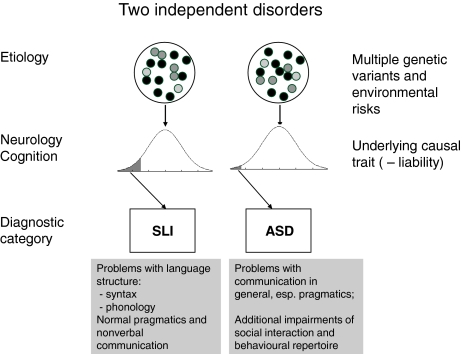
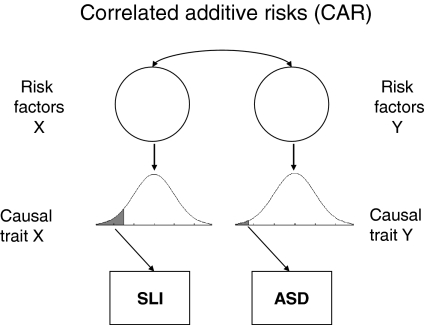
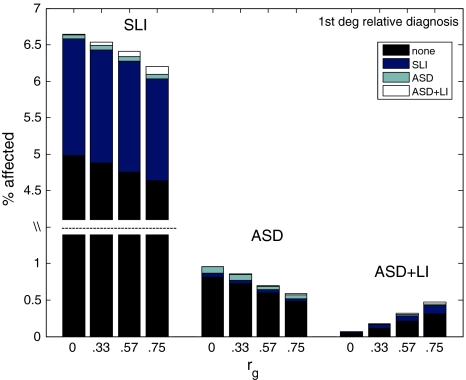
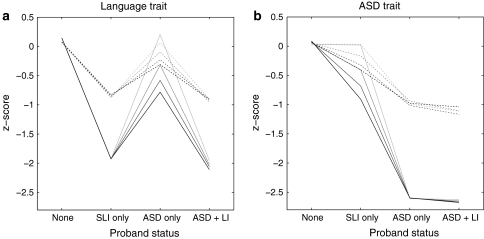
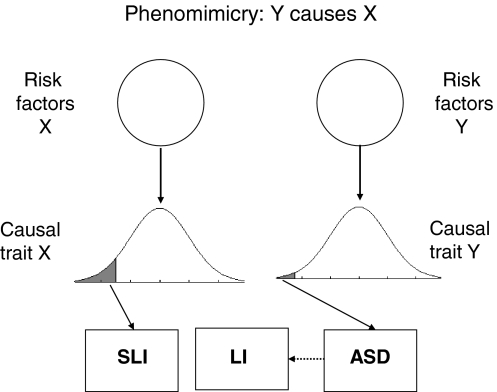
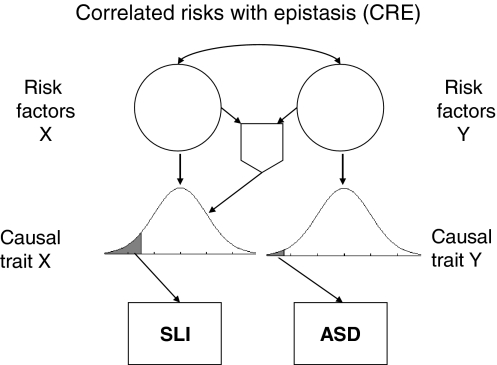
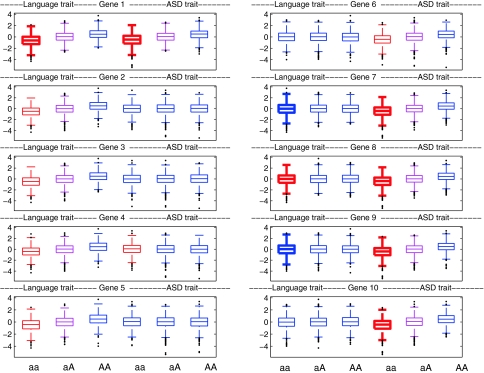
Traditionally, autistic spectrum disorder (ASD) and specific language impairment (SLI) are regarded as distinct conditions with separate etiologies. Yet these disorders co-occur at above chance levels, suggesting shared etiology. Simulations, however, show that additive pleiotropic genes cannot account for observed rates of language impairment in relatives, which are higher for probands with SLI than for those with ASD + language impairment. An alternative account is in terms of 'phenomimicry', i.e., language impairment in comorbid cases may be a consequence of ASD risk factors, and different from that seen in SLI. However, this cannot explain why molecular genetic studies have found a common risk genotype for ASD and SLI. This paper explores whether nonadditive genetic influences could account for both family and molecular findings. A modified simulation involving G x G interactions obtained levels of comorbidity and rates of impairment in relatives more consistent with observed values. The simulations further suggest that the shape of distributions of phenotypic trait scores for different genotypes may provide evidence of whether a gene is involved in epistasis.
Overview
The claims and statistics of this paper haven’t been checked yet.
Run the check — free, no account needed. It reads the open-access text and checks the sources it cites.
Integrity signals
Registry
Cites
Statistics
Figures
Verification
Claims the paper makes
The claims and statistics of this paper haven’t been checked yet.
Run the check — free, no account needed. It reads the open-access text and checks the sources it cites.
Claims other papers make about this one
Each is checked against this paper’s own text: does it say what the citing paper says it does?
The check wasn’t confident either way, so it gives no verdict — never disputed.
In the citing paper
“and in individuals with dysmorphic features [49]”
From DSM-5 and autism spectrum disorders (ASDs): an opportunity for identifying ASD subtypes (2013) · cites this paper as [49]
Experimental — accuracy not yet measured
Self-check
Percentages, sums and reported differences re-computed from the paper’s own numbers.
The self-check needs the paper’s full text.
Citations
Cites
Diagnostic and Statistical Manual of Mental Disorders
Williams, J. B. W., & First, M. B. (2013) · Oxford University Press eBooks · doi:10.1093/acrefore/9780199975839.013.104 · Cited by 109,845
The Endophenotype Concept in Psychiatry: Etymology and Strategic Intentions
Gottesman, I. I., & Gould, T. D. (2003) · American Journal of Psychiatry · doi:10.1176/appi.ajp.160.4.636 · Cited by 5,615
Diagnostic and Statistical Manual of Mental Disorders
Raber, G., & Spokas, M. (2024) · doi:10.4135/9781071886229.n145 · Cited by 2,806
Autism as a strongly genetic disorder: evidence from a British twin study
Bailey, A., Le Couteur, A., Gottesman, I., Bolton, P., Simonoff, E., Yuzda, E., & Rutter, M. (1995) · Psychological Medicine · doi:10.1017/s0033291700028099 · Cited by 2,461
Prevalence of Specific Language Impairment in Kindergarten Children
Tomblin, J. B., Records, N. L., Buckwalter, P., Zhang, X., Smith, E., & O’Brien, M. (1997) · Journal of Speech, Language, and Hearing Research · doi:10.1044/jslhr.4006.1245 · Cited by 2,288
Handbook of Autism and Pervasive Developmental Disorders
(2005) · Wiley eBooks · doi:10.1002/9780470939352 · Cited by 2,262
Baird, G., Simonoff, E., Pickles, A., Chandler, S., Loucas, T., Meldrum, D., & Charman, T. (2006) · The Lancet · doi:10.1016/s0140-6736(06)69041-7 · Cited by 2,104
The inheritance of liability to certain diseases, estimated from the incidence among relatives
Falconer, D. (1965) · Annals of Human Genetics · doi:10.1111/j.1469-1809.1965.tb00500.x · Cited by 1,662
INFANTILE AUTISM: A GENETIC STUDY OF 21 TWIN PAIRS
Folstein, S., & Rutter, M. (1977) · Journal of Child Psychology and Psychiatry · doi:10.1111/j.1469-7610.1977.tb00443.x · Cited by 1,361 · cited 2×
“1995; Folstein and Rutter 1977; Hallmayer et al. 2002; Steffenburg et al. 1989) and SLI (Bishop et al. 1995; Bishop and Hayiou-Thomas 2008; Lewis and Thompson 1992; Tomblin and Buckwalter 1998), despite growing up together and sharing many environmental influences.”
BackgroundAn investigation of language impairment in autism: Implications for genetic subgroups
Kjelgaard, M., & Tager-Flusberg, H. B. (2001) · Language and Cognitive Processes · doi:10.1080/01690960042000058 · Cited by 1,131
Candidate-gene approaches for studying complex genetic traits: practical considerations
Tabor, H. K., Risch, N. J., & Myers, R. M. (2002) · Nature Reviews Genetics · doi:10.1038/nrg796 · Cited by 1,076
Epistasis: too often neglected in complex trait studies?
Carlborg, Ö., & Haley, C. (2004) · Nature Reviews Genetics · doi:10.1038/nrg1407 · Cited by 946
Linkage, association, and gene-expression analyses identify CNTNAP2 as an autism-susceptibility gene
Alarcón, M., Abrahams, B. S., Stone, J. L., Duvall, J. A., Perederiy, J. V., Bomar, J. M., Sebat, J., Wigler, M., Martin, C. L., Ledbetter, D. H., et al. (2008) · The American Journal of Human Genetics · doi:10.1016/j.ajhg.2007.09.005 · Cited by 818
A Twin Study of Autism in Denmark, Finland, Iceland, Norway and Sweden
Steffenburg, S., Gillberg, C., Hellgren, L., Andersson, L., Gillberg, I. C., Jakobsson, G., & Bohman, M. (1989) · Journal of Child Psychology and Psychiatry · doi:10.1111/j.1469-7610.1989.tb00254.x · Cited by 780
Bishop, D., North, T., & Donlan, C. (1996) · Journal of Child Psychology and Psychiatry · doi:10.1111/j.1469-7610.1996.tb01420.x · Cited by 693
Self-citationA Genomic Screen of Autism: Evidence for a Multilocus Etiology
Risch, N., Spiker, D., Lotspeich, L., Nouri, N., Hinds, D., Hallmayer, J., Kalaydjieva, L., McCague, P., Dimiceli, S., Pitts, T., et al. (1999) · The American Journal of Human Genetics · doi:10.1086/302497 · Cited by 684
A functional genetic link between distinct developmental language disorders
Vernes, S. C., Newbury, D. F., Abrahams, B. S., Winchester, L., Nicod, J., Groszer, M., Alarcón, M., Oliver, P. L., Davies, K. E., Geschwind, D. H., et al. (2008) · New England Journal of Medicine · doi:10.1056/nejmoa0802828 · Cited by 676
Rutter's Child and Adolescent Psychiatry
(2015) · doi:10.1002/9781118381953 · Cited by 639
A Comparative Study of Infantile Autism and Specific Developmental Receptive Language Disorder
Bartak, L., Rutter, M. L., & Cox, A. (1975) · The British Journal of Psychiatry · doi:10.1192/bjp.126.2.127 · Cited by 630
Arking, D. E., Cutler, D. J., Brune, C. W., Teslovich, T. M., West, K., Ikeda, M., Rea, A., Guy, M., Lin, S., Cook, E. H., et al. (2008) · The American Journal of Human Genetics · doi:10.1016/j.ajhg.2007.09.015 · Cited by 590
Keller, M. C., & Miller, G. F. (2006) · Behavioral and Brain Sciences · doi:10.1017/s0140525x06009095 · Cited by 553
Incidence of autism spectrum disorders: Changes over time and their meaning*
Rutter, M. L. (2005) · Acta Paediatrica · doi:10.1111/j.1651-2227.2005.tb01779.x · Cited by 541
Genetic Heterogeneity Between the Three Components of the Autism Spectrum: A Twin Study
RONALD, A., HAPPÉ, F., BOLTON, P., BUTCHER, L. M., PRICE, T. S., WHEELWRIGHT, S., BARON-COHEN, S., & PLOMIN, R. (2006) · Journal of the American Academy of Child & Adolescent Psychiatry · doi:10.1097/01.chi.0000215325.13058.9d · Cited by 508
Update on the language disorders of individuals on the autistic spectrum
Rapin, I., & Dunn, M. (2003) · Brain and Development · doi:10.1016/s0387-7604(02)00191-2 · Cited by 492
Diagnostic change and the increased prevalence of autism
King, M., & Bearman, P. (2009) · International Journal of Epidemiology · doi:10.1093/ije/dyp261 · Cited by 481
Speech and Language Impairments in Children: Causes, Characteristics, Intervention, and Outcome
Needlman, R. D. (2001) · Journal of Developmental & Behavioral Pediatrics · doi:10.1097/00004703-200112000-00015 · Cited by 469
Autism: The Phenotype in Relatives
Bailey, A. J., Palferman, S., Heavey, L., & Couteur, A. S. L. (1998) · Journal of Autism and Developmental Disorders · doi:10.1023/a:1026048320785 · Cited by 467
Identifying neurocognitive phenotypes in autism
Tager-Flusberg, H., & Joseph, R. M. (2003) · Philosophical Transactions of the Royal Society of London. Series B: Biological Sciences · doi:10.1098/rstb.2002.1198 · Cited by 460
What Causes Specific Language Impairment in Children?
Bishop, D. (2006) · Current Directions in Psychological Science · doi:10.1111/j.1467-8721.2006.00439.x · Cited by 445
Self-citationGENETIC BASIS OF SPECIFIC LANGUAGE IMPAIRMENT: EVIDENCE FROM A TWIN STUDY
Bishop, D., North, T., & Donlan, C. (1995) · Developmental Medicine & Child Neurology · doi:10.1111/j.1469-8749.1995.tb11932.x · Cited by 422
Self-citationHuman-specific transcriptional regulation of CNS development genes by FOXP2
Konopka, G., Bomar, J. M., Winden, K., Coppola, G., Jonsson, Z. O., Gao, F., Peng, S., Preuss, T. M., Wohlschlegel, J. A., & Geschwind, D. H. (2009) · Nature · doi:10.1038/nature08549 · Cited by 390
Pickles, A. R., Bolton, P., Macdonald, H., Bailey, A., Couteur, A. S. L., Sim, C. H., & Rutter, M. L. (1995) · Europe PMC (PubMed Central) · Cited by 388
Speech and Language Impairments in Children
(2014) · Psychology Press eBooks · doi:10.4324/9781315784878 · Cited by 360
Models of comorbidity for multifactorial disorders.
Neale, M. C., & Kendler, K. S. (1995) · PubMed Central · Cited by 353
Loucas, T., Charman, T., Pickles, A. R., Simonoff, E. A., Chandler, S., Meldrum, D., & Baird, G. (2008) · Journal of Child Psychology and Psychiatry · doi:10.1111/j.1469-7610.2008.01951.x · Cited by 237
Language in autism and specific language impairment: Where are the links?
Williams, D. M., Botting, N., & Boucher, J. (2008) · Psychological Bulletin · doi:10.1037/a0013743 · Cited by 234
FOXP2 Is Not a Major Susceptibility Gene for Autism or Specific Language Impairment
Newbury, D. F., Bonora, E., Lamb, J. A., Fisher, S. E., Lai, C. S. L., Baird, G., Jannoun, L., Slonims, V., Stott, C., Merricks, M. J., et al. (2002) · The American Journal of Human Genetics · doi:10.1086/339931 · Cited by 223
Lindgren, K. A., Folstein, S. E., Tomblin, J. B., & Tager-Flusberg, H. B. (2009) · Autism Research · doi:10.1002/aur.63 · Cited by 223
A Study of Developmental Speech and Language Disorders in Twins
Lewis, B. A., & Thompson, L. A. (1992) · Journal of Speech Language and Hearing Research · doi:10.1044/jshr.3505.1086 · Cited by 206
Heritability of Poor Language Achievement Among Twins
Tomblin, J. B., & Buckwalter, P. R. (1998) · Journal of Speech Language and Hearing Research · doi:10.1044/jslhr.4101.188 · Cited by 179
Heritable and Nonheritable Risk Factors for Autism Spectrum Disorders
Newschaffer, C. J. (2002) · Epidemiologic Reviews · doi:10.1093/epirev/mxf010 · Cited by 168
Genetic advances in autism: heterogeneity and convergence on shared pathways
Bill, B. R., & Geschwind, D. H. (2009) · Current Opinion in Genetics & Development · doi:10.1016/j.gde.2009.04.004 · Cited by 164
The broader language phenotype of autism: a comparison with specific language impairment
Whitehouse, A., Barry, J. G., & Bishop, D. (2007) · Journal of Child Psychology and Psychiatry · doi:10.1111/j.1469-7610.2007.01765.x · Cited by 155
Self-citationGenes, Cognition, and Communication
Bishop, D. (2009) · Annals of the New York Academy of Sciences · doi:10.1111/j.1749-6632.2009.04419.x · Cited by 154
Self-citationHeritability of specific language impairment depends on diagnostic criteria
Bishop, D., & Hayiou‐Thomas, M. E. (2007) · Genes Brain & Behavior · doi:10.1111/j.1601-183x.2007.00360.x · Cited by 134
Self-citationHeritable risk factors associated with language impairments
Barry, J. G., Yasin, I., & Bishop, D. (2006) · Genes Brain & Behavior · doi:10.1111/j.1601-183x.2006.00232.x · Cited by 125
Self-citationDover, C. J., & Couteur, A. S. L. (2007) · Archives of Disease in Childhood · doi:10.1136/adc.2005.086280 · Cited by 124
Stein, A. L., Ramchandani, P. G., & Murray, L. K. (2008) · Cited by 124
Autism and Specific Language Impairment: Categorical Distinction or Continuum?
Bishop, D. (2003) · Novartis Foundation symposium · doi:10.1002/0470869380.ch13 · Cited by 119
Self-citationCantweil, D., Baker, L., & Rutter, M. L. (1978) · Journal of Child Psychology and Psychiatry · doi:10.1111/j.1469-7610.1978.tb00481.x · Cited by 115
Are phonological processing deficits part of the broad autism phenotype?
Bishop, D., Maybery, M. T., Wong, D. K., Maley, A., Hill, W. L., & Hallmayer, J. F. (2004) · American Journal of Medical Genetics Part B Neuropsychiatric Genetics · doi:10.1002/ajmg.b.30039 · Cited by 109
Self-citationRutter, M. L. (2005) · Wiley eBooks · doi:10.1002/9780470939345.ch16 · Cited by 101
Hallmayer, J. F., Glasson, E. J., Bower, C. I., Petterson, B., Croen, L., Grether, J. K., & RISCH, N. J. (2002) · The American Journal of Human Genetics · doi:10.1086/342990 · Cited by 100
Bishop, D., & Norbury, C. (2008) · doi:10.1002/9781444300895.ch47 · Cited by 44
Self-citationSegregation analysis of speech and language disorders
Lewis, B. A., Cox, N. J., & Byard, P. J. (1993) · Behavior Genetics · doi:10.1007/bf01082469 · Cited by 43
Bishop, D. (2005) · Behavior Genetics · doi:10.1007/s10519-004-1834-7 · Cited by 33
Self-citationGenetics of cellular, individual, family, and population variability
Sing, C. F., & Hanis, C. L. (1993) · Cited by 24
Genetics of Common Diseases that Aggregate, but Do Not Segregate, in Families
Sing, C. F., & Reilly, S. L. (1993) · doi:10.1093/oso/9780195066258.003.0009 · Cited by 21
Molecular Windows into Speech and Language Disorders
Fisher, S. E. (2007) · Folia Phoniatrica et Logopaedica · doi:10.1159/000101771 · Cited by 16
Research works printed but not linked: 1
- World Health Organization (1993) The ICD-10 classification for mental and behavioural disorders: diagnostic criteria for research. WHO, Geneva
Cited by
Sorted by citations
DSM-5 and autism spectrum disorders (ASDs): an opportunity for identifying ASD subtypes
Grzadzinski, R., Huerta, M., & Lord, C. (2013) · Molecular Autism · doi:10.1186/2040-2392-4-12 · Cited by 378
“Along the same line, genetic variation in the gene CNTNAP2 (contactin-associated protein-like 2) has been implicated in ASD and SLI research separately, further supporting the potential of a subtype of ASD with comorbid SLI and unique underlying biological mechanisms [57].”
BackgroundResearch Review: Structural language in autistic spectrum disorder – characteristics and causes
Boucher, J. (2012) · Journal of Child Psychology and Psychiatry · doi:10.1111/j.1469-7610.2011.02508.x · Cited by 382
Chisholm, K., Lin, A. P., Abu-Akel, A. M., & Wood, S. J. (2015) · Neuroscience & Biobehavioral Reviews · doi:10.1016/j.neubiorev.2015.04.012 · Cited by 347
CNTNAP2 variants affect early language development in the general population
Whitehouse, A. J. O., Bishop, D. V. M., Ang, Q. W., Pennell, C. E., & Fisher, S. E. (2011) · Genes, Brain and Behavior · doi:10.1111/j.1601-183x.2011.00684.x · Cited by 170
Self-citationRecognizing Psychiatric Comorbidity With Reading Disorders
Hendren, R. L., Haft, S. L., Black, J. M., White, N. C., & Hoeft, F. (2018) · Frontiers in Psychiatry · doi:10.3389/fpsyt.2018.00101 · Cited by 171
Metadata
- Authors
- Bishop, D. V. M.
- Affiliations
- University of Oxford (GB)
- Corresponding author
- Bishop, D. V. M.
- ORCID
- Bishop, D. V. M.
- Venue
- Behavior Genetics
- Published
- 2010-07-18
- Volume
- 40
- Issue
- 5
- Pages
- 618-629
- ISSN
- 0001-8244 (ISSN-L)
- 1573-3297
- PMC
- PMC2921070
- OpenAlex
- W2001905680
- Cited by
- 169
- References
- 59
- Citations by year
- 2026: 2 · 2025: 10 · 2024: 11 · 2023: 29 · 2022: 8 · 2021: 12 · 2020: 7 · 2019: 9 · 2018: 8 · 2017: 11 · 2016: 9 · 2015: 8 · 2014: 13 · 2013: 15 · 2012: 8
- FWCI
- 6.21
- Type
- journal article
- Language
- en
- Open access
- hybrid
- doi.org
- Licence
- cc-by-nc
- Locations
- Behavior Genetics (publishedVersion, cc-by-nc)
- PubMed Central (publishedVersion, cc-by-nc)
- PubMed (publishedVersion)
- Oxford University Research Archive (ORA) (University of Oxford) (submittedVersion, cc-by-nc)
- Funders
- Wellcome Trust (082498/Z/07/Z, 082498)
- Topics
- Life Sciences › Neuroscience › Cognitive Neuroscience › Autism Spectrum Disorder Research
- Social Sciences › Psychology › Developmental and Educational Psychology › Language Development and Disorders
- Life Sciences › Biochemistry, Genetics and Molecular Biology › Genetics › Genetics and Neurodevelopmental Disorders
- Keywords
- autism spectrum disorder, specific language impairment, comorbidities, shared etiology, epistasis, gene-gene interaction, pleiotropy
- MeSH terms
- Autistic Disorder, Epistasis, Genetic, Humans, Language Disorders, Models, Theoretical, Software, Comorbidity
About these checks
Registry, retraction, Cites and statistics results are computed, not judged, with one exception: a printed reference that no index lists is read once by a model before it counts as a citation error. Claims are extracted by a model and kept only when their quote appears verbatim in the text; each cited source is then checked, with a model’s help, for whether it says what the claim relies on. Those verdicts can be wrong — read the claim’s quote and the cited source before relying on one.
Statistics and arithmetic are recomputed, not judged.
Confidence bands are shown only for fields calibrated on our annotated test set. None is calibrated yet, so no band is shown.
What counts as a claim ›How we measure confidence ›How we check this ›
Are you an author, or do you see a problem with this page? Request a review
