

Spermidine toxicity in Saccharomyces cerevisiae due to mitochondrial complex III deficiency
Open accessThe DOI matches its Crossref record; 48 of the 48 references it cites were found in a registry or an index.
Abstract
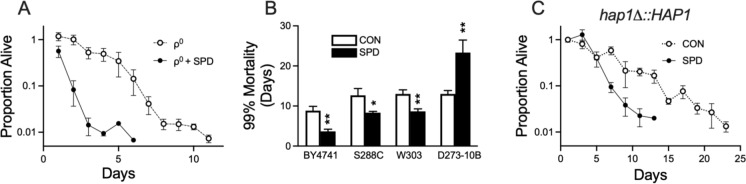
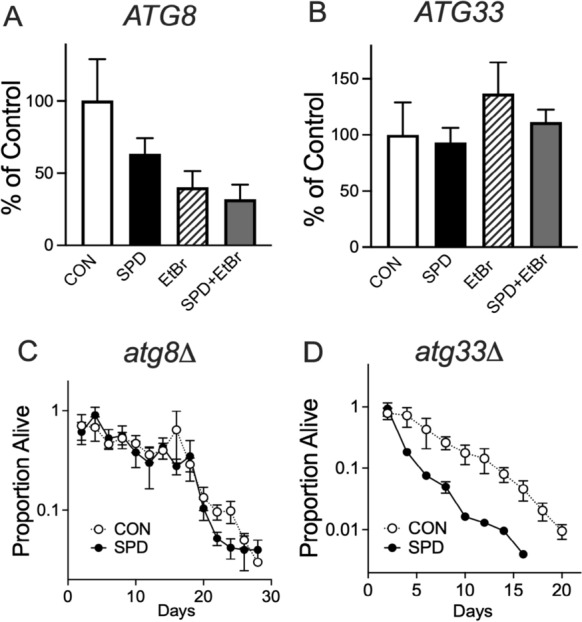
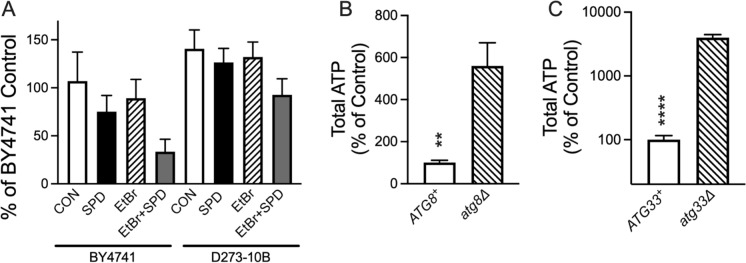
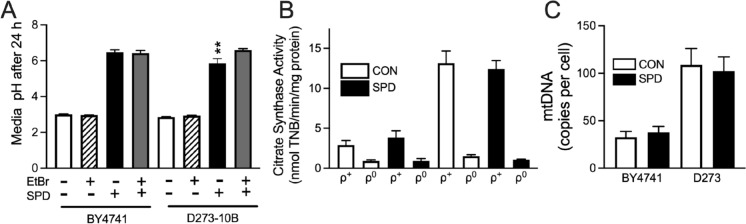
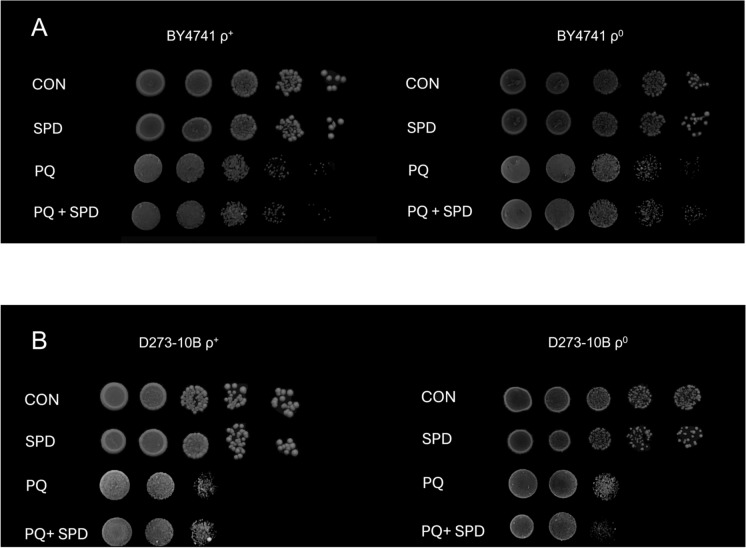
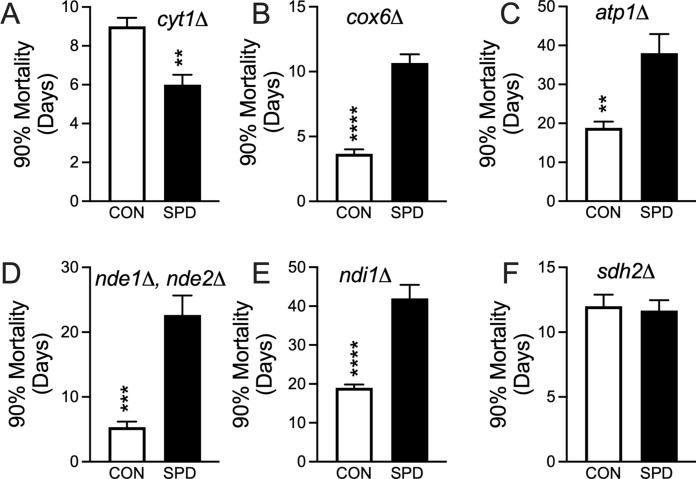
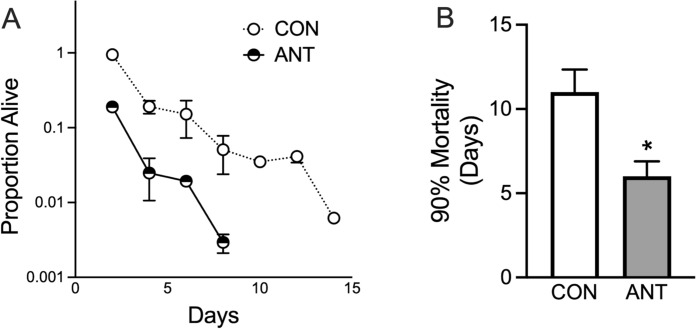
Spermidine is a naturally occurring polyamine present in all cells and is necessary for viability in eukaryotic cells. The cellular levels of spermidine decline as an organism ages, and its supplementation has been found to extend lifespan in yeast, worms, flies, mice, and human cultured cells. The lifespan extending effect of spermidine is thought to be due to its ability to induce autophagy, a turnover of cellular components. Mitochondrial dysfunction is believed to be a major driver of the aging process. We asked whether spermidine could rescue mitochondrial dysfunction using the yeast Saccharomyces cerevisiae lacking mtDNA (ρ 0 cells) as a model. Not only was spermidine unable to rescue survival in ρ 0 cells, but it appeared to exhibit toxicity resulting in a shortened lifespan. This toxicity appears to not be due to the loss of mitochondrial respiration, elevated oxidative stress, or depleted ATP. Spermidine toxicity could be recapitulated by the genetic or pharmacological inactivation of mitochondrial complex III. It can also be prevented by the impairment of autophagy, through the inactivation of ATG8, or by impairment of mitochondrial complex II through the inactivation of SDH2. Spermidine toxicity in ρ 0 cells was present in yeast strains BY4741 and W303, but not D273-10B, demonstrating genetic variance in the phenotype. Thus, caution may be suggested regarding the use of spermidine to alleviate aging in humans. Depending on the genotype of the individual, spermidine could potentially harm the very individuals it is intended to help. Graphical abstract
Overview
The claims and statistics of this paper haven’t been checked yet.
Free: it reads the open-access text and checks the first 5 claims that cite a source we can check. Create a free account to check every claim.
Integrity signals
Registry
Cites
Statistics
Figures
Verification
Claims the paper makes
The claims and statistics of this paper haven’t been checked yet.
Free: it reads the open-access text and checks the first 5 claims that cite a source we can check. Create a free account to check every claim.
Claims other papers make about this one
Each is checked against this paper’s own text: does it say what the citing paper says it does?
The cited source doesn’t support the claim as written.
In the citing paper
“For example, a lack of complex III in Saccharomyces cerevisiae leads to spermine toxicity (20).”
From Mitochondrial complex III subunit Qcr8 regulates the virulence and adhesion of Candida albicans by modulating mitochondrial function (2026) · cites this paper as [20]
Checked by a reasoning model — may be wrong.
Experimental — accuracy not yet measured
Self-check
Percentages, sums and reported differences re-computed from the paper’s own numbers.
The self-check needs the paper’s full text.
Citations
Cites
Small molecule activators of sirtuins extend Saccharomyces cerevisiae lifespan
Howitz, K. T., Bitterman, K. J., Cohen, H. Y., Lamming, D. W., Lavu, S., Wood, J. G., Zipkin, R. E., Chung, P., Kisielewski, A., Zhang, L.-L., et al. (2003) · Nature · doi:10.1038/nature01960 · Cited by 3,796 · cited 1×
“This includes dinitrophenol, metformin, resveratrol, rapamycin, and spermidine (Barros et al. 2004; Caldeira da Silva et al. 2008; Kazi et al. 2017 Martin-Montalvo et al. 2013; Choi et al. 2013; Bjedov et al. 2010; Harrison et al. 2009; Howitz et al. 2003; Eisenberg et al. 2016).”
Rapamycin fed late in life extends lifespan in genetically heterogeneous mice
Harrison, D. E., Strong, R., Sharp, Z. D., Nelson, J. F., Astle, C. M., Flurkey, K., Nadon, N. L., Wilkinson, J. E., Frenkel, K., Carter, C. S., et al. (2009) · Nature · doi:10.1038/nature08221 · Cited by 3,766 · cited 1×
“This includes dinitrophenol, metformin, resveratrol, rapamycin, and spermidine (Barros et al. 2004; Caldeira da Silva et al. 2008; Kazi et al. 2017 Martin-Montalvo et al. 2013; Choi et al. 2013; Bjedov et al. 2010; Harrison et al. 2009; Howitz et al. 2003; Eisenberg et al. 2016).”
Extension of murine life span by overexpression of catalase targeted to mitochondria
Schriner, S. E., Linford, N. J., Martin, G. M., Treuting, P., Ogburn, C. E., Emond, M., Coskun, P. E., Ladiges, W., Wolf, N., Van Remmen, H., et al. (2005) · Science · doi:10.1126/science.1106653 · Cited by 1,724 · cited 1×
“…an increased mean and maximum lifespan, but also improved parameters of cataract formation, insulin sensitivity, exercise performance, cardiac pathology, and invasive breast cancer (Schriner et al. 2005; Wolf et al. 2005; Lee et al. 2010) (Li et al. 2009) (Chiao et al. 2020; Goh et al. 2011).”
Self-citationInduction of autophagy by spermidine promotes longevity
Eisenberg, T., Knauer, H., Schauer, A., Büttner, S., Ruckenstuhl, C., Carmona-Gutierrez, D., Ring, J., Schroeder, S., Magnes, C., Antonacci, L., et al. (2009) · Nature Cell Biology · doi:10.1038/ncb1975 · Cited by 1,680 · cited 5×
“Spermidine shortens lifespan in ρ 0 BY4741 yeast and closely related strains Mitochondrial dysfunction is thought to play a significant role in aging (Bratic and Larsson 2013), and the polyamine SPD has been shown to extend lifespan in model systems (Eisenberg et al. 2009).”
InfluentialMetformin improves healthspan and lifespan in mice
Martin-Montalvo, A., Mercken, E. M., Mitchell, S. J., Palacios, H. H., Mote, P. L., Scheibye-Knudsen, M., Gomes, A. P., Ward, T. M., Minor, R. K., Blouin, M.-J., et al. (2013) · Nature Communications · doi:10.1038/ncomms3192 · Cited by 1,445 · cited 1×
“This includes dinitrophenol, metformin, resveratrol, rapamycin, and spermidine (Barros et al. 2004; Caldeira da Silva et al. 2008; Kazi et al. 2017 Martin-Montalvo et al. 2013; Choi et al. 2013; Bjedov et al. 2010; Harrison et al. 2009; Howitz et al. 2003; Eisenberg et al. 2016).”
Autophagy in healthy aging and disease
Aman, Y., Schmauck-Medina, T., Hansen, M., Morimoto, R. I., Simon, A. K., Bjedov, I., Palikaras, K., Simonsen, A., Johansen, T., Tavernarakis, N., et al. (2021) · Nature Aging · doi:10.1038/s43587-021-00098-4 · Cited by 1,313 · cited 1×
“Autophagy is the turnover of cellular components and is thought to be an important factor in lifespan extension due to dietary restriction (Aman et al. 2021).”
Cardioprotection and lifespan extension by the natural polyamine spermidine
Eisenberg, T., Abdellatif, M., Schroeder, S., Primessnig, U., Stekovic, S., Pendl, T., Harger, A., Schipke, J., Zimmermann, A., Schmidt, A., et al. (2016) · Nature Medicine · doi:10.1038/nm.4222 · Cited by 1,168 · cited 3×
“The levels of SPD decline naturally as an organism ages, and its supplementation has been found to extend lifespan in yeast, worms, flies, mice, and human cultured cells (Eisenberg et al. 2009, 2016).”
Spermidine in health and disease
Madeo, F., Eisenberg, T., Pietrocola, F., & Kroemer, G. (2018) · Science · doi:10.1126/science.aan2788 · Cited by 1,154 · cited 1×
“Spermidine (SPD) is one such compound and is thought to act through the induction of autophagy, which is a process leading to the turnover of cellular components (Madeo et al. 2018; Eisenberg et al. 2009).”
The role of mitochondria in aging
Bratic, A., & Larsson, N.-G. (2013) · Journal of Clinical Investigation · doi:10.1172/jci64125 · Cited by 1,087
Mitochondrial dysfunction in cell senescence and aging
Miwa, S., Kashyap, S., Chini, E., & von Zglinicki, T. (2022) · Journal of Clinical Investigation · doi:10.1172/jci158447 · Cited by 1,061 · cited 1×
“Depending on the genotype of the individual, spermidine could potentially harm the very individuals it is intended to help.”
Cited by
The functional roles and mechanisms of polyamines in age-related bone diseases
Zhang, J., Cai, C., Zhang, Y., Luo, C., Huo, S., Wang, K., Shi, C., Liu, J., & Xu, G. (2025) · Cellular and Molecular Life Sciences · doi:10.1007/s00018-025-06001-3 · Cited by 8
“Moreover, as demonstrated in Saccharomyces cerevisiae , SPD toxicity can be linked to deficiencies in mitochondrial complex III, suggesting that individual genetic or metabolic variations may predispose certain populations to adverse, rather than beneficial, outcomes [129].”
Ding, Y., Li, J., Li, J., Chen, D., Yu, F., Liu, Z., Zhang, Y., Dai, Y., Huang, Y., & Dang, J. (2025) · Biochemical and Biophysical Research Communications · doi:10.1016/j.bbrc.2025.153128 · Cited by 1
Zhao, Q., Huang, X., Liu, Q., Cao, Y., Yu, X., Liu, Y., Hu, N., Han, Z., Tan, J., Li, X., et al. (2026) · Microbiology Spectrum · doi:10.1128/spectrum.01672-25
Numaguchi, T., Nakamura, M., Koshizawa, T., Ishak, N. S. M., & 橋本, 勝. (2026) · Frontiers in Aging · doi:10.3389/fragi.2026.1791853 · Cited by 1
Metadata
- Authors
- Su, W.-H., Smith, J. J., Cheng, E., Nishitani, M. S., Choi, C. Y., Lee, K. R., Salzano, A. P., & Schriner, S. E.
- Affiliations
- University of California, Irvine (US)
- Corresponding author
- Schriner, Samuel E.
- Venue
- Biogerontology
- Published
- 2025-04
- Volume
- 26
- Issue
- 2
- Pages
- 91-91
- ISSN
- 1389-5729 (ISSN-L)
- 1573-6768
- PMC
- PMC11985560
- OpenAlex
- W4409329575
- Cited by
- 4
- References
- 48
- Citations by year
- 2026: 1 · 2025: 3
- FWCI
- 1.26
- Type
- journal article
- Language
- en
- Open access
- hybrid
- doi.org
- Licence
- cc-by
- creativecommons.org/licenses/by/4.0 (tdm)
- creativecommons.org/licenses/by/4.0 (vor, 9 d)
- Locations
- Biogerontology (publishedVersion, cc-by)
- PubMed Central (publishedVersion, cc-by)
- PubMed (publishedVersion)
- eScholarship (California Digital Library) (submittedVersion, cc-by)
- Funders
- UCI Pharmaceutical Sciences
- Topics
- Life Sciences › Biochemistry, Genetics and Molecular Biology › Aging › Genetics, Aging, and Longevity in Model Organisms
- Life Sciences › Biochemistry, Genetics and Molecular Biology › Molecular Biology › Polyamine Metabolism and Applications
- Life Sciences › Biochemistry, Genetics and Molecular Biology › Molecular Biology › Mitochondrial Function and Pathology
- Keywords
- spermidine, polyamines, mitochondrial complex III, mitochondrial dysfunction, aging, lifespan extension, autophagy, ATG8, succinate dehydrogenase, Saccharomyces cerevisiae
- MeSH terms
- Autophagy, DNA, Mitochondrial, Mitochondria, Saccharomyces cerevisiae, Spermidine, Electron Transport Complex III, Oxidative Stress, Saccharomyces cerevisiae Proteins
About these checks
Registry, retraction, Cites and statistics results are computed, not judged, with one exception: a printed reference that no index lists is read once by a model before it counts as a citation error. Claims are extracted by a model and kept only when their quote appears verbatim in the text; each cited source is then checked, with a model’s help, for whether it says what the claim relies on. Those verdicts can be wrong — read the claim’s quote and the cited source before relying on one.
Statistics and arithmetic are recomputed, not judged.
Confidence bands are shown only for fields calibrated on our annotated test set. None is calibrated yet, so no band is shown.
What counts as a claim ›How we measure confidence ›How we check this ›
Are you an author, or do you see a problem with this page? Request a review
How to cite
Cite CoChat for the checks on this page, and the paper for its own findings.
- This page
- CoChat. (2026). Citation check: Spermidine toxicity in Saccharomyces cerevisiae due to mitochondrial complex III deficiency. https://app.cochat.ai/papers/10.1007/s10522-025-10233-y
- The paper
- Su, W.-H., Smith, J. J., Cheng, E., Nishitani, M. S., Choi, C. Y., Lee, K. R., Salzano, A. P., & Schriner, S. E. (2025). Spermidine toxicity in Saccharomyces cerevisiae due to mitochondrial complex III deficiency. Biogerontology. https://doi.org/10.1007/s10522-025-10233-y
Data sources
Bibliographic data: Semantic Scholar, OpenAlex, Crossref.
Contains information from the Semantic Scholar Academic Graph Datasets, made available under the ODC Attribution License (ODC-BY 1.0).
Semantic Scholar’s data is described in: Kinney, R., et al. (2023). The Semantic Scholar Open Data Platform. arXiv:2301.10140.
