

The DOI matches its Crossref record; 32 of the 32 references it cites were found in a registry or an index.
More than “100 worst” alien species in Europe
Open accessAbstract
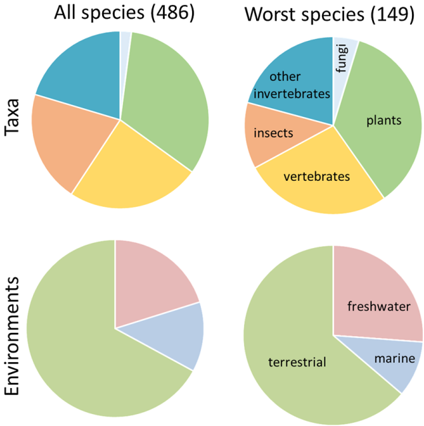
“One hundred worst” lists of alien species of the greatest concern proved useful for raising awareness of the risks and impacts of biological invasions amongst the general public, politicians and stakeholders. All lists so far have been based on expert opinion and primarily aimed at representativeness of the taxonomic and habitat diversity rather than at quantifying the harm the alien species cause. We used the generic impact scoring system (GISS) to rank 486 alien species established in Europe from a wide range of taxonomic groups to identify those with the highest environmental and socioeconomic impact. GISS assigns 12 categories of impact, each quantified on a scale from 0 (no impact detectable) to 5 (the highest impact possible). We ranked species by their total sum of scores and by the number of the highest impact scores. We also compared the listing based on GISS with other expert-based lists of the “worst” invaders. We propose a list of 149 alien species, comprising 54 plants, 49 invertebrates, 40 vertebrates and 6 fungi. Among the highest ranking species are one bird ( Branta canadensis ), four mammals ( Rattus norvegicus, Ondatra zibethicus, Cervus nippon, Muntiacus reevesi ), one crayfish ( Procambarus clarkii ), one mite ( Varroa destructor ), and four plants ( Acacia dealbata, Lantana camara, Pueraria lobata, Eichhornia crassipes ). In contrast to other existing expert-based “worst” lists, the GISS-based list given here highlights some alien species with high impacts that are not represented on any other list. The GISS provides an objective and transparent method to aid prioritization of alien species for management according to their impacts, applicable across taxa and habitats. Our ranking can also be used for justifying inclusion on lists such as the alien species of Union concern of the European Commission, and to fulfill Aichi target 9.
Overview
The claims and statistics of this paper haven’t been checked yet.
Run the check — free, no account needed. It reads the open-access text and checks the sources it cites.
Integrity signals
Registry
Cites
Statistics
Figures
Verification
Claims the paper makes
The claims and statistics of this paper haven’t been checked yet.
Run the check — free, no account needed. It reads the open-access text and checks the sources it cites.
Claims other papers make about this one
Each is checked against this paper’s own text: does it say what the citing paper says it does?
The cited source says what the claim attributes to it.
In the citing paper
“The IAS with the greatest impacts emerge from all taxonomic groups, as illustrated by the example of Europe.”
From Scientists' warning on invasive alien species (2020) · cites this paper as Nentwig et al., 2018
The cited source says what the claim attributes to it.
In the citing paper
“The European list of aliens with highest impacts includes 149 species: 54 plants, 49 invertebrates, 40 vertebrates, and six fungi.”
From Scientists' warning on invasive alien species (2020) · cites this paper as Nentwig et al., 2018
Self-check
Percentages, sums and reported differences re-computed from the paper’s own numbers.
The self-check needs the paper’s full text.
Citations
Cites
Global pollinator declines: trends, impacts and drivers
Potts, S. G., Biesmeijer, J. C., Kremen, C., Neumann, P., Schweiger, O., & Kunin, W. E. (2010) · Trends in Ecology & Evolution · doi:10.1016/j.tree.2010.01.007 · Cited by 6,458
The Ecology of Invasions by Animals and Plants
Elton, C. (1958) · Springer eBooks · doi:10.1007/978-1-4899-7214-9 · Cited by 4,331
The Ecology of Invasions by Animals and Plants.
Richards, P. W., & Elton, C. (1959) · Journal of Ecology · doi:10.2307/2257385 · Cited by 3,907
Pyšek, P., Jaros̆ı́k, V., Hulme, P. E., Pergl, J., Hejda, M., Schaffner, U., & Vilà, M. (2011) · Global Change Biology · doi:10.1111/j.1365-2486.2011.02636.x · Cited by 1,521
Self-citation100 of the world's worst invasive alien species : A selection from global invasive species database
Issg (2000) · Medical Entomology and Zoology · Cited by 1,364
Impact of invasive plants on the species richness, diversity and composition of invaded communities
Hejda, M., Pyšek, P., & Jarošík, V. (2009) · Journal of Ecology · doi:10.1111/j.1365-2745.2009.01480.x · Cited by 1,172
Self-citationA Unified Classification of Alien Species Based on the Magnitude of their Environmental Impacts
Blackburn, T. M., Essl, F., Evans, T., Hulme, P. E., Jeschke, J. M., Kühn, I., Kumschick, S., Marková, Z., Mrugała, A., Nentwig, W., et al. (2014) · PLoS Biology · doi:10.1371/journal.pbio.1001850 · Cited by 959
Self-citationVilà, M., Basnou, C., Pyšek, P., Josefsson, M., Genovesi, P., Gollasch, S., Nentwig, W., Olenin, S., Roques, A., Roy, D., et al. (2010) · Frontiers in Ecology and the Environment · doi:10.1890/080083 · Cited by 934
Self-citationHandbook of Alien Species in Europe
Drake, J. A. (2008) · Springer eBooks · doi:10.1007/978-1-4020-8280-1 · Cited by 593
Kats, L. B., & Ferrer, R. P. (2003) · Diversity and Distributions · doi:10.1046/j.1472-4642.2003.00013.x · Cited by 579
Research works printed but not linked: 1
- EU (2010) Commission Regulation (EU) No 206/2010 of 12 March 2010 laying down lists of third countries, territories or parts thereof authorised for the introduction into the European Union of certain animals and fresh meat and the veterinary certification requirements (Text with EEA relevance). Official Journal of the European Union L 73/1. http://eur-lex.europa.eu/legal-content/EN/ALL/?uri=CELEX%3A32010R0206
Cited by
Sorted by citations
Items 201–300 of 315
Farooq, S. (2025) · BMC Plant Biology · doi:10.1186/s12870-025-07145-x · Cited by 4
Órfão, I., Ramalhosa, P., Kerckhof, F., & Canning‐Clode, J. (2024) · BioInvasions Records · doi:10.3391/bir.2024.13.1.15 · Cited by 4
Buchholz, M. J., Conway, W. C., Arsuffi, T. L., Lockwood, M. L., & Grisham, B. A. (2023) · Journal of Fish and Wildlife Management · doi:10.3996/jfwm-22-036 · Cited by 4
de la Cueva, A. V., Aulló-Maestro, I., & Montes, F. (2022) · Ecosistemas · doi:10.7818/ecos.2331 · Cited by 4
Buchholz, M. J., Wright, E. A., Grisham, B. A., Bradley, R. D., Arsuffi, T. L., & Conway, W. C. (2023) · Journal of Mammalogy · doi:10.1093/jmammal/gyad008 · Cited by 5
Zhang, X., Nie, P., Hu, X., & Feng, J. (2024) · Insects · doi:10.3390/insects15100765 · Cited by 4
Impact of habitat engineering by invasive Corbicula clams on native European unionid mussels
Szarmach, D., Wiśniewski, K., Kobak, J., Lichocka, K., Jermacz, Ł., Kakareko, T., Sousa, R., & Poznańska, M. (2024) · The Science of The Total Environment · doi:10.1016/j.scitotenv.2024.174764 · Cited by 3
Structure of the chromoprotein ovorubin from the golden apple snail ( Pomacea canaliculata )
Wilasluck, P., Saw, W. G., Tran, B. N., Sabat, G., Shih, O., Hengphasatporn, K., Shigeta, Y., Vinayavekhin, N., & Wangkanont, K. (2025) · Protein Science · doi:10.1002/pro.70439 · Cited by 3
The Red‐billed Leiothrix (Leiothrix lutea): a new invasive species for Britain?
Broughton, R. K., Ramellini, S., Maziarz, M., & Pereira, P. (2022) · Ibis · doi:10.1111/ibi.13090 · Cited by 5
Park, S., Rahman, M. M., Ham, C.-H., & Sung, H. (2022) · Check List · doi:10.15560/18.5.989 · Cited by 3
Ramula, S., Mousavi, S. A., & Vesterinen, E. J. (2024) · Ecology and Evolution · doi:10.1002/ece3.70669 · Cited by 3
Maganza, A., Gabetti, A., Mossotto, C., Pastorino, P., Esposito, G., Nicola, M. R. D., Rizzioli, B., Elia, A. C., & Prearo, M. (2025) · Aquatic Sciences · doi:10.1007/s00027-025-01175-1 · Cited by 3
Gelink, H. W., & von Essen, E. (2025) · Journal of Environmental Planning and Management · doi:10.1080/09640568.2025.2524839 · Cited by 3
Yokoyama, H. (2019) · Japanese Journal of Limnology (Rikusuigaku Zasshi) · doi:10.3739/rikusui.80.145 · Cited by 3
Bazterrica, M. C., Casariego, A. M., Álvarez, G., Obenat, S. M., & Barón, P. J. (2021) · Hydrobiologia · doi:10.1007/s10750-021-04692-w · Cited by 3
Global Plant Invasions on the Rise
Clements, D. R., Upadhyaya, M. K., Joshi, S., & Shrestha, A. (2022) · Springer eBooks · doi:10.1007/978-3-030-89684-3_1 · Cited by 4
Paganelli, D., Cianci, M. A., & Marchini, A. (2022) · Diversity · doi:10.3390/d14100838 · Cited by 3
Growth of Invasive Lupinus polyphyllus (Fabaceae) is Not Affected by Site Invasion History
Ramula, S., & Kalske, A. (2023) · Annales Botanici Fennici · doi:10.5735/085.060.0112 · Cited by 3
The Asian clam Corbicula fluminea, an accidental host for the European bitterling Rhodeus amarus
Pfeiffer, M., Mildner, M., Günter, C. P., & Leschner, M. (2025) · Knowledge and Management of Aquatic Ecosystems · doi:10.1051/kmae/2024026 · Cited by 3
Koltun, I., Liesnik, V., & Khamar, I. S. (2020) · Studia Biologica · doi:10.30970/sbi.1401.610 · Cited by 3
DeLeon, H., Garcia, J., Silva, D. C., Quintanilla, O., Faulkes, Z., & Thomas, J. M. (2019) · Journal of Crustacean Biology · doi:10.1093/jcbiol/ruz063 · Cited by 3
Stanicka, A., Zając, K. S., Lachowska‐Cierlik, D., Cichy, A., Żbikowski, J., & Żbikowska, E. (2020) · Knowledge and Management of Aquatic Ecosystems · doi:10.1051/kmae/2020040 · Cited by 3
INTRODUCTION OF MAMMALS IN YAKUTIA: ANALYSIS OF EFFECTIVENESS, PROSPECTS AND NEGATIVE CONSEQUENCES
Шадрина, Е. Г., Volpert, Y. L., & Okhlopkov, I. M. (2021) · Russian Journal of Biological Invasions · doi:10.35885/1996-1499-2021-14-4-134-156 · Cited by 3
Surface crawling and pedal surface collecting in aquatic gastropods: A case of scientific amnesia
Peters, W. S. (2022) · Folia Malacologica · doi:10.12657/folmal.030.023 · Cited by 2
Spatialising the ecological impacts of alien species into risk maps
Boulesnane-Genguant, O., Rouget, M., Becker‐Scarpitta, A., Botella, C., & Kumschick, S. (2025) · Global Ecology and Conservation · doi:10.1016/j.gecco.2025.e03660 · Cited by 2
Self-citationKumari, P., Singh, I., & Bhattacharjya, B. R. (2026) · Biomass and Bioenergy · doi:10.1016/j.biombioe.2026.108949 · Cited by 2
Bączek-Kwinta, R., Grabowska-Joachimiak, A., Baran, A., & Jamal, A. R. (2026) · Applied Sciences · doi:10.3390/app16031419 · Cited by 2
Nikolić, N., Sozzi, M., & Zanin, G. (2026) · Horticulturae · doi:10.3390/horticulturae12020257 · Cited by 2
Materials to the Black Book of Flora of Orenburg Oblast
Abramova, L. M., & Golovanov, Y. M. (2024) · Russian Journal of Biological Invasions · doi:10.1134/s2075111724010028 · Cited by 2
BARKHALOV, R. M., Stolbunov, I. A., Artaev, O., Turbanov, I. S., RABAZANOV, N. I., Khlopkova, M. V., & Павлович, К. Д. (2023) · Inland Water Biology · doi:10.31857/s0320965223040046 · Cited by 2
Alien Plants between Practices and Representations
Uusitalo, H., Lähdesmäki, H., Sonck-Rautio, K., Latva, O., Salmi, H., & Alenius, T. (2024) · Plant Perspectives · doi:10.3197/whppp.63845494909721 · Cited by 2
Sizemskaya, M., & Sapanov, M. (2024) · Растительные ресурсы · doi:10.31857/s0033994624010059
The genome sequence of Reeves’ muntjac, Muntiacus reevesi (Ogilby, 1839)
Ewart, N., Wawman, D. C., collective, D. T. O. L. B., & collective, T. O. L. C. I. (2024) · Wellcome Open Research · doi:10.12688/wellcomeopenres.22608.1 · Cited by 2
Addressing the Significance of the Union List with a Focus on Marine Invasive Alien Species Impacts
Slišković, M., Božić, K., Mikuličić, J. Ž., & Kolanović, I. (2024) · Sustainability · doi:10.3390/su16219435 · Cited by 3
Effectiveness of slash and burn treatments in controlling Acacia dealbata Link invasion
Riveiro, S. F., Nereu, M., Reyes, O., & Silva, J. S. (2025) · Biological Invasions · doi:10.1007/s10530-025-03567-8 · Cited by 2
von Schmalensee, M., Stefánsson, R. A., Macdonald, D. W., Angerbjörn, A., & Pálsson, S. (2025) · Animal Behaviour · doi:10.1016/j.anbehav.2025.123162 · Cited by 2
Schächinger, P. M., Beran, L., Verhaegen, G., Salvador, R. B., Ravalo, L. G. O., & Haase, M. (2025) · Biological Invasions · doi:10.1007/s10530-025-03588-3 · Cited by 2
On the Issue of Hybridogenic Origin of Bidens × decipiens Warnst.
Galkina, M. A., & Vinogradova, Y. K. (2019) · Russian Journal of Biological Invasions · doi:10.1134/s2075111719040039 · Cited by 2
Bomanowska, A., Kirpluk, I., & Otręba, A. (2018) · Chornomorski Botanical Journal · doi:10.32999/ksu1990-553x/2019-15-2-1 · Cited by 2
de la Cueva, A. V., Montes, F., & Aulló-Maestro, I. (2022) · Forest Systems · doi:10.5424/fs/2022312-18787 · Cited by 1
Can suitability indices predict plant growth in the invaded range? The case of Acacias species
Silva, C. P., López, D. N., Naulin, P. I., & Estay, S. A. (2023) · Frontiers in Plant Science · doi:10.3389/fpls.2023.1125019 · Cited by 1
Sizemskaya, M. L., & Sapanov, M. K. (2023) · IOP Conference Series Earth and Environmental Science · doi:10.1088/1755-1315/1212/1/012025 · Cited by 1
Boršić, I., Kutleša, P., de Groot, M., & Jelaska, S. D. (2023) · EPPO Bulletin · doi:10.1111/epp.12971 · Cited by 1
Paturzo, V., Buglione, M., Rivieccio, E., Biondi, C., de Filippo, G., Troisi, S., Gregorio, R., & Fulgione, D. (2025) · Biological Invasions · doi:10.1007/s10530-025-03637-x · Cited by 1
Stamn, J., Johnson, S. R., & Buchholz, R. (2025) · Applied Animal Behaviour Science · doi:10.1016/j.applanim.2025.106814 · Cited by 1
Panitsa, M., Tsakiri, M., Constantinou, I., & Nikoloudis, I. (2025) · Diversity · doi:10.3390/d17110749 · Cited by 1
How does non-native Robinia pseudoacacia L. affect urban forest biodiversity?
Dubińska, A. M., Dyderski, M. K., & Niemczyk, M. (2025) · Urban forestry & urban greening · doi:10.1016/j.ufug.2025.129079 · Cited by 2
Gocić, D. J., Nikolić, D., Raca, I. L., Kostić, I., Stanković, N., Stojanović, J., Vukotić, D. D., Jušković, M. Z., & Andjelković, T. (2026) · Plant Biosystems - An International Journal Dealing with all Aspects of Plant Biology · doi:10.1007/s44473-025-00052-x · Cited by 1
Brito, L. D. S., Lillebø, A. I., & Teixeira, H. (2026) · Frontiers in Environmental Science · doi:10.3389/fenvs.2026.1703625 · Cited by 1
Pringle, H., & SIRIWARDENA, G. M. (2022) · Biological Invasions · doi:10.1007/s10530-022-02785-8 · Cited by 1
Collado, G. A., Muñoz, I., Acuña‐Rodríguez, I. S., & Valladares, M. A. (2022) · Marine and Freshwater Research · doi:10.1071/mf22113 · Cited by 1
Glyphosate efficacy, absorption and translocation for Eragrostis plana control
Caratti, F. C., Zaccaro-Gruener, M. L., Noguera, M. M., de Avila, L. A., Burgos, N. R., & Lamego, F. P. (2022) · Advances in Weed Science · doi:10.51694/advweedsci/2022;40:00017 · Cited by 1
Distribution and Biology of Lupinus polyphyllus Lindl. (Fabaceae) in the Republic of Bashkortostan
Abramova, L. M., Rogozhnikova, D. R., Mustafina, A. N., Golovanov, Y. M., & Владимировна, К. А. (2023) · Russian Journal of Biological Invasions · doi:10.1134/s2075111723020029 · Cited by 1
The impact of invasive alien vertebrates on native insects
Vimercati, G., Britton, J. R., Evans, T., Measey, J. G., Mohanty, N. P., & Volery, L. (2023) · Elsevier eBooks · doi:10.1016/b978-0-323-99918-2.00008-2 · Cited by 1
Collado, G. A., Carballo, R., Villalobos, N., & Alonso, Á. (2024) · New Zealand Journal of Zoology · doi:10.1080/03014223.2024.2393298 · Cited by 1
Abramova, L. M., Golovanov, Y. M., & Акрамович, М. А. (2020) · Bulletin of the State Nikitsky Botanical Gardens · doi:10.36305/0513-1634-2020-137-29-37 · Cited by 1
Karadurmuş, U. (2022) · Marine Biology Research · doi:10.1080/17451000.2022.2120202 · Cited by 1
Ellsworth, E., Li, Y., Chari, L. D., Kron, A., & Moyo, S. (2022) · Insects · doi:10.3390/insects13121129 · Cited by 1
Habitat heterogeneity reduces homogenisation impacts of a non-native water plantPreprint
Salgado, J., Sayer, C. D., Willby, N. J., Goldsmith, B., Davidson, T. A., McGowan, S., Baker, A. G., Patmore, I. R., Bexell, P., & Okamura, B. (2020) · doi:10.22541/au.160432392.24287079/v1
Life-history Trait Variation in Native vs. Invasive Asexual New Zealand Mud SnailsPreprint
Donne, C., Larkin, K., Adrian‐Tucci, C., Good, A., Kephart, C., & Neiman, M. (2021) · Research Square · doi:10.21203/rs.3.rs-643210/v1
Variation in hip and sepal parameters of invasive Rosa rugosa between sites and years
Gudžinskas, Z., & Rasimavičius, M. (2021) · Botanica · doi:10.35513/botlit.2021.1.1
Tropomyosin micelles are the major white components in the boiled soup of shellfishPreprint
Hideki, I., Akihiro, T., Yasui, R., Yasuhira, S., Matsumoto, K.-I., Tanaka, Y., Matsuo, Y., Shimazu, H., Matsuzaki, T., & Matsumoto, S. (2021) · Research Square · doi:10.21203/rs.3.rs-1139359/v1
Tropomyosin micelles are the major white components in the boiled soup of shellfishPreprint
Akihiro, T., Yasui, R., Yasuhira, S., Matsumoto, K.-I., Tanaka, Y., Matsuo, Y., Shimazu, H., Matsuzaki, T., Matsumoto, S., & Ishida, H. (2022) · Research Square · doi:10.21203/rs.3.rs-1139359/v2
GEOLINKS Conference Proceedings
(2021) · Geolinks · doi:10.32008/geolinks2021/b2/v3
Diversity of mollusc communities in some aquatic habitats of Shatsk Lake Area
Koltun, I., & Khamar, I. S. (2022) · Studia Biologica · doi:10.30970/sbi.1603.689
Stanicka, A., Zając, K. S., Lachowska‐Cierlik, D., Lesiak, K., Lewalska, M., Cichy, A., Żbikowski, J., & Żbikowska, E. (2022) · Folia Biologica · doi:10.3409/fb_70-4.26
Een genetische studie van Chinese muntjak in Vlaanderen
Deflem, I. S., D’hondt, B., Corte, Z. D., Mouton, C. C., Breusegem, A. V., Neyrinck, S., Adriaens, T., & Mergeay, J. (2022) · doi:10.21436/inbor.84191641
Records of invasive plant species in the southwest of the Orenburg region. Message 4
Golovanov, Y. M., & Abramova, L. M. (2023) · Vestnik of Orenburg State Pedagogical University Electronic Scientific Journal · doi:10.32516/2303-9922.2023.45.1
Унжаков, А. Р., Антонова, Е. П., Калинина, С. Н., & Unzhakov, A. (2023) · Proceedings of the Karelian Research Centre of the Russian Academy of Sciences · doi:10.17076/eb1806
Az Erdőmérnöki Kar Tudományos Kiadványa
(2023) · Soproni Egyetem Kiadó eBooks · doi:10.35511/978-963-334-496-5
Ji, Y.-E., Park, K.-H., Choi, J.-H., Park, J., Sung, H., & Lee, D.-H. (2024) · Mitochondrial DNA Part B · doi:10.1080/23802359.2023.2301025
Collado, G. A., Carballo, R., Villalobos, N., Gómez, F., Castillo, V., & Alonso, Á. (2024) · New Zealand Journal of Marine and Freshwater Research · doi:10.1080/00288330.2024.2324873
Temporal Dynamics of Alien Species' ImpactsPreprint
Volery, L., Wegmann, D., & Bacher, S. (2024) · doi:10.22541/au.170666472.24988444/v1
Self-citationInvasive freshwater snails are less sensitive to population density than native conspecifics
Najev, B., & Neiman, M. (2024) · Ecology and Evolution · doi:10.1002/ece3.11161
Nikova, P. K., Kachamakova, M., & Koshev, Y. (2024) · Ecologies · doi:10.3390/ecologies5040036
Drivers of winter habitat selection by muskrats in southern boreal wetlands of Alberta, Canada
Lorentz, B. M., & Hood, G. A. (2024) · Mammalian Biology · doi:10.1007/s42991-024-00469-5
Itagaki, H., & Hosoya, T. (2025) · Mycological Progress · doi:10.1007/s11557-024-02019-2
Ordinola‐Zapata, A., Campaña–Maza, P., Ortiz-Mogollón, C., Peralta-Otero, R., Vieyra-Peña, E. G., Suárez, H., & Mogollón, A. H. (2025) · FIGEMPA Investigación y Desarrollo · doi:10.29166/revfig.v19i1.7318
First Find of Ambrosia trifida L. (Asteraceae) in Western Siberia
Глазунов, В. А., & Senator, S. A. (2025) · Russian Journal of Biological Invasions · doi:10.1134/s2075111724700589
Wiberg‐Larsen, P., Kronvang, B., Kristensen, E. A., & Baattrup‐Pedersen, A. (2025) · Ecological Engineering · doi:10.1016/j.ecoleng.2025.107664
Chapman, N. G., & Green, P. (2025) · doi:10.1002/9781394221370.ch30
Malinowska, K., Wawrzynowicz, M., Markowska, K., Chodkiewicz, T., Butler, S. J., & Kuczyński, L. (2025) · bioRxiv (Cold Spring Harbor Laboratory) · doi:10.1101/2025.05.17.654658
Alien Stramenopilous Fungus-Like Organisms (Oomycota) Diversity and Distribution in Lithuania
Markovskaja, S. (2025) · Diversity · doi:10.3390/d17060426
Daniele, G., Caser, M., Barni, E., Sebesta, N., & Larcher, F. (2025) · Acta Horticulturae · doi:10.17660/actahortic.2025.1434.11
Lemus, C. M. S., Ornés, A. S., & Haase, M. (2024) · Aquatic Invasions · doi:10.3391/ai.2024.19.135332
Emerging Invasive Alien Plants in Urban Settlements: Establishment and Impacts
İnci, D., Üremiş, İ., Soylu, S., Arslan, M., Aksoy, N., & Uludağ, A. (2025) · Springer eBooks · doi:10.1007/978-3-032-00997-5_4
I eat what my mother eats. Maternal effects on food preferences in invasive amphipods
Podwysocki, K., Kobak, J., Szczerkowska‐Majchrzak, E., Jermacz, Ł., Desiderato, A., Bącela‐Spychalska, K., & Rewicz, T. (2025) · NeoBiota · doi:10.3897/neobiota.104.164850
Holden, C. A., Morais, C. L. M., Taylor, J. E., Martin, F. L., Beckett, P., & McAinsh, M. R. (2021) · Figshare · doi:10.6084/m9.figshare.16969277
Dániel‐Ferreira, J., Helldin, J. O., & Lennartsson, T. (2026) · Research Square · doi:10.21203/rs.3.rs-8020896/v1
Tartini, N., Formenti, L., Sun, Y., Bégué, L., Daniel, C., Montoya, I. L., León, G. M., Ofiti, N. O. E., Zhao, H., & Thakur, M. P. (2026) · bioRxiv (Cold Spring Harbor Laboratory) · doi:10.64898/2026.02.01.703112
Staszak, A. M., Kostro‐Ambroziak, A., Sienkiewicz, A., & Piotrowska‐Niczyporuk, A. (2026) · Scientific Reports · doi:10.1038/s41598-026-38156-9
Scoring Invasive Plant Species of European Russia by Their Environmental and Socioeconomic Impacts
Morozova, O. V., & Попченко, М. И. (2026) · Russian Journal of Biological Invasions · doi:10.1134/s2075111725600727
Identifying and Quantifying Conflicts Between Humans and Terrestrial Mammals in Great Britain
Palphramand, K. L., Warren, D. A., Smith, G. C., & Cowan, D. (2026) · Mammal Review · doi:10.1111/mam.70031
Winnel, J., Hylander, K., & Bisang, I. (2026) · Biological Invasions · doi:10.1007/s10530-026-03831-5
Varricchione, M., Carranza, M. L., Ciaramella, D., Citterio, S., de Francesco, M. C., Montagnani, C., Santoianni, L. A., & Stanisci, A. (2026) · Vegetation Ecology and Diversity · doi:10.3897/ved.182200
Metadata
- Authors
- Nentwig, W., Bacher, S., Kumschick, S., Pyšek, P., & Vilà, M.
- Affiliations
- University of Bern (CH)
- University of Fribourg (CH)
- Stellenbosch University (ZA)
- Czech Academy of Sciences (CZ)
- Consejo Superior de Investigaciones Científicas (ES)
- Corresponding author
- Nentwig, Wolfgang
- Venue
- Biological Invasions
- Published
- 2017-12-18
- Volume
- 20
- Issue
- 6
- Pages
- 1611-1621
- ISSN
- 1387-3547 (ISSN-L)
- 1573-1464
- OpenAlex
- W2771159618
- Cited by
- 316
- References
- 31
- Citations by year
- 2026: 29 · 2025: 32 · 2024: 34 · 2023: 30 · 2022: 49 · 2021: 44 · 2020: 52 · 2019: 27 · 2018: 19
- FWCI
- 22.09
- Type
- journal article
- Language
- en
- Update notices
- correction (2018-02-02)
- Open access
- hybrid
- doi.org
- Locations
- Biological Invasions (publishedVersion, cc-by)
- RERO DOC (Universität Bern) (submittedVersion)
- SUNScholar (Stellenbosch University) (submittedVersion)
- BORIS (University Library Bern) (submittedVersion, cc-by)
- DIGITAL.CSIC (Spanish National Research Council (CSIC)) (submittedVersion, other-oa)
- Open Access CRIS of the University of Bern
- Funders
- COST Action TD1209 Alien Challenge (TD1209)
- Ministerio de Economía y Competitividad (CGL2015-65346R)
- Severo Ochoa Program for Centres of Excellence (SEV-2012-0262)
- Akademie Věd České Republiky (RVO 67985939)
- Czech Science Foundation (14-36079G)
- South African National Department of Environmental Affairs
- DST-NRF Centre of Excellence for Invasion Biology
- Topics
- Physical Sciences › Environmental Science › Nature and Landscape Conservation › Ecology and Vegetation Dynamics Studies
- Physical Sciences › Environmental Science › Global and Planetary Change › Marine Ecology and Invasive Species
- Physical Sciences › Environmental Science › Ecology › Animal Ecology and Behavior Studies
- Keywords
- introduced species, species ranking, environmental impact, socio-economic impacts, invasive plants, invasive invertebrates, invasive vertebrates, invasive fungi, Procambarus clarkii, Varroa destructor, Lantana camara, water hyacinth, Rattus norvegicus, Ondatra zibethicus, sika deer, Reeves's muntjac, Canada goose, invasive crayfish, invasive birds, invasive mammals, Europe
About these checks
Registry, retraction, Cites and statistics results are computed, not judged, with one exception: a printed reference that no index lists is read once by a model before it counts as a citation error. Claims are extracted by a model and kept only when their quote appears verbatim in the text; each cited source is then checked, with a model’s help, for whether it says what the claim relies on. Those verdicts can be wrong — read the claim’s quote and the cited source before relying on one.
Statistics and arithmetic are recomputed, not judged.
Confidence bands are shown only for fields calibrated on our annotated test set. None is calibrated yet, so no band is shown.
What counts as a claim ›How we measure confidence ›How we check this ›
Are you an author, or do you see a problem with this page? Request a review
