

Interactions between the prefrontal cortex and attentional systems during volitional affective regulation: an effective connectivity reappraisal study.
Open accessThe DOI matches its Crossref record; 40 of the 40 references it cites were found in a registry or an index.
Abstract
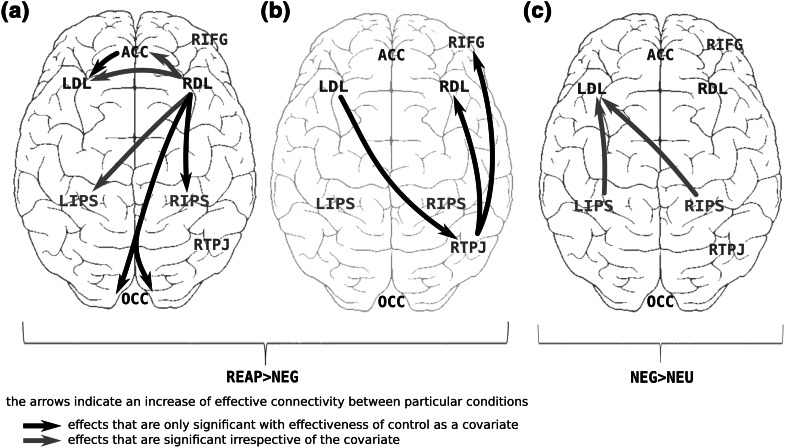
Reappraisal is an emotion regulation strategy used to change reactions to emotion-related stimuli by reinterpreting their meaning. During down-regulation of negative emotions, wide areas of the prefrontal cortex (PFC) inhibit emotion-related brain areas such as the amygdala. Little is known, however, about how this control activity influences the earliest stages of affective responses by modulating perceptual and attentional areas. The aim of this study is to identify the connectivity patterns between the PFC and the core regions of two well-known attentional networks: the dorsal attentional network (which controls attention volitionally) and the ventral attentional network (which controls attention spontaneously) during reappraisal. We used a novel method to study emotional control processes: the directed transfer function, an autoregressive effective connectivity method based on Granger causality. It was applied to EEG recordings to quantify the direction and intensity of information flow during passively watching (control condition) or reappraising (experimental condition) negative film clips. Reappraisal was mostly associated with increased top-down influences from the right dorsolateral PFC over attentional and perceptual areas, reaching areas including dorsal attentional regions. The left dorsolateral PFC was associated with the activation of the ventral attentional network. Passively watching clips (control condition) resulted in increased flow from attentional areas to the left dorsolateral PFC, what is interpreted as a monitoring process. Thus, reappraisal seems to be related to both volitional and automatic control of attention, triggered by the right and left dorsolateral PFC respectively.
Overview
The claims and statistics of this paper haven’t been checked yet.
Free: it reads the open-access text and checks the first 5 claims that cite a source we can check. Create a free account to check every claim.
Integrity signals
Registry
Cites
Statistics
Figures
Verification
Claims the paper makes
The claims and statistics of this paper haven’t been checked yet.
Free: it reads the open-access text and checks the first 5 claims that cite a source we can check. Create a free account to check every claim.
Claims other papers make about this one
Each is checked against this paper’s own text: does it say what the citing paper says it does?
The source backs part of the claim, not all of it — or backs it for a different population, condition or comparison.
In the citing paper
“In particular, the dorsolateral prefrontal cortex is thought critical for top-down conscious reappraisal when reprocessing emotionally latent memories, such as traumatic experiences, in order to dampen the negative affect associated with them (Picó-Pérez et al., 2017; Ligeza et al., 2016; Zilverstand et al., 2017).”
From How Processing of Sensory Information From the Internal and External Worlds Shape the Perception and Engagement With the World in the Aftermath of Trauma: Implications for PTSD (2021) · cites this paper as Ligeza et al., 2016
Experimental — accuracy not yet measured
Self-check
Percentages, sums and reported differences re-computed from the paper’s own numbers.
The self-check needs the paper’s full text.
Citations
Cites
Investigating causal relations by econometric models and cross-spectral methods
Granger, C. W. J. (1969) · Econometrica · doi:10.2307/1912791 · Cited by 22,989
Control of goal-directed and stimulus-driven attention in the brain
Corbetta, M., & Shulman, G. L. (2002) · Nature Reviews Neuroscience · doi:10.1038/nrn755 · Cited by 12,881
Gross, J. J., & John, O. P. (2003) · Journal of Personality and Social Psychology · doi:10.1037/0022-3514.85.2.348 · Cited by 11,929 · cited 2×
“change the affective response to emotionally-laden stimuli by reinterpreting their meaning (Gross and John 2003).”
The cognitive control of emotion
OCHSNER, K., & GROSS, J. (2005) · Trends in Cognitive Sciences · doi:10.1016/j.tics.2005.03.010 · Cited by 4,495 · cited 1×
“In most fMRI/PET studies, implementation of reappraisal activates wide areas of the PFC, including dorsolateral, ventrolateral, dorsomedial and ventromedial parts (DLPFC, VLPFC, DMPFC, VMPFC) (Buhle et al. 2013; Ochsner and Gross 2005).”
Removing electroencephalographic artifacts by blind source separation
Jung, T., Makeig, S., Humphries, C., Lee, T.-W., McKeown, M. J., Iragui, V. J., & Sejnowski, T. J. (2000) · Psychophysiology · doi:10.1017/s0048577200980259 · Cited by 3,334
Canonical Microcircuits for Predictive Coding
Bastos, A. M., Usrey, W. M., Adams, R. A., Mangun, G. R., Fries, P., & Friston, K. J. (2012) · Neuron · doi:10.1016/j.neuron.2012.10.038 · Cited by 2,421 · cited 1×
“It has been proposed that such connections are based, above all, on beta oscillations (Bastos et al. 2012; Vossel et al. 2013).”
Cognitive Reappraisal of Emotion: A Meta-Analysis of Human Neuroimaging Studies
Buhle, J. T., Silvers, J. A., Wager, T. D., Lopez, R., Onyemekwu, C., Kober, H., Weber, J., & Ochsner, K. N. (2014) · Cerebral Cortex · doi:10.1093/cercor/bht154 · Cited by 1,896 · cited 2×
“In most fMRI/PET studies, implementation of reappraisal activates wide areas of the PFC, including dorsolateral, ventrolateral, dorsomedial and ventromedial parts (DLPFC, VLPFC, DMPFC, VMPFC) (Buhle et al. 2013; Ochsner and Gross 2005).”
The Neural Bases of Emotion Regulation: Reappraisal and Suppression of Negative Emotion
Goldin, P. R., McRae, K., Ramel, W., & Gross, J. J. (2008) · Biological Psychiatry · doi:10.1016/j.biopsych.2007.05.031 · Cited by 1,886
Ochsner, K. N., Silvers, J. A., & Buhle, J. T. (2012) · Annals of the New York Academy of Sciences · doi:10.1111/j.1749-6632.2012.06751.x · Cited by 1,879
Dorsal and Ventral Attention Systems: Distinct Neural Circuits but Collaborative Roles
Vossel, S., Geng, J. J., & Fink, G. R. (2014) · The Neuroscientist · doi:10.1177/1073858413494269 · Cited by 1,438
Cited by
Critical Comments on EEG Sensor Space Dynamical Connectivity Analysis
de Steen, F. V., Faes, L., Karahan, E., Songsiri, J., Valdes-Sosa, P. A., & Marinazzo, D. (2016) · Brain Topography · doi:10.1007/s10548-016-0538-7 · Cited by 175
Meta-Analysis of fMRI Studies of Disruptive Behavior Disorders
Alegria, A. A., Radua, J., & Rubia, K. (2016) · American Journal of Psychiatry · doi:10.1176/appi.ajp.2016.15081089 · Cited by 174
Impact of the reference choice on scalp EEG connectivity estimation
Chella, F., Pizzella, V., Zappasodi, F., & Marzetti, L. (2016) · Journal of Neural Engineering · doi:10.1088/1741-2560/13/3/036016 · Cited by 140
Harricharan, S., McKinnon, M. C., & Lanius, R. A. (2021) · Frontiers in Neuroscience · doi:10.3389/fnins.2021.625490 · Cited by 110
Hemispheric asymmetries and emotions: Evidence from effective connectivity
Wyczesany, M., Capotosto, P., Zappasodi, F., & Prete, G. (2018) · Neuropsychologia · doi:10.1016/j.neuropsychologia.2018.10.007 · Cited by 102
Self-citationCapacity and tendency: A neuroscientific framework for the study of emotion regulation
Silvers, J. A., & Guassi Moreira, J. F. (2019) · Neuroscience Letters · doi:10.1016/j.neulet.2017.09.017 · Cited by 91
Emotional regulation strategies in daily life: the intensity of emotions and regulation choice
Kozubal, M., Szuster, A., & Wielgopolan, A. (2023) · Frontiers in Psychology · doi:10.3389/fpsyg.2023.1218694 · Cited by 77
“, 2013) and attentional top-down control (Ligeza et al., 2016).”
Ferdek, M. A., van Rijn, C. M., & Wyczesany, M. (2016) · Cognitive Affective & Behavioral Neuroscience · doi:10.3758/s13415-016-0456-x · Cited by 77
Self-citationThe neural bases of expressive suppression: A systematic review of functional neuroimaging studies
Sikka, P., Stenberg, J., Vorobyev, V. A., & Gross, J. J. (2022) · Neuroscience & Biobehavioral Reviews · doi:10.1016/j.neubiorev.2022.104708 · Cited by 56
Aydın, S. (2022) · Cognitive Neurodynamics · doi:10.1007/s11571-022-09843-w · Cited by 53
Keller, M., Quiñones, R. M., Muñoz, A. C., Iglesias-Fuster, J., Virués, A. V., Zvyagintsev, M., Edgar, J. C., Zweerings, J., & Mathiak, K. (2022) · BMC Psychiatry · doi:10.1186/s12888-022-03780-y · Cited by 51
Ligeza, T. S., Nowak, I., Maciejczyk, M., Szyguła, Z., & Wyczesany, M. (2021) · International Journal of Psychophysiology · doi:10.1016/j.ijpsycho.2021.01.016 · Cited by 41
Self-citationThe Influence of Volume Conduction on DTF Estimate and the Problem of Its Mitigation
Kamiński, M., & Blinowska, K. J. (2017) · Frontiers in Computational Neuroscience · doi:10.3389/fncom.2017.00036 · Cited by 41
Self-citationNeural circuit of verbal humor comprehension in schizophrenia - an fMRI study
Adamczyk, P., Wyczesany, M., Domagalik, A., Daren, A., Cepuch, K., Błądziński, P., Cechnicki, A., & Marek, T. (2017) · NeuroImage Clinical · doi:10.1016/j.nicl.2017.06.005 · Cited by 35
Self-citationAlzhemimer’s Disease is Characterized by Lower Segregation in Resting-State Eyes-Closed EEG
Aydın, S. (2024) · Journal of Medical and Biological Engineering · doi:10.1007/s40846-024-00917-0 · Cited by 33
Ferdek, M. A., Oosterman, J. M., Adamczyk, A. K., van Aken, M., Woudsma, K. J., Peeters, B. W. M. M., Nap, A. W., Wyczesany, M., & van Rijn, C. M. (2019) · Journal of Pain · doi:10.1016/j.jpain.2019.05.011 · Cited by 25
Self-citationCognitive conflict increases processing of negative, task-irrelevant stimuli
Ligeza, T. S., & Wyczesany, M. (2017) · International Journal of Psychophysiology · doi:10.1016/j.ijpsycho.2017.07.013 · Cited by 22
Self-citationOcular Dominance and Functional Asymmetry in Visual Attention Networks
Liu, S., Zhao, B., Shi, C., Ma, X., Sabel, B. A., Chen, X., & Tao, L. (2021) · Investigative Ophthalmology & Visual Science · doi:10.1167/iovs.62.4.9 · Cited by 21
Adamczyk, P., Jáni, M., Ligeza, T. S., Płonka, O., Błądziński, P., & Wyczesany, M. (2021) · Brain Topography · doi:10.1007/s10548-021-00849-x · Cited by 21
Self-citationGuimond, S., Ling, G., Drodge, J., Matheson, H., Wojtalik, J. A., Lopez, B., Collin, G., Brady, R. O., Mesholam‐Gately, R. I., Thermenos, H. W., et al. (2020) · Psychological Medicine · doi:10.1017/s0033291720004110 · Cited by 20
Wang, X., Blain, S. D., Wei, D., Yang, W., Yang, J., Zhuang, K., He, L., DeYoung, C. G., & Qiu, J. (2020) · Brain and Cognition · doi:10.1016/j.bandc.2020.105631 · Cited by 19
Lin, H., Ni, H., Tseng, W. I., & Gau, S. S. (2020) · Autism · doi:10.1177/1362361319888104 · Cited by 18
Cheng, J., Wang, Y., Tang, Y., Lin, L., Gao, J., & Wang, Z. (2024) · Journal of Psychiatric Research · doi:10.1016/j.jpsychires.2024.06.034 · Cited by 18
Xu, N., Spreng, R. N., & Doerschuk, P. C. (2017) · Frontiers in Neuroscience · doi:10.3389/fnins.2017.00271 · Cited by 18
Offline rTMS inhibition of the right dorsolateral prefrontal cortex impairs reappraisal efficacy
Wyczesany, M., Adamczyk, A. K., Hobot, J., Barbalinardo, G., Adamczyk, P., Labaza, A., & Ligeza, T. S. (2022) · Scientific Reports · doi:10.1038/s41598-022-24629-0 · Cited by 15
Self-citationWyczesany, M., & Ligeza, T. S. (2017) · Biological Psychology · doi:10.1016/j.biopsycho.2017.05.009 · Cited by 15
Self-citationDynamics of impaired humour processing in schizophrenia – An EEG effective connectivity study
Adamczyk, P., Wyczesany, M., & Daren, A. (2019) · Schizophrenia Research · doi:10.1016/j.schres.2019.05.008 · Cited by 14
Self-citationPrefrontal but not cerebellar tDCS attenuates renewal of extinguished conditioned eyeblink responses
Lipp, J., Draganova, R., Batsikadze, G., Ernst, T., Uengoer, M., & Timmann, D. (2019) · Neurobiology of Learning and Memory · doi:10.1016/j.nlm.2019.107137 · Cited by 13
Ferdek, M. A., Adamczyk, A. K., van Rijn, C. M., Oosterman, J. M., & Wyczesany, M. (2019) · PubMed · Cited by 11
Self-citationSpatiotemporal functional interactivity among large-scale brain networks
Xu, N., Doerschuk, P. C., Keilholz, S. D., & Spreng, R. N. (2020) · NeuroImage · doi:10.1016/j.neuroimage.2020.117628 · Cited by 11
Ligeza, T. S., Raine, L. B., Pontifex, M. B., Wyczesany, M., Kramer, A. F., & Hillman, C. H. (2024) · Scientific Reports · doi:10.1038/s41598-024-72074-y · Cited by 10
Self-citationOn Interfacing the Brain with Quantum Computers: An Approach to Listen to the Logic of the MindPreprint
Miranda, E. R. (2021) · arXiv (Cornell University) · doi:10.48550/arxiv.2101.03887 · Cited by 6
Mańkowska, A., Harciarek, M., Williamson, J. B., & Heilman, K. M. (2018) · Journal of Clinical and Experimental Neuropsychology · doi:10.1080/13803395.2018.1457138 · Cited by 6
Moser, D. A., Dricu, M., Kotikalapudi, R., Doucet, G. E., & Aue, T. (2023) · Human Brain Mapping · doi:10.1002/hbm.26400 · Cited by 6
Wyczesany, M., Leśniewska, A., Winker, C., Domagała, M., Kroker, T., Kałamała, P., Ligeza, T. S., Rehbein, M. A., Roesmann, K., Wessing, I., et al. (2024) · Biological Psychology · doi:10.1016/j.biopsycho.2024.108980 · Cited by 3
Self-citationJáni, M., Płonka, O., Daren, A., Błądziński, P., Kalisz, A., Wyczesany, M., & Adamczyk, P. (2021) · Acta Neurobiologiae Experimentalis · doi:10.21307/ane-2021-017 · Cited by 2
Self-citationHabitual Aerobic Exercise Is Associated with Reduced Negative Emotional Elicitation: An fNIRS Study
Wang, X., & Zhou, C. (2026) · Brain Sciences · doi:10.3390/brainsci16040409 · Cited by 1
A Quantum Computing Approach to Harnessing the Logic of the Mind for Brain–Computer Interfacing
Miranda, E. R. (2022) · Springer eBooks · doi:10.1007/978-3-030-95538-0_9 · Cited by 1
Wyczesany, M., Spadone, S., Górski, T., Labaza, A., Domagała, M., Kamiński, M., Ligeza, T. S., Capotosto, P., Kroker, T., Junghöfer, M., et al. (2026) · Frontiers in Neuroinformatics · doi:10.3389/fninf.2026.1791461 · Cited by 1
Self-citationCasagrande, W. D., Nakamura-Palacios, E. M., & Frizera, A. (2022) · World Congress on Medical Physics and Biomedical Engineering, September 7 - 12, 2009, Munich, Germany · doi:10.1007/978-3-030-70601-2_250 · Cited by 1
Aberrant large- and mesoscale network segregation and integration in bulimia nervosa
Zhang, P., Tang, L., Li, W., Wang, M., Jia, Y., Yu, F., Li, Z., Wang, Z., Wang, J., Wu, G., et al. (2026) · Journal of Eating Disorders · doi:10.1186/s40337-026-01671-1
Wang, Y., Meng, N., Xing, H., Kou, Y., Zheng, R., Wu, Y., Feng, S., Luo, Y., & Zhang, M. (2026) · Physiology & Behavior · doi:10.1016/j.physbeh.2026.115359
Emotion regulation in self-reported disinhibition, boldness and meannessPreprint
Steijer, R. (2018) · Thesis Commons (OSF Preprints) · doi:10.31237/osf.io/8p9vg
Mózgowe mechanizmy kontroli emocji : rola procesów uwagowych i poznawczych w reinterpretacji
Ligeza, T. S. (2019) · Jagiellonian University Repository (Jagiellonian University)
Self-citationLipp, J. (2021) · DuEPublico (University of Duisburg-Essen) · doi:10.17185/duepublico/74596
Kepribadian Tokoh Haris Dalam Cerpen “Menanti Kelahiran” Karya A. A. Navis: Kajian Psikologi Sastra
Selpila, A., Putri, N. Q. H., & Rokhmansyah, A. (2026) · Journal of Literature and Education · doi:10.69815/jle.v4i1.208
Metadata
- Authors
- Ligeza, T. S., Wyczesany, M., Tymorek, A. D., & Kamiński, M.
- Affiliations
- Jagiellonian University (PL)
- University of Warsaw (PL)
- Corresponding author
- Ligeza, Tomasz S.
- Venue
- Brain Topography
- Published
- 2015-10-06
- Volume
- 29
- Issue
- 2
- Pages
- 253-261
- ISSN
- 0896-0267 (ISSN-L)
- 1573-6792
- PMC
- PMC4754317
- OpenAlex
- W1871454165
- Cited by
- 43
- References
- 40
- Citations by year
- 2026: 4 · 2024: 4 · 2023: 2 · 2022: 7 · 2021: 5 · 2020: 4 · 2019: 4 · 2018: 3 · 2017: 6 · 2016: 4
- FWCI
- 2.60
- Type
- journal article
- Language
- en
- Open access
- hybrid
- doi.org
- Locations
- Brain Topography (publishedVersion, cc-by)
- Europe PMC (PubMed Central) (publishedVersion, cc-by)
- PubMed Central (publishedVersion, cc-by)
- PubMed (publishedVersion)
- Jagiellonian University Repository (Jagiellonian University) (submittedVersion, cc-by-nc-nd)
- Funders
- Narodowe Centrum Nauki (2013/09/B/HS6/02662)
- Topics
- Life Sciences › Neuroscience › Cognitive Neuroscience › Neural and Behavioral Psychology Studies
- Life Sciences › Neuroscience › Cognitive Neuroscience › Functional Brain Connectivity Studies
- Life Sciences › Neuroscience › Cognitive Neuroscience › Neural dynamics and brain function
- Keywords
- emotion regulation, cognitive reappraisal, prefrontal cortex, effective connectivity, directed transfer function, dorsolateral prefrontal cortex, top-down control, attentional control, negative emotions, amygdala, EEG
- MeSH terms
- Adolescent, Adult, Attention, Brain Mapping, Electroencephalography, Emotions, Female, Humans, Male, Models, Neurological, Photic Stimulation, Multivariate Analysis, Prefrontal Cortex, Young Adult, Brain Waves
About these checks
Registry, retraction, Cites and statistics results are computed, not judged, with one exception: a printed reference that no index lists is read once by a model before it counts as a citation error. Claims are extracted by a model and kept only when their quote appears verbatim in the text; each cited source is then checked, with a model’s help, for whether it says what the claim relies on. Those verdicts can be wrong — read the claim’s quote and the cited source before relying on one.
Statistics and arithmetic are recomputed, not judged.
Confidence bands are shown only for fields calibrated on our annotated test set. None is calibrated yet, so no band is shown.
What counts as a claim ›How we measure confidence ›How we check this ›
Are you an author, or do you see a problem with this page? Request a review
Data sources
Bibliographic data: Semantic Scholar, OpenAlex, Crossref.
Contains information from the Semantic Scholar Academic Graph Datasets, made available under the ODC Attribution License (ODC-BY 1.0).
Semantic Scholar’s data is described in: Kinney, R., et al. (2023). The Semantic Scholar Open Data Platform. arXiv:2301.10140.
