

Characterization of primary human hepatocytes, HepG2 cells, and HepaRG cells at the mRNA level and CYP activity in response to inducers and their predictivity for the detection of human hepatotoxins
Open accessThe DOI matches its Crossref record; 49 of the 50 references it cites were found in a registry or an index.
Abstract
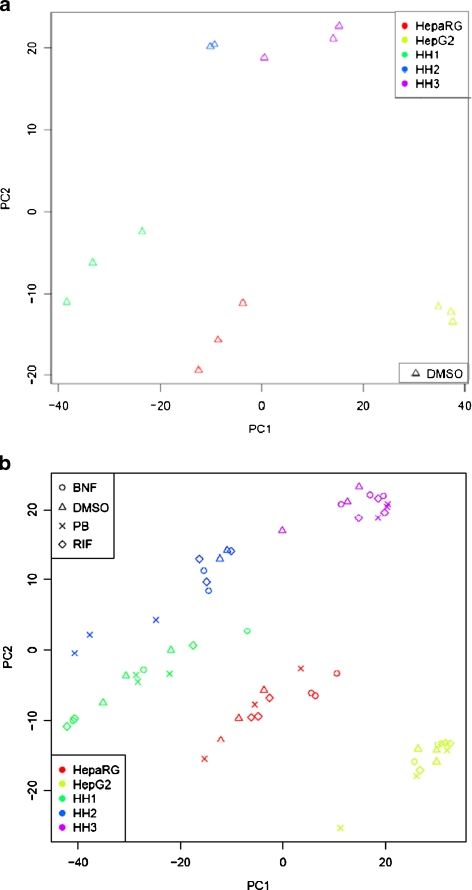
In the pharmaceutical industry, improving the early detection of drug-induced hepatotoxicity is essential as it is one of the most important reasons for attrition of candidate drugs during the later stages of drug development. The first objective of this study was to better characterize different cellular models (i.e., HepG2, HepaRG cells, and fresh primary human hepatocytes) at the gene expression level and analyze their metabolic cytochrome P450 capabilities. The cellular models were exposed to three different CYP450 inducers; beta-naphthoflavone (BNF), phenobarbital (PB), and rifampicin (RIF). HepG2 cells responded very weakly to the different inducers at the gene expression level, and this translated generally into low CYP450 activities in the induced cells compared with the control cells. On the contrary, HepaRG cells and the three human donors were inducible after exposure to BNF, PB, and RIF according to gene expression responses and CYP450 activities. Consequently, HepaRG cells could be used in screening as a substitute and/or in complement to primary hepatocytes for CYP induction studies. The second objective was to investigate the predictivity of the different cellular models to detect hepatotoxins (16 hepatotoxic and 5 nonhepatotoxic compounds). Specificity was 100% with the different cellular models tested. Cryopreserved human hepatocytes gave the highest sensitivity, ranging from 31% to 44% (depending on the donor), followed by lower sensitivity (13%) for HepaRG and HepG2 cells (6.3%). Overall, none of the models under study gave desirable sensitivities (80-100%). Consequently, a high metabolic capacity and CYP inducibility in cell lines does not necessarily correlate with a high sensitivity for the detection of hepatotoxic drugs. Further investigations are necessary to compare different cellular models and determine those that are best suited for the detection of hepatotoxic compounds.
Overview
The claims and statistics of this paper haven’t been checked yet.
Free: it reads the open-access text and checks the first 5 claims that cite a source we can check. Create a free account to check every claim.
Integrity signals
Registry
Cites
Statistics
Figures
Verification
Claims the paper makes
The claims and statistics of this paper haven’t been checked yet.
Free: it reads the open-access text and checks the first 5 claims that cite a source we can check. Create a free account to check every claim.
Claims other papers make about this one
Each is checked against this paper’s own text: does it say what the citing paper says it does?
The source backs part of the claim, not all of it — or backs it for a different population, condition or comparison.
In the citing paper
“In contrast, studies of immortalized hepatocyte lines consistently demonstrated reduced metabolic diversity and physiological responsiveness.”
From Primary cell cultures versus immortalized cell lines: critical comparative insights into biological fidelity and translational applications (2026) · cites this paper as Gerets et al. (2012)
Experimental — accuracy not yet measuredThe source backs part of the claim, not all of it — or backs it for a different population, condition or comparison.
In the citing paper
“While these model systems provide valuable insights into liver function and drug metabolism, they fail to mimic the intricate three-dimensional (3D) architecture, cellular heterogeneity, and zonation observed in the native liver. Consequently, these models often insufficiently simulate the liver microenvironment, leading to discrepancies in drug metabolism and toxicity profiles and reducing their”
From Temporal proteomic profiling of iPSC-derived human liver organoids reveals optimal maturation for drug metabolism and toxicology (2026) · cites this paper as [7]
Experimental — accuracy not yet measuredThe cited source says what the claim attributes to it.
In the citing paper
“Similarly, Gerets et al. (2012) observed that the HepG2 cell line responded weakly to classical CYP450 inducers (e.g.β-naphthoflavone, phenobarbital, and rifampicin) and generally exhibited CYP450 activities lower than primary human hepatocytes (Table 2).”
From Primary cell cultures versus immortalized cell lines: critical comparative insights into biological fidelity and translational applications (2026) · cites this paper as Gerets et al. (2012)
The cited source says what the claim attributes to it.
In the citing paper
“Consistent with this limited metabolic competence, the HepG2 cell line showed poor hepatotoxin detection sensitivity of approximately 6%, compared with 31-44% in PHHs.”
From Primary cell cultures versus immortalized cell lines: critical comparative insights into biological fidelity and translational applications (2026) · cites this paper as Gerets et al. (2012)
The cited source says what the claim attributes to it.
In the citing paper
“Thus, in HepG2, Phase II biotransformation is partially preserved and, on average, better than Phase I, but it is qualitatively shifted.”
From The HepG2 Cell Line as a Model for Studying Metabolic Dysfunction-Associated Steatotic Liver Disease (2026) · cites this paper as [107]
Self-check
Percentages, sums and reported differences re-computed from the paper’s own numbers.
The self-check needs the paper’s full text.
Citations
Cites
Controlling the False Discovery Rate: A Practical and Powerful Approach to Multiple Testing
Benjamini, Y., & Hochberg, Y. (1995) · Journal of the Royal Statistical Society Series B: Statistical Methodology · doi:10.1111/j.2517-6161.1995.tb02031.x · Cited by 109,482 · cited 2×
“The cells were then incubated in a 5% CO2:95% air humidified atmosphere at 37°C.”
BackgroundMethodInfluentialMeasurement of protein using bicinchoninic acid
Smith, P. K., Krohn, R. I., Hermanson, G. T., Mallia, A. K., Gartner, F. H., Provenzano, M. D., Fujimoto, E. K., Goeke, N. M., Olson, B. J., & Klenk, D. C. (1985) · Analytical Biochemistry · doi:10.1016/0003-2697(85)90442-7 · Cited by 18,482 · cited 2×
“Microsomal proteins were determined using the BCA Protein Assay adapted to microtiter plate (Smith et al. 1985).”
BackgroundMethodBioanalytical Method Validation—A Revisit with a Decade of Progress
Shah, V. P., Midha, K. K., Findlay, J. W. A., Hill, H. M., Hulse, J. D., McGilveray, I. J., McKay, G., Miller, K. J., Patnaik, R. N., Powell, M. L., et al. (2000) · Pharmaceutical Research · doi:10.1023/a:1007669411738 · Cited by 1,572
Infection of a human hepatoma cell line by hepatitis B virus
Gripon, P., Rumin, S., Urban, S., Le Seyec, J., Glaise, D., Cannie, I., Guyomard, C., Lucas, J., Trepo, C., & Guguen-Guillouzo, C. (2002) · Proceedings of the National Academy of Sciences · doi:10.1073/pnas.232137699 · Cited by 1,282
Induction of phase I, II and III drug metabolism/transport by xenobiotics
Xu, C., Li, C. Y.-T., & Kong, A.-N. T. (2005) · Archives of Pharmacal Research · doi:10.1007/bf02977789 · Cited by 1,279
Aninat, C., Piton, A., Glaise, D., Le Charpentier, T., Langouët, S., Morel, F., Guguen-Guillouzo, C., & Guillouzo, A. (2006) · Drug Metabolism and Disposition · doi:10.1124/dmd.105.006759 · Cited by 703
Guillouzo, A., Corlu, A., Aninat, C., Glaise, D., Morel, F., & Guguen-Guillouzo, C. (2007) · Chemico-Biological Interactions · doi:10.1016/j.cbi.2006.12.003 · Cited by 675
O’Brien, P. J., Irwin, W., Diaz, D., Howard-Cofield, E., Krejsa, C. M., Slaughter, M. R., Gao, B., Kaludercic, N., Angeline, A., Bernardi, P., et al. (2006) · Archives of Toxicology · doi:10.1007/s00204-006-0091-3 · Cited by 609 · cited 2×
“Reactions were stopped by the addition of ice-cold acetone and clear supernatants analyzed for the presence of metabolites.”
BackgroundWesterink, W. M. A., & Schoonen, W. G. E. J. (2007) · Toxicology in Vitro · doi:10.1016/j.tiv.2007.05.014 · Cited by 544
Cellular Imaging Predictions of Clinical Drug-Induced Liver Injury
Xu, J. J., Henstock, P. V., Dunn, M. C., Smith, A. R., Chabot, J. R., & de Graaf, D. (2008) · Toxicological Sciences · doi:10.1093/toxsci/kfn109 · Cited by 492
Rat toxicogenomic study reveals analytical consistency across microarray platforms
Guo, L., Lobenhofer, E. K., Wang, C., Shippy, R., Harris, S. C., Zhang, L., Mei, N., Chen, T., Herman, D., Goodsaid, F. M., et al. (2006) · Nature Biotechnology · doi:10.1038/nbt1238 · Cited by 406
Evaluation of HepaRG Cells as an in Vitro Model for Human Drug Metabolism Studies
Kanebratt, K. P., & Andersson, T. B. (2008) · Drug Metabolism and Disposition · doi:10.1124/dmd.107.020016 · Cited by 354
Faucette, S. R., Hawke, R. L., Lecluyse, E. L., Shord, S. S., Yan, B., Laethem, R. M., & Lindley, C. M. (2000) · Drug Metabolism and Disposition · doi:10.1016/s0026-895x(24)12054-8 · Cited by 353
Madan, A., Graham, R. A., Carroll, K. M., Mudra, D. R., Burton, L. A., Krueger, L. A., Downey, A. D., Czerwinski, M., Forster, J., Ribadeneira, M. D., et al. (2003) · Drug Metabolism and Disposition · doi:10.1124/dmd.31.4.421 · Cited by 338
Cell Lines: A Tool for In Vitro Drug Metabolism Studies
Gomez-Lechon, M., Donato, M., Lahoz, A., & Castell, J. (2008) · Current Drug Metabolism · doi:10.2174/138920008783331086 · Cited by 300
Stable Expression, Activity, and Inducibility of Cytochromes P450 in Differentiated HepaRG Cells
Anthérieu, S., Chesné, C., Li, R., Camus, S., Lahoz, A., Picazo, L., Turpeinen, M., Tolonen, A., Uusitalo, J., Guguen-Guillouzo, C., et al. (2010) · Drug Metabolism and Disposition · doi:10.1124/dmd.109.030197 · Cited by 278
Abassi, Y. A., Xi, B., Zhang, W., Ye, P., Kirstein, S. L., Gaylord, M. R., Feinstein, S. C., Wang, X., & Xu, X. (2009) · Chemistry & Biology · doi:10.1016/j.chembiol.2009.05.011 · Cited by 254
Effects of Freezing, Thawing, and Storing Human Liver Microsomes on Cytochrome P450 Activity
Pearce, R. E., McIntyre, C. J., Madan, A., Sanzgiri, U., Draper, A. J., Bullock, P. L., Cook, D. C., Burton, L. A., Latham, J., Nevins, C., et al. (1996) · Archives of Biochemistry and Biophysics · doi:10.1006/abbi.1996.0294 · Cited by 253
Lübberstedt, M., Müller-Vieira, U., Mayer, M., Biemel, K. M., Knöspel, F., Knobeloch, D., Nüssler, A. K., Gerlach, J. C., & Zeilinger, K. (2011) · Journal of Pharmacological and Toxicological Methods · doi:10.1016/j.vascn.2010.04.013 · Cited by 227
Westerink, W. M. A., & Schoonen, W. G. E. J. (2007) · Toxicology in Vitro · doi:10.1016/j.tiv.2007.06.017 · Cited by 226 · cited 3×
“Clearly, these cellular models have already been characterized separately at the metabolism levels (e.g., Guillouzo et al. 2007; Westerink and Schoonen 2007; Lambert et al. 2009), and there are also some other publications related to the predictivity of HepG2 (O’Brien et al. 2006) and primary HH…”
BackgroundResultXu, J. J., Diaz, D., & O’Brien, P. J. (2004) · Chemico-Biological Interactions · doi:10.1016/j.cbi.2004.09.011 · Cited by 224
Jennen, D. G. J., Magkoufopoulou, C., Ketelslegers, H. B., van Herwijnen, M. H. M., Kleinjans, J. C. S., & van Delft, J. H. M. (2010) · Toxicological Sciences · doi:10.1093/toxsci/kfq026 · Cited by 220
Donato, M. T., Jiménez, N., Castell, J. V., & Gómez-Lechón, M. J. (2004) · Drug Metabolism and Disposition · doi:10.1124/dmd.32.7.699 · Cited by 214
Expression and regulation of cytochrome P450 enzymes in primary cultures of human hepatocytes
LeCluyse, E. L., Madan, A., Hamilton, G., Carroll, K., DeHaan, R., & Parkinson, A. (2000) · Journal of Biochemical and Molecular Toxicology · doi:10.1002/(sici)1099-0461(2000)14:4<177::aid-jbt1>3.0.co;2-4 · Cited by 196
Drug metabolism by the human hepatoma cell, Hep G2
Sassa, S., Sugita, O., Galbraith, R. A., & Kappas, A. (1987) · Biochemical and Biophysical Research Communications · doi:10.1016/0006-291x(87)90628-0 · Cited by 192
REGULATION OF CYP2B6 IN PRIMARY HUMAN HEPATOCYTES BY PROTOTYPICAL INDUCERS
Faucette, S. R., Wang, H., Hamilton, G. A., Jolley, S. L., Gilbert, D., Lindley, C., Yan, B., Negishi, M., & LeCluyse, E. L. (2004) · Drug Metabolism and Disposition · doi:10.1124/dmd.32.3.348 · Cited by 179
Phase I and II enzyme characterization of two sources of HepG2 cell lines
Hewitt, N. J., & Hewitt, P. (2004) · Xenobiotica · doi:10.1080/00498250310001657568 · Cited by 178
New Technologies and Screening Strategies for Hepatotoxicity: Use of In Vitro Models
Dambach, D. M., Andrews, B. A., & Moulin, F. (2005) · Toxicologic Pathology · doi:10.1080/01926230590522284 · Cited by 177
Glanemann, C., Loos, A., Gorret, N., Willis, L. B., O’Brien, X. M., Lessard, P. A., & Sinskey, A. J. (2002) · Applied Microbiology and Biotechnology · doi:10.1007/s00253-002-1191-5 · Cited by 165
Biobased Performance Bioplastic: Mirel
DiGregorio, B. E. (2009) · Chemistry & Biology · doi:10.1016/j.chembiol.2009.01.001 · Cited by 156
Functional expression, inhibition and induction of CYP enzymes in HepaRG cells
Turpeinen, M., Tolonen, A., Chesné, C., Guillouzo, A., Uusitalo, J., & Pelkonen, O. (2009) · Toxicology in Vitro · doi:10.1016/j.tiv.2009.03.008 · Cited by 125
Toxicity Testing in the 21st Century: A View from the Pharmaceutical Industry
MacDonald, J. S., & Robertson, R. T. (2009) · Toxicological Sciences · doi:10.1093/toxsci/kfp088 · Cited by 119
Gilot, D., Loyer, P., Corlu, A., Glaise, D., Lagadic‐Gossmann, D., Atfi, A., Morel, F., Ichijo, H., & Guguen‐Guillouzo, C. (2002) · Journal of Biological Chemistry · doi:10.1074/jbc.m207325200 · Cited by 117
Atienzar, F. A., Tilmant, K., Gerets, H. H., Toussaint, G., Speeckaert, S., Hanon, E., Depelchin, O., & Dhalluin, S. (2011) · SLAS Discovery · doi:10.1177/1087057111402825 · Cited by 105
Self-citationCoordinated induction of drug transporters and phase I and II metabolism in human liver slices
Olinga, P., Elferink, M. G. L., Draaisma, A. L., Merema, M. T., Castell, J. V., Pérez, G., & Groothuis, G. M. M. (2008) · European Journal of Pharmaceutical Sciences · doi:10.1016/j.ejps.2008.01.008 · Cited by 103
Evans, S. M. H., Casartelli, A., Herreros, E. A., Minnick, D. T., Day, C., GEORGE, E. L., & Westmoreland, C. (2001) · Toxicology in Vitro · doi:10.1016/s0887-2333(01)00064-9 · Cited by 102
Lambert, C. B., Spire, C., Claude, N., & Guillouzo, A. (2008) · Toxicology and Applied Pharmacology · doi:10.1016/j.taap.2008.11.008 · Cited by 90
Roymans, D., Looveren, C. V., Leone, A. M., Parker, J. B., McMillian, M., Johnson, M. D., Koganti, A., Gilissen, R., Silber, P. M., Mannens, G., et al. (2003) · Biochemical Pharmacology · doi:10.1016/j.bcp.2003.09.022 · Cited by 78
Cell based approaches for evaluation of drug-induced liver injury
Greer, M. L., Barber, J., Eakins, J. A., & Kenna, J. G. (2009) · Toxicology · doi:10.1016/j.tox.2009.08.007 · Cited by 76
Pregnane X Receptor Protects HepG2 Cells from BaP-Induced DNA Damage
Naspinski, C., Gu, X., Zhou, G.-D., Mertens‐Talcott, S. U., Donnelly, K. C., & Tian, Y. (2008) · Toxicological Sciences · doi:10.1093/toxsci/kfn058 · Cited by 76
Toxicity Testing in the 21st Century
Greenberg, M., & Lowrie, K. W. (2009) · Risk Analysis · doi:10.1111/j.1539-6924.2009.01222.x · Cited by 75
Gerets, H. H. J., Hanon, É., Cornet, M., Dhalluin, S., Depelchin, O., Canning, M., & Atienzar, F. (2008) · Toxicology in Vitro · doi:10.1016/j.tiv.2008.11.012 · Cited by 74
Self-citationPernelle, K., Guével, R. L., Glaise, D., Gaucher, C., Charpentier, T. L., Bouaita, B., Corlu, A., & Guguen‐Guillouzo, C. (2011) · Toxicology and Applied Pharmacology · doi:10.1016/j.taap.2011.04.018 · Cited by 66
Wen, B., & Zhou, M. (2009) · Chemico-Biological Interactions · doi:10.1016/j.cbi.2009.05.014 · Cited by 61
The Constitutive Active/Androstane Receptor Regulates Phenytoin Induction of Cyp2c29
Jackson, J. P., Ferguson, S., Moore, R., Negishi, M., & Goldstein, J. A. (2004) · Molecular Pharmacology · doi:10.1124/mol.65.6.1397 · Cited by 59
Kanazawa, H., Okada, A., Igarashi, E., Higaki, M., Miyabe, T., Sano, T., & Nishimura, R. (2004) · Journal of Chromatography A · doi:10.1016/j.chroma.2003.12.039 · Cited by 43
Kanno, Y., & Inouye, Y. (2010) · The Journal of Toxicological Sciences · doi:10.2131/jts.35.515 · Cited by 38
Rhodes, S. P., Otten, J. N., Hingorani, G. P., Hartley, D. P., & Franklin, R. B. (2010) · Journal of Pharmacological and Toxicological Methods · doi:10.1016/j.vascn.2010.11.002 · Cited by 37
Evaluation of genes identified by microarray analysis in favorable neuroblastoma
Kamei, N., Hiyama, K., Yamaoka, H., Kamimatsuse, A., Onitake, Y., Sueda, T., & Hiyama, E. (2009) · Pediatric Surgery International · doi:10.1007/s00383-009-2448-1 · Cited by 16
Research works printed but not linked: 2
- Andrews B Chen S Zhu M Moulin F Flint O Evaluation of cytochrome P450-mediated hepatotoxicity using a high throughput robotic system Drug Metab Rev 2003 35 413
- Kamei N Hiyama K Yamaoka H Kaminatsuse A Onitake Y Sueda T Huyama E Evaluation of genes identified by microarray analysis in favourable neuroblastoma Pediatr Surg Int 2009 11 931 937 10.1007/s00383-009-2448-1 19701758 · DOI
Cited by
Bhatia, S. N., & Ingber, D. E. (2014) · Nature Biotechnology · doi:10.1038/nbt.2989 · Cited by 3,305
Organs-on-chips: into the next decade
Low, L. A., Mummery, C., Berridge, B. R., Austin, C. P., & Tagle, D. A. (2021) · Nature Reviews Drug Discovery · doi:10.1038/s41573-020-0079-3 · Cited by 1,029
The Curious Case of the HepG2 Cell Line: 40 Years of Expertise
Arzumanian, V. A., Kiseleva, O. I., & Poverennaya, E. V. (2021) · International Journal of Molecular Sciences · doi:10.3390/ijms222313135 · Cited by 387
“• Low expression and activity levels of the drug-metabolizing enzymes [45]; • There are exceptions such as NQO13, GSTM34, and MRP15 [127,172,173]; • The minor phase I enzymes: CYP27B1, CYP2W1 are expressed at significantly higher elevated levels than in human hepatocytes [172].”
BackgroundPluripotent stem cell-derived hepatocyte-like cells
Schwartz, R. E., Fleming, H. E., Khetani, S. R., & Bhatia, S. N. (2014) · Biotechnology Advances · doi:10.1016/j.biotechadv.2014.01.003 · Cited by 282
Andersson, T. B., Kanebratt, K. P., & Kenna, J. G. (2012) · Expert Opinion on Drug Metabolism & Toxicology · doi:10.1517/17425255.2012.685159 · Cited by 259
Metadata
- Authors
- Gerets, H. H. J., Tilmant, K., Gerin, B., Chanteux, H., Depelchin, B. O., Dhalluin, S., & Atienzar, F. A.
- Affiliations
- UCB Pharma (Belgium) (BE)
- Corresponding author
- Gerets, H. H. J.
- Venue
- Cell Biology and Toxicology
- Published
- 2012-01-19
- Volume
- 28
- Issue
- 2
- Pages
- 69-87
- ISSN
- 0742-2091 (ISSN-L)
- 1573-6822
- PMC
- PMC3303072
- OpenAlex
- W2094392052
- Cited by
- 698
- References
- 50
- Citations by year
- 2026: 37 · 2025: 50 · 2024: 46 · 2023: 33 · 2022: 60 · 2021: 57 · 2020: 75 · 2019: 58 · 2018: 70 · 2017: 48 · 2016: 53 · 2015: 37 · 2014: 45 · 2013: 24 · 2012: 5
- FWCI
- 40.25
- Type
- journal article
- Language
- en
- Open access
- hybrid
- doi.org
- Licence
- cc-by-nc
- creativecommons.org/licenses/by-nc/2.0 (tdm)
- Locations
- Cell Biology and Toxicology (publishedVersion, cc-by-nc)
- PubMed Central (publishedVersion, cc-by-nc)
- PubMed (publishedVersion)
- Topics
- Life Sciences › Pharmacology, Toxicology and Pharmaceutics › Pharmacology › Drug-Induced Hepatotoxicity and Protection
- Life Sciences › Pharmacology, Toxicology and Pharmaceutics › Pharmacology › Pharmacogenetics and Drug Metabolism
- Health Sciences › Veterinary › Small Animals › Animal testing and alternatives
- Keywords
- drug-induced liver injury, hepatotoxicity screening, cytochrome P450 induction, primary human hepatocytes, HepG2 cells, HepaRG cells, beta-naphthoflavone, phenobarbital, rifampicin, cytochrome P450 activity, gene expression, hepatocyte cryopreservation, hepatotoxicity prediction
- MeSH terms
- Adult, Aged, Child, Cytochrome P-450 Enzyme System, Enzyme Induction, Female, Humans, Lethal Dose 50, Male, Middle Aged, Models, Biological, Predictive Value of Tests, RNA, Messenger, Gene Expression, Toxicity Tests, Inhibitory Concentration 50, Gene Expression Profiling, Hepatocytes, Principal Component Analysis, Toxicogenetics, Chemical and Drug Induced Liver Injury, Hep G2 Cells, Drug-Related Side Effects and Adverse Reactions
About these checks
Registry, retraction, Cites and statistics results are computed, not judged, with one exception: a printed reference that no index lists is read once by a model before it counts as a citation error. Claims are extracted by a model and kept only when their quote appears verbatim in the text; each cited source is then checked, with a model’s help, for whether it says what the claim relies on. Those verdicts can be wrong — read the claim’s quote and the cited source before relying on one.
Statistics and arithmetic are recomputed, not judged.
Confidence bands are shown only for fields calibrated on our annotated test set. None is calibrated yet, so no band is shown.
What counts as a claim ›How we measure confidence ›How we check this ›
Are you an author, or do you see a problem with this page? Request a review
Data sources
Bibliographic data: Semantic Scholar, OpenAlex, Crossref.
Contains information from the Semantic Scholar Academic Graph Datasets, made available under the ODC Attribution License (ODC-BY 1.0).
Semantic Scholar’s data is described in: Kinney, R., et al. (2023). The Semantic Scholar Open Data Platform. arXiv:2301.10140.
