

A Systematic Review of Parental Involvement in Cognitive Behavioural Therapy for Adolescent Anxiety Disorders
Open accessThe DOI matches its Crossref record; 52 of the 52 references it cites were found in a registry or an index.
Abstract
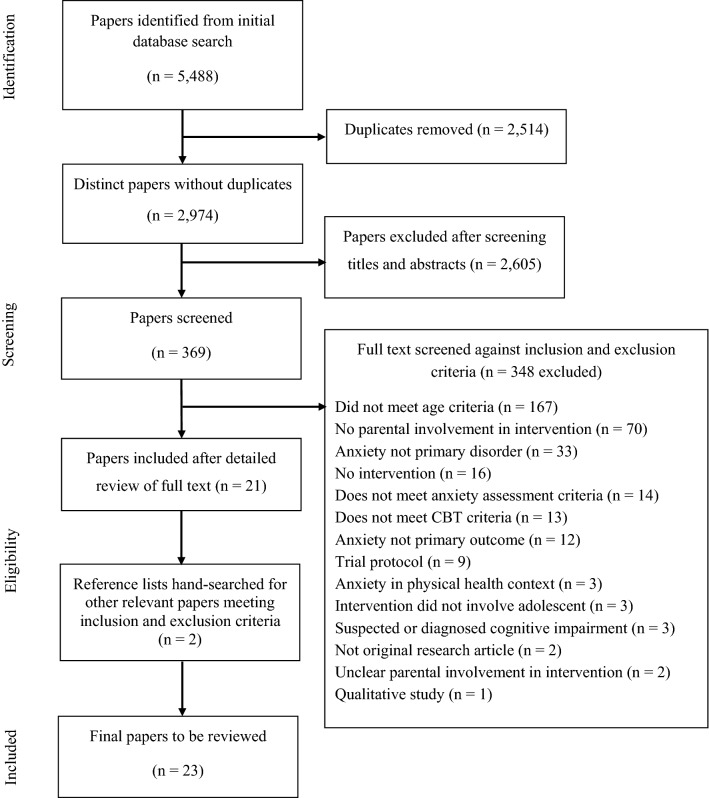
Anxiety disorders are common among adolescents and lead to poor long-term outcomes. Cognitive Behavioural Therapy (CBT) is an evidenced-based intervention for adolescent anxiety disorders, but little is known about whether and how parents should be involved. This systematic review evaluated how parents have been involved and associated treatment outcomes in studies of CBT for adolescent anxiety disorders. Electronic systematic searches were conducted in PsycINFO, Embase, CINAHL, Medline, AMED databases, to identify studies investigating CBT for adolescent anxiety disorder(s) that included parents in treatment. Twenty-three papers were identified. Parents were involved in treatment in a number of different ways: by attending separate parent sessions, joint parent-adolescent sessions, or both, or through provision of a workbook while attending some adolescent sessions. Content varied but was most typically aimed at the parent developing an understanding of core CBT components and skills to help them manage their adolescent's anxiety and avoidance. Treatment outcomes indicate that CBT with parental involvement is an effective intervention for adolescent anxiety disorders; however, it is not possible to draw conclusions regarding whether parental involvement (generally or in any particular form) enhances treatment outcomes. Poor reporting and methodological issues also limit the conclusions. Further research is required to identify whether there are particular types of parental involvement in CBT that bring clinical benefits to adolescents with anxiety disorders generally, as well as in particular circumstances.
Overview
The claims and statistics of this paper haven’t been checked yet.
Free: it reads the open-access text and checks the first 5 claims that cite a source we can check. Create a free account to check every claim.
Integrity signals
Registry
Cites
Statistics
Figures
Verification
Claims the paper makes
The claims and statistics of this paper haven’t been checked yet.
Free: it reads the open-access text and checks the first 5 claims that cite a source we can check. Create a free account to check every claim.
Claims other papers make about this one
Each is checked against this paper’s own text: does it say what the citing paper says it does?
The cited source says what the claim attributes to it.
In the citing paper
“Parents2 often play a limited role in CBT for adolescent anxiety, commonly participating in psychoeducation sessions or learning skills alongside their teens to serve as putative coaches outside of session (22).”
From Combining attachment-based family therapy and cognitive behavioral therapy to improve outcomes for adolescents with anxiety (2023) · cites this paper as [22]
Self-check
Percentages, sums and reported differences re-computed from the paper’s own numbers.
The self-check needs the paper’s full text.
Citations
Cites
Diagnostic and Statistical Manual of Mental Disorders
American Psychiatric Association (2013) · doi:10.1176/appi.books.9780890425596 · Cited by 116,369
Diagnostic and Statistical Manual of Mental Disorders
Williams, J. B. W., & First, M. (2013) · Encyclopedia of Social Work · doi:10.1093/acrefore/9780199975839.013.104 · Cited by 109,519 · cited 1×
“…DSM may have been used to assess the presence of a clinical anxiety disorder, but adolescents had to meet the criteria of anxiety disorders as listed in the current DSM-5, thus excluding post-traumatic stress disorder and obsessive–compulsive disorder (DSM-5; American Psychiatric Association 2013).”
MethodPRISMA-P Group, Moher, D., Shamseer, L., Clarke, M., Ghersi, D., Liberati, A., Petticrew, M., Shekelle, P., & Stewart, L. A. (2015) · Systematic Reviews · doi:10.1186/2046-4053-4-1 · Cited by 26,223
Diagnostic and Statistical Manual of Mental Disorders, 5th ed.
Carter, M. J. (2014) · Therapeutic Recreation Journal · Cited by 15,166
(1968) · Medical Entomology and Zoology · Cited by 15,136
Cohen, J. (1992) · Psychological Bulletin · doi:10.1037//0033-2909.112.1.155 · Cited by 8,771
Downs, S. H., & Black, N. (1998) · Journal of Epidemiology and Community Health · doi:10.1136/jech.52.6.377 · Cited by 8,252
Piaget, J., Inhelder, B., & Weaver, H. (1969) · Medical Entomology and Zoology · Cited by 3,845
Carter, G. H. (1969) · Psychosomatic Medicine · doi:10.1097/00006842-196901000-00012 · Cited by 3,289
Development of the adolescent brain: implications for executive function and social cognition
Blakemore, S., & Choudhury, S. (2006) · Journal of Child Psychology and Psychiatry · doi:10.1111/j.1469-7610.2006.01611.x · Cited by 2,328
Research works printed but not linked: 2
- Higgins, J., & Green, S. (Eds.). (2011). Cochrane handbook for systematic reviews of interventions, version 5.1.0. Retrieved from https://handbook.cochrane.org.
- World Health Organization Psychosocial interventions, treatment of emotional disorders 2015 Geneva World Health Organization
Cited by
Parental Involvement in Adolescent Psychological Interventions: A Meta-analysis
Pine, A. E., Baumann, M. G., Modugno, G., & Compas, B. E. (2024) · Clinical Child and Family Psychology Review · doi:10.1007/s10567-024-00481-8 · Cited by 65
“While there have been several narrative reviews published on the role of parental involvement with adolescent interventions (Cardy et al., 2020; Dardas et al., 2018; Kuntsche & Kuntsche, 2016; Medlow et al., 2016; Newton et al., 2017), the lack of quantitative data limits the conclusions that can…”
BackgroundWickersham, A., Barack, T., Cross, L., & Downs, J. M. (2022) · Journal of Medical Internet Research · doi:10.2196/29842 · Cited by 78
“In addition, parental involvement in child CBT may lead to better outcomes, although evidence on their role in adolescent CBT is less conclusive [58,59].”
BackgroundLi, S. H., Achilles, M. R., Spanos, S., Habak, S., Werner-Seidler, A., & O’Dea, B. (2022) · The Cognitive Behaviour Therapist · doi:10.1017/s1754470x22000095 · Cited by 39
“For example, in-person CBT programs commonly involve parents suggesting a CBT smartphone intervention may benefit from parental involvement (Cardy et al., 2020).”
BackgroundResultBabbage, C. M., Jackson, G. M., Davies, E. B., & Nixon, E. (2022) · JMIR Mental Health · doi:10.2196/25716 · Cited by 44
Randomized Trial Comparing Standard versus Light Intensity Parent Training for Anxious Youth
Storch, E. A., Guzick, A. G., Ayton, D. M., Palo, A. D., Kook, M., Candelari, A. E., Maye, C. E., McNeel, M., Trent, E. S., Garcia, J. L., et al. (2024) · Behaviour Research and Therapy · doi:10.1016/j.brat.2023.104451 · Cited by 29
Byrne, S., Cobham, V., Richardson, M., & Imuta, K. (2023) · Clinical Child and Family Psychology Review · doi:10.1007/s10567-023-00436-5 · Cited by 23
“Cardy et al. (2020) identified 23 primary studies where parents were involved in adolescent anxiety treatment (mean age = 13.3–15.8 years), finding parent involvement was effective, however, they were uncertain whether it enhanced outcomes. In a review that focused on younger children (mean age < 7.9 years), Comer et…”
BackgroundInfluentialParent-Led Cognitive Behavioural Therapy for Children with Autism Spectrum Conditions. A Pilot Study
Byrne, G., Ghráda, Á. N., & O’Mahony, T. (2023) · Journal of Autism and Developmental Disorders · doi:10.1007/s10803-022-05424-2 · Cited by 11
Design of Digital Mental Health Platforms for Family Member Cocompletion: Scoping Review
Welsh, E. T., McIntosh, J. E., Vuong, A. T., Cloud, Z. C. G., Hartley, E., & Boyd, J. (2024) · Journal of Medical Internet Research · doi:10.2196/49431 · Cited by 22
Cobb, C. L. (2022) · Journal of Child Psychology and Psychiatry · doi:10.1111/jcpp.13703 · Cited by 13
Herres, J., Krauthamer Ewing, E. S., Levy, S., Creed, T. A., & Diamond, G. S. (2023) · Frontiers in Psychiatry · doi:10.3389/fpsyt.2023.1096291 · Cited by 11
“Parents2 often play a limited role in CBT for adolescent anxiety, commonly participating in psychoeducation sessions or learning skills alongside their teens to serve as putative coaches outside of session (22).”
BackgroundGrajdan, M. M. V., Etel, E., Farrell, L. J., & Donovan, C. L. (2024) · Clinical Child and Family Psychology Review · doi:10.1007/s10567-024-00505-3 · Cited by 13
“A table adapted from the review by Cardy et al. (2020) depicting common CBT strategies (such as cognitive restructuring) was initially used to categorise intervention components, with additional strategies added as required.”
Zhou, S., Creswell, C., Košir, U., & Reardon, T. C. (2025) · Clinical Psychology Review · doi:10.1016/j.cpr.2025.102548 · Cited by 13
Matheson, B. E., Bohon, C., Grange, D. L., & Lock, J. (2023) · Eating Disorders · doi:10.1080/10640266.2023.2229091 · Cited by 9
“Additionally, psychological interventions for young children often rely on parents as the agents of change and utilize family support to achieve behavioral goals (Cardy et al., 2020; Cobb, 2023; Dedousis-Wallace et al., 2021).”
BackgroundParental cognitions and child anxiety: A systematic review
Fox, J. K., & Fleming, L. E. (2025) · Journal of Anxiety Disorders · doi:10.1016/j.janxdis.2025.103021 · Cited by 14
Bähr, C., Phan, D., Murawska, N., Gerber, J., Jordan, A., Hoffmann, K., & Calvano, C. (2025) · Clinical Psychology Review · doi:10.1016/j.cpr.2025.102642 · Cited by 10
Malik, K., Parikh, R., Sahu, R., Sudhir, P., Fairburn, C. G., Patel, V., & Michelson, D. (2023) · Psychology and Psychotherapy: Theory, Research and Practice · doi:10.1111/papt.12433 · Cited by 7
“This serves as a reminder that adolescents are not a singular group and mental health interventions must acknowledge individuals' preferences for privacy and autonomy (Cardy et al., 2020; Radez et al., 2021).”
BackgroundKlein, C. S., Hollmann, K., Kühnhausen, J., Alt, A. K., Pascher, A., Seizer, L., Primbs, J., Ilg, W., Thierfelder, A., Severitt, B., et al. (2024) · Frontiers in Digital Health · doi:10.3389/fdgth.2024.1384540 · Cited by 7
Who Declines and Who Improves in Wilderness Therapy?
Bettmann, J. E., Gutierrez, N. M., Esrig, R., Blumenthal, E., & Mills, L. (2023) · Child & Youth Care Forum · doi:10.1007/s10566-023-09781-6 · Cited by 5
“Literature suggests that parental involvement in adolescent treatment for anxiety links with stronger short-term and long-term treatment outcomes (Cardy et al., 2020).”
Metts, A. V., Roy‐Byrne, P., Stein, M. B., Sherbourne, C. D., Bystritsky, A., & Craske, M. G. (2022) · Behavior Therapy · doi:10.1016/j.beth.2023.05.008 · Cited by 13
Does Caregiver Engagement Predict Outcomes of Adolescent Wilderness Therapy?
Bettmann, J. E., Gutierrez, N. M., Jolley, A. M., & Mills, L. (2025) · Behavioral Sciences · doi:10.3390/bs15010054 · Cited by 3
“One study defines caregiver engagement as having at least one biological parent as a passive presence in their adolescent child’s treatment sessions (Cardy et al., 2020), while another study defines it as parental involvement in treatment in any capacity (Coll et al., 2018).”
Tømmerås, T., Backer‐Grøndahl, A., Høstmælingen, A., Laland, H., Gomez, M. B., Apeland, A., Karlsson, L. R. A., Grønlie, A. A., Torsvik, S., Bringedal, G., et al. (2024) · BMC Psychology · doi:10.1186/s40359-024-01765-y · Cited by 3
Cognitive behavioral therapy (CBT)
Westhoff, M., Bhattacharya, S., & Hofmann, S. G. (2023) · Elsevier eBooks · doi:10.1016/b978-0-323-96023-6.00024-5 · Cited by 6
Calteaux, I. G., Neumann, D. L., & Farrell, L. J. (2025) · Child Psychiatry & Human Development · doi:10.1007/s10578-025-01902-7 · Cited by 3
Shipp, L., Leigh, E., Rajesh, S., & Waite, P. (2025) · JCPP Advances · doi:10.1002/jcv2.70056 · Cited by 3
“Additionally, forwards and backwards citation searching of the reference lists of eligible studies and key reviews was conducted (Baker et al., 2021; Cardy et al., 2020; Davis et al., 2011; Dülsen & Baumeister, 2024; Ewing et al., 2015; James et al., 2020; Oldham - Cooper & Loades, 2017; Zhou et…”
Parent-led Interventions for Anxiety Problems in Children and Young People in the Real World
Whitaker, E., Chessell, C., Vesey, T., & Creswell, C. (2025) · Psychiatric Clinics of North America · doi:10.1016/j.psc.2025.07.003 · Cited by 2
Lin, X., & Teixeira, V. S. (2026) · Children and Youth Services Review · doi:10.1016/j.childyouth.2026.109139 · Cited by 1
Chen, W., & Bokoch, R. N. (2024) · Journal of Child and Family Studies · doi:10.1007/s10826-024-02848-5 · Cited by 5
“This review pointed out that previous studies only showed CBT plus parent involvement was effective to treat children ’ s anxiety and avoidance, but no conclusions could be drawn to illustrate that parental involvement alone would enhance the treatment outcomes (Cardy et al., 2020).”
Ytreland, K., Bania, E. V., Lydersen, S., Sund, A. M., Neumer, S., Adolfsen, F., Martinsen, K. D., Rasmussen, L. P., & Ingul, J. M. (2025) · Child Psychiatry & Human Development · doi:10.1007/s10578-025-01814-6 · Cited by 4
Low intensity interventions for anxiety disorders in children and adolescents
Creswell, C., Chessell, C., Hill, C., & Waite, P. (2022) · Oxford University Press eBooks · doi:10.1093/med-psych/9780198867791.003.0010
Sharma, S., & Suchita (2022) · International Journal of Multidisciplinary Research and Growth Evaluation · doi:10.54660/anfo.2022.3.5.21 · Cited by 1
Hong, J. S., Choi, M. J., Wade, R. M., O’Donnell, L. A., & Johns, S. (2022) · The Journal of General Psychology · doi:10.1080/00221309.2022.2152414
Parent Participation in Cognitive Behavioral Therapy for Children and Adolescents: A Scoping Review
TEKBAŞ, G., & Koçtürk, N. (2023) · Psikiyatride Guncel Yaklasimlar - Current Approaches in Psychiatry · doi:10.18863/pgy.1150920 · Cited by 2
Olsson, T. M., Enebrink, P., Kapetanovic, S., Ferrer‐Wreder, L., Stålnacke, J., Eninger, L., Eichas, K., Norman, Å., Lindberg, L., Gull, I. C., et al. (2023) · PLoS ONE · doi:10.1371/journal.pone.0284926 · Cited by 1
“…parenting intervention field, there is more knowledge about beneficial interventions when children are showing heightened problems [i.e., at the selected, indicated and treatment levels of interventions; e.g., 15, 16] and less is known about how parenting programs may provide universal benefit.”
Anxiety disorders in children and adolescents
Muris, P. (2023) · Elsevier eBooks · doi:10.1016/b978-0-323-99613-6.00012-0
Horan, A. (2023) · The Child & Family Clinical Psychology Review · doi:10.53841/bpscypf.2023.1.8.16
Line, A. V. (2023) · University of North Texas Digital Library (University of North Texas) · doi:10.12794/metadc2137659
Tømmerås, T., Backer‐Grøndahl, A., Høstmælingen, A., Laland, H., Gomez, M. B., Apeland, A., Karlsson, L. R. A., Grønlie, A. A., Torsvik, S., Bringedal, G. E., et al. (2024) · Research Square · doi:10.21203/rs.3.rs-3916963/v1
Child Assessment with Corroborative Parent Report
Lee, K., Dutta, A., Lee, J., & Pincus, D. B. (2024) · CBT: science into practice · doi:10.1007/978-3-031-74838-7_2
Lin, H. (2025) · Communications in Humanities Research · doi:10.54254/2753-7064/2024.22809
Goen, H. M., Lewandowski, N. A., Rider, J. V., & Lau, C. (2025) · Occupational Therapy in Mental Health · doi:10.1080/0164212x.2025.2559892
“These results are consistent with a systematic review of parental involvement in a cognitive-behavioral program for pediatric anxiety, which found that parental involvement with cognitive-behavioral interventions can improve outcomes (Cardy et al., 2020).”
Onyeka, O. “., Riddle, D. B., Tan, S. X. L., Guzick, A. G., & Storch, E. A. (2025) · Psychiatric Clinics of North America · doi:10.1016/j.psc.2025.06.008 · Cited by 2
Tømmerås, T., Backer‐Grøndahl, A., Høstmælingen, A., Laland, H., Gomez, M. B., Apeland, A., Karlsson, L. R. A., Grønlie, A. A., Torsvik, S., Bringedal, G. E., et al. (2024) · Figshare · doi:10.6084/m9.figshare.25815059
Kim, S., & Kang, H. S. (2026) · Behavioural and Cognitive Psychotherapy · doi:10.1017/s1352465826101283
“Previous reviews have considered research on parent-involved and parent-only interventions for childhood and adolescent anxiety (Cardy et al ., 2020; Jewell et al ., 2022).”
Cassidy, M., Gloe, L. M., Biggs, B. K., Geske, J. R., & Whiteside, S. P. H. (2026) · Evidence-Based Practice in Child and Adolescent Mental Health · doi:10.1080/23794925.2026.2673936
Tustin, R. D. (2026) · Encyclopedia · doi:10.3390/encyclopedia6050112
Angststörungen im Kindes- und Jugendalter
Flasinski, T., Zimmermann, R., & Schneider, S. (2026) · KJP up2date · doi:10.1055/a-2714-2937
Homework for Children With Internalizing Disorders
Sadinoff, G., Demacopoulos, N., Lissauer, D., & Terjesen, M. D. (2026) · Elsevier eBooks · doi:10.1016/b978-0-443-29009-1.00149-9
Kitt, E. R., Bryce, N. V., Dinc, E. N., Lebowitz, E. R., Pine, D. S., Silverman, W. K., & Gee, D. G. (2026) · Nature Mental Health · doi:10.1038/s44220-026-00702-9
“Clinicians commonly involve parents in treatment for childhood anxiety 13,14 .”
Mansoor, Z., Fortune, S. A., Buchanan, M., Schaverien, P. M., Bell, E. M., & Stanley, J. (2026) · The Journal of Early Adolescence · doi:10.1177/02724316261485879
Ganzevoort, C. O. W., Hornstra, R., Wolters, L. H., Isaksen, C. S., Smárason, O., Hybel, K. A., Højgaard, D. R. M. A., Skarphéðinsson, G., Kreuze, L. J., & Nauta, M. H. (2026) · European Child & Adolescent Psychiatry · doi:10.1007/s00787-026-03192-3
Understanding the bidirectional associations between parenting and child anxiety
Yap, M. B. H., Cardamone-Breen, M. C., & Rapee, R. M. (2026) · Nature Reviews Psychology · doi:10.1038/s44159-026-00618-2
Lisøy, C., Neumer, S., Waaktaar, T., Wentzel‐Larsen, T., Ingul, J. M., Adolfsen, F., Holen, S., Bania, E. V., Rasmussen, L. P., Ytreland, K., et al. (2026) · Journal of Child and Adolescent Mental Health · doi:10.2989/17280583.2026.2729473
Metadata
- Authors
- Cardy, J. L., Waite, P., Cocks, F., & Creswell, C.
- Affiliations
- University of Oxford (GB)
- Corresponding author
- Waite, Polly
- Venue
- Clinical Child and Family Psychology Review
- Published
- 2020-08-30
- Volume
- 23
- Issue
- 4
- Pages
- 483-509
- ISSN
- 1096-4037 (ISSN-L)
- 1573-2827
- PMC
- PMC7585571
- OpenAlex
- W3081407982
- Cited by
- 53
- References
- 52
- Citations by year
- 2026: 11 · 2025: 11 · 2024: 9 · 2023: 12 · 2022: 10
- FWCI
- 0.43
- Type
- journal article
- Language
- en
- Open access
- hybrid
- doi.org
- Licence
- cc-by
- creativecommons.org/licenses/by/4.0 (tdm)
- creativecommons.org/licenses/by/4.0 (vor)
- Locations
- Clinical Child and Family Psychology Review (publishedVersion, cc-by)
- PubMed Central (publishedVersion, cc-by)
- PubMed (publishedVersion)
- CentAUR (University of Reading) (submittedVersion, cc-by)
- Funders
- National Institute for Health Research (PDF-2016-09-092, NIHR-RP-2014-04-018)
- Topics
- Social Sciences › Psychology › Clinical Psychology › Child and Adolescent Psychosocial and Emotional Development
- Social Sciences › Psychology › Experimental and Cognitive Psychology › Anxiety, Depression, Psychometrics, Treatment, Cognitive Processes
- Social Sciences › Psychology › Clinical Psychology › Psychological Treatments and Assessments
- Keywords
- parental involvement, cognitive behavioral therapy, adolescent anxiety disorders, parent training, treatment outcomes, family-based treatment, avoidance
- MeSH terms
- Adolescent, Psychology, Adolescent, Anxiety Disorders, Family Therapy, Humans, Parent-Child Relations, Parents, Cognitive Behavioral Therapy
About these checks
Registry, retraction, Cites and statistics results are computed, not judged, with one exception: a printed reference that no index lists is read once by a model before it counts as a citation error. Claims are extracted by a model and kept only when their quote appears verbatim in the text; each cited source is then checked, with a model’s help, for whether it says what the claim relies on. Those verdicts can be wrong — read the claim’s quote and the cited source before relying on one.
Statistics and arithmetic are recomputed, not judged.
Confidence bands are shown only for fields calibrated on our annotated test set. None is calibrated yet, so no band is shown.
What counts as a claim ›How we measure confidence ›How we check this ›
Are you an author, or do you see a problem with this page? Request a review
Data sources
Bibliographic data: Semantic Scholar, OpenAlex, Crossref.
Contains information from the Semantic Scholar Academic Graph Datasets, made available under the ODC Attribution License (ODC-BY 1.0).
Semantic Scholar’s data is described in: Kinney, R., et al. (2023). The Semantic Scholar Open Data Platform. arXiv:2301.10140.
