

Food security outcomes under a changing climate: impacts of mitigation and adaptation on vulnerability to food insecurity
Open accessThe DOI matches its Crossref record; 25 of the 26 references it cites were found in a registry or an index.
Abstract
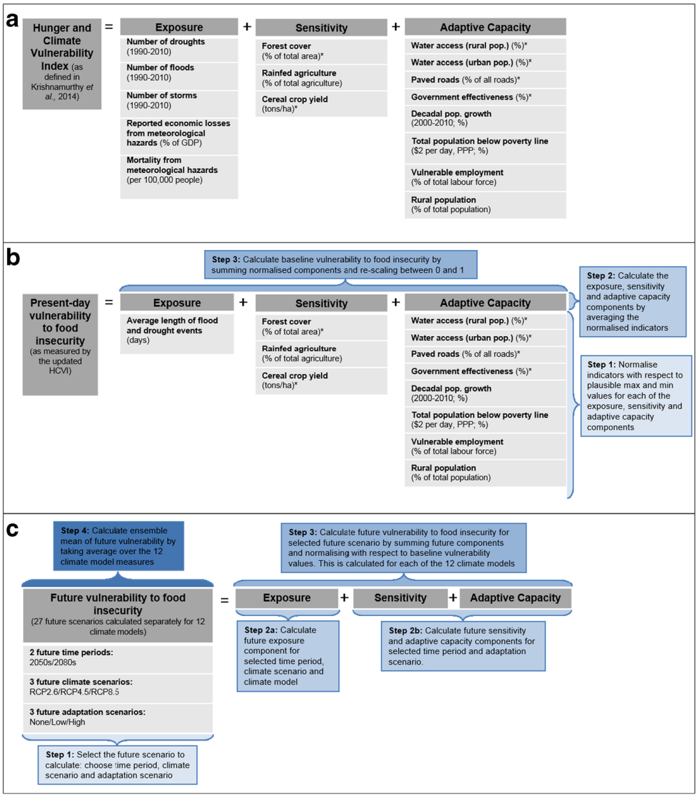
Climate change is a potential threat to achieving food security, particularly in the most food insecure regions. However, interpreting climate change projections to better understand the potential impacts of a changing climate on food security outcomes is challenging. This paper addresses this challenge through presenting a framework that enables rapid country-level assessment of vulnerability to food insecurity under a range of climate change and adaptation investment scenarios. The results show that vulnerability to food insecurity is projected to increase under all emissions scenarios, and the geographic distribution of vulnerability is similar to that of the present-day; parts of sub-Saharan Africa and South Asia are most severely affected. High levels of adaptation act to off-set these increases; however, only the scenario with the highest level of mitigation combined with high levels of adaptation shows improvements in vulnerability compared to the present-day. The results highlight the dual requirement for mitigation and adaptation to avoid the worst impacts of climate change and to make gains in tackling food insecurity. The approach is an update to the existing Hunger and Climate Vulnerability Index methodology to enable future projections, and the framework presented allows rapid updates to the results as and when new information becomes available, such as updated country-level yield data or climate model output. This approach provides a framework for assessing policy-relevant human food security outcomes for use in long-term climate change and food security planning; the results have been made available on an interactive website for policymakers ( www.metoffice.gov.uk/food-insecurity-index ).
Overview
The claims and statistics of this paper haven’t been checked yet.
Free: it reads the open-access text and checks the first 5 claims that cite a source we can check. Create a free account to check every claim.
Integrity signals
Registry
Cites
Statistics
Figures
Verification
Claims the paper makes
The claims and statistics of this paper haven’t been checked yet.
Free: it reads the open-access text and checks the first 5 claims that cite a source we can check. Create a free account to check every claim.
Claims other papers make about this one
Each is checked against this paper’s own text: does it say what the citing paper says it does?
In the citing paper
“Around 815 million people are affected by malnutrition, hindering sustainable development programs to achieve the universal goal of eliminating hunger by 2030 [15].”
From Impact of Climate Change on Crops Adaptation and Strategies to Tackle Its Outcome: A Review (2019) · cites this paper as [15]
Self-check
Percentages, sums and reported differences re-computed from the paper’s own numbers.
The self-check needs the paper’s full text.
Citations
Cites
An Overview of CMIP5 and the Experiment Design
Taylor, K. E., Stouffer, R. J., & Meehl, G. A. (2012) · Bulletin of the American Meteorological Society · doi:10.1175/bams-d-11-00094.1 · Cited by 14,052 · cited 1×
“Future projections of the exposure component of the index were calculated using daily precipitation data from a subset of 12 GCMs from the CMIP5 multi-model ensemble (Taylor et al. 2012), used to inform the Intergovernmental Panel on Climate Change Fifth Assessment Report (IPCC AR5; IPCC 2013).”
MethodThe representative concentration pathways: an overview
van Vuuren, D. P., Edmonds, J., Kainuma, M., Riahi, K., Thomson, A., Hibbard, K., Hurtt, G. C., Kram, T., Krey, V., Lamarque, J.-F., et al. (2011) · Climatic Change · doi:10.1007/s10584-011-0148-z · Cited by 7,741 · cited 2×
“5 (van Vuuren et al. 2011a), for two future time periods; the 2050s (2041–2070) and the 2080s (2071–2100).”
BackgroundClimate Trends and Global Crop Production Since 1980
Lobell, D. B., Schlenker, W., & Costa-Roberts, J. (2011) · Science · doi:10.1126/science.1204531 · Cited by 4,546 · cited 2×
“2014), impacts on access focusing on food prices (Nelson et al. 2010; Lobell et al. 2011) and impacts on utilisation focusing on nutrition outcomes (Thompson and Cohen 2012).”
BackgroundClimate Change Impacts on Global Food Security
Wheeler, T., & von Braun, J. (2013) · Science · doi:10.1126/science.1239402 · Cited by 3,487
Prioritizing Climate Change Adaptation Needs for Food Security in 2030
Lobell, D. B., Burke, M. B., Tebaldi, C., Mastrandrea, M. D., Falcon, W. P., & Naylor, R. L. (2008) · Science · doi:10.1126/science.1152339 · Cited by 3,105
The State of Food Insecurity in the World
WFP, W. (2015) · Cited by 2,947
A new scenario framework for climate change research: the concept of shared socioeconomic pathways
O’Neill, B. C., Kriegler, E., Riahi, K., Ebi, K. L., Hallegatte, S., Carter, T. R., Mathur, R., & van Vuuren, D. P. (2014) · Climatic Change · doi:10.1007/s10584-013-0905-2 · Cited by 2,716 · cited 1×
“Adjusting the components of the index in line with the Shared Socio-economic Pathways (SSPs; O’Neill et al. 2014) was also unfeasible, mainly because the SSPs do not contain all the information required on the individual indicators.”
MethodParry, M. L., Rosenzweig, C., Iglesias, A., Livermore, M., & Fischer, G. (2004) · Global Environmental Change · doi:10.1016/j.gloenvcha.2003.10.008 · Cited by 1,806
Hahn, M. B., Riederer, A. M., & Foster, S. O. (2009) · Global Environmental Change · doi:10.1016/j.gloenvcha.2008.11.002 · Cited by 1,624
Beneficial biofuels—the food, energy, and environment trilemma
Tilman, D., Socolow, R., Foley, J. A., Hill, J., Larson, E., Lynd, L., Pacala, S., Reilly, J., Searchinger, T., Somerville, C., et al. (2009) · Science · doi:10.1126/science.1177970 · Cited by 1,596 · cited 2×
“6 scenario assumes that some proportion of agricultural land is given over to biofuels (Tilman et al. 2009) to meet bio-energy requirements for climate mitigation (van Vuuren et al.”
Background
Research works printed but not linked: 3
- Foresight (2011) The future of food and farming: final project report. The Government Office for Science, London
- IPCC (2013) Climate Change 2013: The Physical Science Basis. Contribution of Working Group I to the Fifth Assessment Report of the Intergovernmental Panel on Climate Change [Stocker, T.F., D. Qin, G.-K. Plattner, M. Tignor, S.K. Allen, J. Boschung, A. Nauels, Y. Xia, V. Bex and P.M. Midgley (eds.)]. Cambridge University Press, Cambridge, United Kingdom and New York, NY, USA, 1535 pp.
- OECD (2011) OECD regional typology. OECD, Paris
Cited by
Impact of Climate Change on Crops Adaptation and Strategies to Tackle Its Outcome: A Review
Raza, A., Razzaq, A., Mehmood, S. S., Zou, X., Zhang, X., Lv, Y., & Xu, J. (2019) · Plants · doi:10.3390/plants8020034 · Cited by 1,762
“Around 815 million people are affected by malnutrition, hindering sustainable development programs to achieve the universal goal of eliminating hunger by 2030 [15].”
BackgroundViana, C. M., Freire, D., Abrantes, P., Rocha, J., & Pereira, P. (2022) · Science of The Total Environment · doi:10.1016/j.scitotenv.2021.150718 · Cited by 593
“The increase of ex-tremeevents (e.g., droughts and fl oods) and the increasingfrequency of pests and diseases associated with climate change can be responsible for crop failure or destruction (e.g., Richardson et al., 2018; Spence et al., 2020).”
BackgroundKey Risks across Sectors and Regions
(2023) · Climate Change 2022 – Impacts, Adaptation and Vulnerability · doi:10.1017/9781009325844.025 · Cited by 189
Mapping the effects of drought on child stunting
Cooper, M. W., Brown, M. E., Hochrainer-Stigler, S., Pflug, G., McCallum, I., Fritz, S., Silva, J., & Zvoleff, A. (2019) · Proceedings of the National Academy of Sciences · doi:10.1073/pnas.1905228116 · Cited by 156
Betts, R. A., Alfieri, L., Bradshaw, C., Caesar, J., Feyen, L., Friedlingstein, P., Gohar, L., Koutroulis, A., Lewis, K., Morfopoulos, C., et al. (2018) · Philosophical Transactions of the Royal Society A: Mathematical, Physical and Engineering Sciences · doi:10.1098/rsta.2016.0452 · Cited by 179
“The proxies were therefore masked to only include data where a significant proportion of people live and grow crops before aggregating to country level and combining to comprise a measure of exposure [23]; nevertheless, it is recognized that precipitation data alone may not always be adequate for representing flood an…”
MethodInfluentialSelf-citationSaptutyningsih, E., Diswandi, D., & Jaung, W. (2019) · Land Use Policy · doi:10.1016/j.landusepol.2019.104189 · Cited by 195
Climate change adaptation strategies, productivity and sustainable food security in southern Mali
Diallo, A., Donkor, E., & Owusu, V. (2020) · Climatic Change · doi:10.1007/s10584-020-02684-8 · Cited by 170
Climate Resilient Development Pathways
(IPCC), I. P. O. C. C. (2023) · Cambridge University Press eBooks · doi:10.1017/9781009325844.027 · Cited by 152
Global water availability under high-end climate change: A vulnerability based assessment
Koutroulis, A., Papadimitriou, L. V., Grillakis, M. G., Tsanis, I. K., Warren, R., & Betts, R. (2019) · Global and Planetary Change · doi:10.1016/j.gloplacha.2019.01.013 · Cited by 132
The future of human malnutrition: rebalancing agency for better nutritional health
Wells, J. C. K., Marphatia, A. A., Amable, G. S., Siervo, M., Friis, H., Miranda, J. J., Haisma, H. H., & Raubenheimer, D. (2021) · Globalization and Health · doi:10.1186/s12992-021-00767-4 · Cited by 130
Berthou, S., Rowell, D. P., Kendon, E., Roberts, M. J., Stratton, R. A., Crook, J. A., & Wilcox, C. (2019) · Climate Dynamics · doi:10.1007/s00382-019-04759-4 · Cited by 110
Exploring global food system shocks, scenarios and outcomes
Hamilton, H., Henry, R., Rounsevell, M., Moran, D., Cossar, F., Allen, K., Boden, L., & Alexander, P. (2020) · Futures · doi:10.1016/j.futures.2020.102601 · Cited by 115
“T increasingly vulnerable to shocks (Richardson et al., 2018).”
Climate risk to agriculture: A synthesis to define different types of critical moments
Shah, H., Hellegers, P., & Siderius, C. (2021) · Climate Risk Management · doi:10.1016/j.crm.2021.100378 · Cited by 90
Potentials of underutilized legumes in food security
Ayilara, M. S., Abberton, M. T., Oyatomi, O., Odeyemi, O., & Babalola, O. O. (2022) · Frontiers in Soil Science · doi:10.3389/fsoil.2022.1020193 · Cited by 75
How much does climate change add to the challenge of feeding the planet this century?
Aggarwal, P. K., Vyas, S., Thornton, P. K., & Campbell, B. (2019) · Environmental Research Letters · doi:10.1088/1748-9326/aafa3e · Cited by 82
“Although our results show smaller country-level impacts of climate change after adoption of improved agricultural practices and technologies, even these could be critical for food security of many countries [34], especially where the current crop yield growth rate is low or already lagging behind future crop demand an…”
ResultAdnan, M., Xiao, B., Bibi, S., Xiao, P., Zhao, P., Wang, H., Ali, M. U., & An, X. (2024) · Sustainability · doi:10.3390/su16146108 · Cited by 86
“Alterations to the freshwater portion of the Earth’s hydrological system are gradually escalating in various areas, but the primary factors contributing to this phenomenon are human population growth, industrialization, water scarcity, and changes in precipitation and run-off patterns linked to…”
Suryanto, S., & Rahman, A. (2019) · Jàmbá Journal of Disaster Risk Studies · doi:10.4102/jamba.v11i1.739 · Cited by 64
“Vulnerability Index or LVI was developed by Hahn, Riederer and Foster (2009), Madhuri, Thewari, and Bhowmick (2014), Simane, Zaitchik and Foltz (2016) and Richardson et al. (2018).”
BackgroundAnalysis of drought and vulnerability in the North Darfur region of Sudan
Mohmmed, A., Zhang, K., Kabenge, M., Keesstra, S. D., Cerdà, A., Makomere, R., Elbashier, M. M. A., Dalson, T., & Ali, A. A. S. (2018) · Land Degradation and Development · doi:10.1002/ldr.3180 · Cited by 56
“Similar to the other risk assessment frameworks (Krishnamurthy et al., 2014; Richardson et al., 2018), the indicator‐based risk assessment frame-”
BackgroundResultClimate Vulnerability in Rainfed Farming: Analysis from Indian Watersheds
Sathyan, A. R., Funk, C., Aenis, T., & Breuer, L. (2018) · Sustainability · doi:10.3390/su10093357 · Cited by 60
“We modified well-established approaches for estimating climate vulnerability and the existing indices according to the local situation, addressing rain fed farming systems in particular [31,33,65,66].”
The effect of climate change on food insecurity in the Horn of Africa
Bedasa, Y., & Bedemo, A. (2022) · GeoJournal · doi:10.1007/s10708-022-10733-1 · Cited by 60
Bazzi, H., Baghdadi, N. N., Amin, G., Fayad, I., Zribi, M., Demarez, V., & Belhouchette, H. (2021) · Remote Sensing · doi:10.3390/rs13132584 · Cited by 48
“The current changing climate has altered the frequency and severity of extreme hydrological events [1] causing adverse impacts on crop production [2] and endangering food security [3].”
BackgroundHeat-health vulnerability in temperate climates: lessons and response options from Ireland
Paterson, S. K., & Godsmark, C. N. (2020) · Globalization and Health · doi:10.1186/s12992-020-00554-7 · Cited by 51
Krishnamurthy, P. K., Choularton, R., & Kareiva, P. (2020) · Global Food Security · doi:10.1016/j.gfs.2020.100374 · Cited by 47
Self-citationClimate change in relation to agriculture: A review
Liaqat, W., Barutçular, C., Farooq, M. U., Ahmad, H., Jan, M. F., Ahmad, Z., Nawaz, H., & Li, M. (2022) · Spanish Journal of Agricultural Research · doi:10.5424/sjar/2022202-17742 · Cited by 52
Tirado, C., Pol, J. L. V., Kerr, R. B., & Krishnamurthy, P. K. (2022) · Current Climate Change Reports · doi:10.1007/s40641-022-00181-x · Cited by 52
Self-citationNatural disasters and challenges toward achieving food security response in Iran
Ainehvand, S., Raeissi, P., Ravaghi, H., & Maleki, M. (2019) · Journal of Education and Health Promotion · doi:10.4103/jehp.jehp_256_18 · Cited by 41
“Their findings suggest that climate drivers will intensify food security risks in the absence of sufficient mitigation and adaptation.[20]”
BackgroundDo you bend or break? System dynamics in resilience planning for food security
de Leon, H. J. H., & Kopainsky, B. (2019) · System Dynamics Review · doi:10.1002/sdr.1643 · Cited by 39
“Climate change and other factors are threatening progress towards increased food security (Richardson et al., 2018; Campbell et al., 2016; Ericksen, 2008b; Schmidhuber and Tubiello, 2007; Vermeulen et al., 2012; Wheeler and von Braun, 2013).”
BackgroundKrishnamurthy, P. K., Fisher, J. B., SCHIMEL, D. S., & Kareiva, P. (2020) · Earth s Future · doi:10.1029/2019ef001456 · Cited by 40
Self-citationSanga, U., Sidibé, A., & Olabisi, L. S. (2021) · World Development · doi:10.1016/j.worlddev.2021.105663 · Cited by 43
Hartley, A. J., & Tandon, A. (2022) · Frontiers for Young Minds · doi:10.3389/frym.2022.716479 · Cited by 37
Abubakar, M., Chanzy, A., Flamain, F., Pouget, G., & Courault, D. (2023) · Remote Sensing · doi:10.3390/rs15092420 · Cited by 35
Climate change in the hottest wheat regions
Tesfaye, K. (2021) · Nature Food · doi:10.1038/s43016-020-00218-0 · Cited by 29
Impact of climate change on food security of small islands: The case of Mauritius
Brizmohun, R. (2019) · Natural Resources Forum · doi:10.1111/1477-8947.12172 · Cited by 27
Versluys, M., Öner, E. T., & den Ende, W. V. (2022) · Journal of Experimental Botany · doi:10.1093/jxb/erac140 · Cited by 27
Climate Change Risks for Agriculture, Health, and Nutrition
von Braun, J. (2020) · Springer eBooks · doi:10.1007/978-3-030-31125-4_11 · Cited by 30
Walters, S. A., Mimouni, A., & Bouharroud, R. (2021) · Climate · doi:10.3390/cli9080129 · Cited by 28
“World food security is a challenge that must be met in part by mitigating plant responses to climate change, while at the same time, conserving essential natural resources so that effective food production activities can be sustained for generations [3,5].”
BackgroundPereira, L. M., Kushitor, S. B., Cramer, C., Drimie, S., Isaacs, M., Malgas, R. R., Phiri, E. E., Tembo, C. P., & Willis, J. (2022) · Sustainability Science · doi:10.1007/s11625-022-01182-3 · Cited by 29
“Nonetheless, the natural biodiversity that underpins the persistence of fynbos wild edible species is currently threatened by conventional agriculture, urbanisation, encroachment by alien invasive species, and climate change (Midg-ley and Bond 2015; Richardson et al. 2018; Ntshanga et al. 2021).”
Impactos del cambio climático en la producción de maíz en México
Cruz-González, A., Arteaga-Ramírez, R., Cohen, I. S., Soria-Ruíz, J., & Monterroso-Rivas, A. I. (2024) · Revista Mexicana de Ciencias Agrícolas · doi:10.29312/remexca.v15i1.3327 · Cited by 33
What Do Weather Disasters Cost? An Analysis of Weather Impacts in Tanzania
Msemo, H. E., Taylor, A. L., Birch, C. E., Dougill, A. J., Hartley, A. J., & Woodhams, B. J. (2021) · Frontiers in Climate · doi:10.3389/fclim.2021.567162 · Cited by 25
“They further affect the food quality and safety; increase risks of outbreaks of animal and crop diseases and pests (Richardson et al., 2018; World Health Organization, 2019).”
BackgroundAgarwala, C., Jemaneh, J., & Kassie, Y. (2022) · Law and Economics · doi:10.35335/laweco.v16i2.53 · Cited by 23
How are climate actions evaluated? A review of United Nations food security evaluations
Lâm, S., Dodd, W., Berrang‐Ford, L., Ford, J. D., Skinner, K. A., Papadopoulos, A., & Harper, S. L. (2021) · Global Food Security · doi:10.1016/j.gfs.2021.100509 · Cited by 23
Gobezie, Y. M., & Boka, J. B. (2023) · Cogent Economics & Finance · doi:10.1080/23322039.2023.2273590 · Cited by 22
“This finding is consistent with results by (Affoh et al., 2022; Islam et al., 2021; Richardson et al., 2018), which have found that, rise in temperature, increase in carbon emission, and depletion of water resource results food insecurity.”
ResultBazzi, H., Baghdadi, N. N., Najem, S., Jaafar, H. H., Page, M. L., Zribi, M., Faraslis, I. N., & Spiliotopoulos, M. G. (2022) · Agronomy · doi:10.3390/agronomy12112725 · Cited by 22
Ibrahim, R. L., Al‐mulali, U., Ajide, K. B., Mohammed, A., & Al‐Faryan, M. A. S. (2023) · Sustainability · doi:10.3390/su15032089 · Cited by 26
Sonko, E., Florkowski, W. J., Agodzo, S. K., & Antwi‐Agyei, P. (2020) · Food Security · doi:10.1007/s12571-020-01024-z · Cited by 22
Plants Response to Different Abiotic Stresses
Jan, S., Bhat, M. A., Kumar, A., Wani, M. A., Bhat, F. A., Kanth, R. H., Shikari, A. B., Bano, H., Manzoor, T., Altaf, H., et al. (2025) · Journal of Plant Diseases and Protection · doi:10.1007/s10343-025-01201-0 · Cited by 23
“Approximately 815 million people are currently malnourished, creating a serious challenge to meeting the global goal of ending hunger by 2030 (Richardson et al. 2018).”
Karki, S., Burton, P., Mackey, B., & Alston‐Knox, C. (2021) · Environment Development and Sustainability · doi:10.1007/s10668-021-01262-x · Cited by 20
Justice in Finnish Food Policies
Puupponen, A., Huttunen, S., Kortetmäki, T., Lahteenmäki‐Uutela, A., & Kaljonen, M. (2023) · Food Ethics · doi:10.1007/s41055-022-00117-z · Cited by 20
“Drawing on recent literature and discourse framings that emphasize food and nutrition security (e.g., Ericksen 2008; Richardson et al. 2018; Stefanovic et al. 2020; Kaljonen et al. 2021), we define the key desired food system outcomes as (1) food security and nutrition, (2) livelihoods and fair income, and (3) environ…”
BackgroundThe impact of forage condition on household food security in northern Kenya and southern Ethiopia
Alulu, V., Shikuku, K. M., Lepariyo, W., Paliwal, A., Galgallo, D., Gobu, W., & Banerjee, R. (2024) · Food Security · doi:10.1007/s12571-024-01473-w · Cited by 21
“Efforts to improve food security in the fragile settings in SSA, including pastoral contexts, emphasize the need for accurate early warning information to enable households to prepare and respond better to drought (Banerjee et al., 2022; Lentz et al., 2019; Richardson et al., 2018).”
Livestock exposure to future cumulated climate-related stressors in West Africa
Brouillet, A., & Sultan, B. (2023) · Scientific Reports · doi:10.1038/s41598-022-22544-y · Cited by 21
Vinzant, K., Rashid, M., Clouse, D. E., Ghosh, P., Quadir, M., Davis, V. A., & Khodakovskaya, M. V. (2025) · Nano Letters · doi:10.1021/acs.nanolett.4c05489 · Cited by 17
Women and climate change adaptation behaviour: What’s the problem and solution?
Goli, I., Najafabadi, M. O., Lashgarara, F., Tanaskovik, V., Chukaliev, O., Viira, A., Pour, M., Sklenička, P., Janečková, K., & Azadi, H. (2022) · Climate and Development · doi:10.1080/17565529.2022.2121597 · Cited by 18
“While the original model was intended for health protection patterns (health care) study (Rogers, 1975, 1983), it is now used in other areas, such as technical, environmental, and natural hazards (Bubeck et al., 2013) and human adaptation to CC (Bubeck et al., 2013) (Truelove et al., 2015).”
MethodAkram, A., Tahir, A., Alam, A., & Waheed, A. (2025) · PLoS ONE · doi:10.1371/journal.pone.0315398 · Cited by 15
“According to the framework [36,38], Exposure is symbolized by e and it is measured by the number of natural disasters that have happened over the past 5 years, while the climate variability is measured by the average standard deviation of the maximum and minimum monthly temperatures and monthly…”
Breeding Efforts for Crop Productivity in Abiotic Stress Environment
Choudhary, J. R., Get, S., Tripathi, A., Kaldate, R. C., Rana, M., Mehta, S., Ahlawat, J., Bansal, M., Zaid, A., & Wani, S. H. (2022) · Springer eBooks · doi:10.1007/978-981-16-6361-1_5 · Cited by 16
Wheat yield responses to rising temperature: insights from northern plains of India
Kuriachen, P., Devi, A., Sam, A. S., Kumar, S., Kumari, J., Suresh, A., & Jha, G. K. (2022) · Theoretical and Applied Climatology · doi:10.1007/s00704-022-04218-x · Cited by 15
“Any variation in these parameters will increase production variability and reduce yield (Richardson et al. 2018; Nelson et al. 2014; Wheeler and von Braun 2013; Houser et al. 2015).”
BackgroundFood crops, growth and productivity as an important focus for sustainable agriculture
Aly, A. A., & Borik, Z. M. (2023) · Elsevier eBooks · doi:10.1016/b978-0-323-91722-3.00002-6 · Cited by 14
Xing, W., Wang, C., Zhang, L., Chen, B., & Liu, H. (2024) · npj Climate and Atmospheric Science · doi:10.1038/s41612-024-00762-7 · Cited by 15
“Countries in the region exhibit high sensitivity to climate risk while possess limited adaptive capacity due to the inadequate infrastructure 8 .”
Salifu, G. A.-N. (2025) · Cogent Food & Agriculture · doi:10.1080/23311932.2025.2518218 · Cited by 13
“…by the following challenges; demographic growth accelerated by urbanization, insufficient investment in the agricultural sector (chao et al., 2024; Richardson et al., 2018) and changing patterns of food consumption, that is, changes in diet structure toward increased intake of proteins such as…”
InfluentialClimate change and agriculture in Burkina Faso
Bilali, H. E. (2021) · Journal of Aridland Agriculture · doi:10.25081/jaa.2021.v7.6596 · Cited by 14
“For instance, climate-smart agriculture (Abegunde et al., 2019; Makate, 2019; Prestele & Verburg, 2020) does not only allow reducing GHG emissions but also making agriculture more climate-resilient.”
BackgroundInfluentialKropp, I., Nejadhashemi, A. P., Jha, P. K., & Hernandez‐Suarez, J. S. (2022) · Computers and Electronics in Agriculture · doi:10.1016/j.compag.2022.107143 · Cited by 13
Sami, A. A., Arabia, S., Sarker, R. H., & Islam, T. (2021) · Current Plant Biology · doi:10.1016/j.cpb.2021.100204 · Cited by 15
Song, Y., Song, Y., & Wang, Q. (2026) · Foods · doi:10.3390/foods15030426 · Cited by 12
“Compounded by the inherent vulnerabilities of the grain industry and structural contradictions derived from imbalanced internal incentive mechanisms [31], this situation underscores the fact that enhancing resilience cannot be accomplished through internal self-adjustment and optimization alone.”
Introduction: Justice and food security in a changing climate
Wallimann-Helmer, I., & Schübel, H. (2021) · Congress of the European Society for Agricultural and Food Ethics (EurSafe) · doi:10.3920/978-90-8686-915-2_0 · Cited by 11
Centering Microbes in the Emerging Role of Integrative Biology in Understanding Environmental Change
Weems, E. I., de la Sancha, N. U., Anderson, L. J., Zambrana‐Torrelio, C., & Ferraris, R. P. (2021) · Integrative and Comparative Biology · doi:10.1093/icb/icab047 · Cited by 11
Climate change and food security at household level in the central dry zone in Myanmar
Zaw, A. K., & Charoenratana, S. (2023) · Management of Environmental Quality An International Journal · doi:10.1108/meq-11-2022-0300 · Cited by 11
Khan, M., Zhang, Y., & Khan, S. A. (2025) · Research on World Agricultural Economy · doi:10.36956/rwae.v6i1.1106 · Cited by 16
Climate change, global population growth, and humanoid robots
McBride, J. (2021) · Journal of Future Robot Life · doi:10.3233/frl-200016 · Cited by 10
Patel, S., Mall, R. K., Jaiswal, R., Singh, R. K., & Chand, R. (2022) · International Journal of Plant Production · doi:10.1007/s42106-022-00208-1 · Cited by 12
Kumar, N., & Khurana, S. P. (2023) · Wiley eBooks · doi:10.1002/9781119858553.ch6 · Cited by 11
Varela, R. P., Balanay, R. M., & Halog, A. (2021) · Springer eBooks · doi:10.1007/978-981-33-4538-6_7 · Cited by 10
Risk-adjusted decision making can help protect food supply and farmer livelihoods in West Africa
Leip, D., Rovenskaya, E., & Wildemeersch, M. (2024) · Communications Earth & Environment · doi:10.1038/s43247-024-01242-9 · Cited by 10
Pinto, A. D., Smith, V., & Robertson, R. (2019) · Climate Research · doi:10.3354/cr01581 · Cited by 11
Changes in land capability for agriculture under climate change in Wales
Hannam, J., Keay, C. A., Mukherjee, K., Rugg, I., Williams, A., & Cooke, J. (2025) · The Science of The Total Environment · doi:10.1016/j.scitotenv.2025.179790 · Cited by 9
Stevens, F. R., Gaughan, A. E., Salerno, J., Pricope, N. G., Cassidy, L., Bailey, K., Hartter, J., Drake, M. D., Weaver, A., Kolarik, N. E., et al. (2023) · Journal of Land Use Science · doi:10.1080/1747423x.2023.2226140 · Cited by 9
“Households that diversify their livelihoods as an adaptation strategy will have lower overall vulnerability, greater adaptability (Cassidy & Barnes, 2012; Shackleton & Shackleton, 2006) and face less food insecurity (Richardson et al., 2018).”
BackgroundBiochar Application for Improving the Yield and Quality of Crops Under Climate Change
Majumder, D., Saha, S., Mukherjee, B., Das, S., Rahman, F. H., & Hossain, A. (2023) · Sustainable agriculture reviews · doi:10.1007/978-3-031-26983-7_1 · Cited by 8
Kori, D. S., Zhou, L., & Sibanda, M. (2023) · Frontiers in Sustainable Food Systems · doi:10.3389/fsufs.2023.1139078 · Cited by 10
A gendered analysis of adaptive capacity and food security in Makueni County, Kenya
Machio, P. M., Sallu, S. M., Waized, B., Mwanri, A. W., & Duodu, K. G. (2025) · Frontiers in Sustainable Food Systems · doi:10.3389/fsufs.2024.1494475 · Cited by 8
Ntiamoah, E. B., Li, D., Ameyaw, B., Sarpong, D. B., Twumasi, M. A., & Nyamah, E. Y. (2022) · Natural Resources Forum · doi:10.1111/1477-8947.12248 · Cited by 8
Regmi, H. P., Upendram, S., Cho, S., & Clark, C. D. (2022) · Climate and Development · doi:10.1080/17565529.2022.2107980 · Cited by 8
OLUWOLE, O. B., & Olagunju-Yusuf, O. F. (2022) · Springer eBooks · doi:10.1007/978-3-031-09614-3_12 · Cited by 9
Ojogiwa, O. T., & Mubangizi, B. C. (2023) · African Journal of Governance and Development (AJGD) · doi:10.36369/2616-9045/2023/v12i2a9 · Cited by 7
Karakuş, Y., Onat, G., & Yılmaz, D. S. (2025) · Sustainability · doi:10.3390/su17030924 · Cited by 7
Mondal, K., Gupta, V. K., Chatterjee, C., & Singh, R. P. (2025) · Water science and technology library · doi:10.1007/978-3-031-76532-2_8 · Cited by 7
Sustainable Farming to Achieve Future-proof Food Security
Amghani, M. S., Sarani, V., Savari, M., & Sheykhi, H. (2025) · Emerald Group Publishing Limited eBooks · doi:10.1108/978-1-83608-388-720251004 · Cited by 7
Climate change–food security nexus in Burkina Faso
Bilali, H. E. (2021) · CABI Reviews · doi:10.1079/pavsnnr202116009 · Cited by 10
Development of Better Wheat Plants for Climate Change Conditions
Akram, S., Ghaffar, M., Wadood, A., & Arif, M. A. R. (2022) · IntechOpen eBooks · doi:10.5772/intechopen.106206 · Cited by 8
Yawson, D. O., Armah, F. A., & Adu, M. O. (2020) · SN Applied Sciences · doi:10.1007/s42452-020-2444-6 · Cited by 6
Bazzi, H., Baghdadi, N. N., & Zribi, M. (2022) · Water · doi:10.3390/w14091341 · Cited by 6
Kumar, K. A., Malleswari, S. N., Sudheer, K. V. S., Bal, S. K., Manikandan, N., Rao, A. V. M. S., & Chandran, M. A. S. (2025) · Agronomy Journal · doi:10.1002/agj2.70020 · Cited by 5
Food Security Issues in Changing Climate
Javeed, H. M. R., Ali, M., Qamar, R., Sarwar, M. A., Jabeen, R., Ihsan, M. Z., Zamir, M. S. I., Shahzad, M., Khalid, S., Saeed, M. F., et al. (2023) · Springer eBooks · doi:10.1007/978-3-031-26692-8_6 · Cited by 5
The Impact of Climate Change on Food Insecurity in The Southern African Development Community
Mavodyo, E. (2023) · Journal of Developing Economies · doi:10.20473/jde.v8i1.43534 · Cited by 5
“…livelihood conditions as a result of climate change can escalate grievances, particularly among marginalized and disadvantaged groups, and heighten tensions over access to and control over resources and livelihood options ( Davis & Vincent, 2017 ; Mobjörk et al., 2020; Richardson et al., 2018).”
BackgroundShaping Equitable Access to Food: Barcelona’s Supply Planning and Policies in Perspective
Escoda, E. M. G. (2025) · Urban Planning · doi:10.17645/up.9489 · Cited by 4
“Urban areas, particularly those with lower incomes, which are often characterized by a prevalence of unhealthy food options, have been termed “food swamps” and are associated with dietary imbalances and increased health risks (Cooksey‐Stowers et al., 2017; Richardson et al., 2018).”
Community Livelihood Vulnerability of Tanah Merah and Lobuk in Sumenep Regency to Climate Change
Iliyyan, D. U., Boer, R., & Hidayati, R. (2022) · Agromet · doi:10.29244/j.agromet.36.2.88-100 · Cited by 4
Anggoro, T., Saptutyningsih, E., & Hartarto, R. B. (2025) · Local Environment · doi:10.1080/13549839.2025.2462538 · Cited by 4
“Consequently, there is a looming threat to food security, as highlighted by numerous studies (Richardson et al. 2018; El Mokhtar et al., 2019; El Bilali et al., 2020).”
Are SACU countries self-sufficient in cereals? A dynamic panel analysis
von Bach, H. J. S., & Kalundu, K. M. (2022) · Agrekon · doi:10.1080/03031853.2022.2052124 · Cited by 4
Climate Resilience Technologies for Wheat Production
Ahmad, Z., Waraich, E. A., Barutçular, C., Hina, A., Abbasi, A., Mohiuddin, M., Haq, I. U., Ayub, M. A., & Sana, S. (2023) · Springer eBooks · doi:10.1007/978-3-031-37428-9_9 · Cited by 6
Pérez, N. I. P., & Jerez, Y. I. P. (2025) · ASCE MAGAZINE · doi:10.70577/asce.v4i4.510 · Cited by 3
Ríos-Romero, A., Valdez‐Cepeda, R. D., Torres-González, J. A., Navarrete-Molina, C., & López-Santos, A. (2024) · Modeling Earth Systems and Environment · doi:10.1007/s40808-024-01959-8 · Cited by 3
Mondal, K., Gupta, V. K., Chatterjee, C., & Singh, R. P. (2025) · Energy and Climate Change · doi:10.1016/j.egycc.2025.100221 · Cited by 2
Cheng, J., & Liu, Y. (2026) · PLoS ONE · doi:10.1371/journal.pone.0340775 · Cited by 2
Metadata
- Authors
- Richardson, K. J., Lewis, K. H., Krishnamurthy, P. K., Kent, C., Wiltshire, A. J., & Hanlon, H. M.
- Affiliations
- Met Office (GB)
- World Food Programme (IT)
- Corresponding author
- Richardson, Katy J.
- Venue
- Climatic Change
- Published
- 2018-02-03
- Volume
- 147
- Issue
- 1-2
- Pages
- 327-341
- ISSN
- 0165-0009 (ISSN-L)
- 1573-1480
- OpenAlex
- W2786215372
- Cited by
- 130
- References
- 26
- Citations by year
- 2026: 9 · 2025: 22 · 2024: 11 · 2023: 20 · 2022: 22 · 2021: 21 · 2020: 10 · 2019: 11 · 2018: 4
- FWCI
- 9.71
- Type
- journal article
- Language
- en
- Open access
- hybrid
- doi.org
- Licence
- cc-by
- creativecommons.org/licenses/by/4.0 (tdm)
- Locations
- Climatic Change (publishedVersion, cc-by)
- RePEc: Research Papers in Economics (submittedVersion)
- INFM-OAR (INFN Catania) (submittedVersion, cc-by)
- Funders
- U.S. Department of Energy
- Sveriges Regering
- Topics
- Life Sciences › Agricultural and Biological Sciences › Agronomy and Crop Science › Climate change impacts on agriculture
- Life Sciences › Agricultural and Biological Sciences › General Agricultural and Biological Sciences › Food Security and Socioeconomic Dynamics
- Physical Sciences › Environmental Science › Ecology › Agriculture Sustainability and Environmental Impact
- Keywords
- food security, climate change impacts, climate change mitigation, climate change adaptation, emission scenarios, crop yield projections, sub-Saharan Africa, South Asia
About these checks
Registry, retraction, Cites and statistics results are computed, not judged, with one exception: a printed reference that no index lists is read once by a model before it counts as a citation error. Claims are extracted by a model and kept only when their quote appears verbatim in the text; each cited source is then checked, with a model’s help, for whether it says what the claim relies on. Those verdicts can be wrong — read the claim’s quote and the cited source before relying on one.
Statistics and arithmetic are recomputed, not judged.
Confidence bands are shown only for fields calibrated on our annotated test set. None is calibrated yet, so no band is shown.
What counts as a claim ›How we measure confidence ›How we check this ›
Are you an author, or do you see a problem with this page? Request a review
Data sources
Bibliographic data: Semantic Scholar, OpenAlex, Crossref.
Contains information from the Semantic Scholar Academic Graph Datasets, made available under the ODC Attribution License (ODC-BY 1.0).
Semantic Scholar’s data is described in: Kinney, R., et al. (2023). The Semantic Scholar Open Data Platform. arXiv:2301.10140.
