

Food security outcomes under a changing climate: impacts of mitigation and adaptation on vulnerability to food insecurity
Open accessThe DOI matches its Crossref record; 25 of the 26 references it cites were found in a registry or an index.
Abstract
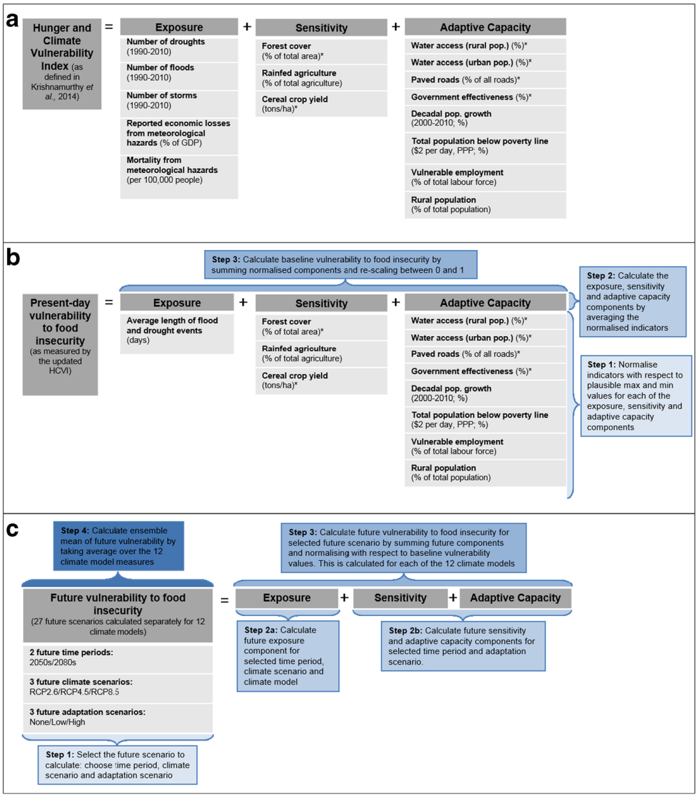
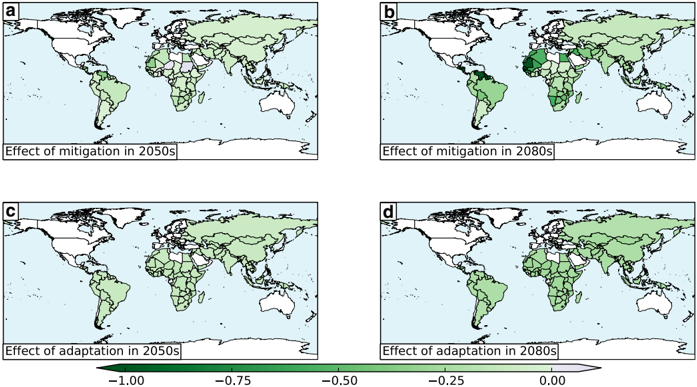
Climate change is a potential threat to achieving food security, particularly in the most food insecure regions. However, interpreting climate change projections to better understand the potential impacts of a changing climate on food security outcomes is challenging. This paper addresses this challenge through presenting a framework that enables rapid country-level assessment of vulnerability to food insecurity under a range of climate change and adaptation investment scenarios. The results show that vulnerability to food insecurity is projected to increase under all emissions scenarios, and the geographic distribution of vulnerability is similar to that of the present-day; parts of sub-Saharan Africa and South Asia are most severely affected. High levels of adaptation act to off-set these increases; however, only the scenario with the highest level of mitigation combined with high levels of adaptation shows improvements in vulnerability compared to the present-day. The results highlight the dual requirement for mitigation and adaptation to avoid the worst impacts of climate change and to make gains in tackling food insecurity. The approach is an update to the existing Hunger and Climate Vulnerability Index methodology to enable future projections, and the framework presented allows rapid updates to the results as and when new information becomes available, such as updated country-level yield data or climate model output. This approach provides a framework for assessing policy-relevant human food security outcomes for use in long-term climate change and food security planning; the results have been made available on an interactive website for policymakers ( www.metoffice.gov.uk/food-insecurity-index ).
Overview
The claims and statistics of this paper haven’t been checked yet.
Free: it reads the open-access text and checks the first 5 claims that cite a source we can check. Create a free account to check every claim.
Integrity signals
Registry
Cites
Statistics
Figures
Verification
Claims the paper makes
The claims and statistics of this paper haven’t been checked yet.
Free: it reads the open-access text and checks the first 5 claims that cite a source we can check. Create a free account to check every claim.
Claims other papers make about this one
Each is checked against this paper’s own text: does it say what the citing paper says it does?
In the citing paper
“Around 815 million people are affected by malnutrition, hindering sustainable development programs to achieve the universal goal of eliminating hunger by 2030 [15].”
From Impact of Climate Change on Crops Adaptation and Strategies to Tackle Its Outcome: A Review (2019) · cites this paper as [15]
Self-check
Percentages, sums and reported differences re-computed from the paper’s own numbers.
The self-check needs the paper’s full text.
Citations
Cites
An Overview of CMIP5 and the Experiment Design
Taylor, K. E., Stouffer, R. J., & Meehl, G. A. (2012) · Bulletin of the American Meteorological Society · doi:10.1175/bams-d-11-00094.1 · Cited by 14,052 · cited 1×
“Future projections of the exposure component of the index were calculated using daily precipitation data from a subset of 12 GCMs from the CMIP5 multi-model ensemble (Taylor et al. 2012), used to inform the Intergovernmental Panel on Climate Change Fifth Assessment Report (IPCC AR5; IPCC 2013).”
MethodThe representative concentration pathways: an overview
van Vuuren, D. P., Edmonds, J., Kainuma, M., Riahi, K., Thomson, A., Hibbard, K., Hurtt, G. C., Kram, T., Krey, V., Lamarque, J.-F., et al. (2011) · Climatic Change · doi:10.1007/s10584-011-0148-z · Cited by 7,741 · cited 2×
“5 (van Vuuren et al. 2011a), for two future time periods; the 2050s (2041–2070) and the 2080s (2071–2100).”
BackgroundClimate Trends and Global Crop Production Since 1980
Lobell, D. B., Schlenker, W., & Costa-Roberts, J. (2011) · Science · doi:10.1126/science.1204531 · Cited by 4,546 · cited 2×
“2014), impacts on access focusing on food prices (Nelson et al. 2010; Lobell et al. 2011) and impacts on utilisation focusing on nutrition outcomes (Thompson and Cohen 2012).”
BackgroundClimate Change Impacts on Global Food Security
Wheeler, T., & von Braun, J. (2013) · Science · doi:10.1126/science.1239402 · Cited by 3,487
Prioritizing Climate Change Adaptation Needs for Food Security in 2030
Lobell, D. B., Burke, M. B., Tebaldi, C., Mastrandrea, M. D., Falcon, W. P., & Naylor, R. L. (2008) · Science · doi:10.1126/science.1152339 · Cited by 3,105
The State of Food Insecurity in the World
WFP, W. (2015) · Cited by 2,947
A new scenario framework for climate change research: the concept of shared socioeconomic pathways
O’Neill, B. C., Kriegler, E., Riahi, K., Ebi, K. L., Hallegatte, S., Carter, T. R., Mathur, R., & van Vuuren, D. P. (2014) · Climatic Change · doi:10.1007/s10584-013-0905-2 · Cited by 2,716 · cited 1×
“Adjusting the components of the index in line with the Shared Socio-economic Pathways (SSPs; O’Neill et al. 2014) was also unfeasible, mainly because the SSPs do not contain all the information required on the individual indicators.”
MethodParry, M. L., Rosenzweig, C., Iglesias, A., Livermore, M., & Fischer, G. (2004) · Global Environmental Change · doi:10.1016/j.gloenvcha.2003.10.008 · Cited by 1,806
Hahn, M. B., Riederer, A. M., & Foster, S. O. (2009) · Global Environmental Change · doi:10.1016/j.gloenvcha.2008.11.002 · Cited by 1,624
Beneficial biofuels—the food, energy, and environment trilemma
Tilman, D., Socolow, R., Foley, J. A., Hill, J., Larson, E., Lynd, L., Pacala, S., Reilly, J., Searchinger, T., Somerville, C., et al. (2009) · Science · doi:10.1126/science.1177970 · Cited by 1,596 · cited 2×
“6 scenario assumes that some proportion of agricultural land is given over to biofuels (Tilman et al. 2009) to meet bio-energy requirements for climate mitigation (van Vuuren et al.”
Background
Research works printed but not linked: 3
- Foresight (2011) The future of food and farming: final project report. The Government Office for Science, London
- IPCC (2013) Climate Change 2013: The Physical Science Basis. Contribution of Working Group I to the Fifth Assessment Report of the Intergovernmental Panel on Climate Change [Stocker, T.F., D. Qin, G.-K. Plattner, M. Tignor, S.K. Allen, J. Boschung, A. Nauels, Y. Xia, V. Bex and P.M. Midgley (eds.)]. Cambridge University Press, Cambridge, United Kingdom and New York, NY, USA, 1535 pp.
- OECD (2011) OECD regional typology. OECD, Paris
Cited by
Items 101–141 of 141
Functional integration of photonic components for (vertical) urban farming
Dreyer, C. J., Müller, V., Bernaschek, A., Frahm, M., Jankowski, B., Elagroudy, Y., Koppusch, K., Fiedler, T., Eckert, A., Tatai, T. M., et al. (2026) · Photonic Technologies in Plant and Agricultural Science · doi:10.1117/12.3081069 · Cited by 2
“While not all countries are equally affected by these threats, innovative solutions are required to address these challenges and decrease dependency on these factors [4].”
Food insecurity experience during climate shock periods and farmers’ aspiration in Ethiopia
Girma, M. M., Jerneck, A., & Dejen, A. (2023) · Environmental Development · doi:10.1016/j.envdev.2023.100868 · Cited by 2
Kumar, A., Mudgal, S., & Singh, N. (2024) · Springer eBooks · doi:10.1007/978-981-97-7110-3_1 · Cited by 4
Boot camp–style teacher workshops to incorporate hands‐on activities in agricultural sciences
Kaur, J., & Kariyat, R. (2020) · Natural sciences education · doi:10.1002/nse2.20021 · Cited by 2
Case for Climate Smart Agriculture in Addressing the Threat of Climate Change
Eleblu, J. S. Y., Darko, E. T., & Danquah, E. Y. (2021) · Springer eBooks · doi:10.1007/978-3-030-45106-6_32 · Cited by 1
Food Crisis, Security, and Sustainability
Vijayaraghavan, A. P., & Chattaraj, D. (2024) · Springer eBooks · doi:10.1007/978-981-97-9302-0_4 · Cited by 2
Tadiya, R., Garg, R., Kumar, K., Singh, H., & Barthwal, S. (2024) · Springer eBooks · doi:10.1007/978-3-031-67837-0_10 · Cited by 1
Dlamini, S. B. (2025) · International Journal of Social Science and Economic Research · doi:10.46609/ijsser.2025.v10i05.007 · Cited by 1
Budi, P., Sutanto, R., & Purwanto, S. (2026) · International Journal Of Humanities Education and Social Sciences (IJHESS) · doi:10.55227/ijhess.v5i4.2071 · Cited by 1
Suryanto, S., Sarjiyanto, S., Firdaus, R. B. R., Doddy, S., & Susilowati, F. (2026) · Environment Development and Sustainability · doi:10.1007/s10668-026-07399-x · Cited by 1
“At the same time, effective climate change mitigation and adaptation efforts can minimize adverse impacts on agricultural systems and food sup - ply chains, thereby safeguarding food security and promoting environmental sustainability (Richardson et al., 2018 ).”
A Proposed Sustainable Model of Food Systems: Social and Environmental Welfare Impact
Hesty, W., Hidayati, F., & Noor, I. (2021) · Advances in economics, business and management research/Advances in Economics, Business and Management Research · doi:10.2991/aebmr.k.210928.104 · Cited by 2
“The model innovation is the interaction of food system activities and their impacts through the Twin Track approach with digital technology using [10], [11], [12].”
MethodOperative Mapping of Irrigated Areas Using Sentinel-1 and Sentinel-2 Time Series
Bazzi, H., Baghdadi, N. N., & Zribi, M. (2022) · IEEE International Geoscience and Remote Sensing Symposium (IGARSS) · doi:10.1109/igarss46834.2022.9884653 · Cited by 1
“With the regional water shortage, new agricultural policies are required to move towards sustainable agricultural system that aims to conserve water resources [1].”
BackgroundBrouillet, A., & Sultan, B. (2025) · PLoS ONE · doi:10.1371/journal.pone.0293551 · Cited by 1
“To support prioritisation of mitigation and adaptation solutions, it is thus of a major importance to address questions on the direction and scale of cross-sectoral changes, and on the timing and location of the worst climate extremes and related impacts [32,33].”
Addressing Food Security Issues: Understanding and Anticipating the Future
Agusdinata, D. B. (2020) · Encyclopedia of the UN sustainable development goals · doi:10.1007/978-3-319-95675-6_90 · Cited by 1
Gierasimiuk, N., Bury, M., & Jaroszewska, A. (2023) · SSRN Electronic Journal · doi:10.2139/ssrn.4669514 · Cited by 1
Nyalapa, M. W. (2018) · Tuwhera (Auckland University of Technology)
Addressing Food Security Issues: Understanding and Anticipating the Future
Agusdinata, D. B. (2019) · Encyclopedia of the UN sustainable development goals · doi:10.1007/978-3-319-69626-3_90-1
Non-Farm Economic Activities of Women and Household Food SecurityPreprint
Abuosi, T. A., Amponsah, O., & Amoah, M. (2022) · SSRN Electronic Journal · doi:10.2139/ssrn.4096304
Asif, K., Asghar, H. N., Zahir, Z. A., & Waraich, E. A. (2023) · Research Square · doi:10.21203/rs.3.rs-3237408/v1
RetractedRahman, J. Y., Rachmawati, R. N., Nugraha, A., & Widjanarko, F. T. (2023) · Desimal Jurnal Matematika · doi:10.24042/djm.v6i2.18928
Economic Growth and Sectorial Impact
Goel, P. A., Chowdhury, J. R., Sharma, C. G., & Parida, Y. (2024) · Springer eBooks · doi:10.1007/978-981-99-7430-6_5
Mubarak, H., Mirza, N., & Hussam, M. (2022) · International Journal of Advanced Research Trends in Science. · doi:10.70035/ijarts.2022.116-13
Hotspots Associated with Climate Change and Food Security Risks
Chhatwal, H., Singh, S., & Pandey, A. K. (2024) · CABI climate change series. · doi:10.1079/9781800625037.0006
Harvesting Solutions: The Intersection of Technology, Agriculture, and Healthcare
Emelogu, U., Ponce, K., & Ganji, S. (2025) · Journal of Strategic Innovation and Sustainability · doi:10.33423/jsis.v20i1.7593 · Cited by 1
“Similarly, Richardson et al. (2018) note that large-scale implementation of precision farming and advanced healthcare tools often requires significant energy consumption and resource allocation, raising questions about long-term environmental impact.”
Agussabti, Nugroho, A., Fariz, A., Alsa, M. C. A., Sarah, S., & Iga, M. (2025) · Rural Society · doi:10.1080/10371656.2025.2535070
“Tackling these hazards, through resource-sharing schemes, irrigation cooperatives, and better credit, could substantially cut vulnerability (Onyenekwe et al., 2022; Richardson et al., 2018).”
Environmental effects and future of plant-food production
Rahim, M. A., Hussain, I., Khan, M., Altaf, M., Al‐Asmari, F., & Rehman, H. (2025) · Elsevier eBooks · doi:10.1016/b978-0-443-31652-4.00012-x
An integrated framework for assessment of coastal vulnerability in the Sunderban delta region
Ganguli, B., & Tarafdar, A. K. (2025) · Journal of Coastal Conservation · doi:10.1007/s11852-025-01130-0
“SLR leads to tidal surges and saltwater intrusion, affect - ing agriculture, livestock and aquaculture which lead to fluctuating food prices, which in turn impact nutrition and health (Food and Agricultural Organization of the United Nations 2008; Richardson et al. 2018).”
Verma, P., Choudhary, S., Sharma, N., Pandey, E., & Kumari, R. (2025) · CABI biotechnology series. · doi:10.1079/9781800627307.0020
Klimavulnerabilität auf personaler Ebene
Fiedler, M., & Lorenz, L. (2025) · Springer eBooks · doi:10.1007/978-3-662-71727-1_17
Socio-Economic Indicator of Childhood Stunting in Indonesia: A GMM Analysis
Margettya, Suryanto, & Gravitiani, E. (2024) · EFFICIENT Indonesian Journal of Development Economics · doi:10.15294/efficient.v7i3.6601 · Cited by 2
“Food insecurity is a result of global conflict, economic contraction and inequality (Food and Agriculture Organization et al., 2022), and extreme climate change (Krishnamurthy et al., 2014; Richardson et al., 2018).”
Dan, L. (2026) · Problemy Ekorozwoju · doi:10.35784/preko.8000
Msemo, H. E. (2025) · White Rose eTheses Online (University of Leeds, The University of Sheffield, University of York)
Mapping Irrigated Areas using Radar and Optical Remote Sensing Data
Bazzi, H. (2021) · theses.fr (ABES) · doi:10.70675/f36bf8dbzfb3dz4b7az8dfez7343c0b5b9ba
Characterization and mapping of irrigated crop classes at territory level
Abubakar, M. (2023) · theses.fr (ABES) · doi:10.70675/84efc384zb70bz479bzb32dz558796f23662 · Cited by 1
Genomic Approach to Monitoring and Understanding Mulberry Genetic Resources to Global Climate Change
Saha, S., Paul, M., Hossain, M. S., Podder, S., & Saha, S. (2026) · Springer eBooks · doi:10.1007/978-3-032-13890-3_10
Manyanga, M., Mweni, M. W., Liswaniso, S., Mulope, E., & Zilombo, R. (2026) · Animal and Veterinary Sciences · doi:10.11648/j.avs.20261403.13
Antimicrobial Analysis and Benefits of Underutilized Legumes
Shoge, M. O., Junaid, A. R., & Umaru, K. (2026) · IntechOpen eBooks · doi:10.5772/intechopen.1014917
Boost or Burden: How Does Green Finance Affect the Dual Security of Food and Ecology?
Wang, C.-S. (2026) · Sustainability · doi:10.3390/su18178785
“Grounded in existing studies and drawing in particular on the work of Richardson et al. (2018) and Hellegers (2022), we formulate an evaluation index system for the vulnerability of the dual security of food and ecology [48,49].”
Spatial equity, climate change and community resilience
Khan, M. (2025) · Digital Repository Service (Northeastern University) · doi:10.17760/d20827600
Schmitz, P. M. U., & Carow, S. (2026) · Geographical Journal · doi:10.1111/geoj.70133
Ramli, I. M., Nisa, Z., & Samsi, S. M. (2026) · Advanced International Journal of Business Entrepreneurship and SMEs · doi:10.35631/aijbes.829100
Metadata
- Authors
- Richardson, K. J., Lewis, K. H., Krishnamurthy, P. K., Kent, C., Wiltshire, A. J., & Hanlon, H. M.
- Affiliations
- Met Office (GB)
- World Food Programme (IT)
- Corresponding author
- Richardson, Katy J.
- Venue
- Climatic Change
- Published
- 2018-02-03
- Volume
- 147
- Issue
- 1-2
- Pages
- 327-341
- ISSN
- 0165-0009 (ISSN-L)
- 1573-1480
- OpenAlex
- W2786215372
- Cited by
- 130
- References
- 26
- Citations by year
- 2026: 9 · 2025: 22 · 2024: 11 · 2023: 20 · 2022: 22 · 2021: 21 · 2020: 10 · 2019: 11 · 2018: 4
- FWCI
- 9.71
- Type
- journal article
- Language
- en
- Open access
- hybrid
- doi.org
- Licence
- cc-by
- creativecommons.org/licenses/by/4.0 (tdm)
- Locations
- Climatic Change (publishedVersion, cc-by)
- RePEc: Research Papers in Economics (submittedVersion)
- INFM-OAR (INFN Catania) (submittedVersion, cc-by)
- Funders
- U.S. Department of Energy
- Sveriges Regering
- Topics
- Life Sciences › Agricultural and Biological Sciences › Agronomy and Crop Science › Climate change impacts on agriculture
- Life Sciences › Agricultural and Biological Sciences › General Agricultural and Biological Sciences › Food Security and Socioeconomic Dynamics
- Physical Sciences › Environmental Science › Ecology › Agriculture Sustainability and Environmental Impact
- Keywords
- food security, climate change impacts, climate change mitigation, climate change adaptation, emission scenarios, crop yield projections, sub-Saharan Africa, South Asia
About these checks
Registry, retraction, Cites and statistics results are computed, not judged, with one exception: a printed reference that no index lists is read once by a model before it counts as a citation error. Claims are extracted by a model and kept only when their quote appears verbatim in the text; each cited source is then checked, with a model’s help, for whether it says what the claim relies on. Those verdicts can be wrong — read the claim’s quote and the cited source before relying on one.
Statistics and arithmetic are recomputed, not judged.
Confidence bands are shown only for fields calibrated on our annotated test set. None is calibrated yet, so no band is shown.
What counts as a claim ›How we measure confidence ›How we check this ›
Are you an author, or do you see a problem with this page? Request a review
Data sources
Bibliographic data: Semantic Scholar, OpenAlex, Crossref.
Contains information from the Semantic Scholar Academic Graph Datasets, made available under the ODC Attribution License (ODC-BY 1.0).
Semantic Scholar’s data is described in: Kinney, R., et al. (2023). The Semantic Scholar Open Data Platform. arXiv:2301.10140.
