

Aerobic Exercise Training Leads to MASH Resolution as Defined by the MASH Resolution Index
Open accessThe DOI matches its Crossref record; 38 of the 39 references it cites were found in a registry or an index; 13 of the 15 sources its claims cite were checked for support.
Abstract
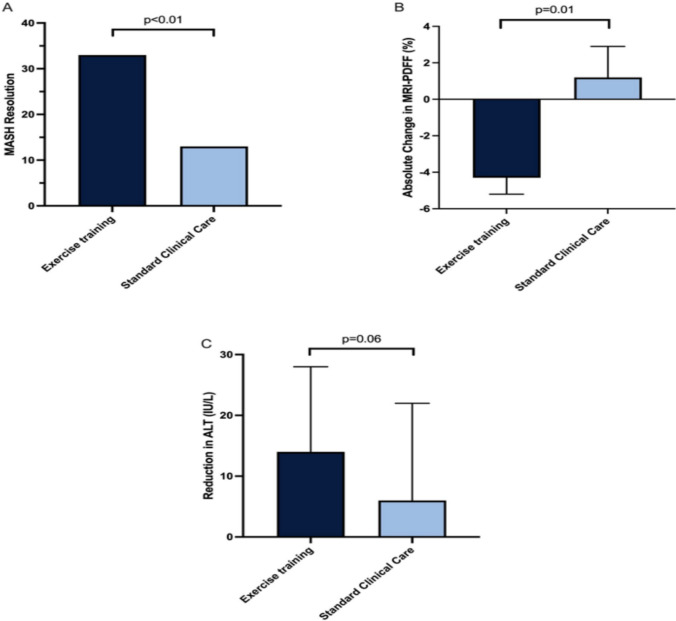
Exercise training is recommended for all patients with metabolic dysfunction-associated steatotic liver disease. Whether exercise training improves liver histology independent of body weight loss remains controversial. Given the increasing reliance on non-invasive biomarkers as a surrogate for liver histology, we investigated the relationship between exercise training and improvement in liver histology using the MASH Resolution Index (MASH-RI), a validated composite score of multiple biomarkers, in a post hoc analysis of the NASHFit trial. This study randomized adults with biopsy-proven MASH to moderate-intensity aerobic exercise training or standard of care for 20 weeks. Mediterranean-informed dietary counseling was provided to each group. Change in the MASH-RI was measured and compared between the two groups (n = 23). Applying the MASH-RI, those who performed exercise training achieved MASH resolution nearly three times more often (33% vs. 13%, p < 0.01) versus those who received standard of care. Exercise training improved individual biomarkers included in the MASH-RI, including ALT, AST, and MRI-PDFF. Exercise training leads to MASH resolution, as defined by the MASH-RI at greater rates than standard lifestyle counseling. NCT03518294.
Overview
CoChat Summary
TL;DR
In a post hoc analysis of the 20-week NASHFit trial, adults with biopsy-proven MASH randomized to moderate-intensity aerobic exercise training achieved MASH resolution by the MASH Resolution Index nearly three times more often than standard of care. The improvement occurred largely without clinically significant body weight loss.
Key findings
- MASH resolution, defined as MASH-RI > −0.67, occurred in 33% of the exercise group vs. 13% of standard of care (p < 0.01).
- ALT decreased by 24% (−14 ± 14 IU/L) with exercise vs. 10% (−6 ± 16 IU/L) with standard of care (p = 0.06); 53% of exercise participants achieved ALT reduction ≥17 IU/L vs. 13% of standard of care (p < 0.01).
- MRI-PDFF decreased by 4.3% with exercise vs. a 1.2% gain with standard of care (p = 0.01); 36% of exercise participants achieved ≥30% relative MRI-PDFF reduction vs. 13% of standard of care (p = 0.016).
- 33% of exercise participants achieved both ALT reduction ≥17 IU/L and ≥30% relative MRI-PDFF reduction vs. 0% with standard of care; clinically significant ≥5% body weight loss occurred in 7% (n = 1) of exercise participants vs. 0% of standard of care.
Methods
- Post hoc analysis of the NASHFit trial (NCT03518294), which randomized adults with biopsy-confirmed MASH in a 2:1 ratio to moderate-intensity aerobic exercise training or standard of care for 20 weeks; both groups received Mediterranean-informed dietary counseling.
- Exercise consisted of 150 min/week of moderate-intensity aerobic exercise (40–59% heart rate reserve), divided into five supervised 30-min sessions; standard-of-care participants continued usual clinical care.
- MASH-RI was calculated for 23 patients (15 exercise, 8 standard of care); the primary endpoint was proportion achieving MASH-RI > −0.67, analyzed with chi-squared test, with continuous variables compared using paired and two-sample t tests.
Limitations
- Stated: modest sample size, primarily non-Hispanic White population, relatively short intervention and follow-up duration, and exploratory post hoc design not included in the original protocol.
- Stated: MASH-RI limitations include lack of data on predicting clinical outcomes such as progression to cirrhosis or HCC, and no post-intervention liver biopsies were performed.
- Evident from the text: the analysis included only 23 of the original 28 enrolled participants, had no extended follow-up beyond 20 weeks, and applied a MASH-RI derived from pharmacologic trials to a lifestyle intervention.
Model-written summary. Check it against the paper before relying on it.
Integrity signals
Registry
Cites
Statistics
Figures
Verification
Claims the paper makes
11 Valid · 0 Not valid · 2 Not checked · 25 Own results and interpretations
Every source the paper cites for this claim was checked and supports it.
In the paper
“In both derivation and external validation cohorts, the MASH-RI demonstrated superior accuracy for detecting histologic MASH resolution, with AUCs of 0.81 and 0.83, respectively.”
§ Aerobic Exercise Training Leads to MASH Resolution as Defined by the MASH Resolution Index > Discussion
What the sources say
- Supportedcites [21] Loomba R, Amangurbanova M, Bettencourt R et al. MASH Resolution Index: development and validation of a non-invasive score to detect histological resolution of MASH. Gut 2024;73:1343–1349. 10.1136/gutjnl-2023-331401. 38418210 PMC12355936 source
The Results sections on diagnostic performance report AUCs of 0.81 in the derivation cohort and 0.83 in the external validation cohort. The Results comparison section says the MASH Resolution Index outperformed ALT- and MRI-PDFF-based measures in both cohorts. (LLM, conf=0.94)
boostedstates an association- Asserted: passes — The authors put it forward as true.
- Checkable: passes — It can be checked against evidence.
- Load-bearing: passes — The paper’s conclusions depend on it.
- Based: passes — The paper gives a reason why it holds.
- Supported
The cited sources support only part of this claim — read each source’s verdict below.
In the paper
“At the rule-out threshold (≤ − 2.67), the MASH-RI achieved negative predictive values of 92.6% and 100%”
§ Aerobic Exercise Training Leads to MASH Resolution as Defined by the MASH Resolution Index > Discussion
What the sources say
- Partly supportedcites [21] Loomba R, Amangurbanova M, Bettencourt R et al. MASH Resolution Index: development and validation of a non-invasive score to detect histological resolution of MASH. Gut 2024;73:1343–1349. 10.1136/gutjnl-2023-331401. 38418210 PMC12355936 sourceExperimental — accuracy not yet measured
The Results sections on diagnostic performance report an NPV of 93% in the derivation cohort and 100% in the validation cohort at the 90% sensitivity cut-point; 93% is consistent with the claimed 92.6% after rounding. The passages available in our copy do not give the specific rule-out threshold of ≤−2.67 or the unrounded 92.6% figure, so those details remain unsupported. (LLM, conf=0.83)
plainstates an association- Asserted: passes — The authors put it forward as true.
- Checkable: passes — It can be checked against evidence.
- Load-bearing: passes — The paper’s conclusions depend on it.
- Based: passes — The paper gives a reason why it holds.
- Partly supported
The cited sources support only part of this claim — read each source’s verdict below.
In the paper
“the MASH Resolution Index (MASH-RI) was recently developed and validated from cohorts of patients with biopsy-proven MASH and liver fibrosis enrolled in MASH drug trials [21].”
§ Aerobic Exercise Training Leads to MASH Resolution as Defined by the MASH Resolution Index > Introduction
What the sources say
- Partly supportedcites [21] Loomba R, Amangurbanova M, Bettencourt R et al. MASH Resolution Index: development and validation of a non-invasive score to detect histological resolution of MASH. Gut 2024;73:1343–1349. 10.1136/gutjnl-2023-331401. 38418210 PMC12355936 sourceExperimental — accuracy not yet measured
The Methods (Study design; page not provided) describe development and validation using two cohorts with biopsy-proven MASH. The validation cohort had stage 2 or 3 fibrosis and came from a drug trial, but the derivation cohort also included patients whose follow-up biopsy was part of standard medical care. The claim therefore overstates that both cohorts were enrolled in MASH drug trials. (LLM, conf=0.90)
plain- Asserted: passes — The authors put it forward as true.
- Checkable: passes — It can be checked against evidence.
- Load-bearing: passes — The paper’s conclusions depend on it.
- Based: passes — The paper gives a reason why it holds.
- Partly supported
The cited sources support only part of this claim — read each source’s verdict below.
In the paper
“the rule-in threshold (≥ − 0.67) yielded specificities of 89.6% and 53.0%”
§ Aerobic Exercise Training Leads to MASH Resolution as Defined by the MASH Resolution Index > Discussion
What the sources say
- Partly supportedcites [21] Loomba R, Amangurbanova M, Bettencourt R et al. MASH Resolution Index: development and validation of a non-invasive score to detect histological resolution of MASH. Gut 2024;73:1343–1349. 10.1136/gutjnl-2023-331401. 38418210 PMC12355936 sourceExperimental — accuracy not yet measured
The Results sections on diagnostic performance report a rule-in cut-point and a derivation-cohort cut-point targeting 90% specificity. In the validation cohort, they report 90% sensitivity and a positive likelihood ratio of 1.9 at rule-in, consistent with roughly 53% specificity. The passages in our copy do not give the ≥−0.67 threshold or explicitly state the exact specificities of 89.6% and 53.0% (page numbers unavailable). (LLM, conf=0.77)
plain- Asserted: passes — The authors put it forward as true.
- Checkable: passes — It can be checked against evidence.
- Load-bearing: passes — The paper’s conclusions depend on it.
- Based: passes — The paper gives a reason why it holds.
- Partly supported
The cited sources support only part of this claim — read each source’s verdict below.
In the paper
“Based on this, it seems reasonable to conclude that should patients continue to complete guideline-based amounts of aerobic exercise over a longer duration, fibrosis improvement may follow [35, 36].”
§ Aerobic Exercise Training Leads to MASH Resolution as Defined by the MASH Resolution Index > Discussion
What the sources say
- Partly supportedcites [35] Rinella ME, Neuschwander-Tetri BA, Siddiqui MS et al. AASLD Practice Guidance on the clinical assessment and management of nonalcoholic fatty liver disease. Hepatology 2023;77:1797–1835. 10.1097/hep.0000000000000323. 36727674 PMC10735173 sourceExperimental — accuracy not yet measured
The guidance’s “Impact of exercise” section says that about 150 minutes per week of moderate exercise can prevent or improve NAFLD. It separately says that even higher-intensity exercise may be needed to reduce fibrosis; it does not say that continuing guideline-based aerobic exercise for longer would improve fibrosis (page not provided). (LLM, conf=0.84)
- Partly supportedcites [36] O’Gorman P, Naimimohasses S, Monaghan A et al. Improvement in histological endpoints of MAFLD following a 12-week aerobic exercise intervention. Aliment Pharmacol Ther 2020;52:1387–1398. 10.1111/apt.15989. 32717123 sourceExperimental — accuracy not yet measured
The Results report fibrosis improvement after a 12-week aerobic exercise intervention, and the Conclusions say the benefits were not sustained at one year without continued prescribed exercise. These findings support the possibility that continued exercise could help, but the paper does not establish that guideline-based amounts over a longer duration would produce fibrosis improvement; that is the citing authors’ extrapolation. (LLM, conf=0.83)
hedgedstates a possible cause- Asserted: passes — The authors put it forward as true.
- Checkable: passes — It can be checked against evidence.
- Load-bearing: passes — The paper’s conclusions depend on it.
- Based: passes — The paper gives a reason why it holds.
- Rests on an assumption not shown here.
- Partly supported
13 more claims
Create a free account to see all 38 claims and every source verdict.
- Borderline: one of the tests for a substantial claim is unclear. 1
- It may state two separate claims as one. 14
- Probably not a substantial claim. 11
- The quote only partly states this claim. 1
Self-check
Percentages, sums and reported differences re-computed from the paper’s own numbers.
Each contradiction between two passages listed here was confirmed by an independent check.
Rated minor: it would not touch a result — a value no result rests on, a p-value that stays on the same side of the significance level, or a conflict that is clerical, resolved elsewhere in the paper, or outside its own findings.
In the paper
§ Aerobic Exercise Training Leads to MASH Resolution as Defined by the MASH Resolution Index > Patients and Methods > Endpoints
“The primary endpoint of this study was the proportion of patients achieving MASH resolution defined as MASH-RI > − 0.67 after 20 weeks of intervention.”
§ Aerobic Exercise Training Leads to MASH Resolution as Defined by the MASH Resolution Index > Discussion
“the rule-in threshold (≥ − 0.67) yielded specificities of 89.6% and 53.0%.”
Rated minor: it would not touch a result — a value no result rests on, a p-value that stays on the same side of the significance level, or a conflict that is clerical, resolved elsewhere in the paper, or outside its own findings.
In the paper
§ Aerobic Exercise Training Leads to MASH Resolution as Defined by the MASH Resolution Index > Patients and Methods > Endpoints
“Secondary outcomes include > 17 IU/L reduction in ALT, changes in MRI-PDFF, and body composition parameters including BMI, body weight, waist circumference, and body fat percentage.”
§ Aerobic Exercise Training Leads to MASH Resolution as Defined by the MASH Resolution Index > Results > MASH Resolution Index
“Fifty three percent of participants in the exercise group achieved a reduction of ALT ≥ 17 IU/L compared to 13% in the standard-of-care group (p < 0.01) (Table 2).”
Citations
Cites
Design and validation of a histological scoring system for nonalcoholic fatty liver disease†
Kleiner, D. E., Brunt, E. M., Van Natta, M., Behling, C., Contos, M. J., Cummings, O. W., Ferrell, L. D., Liu, Y., Torbenson, M. S., Unalp‐Arida, A., et al. (2005) · Hepatology · doi:10.1002/hep.20701 · Cited by 10,791 · cited 1×
“The original study enrolled 28 sedentary adults, with 24 completing the study, between May 2018 and February 2021, who have biopsy-confirmed MASH using NASH Clinical Research Network histologic scoring system [24].”
Rinella, M. E., Neuschwander-Tetri, B. A., Siddiqui, M. S., Abdelmalek, M. F., Caldwell, S., Barb, D., Kleiner, D. E., & Loomba, R. (2023) · Hepatology · doi:10.1097/hep.0000000000000323 · Cited by 2,667 · cited 1×
“Based on this, it seems reasonable to conclude that should patients continue to complete guide-line-based amounts of aerobic exercise over a longer duration, fibrosis improvement may follow [35, 36].”
Self-citationVilar-Gomez, E., Martinez-Perez, Y., Calzadilla-Bertot, L., Torres-Gonzalez, A., Gra-Oramas, B., Gonzalez-Fabian, L., Friedman, S. L., Diago, M., & Romero-Gomez, M. (2015) · Gastroenterology · doi:10.1053/j.gastro.2015.04.005 · Cited by 2,492
Estes, C., Razavi, H., Loomba, R., Younossi, Z., & Sanyal, A. J. (2018) · Hepatology · doi:10.1002/hep.29466 · Cited by 2,399
Self-citationMechanisms and disease consequences of nonalcoholic fatty liver disease
Loomba, R., Friedman, S. L., & Shulman, G. I. (2021) · Cell · doi:10.1016/j.cell.2021.04.015 · Cited by 2,002 · cited 1×
“Metabolic dysfunction-associated steatotic liver disease (MASLD) remains the leading cause of chronic liver disease in the United States, placing millions of individuals at risk for advanced liver disease and its complications [1, 2].”
Self-citationA Meta-Analysis of Randomized Trials for the Treatment of Nonalcoholic Fatty Liver Disease
Musso, G., Gambino, R., Cassader, M., & Pagano, G. (2010) · Hepatology · doi:10.1002/hep.23623 · Cited by 564
Noninvasive, Quantitative Assessment of Liver Fat by MRI‐PDFF as an Endpoint in NASH Trials
Caussy, C., Reeder, S. B., Sirlin, C. B., & Loomba, R. (2018) · Hepatology · doi:10.1002/hep.29797 · Cited by 563
Self-citationYounossi, Z. M., Corey, K. E., & Lim, J. K. (2021) · Gastroenterology · doi:10.1053/j.gastro.2020.11.051 · Cited by 490
Keam, S. J. (2024) · Drugs · doi:10.1007/s40265-024-02045-0 · Cited by 355
Challenges and opportunities in NASH drug development
Harrison, S. A., Allen, A. M., Dubourg, J., Noureddin, M., & Alkhouri, N. (2023) · Nature Medicine · doi:10.1038/s41591-023-02242-6 · Cited by 353 · cited 1×
“…biomarkers show promise for diagnosing and monitoring therapeutic response clinically, especially in early phase MASH drug studies, they continue to remain investigational under the FDA and require further validation before being considered for regulatory or routine clinical use [19, 20].”
Vali, Y., Lee, J., Boursier, J., Spijker, R., Löffler, J., Verheij, J., Brosnan, M. J., Böcskei, Z., Anstee, Q. M., Bossuyt, P. M., et al. (2020) · Journal of Hepatology · doi:10.1016/j.jhep.2020.03.036 · Cited by 302 · cited 1×
“…(ALT), vibration controlled transient elastography (VCTE), enhanced liver fibrosis (ELF) test, magnetic resonance imaging proton density fat fraction (MRI-PDFF), and magnetic resonance elastography (MRE), with clinically meaningful thresholds of improvement widely accepted for each [14–17].”
Stine, J. G., Munaganuru, N., Barnard, A., Wang, J. L., Kaulback, K., Argo, C. K., Singh, S., Fowler, K. J., Sirlin, C. B., & Loomba, R. (2021) · Clinical Gastroenterology and Hepatology · doi:10.1016/j.cgh.2020.08.061 · Cited by 283
Self-citationThe utility of liver biopsy in 2020
Khalifa, A., & Rockey, D. C. (2020) · Current Opinion in Gastroenterology · doi:10.1097/mog.0000000000000621 · Cited by 172
Tamaki, N., Munaganuru, N., Jung, J., Yonan, A. Q., Loomba, R. R., Bettencourt, R., Ajmera, V., Valasek, M. A., Behling, C., Sirlin, C. B., et al. (2022) · Gut · doi:10.1136/gutjnl-2021-324264 · Cited by 130 · cited 1×
“This change in composite biomarker provides further confidence in exercise training as a weight-neutral intervention that can improve surrogates of liver histology, the driver of clinical outcomes in patients with MASH [14, 15].”
Self-citationLoomba, R., Ratziu, V., Harrison, S. A., Loomba, R., McFarlane, S. C., Tamaki, N., Ratziu, V., Abdelmalek, M. F., Rinella, M. E., Anstee, Q. M., et al. (2022) · Gastroenterology · doi:10.1053/j.gastro.2021.10.051 · Cited by 127
Self-citationKeating, S. E., Sabag, A., Hallsworth, K., Hickman, I. J., Macdonald, G. A., Stine, J. G., George, J., & Johnson, N. A. (2023) · Sports Medicine · doi:10.1007/s40279-023-01918-w · Cited by 119 · cited 1×
“…cycling, can reduce hepatic steatosis at clinically meaningful thresholds, and this amount of physical activity or its equivalent (e.g., 75 min/week of vigorous intensity aerobic activity) is recommended by multiple leading scientific societies including the AASLD, ACSM, AGA, and EASL [28, 29].”
Self-citationMazzotti, A., Caletti, M. T., Brodosi, L., Di Domizio, S., Forchielli, M. L., Petta, S., Bugianesi, E., Bianchi, G., & Marchesini, G. (2018) · Journal of Hepatology · doi:10.1016/j.jhep.2018.07.013 · Cited by 117
Improvement in histological endpoints of MAFLD following a 12-week aerobic exercise intervention
O’Gorman, P., Naimimohasses, S., Monaghan, A., Kennedy, M., Melo, A. M., Ní Fhloinn, D., Doherty, D. G., Beddy, P., Finn, S. P., Moore, J. B., et al. (2020) · Alimentary Pharmacology & Therapeutics · doi:10.1111/apt.15989 · Cited by 94
Stine, J. G., DiJoseph, K., Pattison, Z., Harrington, A., Chinchilli, V. M., Schmitz, K. H., & Loomba, R. (2023) · American Journal of Gastroenterology · doi:10.14309/ajg.0000000000002098 · Cited by 94 · cited 1×
“The most widely studied and established benefit of exercise training in patients with MASLD/MASH is an improvement in MRI-measured liver fat [10, 27].”
Self-citationKim, D., Murag, S., Cholankeril, G., Cheung, A., Harrison, S. A., Younossi, Z. M., & Ahmed, A. (2021) · Clinical Gastroenterology and Hepatology · doi:10.1016/j.cgh.2020.07.023 · Cited by 86 · cited 1×
“It is proven that increased physical activity leads to innumerable benefits, including improvement in hepatic steatosis and hepatic inflammation, independently of body weight loss [7, 8].”
Stine, J. G., Schreibman, I. R., Faust, A. J., Dahmus, J., Stern, B., Soriano, C., Rivas, G., Hummer, B., Kimball, S. R., Geyer, N. R., et al. (2022) · Hepatology · doi:10.1002/hep.32274 · Cited by 65 · cited 3×
“Detailed information about research meth-ods completed in this study has been highlighted in previous publications [9, 22, 23].”
Self-citationChinnappan, R., Mir, T. A., Alsalameh, S., Makhzoum, T., Alzhrani, A., AlKattan, K. M., & Yaqinuddin, A. (2023) · Diagnostics · doi:10.3390/diagnostics13182967 · Cited by 61
Stine, J. G., Long, M. T., Corey, K. E., Sallis, R. E., Allen, A. M., Armstrong, M. J., Conroy, D. E., Cuthbertson, D. J., Duarte‐Rojo, A., Hallsworth, K., et al. (2023) · Medicine & Science in Sports & Exercise · doi:10.1249/mss.0000000000003199 · Cited by 54
Self-citationMASLD treatment—a shift in the paradigm is imminent
Machado, M. V. (2023) · Frontiers in Medicine · doi:10.3389/fmed.2023.1316284 · Cited by 51 · cited 2×
“…the MASH-RI can be used as a therapeutic monitoring tool alongside other non-invasive biomarkers to determine response to lifestyle intervention and one that clinicians can rely on when convincing patients about the importance of achieving their weekly dietary and physical activity goals [25, 37].”
Exercise as Medicine: The Impact of Exercise Training on Nonalcoholic Fatty Liver Disease
Thorp, A., & Stine, J. G. (2020) · Current Hepatology Reports · doi:10.1007/s11901-020-00543-9 · Cited by 50
Self-citationNon-pharmacological management options for MAFLD: a practical guide
Stefano, J. T., Duarte, S. M. B., Altikes, R. G., & de Oliveira, C. P. M. S. (2023) · Therapeutic Advances in Endocrinology and Metabolism · doi:10.1177/20420188231160394 · Cited by 46
Loomba, R., Amangurbanova, M., Bettencourt, R., Madamba, E., Siddiqi, H., Richards, L., Behling, C., Sirlin, C. B., Gottwald, M. D., Feng, S., et al. (2024) · Gut · doi:10.1136/gutjnl-2023-331401 · Cited by 43 · cited 6×
“Although reductions in non-invasive biomarkers such as ALT (≥ 17 U/L) and MRI-measured liver fat have previously been associated with histologic improvement in MASH, their diagnostic performance remains modest, with reported area under the curve (AUC) values below 0.66 [21].”
InfluentialSelf-citationIvancovsky Wajcman, D., Byrne, C. J., Dillon, J. F., Brennan, P. N., Villota-Rivas, M., Younossi, Z. M., Allen, A. M., Crespo, J., Gerber, L. H., & Lazarus, J. V. (2026) · Hepatology · doi:10.1097/hep.0000000000001058 · Cited by 33
Harris, S. J., Smith, N., Hummer, B., Schreibman, I. R., Faust, A. J., Geyer, N. R., Chinchilli, V. M., Sciamanna, C., Loomba, R., & Stine, J. G. (2024) · Liver International · doi:10.1111/liv.15769 · Cited by 31 · cited 5×
“Currently, there is no direct scientific evidence, particularly from studies using paired liver biopsies, to confirm that exercise alone can improve liver fibrosis in MASH without accompanying weight loss [6, 9–11].”
InfluentialSelf-citationCurrent management of NAFLD/NASH
Cardoso, A. C., de Figueiredo-Mendes, C., & Villela‐Nogueira, C. A. (2021) · Liver International · doi:10.1111/liv.14869 · Cited by 30
Exercise Is Medicine for Nonalcoholic Fatty Liver Disease: Exploration of Putative Mechanisms
Heinle, J. W., DiJoseph, K., Sabag, A., Oh, S., Kimball, S. R., Keating, S., & Stine, J. G. (2023) · Nutrients · doi:10.3390/nu15112452 · Cited by 26 · cited 2×
“Aerobic exercise improves key pathophysiologic mechanisms in MASH by enhancing insulin sensitivity, reducing hepatic fat accumulation, increasing mitochondrial fatty acid oxidation, and modulating pro-and anti-inflammatory cytokines independent of weight loss [33].”
Self-citationLin, B., Wu, T., Nasb, M., Li, Z., & Chen, N. (2025) · Free Radical Biology and Medicine · doi:10.1016/j.freeradbiomed.2025.02.017 · Cited by 26 · cited 1×
“Preclinical and clinical data also support exercise-induced attenuation of fibrogenesis through reduced stellate cell activation and oxidative stress [34].”
Stine, J. G., Schreibman, I., Navabi, S., Kang, M., Dahmus, J., Soriano, C., Rivas, G., Hummer, B., Beyer, M., Tressler, H., et al. (2020) · Contemporary Clinical Trials Communications · doi:10.1016/j.conctc.2020.100560 · Cited by 19
Self-citationLoomba, R., Daniel, P. C.-Y. N., Amangurbanova, M., Bettencourt, R., Madamba, E., Siddiqi, H., Richards, L., Gottwald, M. D., Feng, S., Margalit, M., et al. (2026) · Hepatology · doi:10.1097/hep.0000000000001396 · Cited by 17
Self-citationTincopa, M. A., & Loomba, R. S. (2024) · Seminars in Liver Disease · doi:10.1055/s-0044-1788277 · Cited by 15
Self-citationChuah, K. H., & Chan, W. (2023) · Clinical and Molecular Hepatology · doi:10.3350/cmh.2023.0062 · Cited by 7
Keating, S. E., Owen, P. J., Pugh, C. J. A., Cuthbertson, D. J., & Stine, J. G. (2025) · Hepatology Communications · doi:10.1097/hc9.0000000000000681 · Cited by 5
Self-citationReply: Considerations on the diagnostic accuracy and applicability of MASHResInd in MASH resolution
Loomba, R., Daniel, P. C.-Y. N., & Huang, D. Q. (2025) · Hepatology · doi:10.1097/hep.0000000000001468 · Cited by 1
Self-citation
Cited by
Braggio, M., Cominacini, M., Dorelli, G., & Giuriato, G. (2026) · ACSMʼs Health & Fitness Journal · doi:10.1249/fit.0000000000001195 · Cited by 1
Asif, M. A., Masood, S., Akbar, S. M. A., Khalid, M. H., Rehman, A., Imran, M., Suhaib, A., Asif, M. S., Khalid, A., Sohaib, M., et al. (2026) · Journal of Clinical Medicine · doi:10.3390/jcm15145737
Metadata
- Authors
- Channapragada, T., Batra, S., Hummer, B. L., Chinchilli, V. M., Huang, D., Loomba, R., Schreibman, I. R., & Stine, J. G.
- Affiliations
- Pennsylvania State University (US)
- University of California San Diego (US)
- University of California, Los Angeles (US)
- Corresponding author
- Stine, Jonathan G.
- Venue
- Digestive Diseases and Sciences
- Published
- 2025-09-03
- Volume
- 71
- Issue
- 2
- Pages
- 628-635
- ISSN
- 0163-2116 (ISSN-L)
- 1573-2568
- PMC
- PMC12946340
- OpenAlex
- W4413959699
- Cited by
- 2
- References
- 39
- Citations by year
- 2026: 2
- FWCI
- 1.37
- Type
- journal article
- Language
- en
- Open access
- hybrid
- doi.org
- Licence
- cc-by
- creativecommons.org/licenses/by/4.0 (tdm)
- creativecommons.org/licenses/by/4.0 (vor)
- Locations
- Digestive Diseases and Sciences (publishedVersion, cc-by)
- PubMed (publishedVersion)
- PubMed Central (publishedVersion, cc-by)
- Funders
- National Institute of Diabetes and Digestive and Kidney Diseases of the National Institutes of Health (K23DK131290)
- NIH/NCATS (Grant UL1TR000127)
- Topics
- Health Sciences › Medicine › Hepatology › Liver Disease Diagnosis and Treatment
- Health Sciences › Medicine › Pathology and Forensic Medicine › Alcohol Consumption and Health Effects
- Health Sciences › Medicine › Public Health, Environmental and Occupational Health › Physical Activity and Health
- Keywords
- aerobic exercise training, non-alcoholic fatty liver disease, non-invasive biomarkers, liver histopathology, Mediterranean diet, lifestyle intervention, MRI-PDFF, ALT and AST
About these checks
Registry, retraction, Cites and statistics results are computed, not judged, with one exception: a printed reference that no index lists is read once by a model before it counts as a citation error. Claims are extracted by a model and kept only when their quote appears verbatim in the text; each cited source is then checked, with a model’s help, for whether it says what the claim relies on. Those verdicts can be wrong — read the claim’s quote and the cited source before relying on one.
The claim verdicts this report counts are experimental: their accuracy is not yet measured.
A language model drew the claims from the paper on 2026-10-10, under version 3 of the claim definition (model deepseek-v4.1-flash, prompt extract-v3).
A second model labelled each claim on 2026-10-10 (model jev-1.13-20260917, definition revision gold-guideline-v0.2).
Cited sources are checked with a language model’s help (gpt-6-sol).
Statistics and arithmetic are recomputed, not judged.
Confidence bands are shown only for fields calibrated on our annotated test set. None is calibrated yet, so no band is shown.
What counts as a claim ›How we measure confidence ›How we check this ›
Are you an author, or do you see a problem with this page? Request a review
Data sources
Bibliographic data: Semantic Scholar, OpenAlex, Crossref.
Contains information from the Semantic Scholar Academic Graph Datasets, made available under the ODC Attribution License (ODC-BY 1.0).
Semantic Scholar’s data is described in: Kinney, R., et al. (2023). The Semantic Scholar Open Data Platform. arXiv:2301.10140.
