

Making Sense of Generative Learning
Open accessThe DOI matches its Crossref record; 211 of the 212 references it cites were found in a registry or an index.
Abstract
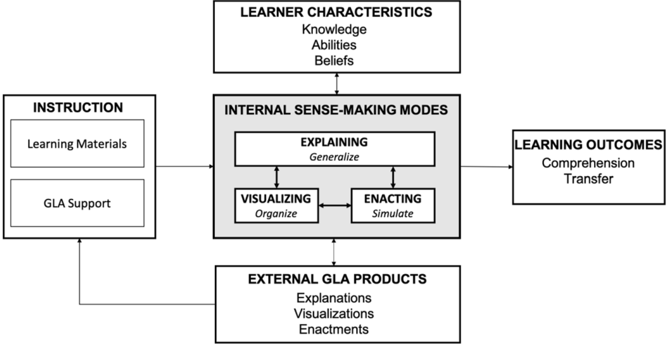
How do learners make sense of what they are learning? In this article, I present a new framework of sense-making based on research investigating the benefits and boundaries of generative learning activities (GLAs). The generative sense-making framework distinguishes among three primary sense-making modes—explaining, visualizing, and enacting—that each serve unique and complementary cognitive functions. Specifically, the framework assumes learners mentally organize and simulate the learning material (via the visualizing and enacting modes) to facilitate their ability to generalize the learning material (via the explaining mode). I present evidence from research on GLAs illustrating how visualizations and enactments (instructor-provided and/or learner-generated) can facilitate higher quality learner explanations and subsequent learning outcomes. I also discuss several barriers to sense-making that help explain when GLAs are not effective and describe possible ways to overcome these barriers by appropriately guiding and timing GLAs. Finally, I discuss implications of the generative sense-making framework for theory and practice and provide recommendations for future research.
Overview
The claims and statistics of this paper haven’t been checked yet.
Free: it reads the open-access text and checks the first 5 claims that cite a source we can check. Create a free account to check every claim.
Integrity signals
Registry
Cites
Statistics
Figures
Verification
Claims the paper makes
The claims and statistics of this paper haven’t been checked yet.
Free: it reads the open-access text and checks the first 5 claims that cite a source we can check. Create a free account to check every claim.
Claims other papers make about this one
Each is checked against this paper’s own text: does it say what the citing paper says it does?
The source backs part of the claim, not all of it — or backs it for a different population, condition or comparison.
In the citing paper
“Theory: Learning requires motivation and self-regulation.”
From Assigning AI: Seven Approaches for Students, with Prompts (2023) · cites this paper as Fiorella, 2023
Experimental — accuracy not yet measuredThe source backs part of the claim, not all of it — or backs it for a different population, condition or comparison.
In the citing paper
“They also need to continually monitor and regulate their own thinking and learning (Fiorella, 2023).”
From Assigning AI: Seven Approaches for Students, with Prompts (2023) · cites this paper as Fiorella, 2023
Experimental — accuracy not yet measuredThe cited source says what the claim attributes to it.
In the citing paper
“Learners must be motivated to put in the work to make sense of new ideas.”
From Assigning AI: Seven Approaches for Students, with Prompts (2023) · cites this paper as Fiorella, 2023
Self-check
Percentages, sums and reported differences re-computed from the paper’s own numbers.
The self-check needs the paper’s full text.
Citations
Cites
Barsalou, L. W. (2008) · Annual Review of Psychology · doi:10.1146/annurev.psych.59.103006.093639 · Cited by 5,936 · cited 3×
“Function According to embodied theories of cognition, thinking is grounded in sensorimotor processing that functions to simulate knowledge (Barsalou, 2008; Glenberg et al., 2013; Lindgren & Johnson-Glenberg, 2013).”
BackgroundWhy a Diagram is (Sometimes) Worth Ten Thousand Words
Larkin, J. H., & Simon, H. A. (1987) · Cognitive Science · doi:10.1016/s0364-0213(87)80026-5 · Cited by 3,733 · cited 1×
“Function Early research in cognitive science suggests that visualizations are more computationally efficient than purely linguistic representations because they explicitly organize information in conceptually meaningful ways (Cox, 1999; Larkin & Simon, 1987; Stenning & Oberlander, 1995).”
BackgroundDunlosky, J., Rawson, K. A., Marsh, E. J., Nathan, M. J., & Willingham, D. T. (2013) · Psychological Science in the Public Interest · doi:10.1177/1529100612453266 · Cited by 3,138
The ICAP framework: Linking cognitive engagement to active learning outcomes
Chi, M. T. H., & Wylie, R. (2014) · Educational Psychologist · doi:10.1080/00461520.2014.965823 · Cited by 2,911 · cited 3×
“The ICAP framework (Chi & Wylie, 2014) distinguishes among four modes of cognitive engagement reflected by learners’ overt behavioral activity during learning.”
BackgroundMethodGlenberg, A. M., & Kaschak, M. P. (2002) · Psychonomic Bulletin & Review · doi:10.3758/bf03196313 · Cited by 2,361 · cited 1×
“Indeed, research suggests the human motor system is involved in a wide range of cognitive tasks, including language production and comprehension (Glenberg & Kaschak, 2002; GoldinMeadow & Alibali, 2013), mathematics (Alibali & Nathan, 2012), and social cognition (Sommerville et al., 2005).”
BackgroundCognitive Architecture and Instructional Design: 20 Years Later
Sweller, J., van Merriënboer, J. J. G., & Paas, F. (2019) · Educational Psychology Review · doi:10.1007/s10648-019-09465-5 · Cited by 2,337 · cited 3×
“…on individual GLAs (e.g., Fiorella & Zhang, 2018; McNamara, 2017) and are analogous to guidance recommendations derived by cognitive load theory (Sweller et al., 2019) : progressing from explicit instruction (worked examples) to scaffolded practice (partial problems) to independent practice…”
BackgroundMethodInfluentialHow are habits formed: modelling habit formation in the real world
Lally, P., van Jaarsveld, C. H. M., Potts, H. W. W., & Wardle, J. (2010) · European Journal of Social Psychology · doi:10.1002/ejsp.674 · Cited by 2,036 · cited 1×
“” With repeated practice in stable and supportive contexts, the decision to use GLAs should become more automatic over time (Lally et al., 2009).”
BackgroundWai, J., Lubinski, D., & Benbow, C. P. (2009) · Journal of Educational Psychology · doi:10.1037/a0016127 · Cited by 1,846
Handbook of Self-Regulation of Learning and Performance
(2017) · Routledge eBooks · doi:10.4324/9781315697048 · Cited by 1,816
Self‐Explanations: How Students Study and Use Examples in Learning to Solve Problems
Chi, M. T. H., Bassok, M., Lewis, M. W., Reimann, P., & Glaser, R. (1989) · Cognitive Science · doi:10.1207/s15516709cog1302_1 · Cited by 1,714 · cited 2×
“Learners may not spontaneously generate principle-based explanations when studying worked examples (Chi et al., 1989; Renkl, 1997), and so they often need explicit prompting and support to engage in self-explaining.”
Background
Research works printed but not linked: 6
- 117. Leinhardt, G. (2001). Instructional explanations: A commonplace for teaching and location for contrast. In Richardson (Ed.), Handbook of research on teaching (pp. 333-357). American Educational Research Association.
- 131. Mayer, R. E. (2022). The cognitive theory of multimedia learning. In R. E. Mayer & L. Fiorella (Eds.), The Cambridge handbook of multimedia learning (3rd ed., pp. 57-72). Cambridge University Press.
- 132. Mayer, R. E., & Fiorella, L. (Eds.). (2022). The Cambridge handbook of multimedia learning (3rd ed.). Cambridge University Press.
- 161. Richland, L. E., Kornell, N., & Kao, L. S. (2009). The pretesting effect: Do unsuccessful retrieval attempts enhance learning? Journal of Experimental Psychology: Applied, 15(3), 243-257.
- 181. Sibley, L., Fiorella, L., & Lachner, A. (2022). It's better when I see it: Students benefit more from open-book than closed-book teaching. Advance online publication.
- 206. Willingham, D. T. (2007). Critical thinking: Why is it so hard to teach? American Educator, Summer, 2007, 8-19.
Cited by
Assigning AI: Seven Approaches for Students, with Prompts
Mollick, E., & Mollick, L. (2023) · arXiv · doi:10.48550/arxiv.2306.10052 · Cited by 586
Wu, D., Zhang, S., Ma, Z., Yue, X.-G., & Dong, R. K. (2024) · Systems · doi:10.3390/systems12090332 · Cited by 91
Research Avenues Supporting Embodied Cognition in Learning and Instruction
Castro-Alonso, J. C., Ayres, P., Zhang, S., de Koning, B. B., & PAAS, F. G. W. C. (2024) · Educational Psychology Review · doi:10.1007/s10648-024-09847-4 · Cited by 163
“Generative actions are effective learning strategies because they allow students to make personal connections between the learning materials and their existing knowledge or experience (see Fiorella & Mayer, 2016b; see also Castro-Alonso et al., 2021a; Fiorella, 2023).”
Skulmowski, A. (2024) · Educational Psychology Review · doi:10.1007/s10648-024-09869-y · Cited by 112
“Currently, forms of activity-based learning known as generative learning are of particular interest in the literature (Fiorella, 2023; Fiorella & Mayer, 2016).”
de Jong, T., Lazonder, A. W., Chinn, C. A., Fischer, F., Gobert, J. D., Hmelo‐Silver, C. E., Koedinger, K. R., Krajcik, J. S., Kyza, E. Α., Linn, M. C., et al. (2024) · Educational Research Review · doi:10.1016/j.edurev.2024.100623 · Cited by 83
Metadata
- Authors
- Fiorella, L.
- Affiliations
- University of Georgia (US)
- Corresponding author
- Fiorella, Logan
- ORCID
- Fiorella, Logan
- Venue
- Educational Psychology Review
- Published
- 2023-04-26
- Volume
- 35
- Issue
- 2
- ISSN
- 1040-726X (ISSN-L)
- 1573-336X
- OpenAlex
- W4367053854
- Semantic Scholar
- 0710367c82ed805e3add1fd2afbae69966f080a6
- Cited by
- 135
- References
- 212
- Citations by year
- 2026: 56 · 2025: 41 · 2024: 27 · 2023: 11
- FWCI
- 35.35
- Type
- journal article
- Language
- en
- Open access
- hybrid
- doi.org
- Licence
- cc-by
- creativecommons.org/licenses/by/4.0 (tdm)
- creativecommons.org/licenses/by/4.0 (vor)
- Locations
- Educational Psychology Review (publishedVersion, cc-by)
- Funders
- Directorate for Education and Human Resources (1955349, 2055117)
- Spencer Foundation (Postdoctoral Fellowship)
- Topics
- Social Sciences › Psychology › Experimental and Cognitive Psychology › Visual and Cognitive Learning Processes
- Social Sciences › Psychology › Developmental and Educational Psychology › Innovative Teaching and Learning Methods
- Social Sciences › Education › Innovative Teaching Methods
- Keywords
- sensemaking, explanation, visualization, enactment, generalization, cognitive function, instructional guidance
About these checks
Registry, retraction, Cites and statistics results are computed, not judged, with one exception: a printed reference that no index lists is read once by a model before it counts as a citation error. Claims are extracted by a model and kept only when their quote appears verbatim in the text; each cited source is then checked, with a model’s help, for whether it says what the claim relies on. Those verdicts can be wrong — read the claim’s quote and the cited source before relying on one.
Statistics and arithmetic are recomputed, not judged.
Confidence bands are shown only for fields calibrated on our annotated test set. None is calibrated yet, so no band is shown.
What counts as a claim ›How we measure confidence ›How we check this ›
Are you an author, or do you see a problem with this page? Request a review
Data sources
Bibliographic data: Semantic Scholar, OpenAlex, Crossref.
Contains information from the Semantic Scholar Academic Graph Datasets, made available under the ODC Attribution License (ODC-BY 1.0).
Semantic Scholar’s data is described in: Kinney, R., et al. (2023). The Semantic Scholar Open Data Platform. arXiv:2301.10140.
