

Making Sense of Generative Learning
Open accessThe DOI matches its Crossref record; 211 of the 212 references it cites were found in a registry or an index.
Abstract
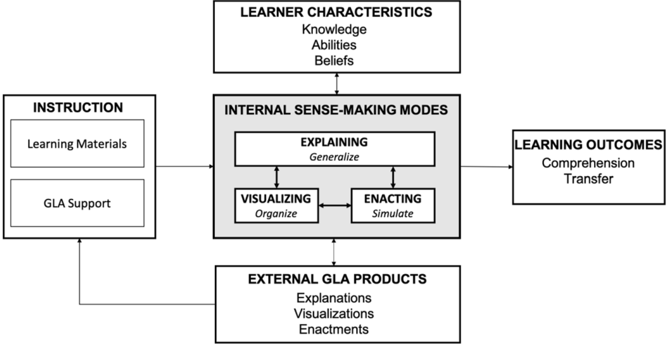
How do learners make sense of what they are learning? In this article, I present a new framework of sense-making based on research investigating the benefits and boundaries of generative learning activities (GLAs). The generative sense-making framework distinguishes among three primary sense-making modes—explaining, visualizing, and enacting—that each serve unique and complementary cognitive functions. Specifically, the framework assumes learners mentally organize and simulate the learning material (via the visualizing and enacting modes) to facilitate their ability to generalize the learning material (via the explaining mode). I present evidence from research on GLAs illustrating how visualizations and enactments (instructor-provided and/or learner-generated) can facilitate higher quality learner explanations and subsequent learning outcomes. I also discuss several barriers to sense-making that help explain when GLAs are not effective and describe possible ways to overcome these barriers by appropriately guiding and timing GLAs. Finally, I discuss implications of the generative sense-making framework for theory and practice and provide recommendations for future research.
Overview
The claims and statistics of this paper haven’t been checked yet.
Free: it reads the open-access text and checks the first 5 claims that cite a source we can check. Create a free account to check every claim.
Integrity signals
Registry
Cites
Statistics
Figures
Verification
Claims the paper makes
The claims and statistics of this paper haven’t been checked yet.
Free: it reads the open-access text and checks the first 5 claims that cite a source we can check. Create a free account to check every claim.
Claims other papers make about this one
Each is checked against this paper’s own text: does it say what the citing paper says it does?
The source backs part of the claim, not all of it — or backs it for a different population, condition or comparison.
In the citing paper
“Theory: Learning requires motivation and self-regulation.”
From Assigning AI: Seven Approaches for Students, with Prompts (2023) · cites this paper as Fiorella, 2023
Experimental — accuracy not yet measuredThe source backs part of the claim, not all of it — or backs it for a different population, condition or comparison.
In the citing paper
“They also need to continually monitor and regulate their own thinking and learning (Fiorella, 2023).”
From Assigning AI: Seven Approaches for Students, with Prompts (2023) · cites this paper as Fiorella, 2023
Experimental — accuracy not yet measuredThe cited source says what the claim attributes to it.
In the citing paper
“Learners must be motivated to put in the work to make sense of new ideas.”
From Assigning AI: Seven Approaches for Students, with Prompts (2023) · cites this paper as Fiorella, 2023
Self-check
Percentages, sums and reported differences re-computed from the paper’s own numbers.
The self-check needs the paper’s full text.
Citations
Cites
Barsalou, L. W. (2008) · Annual Review of Psychology · doi:10.1146/annurev.psych.59.103006.093639 · Cited by 5,936 · cited 3×
“Function According to embodied theories of cognition, thinking is grounded in sensorimotor processing that functions to simulate knowledge (Barsalou, 2008; Glenberg et al., 2013; Lindgren & Johnson-Glenberg, 2013).”
BackgroundWhy a Diagram is (Sometimes) Worth Ten Thousand Words
Larkin, J. H., & Simon, H. A. (1987) · Cognitive Science · doi:10.1016/s0364-0213(87)80026-5 · Cited by 3,733 · cited 1×
“Function Early research in cognitive science suggests that visualizations are more computationally efficient than purely linguistic representations because they explicitly organize information in conceptually meaningful ways (Cox, 1999; Larkin & Simon, 1987; Stenning & Oberlander, 1995).”
BackgroundDunlosky, J., Rawson, K. A., Marsh, E. J., Nathan, M. J., & Willingham, D. T. (2013) · Psychological Science in the Public Interest · doi:10.1177/1529100612453266 · Cited by 3,138
The ICAP framework: Linking cognitive engagement to active learning outcomes
Chi, M. T. H., & Wylie, R. (2014) · Educational Psychologist · doi:10.1080/00461520.2014.965823 · Cited by 2,911 · cited 3×
“The ICAP framework (Chi & Wylie, 2014) distinguishes among four modes of cognitive engagement reflected by learners’ overt behavioral activity during learning.”
BackgroundMethodGlenberg, A. M., & Kaschak, M. P. (2002) · Psychonomic Bulletin & Review · doi:10.3758/bf03196313 · Cited by 2,361 · cited 1×
“Indeed, research suggests the human motor system is involved in a wide range of cognitive tasks, including language production and comprehension (Glenberg & Kaschak, 2002; GoldinMeadow & Alibali, 2013), mathematics (Alibali & Nathan, 2012), and social cognition (Sommerville et al., 2005).”
BackgroundCognitive Architecture and Instructional Design: 20 Years Later
Sweller, J., van Merriënboer, J. J. G., & Paas, F. (2019) · Educational Psychology Review · doi:10.1007/s10648-019-09465-5 · Cited by 2,337 · cited 3×
“…on individual GLAs (e.g., Fiorella & Zhang, 2018; McNamara, 2017) and are analogous to guidance recommendations derived by cognitive load theory (Sweller et al., 2019) : progressing from explicit instruction (worked examples) to scaffolded practice (partial problems) to independent practice…”
BackgroundMethodInfluentialHow are habits formed: modelling habit formation in the real world
Lally, P., van Jaarsveld, C. H. M., Potts, H. W. W., & Wardle, J. (2010) · European Journal of Social Psychology · doi:10.1002/ejsp.674 · Cited by 2,036 · cited 1×
“” With repeated practice in stable and supportive contexts, the decision to use GLAs should become more automatic over time (Lally et al., 2009).”
BackgroundWai, J., Lubinski, D., & Benbow, C. P. (2009) · Journal of Educational Psychology · doi:10.1037/a0016127 · Cited by 1,846
Handbook of Self-Regulation of Learning and Performance
(2017) · Routledge eBooks · doi:10.4324/9781315697048 · Cited by 1,816
Self‐Explanations: How Students Study and Use Examples in Learning to Solve Problems
Chi, M. T. H., Bassok, M., Lewis, M. W., Reimann, P., & Glaser, R. (1989) · Cognitive Science · doi:10.1207/s15516709cog1302_1 · Cited by 1,714 · cited 2×
“Learners may not spontaneously generate principle-based explanations when studying worked examples (Chi et al., 1989; Renkl, 1997), and so they often need explicit prompting and support to engage in self-explaining.”
BackgroundDeFT: A conceptual framework for considering learning with multiple representations
Ainsworth, S. (2006) · Learning and Instruction · doi:10.1016/j.learninstruc.2006.03.001 · Cited by 1,673 · cited 1×
“This principle is derived from the GLA, multimedia learning, cognitive science, and embodied cognition literatures (e.g., Ainsworth, 2006, 2022; Hostetter & Alibali, 2019; Lombrozo, 2006; Mayer & Fiorella, 2022; McCrudden & Rapp, 2017), which indicate that qualitatively different representations…”
BackgroundSelf-Regulated Learning: Beliefs, Techniques, and Illusions
Bjork, R. A., Dunlosky, J., & Kornell, N. (2013) · Annual Review of Psychology · doi:10.1146/annurev-psych-113011-143823 · Cited by 1,468 · cited 1×
“One likely contributing factor is that learners may have suboptimal existing learning habits, such as passively rereading, underlining, or highlighting (Bjork et al., 2013; Dunlosky et al., 2013), which can serve as a metacognitive barrier for spontaneous use of GLAs (Fiorella, 2020).”
BackgroundWood, W., & Rünger, D. (2016) · Annual Review of Psychology · doi:10.1146/annurev-psych-122414-033417 · Cited by 1,445 · cited 1×
“Simply knowing about effective strategies and even intending to use them does not guarantee learners will use them (e.g., Blasiman et al., 2017), likely because the intention to use GLAs competes with learners’ existing habits to use alternative strategies (Fiorella, 2020; Wood & Runger, 2016).”
BackgroundHandbook of Motivation at School
(2016) · Routledge eBooks · doi:10.4324/9781315773384 · Cited by 1,131
Mayer, R. E., & Anderson, R. B. (1992) · Journal of Educational Psychology · doi:10.1037/0022-0663.84.4.444 · Cited by 1,000 · cited 1×
“This provides learners a scaffold for generating appropriate inferences about the cause-effect mechanisms of the system, such as inferring that when someone pushes down on the handle, the inlet valve will close, and the outlet valve will open (Bobek & Tversky, 2016; Mayer & Anderson, 1992).”
BackgroundGenerative Processes of Comprehension
Wittrock, M. C. (1989) · Educational Psychologist · doi:10.1207/s15326985ep2404_2 · Cited by 940 · cited 2×
“Generative learning involves “making sense” of provided learning material by actively organizing and integrating it with one’s existing knowledge (Wittrock, 1989).”
BackgroundLearning and transfer: A general role for analogical encoding.
Gentner, D., Loewenstein, J., & Thompson, L. (2003) · Journal of Educational Psychology · doi:10.1037/0022-0663.95.2.393 · Cited by 865 · cited 1×
“Other common variations of explaining GLAs include comparing (explaining similarities, e.g., Gentner et al., 2003) and predicting (testing explanations, Brod, 2021b).”
BackgroundVisible embodiment: Gestures as simulated action
HOSTETTER, A. B., & ALIBALI, M. W. (2008) · Psychonomic Bulletin & Review · doi:10.3758/pbr.15.3.495 · Cited by 861
Explaining Math: Gesturing Lightens the Load
Goldin-Meadow, S., Nusbaum, H., Kelly, S. D., & Wagner, S. (2001) · Psychological Science · doi:10.1111/1467-9280.00395 · Cited by 842 · cited 1×
“Externalizing knowledge can reduce working memory load and enhance one’s capacity to engage in internal sense-making processes (e.g., Cox, 1999; Goldin-Meadow et al., 2001; Stull et al., 2018), indicated by the doubled-sided arrow from “External GLA Products to “Internal Sense-Making” in Fig.”
BackgroundEight Ways to Promote Generative Learning
Fiorella, L., & Mayer, R. E. (2016) · Educational Psychology Review · doi:10.1007/s10648-015-9348-9 · Cited by 832 · cited 6×
“In earlier reviews (Fiorella & Mayer, 2015, 2016), the original eight GLAs were examined individually and explained in terms of the select-organize-integrate (SOI) framework.”
BackgroundMethodInfluentialSelf-citationAction experience alters 3-month-old infants' perception of others' actions
Sommerville, J. A., Woodward, A. L., & Needham, A. (2005) · Cognition · doi:10.1016/j.cognition.2004.07.004 · Cited by 817
Eliciting Self‐Explanations Improves Understanding
Chi, M. T. H., De Leeuw, N., Chiu, M., & Lavancher, C. (1994) · Cognitive Science · doi:10.1207/s15516709cog1803_3 · Cited by 757
Embodiment in Mathematics Teaching and Learning: Evidence From Learners' and Teachers' Gestures
Alibali, M. W., & Nathan, M. J. (2012) · Journal of the Learning Sciences · doi:10.1080/10508406.2011.611446 · Cited by 691 · cited 2×
“Indeed, research suggests the human motor system is involved in a wide range of cognitive tasks, including language production and comprehension (Glenberg & Kaschak, 2002; GoldinMeadow & Alibali, 2013), mathematics (Alibali & Nathan, 2012), and social cognition (Sommerville et al., 2005).”
BackgroundLearning from worked-out examples: A study on individual differences
RENKL, A. (1997) · Cognitive Science · doi:10.1016/s0364-0213(99)80017-2 · Cited by 679 · cited 12×
“Learners may not spontaneously generate principle-based explanations when studying worked examples (Chi et al., 1989; Renkl, 1997), and so they often need explicit prompting and support to engage in self-explaining.”
BackgroundInfluentialRoscoe, R. D., & Chi, M. T. H. (2007) · Review of Educational Research · doi:10.3102/0034654307309920 · Cited by 647 · cited 1×
“…as when studying texts (Fiorella & Mayer, 2017), visualizations (Renkl & Scheiter, 2017), or worked examples (Chi et al., 1989; Renkl, 1997), or when solving problems (Rellensmann et al., 2022), discussing material with peers (Roscoe & Chi, 2007), or writing essays (Scardamalia & Bereiter, 1987).”
BackgroundThe structure and function of explanations
Lombrozo, T. (2006) · Trends in Cognitive Sciences · doi:10.1016/j.tics.2006.08.004 · Cited by 639 · cited 4×
“Function According to Lombrozo (2006, 2012), the primary function of explanations is to integrate new information with prior knowledge in a way that supports knowledge generalization.”
BackgroundInfluentialOvercoming contextual limitations on problem-solving transfer.
Catrambone, R., & Holyoak, K. J. (1989) · Journal of Experimental Psychology: Learning, Memory, and Cognition · doi:10.1037//0278-7393.15.6.1147 · Cited by 570 · cited 1×
“Still, many learners do not generate comparisons spontaneously (Catrambone & Holyoak, 1989) and thus need explicit prompting and support.”
BackgroundRethinking the Use of Tests: A Meta-Analysis of Practice Testing
Adesope, O. O., Trevisan, D. A., & Sundararajan, N. (2017) · Review of Educational Research · doi:10.3102/0034654316689306 · Cited by 544 · cited 1×
“There is a vast literature demonstrating the benefits of retrieval practice, particularly for supporting long-term retention (Adesope et al., 2017; Agarwal et al., 2021).”
BackgroundKapur, M. (2016) · Educational Psychologist · doi:10.1080/00461520.2016.1155457 · Cited by 523 · cited 3×
“Productive failure research suggests that learners who attempt to generate solutions to problems prior to receiving explicit instruction generally exhibit better understanding than learners who receive explicit instruction prior to problem-solving (Kapur, 2016; Loibl et al., 2017; Sinha & Kapur, 2021).”
BackgroundEmboldened by Embodiment: Six Precepts for Research on Embodied Learning and Mixed Reality
Lindgren, R., & Johnson-Glenberg, M. (2013) · Educational Researcher · doi:10.3102/0013189x13511661 · Cited by 520
Toward an Instructionally Oriented Theory of Example‐Based Learning
Renkl, A. (2014) · Cognitive Science · doi:10.1111/cogs.12086 · Cited by 509 · cited 3×
“Reviews of the learning by explaining literature also highlight knowledge integration and knowledge generalization as key mechanisms underlying learnergenerated explanations (Chi, 2022; Renkl, 2014; Rittle-Johnson & Loehr, 2017).”
BackgroundA meta-analysis of the efficacy of teaching mathematics with concrete manipulatives.
Carbonneau, K. J., Marley, S. C., & Selig, J. P. (2013) · Journal of Educational Psychology · doi:10.1037/a0031084 · Cited by 500 · cited 1×
“Manipulating involves moving physical or virtual objects to represent concepts or strategies, such as using concrete manipulatives to represent mathematical operations (e.g., Bustamante et al., 2022; Carbonneau & Marley, 2015; Carbonneau et al., 2013), translate across representations in chemistry (Stull et al.”
BackgroundCook, S. W., Mitchell, Z., & Goldin-Meadow, S. (2008) · Cognition · doi:10.1016/j.cognition.2007.04.010 · Cited by 500 · cited 1×
“For example, instructors can model the (meta)cognitive processes involved in explaining texts or worked examples, creating visualizations from text, or using hand gestures to represent problem-solving strategies (e.g., Cook et al., 2008; Leopold & Leutner, 2015; McNamara, 2017).”
BackgroundAtkinson, R. K., Renkl, A., & Merrill, M. M. (2003) · Journal of Educational Psychology · doi:10.1037/0022-0663.95.4.774 · Cited by 491
A cognitive theory of graphical and linguistic reasoning: Logic and implementation
Stenning, K. (1995) · Cognitive Science · doi:10.1016/0364-0213(95)90005-5 · Cited by 479 · cited 1×
“Function Early research in cognitive science suggests that visualizations are more computationally efficient than purely linguistic representations because they explicitly organize information in conceptually meaningful ways (Cox, 1999; Larkin & Simon, 1987; Stenning & Oberlander, 1995).”
BackgroundGesturing Gives Children New Ideas About Math
Goldin-Meadow, S., Cook, S. W., & Mitchell, Z. A. (2009) · Psychological Science · doi:10.1111/j.1467-9280.2009.02297.x · Cited by 466 · cited 2×
“Research by GoldinMeadow and colleagues (Cook et al., 2008; Goldin-Meadow et al., 2009) has examined the role of gestures—enacted by the instructor or by the learner—in supporting children’s explanations and understanding of mathematical equivalence problems.”
BackgroundSchwartz, D. L., Chase, C. C., Oppezzo, M. A., & Chin, D. B. (2011) · Journal of Educational Psychology · doi:10.1037/a0025140 · Cited by 464
Learning and Instruction: A SERP Research Agenda
(2003) · National Academies Press eBooks · doi:10.17226/10858 · Cited by 454
The Cambridge Handbook of Multimedia Learning
(2021) · Cambridge University Press eBooks · doi:10.1017/9781108894333 · Cited by 453
Self-citationGesture's Role in Speaking, Learning, and Creating Language
Goldin-Meadow, S., & Alibali, M. W. (2013) · Annual Review of Psychology · doi:10.1146/annurev-psych-113011-143802 · Cited by 437
The Roles of Mental Animations and External Animations in Understanding Mechanical Systems
Hegarty, M., Kriz, S., & Cate, C. (2003) · Cognition and Instruction · doi:10.1207/s1532690xci2104_1 · Cited by 404 · cited 1×
“Enacting activities may also include more dynamic forms of imagining, such as imagining changes in provided static visuals (Hegarty et al., 2003), imagining performing the steps in a procedure (Cooper et al., 2001), or imagining the learning material from one’s own perspective (Leopold et al.,…”
BackgroundActivity and Imagined Activity Can Enhance Young Children's Reading Comprehension.
Glenberg, A. M., Gutierrez, T., Levin, J. R., Japuntich, S., & Kaschak, M. P. (2004) · Journal of Educational Psychology · doi:10.1037/0022-0663.96.3.424 · Cited by 401 · cited 1×
“, 2015), or enact events described in a story (Glenberg et al., 2004).”
BackgroundAnalogy and Relational Reasoning
Holyoak, K. J. (2012) · The Oxford Handbook of Thinking and Reasoning · doi:10.1093/oxfordhb/9780199734689.013.0013 · Cited by 394 · cited 1×
“Second, there is also substantial research on the benefits of comparing across multiple examples or cases (Holyoak, 2012; Rittle-Johnson & Star, 2011), in which learners explain the similarities across examples that share the same underlying principle.”
BackgroundThe Effect of Concept Mapping to Enhance Text Comprehension and Summarization
Chang, K.-E., Sung, Y.-T., & Chen, I.-D. (2002) · The Journal of Experimental Education · doi:10.1080/00220970209602054 · Cited by 392 · cited 1×
“, 2018), such as creating a graphic organizer to compare eastern and western steamboats (Ponce & Mayer, 2014) or creating concept maps to spatially arrange key relationships described in science texts (Chang et al., 2002).”
BackgroundThe effects of self-explaining when learning with text or diagrams
Ainsworth, S. (2003) · Cognitive Science · doi:10.1016/s0364-0213(03)00033-8 · Cited by 390
Learning as a Generative Activity: Eight Learning Strategies that Promote Understanding
Fiorella, L., & Mayer, R. E. (2015) · doi:10.1017/cbo9781107707085 · Cited by 388
Self-citationFrom the Revolution to Embodiment: 25 Years of Cognitive Psychology
Glenberg, A. M., Witt, J. K., & Metcalfe, J. (2013) · Perspectives on Psychological Science · doi:10.1177/1745691613498098 · Cited by 379
Learning from Worked-Out Examples: The Effects of Example Variability and Elicited Self-Explanations
Renkl, A., Stark, R., Gruber, H., & Mandl, H. (1998) · Contemporary Educational Psychology · doi:10.1006/ceps.1997.0959 · Cited by 374 · cited 1×
“Other studies show a similar result (Hilbert & Renkl, 2009; Hilbert et al., 2008; Renkl et al., 1998).”
Result(1987) · Medical Entomology and Zoology · Cited by 371
Learning from text with diagrams: Promoting mental model development and inference generation.
Butcher, K. R. (2006) · Journal of Educational Psychology · doi:10.1037/0022-0663.98.1.182 · Cited by 370 · cited 1×
“A study by Butcher (2006) replicated and extended the findings from Ainsworth and Loizou (2003) to different forms of visualizing support.”
BackgroundThe relative benefits of learning by teaching and teaching expectancy
Fiorella, L., & Mayer, R. E. (2013) · Contemporary Educational Psychology · doi:10.1016/j.cedpsych.2013.06.001 · Cited by 359 · cited 1×
“For example, learners might record a video lecture explaining how the Doppler effect works as if they were teaching a fictitious peer (Fiorella & Mayer, 2013, 2014).”
BackgroundSelf-citationDuckworth, A. L., Grant, H., Loew, B., Oettingen, G., & Gollwitzer, P. M. (2011) · Educational Psychology · doi:10.1080/01443410.2010.506003 · Cited by 349
Representation construction, externalised cognition and individual differences
Cox, R. (1999) · Learning and Instruction · doi:10.1016/s0959-4752(98)00051-6 · Cited by 348
Learning Through Case Comparisons: A Meta-Analytic Review
Alfieri, L., Nokes-Malach, T. J., & Schunn, C. D. (2013) · Educational Psychologist · doi:10.1080/00461520.2013.775712 · Cited by 318
Drawing-to-Learn: A Framework for Using Drawings to Promote Model-Based Reasoning in Biology
Quillin, K., & Thomas, S. (2015) · CBE—Life Sciences Education · doi:10.1187/cbe.14-08-0128 · Cited by 315 · cited 1×
“Explaining, visualizing, and enacting activities are also commonly explored and distinguished within the math and science education literatures (e.g., Nathan & Walkington, 2017; Quillin & Thomas, 2015; Tytler et al., 2020) .”
BackgroundConcreteness Fading in Mathematics and Science Instruction: a Systematic Review
Fyfe, E. R., McNeil, N. M., Son, J. Y., & Goldstone, R. L. (2014) · Educational Psychology Review · doi:10.1007/s10648-014-9249-3 · Cited by 312 · cited 1×
“The use of manipulatives can be scaffolded by using “concreteness fading” (Fyfe et al., 2014): progressing from concrete representations that are more familiar learners to more abstract representations that support transfer.”
Hannus, M., & Hyönä, J. (1999) · Contemporary Educational Psychology · doi:10.1006/ceps.1998.0987 · Cited by 305 · cited 1×
“Unfortunately, many learners do not spontaneously engage in sense-making, such as when learning from text (e.g., Fiorella & Mayer, 2017), visualizations (e.g., Hannus & Hyönä, 1999), or examples (e.g., Renkl, 1997).”
BackgroundCreating visual explanations improves learning
Bobek, E., & Tversky, B. (2016) · Cognitive Research: Principles and Implications · doi:10.1186/s41235-016-0031-6 · Cited by 298 · cited 5×
“However, like many GLA studies, the study by Bobek and Tversky (2016) tested explaining and drawing separately and thus it could not directly assess how drawing affected the quality of students’ explanations.”
BackgroundInfluentialThe Self-Explanation Principle in Multimedia Learning
Wylie, R., & Chi, M. T. H. (2014) · The Cambridge Handbook of Multimedia Learning · doi:10.1017/cbo9781139547369.021 · Cited by 296 · cited 3×
“Reviews of the learning by explaining literature also highlight knowledge integration and knowledge generalization as key mechanisms underlying learnergenerated explanations (Chi, 2022; Renkl, 2014; Rittle-Johnson & Loehr, 2017).”
BackgroundMethodPhysical Experience Enhances Science Learning
Kontra, C., Lyons, D. J., Fischer, S. M., & Beilock, S. L. (2015) · Psychological Science · doi:10.1177/0956797615569355 · Cited by 290 · cited 1×
“…operations (e.g., Bustamante et al., 2022; Carbonneau & Marley, 2015; Carbonneau et al., 2013), translate across representations in chemistry (Stull et al., 2018), directly experience physics principles (Kontra et al., 2015), or enact events described in a story (Glenberg et al., 2004).”
BackgroundMartin, T., & Schwartz, D. L. (2005) · Cognitive Science · doi:10.1207/s15516709cog0000_15 · Cited by 288 · cited 1×
“…Psychology Review (2023) 35:50 1 3 50 Page 18 of 42 explanation-based reasoning, including the ability to generate inferences about the general structure of mathematics word problems (see also Glenberg et al., 2007; Manches & O’Malley, 2016; Martin & Schwartz, 2005; Wall et al., 2022).”
BackgroundConditions for the Effectiveness of Multiple Visual Representations in Enhancing STEM Learning
Rau, M. A. (2017) · Educational Psychology Review · doi:10.1007/s10648-016-9365-3 · Cited by 281 · cited 1×
“functions of different types of representations is particularly critical when learning, communicating, and problem solving within math and science (e.g., Alibali & Nathan, 2012; Rau, 2017; Treagust Tsui, 2013).”
BackgroundTowards a Theory of When and How Problem Solving Followed by Instruction Supports Learning
Loibl, K., Roll, I., & Rummel, N. (2017) · Educational Psychology Review · doi:10.1007/s10648-016-9379-x · Cited by 281 · cited 1×
“Productive failure research suggests that learners who attempt to generate solutions to problems prior to receiving explicit instruction generally exhibit better understanding than learners who receive explicit instruction prior to problem-solving (Kapur, 2016; Loibl et al., 2017; Sinha & Kapur, 2021).”
BackgroundCastro-Alonso, J. C., de Koning, B. B., Fiorella, L., & Paas, F. (2021) · Educational Psychology Review · doi:10.1007/s10648-021-09606-9 · Cited by 278 · cited 1×
“Cognitive barriers include insufficient background knowledge or available working memory capacity to engage in GLAs effectively (Castro-Alonso et al., 2021).”
BackgroundSelf-citationRetrieval-Based Learning: Active Retrieval Promotes Meaningful Learning
Karpicke, J. D. (2012) · Current Directions in Psychological Science · doi:10.1177/0963721412443552 · Cited by 277 · cited 1×
“Retrieval practice serves to strengthen and consolidate one’s memory, making it more accessible in the future (Karpicke, 2012).”
BackgroundInducing Self-Explanation: a Meta-Analysis
Bisra, K., Liu, Q., Nesbit, J. C., Salimi, F., & Winne, P. H. (2018) · Educational Psychology Review · doi:10.1007/s10648-018-9434-x · Cited by 271 · cited 1×
“As documented in prior reviews (e.g., Bisra et al., 2018; Fiorella & Mayer, 2016; Fiorella & Zhang, 2018; Schroeder et al., 2018), the framework accounts for a broad range of empirical research demonstrating that GLAs, such as self-explaining, drawing, or gesturing, are often (but not always) more…”
ResultStudying and Constructing Concept Maps: a Meta-Analysis
Schroeder, N. L., Nesbit, J. C., Anguiano, C. J., & Adesope, O. O. (2018) · Educational Psychology Review · doi:10.1007/s10648-017-9403-9 · Cited by 266 · cited 1×
“As documented in prior reviews (e.g., Bisra et al., 2018; Fiorella & Mayer, 2016; Fiorella & Zhang, 2018; Schroeder et al., 2018), the framework accounts for a broad range of empirical research demonstrating that GLAs, such as self-explaining, drawing, or gesturing, are often (but not always) more effective than non-g…”
ResultDomain-specific prior knowledge and learning: A meta-analysis
Simonsmeier, B. A., Flaig, M., Deiglmayr, A., Schalk, L., & Schneider, M. (2022) · Educational Psychologist · doi:10.1080/00461520.2021.1939700 · Cited by 255 · cited 1×
“Learners must have sufficient background knowledge to generate the inferences required for sense-making (Simonsmeier et al., 2022; Willingham, 2007).”
BackgroundExplanation and abductive inference
Lombrozo, T. (2012) · The Oxford Handbook of Thinking and Reasoning · doi:10.1093/oxfordhb/9780199734689.013.0014 · Cited by 242 · cited 1×
“Function According to Lombrozo (2006, 2012), the primary function of explanations is to integrate new information with prior knowledge in a way that supports knowledge generalization.”
BackgroundBerthold, K., Eysink, T. H. S., & Renkl, A. (2009) · Instructional Science · doi:10.1007/s11251-008-9051-z · Cited by 238
Instructional aids to support a conceptual understanding of multiple representations.
Berthold, K., & Renkl, A. (2009) · Journal of Educational Psychology · doi:10.1037/a0013247 · Cited by 238 · cited 1×
“Other studies report a complementary pattern of results (Cromley et al., 2010, 2013; Eitel et al., 2013), including research on self-explaining dynamic visualizations (e.g., de Koning et al., 2011) and multiple visual representations (Berthold & Renkl, 2009; Rau et al., 2015).”
ResultThe what, how much, and when of study strategies: comparing intended versus actual study behaviour.
Blasiman, R. N., Dunlosky, J., & Rawson, K. A. (2017) · Memory · doi:10.1080/09658211.2016.1221974 · Cited by 227
Advances in Applied Psycholinguistics
(1987) · Cambridge University Press eBooks · doi:10.1017/cbo9780511571374 · Cited by 225
Gesture as simulated action: Revisiting the framework
Hostetter, A. B., & Alibali, M. W. (2019) · Psychonomic Bulletin & Review · doi:10.3758/s13423-018-1548-0 · Cited by 225
The Cambridge Handbook of Motivation and Learning
Renninger, K. A., & Hidi, S. E. (2019) · Cambridge University Press eBooks · doi:10.1017/9781316823279 · Cited by 222
Generative processes in reading comprehension.
Doctorow, M., Wittrock, M. C., & Marks, C. (1978) · Journal of Educational Psychology · doi:10.1037//0022-0663.70.2.109 · Cited by 219 · cited 1×
“GLAs have traditionally been studied as sense-making activities during instruction—that is, when the provided learning materials are available to learners (e.g., Doctorow et al., 1978).”
BackgroundWhen Problem Solving Followed by Instruction Works: Evidence for Productive Failure
Sinha, T., & Kapur, M. (2021) · Review of Educational Research · doi:10.3102/00346543211019105 · Cited by 212 · cited 2×
“The benefits of problem-solving-first approaches appear strongest when learners attempt to solve rich problems that afford generating multiple potential solutions (Kapur, 2016; Sinha & Kapur, 2021).”
BackgroundAnalogy, higher order thinking, and education
Richland, L. E., & Simms, N. (2015) · WIREs Cognitive Science · doi:10.1002/wcs.1336 · Cited by 211
Agarwal, P. K., Nunes, L. D., & Blunt, J. R. (2021) · Educational Psychology Review · doi:10.1007/s10648-021-09595-9 · Cited by 211 · cited 1×
“There is a vast literature demonstrating the benefits of retrieval practice, particularly for supporting long-term retention (Adesope et al., 2017; Agarwal et al., 2021).”
BackgroundWhen our hands help us understand: A meta-analysis into the effects of gesture on comprehension.
Dargue, N., Sweller, N., & Jones, M. P. (2019) · Psychological Bulletin · doi:10.1037/bul0000202 · Cited by 202 · cited 2×
“For example, gestures can be used to simulate the events described in a story (Dargue et al., 2019) , the directions for navigating a route (So et al., 2014), or strategies for solving abstract mathematics problems (Wakefield & Goldin-Meadow, 2019).”
BackgroundMethodLearner-generated drawing as a strategy for learning from content area text
Van Meter, P., Aleksic, M., Schwartz, A., & Garner, J. (2006) · Contemporary Educational Psychology · doi:10.1016/j.cedpsych.2005.04.001 · Cited by 191 · cited 1×
“Indeed, there is evidence that drawing is not effective for elementary school students (van Essen & Hamaker, 1999; Van Meter et al., 2006), and middle schoolers benefit from drawing only if they receive extensive guidance (Van Meter, 2001; Van Meter et al., 2006).”
BackgroundCooper, G., Tindall-Ford, S., Chandler, P., & Sweller, J. (2001) · Journal of Experimental Psychology: Applied · doi:10.1037/1076-898x.7.1.68 · Cited by 191 · cited 2×
“Indeed, there are several examples of studies that do not show a benefit of engaging in GLAs (e.g., Colliot & Jamet, 2019; Cooper et al., 2001; Grobe & Renkl, 2006; McNeil et al., 2009; Schwamborn et al., 2010; Van Meter et al., 2006).”
BackgroundRole of expectations and explanations in learning by teaching
Fiorella, L., & Mayer, R. E. (2014) · Contemporary Educational Psychology · doi:10.1016/j.cedpsych.2014.01.001 · Cited by 189 · cited 1×
“For example, learners might record a video lecture explaining how the Doppler effect works as if they were teaching a fictitious peer (Fiorella & Mayer, 2013, 2014).”
BackgroundSelf-citation“Concrete” Computer Manipulatives in Mathematics Education
Sarama, J., & Clements, D. H. (2009) · Child Development Perspectives · doi:10.1111/j.1750-8606.2009.00095.x · Cited by 183
Drawing construction as a strategy for learning from text.
Van Meter, P. (2001) · Journal of Educational Psychology · doi:10.1037//0022-0663.93.1.129 · Cited by 179 · cited 5×
“In the GLA literature, feedback is often presented in the form of provided explanations, visualizations, or enactments, so that learners can compare what they generated to an “expert” representation (e.g., Roelle & Renkl, 2020; van Meter, 2001; Zhang & Fiorella, 2021).”
BackgroundInfluentialMultiple Representations in Biological Education
Treagust, D. F., & Tsui, C. (2013) · Models and modeling in science education · doi:10.1007/978-94-007-4192-8 · Cited by 178
Computer-supported example-based learning: When instructional explanations reduce self-explanations
Schworm, S., & Renkl, A. (2006) · Computers & Education · doi:10.1016/j.compedu.2004.08.011 · Cited by 175 · cited 2×
“Additionally, worked examples may provide explanations of the solution steps, but these explanations can sometimes interfere with learner-generated self-explanations (Schworm & Renkl, 2006).”
BackgroundDrawing as a generative activity and drawing as a prognostic activity.
Schwamborn, A., Mayer, R. E., Thillmann, H., Leopold, C., & Leutner, D. (2010) · Journal of Educational Psychology · doi:10.1037/a0019640 · Cited by 173 · cited 4×
“Scaffolded practice involves providing specific prompts or hints (e.g., Berthold et al., 2009; Roelle et al., 2017) , or partial representations for learners to complete (e.g., Fiorella et al., 2021; Ponce et al., 2020; Schwamborn et al., 2010).”
BackgroundInfluentialThe Effect of Instructional Explanations on Learning From Scientific Texts
Coleman, E. B., Brown, A. L., & Rivkin, I. D. (1997) · Journal of the Learning Sciences · doi:10.1207/s15327809jls0604_1 · Cited by 170
Studying Visual Displays: How to Instructionally Support Learning
Renkl, A., & Scheiter, K. (2017) · Educational Psychology Review · doi:10.1007/s10648-015-9340-4 · Cited by 165
Cognitive activities in complex science text and diagrams
Cromley, J. G., Snyder-Hogan, L. E., & Luciw-Dubas, U. A. (2010) · Contemporary Educational Psychology · doi:10.1016/j.cedpsych.2009.10.002 · Cited by 165
Drawing to reason and learn in science
Tytler, R., Prain, V., Aranda, G., Ferguson, J. P., & Görur, R. (2019) · Journal of Research in Science Teaching · doi:10.1002/tea.21590 · Cited by 164 · cited 1×
“Explaining, visualizing, and enacting activities are also commonly explored and distinguished within the math and science education literatures (e.g., Nathan & Walkington, 2017; Quillin & Thomas, 2015; Tytler et al., 2020) .”
BackgroundEffects of multiple solution methods in mathematics learning
Große, C. S., & Renkl, A. (2006) · Learning and Instruction · doi:10.1016/j.learninstruc.2006.02.001 · Cited by 163 · cited 1×
“Indeed, there are several examples of studies that do not show a benefit of engaging in GLAs (e.g., Colliot & Jamet, 2019; Cooper et al., 2001; Grobe & Renkl, 2006; McNeil et al., 2009; Schwamborn et al., 2010; Van Meter et al., 2006).”
BackgroundMcNeil, N. M., Uttal, D. H., Jarvin, L., & Sternberg, R. J. (2009) · Learning and Instruction · doi:10.1016/j.learninstruc.2008.03.005 · Cited by 162 · cited 1×
“Indeed, there are several examples of studies that do not show a benefit of engaging in GLAs (e.g., Colliot & Jamet, 2019; Cooper et al., 2001; Grobe & Renkl, 2006; McNeil et al., 2009; Schwamborn et al., 2010; Van Meter et al., 2006).”
BackgroundDrawing Boundary Conditions for Learning by Drawing
Fiorella, L., & Zhang, Q. (2018) · Educational Psychology Review · doi:10.1007/s10648-018-9444-8 · Cited by 161 · cited 7×
“Several subsequent reviews and meta-analyses have further examined the benefits and boundary conditions of various individual GLAs (Bisra et al., 2018; Brod, 2021a; Dargue et al., 2019; Fiorella & Zhang, 2018; Lachner et al., 2021a; Schroeder et al., 2018).”
BackgroundResultInfluentialSelf-citationThe Science of Habit and Its Implications for Student Learning and Well-being
Fiorella, L. (2020) · Educational Psychology Review · doi:10.1007/s10648-020-09525-1 · Cited by 160 · cited 4×
“, 2017), likely because the intention to use GLAs competes with learners’ existing habits to use alternative strategies (Fiorella, 2020; Wood & Runger, 2016).”
BackgroundInfluentialSelf-citationRepresentational Translation With Concrete Models in Organic Chemistry
Stull, A. T., Hegarty, M., Dixon, B., & Stieff, M. (2012) · Cognition and Instruction · doi:10.1080/07370008.2012.719956 · Cited by 160 · cited 1×
“The framework assumes many learners will not spontaneously attempt to explain, visualize, and/or enact the provided learning materials on their own (e.g., Fiorella & Mayer, 2017; Renkl, 1997; Stull et al., 2012).”
BackgroundHow a picture facilitates the process of learning from text: Evidence for scaffolding
Eitel, A., Scheiter, K., Schüler, A., Nyström, M., & Holmqvist, K. (2013) · Learning and Instruction · doi:10.1016/j.learninstruc.2013.05.002 · Cited by 160 · cited 1×
“Other studies report a complementary pattern of results (Cromley et al., 2010, 2013; Eitel et al., 2013), including research on self-explaining dynamic visualizations (e.g., de Koning et al., 2011) and multiple visual representations (Berthold & Renkl, 2009; Rau et al., 2015).”
ResultGeneralizing solution procedures learned from examples.
Catrambone, R. (1996) · Journal of Experimental Psychology: Learning, Memory, and Cognition · doi:10.1037/0278-7393.22.4.1020 · Cited by 154 · cited 1×
“For example, research by Catrambone (1996) shows that visually grouping solution steps by their underlying sub-goals helps learners better organize these steps around general solution procedures (as indicated by the quality of their self-explanations), and results in better transfer performance.”
MethodLearning from number board games: You learn what you encode.
Laski, E. V., & Siegler, R. S. (2014) · Developmental Psychology · doi:10.1037/a0034321 · Cited by 150
Learning from Gesture: How Our Hands Change Our Minds
Novack, M., & Goldin-Meadow, S. (2015) · Educational Psychology Review · doi:10.1007/s10648-015-9325-3 · Cited by 149 · cited 2×
“Gesturing involves using one’s hands to map concepts or strategies onto one’s body (Novack and Goldin-Meadow, 2015), such as when learning problem-solving strategies in mathematics (Wakefield & Goldin-Meadow, 2019), or when enacting dynamic elements described in science texts (Cutica et al.”
BackgroundGenerative Learning: Which Strategies for What Age?
Brod, G. (2021) · Educational Psychology Review · doi:10.1007/s10648-020-09571-9 · Cited by 145
The Cambridge Handbook of Cognition and Education
(2019) · Cambridge University Press eBooks · doi:10.1017/9781108235631 · Cited by 144 · cited 1×
“…is substantial research indicating that various aspects of academic motivation are associated with self-regulated learning Educational Psychology Review (2023) 35:50 1 3 50 Page 22 of 42 strategies and academic achievement (Winne & Marzouk, 2019; Rosenzweig et al., 2019; Schunk and Greene, 2017) .”
BackgroundSchmeck, A., Mayer, R. E., Opfermann, M., Pfeiffer, V. D. I., & Leutner, D. (2014) · Contemporary Educational Psychology · doi:10.1016/j.cedpsych.2014.07.003 · Cited by 143 · cited 2×
“Similarly, drawing and mapping activities are typically more effective when learners are provided partial drawings, graphic organizers, or concept maps to complete (e.g., Chang et al., 2002; Schmeck et al., 2014; Wang et al., 2021).”
BackgroundRittle‐Johnson, B., & Star, J. R. (2011) · The Psychology of learning and motivation/The psychology of learning and motivation · doi:10.1016/b978-0-12-387691-1.00007-7 · Cited by 143 · cited 1×
“Second, there is also substantial research on the benefits of comparing across multiple examples or cases (Holyoak, 2012; Rittle-Johnson & Star, 2011), in which learners explain the similarities across examples that share the same underlying principle.”
BackgroundLearning by Drawing Visual Representations: Potential, Purposes, and Practical Implications
Ainsworth, S. E., & Scheiter, K. (2021) · Current Directions in Psychological Science · doi:10.1177/0963721420979582 · Cited by 141 · cited 1×
“Drawing (or sketching) involves generating external visuals that depict physical structures and their relationships (for recent reviews, see Ainsworth & Scheiter, 2021; Fiorella & Zhang, 2018; Leutner & Schmeck, 2022; Wu & Rau, 2019), such as the structure of the human circulatory system (Zhang &…”
BackgroundLearning to prove in geometry: Learning from heuristic examples and how it can be supported
Hilbert, T. S., Renkl, A., Kessler, S., & Reiss, K. M. (2007) · Learning and Instruction · doi:10.1016/j.learninstruc.2006.10.008 · Cited by 137
Learning how to use a computer-based concept-mapping tool: Self-explaining examples helps
Hilbert, T. S., & Renkl, A. (2009) · Computers in Human Behavior · doi:10.1016/j.chb.2008.12.006 · Cited by 134 · cited 1×
“Other studies show a similar result (Hilbert & Renkl, 2009; Hilbert et al., 2008; Renkl et al., 1998).”
ResultWhen generating a prediction boosts learning: The element of surprise
Brod, G., Hasselhorn, M., & Bunge, S. A. (2018) · Learning and Instruction · doi:10.1016/j.learninstruc.2018.01.013 · Cited by 131
Wu, S. P. W., & Rau, M. A. (2019) · Educational Psychology Review · doi:10.1007/s10648-019-09467-3 · Cited by 131 · cited 2×
“Theories of learner-generated visualizations similarly emphasize the importance of externally organizing the learning material (Fan, 2015; Van Meter & Firetto, 2013; Wu and Rau, 2019).”
BackgroundExpectancy-Value Theory and Its Relevance for Student Motivation and Learning
Rosenzweig, E. Q., Wigfield, A., & Eccles, J. S. (2019) · The Cambridge Handbook of Motivation and Learning · doi:10.1017/9781316823279.026 · Cited by 129
Eliciting explanations: Constraints on when self-explanation aids learning
Rittle‐Johnson, B., & Loehr, A. M. (2016) · Psychonomic Bulletin & Review · doi:10.3758/s13423-016-1079-5 · Cited by 125
The Expertise Reversal Principle in Multimedia Learning
Kalyuga, S. (2014) · The Cambridge Handbook of Multimedia Learning · doi:10.1017/cbo9781139547369.028 · Cited by 122 · cited 1×
“First and foremost, the learning materials should be knowledge appropriate: the materials do not assume knowledge that learners do not already have, nor do they provide knowledge that is excessively redundant with what learners already know (Kalyuga, 2022).”
BackgroundTversky, B. (2019) · Proceedings of the 2019 on Creativity and Cognition · doi:10.1145/3325480.3325525 · Cited by 119 · cited 1×
“…from the embodied and grounded cognition literatures (e.g., Barsalou, 2008; Glenberg et al., 2013; Hostetter & Alibali, 2019; Lindgren & Johnson-Glenberg, 2013; Reed, 2010; Tversky, 2019), which posit that conceptual understanding is grounded in sensorimotor experiences interacting in the world.”
BackgroundNathan, M. J., & Walkington, C. (2017) · Cognitive Research: Principles and Implications · doi:10.1186/s41235-016-0040-5 · Cited by 118 · cited 1×
“Explaining, visualizing, and enacting activities are also commonly explored and distinguished within the math and science education literatures (e.g., Nathan & Walkington, 2017; Quillin & Thomas, 2015; Tytler et al., 2020) .”
BackgroundPonce, H. R., & Mayer, R. E. (2014) · Computers in Human Behavior · doi:10.1016/j.chb.2014.09.010 · Cited by 116 · cited 1×
“…(for recent reviews, see Adesope et al., 2022; Schroeder et al., 2018), such as creating a graphic organizer to compare eastern and western steamboats (Ponce & Mayer, 2014) or creating concept maps to spatially arrange key relationships described in science texts (Chang et al., 2002).”
BackgroundFiorella, L., Stull, A. T., Kuhlmann, S., & Mayer, R. E. (2020) · Journal of Educational Psychology · doi:10.1037/edu0000408 · Cited by 114 · cited 2×
“Several studies have found benefits of integrating explaining GLAs between segments of a lesson (such as an instructional video or text) rather than only at the end of a lesson (Fiorella et al., 2020; Fiorella, 2022b; Lachner et al., 2020; Lawson & Mayer, 2021).”
BackgroundSelf-citationHambrick, D. Z., Libarkin, J. C., Petcovic, H. L., Baker, K. M., Elkins, J., Callahan, C. N., Turner, S. P., Rench, T. A., & LaDue, N. D. (2012) · Journal of Experimental Psychology: General · doi:10.1037/a0025927 · Cited by 114 · cited 1×
“For instance, according to the circumvention-of-limits hypothesis (Hambrick et al., 2012), learners rely on general cognitive abilities, such as spatial ability, when they have relatively low prior knowledge, but cognitive abilities may play less of a role as learners gain expertise.”
BackgroundThe Impact of Visual Displays on Learning Across the Disciplines: A Systematic Review
Guo, D., McTigue, E. M., Matthews, S. D., & Zimmer, W. K. (2020) · Educational Psychology Review · doi:10.1007/s10648-020-09523-3 · Cited by 113
Sketching the Invisible to Predict the Visible: From Drawing to Modeling in Chemistry
Cooper, M. M., Stieff, M., & DeSutter, D. (2017) · Topics in Cognitive Science · doi:10.1111/tops.12285 · Cited by 111 · cited 1×
“Drawing (or sketching) involves generating external visuals that depict physical structures and their relationships (for recent reviews, see Ainsworth & Scheiter, 2021; Fiorella & Zhang, 2018; Leutner & Schmeck, 2022; Wu & Rau, 2019), such as the structure of the human circulatory system (Zhang & Fiorella, 2019), the…”
BackgroundStudents Can (Mostly) Recognize Effective Learning, So Why Do They Not Do It?
Rea, S. D., Wang, L., Muenks, K. M., & Yan, V. X. (2022) · Journal of Intelligence · doi:10.3390/jintelligence10040127 · Cited by 109 · cited 1×
“Recent research suggests many learners may be aware of effective learning strategies, but they do not necessarily apply this knowledge to their actual studying (Rea et al., 2022).”
BackgroundRibosa, J., & Durán, D. (2022) · Educational Research Review · doi:10.1016/j.edurev.2022.100475 · Cited by 106 · cited 1×
“…tio ns o r c on ve y ph ys ic al a nd /o r c on ce pt ua l r el at io ns hi ps Si m ul at in g G es tu rin g M an ip ul at in g Educational Psychology Review (2023) 35:50 1 3 50 Page 10 of 42 intended for others (for recent reviews, see Kobayashi, 2019; Lachner et al., 2021a; Ribosa & Duran, 2022).”
BackgroundComprehending 3D Diagrams: Sketching to Support Spatial Reasoning
Gagnier, K. M., Atit, K., Ormand, C. J., & Shipley, T. F. (2016) · Topics in Cognitive Science · doi:10.1111/tops.12233 · Cited by 105 · cited 1×
“, 2022), or when translating across different types of visual representations (Gagnier et al., 2017).”
BackgroundSpontaneous spatial strategy use in learning from scientific text
Fiorella, L., & Mayer, R. E. (2017) · Contemporary Educational Psychology · doi:10.1016/j.cedpsych.2017.01.002 · Cited by 100 · cited 5×
“For example, Fiorella and Mayer (2017) found that most students simply reproduce the contents of science texts when taking notes, but the small proportion of students who spontaneously attempted to create images or diagrams tended to perform better on a subsequent comprehension test.”
BackgroundInfluentialSelf-citationCreating drawings enhances learning by teaching.
Fiorella, L., & Kuhlmann, S. (2020) · Journal of Educational Psychology · doi:10.1037/edu0000392 · Cited by 99 · cited 2×
“A recent study by Fiorella and Kuhlmann (2020) addressed this issue.”
BackgroundSelf-citationUsing Self-Generated Drawings to Solve Arithmetic Word Problems
Essen, G. V., & Hamaker, C. (1990) · The Journal of Educational Research · doi:10.1080/00220671.1990.10885976 · Cited by 97
How Visual Displays Affect Cognitive Processing
McCrudden, M. T., & Rapp, D. N. (2015) · Educational Psychology Review · doi:10.1007/s10648-015-9342-2 · Cited by 92
McNamara, D. S. (2017) · Discourse Processes · doi:10.1080/0163853x.2015.1101328 · Cited by 92 · cited 4×
“These levels align with prior research on individual GLAs (e.g., Fiorella & Zhang, 2018; McNamara, 2017) and are analogous to guidance recommendations derived by cognitive load theory (Sweller et al.”
BackgroundResultInfluentialSuccessful learning with multiple graphical representations and self-explanation prompts.
Rau, M. A., Aleven, V., & Rummel, N. (2015) · Journal of Educational Psychology · doi:10.1037/a0037211 · Cited by 89 · cited 1×
“, 2011) and multiple visual representations (Berthold & Renkl, 2009; Rau et al., 2015).”
BackgroundEmbodied geometric reasoning: Dynamic gestures during intuition, insight, and proof.
Nathan, M. J., Schenck, K. E., Vinsonhaler, R., Michaelis, J. E., Swart, M. I., & Walkington, C. (2020) · Journal of Educational Psychology · doi:10.1037/edu0000638 · Cited by 89 · cited 1×
“Taken together, this pattern provides strong evidence for the role of gestures in facilitating inference generation and knowledge generalization (see also Cutica et al., 2014; Nathan et al., 2021; Pilegard & Fiorella, 2021).”
BackgroundThe effect of prequestions on learning from video presentations.
Carpenter, S. K., & Toftness, A. R. (2017) · Journal of Applied Research in Memory and Cognition · doi:10.1016/j.jarmac.2016.07.014 · Cited by 87 · cited 1×
“…pre-testing research indicates learners can benefit from taking pre-tests before instruction, even when most of their solutions are incorrect (Carpenter & Toftness, 2017; Richland et al., 2009); however, effects on subsequent post-tests may be limited to the specific information from the…”
BackgroundImproved effectiveness of cueing by self-explanations when learning from a complex animation
De Koning, B. B., Tabbers, H. K., Rikers, R. M. J. P., & Paas, F. (2011) · Applied Cognitive Psychology · doi:10.1002/acp.1661 · Cited by 86
Gerjets, P. H., Scheiter, K., & Schuh, J. (2007) · Educational Technology Research and Development · doi:10.1007/s11423-007-9068-z · Cited by 84 · cited 1×
“Many other studies show that explicitly prompting and guiding learners to compare examples or cases results in better transfer performance by helping learners induce underlying principles (Alfieri et al., 2013; Gerjets et al., 2008; Richland & Sims, 2015).”
BackgroundBarrett, T. J., Stull, A. T., Hsu, T. M., & Hegarty, M. (2014) · Computers & Education · doi:10.1016/j.compedu.2014.09.009 · Cited by 84 · cited 1×
“Another way to scaffold manipulatives is to constrain what learners can manipulate, such as by using virtual rather than physical objects (Barrett et al., 2015).”
BackgroundLearning by Preparing‐to‐Teach and Teaching: A Meta‐Analysis
Kobayashi, K. (2019) · Japanese Psychological Research · doi:10.1111/jpr.12221 · Cited by 84
What brains are for: Action, meaning, and reading comprehension.
Glenberg, A. M., Jaworski, B. A., Rischal, M., & Levin, J. R. (2007) · Cited by 83
Effects of incorporating retrieval into learning tasks: The complexity of the tasks matters
Roelle, J., & Berthold, K. (2017) · Learning and Instruction · doi:10.1016/j.learninstruc.2017.01.008 · Cited by 81 · cited 1×
“The results of such comparisons have been predictably mixed (Hiller et al., 2020; Roelle & Berthold, 2017; Sibley et al., 2022; Waldeyer et al., 2020), given that sense-making and retrieval activities serve distinct instructional goals and have different strengths and weaknesses.”
BackgroundLearning by explaining orally or in written form? Text complexity matters
Jacob, L., Lachner, A., & Scheiter, K. (2020) · Learning and Instruction · doi:10.1016/j.learninstruc.2020.101344 · Cited by 80
Learning by enacting: The role of embodiment in chemistry education
Stull, A. T., Gainer, M. J., & Hegarty, M. (2017) · Learning and Instruction · doi:10.1016/j.learninstruc.2017.09.008 · Cited by 79 · cited 2×
“Externalizing knowledge can reduce working memory load and enhance one’s capacity to engage in internal sense-making processes (e.g., Cox, 1999; Goldin-Meadow et al., 2001; Stull et al., 2018), indicated by the doubled-sided arrow from “External GLA Products to “Internal Sense-Making” in Fig.”
BackgroundDesigning guidance for interpreting dynamic visualizations: Generating versus reading explanations
Ryoo, K., & Linn, M. C. (2013) · Journal of Research in Science Teaching · doi:10.1002/tea.21128 · Cited by 78
Lachner, A., Jacob, L., & Hoogerheide, V. (2021) · Learning and Instruction · doi:10.1016/j.learninstruc.2020.101438 · Cited by 77 · cited 2×
“For example, some studies have found that prompts to explain or elaborate during retrieval are more effective than taking free recall tests (Jacob et al., 2020; Lachner et al., 2021b).”
BackgroundLearning-by-Teaching Without Audience Presence or Interaction: When and Why Does it Work?
Lachner, A., Hoogerheide, V., van Gog, T., & Renkl, A. (2022) · Educational Psychology Review · doi:10.1007/s10648-021-09643-4 · Cited by 77 · cited 2×
“For example, some studies have found that prompts to explain or elaborate during retrieval are more effective than taking free recall tests (Jacob et al., 2020; Lachner et al., 2021b).”
BackgroundLeopold, C., & Leutner, D. (2015) · Metacognition and Learning · doi:10.1007/s11409-014-9130-2 · Cited by 75 · cited 1×
“For example, instructors can model the (meta)cognitive processes involved in explaining texts or worked examples, creating visualizations from text, or using hand gestures to represent problem-solving strategies (e.g., Cook et al., 2008; Leopold & Leutner, 2015; McNamara, 2017).”
BackgroundAn imagination effect in learning from scientific text.
Leopold, C., & Mayer, R. E. (2015) · Journal of Educational Psychology · doi:10.1037/a0037142 · Cited by 74 · cited 2×
“Imagining involves generating an internal visual representation of physical structures or conceptual relationships (for a recent review, see Leopold, 2022), such as forming mental images of the structure of the human respiratory system (Leopold & Mayer, 2015).”
BackgroundTiming matters! Explaining between study phases enhances students’ learning.
Lachner, A., Backfisch, I., Hoogerheide, V., van Gog, T., & Renkl, A. (2020) · Journal of Educational Psychology · doi:10.1037/edu0000396 · Cited by 74 · cited 1×
“Several studies have found benefits of integrating explaining GLAs between segments of a lesson (such as an instructional video or text) rather than only at the end of a lesson (Fiorella et al., 2020; Fiorella, 2022b; Lachner et al., 2020; Lawson & Mayer, 2021).”
BackgroundDrawing to learn: How producing graphical representations enhances scientific thinking.
Fan, J. E. (2015) · Translational Issues in Psychological Science · doi:10.1037/tps0000037 · Cited by 73 · cited 1×
“Theories of learner-generated visualizations similarly emphasize the importance of externally organizing the learning material (Fan, 2015; Van Meter & Firetto, 2013; Wu and Rau, 2019).”
BackgroundImproving Students’ Metacomprehension Accuracy
Griffin, T. D., Mielicki, M. K., & Wiley, J. (2019) · Cambridge University Press eBooks · doi:10.1017/9781108235631.025 · Cited by 71
Cromley, J. G., Bergey, B. W., Fitzhugh, S. L., Newcombe, N. S., Wills, T. W., Shipley, T. F., & Tanaka, J. C. (2013) · Learning and Instruction · doi:10.1016/j.learninstruc.2013.01.003 · Cited by 69
Moving to Learn: How Guiding the Hands Can Set the Stage for Learning
Brooks, N. B., & Goldin-Meadow, S. (2015) · Cognitive Science · doi:10.1111/cogs.12292 · Cited by 69
Roelle, J., & Nückles, M. (2019) · Journal of Educational Psychology · doi:10.1037/edu0000345 · Cited by 68 · cited 1×
“For example, Roelle and Nückles (2019) found that a during-instruction explaining GLA was more effective learning from an expository text low in cohesion and elaboration, presumably because the GLA encouraged learners to use their prior knowledge to improve cohesion and elaborate on the learning…”
BackgroundSchukajlow, S., Blomberg, J., Rellensmann, J., & Leopold, C. (2021) · Learning and Instruction · doi:10.1016/j.learninstruc.2021.101561 · Cited by 67 · cited 2×
“Importantly, like explanations, creating visualizations should require learners to use their prior knowledge to explicitly organize the learning material, such as when learning from science text (Leutner & Schmeck, 2022), mathematics words problems (Schukajlow et al., 2022), or when translating across different types…”
BackgroundWhy Sketching May Aid Learning From Science Texts: Contrasting Sketching With Written Explanations
Scheiter, K., Schleinschok, K., & Ainsworth, S. (2017) · Topics in Cognitive Science · doi:10.1111/tops.12261 · Cited by 66
An integrated model of learning from errors
Zhang, Q., & Fiorella, L. (2023) · Educational Psychologist · doi:10.1080/00461520.2022.2149525 · Cited by 63
Self-citationThe Feedback Principle in Multimedia Learning
Johnson, C. I., & Priest, H. A. (2014) · The Cambridge Handbook of Multimedia Learning · doi:10.1017/cbo9781139547369.023 · Cited by 62
Learning By Tracing Worked Examples
Ginns, P., Hu, F., Byrne, E., & Bobis, J. (2016) · Applied Cognitive Psychology · doi:10.1002/acp.3171 · Cited by 61
The Effects of Physical Manipulatives on Children's Numerical Strategies
Manches, A., & O’Malley, C. L. (2016) · Cognition and Instruction · doi:10.1080/07370008.2015.1124882 · Cited by 60
Learning Strategies and Self-Regulated Learning
Winne, P. H., & Marzouk, Z. (2019) · Cambridge University Press eBooks · doi:10.1017/9781108235631.028 · Cited by 60 · cited 1×
“…is substantial research indicating that various aspects of academic motivation are associated with self-regulated learning Educational Psychology Review (2023) 35:50 1 3 50 Page 22 of 42 strategies and academic achievement (Winne & Marzouk, 2019; Rosenzweig et al., 2019; Schunk and Greene, 2017) .”
BackgroundLearning from Multiple Representations
Cromley, J. G. (2020) · Routledge eBooks · doi:10.4324/9780429443961-6 · Cited by 59
Prinz, A., Golke, S., & Wittwer, J. (2020) · Educational Psychology Review · doi:10.1007/s10648-020-09558-6 · Cited by 57
Roelle, J., & Renkl, A. (2020) · Journal of Educational Psychology · doi:10.1037/edu0000365 · Cited by 55 · cited 1×
“In the GLA literature, feedback is often presented in the form of provided explanations, visualizations, or enactments, so that learners can compare what they generated to an “expert” representation (e.g., Roelle & Renkl, 2020; van Meter, 2001; Zhang & Fiorella, 2021).”
BackgroundThe power of imagination and perspective in learning from science text.
Leopold, C., Mayer, R. E., & Dutke, S. (2018) · Journal of Educational Psychology · doi:10.1037/edu0000310 · Cited by 53 · cited 1×
“…activities may also include more dynamic forms of imagining, such as imagining changes in provided static visuals (Hegarty et al., 2003), imagining performing the steps in a procedure (Cooper et al., 2001), or imagining the learning material from one’s own perspective (Leopold et al., 2019).”
BackgroundPredicting as a learning strategy
Brod, G. (2021) · Psychonomic Bulletin & Review · doi:10.3758/s13423-021-01904-1 · Cited by 52 · cited 8×
“A related barrier concerns whether learners have sufficient available working memory capacity to engage in GLAs effectively (Breitweister & Brod, 2021a, 2021b).”
BackgroundInfluentialCarbonneau, K. J., & Marley, S. C. (2015) · The Journal of Experimental Education · doi:10.1080/00220973.2014.989306 · Cited by 51 · cited 1×
“…to represent concepts or strategies, such as using concrete manipulatives to represent mathematical operations (e.g., Bustamante et al., 2022; Carbonneau & Marley, 2015; Carbonneau et al., 2013), translate across representations in chemistry (Stull et al., 2018), directly experience…”
BackgroundReed, S. K. (2010) · Cited by 50
Lachner, A., & Neuburg, C. (2018) · Instructional Science · doi:10.1007/s11251-018-9470-4 · Cited by 49
Strategy Motivation and Strategy Use: Role of Student Appraisals of Utility and Cost
Karabenick, S. A., Berger, J., Ruzek, E. A., & Schenke, K. (2021) · Metacognition and Learning · doi:10.1007/s11409-020-09256-2 · Cited by 49
Cognitive model of drawing construction: Learning through the construction of drawings.
Meter, P. N. V., & Firetto, C. M. (2013) · Cited by 47
Role of generated and provided visuals in supporting learning from scientific text
Zhang, Q., & Fiorella, L. (2019) · Contemporary Educational Psychology · doi:10.1016/j.cedpsych.2019.101808 · Cited by 47 · cited 6×
“…Ainsworth & Scheiter, 2021; Fiorella & Zhang, 2018; Leutner & Schmeck, 2022; Wu & Rau, 2019), such as the structure of the human circulatory system (Zhang & Fiorella, 2019), the mechanics of a bicycle tire pump (Bobek & Tversky, 2016), or the structures underlying invisible molecular processes…”
BackgroundInfluentialSelf-citationFraction ball: Playful and physically active fraction and decimal learning.
Bustamante, A. S., Begolli, K. N., Alvarez-Vargas, D., Bailey, D. H., & Richland, L. E. (2022) · Journal of Educational Psychology · doi:10.1037/edu0000714 · Cited by 47
Can generative learning tasks be optimized by incorporation of retrieval practice?
Waldeyer, J., Heitmann, S., Moning, J., & Roelle, J. (2020) · Journal of Applied Research in Memory and Cognition · doi:10.1016/j.jarmac.2020.05.001 · Cited by 46 · cited 1×
“The results of such comparisons have been predictably mixed (Hiller et al., 2020; Roelle & Berthold, 2017; Sibley et al., 2022; Waldeyer et al., 2020), given that sense-making and retrieval activities serve distinct instructional goals and have different strengths and weaknesses.”
BackgroundLearning from text benefits from enactment
Cutica, I., Ianì, F., & Bucciarelli, M. (2014) · Memory & Cognition · doi:10.3758/s13421-014-0417-y · Cited by 46 · cited 1×
“Gesturing involves using one’s hands to map concepts or strategies onto one’s body (Novack and Goldin-Meadow, 2015), such as when learning problem-solving strategies in mathematics (Wakefield & Goldin-Meadow, 2019), or when enacting dynamic elements described in science texts (Cutica et al., 2014).”
Backgroundvan de Pol, J., van Loon, M., van Gog, T., Braumann, S., & de Bruin, A. (2020) · Educational Psychology Review · doi:10.1007/s10648-020-09560-y · Cited by 45
Example-based learning: The benefits of prompting organization before providing examples
Roelle, J., Hiller, S., Berthold, K., & Rumann, S. (2016) · Learning and Instruction · doi:10.1016/j.learninstruc.2016.11.012 · Cited by 42 · cited 1×
“Scaffolded practice involves providing specific prompts or hints (e.g., Berthold et al., 2009; Roelle et al., 2017) , or partial representations for learners to complete (e.”
BackgroundGenerating explanations via analogical comparison
Hoyos, C., & Gentner, D. (2017) · Psychonomic Bulletin & Review · doi:10.3758/s13423-017-1289-5 · Cited by 40
Study Activities That Foster Generative Learning: Notetaking, Graphic Organizer, and Questioning
Ponce, H. R., Mayer, R. E., Loyola, M. S., & López, M. (2019) · Journal of Educational Computing Research · doi:10.1177/0735633119865554 · Cited by 40
Learning by drawing: When is it worth the time and effort?
Zhang, Q., & Fiorella, L. (2021) · Contemporary Educational Psychology · doi:10.1016/j.cedpsych.2021.101990 · Cited by 40 · cited 2×
“Recent work by Zhang and Fiorella (2019, 2021) and related early work by Van Meter (2001) suggest learners may benefit most from a combination of generated and provided visuals.”
BackgroundSelf-citationThe Generative Activity Principle in Multimedia Learning
Fiorella, L., & Mayer, R. E. (2021) · The Cambridge Handbook of Multimedia Learning · doi:10.1017/9781108894333.036 · Cited by 40 · cited 1×
“The three modes of sense-making are primarily derived from the GLA literature (Fiorella & Mayer, 2016, 2022): GLAs require learners to generate explanations (such as for oneself or others), visualizations (such as maps or drawings), or enactments (such as gestures or object manipulations).”
MethodSelf-citationProducing Gestures Facilitates Route Learning
So, W., Ching, T. H.-W., Lim, P., Cheng, X., & Ip, K. Y. (2014) · PLoS ONE · doi:10.1371/journal.pone.0112543 · Cited by 39 · cited 1×
“For example, gestures can be used to simulate the events described in a story (Dargue et al., 2019) , the directions for navigating a route (So et al., 2014), or strategies for solving abstract mathematics problems (Wakefield & Goldin-Meadow, 2019).”
MethodEmbodied Action Scaffolds Dialogic Reading
Wall, D., Foltz, S., Kupfer, A. S., & Glenberg, A. M. (2021) · Educational Psychology Review · doi:10.1007/s10648-021-09617-6 · Cited by 39 · cited 1×
“explanation-based reasoning, including the ability to generate inferences about the general structure of mathematics word problems (see also Glenberg et al., 2007; Manches & O’Malley, 2016; Martin & Schwartz, 2005; Wall et al., 2022).”
BackgroundExample-based learning: should learners receive closed-book or open-book self-explanation prompts?
Hiller, S., Rumann, S., Berthold, K., & Roelle, J. (2020) · Instructional Science · doi:10.1007/s11251-020-09523-4 · Cited by 38 · cited 1×
“The results of such comparisons have been predictably mixed (Hiller et al., 2020; Roelle & Berthold, 2017; Sibley et al., 2022; Waldeyer et al., 2020), given that sense-making and retrieval activities serve distinct instructional goals and have different strengths and weaknesses.”
BackgroundSupporting reflection to improve learning from self-generated concept maps
Eshuis, E. H., ter Vrugte, J., & de Jong, T. (2022) · Metacognition and Learning · doi:10.1007/s11409-022-09299-7 · Cited by 38 · cited 1×
“…errors, using visualizations to scaffold the presentation of feedback, explicitly prompting learners to reflect on the feedback, and providing opportunities to discuss feedback with the instructor and/or one’s peers (e.g., Burkhart et al., 2021; Eshuis et al., 2022; Lachner & Neuburg, 2019).”
MethodSelf-Explaining: Learning About Principles and Their Application
Renkl, A., & Eitel, A. (2019) · Cambridge University Press eBooks · doi:10.1017/9781108235631.022 · Cited by 37
Benefits of Writing an Explanation During Pauses in Multimedia Lessons
Lawson, A. P., & Mayer, R. E. (2021) · Educational Psychology Review · doi:10.1007/s10648-021-09594-w · Cited by 37 · cited 1×
“Several studies have found benefits of integrating explaining GLAs between segments of a lesson (such as an instructional video or text) rather than only at the end of a lesson (Fiorella et al., 2020; Fiorella, 2022b; Lachner et al., 2020; Lawson & Mayer, 2021).”
BackgroundBreitwieser, J., & Brod, G. (2021) · Child Development · doi:10.1111/cdev.13393 · Cited by 35
Coordinating Gesture, Word, and Diagram: Explanations for Experts and Novices
Kang, S., Tversky, B., & Black, J. B. (2015) · Spatial Cognition & Computation · doi:10.1080/13875868.2014.958837 · Cited by 35
The limited effects of prequestions on learning from authentic lecture videos
Toftness, A. R., Carpenter, S. K., Lauber, S., & Mickes, L. (2018) · Journal of Applied Research in Memory and Cognition · doi:10.1016/j.jarmac.2018.06.003 · Cited by 34
Nathan, M. J., & Martinez, C. J. (2015) · Learning Research and Practice · doi:10.1080/23735082.2015.1006758 · Cited by 34 · cited 1×
“A study by Nathan and Martinez (2015) demonstrated the facilitative effects of gesturing for explaining when learning from science text.”
BackgroundHui, L., de Bruin, A. B. H., Donkers, J., & van Merriënboer, J. J. G. (2022) · Applied Cognitive Psychology · doi:10.1002/acp.3933 · Cited by 33
Animacy and animate imagery improve retention in the method of loci among novice users
Blunt, J. R., & VanArsdall, J. E. (2021) · Memory & Cognition · doi:10.3758/s13421-021-01175-0 · Cited by 32 · cited 1×
“Thus, imagining can function as a visualizing and/or enacting activity depending on what learners are prompted to generate (e.g., Blunt & VanArsdall, 2021).”
BackgroundThe Worked Example Principle in Multimedia Learning
Renkl, A. (2021) · Cambridge University Press eBooks · doi:10.1017/9781108894333.023 · Cited by 32 · cited 2×
“There is also strong evidence that the effectiveness of learning from examples ultimately depends on the explaining mode (Renkl, 2014, 2022).”
BackgroundThe Embodiment Principle in Multimedia Learning
Fiorella, L. (2021) · Cambridge University Press eBooks · doi:10.1017/9781108894333.030 · Cited by 27 · cited 7×
“…for reducing or managing cognitive load, such as removing seductive details, spatially or temporally integrated related sources of information, offloading printed text to speech, and breaking down complex materials into more manageable parts (see Mayer & Fiorella, 2022; Sweller et al., 2019).”
BackgroundInfluentialSelf-citationWang, X., Mayer, R., Zhou, P., & Lin, L. (2021) · Journal of Educational Psychology · doi:10.1037/edu0000606 · Cited by 25 · cited 1×
“Similarly, drawing and mapping activities are typically more effective when learners are provided partial drawings, graphic organizers, or concept maps to complete (e.g., Chang et al., 2002; Schmeck et al., 2014; Wang et al., 2021).”
BackgroundThe Drawing Principle in Multimedia Learning
Leutner, D., & Schmeck, A. (2021) · Cambridge University Press eBooks · doi:10.1017/9781108894333.038 · Cited by 25 · cited 2×
“…should require learners to use their prior knowledge to explicitly organize the learning material, such as when learning from science text (Leutner & Schmeck, 2022), mathematics words problems (Schukajlow et al., 2022), or when translating across different types of visual representations…”
BackgroundRellensmann, J., Schukajlow, S., Blomberg, J., & Leopold, C. (2022) · Applied Cognitive Psychology · doi:10.1002/acp.3930 · Cited by 24 · cited 2×
“, 1989; Renkl, 1997), or when solving problems (Rellensmann et al., 2022), discussing material with peers (Roscoe & Chi, 2007), or writing essays (Scardamalia & Bereiter, 1987).”
BackgroundEmbedding self-explanation prompts to support learning via instructional video
Bai, C., Yang, J., & Tang, Y. (2022) · Instructional Science · doi:10.1007/s11251-022-09587-4 · Cited by 24 · cited 1×
“Learners may also benefit from receiving scaffolded prompts in which learners fill in key components of an explanation rather than generating a complete explanation themselves (Bai et al., 2022) .”
BackgroundThe Multiple Representations Principle in Multimedia Learning
Ainsworth, S. E. (2021) · Cambridge University Press eBooks · doi:10.1017/9781108894333.016 · Cited by 23 · cited 1×
“This principle is derived from the GLA, multimedia learning, cognitive science, and embodied cognition literatures (e.g., Ainsworth, 2006, 2022; Hostetter & Alibali, 2019; Lombrozo, 2006; Mayer & Fiorella, 2022; McCrudden & Rapp, 2017), which indicate that qualitatively different representations…”
BackgroundColliot, T., & Jamet, É. (2019) · Instructional Science · doi:10.1007/s11251-019-09488-z · Cited by 22 · cited 1×
“Indeed, there are several examples of studies that do not show a benefit of engaging in GLAs (e.g., Colliot & Jamet, 2019; Cooper et al., 2001; Grobe & Renkl, 2006; McNeil et al., 2009; Schwamborn et al., 2010; Van Meter et al., 2006).”
BackgroundBurkhart, C., Lachner, A., & Nückles, M. (2021) · Journal of Educational Psychology · doi:10.1037/edu0000607 · Cited by 22 · cited 1×
“…errors, using visualizations to scaffold the presentation of feedback, explicitly prompting learners to reflect on the feedback, and providing opportunities to discuss feedback with the instructor and/or one’s peers (e.g., Burkhart et al., 2021; Eshuis et al., 2022; Lachner & Neuburg, 2019).”
MethodLearning by explaining after pauses in video lectures: Are provided visuals a scaffold or a crutch?
Fiorella, L. (2022) · Applied Cognitive Psychology · doi:10.1002/acp.3994 · Cited by 19 · cited 7×
“…for reducing or managing cognitive load, such as removing seductive details, spatially or temporally integrated related sources of information, offloading printed text to speech, and breaking down complex materials into more manageable parts (see Mayer & Fiorella, 2022; Sweller et al., 2019).”
BackgroundInfluentialSelf-citationSketching and verbal self‐explanation: Do they help middle school children solve science problems?
Miller‐Cotto, D., Booth, J. L., & Newcombe, N. S. (2022) · Applied Cognitive Psychology · doi:10.1002/acp.3980 · Cited by 19
Research works printed but not linked: 6
- 117. Leinhardt, G. (2001). Instructional explanations: A commonplace for teaching and location for contrast. In Richardson (Ed.), Handbook of research on teaching (pp. 333-357). American Educational Research Association.
- 131. Mayer, R. E. (2022). The cognitive theory of multimedia learning. In R. E. Mayer & L. Fiorella (Eds.), The Cambridge handbook of multimedia learning (3rd ed., pp. 57-72). Cambridge University Press.
- 132. Mayer, R. E., & Fiorella, L. (Eds.). (2022). The Cambridge handbook of multimedia learning (3rd ed.). Cambridge University Press.
- 161. Richland, L. E., Kornell, N., & Kao, L. S. (2009). The pretesting effect: Do unsuccessful retrieval attempts enhance learning? Journal of Experimental Psychology: Applied, 15(3), 243-257.
- 181. Sibley, L., Fiorella, L., & Lachner, A. (2022). It's better when I see it: Students benefit more from open-book than closed-book teaching. Advance online publication.
- 206. Willingham, D. T. (2007). Critical thinking: Why is it so hard to teach? American Educator, Summer, 2007, 8-19.
Cited by
Assigning AI: Seven Approaches for Students, with Prompts
Mollick, E., & Mollick, L. (2023) · arXiv · doi:10.48550/arxiv.2306.10052 · Cited by 586
Wu, D., Zhang, S., Ma, Z., Yue, X.-G., & Dong, R. K. (2024) · Systems · doi:10.3390/systems12090332 · Cited by 91
Research Avenues Supporting Embodied Cognition in Learning and Instruction
Castro-Alonso, J. C., Ayres, P., Zhang, S., de Koning, B. B., & PAAS, F. G. W. C. (2024) · Educational Psychology Review · doi:10.1007/s10648-024-09847-4 · Cited by 163
“Generative actions are effective learning strategies because they allow students to make personal connections between the learning materials and their existing knowledge or experience (see Fiorella & Mayer, 2016b; see also Castro-Alonso et al., 2021a; Fiorella, 2023).”
Skulmowski, A. (2024) · Educational Psychology Review · doi:10.1007/s10648-024-09869-y · Cited by 112
“Currently, forms of activity-based learning known as generative learning are of particular interest in the literature (Fiorella, 2023; Fiorella & Mayer, 2016).”
de Jong, T., Lazonder, A. W., Chinn, C. A., Fischer, F., Gobert, J. D., Hmelo‐Silver, C. E., Koedinger, K. R., Krajcik, J. S., Kyza, E. Α., Linn, M. C., et al. (2024) · Educational Research Review · doi:10.1016/j.edurev.2024.100623 · Cited by 83
Metadata
- Authors
- Fiorella, L.
- Affiliations
- University of Georgia (US)
- Corresponding author
- Fiorella, Logan
- ORCID
- Fiorella, Logan
- Venue
- Educational Psychology Review
- Published
- 2023-04-26
- Volume
- 35
- Issue
- 2
- ISSN
- 1040-726X (ISSN-L)
- 1573-336X
- OpenAlex
- W4367053854
- Semantic Scholar
- 0710367c82ed805e3add1fd2afbae69966f080a6
- Cited by
- 135
- References
- 212
- Citations by year
- 2026: 56 · 2025: 41 · 2024: 27 · 2023: 11
- FWCI
- 35.35
- Type
- journal article
- Language
- en
- Open access
- hybrid
- doi.org
- Licence
- cc-by
- creativecommons.org/licenses/by/4.0 (tdm)
- creativecommons.org/licenses/by/4.0 (vor)
- Locations
- Educational Psychology Review (publishedVersion, cc-by)
- Funders
- Directorate for Education and Human Resources (1955349, 2055117)
- Spencer Foundation (Postdoctoral Fellowship)
- Topics
- Social Sciences › Psychology › Experimental and Cognitive Psychology › Visual and Cognitive Learning Processes
- Social Sciences › Psychology › Developmental and Educational Psychology › Innovative Teaching and Learning Methods
- Social Sciences › Education › Innovative Teaching Methods
- Keywords
- sensemaking, explanation, visualization, enactment, generalization, cognitive function, instructional guidance
About these checks
Registry, retraction, Cites and statistics results are computed, not judged, with one exception: a printed reference that no index lists is read once by a model before it counts as a citation error. Claims are extracted by a model and kept only when their quote appears verbatim in the text; each cited source is then checked, with a model’s help, for whether it says what the claim relies on. Those verdicts can be wrong — read the claim’s quote and the cited source before relying on one.
Statistics and arithmetic are recomputed, not judged.
Confidence bands are shown only for fields calibrated on our annotated test set. None is calibrated yet, so no band is shown.
What counts as a claim ›How we measure confidence ›How we check this ›
Are you an author, or do you see a problem with this page? Request a review
Data sources
Bibliographic data: Semantic Scholar, OpenAlex, Crossref.
Contains information from the Semantic Scholar Academic Graph Datasets, made available under the ODC Attribution License (ODC-BY 1.0).
Semantic Scholar’s data is described in: Kinney, R., et al. (2023). The Semantic Scholar Open Data Platform. arXiv:2301.10140.
