

Making Sense of Generative Learning
Open accessThe DOI matches its Crossref record; 211 of the 212 references it cites were found in a registry or an index.
Abstract
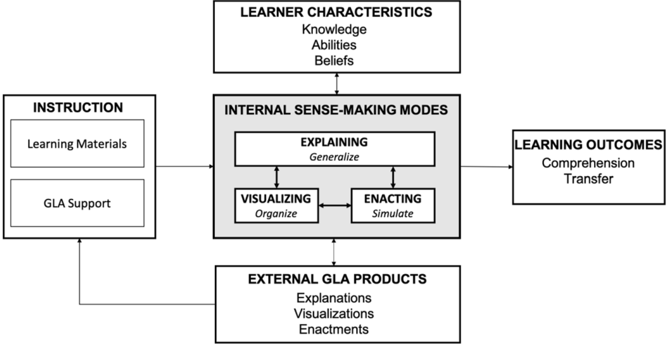
How do learners make sense of what they are learning? In this article, I present a new framework of sense-making based on research investigating the benefits and boundaries of generative learning activities (GLAs). The generative sense-making framework distinguishes among three primary sense-making modes—explaining, visualizing, and enacting—that each serve unique and complementary cognitive functions. Specifically, the framework assumes learners mentally organize and simulate the learning material (via the visualizing and enacting modes) to facilitate their ability to generalize the learning material (via the explaining mode). I present evidence from research on GLAs illustrating how visualizations and enactments (instructor-provided and/or learner-generated) can facilitate higher quality learner explanations and subsequent learning outcomes. I also discuss several barriers to sense-making that help explain when GLAs are not effective and describe possible ways to overcome these barriers by appropriately guiding and timing GLAs. Finally, I discuss implications of the generative sense-making framework for theory and practice and provide recommendations for future research.
Overview
The claims and statistics of this paper haven’t been checked yet.
Free: it reads the open-access text and checks the first 5 claims that cite a source we can check. Create a free account to check every claim.
Integrity signals
Registry
Cites
Statistics
Figures
Verification
Claims the paper makes
The claims and statistics of this paper haven’t been checked yet.
Free: it reads the open-access text and checks the first 5 claims that cite a source we can check. Create a free account to check every claim.
Claims other papers make about this one
Each is checked against this paper’s own text: does it say what the citing paper says it does?
The source backs part of the claim, not all of it — or backs it for a different population, condition or comparison.
In the citing paper
“Theory: Learning requires motivation and self-regulation.”
From Assigning AI: Seven Approaches for Students, with Prompts (2023) · cites this paper as Fiorella, 2023
Experimental — accuracy not yet measuredThe source backs part of the claim, not all of it — or backs it for a different population, condition or comparison.
In the citing paper
“They also need to continually monitor and regulate their own thinking and learning (Fiorella, 2023).”
From Assigning AI: Seven Approaches for Students, with Prompts (2023) · cites this paper as Fiorella, 2023
Experimental — accuracy not yet measuredThe cited source says what the claim attributes to it.
In the citing paper
“Learners must be motivated to put in the work to make sense of new ideas.”
From Assigning AI: Seven Approaches for Students, with Prompts (2023) · cites this paper as Fiorella, 2023
Self-check
Percentages, sums and reported differences re-computed from the paper’s own numbers.
The self-check needs the paper’s full text.
Citations
Cites
Barsalou, L. W. (2008) · Annual Review of Psychology · doi:10.1146/annurev.psych.59.103006.093639 · Cited by 5,936 · cited 3×
“Function According to embodied theories of cognition, thinking is grounded in sensorimotor processing that functions to simulate knowledge (Barsalou, 2008; Glenberg et al., 2013; Lindgren & Johnson-Glenberg, 2013).”
BackgroundWhy a Diagram is (Sometimes) Worth Ten Thousand Words
Larkin, J. H., & Simon, H. A. (1987) · Cognitive Science · doi:10.1016/s0364-0213(87)80026-5 · Cited by 3,733 · cited 1×
“Function Early research in cognitive science suggests that visualizations are more computationally efficient than purely linguistic representations because they explicitly organize information in conceptually meaningful ways (Cox, 1999; Larkin & Simon, 1987; Stenning & Oberlander, 1995).”
BackgroundDunlosky, J., Rawson, K. A., Marsh, E. J., Nathan, M. J., & Willingham, D. T. (2013) · Psychological Science in the Public Interest · doi:10.1177/1529100612453266 · Cited by 3,138
The ICAP framework: Linking cognitive engagement to active learning outcomes
Chi, M. T. H., & Wylie, R. (2014) · Educational Psychologist · doi:10.1080/00461520.2014.965823 · Cited by 2,911 · cited 3×
“The ICAP framework (Chi & Wylie, 2014) distinguishes among four modes of cognitive engagement reflected by learners’ overt behavioral activity during learning.”
BackgroundMethodGlenberg, A. M., & Kaschak, M. P. (2002) · Psychonomic Bulletin & Review · doi:10.3758/bf03196313 · Cited by 2,361 · cited 1×
“Indeed, research suggests the human motor system is involved in a wide range of cognitive tasks, including language production and comprehension (Glenberg & Kaschak, 2002; GoldinMeadow & Alibali, 2013), mathematics (Alibali & Nathan, 2012), and social cognition (Sommerville et al., 2005).”
BackgroundCognitive Architecture and Instructional Design: 20 Years Later
Sweller, J., van Merriënboer, J. J. G., & Paas, F. (2019) · Educational Psychology Review · doi:10.1007/s10648-019-09465-5 · Cited by 2,337 · cited 3×
“…on individual GLAs (e.g., Fiorella & Zhang, 2018; McNamara, 2017) and are analogous to guidance recommendations derived by cognitive load theory (Sweller et al., 2019) : progressing from explicit instruction (worked examples) to scaffolded practice (partial problems) to independent practice…”
BackgroundMethodInfluentialHow are habits formed: modelling habit formation in the real world
Lally, P., van Jaarsveld, C. H. M., Potts, H. W. W., & Wardle, J. (2010) · European Journal of Social Psychology · doi:10.1002/ejsp.674 · Cited by 2,036 · cited 1×
“” With repeated practice in stable and supportive contexts, the decision to use GLAs should become more automatic over time (Lally et al., 2009).”
BackgroundWai, J., Lubinski, D., & Benbow, C. P. (2009) · Journal of Educational Psychology · doi:10.1037/a0016127 · Cited by 1,846
Handbook of Self-Regulation of Learning and Performance
(2017) · Routledge eBooks · doi:10.4324/9781315697048 · Cited by 1,816
Self‐Explanations: How Students Study and Use Examples in Learning to Solve Problems
Chi, M. T. H., Bassok, M., Lewis, M. W., Reimann, P., & Glaser, R. (1989) · Cognitive Science · doi:10.1207/s15516709cog1302_1 · Cited by 1,714 · cited 2×
“Learners may not spontaneously generate principle-based explanations when studying worked examples (Chi et al., 1989; Renkl, 1997), and so they often need explicit prompting and support to engage in self-explaining.”
Background
Research works printed but not linked: 6
- 117. Leinhardt, G. (2001). Instructional explanations: A commonplace for teaching and location for contrast. In Richardson (Ed.), Handbook of research on teaching (pp. 333-357). American Educational Research Association.
- 131. Mayer, R. E. (2022). The cognitive theory of multimedia learning. In R. E. Mayer & L. Fiorella (Eds.), The Cambridge handbook of multimedia learning (3rd ed., pp. 57-72). Cambridge University Press.
- 132. Mayer, R. E., & Fiorella, L. (Eds.). (2022). The Cambridge handbook of multimedia learning (3rd ed.). Cambridge University Press.
- 161. Richland, L. E., Kornell, N., & Kao, L. S. (2009). The pretesting effect: Do unsuccessful retrieval attempts enhance learning? Journal of Experimental Psychology: Applied, 15(3), 243-257.
- 181. Sibley, L., Fiorella, L., & Lachner, A. (2022). It's better when I see it: Students benefit more from open-book than closed-book teaching. Advance online publication.
- 206. Willingham, D. T. (2007). Critical thinking: Why is it so hard to teach? American Educator, Summer, 2007, 8-19.
Cited by
Assigning AI: Seven Approaches for Students, with Prompts
Mollick, E., & Mollick, L. (2023) · arXiv · doi:10.48550/arxiv.2306.10052 · Cited by 586
Wu, D., Zhang, S., Ma, Z., Yue, X.-G., & Dong, R. K. (2024) · Systems · doi:10.3390/systems12090332 · Cited by 91
Research Avenues Supporting Embodied Cognition in Learning and Instruction
Castro-Alonso, J. C., Ayres, P., Zhang, S., de Koning, B. B., & PAAS, F. G. W. C. (2024) · Educational Psychology Review · doi:10.1007/s10648-024-09847-4 · Cited by 163
“Generative actions are effective learning strategies because they allow students to make personal connections between the learning materials and their existing knowledge or experience (see Fiorella & Mayer, 2016b; see also Castro-Alonso et al., 2021a; Fiorella, 2023).”
Skulmowski, A. (2024) · Educational Psychology Review · doi:10.1007/s10648-024-09869-y · Cited by 112
“Currently, forms of activity-based learning known as generative learning are of particular interest in the literature (Fiorella, 2023; Fiorella & Mayer, 2016).”
de Jong, T., Lazonder, A. W., Chinn, C. A., Fischer, F., Gobert, J. D., Hmelo‐Silver, C. E., Koedinger, K. R., Krajcik, J. S., Kyza, E. Α., Linn, M. C., et al. (2024) · Educational Research Review · doi:10.1016/j.edurev.2024.100623 · Cited by 83
Garcia, M. B. (2025) · Education and Information Technologies · doi:10.1007/s10639-025-13452-5 · Cited by 68
“In educational research, there is substantial evidence supporting the benefits of learning from and comparing across multiple examples (Fiorella, 2023).”
Roelle, J., Endres, T., Abel, R., Obergassel, N., Nückles, M., & Renkl, A. (2023) · Educational Psychology Review · doi:10.1007/s10648-023-09810-9 · Cited by 33
“These activities are assumed to increase the degree to which coherent mental representations are constructed that are well-integrated with learners’ prior knowledge (e.g., Fiorella, 2023; Fiorella & Mayer, 2016).”
Constructive retrieval: Benefits for learning, motivation, and metacognitive monitoring
Endres, T., Carpenter, S. K., & Renkl, A. (2024) · Learning and Instruction · doi:10.1016/j.learninstruc.2024.101974 · Cited by 38
Active learning strategies in video learning: A meta-analysis
Zhang, Y., Li, R., Pi, Z., & Yang, J. (2025) · Educational Research Review · doi:10.1016/j.edurev.2025.100708 · Cited by 38
Akmam, A., Afrizon, R., Koto, I., Setiawan, D., Hidayat, R., & Novitra, F. (2024) · Eurasia Journal of Mathematics Science and Technology Education · doi:10.29333/ejmste/15026 · Cited by 33
“Generative learning must be supported by creative thinking focused on knowledge construction through object design (Fiorella, 2023).”
BackgroundMoser, S., & Lewalter, D. (2024) · European Journal of Psychology of Education · doi:10.1007/s10212-024-00813-w · Cited by 32
“According to Fiorella (2023), self-explaining generalizes knowledge, while drawing organizes knowledge.”
Beyond the “Wow” Factor: Using Generative AI for Increasing Generative Sense-Making
Makransky, G., Shiwalia, B. M., Herlau, T., & Blurton, S. (2025) · Educational Psychology Review · doi:10.1007/s10648-025-10039-x · Cited by 27
“In this study, we specifically build on generative learning (Fiorella, 2023) and the select-integrate-organize framework (Mayer, 2024), which builds on cognitive constructivism (Mayer, 2012a, 2012b)—the idea that rather than passively absorbing information, learners construct meaning based on prior…”
InfluentialTan, L.-P., Gong, S., Wang, Y., Guo, X., Xu, X., & Wang, Y. (2025) · Educational Psychology Review · doi:10.1007/s10648-025-10001-x · Cited by 25
“To systematically investigate the effects of self-explanation on academic performance in DLEs, we propose a comprehensive framework (cf. Fiorella, 2023; Heidig & Clarebout, 2011), which is designed to address the boundary conditions that are influenced by four pivotal dimensions, named the…”
There Are Multiple Paths to Personalized Education, and They Should Be Combined
Brod, G. (2024) · Current Directions in Psychological Science · doi:10.1177/09637214241242459 · Cited by 25
“If successful, the learners thereby automatically adapt the task to their needs and effectively integrate the learning material with their existing knowledge (Fiorella, 2023; Lachner et al., 2022).”
BackgroundLearning against the machine: the double edged sword of (Gen)AI in STEM education
Wulff, P., & Kubsch, M. (2025) · International Journal of STEM Education · doi:10.1186/s40594-025-00588-6 · Cited by 23
“Especially in STEM education, embodiment, enactments, and interactions with the environment are crucial for the learning process, both from a motivational and cognitive view-point (Euler et al., 2019; Fiorella, 2023).”
Transforming fear into rigor, love, freedom, and joy: A new paradigm of standards-based reform
Zusho, A., Kumar, R., & Bondie, R. S. (2023) · Educational Psychologist · doi:10.1080/00461520.2023.2250879 · Cited by 23
“…generative learning also suggests that learning is more effective when students attempt to solve problems before they are taught the solution, even if errors are made in the process, lending further credence to King ’ s preference for learning that is scientific and inquiry-based (Fiorella, 2023).”
BackgroundChouvalova, A., Navlekar, A. S., Mills, D. J., Adams, M., Daye, S., Anda, F. D., & Limeri, L. B. (2024) · International Journal of STEM Education · doi:10.1186/s40594-024-00485-4 · Cited by 23
“More specifically, generative learning refers to the process of forming deep connections between the new content and existing knowledge schemas, as well as rearrangement of neural networks (Fiorella, 2023; Fiorella & Mayer, 2016).”
BackgroundAre there metacognitive benefits of learner‐ and instructor‐generated visualizations?
Fiorella, L., & Jaeger, A. J. (2023) · Applied Cognitive Psychology · doi:10.1002/acp.4135 · Cited by 18
Self-citationFütterer, T., Bardach, L., Kuhn, J., Keller, S. D., & Gerjets, P. (2026) · Educational Psychology Review · doi:10.1007/s10648-026-10133-8 · Cited by 17
Effects of explaining a science lesson to others or to oneself: A cognitive neuroscience approach
Zhu, W., Wang, F., Mayer, R. E., & Liu, T. (2024) · Learning and Instruction · doi:10.1016/j.learninstruc.2024.101897 · Cited by 17
Does technology-based non-interactive teaching enhance students’ learning in the classroom?
Sibley, L., Russ, H., Ahmad, G., Baumgärtner, B., Bräutigam, D., Brümmer, S., Bussmann, H., Erb, N., Evans, L., Fischer, S., et al. (2024) · Computers and Education Open · doi:10.1016/j.caeo.2024.100233 · Cited by 17
Reimagining Education - The Role of E-Learning, Creativity, and Technology in the Post-Pandemic Era
Mistretta, S. (2023) · IntechOpen eBooks · doi:10.5772/intechopen.110350 · Cited by 17
Effects of self-explaining feedback on learning from problem-solving errors
Zhang, Q., & Fiorella, L. (2024) · Contemporary Educational Psychology · doi:10.1016/j.cedpsych.2024.102326 · Cited by 14
Self-citationThe benefits of elaborative encoding over retrieval practice for associative learning
Jaeger, A., Martins, T. H. P. G., Rodrigues, J. P. P., Muniz, B. F. B., Fonseca, A. L. S. D. S., & Gonçalves, A. D. O. (2024) · Memory & Cognition · doi:10.3758/s13421-024-01671-z · Cited by 12
“…learning strategies typically used by students (Ekuni et al., 2022; Karpicke et al., 2009), alternative generative strategies supported by decades of research can be likewise beneficial (Chi, 2021; Fiorella, 2023; Fiorella & Mayer, 2016) and should be further developed for educational purposes.”
Pi, Z., Dong, J., Wang, J., Li, X., & Zhao, X. (2025) · International Journal of STEM Education · doi:10.1186/s40594-025-00539-1 · Cited by 11
“…primarily conceptualized written instructional explanations as “typing textual explanations” that repeats the oral content (Jacob et al., 2020; Lachner et al., 2021), thereby leading to the redundant effect and limiting the novel generative contents (Fiorella, 2023; Zavaleta Bernuy et al., 2024).”
Lai, C., Pan, M., Guo, K., & Cui, Y. (2026) · Computers & Education · doi:10.1016/j.compedu.2026.105675 · Cited by 13
Qin, T., & Wu, C. (2025) · Computers & Education · doi:10.1016/j.compedu.2025.105416 · Cited by 11
Martella, A. M., Swisher, M., & Mayer, R. E. (2024) · Contemporary Educational Psychology · doi:10.1016/j.cedpsych.2024.102316 · Cited by 11
Doctoral Program in Educational Technology, U. P. G., & Prabawa, D. G. A. P. (2024) · International Journal of Information and Education Technology · doi:10.18178/ijiet.2024.14.12.2201 · Cited by 10
Jin, S., & Zhong, Z. (2025) · Journal of Educational Computing Research · doi:10.1177/07356331251396412 · Cited by 10
“Generative activities foster active processing, connection-building, and knowledge internalization, thereby improving outcomes (Fiorella, 2023; Rahayu et al., 2019).”
Wilson, J. T., & Bauer, P. J. (2024) · Cognition · doi:10.1016/j.cognition.2023.105709 · Cited by 9
“My drawing is quite different!” Drawbacks of comparing generative drawings to instructional visuals
Fiorella, L., Jaeger, A. J., Capobianco, A., & Burnett, A. (2024) · Contemporary Educational Psychology · doi:10.1016/j.cedpsych.2024.102277 · Cited by 9
Self-citationRuss, H., Sibley, L., Flegr, S., Kühn, J., Hoogerheide, V., Scheiter, K., & Lachner, A. (2025) · Learning and Individual Differences · doi:10.1016/j.lindif.2025.102687 · Cited by 9
Roelle, J., & Richter, T. (2025) · Learning and Instruction · doi:10.1016/j.learninstruc.2025.102277 · Cited by 9
Pedagoški temelji uporabe generativne umetne inteligence v izobraževanju
Flogie, A., & Škrobar, J. (2025) · doi:10.26493/978-961-293-431-6.1 · Cited by 8
Liu, Y., Ji, Z., & Guo, K. (2026) · Educational Psychology Review · doi:10.1007/s10648-025-10109-0 · Cited by 9
“This is consistent with Fiorella (2023), who emphasized that multimedia design should fit the knowledge domain and focus on the conceptual core, while at the same time adapting to learner characteristics to better provide dif - ferentiated scaffolding.”
Marsam, T., Afriani, R., Hidayah, R. N., Oktovia, Sipahutar, R. P., Sajiman, S. U., & Suhendri, H. (2026) · Jurnal Penelitian Pendidikan IPA · doi:10.29303/jppipa.v12i2.13673 · Cited by 8
“This orientation aligns with contemporary educational research emphasizing the development of higher-order thinking skills and meaningful knowledge construction in the 21st century (Fiorella, 2023; Mystakidis, 2021).”
Ponce, H. R., Mayer, R. E., & Méndez, E. E. (2025) · Educational Psychology Review · doi:10.1007/s10648-025-10084-6 · Cited by 8
Explaining procedures and interleaving practice in fraction arithmetic
Braithwaite, D. W., & Hall, G. J. (2023) · Learning and Instruction · doi:10.1016/j.learninstruc.2023.101854 · Cited by 8
Kim, S., Abel, R., Leutner, D., Schmiemann, P., & Roelle, J. (2025) · Learning and Instruction · doi:10.1016/j.learninstruc.2025.102143 · Cited by 7
Boel, C., Rotsaert, T., Valcke, M., & Schellens, T. (2025) · Journal of Computer Assisted Learning · doi:10.1111/jcal.70045 · Cited by 7
Chen, C., & Yeh, H. (2025) · Computer Assisted Language Learning · doi:10.1080/09588221.2025.2518410 · Cited by 7
Sari, D. A., Mapunda, W. M., Bayan, R. P., & Asyhari, A. (2025) · Jurnal Pendidikan IPA Indonesia · doi:10.15294/jpii.v14i3.29894 · Cited by 8
“Fiorella (2023) and Mikolaj (2019) similarly noted that verbal explanations alone are often insufficient for young learners to form durable scientific understanding.”
Fiorella, L. (2023) · Applied Cognitive Psychology · doi:10.1002/acp.4100 · Cited by 8
Self-citationLim, S. W. H., Wong, S. S. H., & Visessuvanapoom, P. (2024) · The Journal of Experimental Education · doi:10.1080/00220973.2024.2364625 · Cited by 6
“During teaching preparation, the tutor presumably contem-plates what material to include or exclude, and how best to organize and present the selected material (Fiorella, 2023; Fiorella & Mayer, 2016).”
Beyond verbal self‐explanations: Student annotations of a code‐tracing solution produced by ChatGPT
Gandhi, A., & Müldner, K. (2025) · British Journal of Educational Technology · doi:10.1111/bjet.13600 · Cited by 6
The seductive details in online mathematics learning
Jimmy Zambrano, R., Martínez, E. G. C., Márquez, E. J. L., Loaiza, A. C. B., & Yaguarema, M. (2024) · RIED Revista Iberoamericana de Educación a Distancia · doi:10.5944/ried.27.2.38772 · Cited by 6
Why don’t students draw when learning from science texts?
Eidman, L., & Fiorella, L. (2024) · Frontiers in Education · doi:10.3389/feduc.2024.1365202 · Cited by 5
Self-citationBiedermann, D., Breitwieser, J., Nobbe, L., Drachsler, H., & Brod, G. (2025) · Learning and Individual Differences · doi:10.1016/j.lindif.2025.102641 · Cited by 5
Generative AI for Learning English as a Foreign Language (EFL)
Çakmak, F. (2025) · Advances in computational intelligence and robotics book series · doi:10.4018/979-8-3693-9077-1.ch012 · Cited by 5
Krause-Wichmann, T., Klopp, E., Stark, L., & Stark, R. (2025) · Instructional Science · doi:10.1007/s11251-024-09694-4 · Cited by 5
“Generative learning theory suggests that generative activities foster understanding and sense-making, as learners are encouraged to actively integrate the new information with prior knowledge and experience and to deeply process the information at a meaningful level (Fiorella, 2023; Wittrock, 1989).”
InfluentialLeutner, D., & Biele, J. (2025) · Educational Psychology Review · doi:10.1007/s10648-025-10067-7 · Cited by 5
“These generative activities are plausible and practically relevant (for an overview, see Fiorella, 2023a).”
InfluentialThe effects of situated gestures on Mandarin Chinese word learning
He-Zhang, Y., Duvignau, K., & Huet, N. (2025) · Acta Psychologica · doi:10.1016/j.actpsy.2025.105806 · Cited by 5
A Model for Adolescent Reading Instruction
Frey, N., Fisher, D., Barbee, K., & Ortega., S. I. E. (2025) · Education Sciences · doi:10.3390/educsci15111442 · Cited by 5
“Research shows that improving verbal reasoning enhances students’ ability to comprehend complex texts by enabling them to engage in higher-order thinking and make inferences beyond the surface meaning of words (Barnes et al., 2024; Fiorella, 2023).”
Domenichini, D., Strauß, S., Gombert, S., Rummel, N., Drachsler, H., Neumann, K., Chiarello, F., Fantoni, G., & Kubsch, M. (2025) · Disciplinary and Interdisciplinary Science Education Research · doi:10.1186/s43031-025-00150-y · Cited by 5
“Self-explanations represent a generative learning technique (Brod, 2021; Fiorella, 2023).”
Re-Experiencing vs. Self-Explaining: Comparing Generative Learning Activities in VR
Stenberdt, V. A., Shiwalia, B. M., & Makransky, G. (2025) · Educational Psychology Review · doi:10.1007/s10648-025-10096-2 · Cited by 5
“However, we still have limited knowledge about when and why different GLAs work or what happens when they are combined, especially in VR (Fiorella, 2023; Stenberdt et al., in press ).”
InfluentialDusanek, V., & Kollar, I. (2025) · Psychology Learning & Teaching · doi:10.1177/14757257251407698 · Cited by 5
“Providing answers to such quiz tasks can be regarded as a generative learning activity (e.g., Fiorella, 2023; Mende et al., 2021; Roelle & Nückles, 2019), especially when they involve the generation of shorter or longer answers (as opposed to clicking on correct options of multiple-choice…”
InfluentialRuffin, M. A., Tudor, R. N., & Beier, M. E. (2024) · Behavioral Sciences · doi:10.3390/bs14090764 · Cited by 5
“The current study explores the impact of prompting generative learning strategies, which involve learners making sense of information to be learned by selecting relevant information, organizing it meaningfully and coherently, and integrating it into existing knowledge [4,5].”
BackgroundPratschke, B. M. (2024) · Springer briefs in education · doi:10.1007/978-3-031-67991-9_4 · Cited by 5
When actively self-generating graphic organisers hinders undergraduates’ learning
Colliot, T., & Jamet, É. (2026) · European Journal of Psychology of Education · doi:10.1007/s10212-025-01057-y · Cited by 4
“Therefore, scaffolding may be required to observe the benefits of GOs on students’ learning (e.g. Brod, 2021; Colliot & Jamet, 2020a, b; Fiorella, 2023; Fiorella & Jaeger, 2023; Qin & Wu, 2025; Wang et al., 2021).”
The Powerful Teacher: A Power Hypothesis for the Benefits of Learning-by-Teaching
Wong, S. S. H., & Lim, S. W. H. (2026) · Educational Psychology Review · doi:10.1007/s10648-025-10097-1 · Cited by 5
“Collectively, generative and metacognitive processes could thus enable students to build rich mental representations of the material that support their deep learning and knowledge generalization (Fiorella, 2023; Wittrock, 1974).”
Liao, Y.-S., & Chen, M.-J. (2026) · Professional Development in Education · doi:10.1080/19415257.2026.2653009 · Cited by 4
Scheepers, S. J., & Stott, A. E. (2026) · Education Sciences · doi:10.3390/educsci16040573 · Cited by 4
Investigating Co-Constructive Behavior of Large Language Models in Explanation Dialogues
Fichtel, L., Spliethöver, M., Hüllermeier, E., Jimenez, P., Klowait, N. O., Kopp, S., Ngomo, A.-C. N., Robrecht, A. S., Scharlau, I., Terfloth, L., et al. (2025) · Annual Meeting of the Special Interest Group on Discourse and Dialogue · doi:10.18653/v1/2025.sigdial-1.1 · Cited by 4
Wu, J., Li, M., Wang, Z., & Hu, X. (2025) · Thinking Skills and Creativity · doi:10.1016/j.tsc.2025.101814 · Cited by 6
Zhang, E. (2025) · Learning and Instruction · doi:10.1016/j.learninstruc.2025.102199 · Cited by 5
Learning out Loud: A Framework for Learning in an Era of Information Abundance
Caldwell, K. (2023) · IntechOpen eBooks · doi:10.5772/intechopen.1002923 · Cited by 4
The Effect of Concept map Scaffolding on Learning Effectiveness for Chemistry Student
Fabiyi, D. G., Adesope, O., Robert, D., Sunday, O. J., Oni, O. S., & Krista, N. (2025) · Journal of STEM Education Innovations and Research · doi:10.63504/jstem.v25i4.2676 · Cited by 3
“More so, generative learning theory suggests that moving from linear text to a visual representation, such as a concept map or related exercises, can facilitate learning, one of which is scaffolded practice (Fiorella, 2023).”
Dechamps, T., & Skulmowski, A. (2025) · Trends in Neuroscience and Education · doi:10.1016/j.tine.2025.100256 · Cited by 3
Pragmatic Adaptive Leadership: Tools for Guiding in Complex Educational Systems
Leonard, S. N., Fowler, S., Kennedy, J., & Devis, D. (2025) · Policy Press eBooks · doi:10.51952/9781447376996 · Cited by 3
Digital Prompting in Education: A Design Framework and Bibliometric Analysis
Breitwieser, J., Bittermann, A., Theobald, M., Lauer, T., Schaaf, M., & Brod, G. (2026) · Educational Psychology Review · doi:10.1007/s10648-026-10164-1 · Cited by 4
Generative AI (GenAI) as a mindtool that supports generative learning (GL)
Dabbagh, N. H., & Fake, H. (2026) · Computers and Education Artificial Intelligence · doi:10.1016/j.caeai.2026.100626 · Cited by 4
Cho, H. (2026) · Educational Psychology Review · doi:10.1007/s10648-026-10210-y · Cited by 4
“In a more recent update, Fiorella (2023) grouped these strategies into three sense-making modes (explaining, visualizing, and enacting) according to the primary form of generative activity, arguing that tasks requiring translation across these forms are especially effective.”
Zhu, W., Yang, Y. P., & Yang, Y. (2026) · Computers and Education Artificial Intelligence · doi:10.1016/j.caeai.2026.100669 · Cited by 3
Narrative and Physical Contextualization in AR Learning Environments
Palzer, K., Krüger, J. M., & Bodemer, D. (2024) · Proceedings. · doi:10.22318/icls2024.592902 · Cited by 3
Hazaymeh, W. A., Alshaikhi, T. E., Wahab, M. O. A., & Khasawneh, M. A. S. (2025) · World Journal of English Language · doi:10.5430/wjel.v15n6p199 · Cited by 3
Vosniadou, S., Stephenson, H., Lawson, M. J., & Jeffries, D. (2025) · Behavioral Sciences · doi:10.3390/bs15111512 · Cited by 3
“This increase in the time spent on interactive and constructive tasks maximized the students’ opportunities for use of knowledge change processes that is likely to increase the generative power of their learning actions (Fiorella, 2023; Wittrock, 1989).”
Keningale, P., Halford, E., Hussain, A. T., Condon, C., & Bullock, K. (2024) · Policing A Journal of Policy and Practice · doi:10.1093/police/paae101 · Cited by 3
Lechuga, M. T., Ortega-Tudela, J. M., & Gómez-Ariza, C. J. (2024) · Frontiers in Education · doi:10.3389/feduc.2024.1287744 · Cited by 2
Investigating the impact of explanation type and peer relationship closeness on multimedia learning
Yu, Q., Liu, C., Pi, Z., & Yang, J. (2025) · Educational Technology Research and Development · doi:10.1007/s11423-025-10497-8 · Cited by 2
“This finding aligns with the predictions from generative sense-making framework (Fiorella, 2023; Fiorella & Mayer, 2015, 2016; Mayer & Fiorella, 2021; Wittrock, 1974, 1989) and ICAP framework (Chi & Wylie, 2014).”
InfluentialZheng, Y. H., Zhao, X., Yang, Y., Wang, J., Pi, Z., & Li, X. (2025) · Active Learning in Higher Education · doi:10.1177/14697874241305944 · Cited by 2
“…results aligned with previous studies on generative learning, which suggested that learners in the role of teachers actively reorganize and integrate newly acquired information with their prior knowledge through generative understanding and inference-making (Fiorella, 2023; Fiorella & Mayer, 2016).”
Lembrar para aprender: a evocação de memórias enquanto uma estratégia de aprendizagem
Jaeger, A. (2025) · Psicologia da Educação · doi:10.23925/2175-3520.2025i58p26-36 · Cited by 2
“Por possuir essas características, a prática da lembrança tem sido considerada uma estratégia de aprendizagem generativa (Chi, 2009; Fiorella & Mayer, 2016; Fiorella, 2023), assim como a construção de mapas mentais, por exemplo (Schoeder et al., 2018).”
Implications of Cognitive Learning Theory in ICT Education
Diyal, S. B., & Malla, V. (2025) · Educational Journal · doi:10.3126/ej.v4i1.86153 · Cited by 2
“For example, animations of CPU – RAM interaction reduce memory load compared to text-based explanations (Mayer, 2001; Fiorella, 2023).”
Sánchez, M. J., Pérez‐García, E., Arroyo, B. L., & Margaretto, B. B. (2025) · International Journal of Applied Linguistics · doi:10.1111/ijal.70064 · Cited by 2
Fadhil, A., & Al-Alwan, H. A. S. (2026) · Journal of Asian Architecture and Building Engineering · doi:10.1080/13467581.2026.2641354 · Cited by 2
Davis, R. O., Lee, Y. L., Vincent, J., & Lee, J. H. (2026) · Journal of Intelligence · doi:10.3390/jintelligence14050074 · Cited by 2
“Fiorella (2023) reviewed experimental studies demonstrating that learner-generated activities such as explaining, imagining, and drawing consistently improved learning and transfer compared to passive study.”
Novitra, F., Sundari, P. D., Muslim, Suherman, D. S., Anshari, R., Hidayati, & Dwiridal, L. (2026) · Social Sciences & Humanities Open · doi:10.1016/j.ssaho.2026.103032 · Cited by 2
Colliot, T., & Amadieu, F. (2026) · Discourse Processes · doi:10.1080/0163853x.2026.2678175 · Cited by 1
“As highlighted by Fiorella (2023), scaffolded practices – such as providing partial representations for learners to complete – are more effective than asking students to generate information from scratch.”
InfluentialBraumann, S., van Wermeskerken, M., van de Pol, J., Pijeira‐Díaz, H. J., de Bruin, A. B. H., & van Gog, T. (2024) · Applied Cognitive Psychology · doi:10.1002/acp.4170 · Cited by 2
Zhang, Y., Pi, Z., Xu, K., Pan, Y., & Yang, J. (2024) · Active Learning in Higher Education · doi:10.1177/14697874241270536 · Cited by 2
“Generative learning theory (Fiorella, 2023; Schwamborn et al., 2010) suggests that while both formats are beneficial for learning, the open-book approach is better.”
Kudus, U. M., & Senawati, Y. (2025) · Jurnal Guru Sekolah Dasar. · doi:10.70277/jgsd.v1i6.1 · Cited by 2
“Fitur ini sejalan dengan prinsip generative learning theory yang menekankan pentingnya eksperimen aktif dalam konstruksi pengetahuan (Fiorella, 2023).”
Retrieval Practice Versus Elaborative Encoding: A Systematic and Meta-analytic Review
Gonçalves, A. D. O., Muniz, B. F. B., & Jaeger, A. (2025) · Educational Psychology Review · doi:10.1007/s10648-025-10076-6 · Cited by 1
Kadir, D., Nuzalifa, Y. U., Siregar, N., & Rhamadona, F. (2025) · Journal Corner of Education Linguistics and Literature · doi:10.54012/jcell.v5i2.636 · Cited by 1
Nursupiamin, N., Rochaminah, S., Pathuddin, P., Sukayasa, & Sudarsana, I. W. (2025) · Journal of Advanced Sciences and Mathematics Education · doi:10.58524/jasme.v5i2.886 · Cited by 1
Rizky, K. F., Ramadhani, D. A., & Muti'ah (2024) · ISEJ Indonesian Science Education Journal · doi:10.62159/isej.v5i3.1778 · Cited by 1
“…debugging) with generative visual communication (selecting, structuring, signaling), thereby exercising multiple dimensions of digital literacy information curation, multimodal content production, and ethical sharing within authentic tasks (Noetel et al., 2022; Fiorella, 2023; Le et al., 2022).”
InfluentialStutzman, D. N. (2026) · Scholars Crossing (Liberty University) · Cited by 1
Huangfu, Q., Wang, Z. K., Li, Y., Zhu, L., & Guo, Y. (2026) · Instructional Science · doi:10.1007/s11251-026-09795-2 · Cited by 1
“…be difficult because of the limits of working memory, which results in learners who are prompted to generate an imagination may only retell what was shown in the course instead of generating an inference, thus leading to the reduction of learning engagement (Fiorella, 2023; Leahy & Sweller, 2004).”
Hassoun, H., & Trimasse, N. (2026) · Journal of language and Education · doi:10.17323/jle.2026.29815 · Cited by 1
“This process aligns with recent evidence showing that inquiry prompts significantly enhance encoding and long-term retention by promoting elaboration and retrieval-based processing (Fiorella, 2023).”
Joy-centred pedagogy and generative learning in Vietnamese higher education: A mixed-methods study
La, P. T., Tuan, K. M., Nguyen, C. T., & Nghiem, T. T. (2026) · Journal of Pedagogical Sociology and Psychology · doi:10.33902/jpsp.202645129 · Cited by 1
Metadata
- Authors
- Fiorella, L.
- Affiliations
- University of Georgia (US)
- Corresponding author
- Fiorella, Logan
- ORCID
- Fiorella, Logan
- Venue
- Educational Psychology Review
- Published
- 2023-04-26
- Volume
- 35
- Issue
- 2
- ISSN
- 1040-726X (ISSN-L)
- 1573-336X
- OpenAlex
- W4367053854
- Semantic Scholar
- 0710367c82ed805e3add1fd2afbae69966f080a6
- Cited by
- 135
- References
- 212
- Citations by year
- 2026: 56 · 2025: 41 · 2024: 27 · 2023: 11
- FWCI
- 35.35
- Type
- journal article
- Language
- en
- Open access
- hybrid
- doi.org
- Licence
- cc-by
- creativecommons.org/licenses/by/4.0 (tdm)
- creativecommons.org/licenses/by/4.0 (vor)
- Locations
- Educational Psychology Review (publishedVersion, cc-by)
- Funders
- Directorate for Education and Human Resources (1955349, 2055117)
- Spencer Foundation (Postdoctoral Fellowship)
- Topics
- Social Sciences › Psychology › Experimental and Cognitive Psychology › Visual and Cognitive Learning Processes
- Social Sciences › Psychology › Developmental and Educational Psychology › Innovative Teaching and Learning Methods
- Social Sciences › Education › Innovative Teaching Methods
- Keywords
- sensemaking, explanation, visualization, enactment, generalization, cognitive function, instructional guidance
About these checks
Registry, retraction, Cites and statistics results are computed, not judged, with one exception: a printed reference that no index lists is read once by a model before it counts as a citation error. Claims are extracted by a model and kept only when their quote appears verbatim in the text; each cited source is then checked, with a model’s help, for whether it says what the claim relies on. Those verdicts can be wrong — read the claim’s quote and the cited source before relying on one.
Statistics and arithmetic are recomputed, not judged.
Confidence bands are shown only for fields calibrated on our annotated test set. None is calibrated yet, so no band is shown.
What counts as a claim ›How we measure confidence ›How we check this ›
Are you an author, or do you see a problem with this page? Request a review
Data sources
Bibliographic data: Semantic Scholar, OpenAlex, Crossref.
Contains information from the Semantic Scholar Academic Graph Datasets, made available under the ODC Attribution License (ODC-BY 1.0).
Semantic Scholar’s data is described in: Kinney, R., et al. (2023). The Semantic Scholar Open Data Platform. arXiv:2301.10140.
