

Enhancing School Students' Self-Regulated Learning through Generative AI Support: A Randomized Controlled Trial
Open accessThe DOI matches its Crossref record; 138 of the 139 references it cites were found in a registry or an index; 38 of the 74 sources its claims cite were checked for support.
Abstract
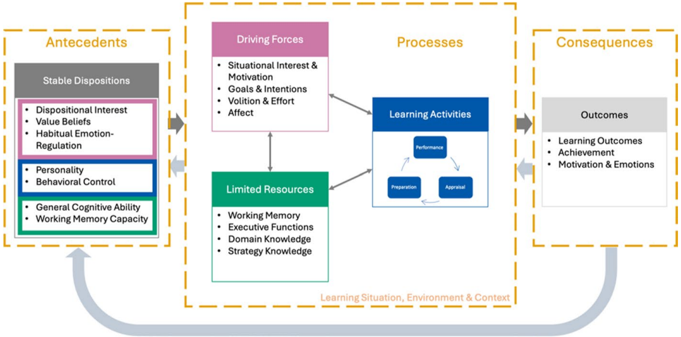
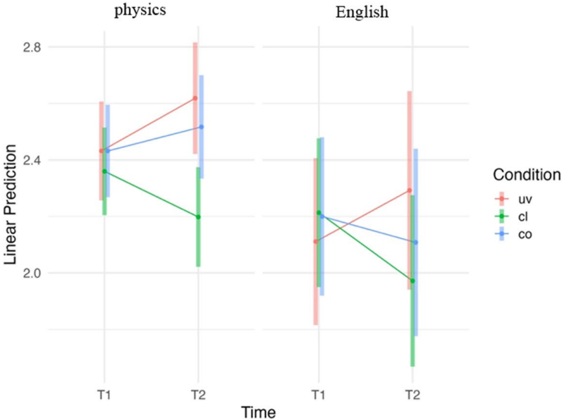
Abstract Self-regulated learning (SRL) is a critical competency for academic success and lifelong learning, yet providing personalized SRL support in real-time classroom settings remains challenging. In this randomized controlled trial, we investigated whether generative-AI-(GenAI)-based interventions can effectively support SRL in secondary school students. Drawing on an integrative model of self-regulation in education, the study contrasted two types of GenAI-supported interventions—targeting either motivational (utility value) or strategic (cognitive-learning-strategy-based) aspects of SRL—with a control condition using standard ChatGPT. A total of 371 students (Grades 7–9) were randomly assigned to one of the three conditions and participated in six 45-min sessions during regular physics or English lessons. Outcome measures included self-reported utility value, strategy use (self-reported and tested performance), interest, effort, and tested domain-specific knowledge, assessed at pre- and posttest. The results showed that students in the utility value condition reported more favorable development of perceived utility value than those in the cognitive strategy condition. However, no statistically significant advantages of either intervention over the control condition were found for effort, domain-specific knowledge, or elaboration-based strategy use. Exploratory analyses indicated that students who engaged more meaningfully with the GenAI tended to have more sustained interest than those in the control group. No subject-specific (physics or English) differences in intervention effects were observed. Findings suggest GenAI-based interventions may help preserve motivational aspects of SRL under certain conditions, but further development is needed to effectively support cognitive strategies and improve learning outcomes in secondary school settings.
Overview
CoChat Summary
TL;DR
This preregistered RCT tested whether two types of GenAI-supported prompting—utility value reflection and cognitive learning strategy prompting—could foster self-regulated learning in German secondary school students, compared with standard ChatGPT use. Only the utility value condition showed a relative advantage, and only over the cognitive strategy condition (not the control); no condition effects emerged for strategy use, effort, or domain-specific knowledge.
Key findings
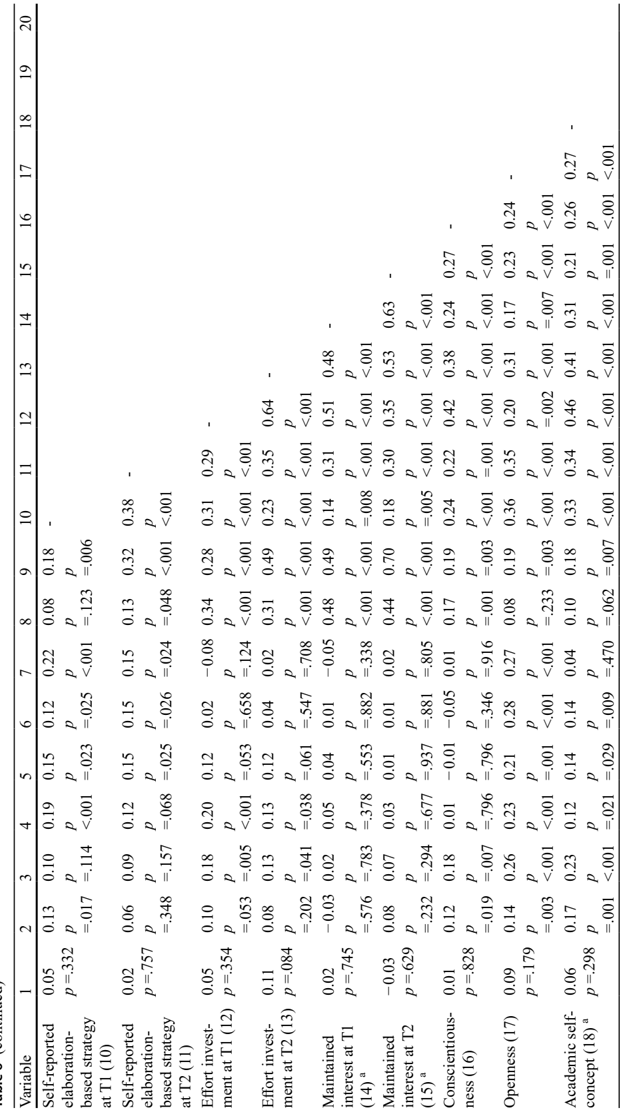
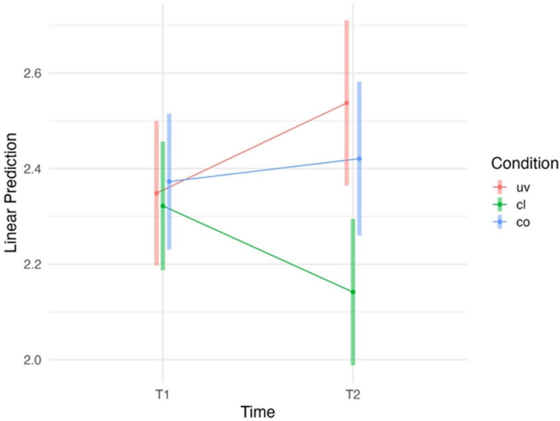
- Utility value: the time × condition interaction was significant, χ²(2) = 19.05, p < .001. Students in the utility value condition showed a more favorable trajectory than those in the cognitive learning strategy condition (β = −0.50, SE = 0.11, p < .001), driven by a significant decline in the cognitive strategy condition (ΔM = 0.30, p < .001) rather than a gain in the utility value condition (ΔM = −0.08, p = .328). The utility value condition did not differ significantly from the control condition (ΔM = −0.15, p = .063).
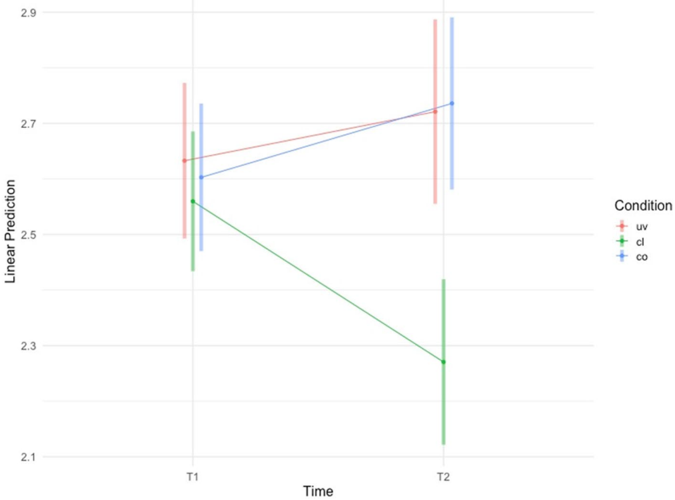
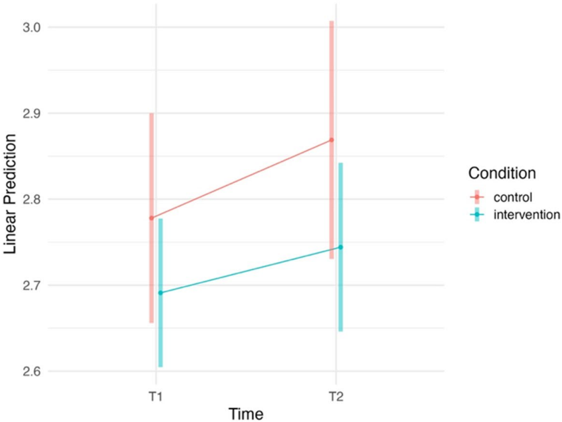
- Strategy use: no differential change across conditions for self-reported elaboration-based strategy use, χ²(2) = 0.08, p = .960, or for applied learning-by-explaining, χ²(2) = 0.01, p = .992; all conditions showed slight descriptive decreases (ΔM ≈ 0.32–0.35) that were not significant.
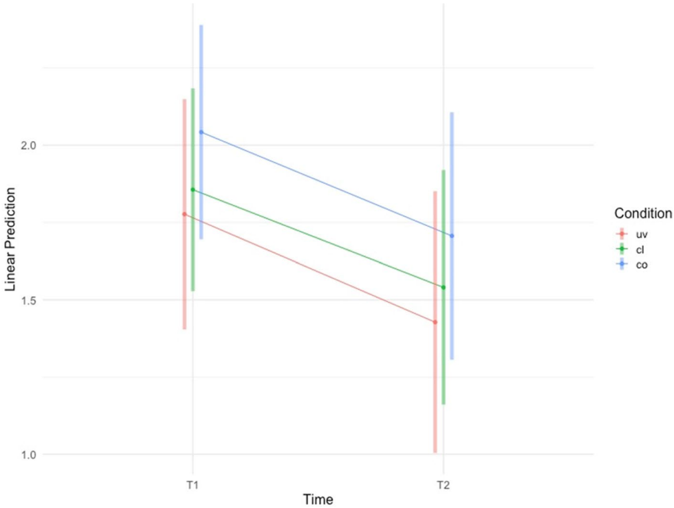
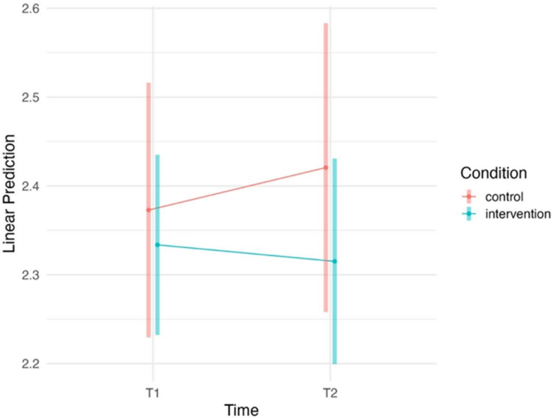
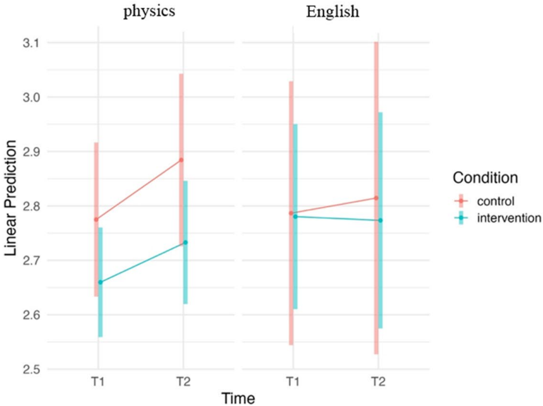
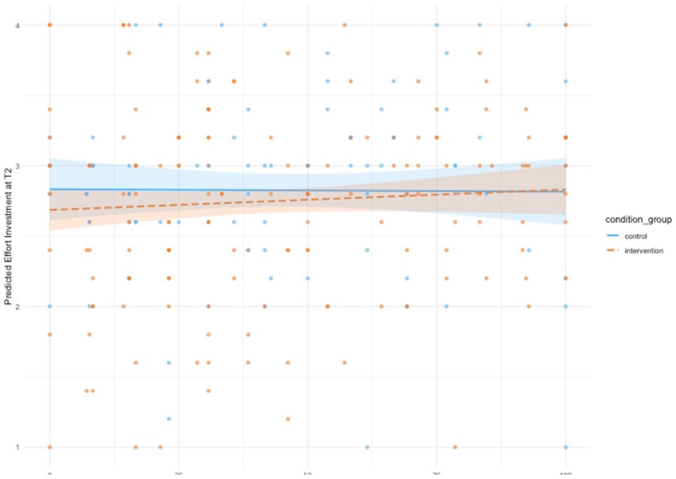
- Other outcomes: no condition × time effects for maintained interest (χ²(1) = 0.54, p = .463), effort investment (χ²(1) = 0.24, p = .623), or domain-specific knowledge (χ²(1) = 1.28, p = .257).
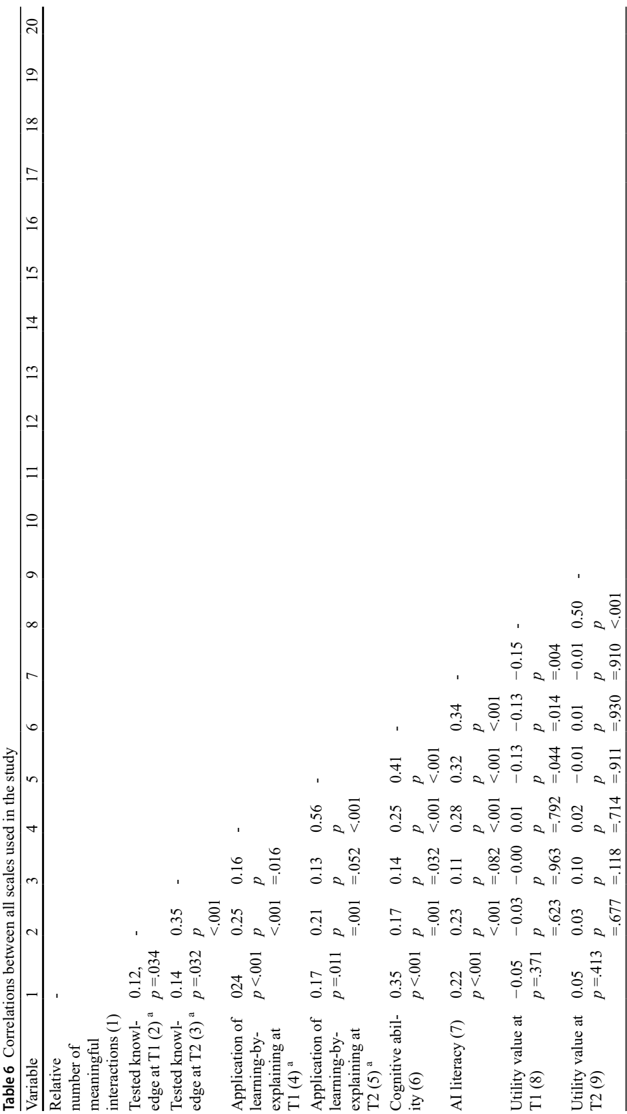
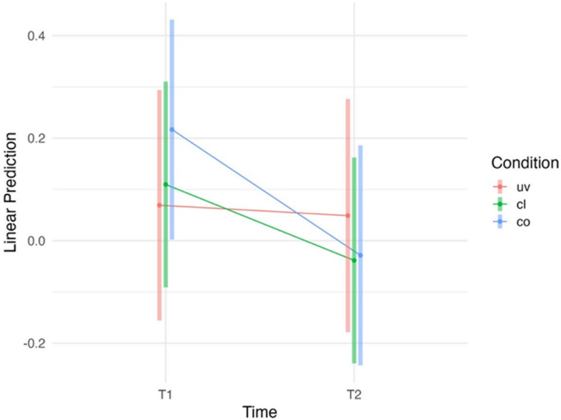
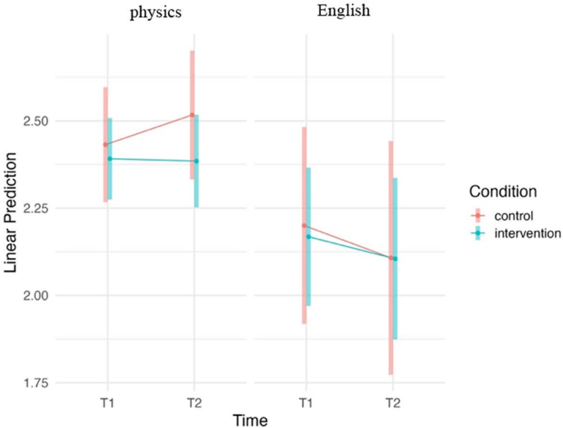
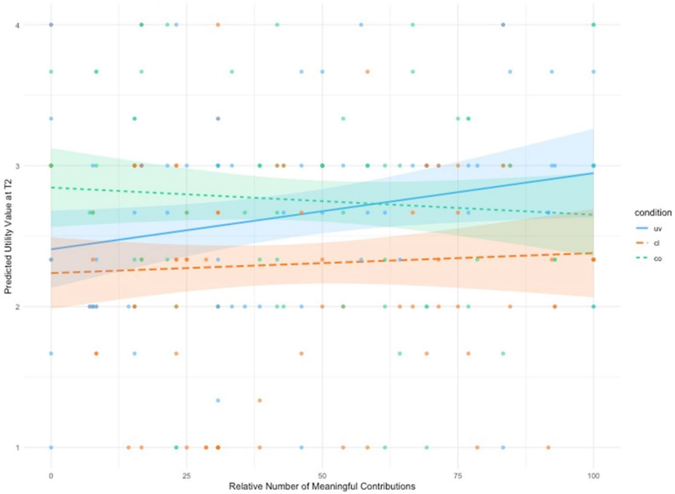
- Exploratory: a significant three-way interaction of condition, time, and relative number of meaningful GPT interactions for maintained interest (β = 0.30, SE = 0.00, p = .009), indicating that meaningful engagement buffered motivational decline in the intervention conditions relative to control. No subject-specific (physics vs. English) differences emerged for any outcome.
Methods
- Preregistered three-arm RCT in authentic classrooms (physics and English) in Baden-Württemberg, Germany; N = 371 students in Grades 7–9 (age M = 13.92, SD = 1.27; 54% female; 45% reported a migration background), individually randomized within the IWM Author platform to utility value reflection, cognitive learning strategy prompting, or a standard-ChatGPT control condition.
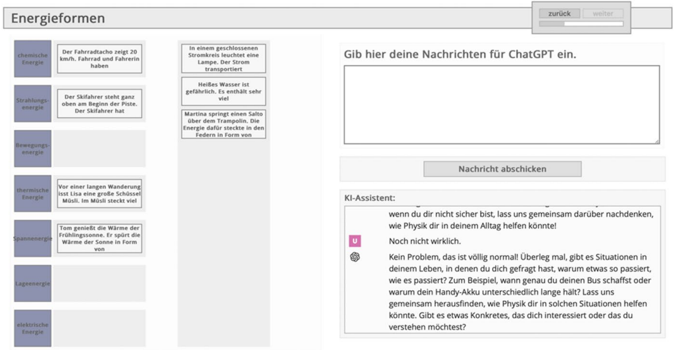
- Intervention spanned six 45-min sessions (pretest, four learning sessions, posttest) with GPT-4o-powered CustomGPTs; all conditions withheld correct answers, and conditions differed only in theory-informed system prompts. Outcomes at T1 and T2 included self-reported utility value, elaboration-based strategy use, applied learning-by-explaining, maintained interest, effort, and tested domain-specific knowledge.
- Analysis used linear mixed-effects models (lme4) with condition, time, and their interaction, random intercepts for participants, emmeans post hoc contrasts, and Benjamini–Hochberg correction; robustness checks included multiple imputation (50 datasets), complete-case analysis, covariate adjustment per WWC standards, and CACE estimation via instrumental variable regression.
Limitations
- Stated by the authors: convenience sampling limits generalizability beyond German secondary schools; unequal group sizes with no blocking or stratification may have introduced baseline imbalances; 35% dropout between T1 and T2 (130 students) risked attrition bias; several exploratory analyses increased false-positive risk; teacher presence may have introduced implementation variability; interaction measures captured engagement/compliance rather than process-level SRL behaviors; all outcomes were measured immediately post-intervention with no follow-up; and reliability of some self-report scales was low (e.g., openness α = 0.39; conscientiousness α = 0.59; AI literacy KR-20 = 0.23).
- Evident from the text: the self-report elaboration measure captured dispositional rather than task-specific strategy use, which the authors note was misaligned with the intervention and hypothesis; the control condition was an active ChatGPT condition rather than a waitlist, which the authors identify as a possible reason for null effects; and the four-session intervention may have been too brief to change deep-level competencies such as English grammar structures.
Model-written summary. Check it against the paper before relying on it.
Integrity signals
Registry
Cites
Statistics
Figures









Verification
Claims the paper makes
27 Valid · 5 Not valid · 24 Not checked · 173 Own results and interpretations
At least one cited source doesn’t support this claim or points to a different paper, and none confirmed it — see the verdicts below.
In the paper
“Many current studies have lacked a sound theoretical foundation.”
What the sources say
- Disputedcites Lan & Zhou, 2025 sourceExperimental — accuracy not yet measured
The Discussion (page unavailable) says the reviewed studies rely strongly on established educational theories and that studies are predominantly anchored in classical frameworks. It identifies a lack of innovative frameworks suited to AI and self-regulated learning, not a general lack of sound theoretical foundations. (LLM, conf=0.84)
Checked by a reasoning model — may be wrong.
plain- Asserted: passes — The authors put it forward as true.
- Checkable: passes — It can be checked against evidence.
- Load-bearing: passes — The paper’s conclusions depend on it.
- Based: passes — The paper gives a reason why it holds.
- Disputed
The cited sources support only part of this claim — read each source’s verdict below.
In the paper
“Several meta-analyses have demonstrated the effectiveness of SRL interventions in promoting students' achievement, strategy use, and motivation across educational contexts and age groups (e.g., Dignath & Büttner, 2008; Jansen et al., 2019 ).”
What the sources say
- Not checked — no full text of the sourcecites Dignath & Büttner, 2008 source
- Partly supportedcites Jansen et al., 2019 sourceExperimental — accuracy not yet measured
Section 4.3 reports that SRL interventions improved achievement and engagement in SRL activities among higher-education students. Section 1.1 explicitly places motivation outside this review’s scope. The paper discusses earlier reviews in primary and secondary education, but its own meta-analyses do not demonstrate effects across age groups. (LLM, conf=0.90)
boostedstates a cause- Asserted: passes — The authors put it forward as true.
- Checkable: passes — It can be checked against evidence.
- Load-bearing: passes — The paper’s conclusions depend on it.
- Based: passes — The paper gives a reason why it holds.
Every source the paper cites for this claim was checked and supports it.
In the paper
“Although several theoretical advancements have occurred in recent years (Tinajero et al., 2024 ), implementing effective SRL support in real classrooms remains a considerable challenge.”
What the sources say
- Supportedcites Tinajero et al., 2024 sourceExperimental — accuracy not yet measured
The citation is attached to the statement that SRL theory has advanced in recent years, not to the citing authors’ statement about the difficulty of classroom implementation. The Discussion and conclusions describes advances in SRL models and explains how modern models better represent the complexity of learning. (LLM, conf=0.91)
plain- Asserted: passes — The authors put it forward as true.
- Checkable: passes — It can be checked against evidence.
- Load-bearing: passes — The paper’s conclusions depend on it.
- Based: passes — The paper gives a reason why it holds.
- Supported
The cited sources support only part of this claim — read each source’s verdict below.
In the paper
“In addition to emphasizing the value of the learning content, prompting students to elaborate on it-especially through generative strategies such as explaininghas been shown to be a highly effective cognitive learning strategy (Donker et al., 2014 ; Fiorella & Mayer, 2015; Lachner et al., 2022).”
What the sources say
- Supportedcites Donker et al., 2014 source
Section 4.1 calls elaboration a generally very effective strategy. Section 4.5 says it proved very effective in mathematics and gives students explaining their solution steps to themselves as an example of elaboration. (LLM, conf=0.88)
- Not checked — no full text of the sourcecites Fiorella & Mayer, 2015 source
- Partly supportedcites Lachner et al., 2022 sourceExperimental — accuracy not yet measured
The section ‘Which Processes are Responsible for the Effectiveness of Learning by Non-Interactive Teaching?’ (page unavailable) describes prompting explanations as activating elaboration and other generative processes. The Introduction (page unavailable) reports learning benefits, but also null and detrimental findings. It therefore supports explaining as a potentially effective strategy, not the unqualified description ‘highly effective.’ (LLM, conf=0.86)
boostedstates a cause- Asserted: passes — The authors put it forward as true.
- Checkable: passes — It can be checked against evidence.
- Load-bearing: passes — The paper’s conclusions depend on it.
- Based: passes — The paper gives a reason why it holds.
- Supported
The cited sources support only part of this claim — read each source’s verdict below.
In the paper
“Experimental evidence further suggests that support emphasizing direct answer provision can reduce generative cognitive engagement and cognitive activation, sometimes described as 'metacognitive laziness' (Fan et al., 2025; see also Yan et al., 2025).”
What the sources say
- Partly supportedcites Fan et al., 2025 sourceExperimental — accuracy not yet measured
Section 5.2 (page unavailable) reports that the ChatGPT group showed fewer metacognitive processes than the human-expert and checklist groups, which the authors describe as potential ‘metacognitive laziness.’ But the experiment did not isolate direct answer provision as the cause, and the same section reports more elaboration and organization during revision in the supported groups, including the ChatGPT group. Thus, the claimed reduction in generative cognitive engagement is not established by this source. (LLM, conf=0.85)
- Partly supportedcites Yan et al., 2025 sourceExperimental — accuracy not yet measured
In “Cognitive load, metacognition and self-efficacy” (page unavailable), the paper reports a randomized study linking frequent generative-AI use to “metacognitive laziness” and says excessive offloading risks reducing active cognitive engagement. It does not identify direct answer provision as the specific form of support responsible, or report a measure of cognitive activation. (LLM, conf=0.83)
hedgedstates a possible cause- Asserted: passes — The authors put it forward as true.
- Checkable: passes — It can be checked against evidence.
- Load-bearing: passes — The paper’s conclusions depend on it.
- Based: passes — The paper gives a reason why it holds.
- Partly supported
101 more claims · 5 with their cited sources checked
Create a free account to see all 229 claims and every source verdict.
- Probably not a substantial claim. 85
- It may state two separate claims as one. 55
- The quote only partly states this claim. 3
Statistics recomputed
Every reported test result, recomputed from its test statistic and degrees of freedom. A result shows as not adding up only once an independent check has confirmed it.
- Not confirmedχ²(2) = 0.01reported p = .992 · recomputed p = .995
“χ2(2) = 0.01, p = .992”
- Consistentχ²(2) = 19.05reported p < .001 · recomputed p < .001
“χ2(2) = 19.05, p < .001”
- Consistentχ²(2) = 0.08reported p = .96 · recomputed p = .961
“χ2(2) = 0.08, p = .960”
- Consistentχ²(1) = 0.54reported p = .463 · recomputed p = .462
“χ2(1) = 0.54, p = .463”
- Consistentχ²(1) = 0.24reported p = .623 · recomputed p = .624
“χ2(1) = 0.24, p = .623”
4 more recomputed tests
Create a free account to see every test the Stats check recomputed.
Self-check
Percentages, sums and reported differences re-computed from the paper’s own numbers.
Each contradiction between two passages listed here was confirmed by an independent check.
Rated major: it would touch a result — a value a result rests on, reported and recomputed p-values on opposite sides of the significance level, two passages that conflict with no sign which is right, or a cited work retracted before this paper was published.
In the paper
§ Compliance Variable used for Robustness Checks
“1 = compliers , i.e., students who used the GPT meaningfully at least once per task”
§ Data Collection Procedure
“| uv - Physics | 23 (46.9%) | 42 (53.2%) | 1,045 (1191) [0, 5797] | 476.34 (225.25) | 13 (12) [0, 42] | 10 (11) [0, 41] | 37.80 (32.68) |”
Citations
Cites
R: A Language and Environment for Statistical Computing
R Core Team (2025) · doi:10.32614/r.manuals · Cited by 352,181
Controlling the False Discovery Rate: A Practical and Powerful Approach to Multiple Testing
Benjamini, Y., & Hochberg, Y. (1995) · Journal of the Royal Statistical Society Series B: Statistical Methodology · doi:10.1111/j.2517-6161.1995.tb02031.x · Cited by 109,482
Fitting Linear Mixed-Effects Models Using lme4
Bates, D., Mächler, M., Bolker, B., & Walker, S. (2015) · Journal of Statistical Software · doi:10.18637/jss.v067.i01 · Cited by 86,835
Miyake, A., Friedman, N. P., Emerson, M. J., Witzki, A. H., Howerter, A., & Wager, T. D. (2000) · Cognitive Psychology · doi:10.1006/cogp.1999.0734 · Cited by 15,798
mice: Multivariate Imputation by Chained Equations in R
Buuren, S. V., & Groothuis-Oudshoorn, K. (2011) · Journal of Statistical Software · doi:10.18637/jss.v045.i03 · Cited by 13,870
The Use of Cronbach’s Alpha When Developing and Reporting Research Instruments in Science Education
Taber, K. S. (2018) · Research in Science Education · doi:10.1007/s11165-016-9602-2 · Cited by 10,679
Becoming a Self-Regulated Learner: An Overview
Zimmerman, B. J. (2002) · Theory Into Practice · doi:10.1207/s15430421tip4102_2 · Cited by 10,197
ChatGPT for good? On opportunities and challenges of large language models for education
Kasneci, E., Sessler, K., Küchemann, S., Bannert, M., Dementieva, D., Fischer, F., Gasser, U., Groh, G., Günnemann, S., Hüllermeier, E., et al. (2023) · Learning and Individual Differences · doi:10.1016/j.lindif.2023.102274 · Cited by 7,326
Self-citationPekrun, R. (2006) · Educational Psychology Review · doi:10.1007/s10648-006-9029-9 · Cited by 5,566
The Role of Goal Orientation in Self-Regulated Learning
Pintrich, P. R. (2000) · Handbook of Self-Regulation · doi:10.1016/b978-012109890-2/50043-3 · Cited by 5,173
Research works printed but not linked: 7
- Angrist, J. D., & Pischke, J. S. (2015). Mastering ’metrics. The path from cause to effect. Princeton University Press.
- Chi, M. T. H. (2000). Self-explaining: The dual processes of generating inference and repairing mental models. In R. Glaser (Ed.), Advances in instructional psychology: Educational design and cognitive science (Vol. 5, pp. 161–238). Lawrence Erlbaum Associates.
- Foster, N., & Piacentini, M. (2023). Innovating assessments to measure and support complex skills (1st ed.). Organization for Economic Cooperation & Development (OECD).
- Hausmann, R. G. M., & Vanlehn, K. (2007). Explaining self-explaining: A contrast between content and generation. Proceedings of the 2007 Conference on Artificial Intelligence in Education: Building Technology Rich Learning Contexts That Work, 417–424.
- John, O. P., Naumann, L. P., & Soto, C. J. (2008). Paradigm shift to the integrative Big Five trait taxonomy: History, measurement, and conceptual issues. In O. P. John, R. W. Robins, & L. A. Pervin (Eds.), Handbook of personality: Theory and research (3rd ed., pp. 114–158). The Guilford Press.
- Lightbown, P., & Spada, N. M. (2013). How languages are learned (4th ed.). Oxford University Press.
- Schunk, D. H., & Zimmerman, B. J. (Eds.). (1998). Self-regulated learning: From teaching to self-reflective practice. Guilford Press.
Cited by
Klapproth, F. (2026) · Education Sciences · doi:10.3390/educsci16091507
Cho, N., Li, H., Zhang, X., & Li, Y. (2026) · Interactive Learning Environments · doi:10.1080/10494820.2026.2723298
Liu, W., Tian, Z., Liu, D., & Hargood, C. (2026) · ACM Conference on Hypertext and Social Media (HT) · doi:10.1145/3800935.3830852
“Related studies also report GenAI-supported interventions and GenAI-supported chatbots in learning settings [14, 17].”
Xia, Q., Jiang, R., Zhang, Z., & Chiu, T. K. F. (2026) · Measurement Interdisciplinary Research and Perspectives · doi:10.1080/15366367.2026.2717599
Why using AI as a learning coach can improve education
Fütterer, T., Gerjets, P. H., Steinhauser, R., Fabian, A., Udvardi-Lakos, N., Greene, J. A., Bernacki, M. L., Brod, G., & Trautwein, U. (2026) · Nature Human Behaviour · doi:10.1038/s41562-026-02524-2 · Cited by 1
Self-citation
Metadata
- Authors
- Fütterer, T., Bardach, L., Kuhn, J., Keller, S. D., & Gerjets, P.
- Affiliations
- University of Tübingen (DE)
- Kaunas University of Technology (LT)
- Zurich University of Teacher Education (CH)
- Leibniz-Institut für Wissensmedien (DE)
- Corresponding author
- Fütterer, Tim
- Venue
- Educational Psychology Review
- Published
- 2026-04-14
- Volume
- 38
- Issue
- 1
- ISSN
- 1040-726X (ISSN-L)
- 1573-336X
- OpenAlex
- W7154244448
- Semantic Scholar
- 63a4eb733b09fdf977d137a9e960baf57aa79e04
- Cited by
- 17
- References
- 124
- Citations by year
- 2026: 17
- FWCI
- 245.63
- Type
- journal article
- Language
- en
- Open access
- hybrid
- doi.org
- Licence
- cc-by
- creativecommons.org/licenses/by/4.0 (tdm)
- creativecommons.org/licenses/by/4.0 (vor)
- Locations
- Educational Psychology Review (publishedVersion, cc-by)
- KTUePubl (Repository of Kaunas University of Technology) (submittedVersion, other-oa)
- Universitätsbibliothek Tübingen
- Funders
- Eberhard Karls Universität Tübingen
- Topics
- Social Sciences › Psychology › Developmental and Educational Psychology › Innovative Teaching and Learning Methods
- Social Sciences › Education › Artificial Intelligence in Education
- Physical Sciences › Computer Science › Artificial Intelligence › Intelligent Tutoring Systems and Adaptive Learning
- Keywords
- student self-regulation, generative AI, ChatGPT, high school students, utility value, cognitive strategies, elaboration, student motivation, interest, effort, domain knowledge, AI-based interventions, physics education, English education
About these checks
Registry, retraction, Cites and statistics results are computed, not judged, with one exception: a printed reference that no index lists is read once by a model before it counts as a citation error. Claims are extracted by a model and kept only when their quote appears verbatim in the text; each cited source is then checked, with a model’s help, for whether it says what the claim relies on. Those verdicts can be wrong — read the claim’s quote and the cited source before relying on one.
The claim verdicts this report counts are experimental: their accuracy is not yet measured.
A language model drew the claims from the paper on 2026-09-28, under version 3 of the claim definition (prompt extract-v3).
A second model labelled each claim on 2026-09-28 (model jev-1.13-20260917, definition revision gold-guideline-v0.2).
Cited sources are checked with a language model’s help (gpt-6-sol).
Statistics and arithmetic are recomputed, not judged.
Confidence bands are shown only for fields calibrated on our annotated test set. None is calibrated yet, so no band is shown.
What counts as a claim ›How we measure confidence ›How we check this ›
Are you an author, or do you see a problem with this page? Request a review
How to cite
Cite CoChat for the checks on this page, and the paper for its own findings.
- This page
- CoChat. (2026). Citation check: Enhancing School Students' Self-Regulated Learning through Generative AI Support: A Randomized Controlled Trial. https://app.cochat.ai/papers/10.1007/s10648-026-10133-8
- The paper
- Fütterer, T., Bardach, L., Kuhn, J., Keller, S. D., & Gerjets, P. (2026). Enhancing School Students' Self-Regulated Learning through Generative AI Support: A Randomized Controlled Trial. Educational Psychology Review. https://doi.org/10.1007/s10648-026-10133-8
Data sources
Bibliographic data: Semantic Scholar, OpenAlex, Crossref.
Contains information from the Semantic Scholar Academic Graph Datasets, made available under the ODC Attribution License (ODC-BY 1.0).
Semantic Scholar’s data is described in: Kinney, R., et al. (2023). The Semantic Scholar Open Data Platform. arXiv:2301.10140.
