

Impact of log parsing on deep learning-based anomaly detection
Open accessThe DOI matches its Crossref record; 47 of the 47 references it cites were found in a registry or an index.
Abstract
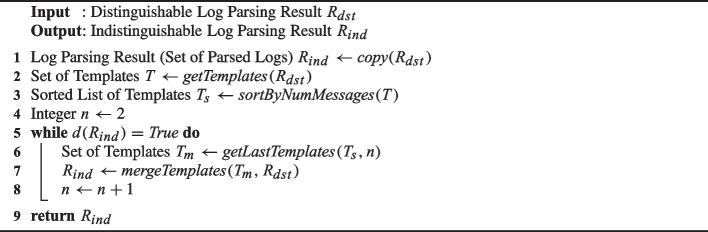
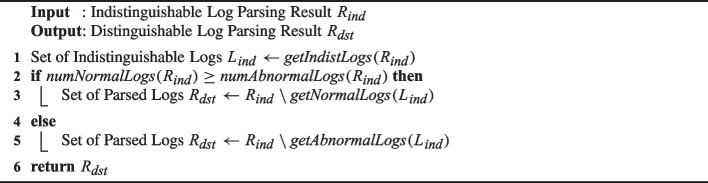
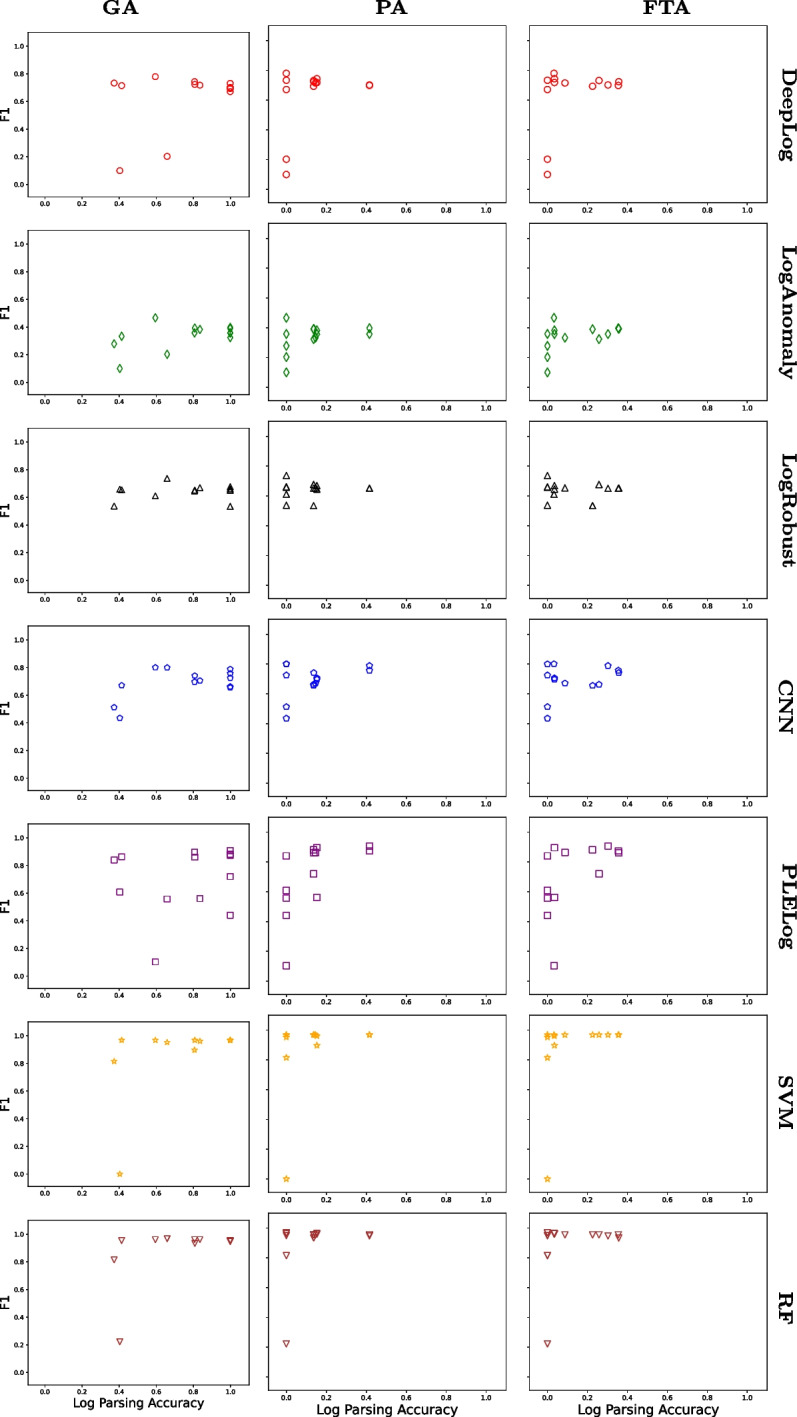
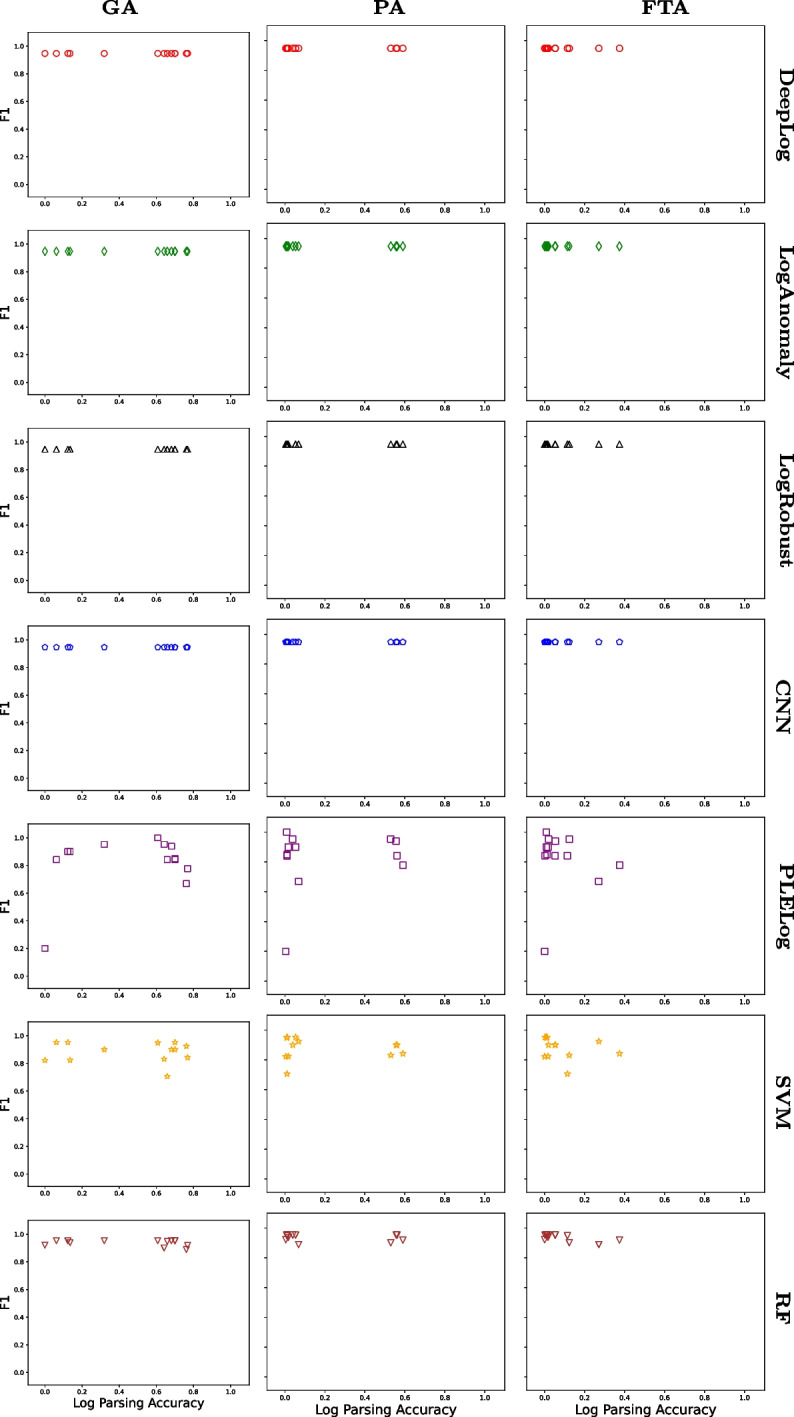
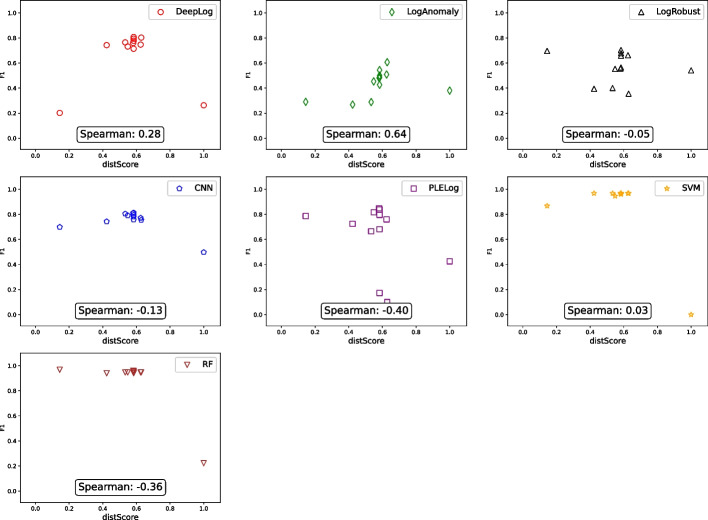
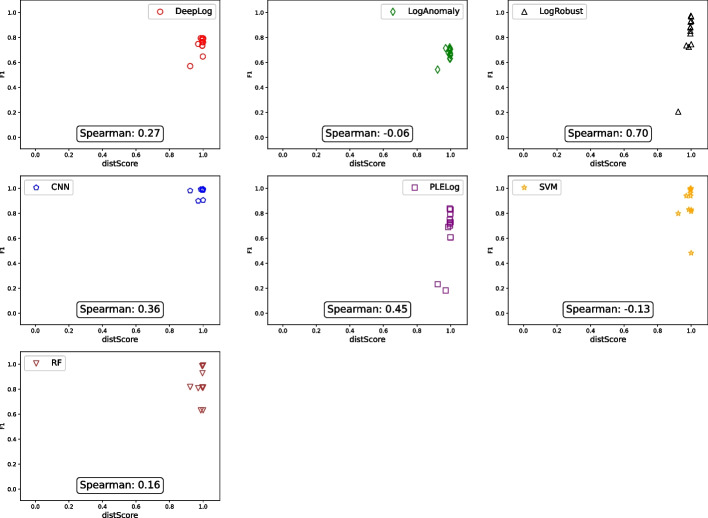
Software systems log massive amounts of data, recording important runtime information. Such logs are used, for example, for log-based anomaly detection, which aims to automatically detect abnormal behaviors of the system under analysis by processing the information recorded in its logs. Many log-based anomaly detection techniques based on deep learning models include a pre-processing step called log parsing. However, understanding the impact of log parsing on the accuracy of anomaly detection techniques has received surprisingly little attention so far. Investigating what are the key properties log parsing techniques should ideally have to help anomaly detection is therefore warranted. In this paper, we report on a comprehensive empirical study on the impact of log parsing on anomaly detection accuracy, using 13 log parsing techniques, seven anomly detection techniques (five based on deep learning and two based on traditional machine learning) on three publicly available log datasets. Our empirical results show that, despite what is widely assumed, there is no strong correlation between log parsing accuracy and anomaly detection accuracy, regardless of the metric used for measuring log parsing accuracy. Moreover, we experimentally confirm existing theoretical results showing that it is a property that we refer to as distinguishability in log parsing results—as opposed to their accuracy—that plays an essential role in achieving accurate anomaly detection.
Overview
The claims and statistics of this paper haven’t been checked yet.
Free: it reads the open-access text and checks the first 5 claims that cite a source we can check. Create a free account to check every claim.
Integrity signals
Registry
Cites
Statistics
Figures

Verification
Claims the paper makes
The claims and statistics of this paper haven’t been checked yet.
Free: it reads the open-access text and checks the first 5 claims that cite a source we can check. Create a free account to check every claim.
Claims other papers make about this one
Each is checked against this paper’s own text: does it say what the citing paper says it does?
In the citing paper
“Research has focused on tasks such as anomaly detection [90, 237], incident classification [36, 68], and root cause analysis [228, 247].”
From A 2030 Roadmap for Software Engineering (2025) · cites this paper as [90]
Self-check
Percentages, sums and reported differences re-computed from the paper’s own numbers.
The self-check needs the paper’s full text.
Citations
Cites
Breiman, L. (2001) · Machine Learning · doi:10.1023/a:1010933404324 · Cited by 133,538 · cited 2×
“…learning models, we included two representative traditional machine learning models, namely Support Vector Machine (SVM) (Hearst et al. 1998) and Random Forest(RF)Breiman(2001) 2 sincetheyareknownfortheireffectivenessinanomalydetection tasks on the HDFS dataset (Wu et al. 2023; Jia et al. 2023).”
MethodBERT: Pre-training of Deep Bidirectional Transformers for Language Understanding
Devlin, J., Chang, M.-W., Lee, K., & Toutanova, K. (2018) · arXiv · doi:10.48550/arxiv.1810.04805 · Cited by 73,173 · cited 3×
“…log representation techniques, such as FastText (Joulin et al. 2016), Word2Vec (Mikolov et al. 2013), TF-IDF (Salton and Buckley 1988) and BERT (Devlin et al. 2018), used to convert textual log data into numerical feature vectors for machine learning algorithms, such as Support Vector Machine,…”
BackgroundMethodEfficient Estimation of Word Representations in Vector Space
Mikolov, T., Chen, K., Corrado, G., & Dean, J. (2013) · arXiv · doi:10.48550/arxiv.1301.3781 · Cited by 26,568 · cited 3×
“They considered different log representation techniques, such as FastText (Joulin et al. 2016), Word2Vec (Mikolov et al. 2013), TF-IDF (Salton and Buckley 1988) and BERT (Devlin et al. 2018), used to convert textual log data into numerical feature vectors for machine learning algorithms, such as Support Vector Machine…”
MethodTerm-weighting approaches in automatic text retrieval
Salton, G., & Buckley, C. (1988) · Information Processing & Management · doi:10.1016/0306-4573(88)90021-0 · Cited by 9,740 · cited 2×
“They considered different log representation techniques, such as FastText (Joulin et al. 2016), Word2Vec (Mikolov et al. 2013), TF-IDF (Salton and Buckley 1988) and BERT (Devlin et al. 2018), used to convert textual log data into numerical feature vectors for machine learning algorithms, such as Support Vector Machine…”
MethodHearst, M. A., Dumais, S. T., Osuna, E., Platt, J., & Scholkopf, B. (1998) · IEEE Intelligent Systems and their Applications · doi:10.1109/5254.708428 · Cited by 7,243 · cited 8×
“In Table 6, except for PLELog, SVM, and RF, the values for all anomaly detection techniques are identical due to the reasons explained in the last paragraph of Section 5.1.”
MethodInfluentialOn the Properties of Neural Machine Translation: Encoder–Decoder Approaches
Cho, K., van Merrienboer, B., Bahdanau, D., & Bengio, Y. (2014) · Proceedings of SSST-8, Eighth Workshop on Syntax, Semantics and Structure in Statistical Translation · doi:10.3115/v1/w14-4012 · Cited by 7,099
Individual Comparisons by Ranking Methods
Wilcoxon, F. (1992) · Springer Series in Statistics · doi:10.1007/978-1-4612-4380-9_16 · Cited by 2,915 · cited 1×
“To see if the differences between R dst and R ind are significant, we applied the non-parametric L og R obu s t ( F 1 ) Wilcoxon signed rank test (Wilcoxon 1992) for paired samples to the F1 scores of R dst and R ind , for each of the seven anomaly detection techniques and the two datasets.”
MethodDeepLog: Anomaly Detection and Diagnosis from System Logs through Deep Learning
Du, M., Li, F., Zheng, G., & Srikumar, V. (2017) · Proceedings of the 2017 ACM SIGSAC Conference on Computer and Communications Security · doi:10.1145/3133956.3134015 · Cited by 1,835 · cited 12×
“…would be enough in some cases (e.g., detecting anomalies based on the sequence of template IDs without considering the content of the templates (Du et al. 2017)), correctly identified templates (i.e., templates identical to the corresponding oracle ones) matter when the fixed parts of templates…”
BackgroundMethodInfluentialDrain: an online log parsing approach with fixed depth tree
He, P., Zhu, J., Zheng, Z., & Lyu, M. R. (2017) · 2017 IEEE International Conference on Web Services (ICWS) · doi:10.1109/icws.2017.13 · Cited by 943 · cited 7×
“…various elements of each variable part with a special character “ <*> ”; this representation is widely used in log-based analyses (e.g., log parsing (He et al. 2017; Jiang et al. 2008), anomaly detection (Zhang et al. 2019; Du et al. 2017), and log-based testing (Elyasov 2012; Jeong et al.…”
BackgroundMethodInfluentialFastText.zip: Compressing text classification models
Joulin, A., Grave, E., Bojanowski, P., Douze, M., Jégou, H., & Mikolov, T. (2016) · arXiv · doi:10.48550/arxiv.1612.03651 · Cited by 887 · cited 4×
“Furthermore, this is the first work to empirically demonstrate the importance of distinguishability after the theoretical framework proposed by Shin et al. (2021).”
BackgroundMethodInfluentialRobust log-based anomaly detection on unstable log data
Zhang, X., Xu, Y., Lin, Q., Qiao, B., Zhang, H., Dang, Y., Xie, C., Yang, X., Cheng, Q., Li, Z., et al. (2019) · Proceedings of the 2019 27th ACM Joint Meeting on European Software Engineering Conference and Symposium on the Foundations of Software Engineering · doi:10.1145/3338906.3338931 · Cited by 761 · cited 15×
“X , Y could not be computed for DeepLog, LogAnomaly, LogRobust, and CNN since the F1 score does not vary at all with (cid”
BackgroundMethodInfluentialTools and benchmarks for automated log parsing
Zhu, J., He, S., Liu, J., He, P., Xie, Q., Zheng, Z., & Lyu, M. R. (2019) · 2019 IEEE/ACM 41st International Conference on Software Engineering: Software Engineering in Practice (ICSE-SEIP) · doi:10.1109/icse-seip.2019.00021 · Cited by 574 · cited 11×
“Zhu et al. (2019) observed that log parsing can be considered as a clustering process where log messages with the same template are clustered into the same group.”
BackgroundMethodInfluentialExecution Anomaly Detection in Distributed Systems through Unstructured Log Analysis
Fu, Q., Lou, J.-G., Wang, Y., & Li, J. (2009) · 2009 Ninth IEEE International Conference on Data Mining · doi:10.1109/icdm.2009.60 · Cited by 542 · cited 4×
“Although we could additionally reduce the datasets based on the slowest log parsing technique (i.e., LKE), we found that it would result in small logs that are not representative of the size and complexity of real-world logs.”
MethodInfluentialA data clustering algorithm for mining patterns from event logs
Vaarandi, R. (2004) · Proceedings of the 3rd IEEE Workshop on IP Operations & Management (IPOM 2003) (IEEE Cat. No.03EX764) · doi:10.1109/ipom.2003.1251233 · Cited by 453 · cited 6×
“To address this problem, many automated log-parsing approaches, which take as input log messages and identify their log templates using different heuristics, have been proposed in the literature (e.g., AEL (Jiang et al. 2008), Drain (He et al. 2017), IPLoM (Makanju et al. 2009), LenMa (Shima 2016), LFA (Nagappan and V…”
BackgroundMethodInfluentialSpell: Streaming Parsing of System Event Logs
Du, M., & Li, F. (2016) · 2016 IEEE 16th International Conference on Data Mining (ICDM) · doi:10.1109/icdm.2016.0103 · Cited by 423 · cited 7×
“To address this problem, many automated log-parsing approaches, which take as input log messages and identify their log templates using different heuristics, have been proposed in the literature (e.g., AEL (Jiang et al. 2008), Drain (He et al. 2017), IPLoM (Makanju et al. 2009), LenMa (Shima 2016), LFA (Nagappan and V…”
BackgroundMethodInfluentialLog-based Anomaly Detection Without Log Parsing
Le, V.-H., & Zhang, H. (2021) · 2021 36th IEEE/ACM International Conference on Automated Software Engineering (ASE) · doi:10.1109/ase51524.2021.9678773 · Cited by 361 · cited 4×
“In the future, to develop better log parsing techniques targeting anomaly detection, it would beneficial to focus on distinguishability, which has not been the case so far.”
BackgroundMethodInfluentialClustering event logs using iterative partitioning
Makanju, A. A. O., Zincir-Heywood, A. N., & Milios, E. E. (2009) · Proceedings of the 15th ACM SIGKDD international conference on Knowledge discovery and data mining · doi:10.1145/1557019.1557154 · Cited by 338 · cited 6×
“…their log templates using different heuristics, have been proposed in the literature (e.g., AEL (Jiang et al. 2008), Drain (He et al. 2017), IPLoM (Makanju et al. 2009), LenMa (Shima 2016), LFA (Nagappan and Vouk 2010), LogCluster (Vaarandi and Pihelgas 2015), LogMine (Hamooni et al. 2016),…”
MethodInfluentialA Survey on Automated Log Analysis for Reliability Engineering
He, S., He, P., Chen, Z., Yang, T., Su, Y., & Lyu, M. R. (2022) · ACM Computing Surveys · doi:10.1145/3460345 · Cited by 334 · cited 2×
“(Log-based) anomaly detection is a technique that aims to identify anomalous patterns, recorded in input logs, that do not conform to the expected behaviors of the system under analysis (He et al. 2021).”
BackgroundMethodLoghub: a large collection of system log datasets for AI-driven log analytics
Zhu, J., He, S., He, P., Liu, J., & Lyu, M. R. (2023) · 2023 IEEE 34th International Symposium on Software Reliability Engineering (ISSRE) · doi:10.1109/issre59848.2023.00071 · Cited by 302
LogCluster - A data clustering and pattern mining algorithm for event logs
Vaarandi, R., & Pihelgas, M. (2015) · 2015 11th International Conference on Network and Service Management (CNSM) · doi:10.1109/cnsm.2015.7367331 · Cited by 246 · cited 9×
“To address this problem, many automated log-parsing approaches, which take as input log messages and identify their log templates using different heuristics, have been proposed in the literature (e.g., AEL (Jiang et al. 2008), Drain (He et al. 2017), IPLoM (Makanju et al. 2009), LenMa (Shima 2016), LFA (Nagappan and V…”
BackgroundMethodInfluentialLogSig: generating system events from raw textual logs
Tang, L., Li, T., & Perng, C.-S. (2011) · Proceedings of the 20th ACM international conference on Information and knowledge management · doi:10.1145/2063576.2063690 · Cited by 244 · cited 5×
“To address this problem, many automated log-parsing approaches, which take as input log messages and identify their log templates using different heuristics, have been proposed in the literature (e.g., AEL (Jiang et al. 2008), Drain (He et al. 2017), IPLoM (Makanju et al. 2009), LenMa (Shima 2016), LFA (Nagappan and V…”
BackgroundMethodInfluentialSemi-Supervised Log-Based Anomaly Detection via Probabilistic Label Estimation
Yang, L., Chen, J., Wang, Z., Wang, W., Jiang, J., Dong, X., & Zhang, W. (2021) · 2021 IEEE/ACM 43rd International Conference on Software Engineering (ICSE) · doi:10.1109/icse43902.2021.00130 · Cited by 244 · cited 14×
“In Table 6, except for PLELog, SVM, and RF, the values for all anomaly detection techniques are identical due to the reasons explained in the last paragraph of Section 5.1.”
BackgroundMethodInfluentialLogMine: Fast Pattern Recognition for Log Analytics
Hamooni, H., Debnath, B., Xu, J., Zhang, H., Jiang, G., & Mueen, A. (2016) · Proceedings of the 25th ACM International on Conference on Information and Knowledge Management · doi:10.1145/2983323.2983358 · Cited by 227 · cited 7×
“To address this problem, many automated log-parsing approaches, which take as input log messages and identify their log templates using different heuristics, have been proposed in the literature (e.g., AEL (Jiang et al. 2008), Drain (He et al. 2017), IPLoM (Makanju et al. 2009), LenMa (Shima 2016), LFA (Nagappan and V…”
BackgroundMethodInfluentialSelf-Attentive Classification-Based Anomaly Detection in Unstructured Logs
Nedelkoski, S., Bogatinovski, J., Acker, A., Cardoso, J., & Kao, O. (2020) · 2020 IEEE International Conference on Data Mining (ICDM) · doi:10.1109/icdm50108.2020.00148 · Cited by 176 · cited 2×
“Although a few recent studies (Le and Zhang 2021; Mvula et al. 2023; Nedelkoski et al. 2020) have proposed anomaly detection techniques that do not require log parsing, we did not consider them in our work.”
BackgroundMethodAbstracting log lines to log event types for mining software system logs
Nagappan, M., & Vouk, M. A. (2010) · 2010 7th IEEE Working Conference on Mining Software Repositories (MSR 2010) · doi:10.1109/msr.2010.5463281 · Cited by 171 · cited 9×
“…their log templates using different heuristics, have been proposed in the literature (e.g., AEL (Jiang et al. 2008), Drain (He et al. 2017), IPLoM (Makanju et al. 2009), LenMa (Shima 2016), LFA (Nagappan and Vouk 2010), LogCluster (Vaarandi and Pihelgas 2015), LogMine (Hamooni et al. 2016),…”
BackgroundMethodInfluentialLogram: Efficient Log Parsing Using n-Gram Dictionaries
Dai, H., Li, H., Chen, C. S., Shang, W., & Chen, T.-H. (2020) · IEEE Transactions on Software Engineering · doi:10.1109/tse.2020.3007554 · Cited by 170
A search-based approach for accurate identification of log message formats
Messaoudi, S., Panichella, A., Bianculli, D., Briand, L., & Sasnauskas, R. (2018) · Proceedings of the 26th Conference on Program Comprehension · doi:10.1145/3196321.3196340 · Cited by 149 · cited 6×
“To address this problem, many automated log-parsing approaches, which take as input log messages and identify their log templates using different heuristics, have been proposed in the literature (e.g., AEL (Jiang et al. 2008), Drain (He et al. 2017), IPLoM (Makanju et al. 2009), LenMa (Shima 2016), LFA (Nagappan and V…”
BackgroundMethodInfluentialSelf-citationExplainable Deep Few-shot Anomaly Detection with Deviation NetworksPreprint
Pang, G., Ding, C., Shen, C., & van den Hengel, A. (2021) · arXiv (Cornell University) · doi:10.48550/arxiv.2108.00462 · Cited by 142 · cited 2×
“In the future, to develop better log parsing techniques targeting anomaly detection, it would beneficial to focus on distinguishability, which has not been the case so far.”
BackgroundIncremental Mining of System Log Format
Mizutani, M. (2013) · 2013 IEEE International Conference on Services Computing · doi:10.1109/scc.2013.73 · Cited by 139 · cited 12×
“To address this problem, many automated log-parsing approaches, which take as input log messages and identify their log templates using different heuristics, have been proposed in the literature (e.g., AEL (Jiang et al. 2008), Drain (He et al. 2017), IPLoM (Makanju et al. 2009), LenMa (Shima 2016), LFA (Nagappan and V…”
BackgroundMethodInfluentialAbstracting Execution Logs to Execution Events for Enterprise Applications (Short Paper)
Jiang, Z. M., Hassan, A. E., Flora, P., & Hamann, G. (2008) · 2008 The Eighth International Conference on Quality Software · doi:10.1109/qsic.2008.50 · Cited by 138 · cited 8×
“To address this problem, many automated log-parsing approaches, which take as input log messages and identify their log templates using different heuristics, have been proposed in the literature (e.g., AEL (Jiang et al. 2008), Drain (He et al. 2017), IPLoM (Makanju et al. 2009), LenMa (Shima 2016), LFA (Nagappan and V…”
BackgroundMethodInfluentialLog Parsing with Prompt-based Few-shot Learning
Le, V.-H., & Zhang, H. (2023) · 2023 IEEE/ACM 45th International Conference on Software Engineering (ICSE) · doi:10.1109/icse48619.2023.00204 · Cited by 129
Guidelines for assessing the accuracy of log message template identification techniques
Khan, Z. A., Shin, D., Bianculli, D., & Briand, L. (2022) · Proceedings of the 44th International Conference on Software Engineering · doi:10.1145/3510003.3510101 · Cited by 88 · cited 10×
“Fu et al. (2023) attempted to address the issue by evaluating log parsing and anomaly detection accuracy.”
BackgroundMethodInfluentialSelf-citationLength Matters: Clustering System Log Messages using Length of Words
Shima, K. (2016) · arXiv (Cornell University) · doi:10.48550/arxiv.1611.03213 · Cited by 81 · cited 6×
“To address this problem, many automated log-parsing approaches, which take as input log messages and identify their log templates using different heuristics, have been proposed in the literature (e.g., AEL (Jiang et al. 2008), Drain (He et al. 2017), IPLoM (Makanju et al. 2009), LenMa (Shima 2016), LFA (Nagappan and V…”
BackgroundMethodInfluential(2018) · doi:10.1109/dasc/picom/datacom/c44849.2018 · Cited by 68
Experience Report: Deep Learning-based System Log Analysis for Anomaly Detection
Chen, Z., Liu, J., Gu, W., Su, Y., & Lyu, M. R.-T. (2021) · arXiv (Cornell University) · doi:10.48550/arxiv.2107.05908 · Cited by 60 · cited 2×
“Therefore, even though the datasets have been widely used in existing literature Le and Zhang (2022); Chen et al. (2021) on log-based anomaly detection, they may not capture diverse characteristics of log data.”
BackgroundMethodAn empirical study of the impact of log parsers on the performance of log-based anomaly detection
Fu, Y., Yan, M. L., Xu, Z., Xia, X., Zhang, X., & Yang, D. (2022) · Empirical Software Engineering · doi:10.1007/s10664-022-10214-6 · Cited by 54
On the effectiveness of log representation for log-based anomaly detection
Wu, X., Li, H., & Khomh, F. (2023) · Empirical Software Engineering · doi:10.1007/s10664-023-10364-1 · Cited by 53 · cited 2×
“Wu et al. (2023) recently presented an empirical study on the effectiveness of log representation for machine learning-based anomaly detection.”
BackgroundMethodRobust and Transferable Log-based Anomaly Detection
Jia, P., Cai, S., Ooi, B. C., Wang, P., & Xiong, Y. (2023) · Proceedings of the ACM on Management of Data · doi:10.1145/3588918 · Cited by 47 · cited 1×
“…learning models, we included two representative traditional machine learning models, namely Support Vector Machine (SVM) (Hearst et al. 1998) and Random Forest(RF)Breiman(2001) 2 sincetheyareknownfortheireffectivenessinanomalydetection tasks on the HDFS dataset (Wu et al. 2023; Jia et al. 2023).”
MethodA Theoretical Framework for Understanding the Relationship Between Log Parsing and Anomaly Detection
Shin, D., Khan, Z. A., Bianculli, D., & Briand, L. (2021) · Lecture notes in computer science · doi:10.1007/978-3-030-88494-9_16 · Cited by 23 · cited 15×
“Shin et al. (2021) presented the first theoretical study considering the relationship between log parsing and anomaly detection.”
BackgroundMethodInfluentialSelf-citationCan You Capture Information As You Intend To? A Case Study on Logging Practice in Industry
Rong, G., Xu, Y., Gu, S., Zhang, H., & Shao, D. (2020) · IEEE International Conference on Software Maintenance (ICSM) · doi:10.1109/icsme46990.2020.00012 · Cited by 8 · cited 2×
“Using a specific set of log datasets is a potential threat to external validity.”
BackgroundDA-Parser: A Pre-trained Domain-aware Parsing Framework for Heterogeneous Log Analysis
Tao, S., Liu, Y., Meng, W., Wang, J., Zhao, Y., Su, C., Tian, W., Zhang, M., Yang, H., & Chen, X. (2023) · IEEE Annual International Computer Software and Applications Conference (COMPSAC) · doi:10.1109/compsac57700.2023.00050 · Cited by 8 · cited 1×
“In the future, to develop better log parsing techniques targeting anomaly detection, it would beneficial to focus on distinguishability, which has not been the case so far.”
BackgroundElyasov, A. (2012) · ACM/IEEE International Conference on Software Engineering: Companion Proceedings (ICSE-Companion) · doi:10.1109/icse.2012.6227029 · Cited by 6 · cited 2×
“…representation is widely used in log-based analyses (e.g., log parsing (He et al. 2017; Jiang et al. 2008), anomaly detection (Zhang et al. 2019; Du et al. 2017), and log-based testing (Elyasov 2012; Jeong et al. 2020)) when it is important to focus on the event types captured by a log message.”
MethodHEART: Heterogeneous Log Anomaly Detection Using Robust Transformers
Mvula, P. K., Branco, P., Jourdan, G.-V., & Viktor, H. L. (2023) · Lecture notes in computer science · doi:10.1007/978-3-031-45275-8_45 · Cited by 6 · cited 2×
“In the future, to develop better log parsing techniques targeting anomaly detection, it would beneficial to focus on distinguishability, which has not been the case so far.”
BackgroundMethodJeong, S., Jha, A. K., Shin, Y., & Lee, W. J. (2019) · IEICE Transactions on Information and Systems · doi:10.1587/transinf.2019edl8149 · Cited by 3 · cited 2×
“…representation is widely used in log-based analyses (e.g., log parsing (He et al. 2017; Jiang et al. 2008), anomaly detection (Zhang et al. 2019; Du et al. 2017), and log-based testing (Elyasov 2012; Jeong et al. 2020)) when it is important to focus on the event types captured by a log message.”
MethodReplication package for "Impact of Log Parsing on Deep Learning-Based Anomaly Detection"
Khan, Z. A., Shin, D., Bianculli, D., & Briand, L. C. (2024) · Figshare · doi:10.6084/m9.figshare.21995183 · Cited by 1
Self-citationLoghub: A Large Collection of System Log Datasets for AI-driven Log Analytics
Zhu, J., He, S., He, P., Liu, J., & Lyu, M. R. (2020) · arXiv · doi:10.48550/arxiv.2008.06448 · cited 2×
“To answer the research questions introduced in Section 3, we used publicly available datasets based on the LogHub benchmark (He et al. 2020), which contains a large collection of log messages from various types of systems including operating systems (Linux, Windows, and Mac), distributed systems…”
Method
Research works printed but not linked: 6
- Ali Abd Al-Hameed K (2022) Spearman’s correlation coefficient in statistical analysis. Int J Nonlinear Anal Appl 13(1):3249–3255
- Huang C, Guan H, Jiang A, Zhang Y, Spratling M, Wang YF (2022) Registration based few-shot anomaly detection. European conference on computer vision. Springer, Springer, New York, NY, USA, pp 303–319
- Meng W, Liu Y, Zhu Y, Zhang S, Pei D, Liu Y, Chen Y, Zhang R, Tao S, Sun P et al (2019) Loganomaly: Unsupervised detection of sequential and quantitative anomalies in unstructured logs. IJCAI, ACM, New York, NY, USA 19:4739–4745
- Oliner A, Stearley J (2007) What supercomputers say: A study of five system logs. 37th annual IEEE/IFIP international conference on dependable systems and networks (DSN’07), IEEE, IEEE/IFIP International Conference on Dependable Systems and Networks (DSN’07). Edinburgh, UK, pp 575–584
- Pedregosa F, Varoquaux G, Gramfort A, Michel V, Thirion B, Grisel O, Blondel M, Prettenhofer P, Weiss R, Dubourg V et al (2011) Scikit-learn: Machine learning in python. J Mach Learn Res 12:2825–2830
- Vaarandi R, Pihelgas M (2015) Logcluster - a data clustering and pattern mining algorithm for event logs. In: 2015 11th International conference on network and service management (CNSM), IEEE, Los Alamitos, CA, USA, pp 1–7. 10.1109/CNSM.2015.7367331 · DOI · Paper page
Cited by
A Large-Scale Evaluation for Log Parsing Techniques: How Far Are We?
Jiang, Z., Liu, J., Huang, J., Li, Y., Huo, Y., Gu, J., Chen, Z., Zhu, J., & Lyu, M. R.-T. (2024) · ACM SIGSOFT International Symposium on Software Testing and Analysis (ISSTA) · doi:10.1145/3650212.3652123 · Cited by 179
LLMParser: An Exploratory Study on Using Large Language Models for Log Parsing
Ma, Z., Chen, A. R., Kim, D. J., Chen, T.-H., & Wang, S. (2024) · Proceedings of the IEEE/ACM 46th International Conference on Software Engineering · doi:10.1145/3597503.3639150 · Cited by 92
Exploring the Effectiveness of LLMs in Automated Logging Statement Generation: An Empirical Study
Li, Y.-C., Huo, Y.-T., Jiang, Z., Zhong, R.-Y., He, P.-J., Su, Y.-X., Briand, L., & Lyu, M. R. (2024) · IEEE Transactions on Software Engineering · doi:10.1109/tse.2024.3475375 · Cited by 40
Self-citationArtificial Intelligence for Software Engineering: The Journey So Far and the Road Ahead
Ahmed, I., Aleti, A., Cai, H., Chatzigeorgiou, A., He, P., Hu, X., Pezzè, M., Poshyvanyk, D., & Xia, X. (2025) · ACM Transactions on Software Engineering and Methodology · doi:10.1145/3719006 · Cited by 54
A comprehensive study of machine learning techniques for log-based anomaly detection
Ali, S., Boufaied, C., Bianculli, D., Branco, P., & Briand, L. (2025) · Empirical Software Engineering · doi:10.1007/s10664-025-10669-3 · Cited by 50
Self-citation
Metadata
- Authors
- Khan, Z. A., Shin, D., Bianculli, D., & Briand, L. C.
- Affiliations
- University of Luxembourg (LU)
- University of Sheffield (GB)
- University of Ottawa (CA)
- Corresponding author
- Khan, Zanis Ali
- Venue
- Empirical Software Engineering
- Published
- 2024-08-17
- Volume
- 29
- Issue
- 6
- Pages
- 139-139
- ISSN
- 1382-3256 (ISSN-L)
- 1573-7616
- PMC
- PMC11330418
- OpenAlex
- W4401667316
- Cited by
- 49
- References
- 42
- Citations by year
- 2026: 23 · 2025: 25 · 2024: 1
- FWCI
- 8.16
- Type
- journal article
- Language
- en
- Open access
- hybrid
- doi.org
- Licence
- cc-by
- creativecommons.org/licenses/by/4.0 (tdm)
- creativecommons.org/licenses/by/4.0 (vor)
- Locations
- Empirical Software Engineering (publishedVersion, cc-by)
- PubMed Central (publishedVersion, cc-by)
- PubMed (publishedVersion)
- arXiv (Cornell University) (submittedVersion, cc-by)
- White Rose Research Online (University of Leeds, The University of Sheffield, University of York) (submittedVersion, cc-by)
- Open Repository and Bibliography (University of Luxembourg) (submittedVersion, cc-by)
- Figshare (submittedVersion, cc-by-nc-sa)
- University of Limerick Institutional Repository (University of Limerick) (submittedVersion, cc-by-nc-sa)
- arXiv (Cornell University) (cc-by)
- University of Limerick Institutional Repository (University of Limerick)
- Funders
- Fonds National de la Recherche Luxembourg (C22/IS/17373407/LOGODOR)
- Natural Sciences and Engineering Research Council of Canada
- Topics
- Physical Sciences › Computer Science › Computer Networks and Communications › Software System Performance and Reliability
- Physical Sciences › Computer Science › Information Systems › Software Engineering Research
- Physical Sciences › Computer Science › Software › Software Testing and Debugging Techniques
- Keywords
- log parsing, log anomaly detection, deep learning, distinguishability
About these checks
Registry, retraction, Cites and statistics results are computed, not judged, with one exception: a printed reference that no index lists is read once by a model before it counts as a citation error. Claims are extracted by a model and kept only when their quote appears verbatim in the text; each cited source is then checked, with a model’s help, for whether it says what the claim relies on. Those verdicts can be wrong — read the claim’s quote and the cited source before relying on one.
Statistics and arithmetic are recomputed, not judged.
Confidence bands are shown only for fields calibrated on our annotated test set. None is calibrated yet, so no band is shown.
What counts as a claim ›How we measure confidence ›How we check this ›
Are you an author, or do you see a problem with this page? Request a review
Data sources
Bibliographic data: Semantic Scholar, OpenAlex, Crossref.
Contains information from the Semantic Scholar Academic Graph Datasets, made available under the ODC Attribution License (ODC-BY 1.0).
Semantic Scholar’s data is described in: Kinney, R., et al. (2023). The Semantic Scholar Open Data Platform. arXiv:2301.10140.
