

Religion and Fertility in Western Europe: Trends Across Cohorts in Britain, France and the Netherlands
Open accessThe DOI matches its Crossref record; 85 of the 90 references it cites were found in a registry or an index.
Abstract
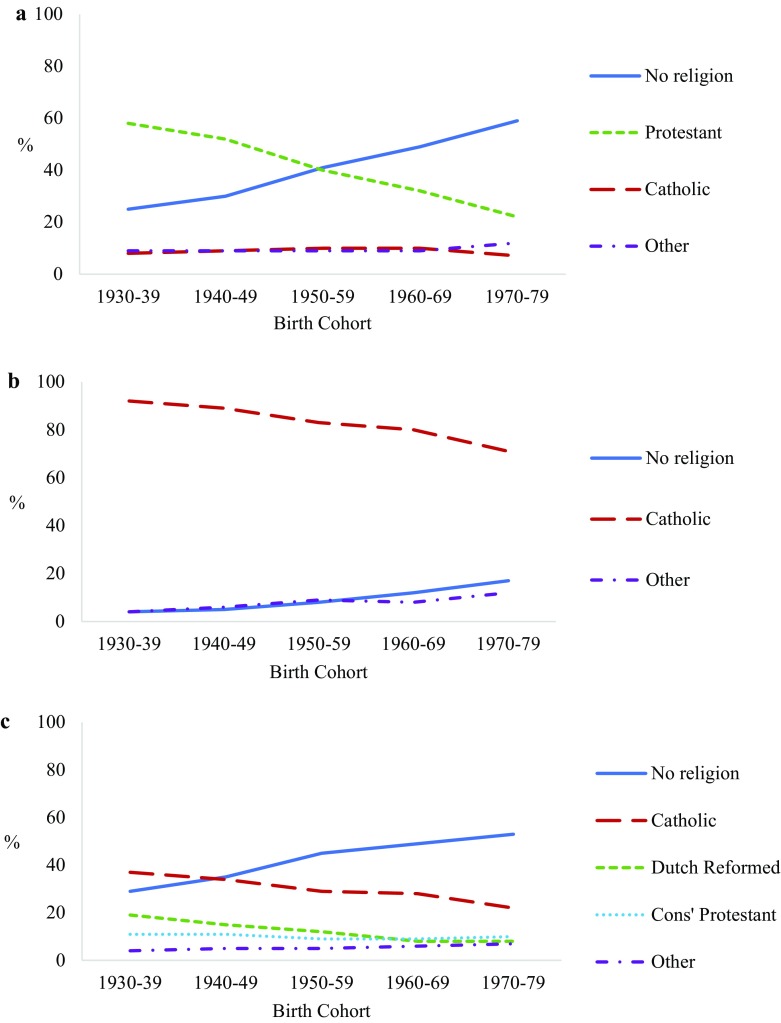
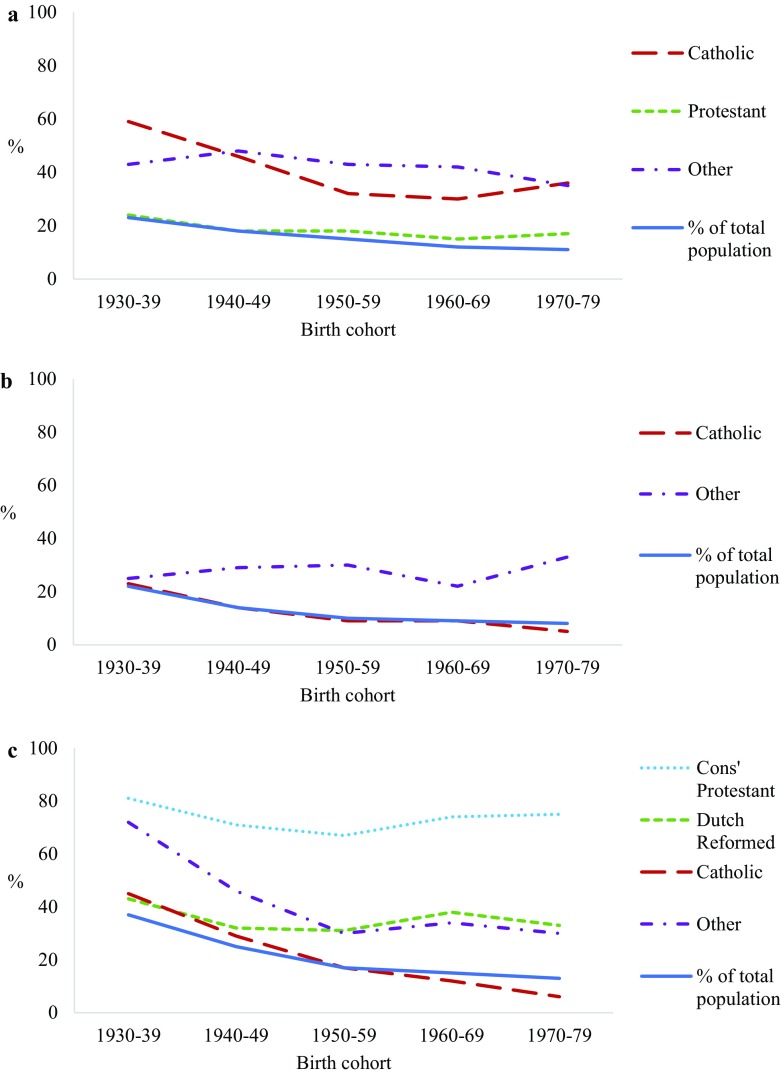
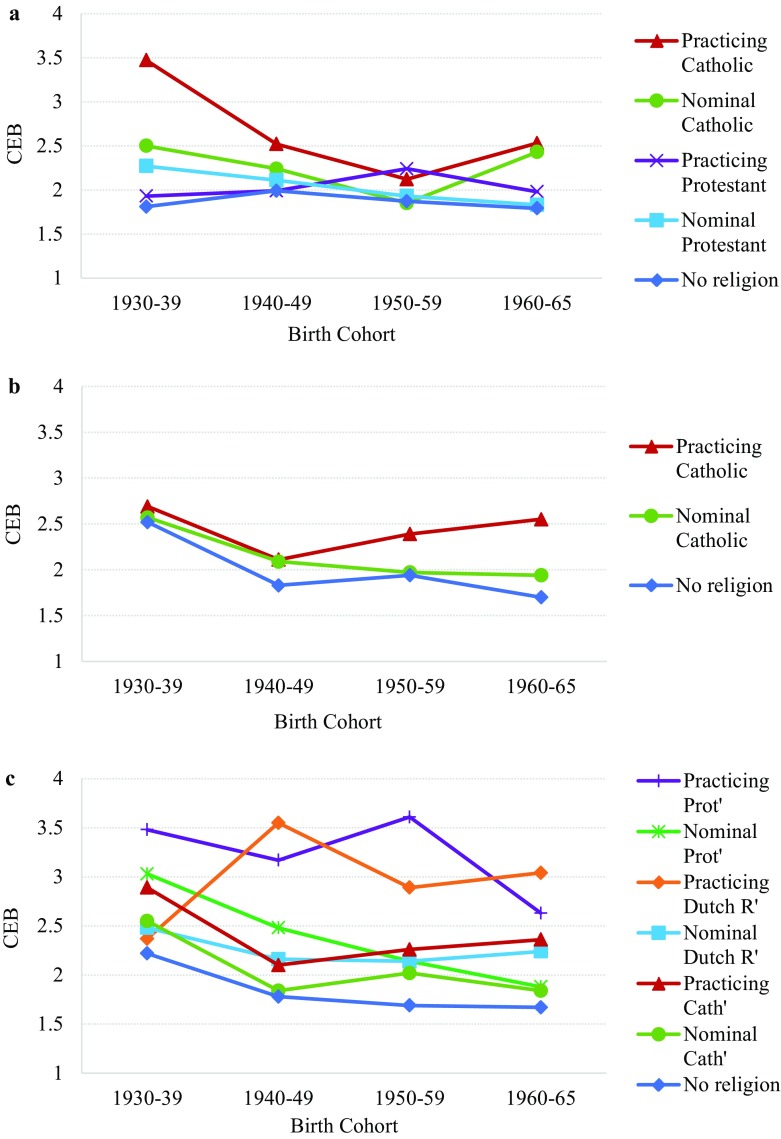
The role of religion in explaining fertility differences is often overlooked in demographic studies, particularly in Western Europe, where there has been a substantial decline in institutional forms of religious adherence. The current study explores the changing relationships between religion and childbearing in Britain, France and the Netherlands. Using data from the Generations and Gender Programme and the British Household Panel Survey, religious differences in completed fertility and the transition to first birth are explored across cohorts of women. In addition, a longitudinal analysis is employed to examine the influence of religion on subsequent childbearing. Although the secularization paradigm assumes that the influence of religion on individual behavior will diminish over time, it is found that religious affiliation and practice continue to be important determinants of fertility and family formation patterns. However, there is some variation in the relationship between religion and fertility across countries; while in France and the Netherlands fertility gaps by religiosity are either consistent or increasing, in Britain, this gap appears to have narrowed over time. These findings suggest that fertility differences by religion also depend on the particular social context of religious institutions in each country.
Overview
The claims and statistics of this paper haven’t been checked yet.
Free: it reads the open-access text and checks the first 5 claims that cite a source we can check. Create a free account to check every claim.
Integrity signals
Registry
Cites
Statistics
Figures
Verification
Claims the paper makes
The claims and statistics of this paper haven’t been checked yet.
Free: it reads the open-access text and checks the first 5 claims that cite a source we can check. Create a free account to check every claim.
Claims other papers make about this one
Each is checked against this paper’s own text: does it say what the citing paper says it does?
The source backs part of the claim, not all of it — or backs it for a different population, condition or comparison.
In the citing paper
“Several other studies also suggest that religiosity favors high TFR [35–37].”
From Human fertility in relation to education, economy, religion, contraception, and family planning programs (2020) · cites this paper as [37]
Experimental — accuracy not yet measured
Self-check
Percentages, sums and reported differences re-computed from the paper’s own numbers.
The self-check needs the paper’s full text.
Citations
Cites
Bowling alone: the collapse and revival of American community
(2000) · Choice Reviews Online · doi:10.5860/choice.38-2454 · Cited by 28,789
Putnam, R. (2000) · doi:10.1145/358916.361990 · Cited by 17,114 · cited 1×
“…basis; previous studies have found that religious congregations promote the formation of social networks, where different types of informational, emotional and practical support are exchanged between members (Chatters and Taylor 2005; Philipov et al. 2006; Putnam 2000; Waite and Lehrer 2003).”
BackgroundInternational Standard Classification of Education, ISCED 1997
UNESCO United Nations Educational, S. A. C. O. (2003) · Advances in Cross-National Comparison · doi:10.1007/978-1-4419-9186-7_10 · Cited by 2,351
Sacred and secular religion and politics worldwide
Norris, P., & Inglehart, R. (2004) · Cited by 2,259
Rising Tide: Gender Equality and Cultural Change Around the World
Inglehart, R., & Norris, P. (2003) · Cambridge University Press eBooks · doi:10.1017/cbo9780511550362 · Cited by 2,171
Europe's second demographic transition.
van de Kaa, D. J. (1987) · PubMed · Cited by 1,935
Sacred and Secular: Religion and Politics Worldwide
Norris, P., & Inglehart, R. (2004) · doi:10.1017/cbo9780511791017 · Cited by 1,795
The Unfolding Story of the Second Demographic Transition
Lesthaeghe, R. (2010) · Population and Development Review · doi:10.1111/j.1728-4457.2010.00328.x · Cited by 1,794 · cited 2×
“This process is assumed to have a major influence on changing family behaviors, since decisions about union formation and reproductive choices are increasingly guided by personal aspirations of self-fulfillment, rather than by the moral order of religious institutions (Lesthaeghe 2010; Lesthaeghe and Surkyn 1988; van…”
BackgroundRising tide: gender equality and cultural change around the world
(2004) · Choice Reviews Online · doi:10.5860/choice.41-3062 · Cited by 1,489
(2023) · Review of Religious Research · doi:10.1007/13644.2211-4866 · Cited by 1,157
Research works printed but not linked: 2
- Richards J Blyth E Landau R A Roman Catholic perspective on fertility issues: Objective truths, moral absolutes and the natural law Faith and fertility: Attitudes towards reproductive practices in different religions from ancient to modern times 2009 London Jessica Kingsley Publishers 35 56
- United Nations Generations and Gender Programme: Survey Instruments 2005 New York UN 2005
Cited by
Götmark, F., & Andersson, M. (2020) · BMC Public Health · doi:10.1186/s12889-020-8331-7 · Cited by 230
Jeuring, H. W., Comijs, H. C., Deeg, D. J. H., Stek, M. L., Huisman, M. A., & Beekman, A. T. F. (2017) · Psychological Medicine · doi:10.1017/s0033291717003324 · Cited by 48
“2005); while exposure to religiousness has decreased (Peri-Rotem, 2016).”
Religiosity and Fertility: Jews in Israel
Okun, B. S. (2017) · European Journal of Population / Revue européenne de Démographie · doi:10.1007/s10680-016-9409-x · Cited by 49
“Recent research focused on the USA and Europe has provided varied evidence that women and men with greater religious commitment and consistent religious practice, those who define themselves as practicing Catholics, those who report more frequent church attendance, and those whose parents were more religious tend to h…”
BackgroundInfluentialStuder, M., Liefbroer, A. C., & Mooyaart, J. (2018) · Advances in Life Course Research · doi:10.1016/j.alcr.2018.02.003 · Cited by 51
“…including a higher likelihood to marry (Eggebeen & Dew, 2009; Manting, 1996), a smaller likelihood to cohabit (Eggebeen & Dew, 2009; Manting, 1996), early parenthood and more children (Peri-Rotem, 2016), and a smaller likelihood to divorce than non-religious young adults (De Graaf & Kalmijn, 2006).”
BackgroundMeasurement of shock effect following change of one-child policy based on grey forecasting approach
Xie, N., Wang, R., & Chen, N. (2018) · Kybernetes · doi:10.1108/k-05-2017-0159 · Cited by 35
Alqahtani, E., Janbi, N. F., Sharaf, S. A., & Mehmood, R. (2022) · Sustainability · doi:10.3390/su142013534 · Cited by 42
Religiosity, Secularity and Fertility in Canada
Dilmaghani, M. (2018) · European Journal of Population / Revue européenne de Démographie · doi:10.1007/s10680-018-9487-z · Cited by 40
“Peri-Rotem (2016) additionally finds that the fertility gap associated with the degree of religious commitment is increasing in the Netherlands, one of the least religious countries in the world.”
BackgroundInfluentialBuber‐Ennser, I., & Berghammer, C. (2021) · Population Space and Place · doi:10.1002/psp.2433 · Cited by 44
“…religion and fertility has been documented almost unanimously for many countries and by various religious measures (Adsera, 2006; Baudin, 2015; Frejka & Westoff, 2008; Guetto et al., 2015; McGregor & McKee, 2016; Peri-Rotem, 2016; Philipov & Berghammer, 2007; Régnier-Loilier & Prioux, 2008).”
BackgroundMethodInfluentialReligiosity and Fertility Intentions: Can the Gender Regime Explain Cross-Country Differences?
Bein, C., Gauthier, A. H., & Mynarska, M. A. (2021) · European Journal of Population / Revue européenne de Démographie · doi:10.1007/s10680-020-09574-w · Cited by 27
“Furthermore, many researchers used the frequency of attendance at religious services (Berghammer 2012; Dilmaghani 2019; Hubert 2015; Peri-Rotem 2016), believing that it is a more objective indicator of religiosity.”
BackgroundMethodInfluentialBein, C., Mynarska, M. A., & Gauthier, A. H. (2020) · Journal of Biosocial Science · doi:10.1017/s0021932020000280 · Cited by 30
“More-religious people have been found to be more likely to have children in comparison to the less religious in many different country settings (Adserà, 2006b; Hubert, 2015; Peri-Rotem, 2016; Okun, 2017; Dilmaghani, 2019).”
Is perception of inability to procreate a temporal phenomenon?
Passet-Wittig, J., Bujard, M., McQuillan, J., & Greil, A. L. (2020) · Advances in Life Course Research · doi:10.1016/j.alcr.2020.100339 · Cited by 25
Cognitive Enhancement and Network Effects: how Individual Prosperity Depends on Group Traits
Anomaly, J., & Jones, G. (2020) · Philosophia · doi:10.1007/s11406-020-00189-3 · Cited by 26
Mussino, E., & Ortensi, L. E. (2019) · Comparative Population Studies · doi:10.12765/cpos-2019-03 · Cited by 29
Kolk, M., Saarela, J. M., & Xia, W. (2024) · European Journal of Population / Revue européenne de Démographie · doi:10.1007/s10680-023-09693-0 · Cited by 19
“There are still some contexts such as the UK, where Catholics have higher fertility (Peri-Rotem, 2016).”
BackgroundResultDantis, C., Rizzi, E. L., & Baudin, T. (2023) · European Journal of Population / Revue européenne de Démographie · doi:10.1007/s10680-023-09652-9 · Cited by 13
“…between religiosity and fertility‑related behaviour in European countries is already quite extensive (Bein et al., 2020; Bein et al., 2017; Peri‑Rotem, 2016; Baudin, 2015; Berghammer, 2012 and 2009; Régnier‑Loilier & Prioux, 2008; Adsera, 2006), studies explor‑ ing the mechanisms of…”
BackgroundInfluentialBlekesaune, M., & Skirbekk, V. (2022) · European Sociological Review · doi:10.1093/esr/jcac060 · Cited by 11
“Further, by joining a religious community, you will also meet people with similar characteristics, which may lead to social inclusion and social support (Peri-Rotem, 2016).”
BackgroundMaftei, A., Holman, A. C., & Marchiș, M. (2021) · Current Psychology · doi:10.1007/s12144-021-02446-4 · Cited by 15
“Religiosity was extensively documented and identified as a significant factor related to fertility behavior worldwide (e.g., Götmark & Andersson, 2020; Peri-Rotem, 2016; Pinter et al., 2016).”
BackgroundBazzani, G., & Vignoli, D. (2022) · Frontiers in Sociology · doi:10.3389/fsoc.2022.923756 · Cited by 16
“…children have shown that, in wealthy countries, the utilitarian-normative values of children have been replaced by their emotional value (Trommsdorff and Nauck, 2010; Nauck, 2014) – which is also occasionally connected with religious orientation (Adserà, 2006; Peri-Rotem, 2016; Dilmaghani, 2019).”
BackgroundReligious Affiliation and Childbearing Preferences of Iranian Women
Malmir, M., Ebrahimi, M., & Sadeghi, R. (2023) · Journal of Religion and Health · doi:10.1007/s10943-022-01725-z · Cited by 10
“In health and demographic research, religious differences in fertility are among the significant issues which have primarily been considered in developed countries by comparing Catholic and Protestant fertility behaviors (Hayford & Morgan, 2008; McGregor & McKee, 2016; Peri-Rotem, 2016).”
BackgroundKuang, B., Berrington, A. M., Vasireddy, S., & Kulu, H. (2025) · Demographic Research · doi:10.4054/demres.2025.52.7 · Cited by 26
An exploration of differences in ideal family size between Muslim and non-Muslim women in France
Behrman, J. A., & Erman, J. (2019) · Demographic Research · doi:10.4054/demres.2019.41.22 · Cited by 10
“Although overall TFR is comparatively high in France, more religious Christian women have on average significantly higher birth rates than less religious women (Baudin 2015; Kaufmann et al. 2012; Peri-Rotem 2018).”
BackgroundA Representation of the World Population Dynamics for Integrated Assessment Models
Court, V., & McIsaac, F. (2020) · Environmental Modeling & Assessment · doi:10.1007/s10666-020-09703-z · Cited by 11
Shaver, J. H., Chvaja, R., Spake, L., Hassan, A., Badjie, J., Prentice, A. M., Cerami, C., Sear, R., Shenk, M. K., & Sosis, R. H. (2024) · American Journal of Human Biology · doi:10.1002/ajhb.24144 · Cited by 13
Kuang, B., Berrington, A. M., Christison, S., & Kulu, H. (2024) · Demographic Research · doi:10.4054/demres.2024.51.36 · Cited by 11
“The strong and persistent influence of religion, which has been shown to be linked to fertility preferences (Compton and Coward 1989; McGregor and McKee 2016; Peri-Rotem 2016), has sustained consistently higher fertility in Northern Ireland than in the rest of the United Kingdom.”
Fořt, J., Jaroslav Flegr, A., Kuba, R., & Kaňková, Š. (2024) · Archives of Sexual Behavior · doi:10.1007/s10508-024-02827-3 · Cited by 9
“Higher religiosity is generally linked to higher fertility rates (Peri-Rotem, 2016), and it has been suggested that “a decision to produce fewer children could (…) prevent the female relatives of androphilic males from exhibiting the elevated reproduction that the SAGH predicts” (Gómez Jiménez et…”
BackgroundThe paradox of change: Religion and fertility decline in South Korea
Yoo, S. H., & Agadjanian, V. (2021) · Demographic Research · doi:10.4054/demres.2021.44.23 · Cited by 24
“The possibility of changing relation between religion and fertility has been demonstrated in the literature (e.g., Chamie 1977; Peri-Rotem 2016; Westoff and Jones 1979), but empirical research is limited to finding a unilineal change, such as a gradual decline or rise in differential fertility.”
BackgroundResultInfluentialThe Decline of Spanish Fertility: The Role of Religion
Mogi, R., Esteve, A., & Skirbekk, V. (2022) · European Journal of Population / Revue européenne de Démographie · doi:10.1007/s10680-022-09644-1 · Cited by 8
“Net of schooling, financial context or regional characteristics, religion is independently related to family formation patterns, as found across a range of different national contexts (Anson & Meir, 2017; Dilmaghani, 2019; Goujon et al., 2007; Peri-Rotem, 2016).”
BackgroundReligiosity and trajectories of lifetime fertility intentions – Evidence from a German panel study
Bein, C., Passet-Wittig, J., Bujard, M., & Gauthier, A. H. (2023) · Advances in Life Course Research · doi:10.1016/j.alcr.2023.100578 · Cited by 11
The Fertility of Female Immigrants to Europe from Christian and Muslim Countries
Blekesaune, M. (2020) · Journal of Religion and Demography · doi:10.1163/2589742x-12347109 · Cited by 9
Globalization, economic and social development, and fertility decline in Bangladesh
Maitra, B. (2024) · Oxford Development Studies · doi:10.1080/13600818.2024.2416186 · Cited by 8
“Researchers argue that religion significantly influences ideals, intentions, and behavior related to fertility (among others, Peri-Rotem, 2016; Philipov & Berghammer, 2007).”
Борисова, О. Н., & Павлюткин, И. В. (2019) · Мир России · doi:10.17323/1811-038x-2019-28-4-128-151 · Cited by 17
German Churches in Times of Demographic Change and Declining Affiliation: A Projection to 2060
Gutmann, D., & Peters, F. (2020) · Comparative Population Studies · doi:10.12765/cpos-2020-01 · Cited by 7
Ranking fertility predictors in Spain: a multicriteria decision approach
Llorente‐Marrón, M., Fernández, M. M. D., & Méndez‐Rodríguez, P. (2020) · Annals of Operations Research · doi:10.1007/s10479-020-03669-7 · Cited by 11
Religion effects on fertility preference: evidence from China
Xie, D., & Zhou, Y. (2022) · Journal of Population Research · doi:10.1007/s12546-022-09286-4 · Cited by 7
“Such research includes the studies based on, for example, Netherlands (Berghammer, 2012), the comparison between US and European countries (Frejka & Westoff, 2008), Britain, France, and Netherlands (Peri-Rotem, 2016).”
MethodFertility differences by education in Britain and France: The role of religion
Peri-Rotem, N. (2020) · Population (English Edition) · doi:10.3917/popu.2001.0009 · Cited by 12
Self-citationRettaroli, R., Samoggia, A., & Scalone, F. (2017) · Demographic Research · doi:10.4054/demres.2017.37.15 · Cited by 8
“Elite groups are more open culturally and more likely to adopt new emerging attitudes towards procreation, as shown by the processes of secularisation and individualisation (Goldscheider 2006; Lesthaeghe and Surkyn 1988; Norris and Inglehart 2004; Surkyn and Lesthaeghe 2004; Peri-Rotem 2016).”
BackgroundBecker, O. A., & Lois, D. (2017) · Zeitschrift für Soziologie · doi:10.1515/zfsoz-2017-1024 · Cited by 8
Козлов, В. А. (2019) · The Journal of Social Policy Studies · doi:10.17323/727-0634-2019-17-1-89-102 · Cited by 6
“The conclusion about the significance of personal religiosity agrees with some recent studies which argue that religious affiliation and/or personal religious adherence can be of independent significance for fertility in non-Muslim societies (cf. Zhang 2008; see also, Philipov, Berghammer 2007; Peri-Rotem 2016).”
ResultBeyond geography: Cultural zones and global patterns of modern-method contraceptive use
Geist, C., & Cole, W. M. (2019) · Health Care For Women International · doi:10.1080/07399332.2019.1672170 · Cited by 7
“After adjusting for economic development and women’s education (Model 4), women living in non-Western Protestant countries use modern methods at rates lower than women in the Protestant West, as do women in Catholic countries outside of Europe and Latin America.”
BackgroundInfluentialWu, T., Su, Y., Shi, X., & Zheng, Y. (2023) · Sexuality Research and Social Policy · doi:10.1007/s13178-023-00823-1 · Cited by 6
“This seems inconsistent with previous propositions and findings that BS played a unique role in restricting women’s reproductive rights (Osborne et al., 2022) and was positively associated with opposition to abortion (Begun & Walls, 2015; Huang et al., 2014, 2016; Osborne & Davies, 2012).”
BackgroundResultInfluentialПруцкова, Е., Павлюткин, И. В., & Борисова, О. Н. (2023) · Monitoring obŝestvennogo mneniâ: èkonomičeskie i socialʹnye peremeny · doi:10.14515/monitoring.2023.2.2359 · Cited by 12
Spake, L., Schaffnit, S. B., Page, A. E., Hassan, A., Lynch, R., Watts, J., Sosis, R. H., Sear, R., Shenk, M. K., & Shaver, J. H. (2024) · Evolution and Human Behavior · doi:10.1016/j.evolhumbehav.2024.04.001 · Cited by 8
Secularism, family ties and loneliness: A multilevel longitudinal study of ten European societies
Das, A. (2021) · Social Science Research · doi:10.1016/j.ssresearch.2021.102619 · Cited by 8
Motherhood in the Making: Key Determinants of Parenthood Motivation in Young Adult Women
Vučenović, D., Petrović, M., & Jelić, K. (2024) · Psychology International · doi:10.3390/psycholint6040059 · Cited by 4
New Times, Old Beliefs: Religion and Contemporary Fertility
Skirbekk, V. (2022) · Springer eBooks · doi:10.1007/978-3-030-91611-4_15 · Cited by 5
Relevance of Social Marketing in the Global South’s Family Planning Programmes: A Case of Zambia
Nyundo, L., Eagle, L. C., & Whittaker, M. A. (2020) · Springer eBooks · doi:10.1007/978-981-15-8517-3_9 · Cited by 4
Slyke, J. A. V. (2021) · Evolutionary Psychological Science · doi:10.1007/s40806-021-00286-w · Cited by 5
The relationship between birth order and acute alcohol intoxication among Dutch adolescents
de Veld, L., Wolberink, I. M., van Hoof, J. J., & van der Lely, N. (2018) · Journal of Child & Adolescent Substance Abuse · doi:10.1080/1067828x.2018.1544103 · Cited by 3
Disentangling the Roles of Modernization and Secularization on Fertility: The Case of Turkey
Hatun, D., & Warner, D. F. (2021) · Population Research and Policy Review · doi:10.1007/s11113-021-09685-0 · Cited by 3
Dilan, Y. A. R., ULAŞ, S., & Yılmaz, M. (2023) · Uluslararası İnsan Çalışmaları Dergisi · doi:10.35235/uicd.1221639 · Cited by 3
Jafari, H., Pourreza, A., Sadeghi, A., Alizadeh, G., & Zarnaq, R. K. (2021) · Quality & Quantity · doi:10.1007/s11135-021-01273-w · Cited by 5
“Several other studies have suggested that religiosity supports high TFR (Akintunde et al. 2013; Hackett et al. 2015; Peri-Rotem 2016).”
BackgroundInfluentialGeçioğlu, A. R. (2022) · Akademisyen Kitabevi eBooks · doi:10.37609/akya.1412 · Cited by 3
Balabeykina, O. A. (2020) · Pskov region studies journal · doi:10.37490/s221979310008622-7 · Cited by 3
“In recent decades, various fields of Russian and foreign science have increasingly shown a high and steady interest in issues related to the study of the functioning of social institutions and other elements that form the confessional space of countries and regions [10; 16; 23; 24], etc.”
BackgroundReligion, gender norms and fertility in Muslim post-communist economies
Kumo, K., & Perugini, C. (2024) · Post-Communist Economies · doi:10.1080/14631377.2024.2437734 · Cited by 5
“While most studies agree on the existence of a positive relationship between religiosity and fertility (e.g. Adserà, 2006; Peri-Rotem, 2016), this link is not universal, and its magnitude varies considerably across countries (Guetto et al., 2015; Philipov & Berghammer, 2007).”
Czyżowska, D., Kalus, A. M., & Wendołowska, A. M. (2024) · The Person and the Challenges The Journal of Theology Education Canon Law and Social Studies Inspired by Pope John Paul II · doi:10.15633/pch.14111 · Cited by 2
Migration, Partner Selection, and Fertility in Germany: How Many Children are Born in Mixed Unions?
Gawron, A., & Milewski, N. (2024) · European Journal of Population / Revue européenne de Démographie · doi:10.1007/s10680-024-09710-w · Cited by 3
“Religiousness is associated with a higher ideal number of children (Bein et al., 2023; Philipov & Bergham-mer, 2007), and may contribute to higher fertility within unions (Peri-Rotem, 2016).”
BackgroundGavrus‐Ion, A., Sjøvold, T., Hernández, M., González‐José, R., Martínez‐Abadías, N., Esteban, E., & Esparza, M. (2020) · Journal of Biosocial Science · doi:10.1017/s0021932020000243 · Cited by 2
Diller, C., & Gareis, P. (2020) · Religions · doi:10.3390/rel11120657 · Cited by 2
“Peri-Rotem determined the development of the fertility rates of the largest religious groups for Great Britain, France, and the Netherlands from the 1930s to the 1980s (Peri-Rotem 2016).”
BackgroundThe Role of Culture in Negotiating Reproductive Rights of Diaspora Heterosexual Nigerian Women
Anizoba, E. L., & Davis, S. J. (2019) · Feminist Encounters A Journal of Critical Studies in Culture and Politics · doi:10.20897/femenc/5922 · Cited by 2
“The effects of secularisation cannot be assumed to be the same across all demographics (Norris and Inglehart, 2011; Peri-Rotem, 2016).”
BackgroundChvaja, R., Shaver, J. H., & Bulbulia, J. A. (2026) · Scientific Reports · doi:10.1038/s41598-025-34358-9 · Cited by 1
Naz, M. S. G., Ozgoli, G., Fahimeh, H., Sheikhan, Z., Nasiri, M., & Jannesari, S. (2017) · International Journal of Women s Health and Reproduction Sciences · doi:10.15296/ijwhr.2017.47 · Cited by 1
RELIGION AND WOMEN’S FERTILITY IN TURKEY: AN ISLAMIC CONTEXT
FİDAN, A. (2021) · Adıyaman üniversitesi sosyal bilimler enstitüsü dergisi/Adıyaman üniversitesi sosyal bilimler enstitisü dergisi · doi:10.14520/adyusbd.923350 · Cited by 4
“…has focused on the United States (Hayford & Morgan, 2008; Mosher, 1988; Mosher & Bachrach, 1996), other developed Western societies (Adsera & Ferrer, 2016; Peri-Rotem, 2016), and some of them in non-Western contexts (Basten & Jiang, 2015; Peng, 1998; Poston & Gu, 1987; Retherford et al., 2005).”
InfluentialReligions and low fertility today
Rašević, M. (2019) · Stanovnistvo · doi:10.2298/stnv190814005r · Cited by 1
Cohort Fertility Trends and Religion Affiliation in Latin America: a Glimpse Through Time
de Lima, E. E. C., da Silva, J. H. C. M., & Skirbekk, V. (2019) · Journal of Religion and Demography · doi:10.1163/2589742x-00602004 · Cited by 1
Has the New Natalism Reduced the Religious Fertility Advantage?
DeRose, L. F., Wilcox, W. B., Townsend, P. L., Brito, J. R., & James, S. L. (2021) · Journal for the Scientific Study of Religion · doi:10.1111/jssr.12747 · Cited by 2
Lotfizadeh, M., & Fatahian, F. (2024) · Research Square · doi:10.21203/rs.3.rs-4634006/v1 · Cited by 1
Becker, O. A., & Lois, D. (2018) · Springer eBooks · doi:10.1007/978-3-658-23759-2_7 · Cited by 1
Is religion natural? Religion, naturalism and near-naturalism
Spiegel, T. J. (2020) · Bijdragen · doi:10.1080/21692327.2020.1749717 · Cited by 1
Confessional Regional Studies: Directions and Approaches in Research
Balabeykina, O. A., & Дмитриев, А. Л. (2021) · Vestnik Volgogradskogo gosudarstvennogo universiteta Serija 4 Istorija Regionovedenie Mezhdunarodnye otnoshenija · doi:10.15688/jvolsu4.2021.5.4
The Influence of French Higher Education in French-German Business-to-Business Relationships.
Fontaine, O. (2021) · doi:10.46289/fr51ge23 · Cited by 1
Saarela, J. M., Hardy, M. A., & Skirbekk, V. (2022) · Journal of Comparative Family Studies · doi:10.3138/jcfs.53.2.030 · Cited by 1
“Childbearing can be advocated through many mechanisms related to marriage, such as traditionalism and religious beliefs (Dilmaghani, 2018; Kaufmann & Skirbekk, 2012; Peri-Rotem, 2016; Stonawski et al., 2015).”
BackgroundReproductive Decisions of the 1970–1984 Cohort Born in Lithuania
Platūkytė, E. (2022) · Sociologija Mintis ir veiksmas · doi:10.15388/socmintvei.2022.2.35
The Impact of COVID-19 on the Motivations of Women Seeking a Uterus Transplant
Vali, S., Jones, B. P., Saso, S., & Smith, J. (2023) · Future Science OA · doi:10.2144/fsoa-2022-0047
Religion, Human Sexuality, and Evolution
Slyke, J. A. V. (2023) · Springer eBooks · doi:10.1007/978-3-031-08956-5_737-1
Wilkins‐Laflamme, S. (2023) · Social Compass · doi:10.1177/00377686231200978
“Facteur souvent primordial dans les choix de formation de famille (Baudin, 2015 ; Liefbroer et Rijken, 2019 ; Peri-Rotem, 2016 ; Sigalow et al., 2012), l’engagement civique (Beyerlein et Hipp, 2006 ; Borgonovi, 2008 ; Cnaan, 2002 ; Johnston, 2013 ; Lim et MacGregor, 2012), le choix de vote…”
BackgroundThe dysgenics objection to longtermism
de Vries, B. (2024) · Futures · doi:10.1016/j.futures.2024.103417 · Cited by 3
Declining fertility trends: a cause for concern
Lyngdoh, T., Kandpal, V., Shukla, V., Priyanka, K. Y., Mukherjee, R., & Kulkarni, B. (2024) · International Journal of Community Medicine and Public Health · doi:10.18203/2394-6040.ijcmph20244078 · Cited by 1
The dominant confessional space in Finland: a comprehensive characteristic
Balabeykina, O. A., & Afanasyev, D. D. (2024) · Geografičeskaâ sreda i živye sistemy · doi:10.18384/2712-7621-2024-1-120-136
The process of Iranian couples facing childbearing: a grounded theory study
Mohammadi, E., Nobahar, M., Vafaei, A. A., Paknazar, F., & Maanavi, M. (2025) · Current Psychology · doi:10.1007/s12144-025-07688-0
“Most studies conducted in other countries include works, such as the United States, (Moore, 2018), Chine, (Li et al., 2023), Europe, (Peri-Rotem, 2016), and Australia, (Brad-shaw et al., 2023) and so on.”
InfluentialGötmark, F., & Andersson, M. (2020) · Figshare · doi:10.6084/m9.figshare.12023394
Is Religiosity Related to the Risk of Technology-Induced Job Loss?
Blekesaune, M., & Skirbekk, V. (2025) · Nordic Journal of Religion and Society · doi:10.18261/njrs.38.2.1
Secularization and low fertility: How declining church membership changes couples’ childbearing
Schubert, H.-A., Skirbekk, V., & Nisén, J. (2026) · Social Science Research · doi:10.1016/j.ssresearch.2026.103371 · Cited by 1
Islam, Institutions, and Fertility
Kumo, K., & Perugini, C. (2026) · Springer eBooks · doi:10.1007/978-3-319-57365-6_251-1
Asadi, N., Farokhzadian, J., Nakhaee, N., & Pourkhajoei, S. (2026) · Health Science Reports · doi:10.1002/hsr2.72831
Dvořáčková, T., Klocová, E. K., & Kundt, R. (2026) · Biosemiotics/Biosemiotics. Bookseries · doi:10.1007/978-3-032-16124-6_8
Metadata
- Authors
- Peri-Rotem, N.
- Affiliations
- University of Cambridge (GB)
- Corresponding author
- Peri-Rotem, Nitzan
- ORCID
- Peri-Rotem, Nitzan
- Venue
- European Journal of Population
- Published
- 2016-01-28
- Volume
- 32
- Issue
- 2
- Pages
- 231-265
- ISSN
- 0168-6577 (ISSN-L)
- 1572-9885
- PMC
- PMC4875064
- OpenAlex
- W2288533755
- Cited by
- 86
- References
- 90
- Citations by year
- 2026: 6 · 2025: 3 · 2024: 14 · 2023: 9 · 2022: 9 · 2021: 12 · 2020: 15 · 2019: 8 · 2018: 5 · 2017: 5
- FWCI
- 16.77
- Type
- journal article
- Language
- en
- Open access
- hybrid
- doi.org
- Locations
- European Journal of Population / Revue européenne de Démographie (publishedVersion, cc-by)
- Europe PMC (PubMed Central) (publishedVersion, cc-by)
- PubMed Central (publishedVersion, cc-by)
- PubMed (publishedVersion)
- Apollo (University of Cambridge) (submittedVersion, cc-by)
- RePEc: Research Papers in Economics (submittedVersion)
- Funders
- University of Oxford
- Nuffield College, University of Oxford
- Clarendon Fund
- Topics
- Social Sciences › Demography › Family Dynamics and Relationships
- Social Sciences › Sociology and Political Science › Religion and Society Interactions
- Social Sciences › Arts and Humanities › History › Historical Studies on Reproduction, Gender, Health, and Societal Changes
- Keywords
- religion and fertility, secularization, completed fertility, religious affiliation, religious practice, cohort differences, family formation, childbearing, Great Britain, France, Netherlands
About these checks
Registry, retraction, Cites and statistics results are computed, not judged, with one exception: a printed reference that no index lists is read once by a model before it counts as a citation error. Claims are extracted by a model and kept only when their quote appears verbatim in the text; each cited source is then checked, with a model’s help, for whether it says what the claim relies on. Those verdicts can be wrong — read the claim’s quote and the cited source before relying on one.
Statistics and arithmetic are recomputed, not judged.
Confidence bands are shown only for fields calibrated on our annotated test set. None is calibrated yet, so no band is shown.
What counts as a claim ›How we measure confidence ›How we check this ›
Are you an author, or do you see a problem with this page? Request a review
Data sources
Bibliographic data: Semantic Scholar, OpenAlex, Crossref.
Contains information from the Semantic Scholar Academic Graph Datasets, made available under the ODC Attribution License (ODC-BY 1.0).
Semantic Scholar’s data is described in: Kinney, R., et al. (2023). The Semantic Scholar Open Data Platform. arXiv:2301.10140.
