

Religion and Fertility in Western Europe: Trends Across Cohorts in Britain, France and the Netherlands
Open accessThe DOI matches its Crossref record; 85 of the 90 references it cites were found in a registry or an index.
Abstract
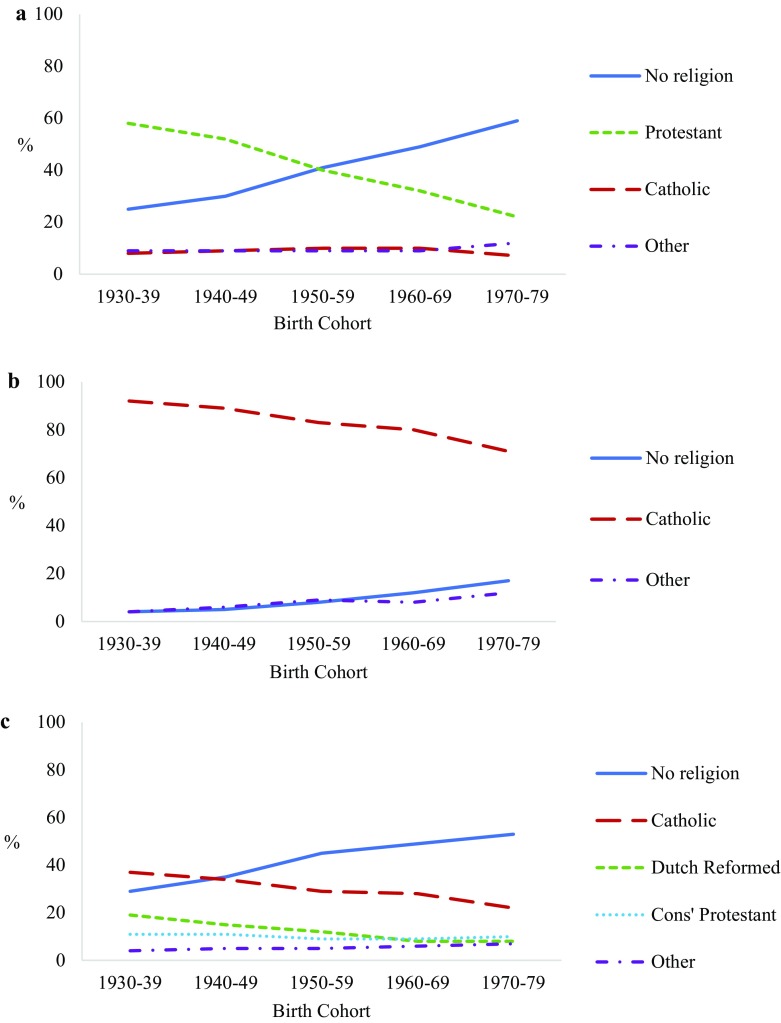
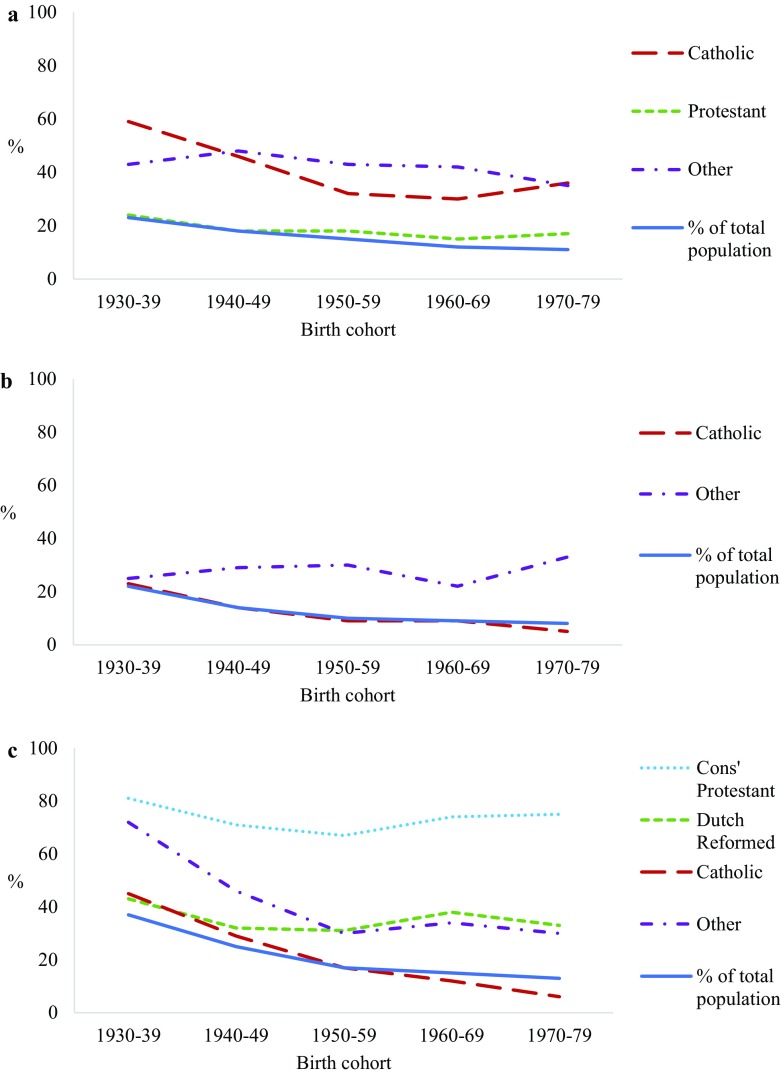
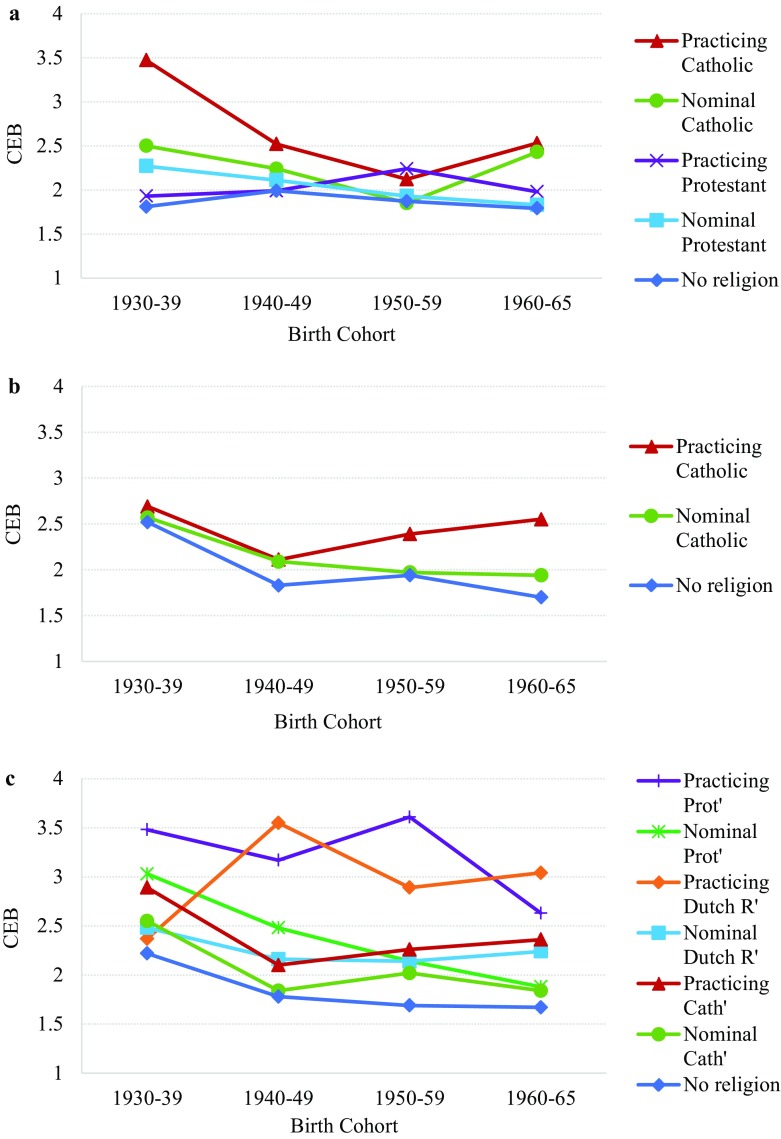
The role of religion in explaining fertility differences is often overlooked in demographic studies, particularly in Western Europe, where there has been a substantial decline in institutional forms of religious adherence. The current study explores the changing relationships between religion and childbearing in Britain, France and the Netherlands. Using data from the Generations and Gender Programme and the British Household Panel Survey, religious differences in completed fertility and the transition to first birth are explored across cohorts of women. In addition, a longitudinal analysis is employed to examine the influence of religion on subsequent childbearing. Although the secularization paradigm assumes that the influence of religion on individual behavior will diminish over time, it is found that religious affiliation and practice continue to be important determinants of fertility and family formation patterns. However, there is some variation in the relationship between religion and fertility across countries; while in France and the Netherlands fertility gaps by religiosity are either consistent or increasing, in Britain, this gap appears to have narrowed over time. These findings suggest that fertility differences by religion also depend on the particular social context of religious institutions in each country.
Overview
The claims and statistics of this paper haven’t been checked yet.
Free: it reads the open-access text and checks the first 5 claims that cite a source we can check. Create a free account to check every claim.
Integrity signals
Registry
Cites
Statistics
Figures
Verification
Claims the paper makes
The claims and statistics of this paper haven’t been checked yet.
Free: it reads the open-access text and checks the first 5 claims that cite a source we can check. Create a free account to check every claim.
Claims other papers make about this one
Each is checked against this paper’s own text: does it say what the citing paper says it does?
The source backs part of the claim, not all of it — or backs it for a different population, condition or comparison.
In the citing paper
“Several other studies also suggest that religiosity favors high TFR [35–37].”
From Human fertility in relation to education, economy, religion, contraception, and family planning programs (2020) · cites this paper as [37]
Experimental — accuracy not yet measured
Self-check
Percentages, sums and reported differences re-computed from the paper’s own numbers.
The self-check needs the paper’s full text.
Citations
Cites
Bowling alone: the collapse and revival of American community
(2000) · Choice Reviews Online · doi:10.5860/choice.38-2454 · Cited by 28,789
Putnam, R. (2000) · doi:10.1145/358916.361990 · Cited by 17,114 · cited 1×
“…basis; previous studies have found that religious congregations promote the formation of social networks, where different types of informational, emotional and practical support are exchanged between members (Chatters and Taylor 2005; Philipov et al. 2006; Putnam 2000; Waite and Lehrer 2003).”
BackgroundInternational Standard Classification of Education, ISCED 1997
UNESCO United Nations Educational, S. A. C. O. (2003) · Advances in Cross-National Comparison · doi:10.1007/978-1-4419-9186-7_10 · Cited by 2,351
Sacred and secular religion and politics worldwide
Norris, P., & Inglehart, R. (2004) · Cited by 2,259
Rising Tide: Gender Equality and Cultural Change Around the World
Inglehart, R., & Norris, P. (2003) · Cambridge University Press eBooks · doi:10.1017/cbo9780511550362 · Cited by 2,171
Europe's second demographic transition.
van de Kaa, D. J. (1987) · PubMed · Cited by 1,935
Sacred and Secular: Religion and Politics Worldwide
Norris, P., & Inglehart, R. (2004) · doi:10.1017/cbo9780511791017 · Cited by 1,795
The Unfolding Story of the Second Demographic Transition
Lesthaeghe, R. (2010) · Population and Development Review · doi:10.1111/j.1728-4457.2010.00328.x · Cited by 1,794 · cited 2×
“This process is assumed to have a major influence on changing family behaviors, since decisions about union formation and reproductive choices are increasingly guided by personal aspirations of self-fulfillment, rather than by the moral order of religious institutions (Lesthaeghe 2010; Lesthaeghe and Surkyn 1988; van…”
BackgroundRising tide: gender equality and cultural change around the world
(2004) · Choice Reviews Online · doi:10.5860/choice.41-3062 · Cited by 1,489
(2023) · Review of Religious Research · doi:10.1007/13644.2211-4866 · Cited by 1,157
Sacred and Secular: The Consequences of Secularization
Norris, P., & Inglehart, R. (2004) · Cited by 1,142
Blossfeld, H.-P., & Huinink, J. (1991) · American Journal of Sociology · doi:10.1086/229743 · Cited by 819 · cited 2×
“Since women may defer family formation until after they complete their education (Blossfeld and Huinink 1991; Nı́ Bhrolcháin and Beaujouan 2012), the model also incorporates a time-varying covariate of educational enrollment.”
BackgroundCultural Dynamics and Economic Theories of Fertility Change
Lesthaeghe, R., & Surkyn, J. (1988) · Population and Development Review · doi:10.2307/1972499 · Cited by 712 · cited 4×
“…in first marriage and first birth, as well as a sharp decrease in fertility rates, are often associated with the process of secularization and the shift of values toward greater individualization (Goldscheider 2006; Lesthaeghe and Surkyn 1988; Norris and Inglehart 2004; Surkyn and Lesthaeghe 2004).”
BackgroundInfluentialSourcebook of Family Theory and Research
Bengtson, V., Acock, A., Allen, K., Dilworth-Anderson, P., & Klein, D. (2005) · Sage eBooks · doi:10.4135/9781412990172 · Cited by 592
The Ties That Bind: Perspectives on Marriage and Cohabitation
Cohen, P. N., Waite, L. J., Bachrach, C., Hindin, M., Thomson, E., & Thornton, A. (2001) · Contemporary Sociology · doi:10.2307/3089243 · Cited by 575
Şentürk, R. (2000) · Zenodo (CERN European Organization for Nuclear Research) · doi:10.5281/zenodo.2667945 · Cited by 567
Surkyn, J., & Lesthaeghe, R. (2004) · Demographic Research · doi:10.4054/demres.2004.s3.3 · Cited by 500
Believing without Belonging: Is This the Future of Religion in Britain?
DAVIE, G. (1990) · Social Compass · doi:10.1177/003776890037004004 · Cited by 488 · cited 1×
“It should be noted, however, that the classic theory of secularization has been widely criticized by numerous scholars, who have claimed that the decline in religion is neither as widespread nor consistent as previously assumed (Davie 1990, 2007; Greeley 2003; Norris and Inglehart 2004).”
ResultThe Rise and Fall of Fuzzy Fidelity in Europe
Voas, D. (2008) · European Sociological Review · doi:10.1093/esr/jcn044 · Cited by 484 · cited 4×
“This is evident mainly by the generational decline in the proportion of religiously affiliated individuals and in the number of people who attend religious services regularly, especially among the cohorts born after the Second World War (Greeley 2003; Inglehart and Norris 2003; Voas 2009).”
BackgroundInfluentialEurope : the exceptional case : parameters of faith in the modern world
Davie, G. (2002) · Cited by 454
When Does Religion Influence Fertility?
McQuillan, K. (2004) · Population and Development Review · doi:10.1111/j.1728-4457.2004.00002.x · Cited by 434 · cited 7×
“According to McQuillan (2004), specific social and political settings may determine the extent to which religion influences fertility patterns; for example, religious groups are expected to have a greater effect on behavior when members feel a strong sense of attachment to the religious community,…”
BackgroundInfluentialReciprocal Effects of Religiosity, Cohabitation, and Marriage
Thornton, A., Axinn, W. G., & Hill, D. H. (1992) · American Journal of Sociology · doi:10.1086/230051 · Cited by 424
Religion as a Determinant of Economic and Demographic Behavior in the United States
Lehrer, E. L. (2004) · Population and Development Review · doi:10.1111/j.1728-4457.2004.00038.x · Cited by 411 · cited 6×
“Theoretical explanations for the effect of religion on fertility behavior stress the high value that most religions ascribe to family and children, alongside other fertility-related doctrines, which emphasize women’s familial roles (Lehrer 2004a; McQuillan 2004; Norris and Inglehart 2004; Sherkat 2000).”
BackgroundInfluentialSecularization: In Defence of an Unfashionable Theory
Bruce, S. (2011) · Oxford University Press eBooks · doi:10.1093/acprof:osobl/9780199654123.001.0001 · Cited by 408
Hervieu-Léger, D. (2005) · Nova Religio · doi:10.1525/nr.2005.8.3.128 · Cited by 394 · cited 1×
“This may indicate a strong attachment to Catholic cultural identity, which is also associated with national French identity (Byrnes 2005; Hervieu-Léger 1990, 2000; Pace 2007), although this proportion may also be exaggerated as a result of the particular phrasing of the question on religious…”
BackgroundOn Secularization: Towards a Revised General Theory
Vanderstraeten, R. (2005) · Sociological Research Online · doi:10.1177/136078040501000408 · Cited by 393
Believing in BelongingBelief and Social Identity in the Modern World
Day, A. (2011) · Oxford University Press eBooks · doi:10.1093/acprof:oso/9780199577873.001.0001 · Cited by 390
The Benefits from Marriage and Religion in the United States: A Comparative Analysis
Waite, L. J., & Lehrer, E. L. (2003) · Population and Development Review · doi:10.1111/j.1728-4457.2003.00255.x · Cited by 378 · cited 1×
“…basis; previous studies have found that religious congregations promote the formation of social networks, where different types of informational, emotional and practical support are exchanged between members (Chatters and Taylor 2005; Philipov et al. 2006; Putnam 2000; Waite and Lehrer 2003).”
BackgroundReligious Participation in Early Adulthood: Age and Family Life Cycle Effects on Church Membership
Stolzenberg, R. M., Blair-Loy, M., & Waite, L. J. (1995) · American Sociological Review · doi:10.2307/2096347 · Cited by 372
Glock, C. Y., & Wilson, B. (1968) · Journal for the Scientific Study of Religion · doi:10.2307/1385130 · Cited by 364 · cited 1×
“…theory of secularization contends that processes of modernization, including advancements in science, technology, education and economic development, would result in gradual erosion in the importance of religion, until it loses its significance in social and private life (Bruce 2011; Wilson 1966).”
BackgroundMuslims and the state in Britain, France, and Germany
(2005) · Choice Reviews Online · doi:10.5860/choice.43-0575 · Cited by 356
Church‐Based Social Support and Religious Coping
Krause, N., Ellison, C. G., Shaw, B. A., Marcum, J. P., & Boardman, J. D. (2001) · Journal for the Scientific Study of Religion · doi:10.1111/0021-8294.00082 · Cited by 319 · cited 1×
“Furthermore, religious belief and practice can contribute to coping with stressors and difficulties of daily life, including those related to family formation and expansion (Chatters and Taylor 2005; Krause et al. 2001; Pargament et al. 2000).”
BackgroundFertility postponement is largely due to rising educational enrolment
Ní Bhrolcháin, M., & Beaujouan, É. (2012) · Population Studies · doi:10.1080/00324728.2012.697569 · Cited by 313 · cited 1×
“Since women may defer family formation until after they complete their education (Blossfeld and Huinink 1991; Nı́ Bhrolcháin and Beaujouan 2012), the model also incorporates a time-varying covariate of educational enrollment.”
BackgroundSecularization: in defence of an unfashionable theory
(2011) · Choice Reviews Online · doi:10.5860/choice.49-1773 · Cited by 301
On Secularization: Towards a Revised General Theory
Martin, D. (2005) · Cited by 269
The end of “Catholic” fertility
Westoff, C. F., & Jones, E. F. (1979) · Demography · doi:10.2307/2061139 · Cited by 245 · cited 2×
“As a result, Catholic fertility became closer to the fertility levels of other major religious denominations, a process that was described as ‘‘the end of Catholic fertility’’ (Westoff and Jones 1979).”
BackgroundThe Center Doesn't Hold: Church Attendance in the United States, 1940-1984
Hout, M., & Greeley, A. M. (1987) · American Sociological Review · doi:10.2307/2095353 · Cited by 240 · cited 3×
“This is similar to the trends found in the USA, which were attributed in part to the growing dissent to the church teachings on sexuality (Hout and Greeley 1987).”
BackgroundResultReligion in Secular Society: Fifty Years On
Wilson, B. R. (2016) · Oxford University Press eBooks · doi:10.1093/acprof:oso/9780198788379.001.0001 · Cited by 230
Philipov, D., Spéder, Z., & Billari, F. C. (2006) · Population Studies · doi:10.1080/00324720600896080 · Cited by 209 · cited 1×
“…basis; previous studies have found that religious congregations promote the formation of social networks, where different types of informational, emotional and practical support are exchanged between members (Chatters and Taylor 2005; Philipov et al. 2006; Putnam 2000; Waite and Lehrer 2003).”
BackgroundReligion and fertility in the United States: New patterns
Mosher, W. D., Williams, L. B., & Johnson, D. P. (1992) · Demography · doi:10.2307/2061727 · Cited by 195 · cited 1×
“…significance of religion in society has also been a common explanation to the apparent convergence into lower fertility levels among different religious denominations in the USA and in Ireland (Goldscheider and Mosher 1991; Mosher et al. 1992; O’Grada and Walsh 1995; Westoff and Jones 1979).”
BackgroundPatterns of Contraceptive Use in the United States: The Importance of Religious Factors
Goldscheider, C., & Mosher, W. D. (1991) · Studies in Family Planning · doi:10.2307/1966780 · Cited by 195 · cited 7×
“…significance of religion in society has also been a common explanation to the apparent convergence into lower fertility levels among different religious denominations in the USA and in Ireland (Goldscheider and Mosher 1991; Mosher et al. 1992; O’Grada and Walsh 1995; Westoff and Jones 1979).”
BackgroundInfluentialKirk, D., & Matras, J. (1974) · Population Studies · doi:10.2307/2173650 · Cited by 185
Frejka, T., & Westoff, C. F. (2008) · European Journal of Population / Revue européenne de Démographie · doi:10.1007/s10680-007-9121-y · Cited by 182 · cited 1×
“…in the effect of religion on fertility, and recent studies have pointed to the persisting influence of religion on fertility patterns; for example, Frejka and Westoff (2008) found that in Europe and the USA, women who identify as Protestants or Catholics had higher fertility rates compared with…”
BackgroundCatholic Identity in Contemporary Ireland: Belief and Belonging to Tradition1
Inglis, T. (2007) · Journal of Contemporary Religion · doi:10.1080/13537900701331064 · Cited by 176 · cited 2×
“Some scholars have argued that religious identification is becoming less a matter of adherence to church teachings and regulations, and more a matter of belonging to a shared cultural heritage (HervieuLéger 1990, 2000; Inglis 2007; Pace 2007).”
BackgroundThe End of Secularization in Europe?: A Socio-Demographic Perspective
Kaufmann, E., Goujon, A., & Skirbekk, V. (2011) · Sociology of Religion · doi:10.1093/socrel/srr033 · Cited by 176 · cited 7×
“These results are in line with recent studies, showing that the decline in religious service attendance in Western Europe is leveling off among younger cohorts (Burkimsher 2014; Kaufmann et al. 2012).”
BackgroundResultInfluentialSupport for Redistribution in Western Europe: Assessing the role of religion
Stegmueller, D., Scheepers, P. L. H., Roßteutscher, S., & de Jong, E. (2011) · European Sociological Review · doi:10.1093/esr/jcr011 · Cited by 172
The fertility of ethnic minorities in the UK, 1960s–2006
Coleman, D. A., & Dubuc, S. (2010) · Population Studies · doi:10.1080/00324720903391201 · Cited by 166 · cited 1×
“For example, in recent decades a large proportion of immigrants to Britain have come from Eastern Europe, where fertility levels are often lower in relation to Britain (Coleman and Dubuc 2010).”
BackgroundSherkat, D. E. (2000) · Review of Religious Research · doi:10.2307/3512034 · Cited by 163 · cited 1×
“…explanations for the effect of religion on fertility behavior stress the high value that most religions ascribe to family and children, alongside other fertility-related doctrines, which emphasize women’s familial roles (Lehrer 2004a; McQuillan 2004; Norris and Inglehart 2004; Sherkat 2000).”
BackgroundDavie, G. (2017) · The Blackwell Companion to the Study of Religion · doi:10.1002/9781405168748.ch8 · Cited by 160
Methods to Account for Attrition in Longitudinal Data: Do They Work? A Simulation Study
Kristman, V. L., Manno, M., & Côté, P. (2005) · European Journal of Epidemiology · doi:10.1007/s10654-005-7919-7 · Cited by 139 · cited 1×
“Based on a method proposed by Kristman et al. (2005), a propensity score was calculated by modeling the probability of attrition (yes or no) as a function of the relevant predictor variables that were used in the longitudinal analysis (age, education, religious affiliation and practice, marital…”
MethodReligious Trajectories and Transitions Over the Life Course
Ingersoll-Dayton, B., Krause, N., & Morgan, D. (2002) · The International Journal of Aging and Human Development · doi:10.2190/297q-mrmv-27te-vlfk · Cited by 136 · cited 1×
“Furthermore, several studies from the USA have found that life-cycle events, such as marriage and childbearing, are associated with a subsequent increase in religious participation (Ingersoll-Dayton et al. 2002; Stolzenberg et al. 1995; Thornton et al. 1992).”
BackgroundSecularization in Europe: religious change between and within birth cohorts
Voas, D., & Doebler, S. (2011) · Open Access at Essex (University of Essex) · Cited by 129
Religion and changes in family-size norms in developed countries
Adserà, A. (2006) · Review of Religious Research · Cited by 126
Religion and fertility ideals, intentions and behaviour: a comparative study of European countries
Philipov, D. (2007) · Vienna Yearbook of Population Research · doi:10.1553/populationyearbook2007s271 · Cited by 123 · cited 3×
“Similarly, in a comparative study of 18 European countries, Philipov and Berghammer (2007) reported a positive correlation between different measures of religiosity (e.g., affiliation, practice and selfrated religiosity), and individuals’ intended and actual fertility.”
BackgroundResultThe Role of Religion in Union Formation: An Economic Perspective
Lehrer, E. L. (2004) · Population Research and Policy Review · doi:10.1023/b:popu.0000019917.00860.ba · Cited by 116 · cited 4×
“This could be attributed to the tendency of late entry to marriage (as well as later transition to first birth) among Catholics (Lehrer 2000, 2004b).”
BackgroundInfluentialMarital fertility and religion in Spain, 1985 and 1999
Adsera, A. (2006) · Population Studies · doi:10.1080/00324720600684817 · Cited by 111 · cited 5×
“These explanations are in line with empirical studies which show that religious service attendance is a stronger predictor of fertility intentions and behavior, compared with affiliation alone (Adsera 2006a, b; Philipov and Berghammer 2007).”
BackgroundMethodResultInfluentialShall the religious inherit the Earth? Demography and politics in the twenty-first century
Blume, M. (2013) · Religion, Brain & Behavior · doi:10.1080/2153599x.2012.744600 · Cited by 102
Research note: The 2001 census and christian identification in Britain
Voas, D., & Bruce, S. (2004) · Journal of Contemporary Religion · doi:10.1080/1353790032000165087 · Cited by 93 · cited 3×
“…question; it has been argued that answers to questions on religion may be susceptible to factors such as the context in which the question appears on the survey, the way it is formalized and even more importantly, by the social and political context in a given place and time (Voas and Bruce 2004).”
BackgroundThe changing religious landscape of Europe
Knippenberg, H. (2005) · Cited by 89
Religion in Britain and the United States
Voas, D., & Ling, R. (2010) · SAGE Publications Ltd eBooks · doi:10.4135/9781446212073.n4 · Cited by 85 · cited 4×
“For example, church attendance rates are markedly higher among British Catholics than among those affiliated with the Church of England (40 % of Roman Catholics attend at least once a month compared with 18 % of Anglicans, see: Voas and Ling 2010).”
BackgroundInfluentialChatters, L. M., & Taylor, R. J. (2005) · Sage eBooks · doi:10.4135/9781412990172.n21 · Cited by 76
Shall the religious inherit the Earth?: demography and politics in the twenty-first century
(2012) · Choice Reviews Online · doi:10.5860/choice.49-2744 · Cited by 74 · cited 4×
“Therefore, over time, the underlying differences in fertility behavior between practicing and non-practicing individuals may become more pronounced (Kaufmann 2010; Régnier-Loilier and Prioux 2008).”
BackgroundInfluentialNordic Journal of Religion and Society
(2021) · Nordic Journal of Religion and Society · doi:10.18261/issn.1890-7008 · Cited by 74
Secularization and Aging in Britain: Does Family Formation Cause Greater Religiosity?
Tilley, J. R. (2003) · Journal for the Scientific Study of Religion · doi:10.1111/1468-5906.00178 · Cited by 62 · cited 1×
“Religion and Fertility in Western Europe: Trends Across… 241 family formation effects on religiosity was found in similar studies from Europe (Berghammer 2012; Tilley 2003), there is still a risk of reverse causality in the religion–fertility relationship.”
BackgroundReligion in Europe at the End of the Second Millenium: A Sociological Profile
Greeley, A. M. (2002) · Medical Entomology and Zoology · Cited by 55
Religion and Modernity in the French Context: For a New Approach to Secularization
Hervieu‐Léger, D. (1990) · Sociological Analysis · doi:10.2307/3711671 · Cited by 52 · cited 1×
“This may indicate a strong attachment to Catholic cultural identity, which is also associated with national French identity (Byrnes 2005; Hervieu-Léger 1990, 2000; Pace 2007), although this proportion may also be exaggerated as a result of the particular phrasing of the question on religious…”
BackgroundSecularization in the Netherlands in its historical and geographical dimensions
Knippenberg, H. (1998) · GeoJournal · doi:10.1023/a:1006973011455 · Cited by 50 · cited 5×
“236 N. Peri-Rotem the other hand, the fundamentalist wing may have contributed to maintaining relatively high participation rates (Knippenberg 1998, 2005).”
BackgroundInfluentialReligion as Communication: The Changing Shape of Catholicism in Europe
Pace, E. (2007) · Oxford University Press eBooks · doi:10.1093/acprof:oso/9780195305418.003.0002 · Cited by 47 · cited 5×
“This may indicate a strong attachment to Catholic cultural identity, which is also associated with national French identity (Byrnes 2005; Hervieu-Léger 1990, 2000; Pace 2007), although this proportion may also be exaggerated as a result of the particular phrasing of the question on religious affiliation.”
BackgroundInfluentialReligion, family, and fertility: What do we know historically and comparatively?
Goldscheider, C. (2006) · Springer eBooks · doi:10.1007/1-4020-5190-5_3 · Cited by 44 · cited 1×
“…in first marriage and first birth, as well as a sharp decrease in fertility rates, are often associated with the process of secularization and the shift of values toward greater individualization (Goldscheider 2006; Lesthaeghe and Surkyn 1988; Norris and Inglehart 2004; Surkyn and Lesthaeghe 2004).”
BackgroundThe Intergenerational Transmission of Religious Service Attendance
Voas, D., Storm, I., & Voas, D. (2012) · Nordic Journal of Religion and Society · doi:10.18261/issn1890-7008-2012-02-02 · Cited by 42
Is Religious Attendance Bottoming Out? An Examination of Current Trends Across Europe
Burkimsher, M. (2014) · Journal for the Scientific Study of Religion · doi:10.1111/jssr.12111 · Cited by 41 · cited 3×
“According to Burkimsher (2014), monthly attendance is a commonly used cutoff between attenders and non-attenders, although some studies use weekly attendance.”
BackgroundResultChurch attendance and childbearing: Evidence from a Dutch panel study, 1987–2005
Berghammer, C. (2012) · Population Studies · doi:10.1080/00324728.2012.655304 · Cited by 40 · cited 4×
“family formation effects on religiosity was found in similar studies from Europe (Berghammer 2012; Tilley 2003), there is still a risk of reverse causality in the religion–fertility relationship.”
BackgroundResultInfluentialvan Poppel, F. W. A. (1985) · European Journal of Population / Revue européenne de Démographie · doi:10.1007/bf01797148 · Cited by 40 · cited 2×
“These patterns may be related to the pronounced religious diversity in the Netherlands and the fact that religion was considered an important aspect of social identity, at least during the pillarization period (Knippenberg 1998; van Poppel 1985; van Rooden 2003).”
BackgroundFertility and Population in Ireland, North and South
Gráda, C. Ó., & Walsh, B. (1995) · Population Studies · doi:10.1080/0032472031000148506 · Cited by 34
Neuberger, J. (2010) · Human Fertility · doi:10.3109/14647271003625391 · Cited by 26 · cited 1×
“Furthermore, the Catholic Church has a strict opposition to divorce, since marriage is seen as a lifelong, unbreakable commitment between men and women and as the sacred basis for family formation (Richards 2009).”
BackgroundByrnes, J. F. (2005) · Penn State University Press eBooks · doi:10.5325/j.ctv14gp3zs · Cited by 25
British Household Panel Survey Consolidated Marital, Cohabitation and Fertility Histories, 1991-2009
Pronzato, C. (2011) · UK Data Archive · doi:10.5255/ukda-sn-5629-1 · Cited by 24 · cited 1×
“The BHPS survey is complemented with additional data from the consolidated union and births histories (Pronzato 2011), which contains retrospective lifetime histories and subsequent panel data related to respondents’ partnerships and childbearing.”
Method‘Religion’ in the 2001 Census for England and Wales
Southworth, J. R. (2005) · Population Space and Place · doi:10.1002/psp.361 · Cited by 23 · cited 2×
“Religious affiliation is regarded as a meaningful form of identification, which represents the cultural background into which a person was born or grew up in and may have consequences on social behavior (Day 2011; Southworth 2005).”
BackgroundBritish Household Panel Survey: Waves 1-18, 1991-2009
University Of Essex, I. F. S. (2010) · UK Data Archive · doi:10.5255/ukda-sn-5151-1 · Cited by 23
Perelli‐Harris, B., Kreyenfeld, M. R., Sigle‐Rushton, W., Keizer, R., Lappegård, T., Jasilioniene, A., Berghammer, C., Giulio, P. D., & Köppen, K. (2009) · doi:10.4054/mpidr-wp-2009-021 · Cited by 20 · cited 2×
“This may be the result of differential marriage trends among religious groups in these countries; while the proportion of ever married people in Europe has declined over time (Perelli-Harris et al. 2009), the more religious segments of society are more likely to maintain high marriage rates (Régnier-Loilier and Prioux…”
BackgroundLong-term religious developments in the Netherlands, c. 1750–2000
van Rooden, P. (2003) · Cambridge University Press eBooks · doi:10.1017/cbo9780511496783.008 · Cited by 17
Religious Affiliation, Participation and Fertility: A Cautionary Note
Marcum, J. P. (1988) · Journal for the Scientific Study of Religion · doi:10.2307/1386953 · Cited by 15 · cited 1×
“Nonetheless, it is difficult to draw conclusions about a causal relationship between religion and fertility when using retrospective data, since indicators of religious adherence are measured only at the time of interview, after childbearing has already occurred (Marcum 1988).”
BackgroundThe Netherlands: Selling churches and building mosques
Knippenberg, H. (2005) · UvA-DARE (University of Amsterdam) · Cited by 10
Presentation and modifications to the generations and gender survey questionnaire in France (wave 2)Preprint
Régnier‐Loilier, A., Saboni, L., & Valdes, B. (2011) · RePEc: Research Papers in Economics · Cited by 3
(2000) · doi:10.1002/(sici)1097-4679(200004)56:4<519::aid-jclp6>3.0.co;2-1
Research works printed but not linked: 2
- Richards J Blyth E Landau R A Roman Catholic perspective on fertility issues: Objective truths, moral absolutes and the natural law Faith and fertility: Attitudes towards reproductive practices in different religions from ancient to modern times 2009 London Jessica Kingsley Publishers 35 56
- United Nations Generations and Gender Programme: Survey Instruments 2005 New York UN 2005
Cited by
Götmark, F., & Andersson, M. (2020) · BMC Public Health · doi:10.1186/s12889-020-8331-7 · Cited by 230
Jeuring, H. W., Comijs, H. C., Deeg, D. J. H., Stek, M. L., Huisman, M. A., & Beekman, A. T. F. (2017) · Psychological Medicine · doi:10.1017/s0033291717003324 · Cited by 48
“2005); while exposure to religiousness has decreased (Peri-Rotem, 2016).”
Religiosity and Fertility: Jews in Israel
Okun, B. S. (2017) · European Journal of Population / Revue européenne de Démographie · doi:10.1007/s10680-016-9409-x · Cited by 49
“Recent research focused on the USA and Europe has provided varied evidence that women and men with greater religious commitment and consistent religious practice, those who define themselves as practicing Catholics, those who report more frequent church attendance, and those whose parents were more religious tend to h…”
BackgroundInfluentialStuder, M., Liefbroer, A. C., & Mooyaart, J. (2018) · Advances in Life Course Research · doi:10.1016/j.alcr.2018.02.003 · Cited by 51
“…including a higher likelihood to marry (Eggebeen & Dew, 2009; Manting, 1996), a smaller likelihood to cohabit (Eggebeen & Dew, 2009; Manting, 1996), early parenthood and more children (Peri-Rotem, 2016), and a smaller likelihood to divorce than non-religious young adults (De Graaf & Kalmijn, 2006).”
BackgroundMeasurement of shock effect following change of one-child policy based on grey forecasting approach
Xie, N., Wang, R., & Chen, N. (2018) · Kybernetes · doi:10.1108/k-05-2017-0159 · Cited by 35
Metadata
- Authors
- Peri-Rotem, N.
- Affiliations
- University of Cambridge (GB)
- Corresponding author
- Peri-Rotem, Nitzan
- ORCID
- Peri-Rotem, Nitzan
- Venue
- European Journal of Population
- Published
- 2016-01-28
- Volume
- 32
- Issue
- 2
- Pages
- 231-265
- ISSN
- 0168-6577 (ISSN-L)
- 1572-9885
- PMC
- PMC4875064
- OpenAlex
- W2288533755
- Cited by
- 86
- References
- 90
- Citations by year
- 2026: 6 · 2025: 3 · 2024: 14 · 2023: 9 · 2022: 9 · 2021: 12 · 2020: 15 · 2019: 8 · 2018: 5 · 2017: 5
- FWCI
- 16.77
- Type
- journal article
- Language
- en
- Open access
- hybrid
- doi.org
- Locations
- European Journal of Population / Revue européenne de Démographie (publishedVersion, cc-by)
- Europe PMC (PubMed Central) (publishedVersion, cc-by)
- PubMed Central (publishedVersion, cc-by)
- PubMed (publishedVersion)
- Apollo (University of Cambridge) (submittedVersion, cc-by)
- RePEc: Research Papers in Economics (submittedVersion)
- Funders
- University of Oxford
- Nuffield College, University of Oxford
- Clarendon Fund
- Topics
- Social Sciences › Demography › Family Dynamics and Relationships
- Social Sciences › Sociology and Political Science › Religion and Society Interactions
- Social Sciences › Arts and Humanities › History › Historical Studies on Reproduction, Gender, Health, and Societal Changes
- Keywords
- religion and fertility, secularization, completed fertility, religious affiliation, religious practice, cohort differences, family formation, childbearing, Great Britain, France, Netherlands
About these checks
Registry, retraction, Cites and statistics results are computed, not judged, with one exception: a printed reference that no index lists is read once by a model before it counts as a citation error. Claims are extracted by a model and kept only when their quote appears verbatim in the text; each cited source is then checked, with a model’s help, for whether it says what the claim relies on. Those verdicts can be wrong — read the claim’s quote and the cited source before relying on one.
Statistics and arithmetic are recomputed, not judged.
Confidence bands are shown only for fields calibrated on our annotated test set. None is calibrated yet, so no band is shown.
What counts as a claim ›How we measure confidence ›How we check this ›
Are you an author, or do you see a problem with this page? Request a review
Data sources
Bibliographic data: Semantic Scholar, OpenAlex, Crossref.
Contains information from the Semantic Scholar Academic Graph Datasets, made available under the ODC Attribution License (ODC-BY 1.0).
Semantic Scholar’s data is described in: Kinney, R., et al. (2023). The Semantic Scholar Open Data Platform. arXiv:2301.10140.
