

Students’ trajectories through higher education: a review of quantitative research
Open accessThe DOI matches its Crossref record; 80 of the 82 references it cites were found in a registry or an index.
Abstract
With the increasing availability of high-quality longitudinal data on students in higher education, scholars’ interest in how students proceed through higher education has risen. So far, the research field is diverse in theoretical perspectives and methodological approaches. Thus, based on 27 studies published in (higher) education research journals during the past two decades, this literature review provides an overview of the theoretical concepts, methodologies and main empirical findings in the study of students’ trajectories in higher education. The results depict a US dominated research field. Most theoretical frameworks are based on student’s decision-making. Across different country contexts and research designs—ranging from descriptions of student trajectories to studies predicting who engages in which types of trajectories to sequential trajectory reconstruction—we found that historically disadvantaged groups in higher education such as students from low social origin follow less linear and less smooth higher education trajectories. However, while the field of comparative education is growing steadily and may significantly contribute to explaining the link between the realization of students’ opportunities and the way how higher education is designed and implemented both on the national and local level, there were no cross-country comparison studies on higher education trajectories.
Overview
The claims and statistics of this paper haven’t been checked yet.
Free: it reads the open-access text and checks the first 5 claims that cite a source we can check. Create a free account to check every claim.
Integrity signals
Registry
Cites
Statistics
Figures
Verification
Claims the paper makes
The claims and statistics of this paper haven’t been checked yet.
Free: it reads the open-access text and checks the first 5 claims that cite a source we can check. Create a free account to check every claim.
Claims other papers make about this one
Each is checked against this paper’s own text: does it say what the citing paper says it does?
The cited source says what the claim attributes to it.
In the citing paper
“Higher education trajectory research treats persistence as a pathway rather than a single access event [49], and inclusion mechanisms are more likely to protect that pathway when they remain available during disruption or resource pressure [16,50].”
From Inclusive Higher Education and Disability: Policy–Implementation Gaps Across Universities in Mexico and Colombia (2026) · cites this paper as [49]
Self-check
Percentages, sums and reported differences re-computed from the paper’s own numbers.
The self-check needs the paper’s full text.
Citations
Cites
Dropout from Higher Education: A Theoretical Synthesis of Recent Research
Tinto, V. (1975) · Review of Educational Research · doi:10.2307/1170024 · Cited by 7,888 · cited 1×
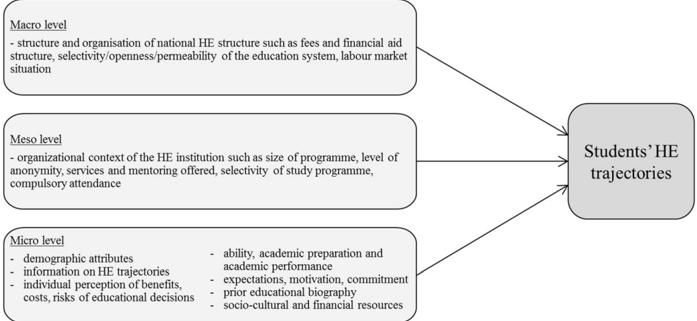
“The micro-/meso-level link: trajectories as processes of integration into the HE environment Another dominant theoretical perspective refers to a lack of students’ integration in educational institutions as a major cause of dropout (e.g. Bean and Metzner 1985; Tinto 1975).”
BackgroundHuman Capital. A Theoretical and Empirical Analysis, with Special Reference to Education
Muhsam, H. V., & Becker, G. S. (1965) · Revue de l'Institut International de Statistique / Review of the International Statistical Institute · doi:10.2307/1401709 · Cited by 5,146
(1964) · SSRN Electronic Journal · Cited by 5,128
A Conceptual Model of Nontraditional Undergraduate Student Attrition
Bean, J. P., & Metzner, B. S. (1985) · Review of Educational Research · doi:10.3102/00346543055004485 · Cited by 2,017 · cited 1×
“The micro-/meso-level link: trajectories as processes of integration into the HE environment Another dominant theoretical perspective refers to a lack of students’ integration in educational institutions as a major cause of dropout (e.g. Bean and Metzner 1985; Tinto 1975).”
BackgroundThe Worldwide Expansion of Higher Education in the Twentieth Century
Schofer, E., & Meyer, J. W. (2005) · American Sociological Review · doi:10.1177/000312240507000602 · Cited by 1,653 · cited 1×
“…from undergraduate to graduate studies) and states (e.g. enrolment patterns such as part-time vs full-time enrolment) within a certain period (e.g. academic year or 3-year life period; Sackmann and Wingens 2001, 42), while we assign the term Bpathway^ to institutionally ideal progression patterns.”
BackgroundEXPLAINING EDUCATIONAL DIFFERENTIALS: TOWARDS A FORMAL RATIONAL ACTION THEORY
Breen, R., & Goldthorpe, J. H. (1997) · Rationality and Society · doi:10.1177/104346397009003002 · Cited by 1,644 · cited 1×
“In addition, Breen and Goldthorpe (1997) advanced this theoretical frame to explain differences in decision-making by social origin.”
Background(2006) · US Department of Education · Cited by 1,586
Answers In The Tool Box: Academic Intensity, Attendance Patterns, And Bachelor's Degree Attainment
Adelman, C. (1999) · Cited by 1,409
Manski, C. F., & Wise, D. A. (1983) · Harvard University Press eBooks · doi:10.4159/harvard.9780674422285 · Cited by 965
Life Course Dynamics: Trajectories and Transitions, 1968-1980.
Chew, K. S. Y., & Elder, G. H. (1987) · Social Forces · doi:10.2307/2578775 · Cited by 926
Research works printed but not linked: 1
- 42. Hossler, D., Braxton, J., & Coopersmith, G. (1989). Understanding student choice. In J. Smart (Ed.), Higher education: handbook of theory and research (Vol. 5, pp. 231-288). New York: Agathon Press.
Cited by
Items 101–151 of 151
Ramaano, T., Jadhav, A., & Ajoodha, R. (2026) · International Journal of Modern Education and Computer Science · doi:10.5815/ijmecs.2026.01.02 · Cited by 1
CROSS-BORDER LEARNING IN THE CONTEXT OF GLOBAL EDUCATIONAL TRANSFORMATIONS
Вороніна-Пригодій, Д. (2026) · Professional Pedagogics · doi:10.32835/2707-3092.2026.32.67-84 · Cited by 1
Abdi, M. K., Ali, J. A., Ali, T. A., Muse, A. H., & Cumar, M. A. (2026) · Discover Computing · doi:10.1007/s10791-026-10164-3 · Cited by 1
“Secondary education expansion is frequently associated with improved human capital formation and long-term socioeconomic stability [14, 20].”
InfluentialVeecock, C., & Zhang, W. (2023) · Chinese Education & Society · doi:10.1080/10611932.2024.2303923 · Cited by 1
“Macro-level factors refers to the regional or national structures (Haas and Hadjar 2020).”
BackgroundDigital cognitive tribes in classroom
Potosí, U. A. D. S. L., Rueda, I. C. F., Sánchez, J. D. J. R., & Monrroy, B. V. T. (2024) · Apertura · doi:10.32870/ap.v16n1.2436 · Cited by 1
Factors Causing Delays for Higher Education Students in Completing Final Undergraduate Assignments
Prihantini, P., Rustini, T., Rukmini, A., & Bawamenewi, A. (2024) · Journal of Higher Education Theory and Practice · doi:10.33423/jhetp.v24i4.6954 · Cited by 1
“Higher education provides education at the advanced level of upper secondary education in the formal education pathway (Krstikj et al., 2022; Haas & Hadjar, 2020).”
BackgroundESSENCE OF THE CONCEPT OF AN INDIVIDUAL EDUCATIONAL TRAJECTORY OF A STUDENT AT A UNIVERSITY
Mustafaeva, M. G., & Doctoral student at Jizzakh branch of UzNU, U. (2024) · International Journal of Pedagogics · doi:10.37547/ijp/volume04issue07-05 · Cited by 1
Davis, C. (2025) · Maryland Shared Open Access Repository (USMAI Consortium) · doi:10.13016/m2hioi-dzaj · Cited by 1
Máximo, R. D. O. (2024) · doi:10.14393/ufu.te.2024.739 · Cited by 1
Social class and the experience of university education: narrative inquiry.
Ragodoo, N. (2022) · ResearchSpace (University of KwaZulu-Natal) · Cited by 1
Complex Trajectories. Example of sequence analysis : comparative report
Troiano, H., Sánchez‐Gelabert, A., Jongbloed, J., Giret, J., Miguéis, V., Edwards, C., Valls, O., & Treball, U. A. D. B. G. D. R. E. I. (2023) · UPCommons institutional repository (Universitat Politècnica de Catalunya) · Cited by 1
Vo, D. (2026) · eScholarship (California Digital Library) · Cited by 1
Carrillo-Sierra, S.-M., Munda Magill, F., & Rivera-Porras, D. (2026) · Societies · doi:10.3390/soc16070222
“Higher education trajectory research treats persistence as a pathway rather than a single access event [49], and inclusion mechanisms are more likely to protect that pathway when they remain available during disruption or resource pressure [16,50].”
Stages of Learning and Progression in Mathematics
Krupa, T. V. (2021) · doi:10.47750/cibg.2021.27.02.518
Giese, M. (2021) · DuEPublico (University of Duisburg-Essen) · doi:10.17185/duepublico/74317
Stages of a Mathematical Model Developing of the Educational Trajectory
Tatiana, K. T. (2020) · International Journal of Engineering and Advanced Technology · doi:10.35940/ijeat.c4830.029320
“This additional education in the direction of the mathematical model is considered to be an opportunity to reflect changes in the student's academic, and compliance [1, 7-11].”
BackgroundPrinciples Of Regulation Of The Individual Style Of Foreign Language Communication
Николаевна, К. Н., Kim, B., & Mametova, J. F. (2021) · The European Proceedings of Social & Behavioural Sciences · doi:10.15405/epsbs.2021.12.85
Examining Gender (In)Equality in German Engineering
Dusdal, J., & Fernandez, F. (2021) · Routledge eBooks · doi:10.4324/9781003053217-1014
“In future research, scholars will need to use multiple data sources and methods, including sequential analyses of progression or trajectories (Haas & Hadjar, 2019) to investigate why women are underrepresented in STEM.”
Daniel, A., & Neumann, M. (2022) · Springer eBooks · doi:10.1007/978-3-658-24734-8_73-1
Pathways of Indian Students Transition Through Higher Education: Why do they differ?
Wadhwa, R., Wani, M. A., & Rana, N. (2024) · MIER Journal of Educational Studies Trends & Practices · doi:10.52634/mier/2024/v14/i1/2564
“The diversity of students that is increasing in higher education institutions is leading towards the diversification of pathways followed by the heterogeneous segments of students (Goldrick-Rab et al., 2007; Hass & Hadjar, 2020; Weiss & Roska, 2016).”
BackgroundAddressing Challenges in Half-Year Higher Education Study Programs
Erman, N., & Rojko, K. (2024) · Education and human development · doi:10.5772/intechopen.1005484
Création d’un outil pour visualiser les parcours d’étudiants en Licence
Scordo, Q., Bouclier, L., Dartigues-Pallez, C., & Mirbel, I. (2024) · HAL
Digital Skills and Labor Market Prospects: A Conjoint Experiment on Students’ Preferences
Mihaela, M. M. M., Mocanu, C., Zamfir, A.-M., & Năstasă, A. (2025) · Smart innovation, systems and technologies · doi:10.1007/978-981-96-0161-5_27
Investigating Dynamic Transfer Processes Among STEM Majors
Thiry, H. (2025) · Community College Journal of Research and Practice · doi:10.1080/10668926.2025.2505056
“Students from underrepresented communities more often follow non-linear higher education trajectories, such as general swirling and multiple institution attendance (Haas & Hadjar, 2020).”
Introducing the ‘Access and Participation’ and ‘Evaluation’ Agenda
Clements, N. (2025) · Emerald Group Publishing Limited eBooks · doi:10.1108/978-1-83549-954-220251003
Essays on Cognition and Firm Performance
Heshmati, M. (2023) · Deep Blue (University of Michigan) · doi:10.7302/7443
Academic Expectations of First-Year University Quota Students
Gomes, C. M. A., Marinho-Araújo, C. M., Rabelo, M. L., Almeida, L. S., & Fleith, D. D. S. (2025) · Psicologia Teoria e Pesquisa · doi:10.1590/0102.3772e41304.en
Student Engagement and Sense of Belonging: Are We Ready for a New Approach?
Jones, C., & Sweeney, L. (2025) · Emerald Group Publishing Limited eBooks · doi:10.1108/978-1-80592-242-120251010
(2024) · Journal of Comparative & International Higher Education · doi:10.64899/2151-0407.1557
What, Then, Is Critical Thinking? Insights from a Longitudinal Study of Critical Thinking
Ben‐Avie, M., Darrow, B., Brown, L., Gupta, K., & Torres, J. (2025) · Journal of Assessment and Institutional Effectiveness · doi:10.5325/jasseinsteffe.15.1-2.0019
Podshivalov, A. (2025) · National Interests Priorities and Security · doi:10.24891/ofmciz
Understanding adult student stop-out: perspectives of mid-career online graduate students
Gnadt, A. S. (2023) · K-State Research Exchange (Kansas State University)
Saavedra Samata, A. M., & Salazar Medina, D. R. (2023) · renati
Troiano, H., & Sánchez‐Gelabert, A. (2025) · UPCommons institutional repository (Universitat Politècnica de Catalunya)
Professional Pathways of Secondary Education Graduates
Pasco, J. C. (2025) · International Journal of Studies in Education and Science · doi:10.46328/ijses.5604
Teorias do abandono na educação superior: fundamentos, natureza e limites
Silva, L. B. E. (2025) · doi:10.14393/ufu.pr.2025.1
Complex Trajectories - Example of Sequence Analysis: Comparative Report
Troiano, H., Sánchez‐Gelabert, A., Jongbloed, J., Giret, J., Miguéis, V., Edwards, C., & Valls, O. (2023) · Open Research Online (The Open University)
Análisis de trayectorias estudiantiles mediante distribuciones de fase discretas acíclicas
Esparza, L. J. R., & Baltazar‐Larios, F. (2026) · Revista Latinoamericana de Estudios Educativos · doi:10.48102/rlee.2026.56.2.834
Liang, C. W.-Y., & Oladipo, O. A. (2026) · Asian Education and Development Studies · doi:10.1108/aeds-10-2025-0533
Kumura, B., Meher, S., & Kumura, B. (2026) · JOURNAL OF ADVANCE AND FUTURE RESEARCH · doi:10.56975/jaafr.v4i6.511430
Investire nel futuro: asset building e disuguaglianze educative : Pratiche, evidenze e prospettive
Maino, F. (2026) · Archivio Istituzionale della Ricerca (Universita Degli Studi Di Milano)
Interseccionalidad y acceso a la Educación Superior en Honduras
Godoy, G. E. M., Reyes, C. M. V., & Flores, L. G. R. (2026) · Fronteiras Journal of Social Technological and Environmental Science · doi:10.21664/2238-8869.2026v15i2.8295
L’esperienza istituzionale del Gruppo Orientamento in ingresso – Commissione CRUI 2022-2025
Riva, M., & Badino, M. (2026) · BOA (University of Milano-Bicocca)
Determinants of Academic Progression Among Diploma Nursing Students: An Integrative ReviewPreprint
Maliko, C. N., Nyirenda, H. T., & MUSONDA, P. P. (2026) · Research Square · doi:10.21203/rs.3.rs-10502465/v1
Whitehouse, D. G. (2026) · Digital Commons - East Tennessee State University (East Tennessee State University)
Pérez-Ossa, D., & Sepúlveda, D. (2026) · Revista latinoamericana de educación inclusiva · doi:10.4067/s0718-73782026000100101
Venegas, J. D. F. (2026) · Research Square · doi:10.21203/rs.3.rs-10857754/v1
Gomides, A., Jr., Oliveira, G. V. D. C., Puggina, E. F., Lemos, M. D. P., & Santos, I. A. (2026) · International journal of exercise science · doi:10.70252/ijes2026612
Azzolini, D., Revello, W., Battiloro, V., Maino, F., & Vezzoli, G. (2026) · Institutional Research Information System (Università degli Studi di Brescia)
Mohrman, A. S. (2026) · Scholar Commons (University of South Carolina)
Behavioral Influence Channels in Education: Conceptualization and Practical Potential
KHMELEVSKA, О. М. (2026) · Demography and social economy · doi:10.15407/dse2026.03.114
Metadata
- Authors
- Haas, C., & Hadjar, A.
- Affiliations
- University of Luxembourg (LU)
- Corresponding author
- Haas, Christina
- Venue
- Higher Education
- Published
- 2019-10-31
- Volume
- 79
- Issue
- 6
- Pages
- 1099-1118
- ISSN
- 0018-1560 (ISSN-L)
- 1573-174X
- OpenAlex
- W2985657353
- Cited by
- 97
- References
- 82
- Citations by year
- 2026: 9 · 2025: 15 · 2024: 19 · 2023: 17 · 2022: 20 · 2021: 16 · 2020: 1
- FWCI
- 24.96
- Type
- journal article
- Language
- en
- Open access
- hybrid
- doi.org
- Licence
- cc-by
- creativecommons.org/licenses/by/4.0 (tdm)
- creativecommons.org/licenses/by/4.0 (vor)
- Locations
- Higher Education (publishedVersion, cc-by)
- Open Repository and Bibliography (University of Luxembourg) (submittedVersion, cc-by-nc-sa)
- Topics
- Social Sciences › Education › Higher Education Research Studies
- Social Sciences › Sociology and Political Science › Sociology and Education Studies
- Social Sciences › Education › Higher Education Governance and Development
- Keywords
- student trajectories, student decision-making, longitudinal student data, historically disadvantaged students, trajectory reconstruction, comparative education, educational inequality
About these checks
Registry, retraction, Cites and statistics results are computed, not judged, with one exception: a printed reference that no index lists is read once by a model before it counts as a citation error. Claims are extracted by a model and kept only when their quote appears verbatim in the text; each cited source is then checked, with a model’s help, for whether it says what the claim relies on. Those verdicts can be wrong — read the claim’s quote and the cited source before relying on one.
Statistics and arithmetic are recomputed, not judged.
Confidence bands are shown only for fields calibrated on our annotated test set. None is calibrated yet, so no band is shown.
What counts as a claim ›How we measure confidence ›How we check this ›
Are you an author, or do you see a problem with this page? Request a review
Data sources
Bibliographic data: Semantic Scholar, OpenAlex, Crossref.
Contains information from the Semantic Scholar Academic Graph Datasets, made available under the ODC Attribution License (ODC-BY 1.0).
Semantic Scholar’s data is described in: Kinney, R., et al. (2023). The Semantic Scholar Open Data Platform. arXiv:2301.10140.
