

Oxygen can limit heat tolerance in freshwater gastropods: differences between gill and lung breathers
Open accessThe DOI matches its Crossref record; 54 of the 56 references it cites were found in a registry or an index.
Abstract
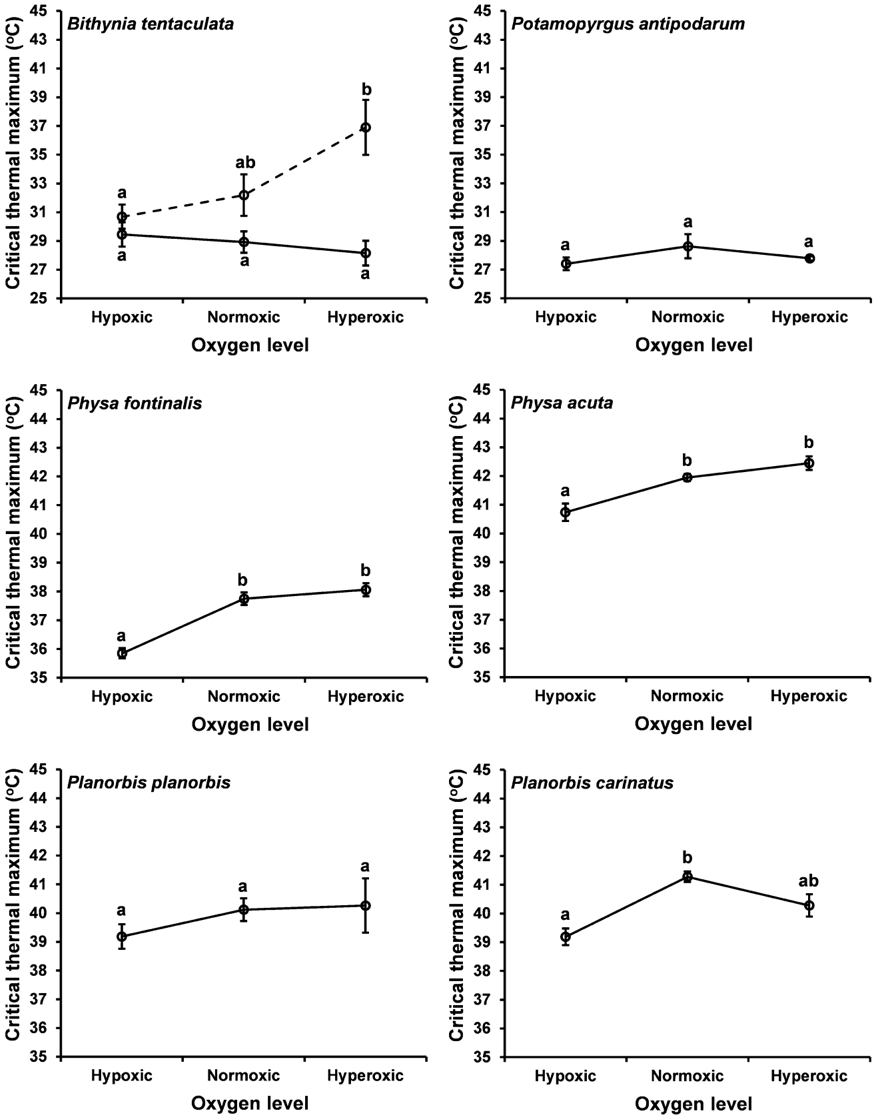
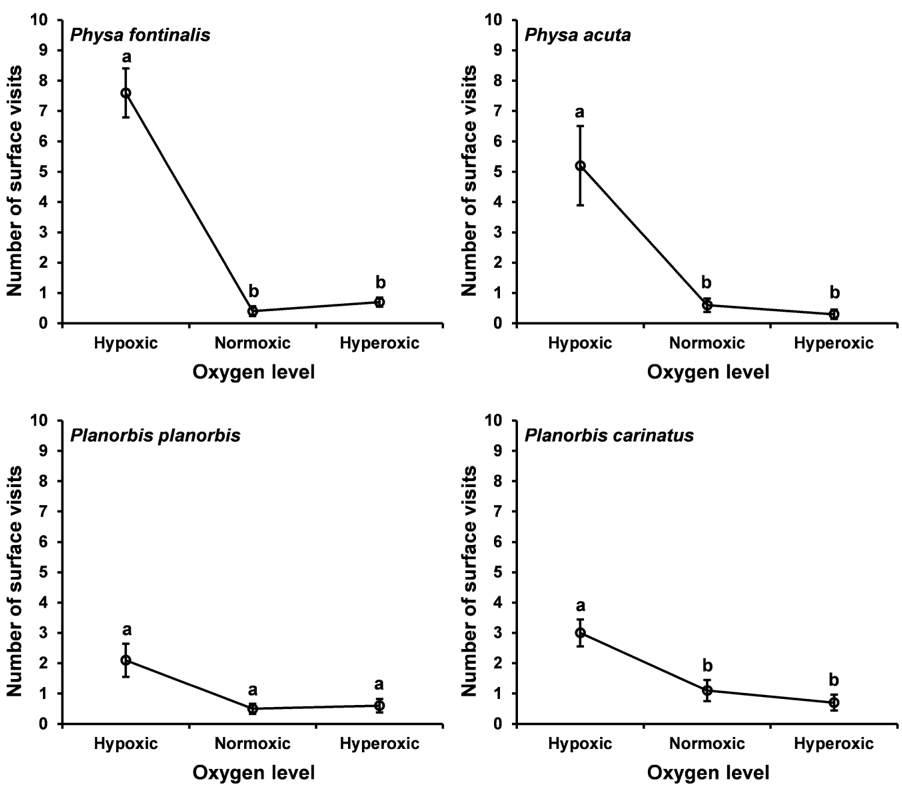
Insufficient oxygen delivery to tissues is hypothesised to limit thermal tolerance, but evidence in ectotherms is mixed. We assessed heat tolerance under hypoxia, normoxia and hyperoxia to test whether the extent in which oxygen can lower or increase heat tolerance differed with mode of respiration, comparing gill-breathing caenogastropods and lung-breathing pulmonates with or without an accessory gill. Hypoxia lowered heat tolerance in three of the four pulmonates (Physa fontinalis, Physa acuta and Planorbis carinatus) by 1.2–2.1°C. Hyperoxia, however, did not increase the heat tolerance in any of the pulmonate species. Thus, heat tolerance limits of these pulmonates does not appear to be oxygen limited under normoxia, possibly because of their high capacity to regulate oxygen consumption associated with aerial gas exchange. Instead, other processes may become limiting at thermal extremes such as loss of protein function, loss of membrane stability or neuronal dysfunction. The caenogastropod species tested (Potamopyrgus antipodarum, Bithynia tentaculata) closed their operculum during the warming experiments. This behavioural response prevented us from obtaining clear results. Nevertheless, our results suggested hyperoxia may increase heat tolerance in B. tentaculata. This could be related to its lower capacity to regulate oxygen, owing to its fully aquatic gas exchange mechanism.
Overview
The claims and statistics of this paper haven’t been checked yet.
Free: it reads the open-access text and checks the first 5 claims that cite a source we can check. Create a free account to check every claim.
Integrity signals
Registry
Cites
Statistics
Figures
Verification
Claims the paper makes
The claims and statistics of this paper haven’t been checked yet.
Free: it reads the open-access text and checks the first 5 claims that cite a source we can check. Create a free account to check every claim.
Claims other papers make about this one
Each is checked against this paper’s own text: does it say what the citing paper says it does?
The cited source says what the claim attributes to it.
In the citing paper
“although also within aquatic ectotherms there appears variation in the extent to which oxygen is involved (Ern et al., 2015;Koopman et al., 2016;Verberk et al., 2018;Verberk andBilton, 2013, 2015).”
From It's about time: Linkages between heat tolerance, thermal acclimation and metabolic rate at different temporal scales in the freshwater amphipod Gammarus fossarum Koch, 1836 (2018) · cites this paper as Koopman et al., 2016
Self-check
Percentages, sums and reported differences re-computed from the paper’s own numbers.
The self-check needs the paper’s full text.
Citations
Cites
Fingerprints of global warming on wild animals and plants
Root, T. L., Price, J. T., Hall, K. R., Schneider, S. H., Rosenzweig, C., & Pounds, J. A. (2003) · Nature · doi:10.1038/nature01333 · Cited by 4,774
Feder, M. E., & Hofmann, G. E. (1999) · Annual Review of Physiology · doi:10.1146/annurev.physiol.61.1.243 · Cited by 4,287
Hutchinson, E. G. (1957) · Medical Entomology and Zoology · Cited by 3,896
Pörtner, H.-O. (2010) · Journal of Experimental Biology · doi:10.1242/jeb.037523 · Cited by 1,458 · cited 2×
“…for Water and Wetland Research, Radboud University Nijmegen, Nijmegen, The Netherlands G. van der Velde Naturalis Biodiversity Center, Leiden, The Netherlands not directly caused by high temperatures per se, but instead result from oxygen limitation (Winterstein, 1905; Pörtner, 2001, 2010).”
Pörtner, H. O. (2002) · Comparative Biochemistry and Physiology Part A: Molecular & Integrative Physiology · doi:10.1016/s1095-6433(02)00045-4 · Cited by 1,436 · cited 1×
“This lack of energy causes the animal to enter a comatose state where its survival is passive and time-limited (Pörtner, 2002, 2010).”
Global analysis of thermal tolerance and latitude in ectotherms
Sunday, J. M., Bates, A. E., & Dulvy, N. K. (2011) · Proceedings of the Royal Society B: Biological Sciences · doi:10.1098/rspb.2010.1295 · Cited by 1,300 · cited 2×
“Temperature is considered to be a primary driver of species distributions (e.g. Root et al., 2003; Calosi et al., 2010; Sunday et al., 2011).”
H., P. (2001) · Naturwissenschaften · doi:10.1007/s001140100216 · Cited by 1,160
Integrative and Comparative Biology
Spagna, J., Patek, S. N., Vakis, A. I., & Suarez, A. (2006) · Cited by 1,059
The critical thermal maximum: history and critique
Lutterschmidt, W. I., & Hutchison, V. H. (1997) · Canadian Journal of Zoology · doi:10.1139/z97-783 · Cited by 919 · cited 1×
“All endpoints are indicative of high heating stress, with gastropods no longer being able to escape from the environmental conditions that will eventually kill them, which is the endpoint relevant for critical thermal maxima (CTmax; Lutterschmidt & Hutchinson, 1997).”
Somero, G. N. (1995) · Annual Review of Physiology · doi:10.1146/annurev.ph.57.030195.000355 · Cited by 843
Research works printed but not linked: 6
- Ghiretti, F. & A. Ghirefli-Maguldi, 1972. Respiratory proteins in Mollusks. Mollusca 7: 201-217.
- Gittenberger, E., A. W. Janssen, W. J. Kuijper, J. G. J. Kuiper, T. Meijer, G. van der Velde & J. N. de Vries, 2004. De Nederlandse zoetwatermollusken: Recente en fossiele weekdieren uit zoet en brak water. Nederlandse Fauna 2. Nationaal Natuurhistorisch Museum Naturalis, KNNV Uitgeverij and European Invertebrate Survey-Nederland, Leiden.
- Hutchinson, G. Y., 1993. The Zoobenthos. A Treatise on Lim- nology, Vol. IV. Wiley, New York.
- Jordan, H. J., 1939. Het leven der dieren in het water. Oosthoek, Utrecht.
- Jordan, H. J., 1951. Het leven der dieren in het water, 2nd ed. A. Oosthoek's Uitgevers mij, Utrecht.
- Winterstein, H., 1905. Wa ¨rmela ¨hmung und Narkose. Zeitschrift fu ¨r Allgemeine Physiologie 5: 323-350.
Cited by
Does oxygen limit thermal tolerance in arthropods? A critical review of current evidence
Verberk, W. C. E. P., Overgaard, J., Ern, R., Bayley, M., Wang, T., Boardman, L., & Terblanche, J. S. (2016) · Comparative Biochemistry and Physiology Part A: Molecular & Integrative Physiology · doi:10.1016/j.cbpa.2015.10.020 · Cited by 321
Self-citationVerberk, W. C. E. P., Durance, I., Vaughan, I. P., & Ormerod, S. J. (2016) · Global Change Biology · doi:10.1111/gcb.13240 · Cited by 160
Self-citationBulleri, F., Eriksson, B. K., Queirós, A. M., Airoldi, L., Arenas, F., Arvanitidis, C., Bouma, T. J., Crowe, T. P., Davoult, D., Guizien, K., et al. (2018) · PLoS Biology · doi:10.1371/journal.pbio.2006852 · Cited by 167
Verberk, W. C. E. P., Leuven, R. S. E. W., van der Velde, G., & Gabel, F. (2018) · Functional Ecology · doi:10.1111/1365-2435.13050 · Cited by 68
Self-citationSemsar-kazerouni, M., & Verberk, W. C. E. P. (2018) · Journal of Thermal Biology · doi:10.1016/j.jtherbio.2018.04.016 · Cited by 63
Self-citationLong‐term forecast of thermal mortality with climate warming in riverine amphipods
Verberk, W. C. E. P., Hoefnagel, K. N., Peralta‐Maraver, I., Floury, M., & Rezende, E. L. (2023) · Global Change Biology · doi:10.1111/gcb.16834 · Cited by 45
Self-citationKujiek, D. C., & Sahile, Z. A. (2023) · Heliyon · doi:10.1016/j.heliyon.2023.e23234 · Cited by 38
Hoefnagel, K. N., & Verberk, W. C. E. P. (2016) · Journal of Thermal Biology · doi:10.1016/j.jtherbio.2016.11.017 · Cited by 40
Self-citationShen, Y., Zhang, Y., Xiao, Q., Gan, Y., Wang, Y., Pang, G., Huang, Z., Yu, F. G., Luo, X., Ke, C., et al. (2021) · The Science of The Total Environment · doi:10.1016/j.scitotenv.2021.148698 · Cited by 34
The survival and respiration response of two abalones under short-term hypoxia challenges
Shen, Y., Huang, M., You, W., Luo, X., & Ke, C. (2020) · Aquaculture · doi:10.1016/j.aquaculture.2020.735658 · Cited by 32
Collas, F. P. L., van Iersel, W. K., Straatsma, M., Buijse, A. D., & LEUVEN, R. S. E. W. (2019) · Remote Sensing · doi:10.3390/rs11202367 · Cited by 33
Self-citationBooth, J. M., Giomi, F., Daffonchio, D. G., McQuaid, C. D., & Fusi, M. (2023) · The Science of The Total Environment · doi:10.1016/j.scitotenv.2023.162135 · Cited by 22
“Certain species are undoubtedly more likely to pro fi t from the bene fi ts of hyperoxia, such as those with a fully aquatic gas exchange system e.g. the freshwater mollusc Bithynia (Koopman et al., 2016).”
InfluentialOxygen concentration affects upper thermal tolerance in a terrestrial vertebrate
Shea, T. K., DuBois, P. M., Claunch, N. M., Murphey, N. E., Rucker, K. A., Brewster, R., & Taylor, E. N. (2016) · Comparative Biochemistry and Physiology Part A Molecular & Integrative Physiology · doi:10.1016/j.cbpa.2016.05.026 · Cited by 23
Genome-wide association analysis of heat tolerance in the northern pike (Esox Lucius)
Jiang, Y., Guo, J., Haisa, A., & Shen, Y. (2022) · Aquaculture · doi:10.1016/j.aquaculture.2022.738459 · Cited by 20
Baag, S., Mahapatra, S., & Mandal, S. (2019) · Journal of Thermal Biology · doi:10.1016/j.jtherbio.2019.102494 · Cited by 20
Rivi, V., Batabyal, A., Benatti, C., Tascedda, F., Blom, J. M., & Lukowiak, K. D. (2022) · Biological Bulletin · doi:10.1086/720948 · Cited by 24
Collas, F. P. L., Buijse, A. D., Hendriks, A. J., van der Velde, G., & LEUVEN, R. S. E. W. (2018) · Ecosphere · doi:10.1002/ecs2.2184 · Cited by 23
Self-citationZutshi, B., Singh, A., & Dasgupta, P. (2020) · The Journal of Basic and Applied Zoology · doi:10.1186/s41936-020-0142-y · Cited by 17
Reddythota, D., & Timotewos, M. T. (2022) · Journal of Environmental and Public Health · doi:10.1155/2022/5859132 · Cited by 14
DuBois, P. M., Shea, T. K., Claunch, N. M., & Taylor, E. N. (2017) · Journal of Thermal Biology · doi:10.1016/j.jtherbio.2017.02.008 · Cited by 15
Березина, Н. А., Verbitsky, V. B., Sharov, A. N., Chernova, E., Meteleva, N. Y., & Малышева, О. А. (2020) · Ecotoxicology and Environmental Safety · doi:10.1016/j.ecoenv.2020.110994 · Cited by 13
Dinh, K. V., Cuevas-Sanchez, A. Y., Buhl, K., Moeser, E. A., & Dowd, W. W. (2020) · Scientific Reports · doi:10.1038/s41598-020-75635-z · Cited by 15
Hamli, H., Azmai, S. H. S., Hamed, S. A., & Asif, A. A. (2019) · Poly(amino acid)-Catalyzed Epoxidation · doi:10.3923/sjsres.2020.23.27 · Cited by 12
Barrios-Figueroa, R., & Urbina, M. A. (2023) · Conservation Physiology · doi:10.1093/conphys/coac089 · Cited by 12
Bartolini, F., & Giomi, F. (2021) · Conservation Physiology · doi:10.1093/conphys/coab006 · Cited by 15
Dallas, H. F. (2016) · Hydrobiologia · doi:10.1007/s10750-016-2826-3 · Cited by 13
Influence of respiratory mode on the thermal tolerance of intertidal limpets
Kankondi, S. L., McQuaid, C. D., & Tagliarolo, M. (2018) · PLoS ONE · doi:10.1371/journal.pone.0203555 · Cited by 12
Stasio, B. T. D., Acy, C. N., Frankel, K. E., Fritz, G. M., & Lawhun, S. D. (2019) · Lake and Reservoir Management · doi:10.1080/10402381.2019.1599086 · Cited by 10
Laetz, E. M. J., Kahyaoglu, C., Borgstein, N. M., Merkx, M., van der Meij, S. E. T., & Verberk, W. C. E. P. (2024) · Journal of Experimental Biology · doi:10.1242/jeb.246331 · Cited by 9
Self-citationWarmer and more acidic conditions enhance performance of an endemic low-shore gastropod
Martin, N., Robinson, T. B., & Clusella‐Trullas, S. (2023) · Journal of Experimental Biology · doi:10.1242/jeb.245423 · Cited by 8
Chen, B., Ji, Q., Yao, Y., Zhang, Z., & Lin, Y. (2025) · Ecology and Evolution · doi:10.1002/ece3.72415 · Cited by 7
Effect of predator cue on escape and oviposition behaviour of freshwater snail
Kawaguchi, M., & Kuriwada, T. (2020) · Behaviour · doi:10.1163/1568539x-bja10018 · Cited by 7
DeWhatley, M. C., & Alexander, J. E. (2018) · Marine and Freshwater Behaviour and Physiology · doi:10.1080/10236244.2018.1538699 · Cited by 7
Bórquez, J., Valdovinos, C., & Brante, A. (2020) · Conservation Genetics · doi:10.1007/s10592-020-01308-z · Cited by 7
Kattel, G., Cai, Y., Yang, X., Zhang, K., Xu, H., Wang, R., & Dong, X. (2018) · Geosciences · doi:10.3390/geosciences8060222 · Cited by 6
Ndatimana, G., Dusabe, M. C., & Albrecht, C. (2025) · Environmental Monitoring and Assessment · doi:10.1007/s10661-025-14641-y · Cited by 4
de Lima, M. C. M., Campos, D. F., Kochhann, D., & Val, A. L. (2025) · Journal of Experimental Biology · doi:10.1242/jeb.247610 · Cited by 4
King, E. E., Williams, C. M., & Stillman, J. H. (2022) · Physiological and Biochemical Zoology · doi:10.1086/719899 · Cited by 5
Khatri, K., Gurung, S., Jha, B., & Khadka, U. (2022) · Biodiversity Data Journal · doi:10.3897/bdj.10.e79275 · Cited by 3
Impacts of ammonia and temperature on freshwater snail behavior and physiology.
DeWhatley, M. C. (2018) · ThinkIR: The University of Louisville's Institutional Repository (University of Louisville) · doi:10.18297/etd/3118 · Cited by 3
WIBOWO, A. A., Basukriadi, A., Nurdin, E., & Nasution, N. S. (2022) · International Journal of Bonorowo Wetlands · doi:10.13057/bonorowo/w120103 · Cited by 2
Kolhe, B. G., Naik, R. D., Aravind, N. A., & Padhye, S. M. (2025) · Biologia · doi:10.1007/s11756-025-01907-6 · Cited by 1
Overlooked and underestimated: reframing restoration to include inconspicuous native invaders
Brown, S. K., McIntosh, A. R., Hamilton, Z. B., & Warburton, H. J. (2025) · Restoration Ecology · doi:10.1111/rec.70191 · Cited by 1
Nekhaev, I. O., & Ishayeva, A. A. (2026) · Ecologica Montenegrina · doi:10.37828/em.2026.97.4 · Cited by 1
Bird trematodes in the era of rapid environmental change
Heneberg, P. (2026) · Parasites & Vectors · doi:10.1186/s13071-026-07470-6 · Cited by 1
“Hypoxia reduces snail survival and cercarial emergence in some systems, although tolerant species may persist and dominate under low-oxygen conditions [63, 64].”
Helmond, E., Finlay, K. P., Sheffield, C. S., Hart, M., & Heron, J. (2023) · Canadian Journal of Zoology · doi:10.1139/cjz-2022-0217
Expansion and Environmental Drivers of Invasive Freshwater Molluscs in CataloniaPreprint
Rocaspana, R., Pou‐Rovira, Q., & Aparicio, E. (2026) · bioRxiv (Cold Spring Harbor Laboratory) · doi:10.64898/2026.01.05.697568
Metadata
- Authors
- Koopman, K. R., Collas, F. P. L., van der Velde, G., & Verberk, W. C. E. P.
- Affiliations
- Radboud University Nijmegen (NL)
- Corresponding author
- Koopman, K. Remon
- Venue
- Hydrobiologia
- Published
- 2015-07-16
- Volume
- 763
- Issue
- 1
- Pages
- 301-312
- ISSN
- 0018-8158 (ISSN-L)
- 1573-5117
- OpenAlex
- W907637480
- Cited by
- 47
- References
- 56
- Citations by year
- 2026: 2 · 2025: 4 · 2024: 1 · 2023: 7 · 2022: 6 · 2021: 2 · 2020: 7 · 2019: 4 · 2018: 8 · 2017: 1 · 2016: 4 · 2015: 1
- FWCI
- 4.23
- Type
- journal article
- Language
- en
- Open access
- hybrid
- doi.org
- Locations
- Hydrobiologia (publishedVersion, cc-by)
- Radboud Repository (Radboud University) (submittedVersion)
- Radboud Repository (Radboud University) (submittedVersion, other-oa)
- Topics
- Physical Sciences › Environmental Science › Ecology › Physiological and biochemical adaptations
- Life Sciences › Agricultural and Biological Sciences › Animal Science and Zoology › Mollusks and Parasites Studies
- Health Sciences › Medicine › Physiology (medical) › Thermoregulation and physiological responses
- Keywords
- heat tolerance, hypoxia, hyperoxia, oxygen limitation, freshwater snails, Caenogastropoda, Physa fontinalis, Physella acuta, Planorbis carinatus, Potamopyrgus antipodarum, Bithynia tentaculata, ectotherms
About these checks
Registry, retraction, Cites and statistics results are computed, not judged, with one exception: a printed reference that no index lists is read once by a model before it counts as a citation error. Claims are extracted by a model and kept only when their quote appears verbatim in the text; each cited source is then checked, with a model’s help, for whether it says what the claim relies on. Those verdicts can be wrong — read the claim’s quote and the cited source before relying on one.
Statistics and arithmetic are recomputed, not judged.
Confidence bands are shown only for fields calibrated on our annotated test set. None is calibrated yet, so no band is shown.
What counts as a claim ›How we measure confidence ›How we check this ›
Are you an author, or do you see a problem with this page? Request a review
Data sources
Bibliographic data: Semantic Scholar, OpenAlex, Crossref.
Contains information from the Semantic Scholar Academic Graph Datasets, made available under the ODC Attribution License (ODC-BY 1.0).
Semantic Scholar’s data is described in: Kinney, R., et al. (2023). The Semantic Scholar Open Data Platform. arXiv:2301.10140.
