

Oxygen can limit heat tolerance in freshwater gastropods: differences between gill and lung breathers
Open accessThe DOI matches its Crossref record; 54 of the 56 references it cites were found in a registry or an index.
Abstract
Insufficient oxygen delivery to tissues is hypothesised to limit thermal tolerance, but evidence in ectotherms is mixed. We assessed heat tolerance under hypoxia, normoxia and hyperoxia to test whether the extent in which oxygen can lower or increase heat tolerance differed with mode of respiration, comparing gill-breathing caenogastropods and lung-breathing pulmonates with or without an accessory gill. Hypoxia lowered heat tolerance in three of the four pulmonates (Physa fontinalis, Physa acuta and Planorbis carinatus) by 1.2–2.1°C. Hyperoxia, however, did not increase the heat tolerance in any of the pulmonate species. Thus, heat tolerance limits of these pulmonates does not appear to be oxygen limited under normoxia, possibly because of their high capacity to regulate oxygen consumption associated with aerial gas exchange. Instead, other processes may become limiting at thermal extremes such as loss of protein function, loss of membrane stability or neuronal dysfunction. The caenogastropod species tested (Potamopyrgus antipodarum, Bithynia tentaculata) closed their operculum during the warming experiments. This behavioural response prevented us from obtaining clear results. Nevertheless, our results suggested hyperoxia may increase heat tolerance in B. tentaculata. This could be related to its lower capacity to regulate oxygen, owing to its fully aquatic gas exchange mechanism.
Overview
The claims and statistics of this paper haven’t been checked yet.
Free: it reads the open-access text and checks the first 5 claims that cite a source we can check. Create a free account to check every claim.
Integrity signals
Registry
Cites
Statistics
Figures
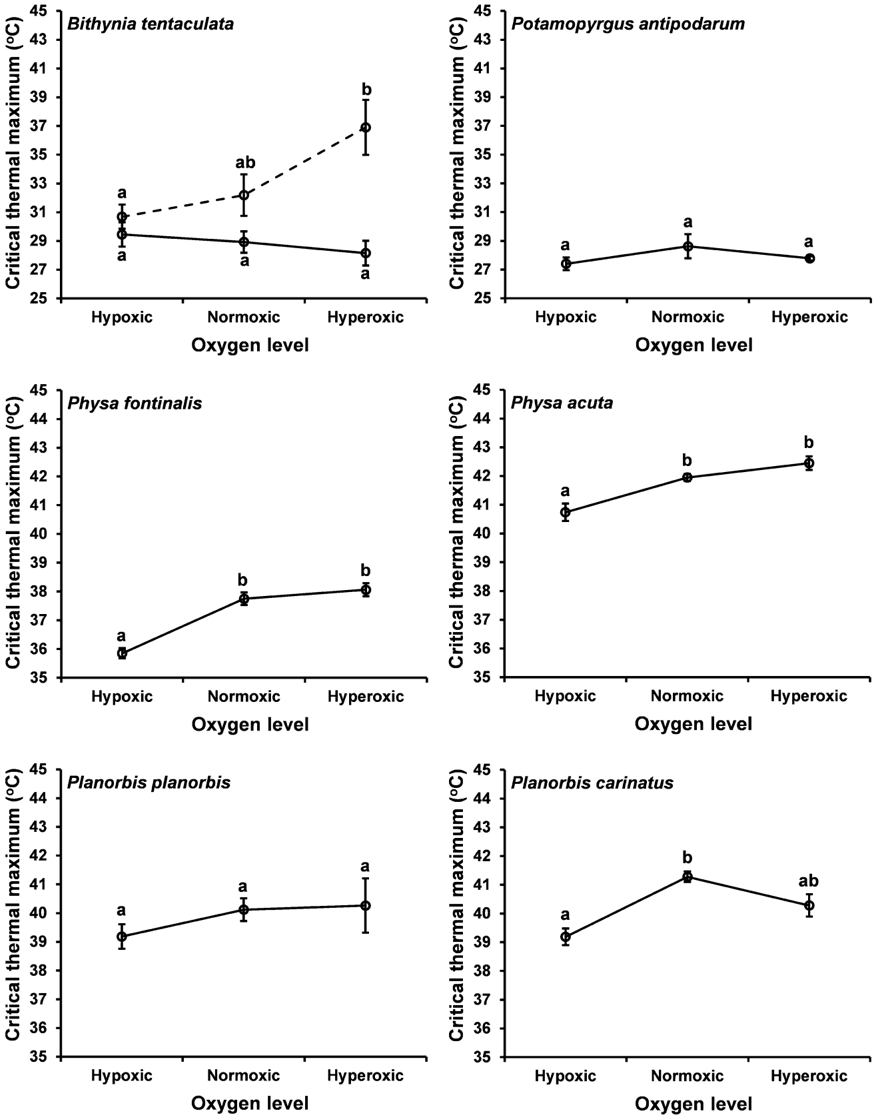
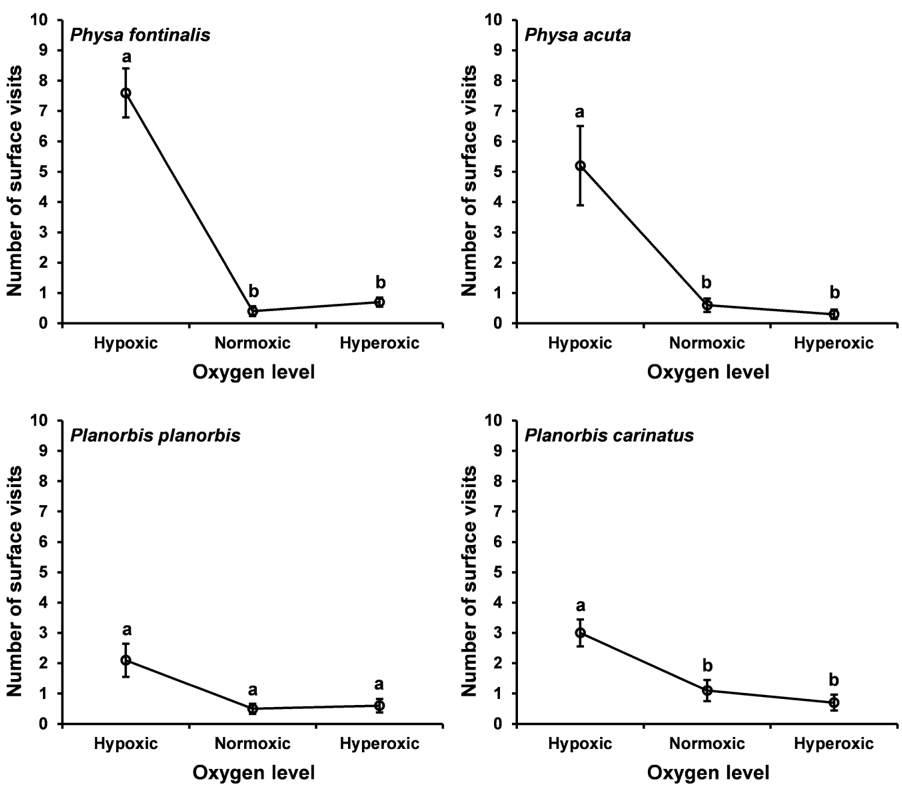
Verification
Claims the paper makes
The claims and statistics of this paper haven’t been checked yet.
Free: it reads the open-access text and checks the first 5 claims that cite a source we can check. Create a free account to check every claim.
Claims other papers make about this one
Each is checked against this paper’s own text: does it say what the citing paper says it does?
The cited source says what the claim attributes to it.
In the citing paper
“although also within aquatic ectotherms there appears variation in the extent to which oxygen is involved (Ern et al., 2015;Koopman et al., 2016;Verberk et al., 2018;Verberk andBilton, 2013, 2015).”
From It's about time: Linkages between heat tolerance, thermal acclimation and metabolic rate at different temporal scales in the freshwater amphipod Gammarus fossarum Koch, 1836 (2018) · cites this paper as Koopman et al., 2016
Self-check
Percentages, sums and reported differences re-computed from the paper’s own numbers.
The self-check needs the paper’s full text.
Citations
Cites
Fingerprints of global warming on wild animals and plants
Root, T. L., Price, J. T., Hall, K. R., Schneider, S. H., Rosenzweig, C., & Pounds, J. A. (2003) · Nature · doi:10.1038/nature01333 · Cited by 4,774
Feder, M. E., & Hofmann, G. E. (1999) · Annual Review of Physiology · doi:10.1146/annurev.physiol.61.1.243 · Cited by 4,287
Hutchinson, E. G. (1957) · Medical Entomology and Zoology · Cited by 3,896
Pörtner, H.-O. (2010) · Journal of Experimental Biology · doi:10.1242/jeb.037523 · Cited by 1,458 · cited 2×
“…for Water and Wetland Research, Radboud University Nijmegen, Nijmegen, The Netherlands G. van der Velde Naturalis Biodiversity Center, Leiden, The Netherlands not directly caused by high temperatures per se, but instead result from oxygen limitation (Winterstein, 1905; Pörtner, 2001, 2010).”
Pörtner, H. O. (2002) · Comparative Biochemistry and Physiology Part A: Molecular & Integrative Physiology · doi:10.1016/s1095-6433(02)00045-4 · Cited by 1,436 · cited 1×
“This lack of energy causes the animal to enter a comatose state where its survival is passive and time-limited (Pörtner, 2002, 2010).”
Global analysis of thermal tolerance and latitude in ectotherms
Sunday, J. M., Bates, A. E., & Dulvy, N. K. (2011) · Proceedings of the Royal Society B: Biological Sciences · doi:10.1098/rspb.2010.1295 · Cited by 1,300 · cited 2×
“Temperature is considered to be a primary driver of species distributions (e.g. Root et al., 2003; Calosi et al., 2010; Sunday et al., 2011).”
H., P. (2001) · Naturwissenschaften · doi:10.1007/s001140100216 · Cited by 1,160
Integrative and Comparative Biology
Spagna, J., Patek, S. N., Vakis, A. I., & Suarez, A. (2006) · Cited by 1,059
The critical thermal maximum: history and critique
Lutterschmidt, W. I., & Hutchison, V. H. (1997) · Canadian Journal of Zoology · doi:10.1139/z97-783 · Cited by 919 · cited 1×
“All endpoints are indicative of high heating stress, with gastropods no longer being able to escape from the environmental conditions that will eventually kill them, which is the endpoint relevant for critical thermal maxima (CTmax; Lutterschmidt & Hutchinson, 1997).”
Somero, G. N. (1995) · Annual Review of Physiology · doi:10.1146/annurev.ph.57.030195.000355 · Cited by 843
Principles of comparative respiratory physiology
Bernards, J. A. (1976) · European Journal of Obstetrics & Gynecology and Reproductive Biology · doi:10.1016/0028-2243(76)90013-7 · Cited by 605 · cited 2×
“Warming reduces the solubility of oxygen in water, while maximum rates of oxygen diffusion can be slightly enhanced as the diffusion coefficient of oxygen in water increases with temperature (Dejours, 1981; Woods, 1999; Verberk et al., 2011).”
Principles of Comparative Respiratory Physiology
Dejours, P. (1975) · Medical Entomology and Zoology · Cited by 587
Critical thermal limits depend on methodological context
Terblanche, J. S., Deere, J. A., Clusella-Trullas, S., Janion, C., & Chown, S. L. (2007) · Proceedings of the Royal Society B: Biological Sciences · doi:10.1098/rspb.2007.0985 · Cited by 532 · cited 2×
“As the ramping rate is known to affect the CT (e.g. Terblanche et al., 2007; Rezende et al., 2014), we adopted a ramping rate of 0.25 C min-1 in order to be able to compare our results to other studies that used the same ramping rate (e.g. Klok et al., 2004; Verberk & Calosi, 2012; Verberk &…”
InfluentialTolerance landscapes in thermal ecology
Rezende, E. L., Castañeda, L. E., & Santos, M. (2014) · Functional Ecology · doi:10.1111/1365-2435.12268 · Cited by 429 · cited 2×
“As the ramping rate is known to affect the CT (e.g. Terblanche et al., 2007; Rezende et al., 2014), we adopted a ramping rate of 0.25 C min-1 in order to be able to compare our results to other studies that used the same ramping rate (e.g. Klok et al., 2004; Verberk & Calosi, 2012; Verberk &…”
InfluentialAnimal temperature limits and ecological relevance: effects of size, activity and rates of change
Peck, L. S., Clark, M. S., Morley, S. A., Massey, A., & Rossetti, H. (2009) · Functional Ecology · doi:10.1111/j.1365-2435.2008.01537.x · Cited by 374
Verberk, W. C. E. P., Bilton, D. T., Calosi, P., & Spicer, J. I. (2011) · Ecology · doi:10.1890/10-2369.1 · Cited by 335 · cited 2×
“Warming reduces the solubility of oxygen in water, while maximum rates of oxygen diffusion can be slightly enhanced as the diffusion coefficient of oxygen in water increases with temperature (Dejours, 1981; Woods, 1999; Verberk et al., 2011).”
Self-citationCalosi, P., Bilton, D. T., Spicer, J. I., Votier, S. C., & Atfield, A. (2010) · Journal of Animal Ecology · doi:10.1111/j.1365-2656.2009.01611.x · Cited by 332 · cited 1×
“Temperature is considered to be a primary driver of species distributions (e.g. Root et al., 2003; Calosi et al., 2010; Sunday et al., 2011).”
Activity Metabolism of the Lower Vertebrates
Bennett, A. F. (1978) · Annual Review of Physiology · doi:10.1146/annurev.ph.40.030178.002311 · Cited by 311 · cited 2×
“As a result, warming makes it increasingly difficult for an animal to either extract sufficient oxygen from the water due to a limited capacity for ventilation or transport sufficient oxygen to its tissues due to a limited cardiovascular capacity, eventually giving rise to critical temperatures (CTs), at which point t…”
Upper Temperature Limits of Tropical Marine Ectotherms: Global Warming Implications
Nguyen, K. D. T., Morley, S. A., Lai, C.-H., Clark, M. S., Tan, K. S., Bates, A. E., & Peck, L. S. (2011) · PLoS ONE · doi:10.1371/journal.pone.0029340 · Cited by 245 · cited 1×
“While these studies employed different methodologies and are therefore not strictly comparable (Peck et al., 2009; Nguyen et al., 2011), they make it likely that the CTs found in this study for P. antipodarum were in fact not lethal.”
Operant Conditioning of Aerial Respiratory Behaviour in Lymnaea Stagnalis
Lukowiak, K., Ringseis, E., Spencer, G., Wildering, W., & Syed, N. (1996) · Journal of Experimental Biology · doi:10.1242/jeb.199.3.683 · Cited by 243
Upper thermal tolerances of twelve New Zealand stream invertebrate species
Quinn, J. M., Steele, G. L., Hickey, C. W., & Vickers, M. L. (1994) · New Zealand Journal of Marine and Freshwater Research · doi:10.1080/00288330.1994.9516629 · Cited by 183
Upper thermal tolerance and oxygen limitation in terrestrial arthropods
Klok, C. J., Sinclair, B. J., & Chown, S. L. (2004) · Journal of Experimental Biology · doi:10.1242/jeb.01023 · Cited by 169
Egg-Mass Size and Cell Size: Effects of Temperature on Oxygen Distribution
WOODS, H. A. (1999) · American Zoologist · doi:10.1093/icb/39.2.244 · Cited by 152 · cited 1×
“Warming reduces the solubility of oxygen in water, while maximum rates of oxygen diffusion can be slightly enhanced as the diffusion coefficient of oxygen in water increases with temperature (Dejours, 1981; Woods, 1999; Verberk et al., 2011).”
Spatial and temporal traction response in human airway smooth muscle cells
Tolić, I. M., Butler, J. P., Chen, J., & Wang, N. (2002) · American Journal of Physiology-Cell Physiology · doi:10.1152/ajpcell.00169.2002 · Cited by 149
Pörtner, H., Peck, L. S., & Hirse, T. (2006) · Polar Biology · doi:10.1007/s00300-005-0106-1 · Cited by 144
Oxygen-limited thermal tolerance in Antarctic fish investigated by MRI and31P-MRS
Mark, F. C., Bock, C., & Pörtner, H. O. (2002) · American Journal of Physiology-Regulatory, Integrative and Comparative Physiology · doi:10.1152/ajpregu.00167.2002 · Cited by 134 · cited 1×
“Several studies have tested this prediction in a range of species, such as fish (Mark et al., 2002), crustaceans (Ern et al., 2014, 2015), insects (Klok et al., 2004; Stevens et al., 2010; Verberk & Bilton, 2011, 2013, 2015; Verberk & Calosi, 2012; Neven et al., 2014), bivalves (Pörtner et al.,…”
Respiratory control in aquatic insects dictates their vulnerability to global warming
Verberk, W. C. E. P., & Bilton, D. T. (2013) · Biology Letters · doi:10.1098/rsbl.2013.0473 · Cited by 133 · cited 7×
“Studies on several aquatic insects using the same methodology and oxygen conditions report a decreased thermal tolerance under hypoxia ranging from 1.2 to 13.3 C (average of 5.1 C) (Verberk & Calosi, 2012; Verberk & Bilton, 2013; Verberk et al., 2013).”
InfluentialSelf-citationVerberk, W. C. E. P., & Atkinson, D. (2013) · Functional Ecology · doi:10.1111/1365-2435.12152 · Cited by 126
Self-citationAspects of respiration in Planorbis corneus L. and Lymnaea stagnalis L. (gastropoda: pulmonata)
Jones, J. (1961) · Comparative Biochemistry and Physiology · doi:10.1016/0010-406x(61)90042-1 · Cited by 117 · cited 6×
“5 kPa (at 15 C; Jones, 1961) and thus these oxygen levels did not affect survival at the start temperature of 10 C.”
InfluentialOxygen limitation and thermal tolerance in two terrestrial arthropod species
Stevens, M. M., Jackson, S., Bester, S. A., Terblanche, J. S., & Chown, S. L. (2010) · Journal of Experimental Biology · doi:10.1242/jeb.040170 · Cited by 115 · cited 3×
“…extent to which thermal tolerance limits depend on ambient oxygen levels was found to vary among species, e.g. studies that focussed on terrestrial, airbreathing insects report little or no evidence for oxygen limited thermal tolerance (Klok et al., 2004; Stevens et al., 2010; Neven et al., 2014).”
Wesenberg‐Lund, C., & Storch, O. (1939) · Springer eBooks · doi:10.1007/978-3-7091-9810-0 · Cited by 105
Chown, S. L. (2012) · Philosophical Transactions of the Royal Society B Biological Sciences · doi:10.1098/rstb.2011.0422 · Cited by 103 · cited 2×
“The thermal tolerance of a species can be considered as a key trait, which can be used to predict biological responses to a rapidly changing climate (Chown, 2012).”
Verberk, W. C. E. P., Sommer, U., Davidson, R. L., & Viant, M. R. (2013) · Integrative and Comparative Biology · doi:10.1093/icb/ict015 · Cited by 103 · cited 2×
“Studies on several aquatic insects using the same methodology and oxygen conditions report a decreased thermal tolerance under hypoxia ranging from 1.2 to 13.3 C (average of 5.1 C) (Verberk & Calosi, 2012; Verberk & Bilton, 2013; Verberk et al., 2013).”
InfluentialSelf-citationCan oxygen set thermal limits in an insect and drive gigantism
Verberk, W. C. E. P., & Bilton, D. T. (2011) · PLoS ONE · doi:10.1371/journal.pone.0022610 · Cited by 101 · cited 3×
“…in a range of species, such as fish (Mark et al., 2002), crustaceans (Ern et al., 2014, 2015), insects (Klok et al., 2004; Stevens et al., 2010; Verberk & Bilton, 2011, 2013, 2015; Verberk & Calosi, 2012; Neven et al., 2014), bivalves (Pörtner et al., 2006) and marine gastropods (Davenport &…”
Self-citationSome like it hot: thermal tolerance and oxygen supply capacity in two eurythermal crustaceans
Ern, R., Huong, D. T. T., Phuong, N. T., Madsen, P. T., Wang, T., & Bayley, M. (2015) · Scientific Reports · doi:10.1038/srep10743 · Cited by 101 · cited 2×
“Several studies have tested this prediction in a range of species, such as fish (Mark et al., 2002), crustaceans (Ern et al., 2014, 2015), insects (Klok et al., 2004; Stevens et al., 2010; Verberk & Bilton, 2011, 2013, 2015; Verberk & Calosi, 2012; Neven et al., 2014), bivalves (Pörtner et al.,…”
Physiological Ecology of Freshwater Pulmonates
McMahon, R. F. (1983) · Elsevier eBooks · doi:10.1016/b978-0-12-751406-2.50016-7 · Cited by 96 · cited 1×
“They can also fill their mantle pocket with water and use it as a derived gill (McMahon, 1983).”
Oxygen delivery does not limit thermal tolerance in a tropical eurythermal crustacean
Ern, R., Huong, D. T. T., Phuong, N. T., Wang, T., & Bayley, M. (2013) · Journal of Experimental Biology · doi:10.1242/jeb.094169 · Cited by 90 · cited 2×
“Several studies have tested this prediction in a range of species, such as fish (Mark et al., 2002), crustaceans (Ern et al., 2014, 2015), insects (Klok et al., 2004; Stevens et al., 2010; Verberk & Bilton, 2011, 2013, 2015; Verberk & Calosi, 2012; Neven et al., 2014), bivalves (Pörtner et al.,…”
The Comparative Physiology of Respiration
(1892) · Nature · doi:10.1038/046598b0 · Cited by 83
Zukowski, S., & Walker, K. F. (2009) · Marine and Freshwater Research · doi:10.1071/mf08183 · Cited by 78 · cited 1×
“Some pulmonates possess both a lung and an accessory gill allowing them to retrieve oxygen from air and water, respectively (Gittenberger et al., 2004; Zukowski & Walker, 2009).”
Verberk, W. C. E. P., & Calosi, P. (2012) · Journal of Thermal Biology · doi:10.1016/j.jtherbio.2012.01.004 · Cited by 67 · cited 5×
“Studies on several aquatic insects using the same methodology and oxygen conditions report a decreased thermal tolerance under hypoxia ranging from 1.2 to 13.3 C (average of 5.1 C) (Verberk & Calosi, 2012; Verberk & Bilton, 2013; Verberk et al., 2013).”
InfluentialSelf-citationComparative Physiology (Respiration)
Zeuthen, E. (1955) · Annual Review of Physiology · doi:10.1146/annurev.ph.17.030155.002331 · Cited by 58 · cited 1×
“Compared to air, water has a higher density and viscosity and oxygen diffusion rates are orders of magnitude lower (Jones, 1972;Dejours, 1981; Verberk et al., 2011).”
Verberk, W. C. E. P., & Bilton, D. T. (2015) · Journal of Experimental Biology · doi:10.1242/jeb.119560 · Cited by 45 · cited 3×
“…in a range of species, such as fish (Mark et al., 2002), crustaceans (Ern et al., 2014, 2015), insects (Klok et al., 2004; Stevens et al., 2010; Verberk & Bilton, 2011, 2013, 2015; Verberk & Calosi, 2012; Neven et al., 2014), bivalves (Pörtner et al., 2006) and marine gastropods (Davenport &…”
Self-citationMcMahon, R. F., & Russell-Hunter, W. D. (1981) · Biological Bulletin · doi:10.2307/1540802 · Cited by 37 · cited 1×
“Before recording CTs, all species were acclimated for at least 7 days to 10 C to reduce variability in thermal history (McMahon & Russell-Hunter, 1981).”
Winterbourn, M. J. (1969) · New Zealand Journal of Marine and Freshwater Research · doi:10.1080/00288330.1969.9515310 · Cited by 37 · cited 3×
“In addition, Winterbourn (1969) showed that the decline in activity of P. antipodarum under increasing temperatures was less rapid in super-oxygenated water.”
InfluentialEffects of temperature and modified atmospheres on diapausing 5th instar codling moth metabolism
Neven, L. G., Lehrman, N. J., & Hansen, L. D. (2014) · Journal of Thermal Biology · doi:10.1016/j.jtherbio.2014.02.017 · Cited by 36 · cited 3×
“…extent to which thermal tolerance limits depend on ambient oxygen levels was found to vary among species, e.g. studies that focussed on terrestrial, airbreathing insects report little or no evidence for oxygen limited thermal tolerance (Klok et al., 2004; Stevens et al., 2010; Neven et al., 2014).”
Smith, S., Chen, M. H., BAILEY, R. G., & Williams, W. P. (1996) · Hydrobiologia · doi:10.1007/bf00012305 · Cited by 33 · cited 1×
“Within the pulmonate species, Physidae utilise haemocyanin as a respiratory pigment (e.g. Smith et al., 1996) and have an accessory gill, which likely causes them to relymore on aquatic gas exchange,whereas the Planorbidae have a greater reliance on aerial gas exchange and have haemoglobin as a…”
Lefevre, S., Findorf, I., Bayley, M., Huong, D. T. T., & Wang, T. (2015) · Journal of Fish Biology · doi:10.1111/jfb.12696 · Cited by 31 · cited 2×
“The prediction that oxygen modulates thermal limits was better supported in aquatic arthropods and fish, but again support was not universal (see e.g. Verberk & Bilton, 2013; Ern et al., 2014, 2015; Lefevre et al., 2015).”
Gardeström, J., Elfwing, T., Löf, M. F., Tedengren, M., Davenport, J., & Davenport, J. (2007) · Comparative Biochemistry and Physiology Part A Molecular & Integrative Physiology · doi:10.1016/j.cbpa.2007.08.034 · Cited by 23 · cited 2×
“Also in a marine caenogastropod Nucella lapillus (Linnaeus, 1758), the thermal tolerance was found to decrease and increase under hypoxia and hyperoxia, respectively (Davenport & Davenport, 2007; Gardeström et al., 2007).”
Davenport, J., & Davenport, J. (2007) · Marine Ecology Progress Series · doi:10.3354/meps332167 · Cited by 20 · cited 3×
“Also in a marine caenogastropod Nucella lapillus (Linnaeus, 1758), the thermal tolerance was found to decrease and increase under hypoxia and hyperoxia, respectively (Davenport & Davenport, 2007; Gardeström et al., 2007).”
Andrews, E. B., & Taylor, P. M. (1988) · Journal of Comparative Physiology B · doi:10.1007/bf01075839 · Cited by 18
Hahn, T. (2005) · Journal of Molluscan Studies · doi:10.1093/mollus/eyi015 · Cited by 14
Hamada, K., Takeda, N., Tatara, Y., Ogata, D., Nakajima, M., 園原, 哲., & Urabe, M. (2013) · Medical Entomology and Zoology · Cited by 4
EFFECT OF HYPOXIA ON THE OXYGEN CONSUMPTION OF AN INTERTIDAL GASTROPOD MORULA GRANULATA (DUCLOS)
Rao, D. G. V. P., & Devi, V. U. (2013) · Monitore Zoologico Italiano-Italian Journal of Zoology · Cited by 3
Alaykrinskaya, I. O. (1998) · Hydrobiological Journal · doi:10.1615/hydrobj.v34.i6.120 · Cited by 3
Research works printed but not linked: 6
- Ghiretti, F. & A. Ghirefli-Maguldi, 1972. Respiratory proteins in Mollusks. Mollusca 7: 201-217.
- Gittenberger, E., A. W. Janssen, W. J. Kuijper, J. G. J. Kuiper, T. Meijer, G. van der Velde & J. N. de Vries, 2004. De Nederlandse zoetwatermollusken: Recente en fossiele weekdieren uit zoet en brak water. Nederlandse Fauna 2. Nationaal Natuurhistorisch Museum Naturalis, KNNV Uitgeverij and European Invertebrate Survey-Nederland, Leiden.
- Hutchinson, G. Y., 1993. The Zoobenthos. A Treatise on Lim- nology, Vol. IV. Wiley, New York.
- Jordan, H. J., 1939. Het leven der dieren in het water. Oosthoek, Utrecht.
- Jordan, H. J., 1951. Het leven der dieren in het water, 2nd ed. A. Oosthoek's Uitgevers mij, Utrecht.
- Winterstein, H., 1905. Wa ¨rmela ¨hmung und Narkose. Zeitschrift fu ¨r Allgemeine Physiologie 5: 323-350.
Cited by
Does oxygen limit thermal tolerance in arthropods? A critical review of current evidence
Verberk, W. C. E. P., Overgaard, J., Ern, R., Bayley, M., Wang, T., Boardman, L., & Terblanche, J. S. (2016) · Comparative Biochemistry and Physiology Part A: Molecular & Integrative Physiology · doi:10.1016/j.cbpa.2015.10.020 · Cited by 321
Self-citationVerberk, W. C. E. P., Durance, I., Vaughan, I. P., & Ormerod, S. J. (2016) · Global Change Biology · doi:10.1111/gcb.13240 · Cited by 160
Self-citationBulleri, F., Eriksson, B. K., Queirós, A. M., Airoldi, L., Arenas, F., Arvanitidis, C., Bouma, T. J., Crowe, T. P., Davoult, D., Guizien, K., et al. (2018) · PLoS Biology · doi:10.1371/journal.pbio.2006852 · Cited by 167
Verberk, W. C. E. P., Leuven, R. S. E. W., van der Velde, G., & Gabel, F. (2018) · Functional Ecology · doi:10.1111/1365-2435.13050 · Cited by 68
Self-citationSemsar-kazerouni, M., & Verberk, W. C. E. P. (2018) · Journal of Thermal Biology · doi:10.1016/j.jtherbio.2018.04.016 · Cited by 63
Self-citation
Metadata
- Authors
- Koopman, K. R., Collas, F. P. L., van der Velde, G., & Verberk, W. C. E. P.
- Affiliations
- Radboud University Nijmegen (NL)
- Corresponding author
- Koopman, K. Remon
- Venue
- Hydrobiologia
- Published
- 2015-07-16
- Volume
- 763
- Issue
- 1
- Pages
- 301-312
- ISSN
- 0018-8158 (ISSN-L)
- 1573-5117
- OpenAlex
- W907637480
- Cited by
- 47
- References
- 56
- Citations by year
- 2026: 2 · 2025: 4 · 2024: 1 · 2023: 7 · 2022: 6 · 2021: 2 · 2020: 7 · 2019: 4 · 2018: 8 · 2017: 1 · 2016: 4 · 2015: 1
- FWCI
- 4.23
- Type
- journal article
- Language
- en
- Open access
- hybrid
- doi.org
- Locations
- Hydrobiologia (publishedVersion, cc-by)
- Radboud Repository (Radboud University) (submittedVersion)
- Radboud Repository (Radboud University) (submittedVersion, other-oa)
- Topics
- Physical Sciences › Environmental Science › Ecology › Physiological and biochemical adaptations
- Life Sciences › Agricultural and Biological Sciences › Animal Science and Zoology › Mollusks and Parasites Studies
- Health Sciences › Medicine › Physiology (medical) › Thermoregulation and physiological responses
- Keywords
- heat tolerance, hypoxia, hyperoxia, oxygen limitation, freshwater snails, Caenogastropoda, Physa fontinalis, Physella acuta, Planorbis carinatus, Potamopyrgus antipodarum, Bithynia tentaculata, ectotherms
About these checks
Registry, retraction, Cites and statistics results are computed, not judged, with one exception: a printed reference that no index lists is read once by a model before it counts as a citation error. Claims are extracted by a model and kept only when their quote appears verbatim in the text; each cited source is then checked, with a model’s help, for whether it says what the claim relies on. Those verdicts can be wrong — read the claim’s quote and the cited source before relying on one.
Statistics and arithmetic are recomputed, not judged.
Confidence bands are shown only for fields calibrated on our annotated test set. None is calibrated yet, so no band is shown.
What counts as a claim ›How we measure confidence ›How we check this ›
Are you an author, or do you see a problem with this page? Request a review
Data sources
Bibliographic data: Semantic Scholar, OpenAlex, Crossref.
Contains information from the Semantic Scholar Academic Graph Datasets, made available under the ODC Attribution License (ODC-BY 1.0).
Semantic Scholar’s data is described in: Kinney, R., et al. (2023). The Semantic Scholar Open Data Platform. arXiv:2301.10140.
