

Attentional Performance in Children and Adolescents with Tic Disorder and Co-Occurring Attention-Deficit/Hyperactivity Disorder: New Insights from a 2 × 2 Factorial Design Study
Open accessThe DOI matches its Crossref record; 69 of the 71 references it cites were found in a registry or an index.
Abstract
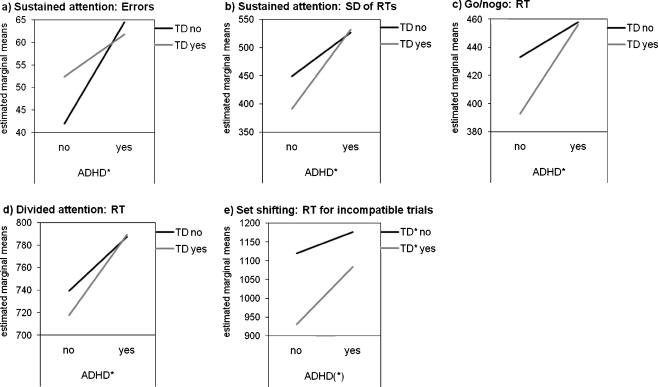
The aim of the present study was to investigate the effect of both tic disorder (TD) and attention-deficit/hyperactivity disorder (ADHD) on attentional functions. N=96 children and adolescents participated in the study, including n=21 subjects with TD, n=23 subjects with ADHD, n=25 subjects with TD+ADHD, and n=27 controls. Attentional performance was tested based on four computerized attention tasks (sustained attention, divided attention, go/nogo and set shifting). The effect of TD as well as ADHD on attentional performance was tested using a 2 × 2 factorial approach. A diagnosis of TD had no negative impact on attentional functions but was associated with improved performance in the set shifting task. By contrast, regardless of a diagnosis of TD, subjects with ADHD were found to perform worse in the sustained attention, divided attention and go/nogo task. No interaction effect between the factors TD and ADHD was revealed for any of the attention measures. Our results add to findings from other areas of research, showing that in subjects with TD and ADHD, ADHD psychopathology is often the main source of impairment, whereas a diagnosis of TD has little or no impact on neuropsychological performance in most cases and even seems to be associated with adaptive mechanisms.
Overview
The claims and statistics of this paper haven’t been checked yet.
Free: it reads the open-access text and checks the first 5 claims that cite a source we can check. Create a free account to check every claim.
Integrity signals
Registry
Cites
Statistics
Figures
Verification
Claims the paper makes
The claims and statistics of this paper haven’t been checked yet.
Free: it reads the open-access text and checks the first 5 claims that cite a source we can check. Create a free account to check every claim.
Claims other papers make about this one
Each is checked against this paper’s own text: does it say what the citing paper says it does?
In the citing paper
“In childhood ADHD, comorbidity with tics/Tourette seems to result in a combination of neuropsychological problems associated with both disorders”
From The neurobiological link between OCD and ADHD (2014) · cites this paper as Greimel et al. 2011
Self-check
Percentages, sums and reported differences re-computed from the paper’s own numbers.
The self-check needs the paper’s full text.
Citations
Cites
Journal of Clinical Psychiatry
(2018) · Journal of Clinical Psychiatry · doi:10.5505/kpd · Cited by 13,651
Applied Multivariate Statistics for the Social Sciences
Stevens, J. P. (2012) · Routledge eBooks · doi:10.4324/9780203843130 · Cited by 10,648
KAUFMAN, J., BIRMAHER, B., BRENT, D., RAO, U., FLYNN, C., MORECI, P., WILLIAMSON, D., & RYAN, N. (1997) · Journal of the American Academy of Child & Adolescent Psychiatry · doi:10.1097/00004583-199707000-00021 · Cited by 10,148
Applied multivariate statistics for the social sciences
Stevens, J. P., & Stevens, J. P. (2001) · doi:10.4324/9781410604491 · Cited by 4,993
Attention Deficit Hyperactivity Disorder: A Handbook for Diagnosis and Treatment
Barkley, R. A., & Poillion, M. J. (1994) · Behavioral Disorders · doi:10.1177/019874299401900205 · Cited by 4,639
Manual for the Wechsler intelligence scale for children
Wechsler, D. (1974) · Psychological Corp. eBooks · Cited by 3,704
Willcutt, E. G., Doyle, A. E., Nigg, J. T., Faraone, S. V., & Pennington, B. F. (2005) · Biological Psychiatry · doi:10.1016/j.biopsych.2005.02.006 · Cited by 3,568
The yale global tic severity scale: initial testing of a clinician-rated scale of tic severity
LECKMAN, J. F., RIDDLE, M. A., HARDIN, M. T., ORT, S. I., SWARTZ, K. L., STEVENSON, J., & COHEN, D. J. (1989) · Journal of the American Academy of Child & Adolescent Psychiatry · doi:10.1097/00004583-198907000-00015 · Cited by 2,146
Freeman, R. D., Fast, D. K., Burd, L., Kerbeshian, J., Robertson, M. M., & Sandor, P. (2000) · Developmental Medicine & Child Neurology · doi:10.1017/s0012162200000839 · Cited by 924
Manly, T., Anderson, V., Nimmo‐Smith, I., Turner, A., Watson, P., & Robertson, I. H. (2001) · Journal of Child Psychology and Psychiatry · doi:10.1111/1469-7610.00806 · Cited by 693
Research works printed but not linked: 6
- Achenbach TM Empirically based taxonomy: how to use syndromes and profile types derived from the CBCL from 4 to 18, TRF, and WSR 1993 Burlington University of Vermont, Department of Psychiatry
- Delmo C Weiffenbach O Gabriel M Poustka F 3. Auflage der deutschen Forschungsversion des K-SADS-PL, erweitert um ICD-10-Diagnostik 2000 Bern Huber
- DeSonneville LMJ ANT 2.1 Amsterdam Neuropsychological Tasks, Manual 2001 Amstelveen Sonar
- Döpfner M Lehmkuhl G Diagnostik-System für psychische Störungen im Kindes- und Jugendalter nach ICD-10 und DSM-IV 1998 Bern Huber
- Tewes U Rossmann P Schallberger U Hamburg-Wechsler-Intelligenztest für Kinder—Dritte Auflage. Manual 1999 Bern Hans Huber
- World Health Organization The ICD-10 classification of mental and behavioural disorders: Diagnostic criteria for research 1993 Geneva World Health Organization
Cited by
Neuromodulation in Tourette syndrome: dopamine and beyond
Buse, J., Schoenefeld, K., Münchau, A., & Roessner, V. (2013) · Neuroscience & Biobehavioral Reviews · doi:10.1016/j.neubiorev.2012.10.004 · Cited by 185
Self-citationPharmacological treatment of tic disorders and Tourette Syndrome
Roessner, V., Schoenefeld, K., Buse, J., Bender, S., Ehrlich, S., & Münchau, A. M. (2012) · Neuropharmacology · doi:10.1016/j.neuropharm.2012.05.043 · Cited by 152
Self-citationChen, M., Su, T., Chen, Y., Hsu, J., Huang, K., Chang, W., & Bai, Y. (2013) · Journal of Child Psychology and Psychiatry · doi:10.1111/jcpp.12018 · Cited by 131
The puzzling question of inhibitory control in Tourette syndrome: A meta-analysis
Morand‐Beaulieu, S., Grot, S., Lavoie, J., Leclerc, J. B., Luck, D., & Lavoie, M. E. (2017) · Neuroscience & Biobehavioral Reviews · doi:10.1016/j.neubiorev.2017.05.006 · Cited by 137
The neurobiological link between OCD and ADHD
Brem, S., Grünblatt, E., Drechsler, R., Riederer, P., & Walitza, S. (2014) · ADHD Attention Deficit and Hyperactivity Disorders · doi:10.1007/s12402-014-0146-x · Cited by 109
Reigal, R. E., Barrero, S., Tamayo, I. M., Morales‐Sánchez, V., de Mier, R. J.-R., & Hernández-Mendo, A. (2019) · Frontiers in Psychology · doi:10.3389/fpsyg.2019.02278 · Cited by 157
Lou, J., Jin, L., Wu, N., Tan, Y., Song, Y., Gao, M., Liu, K., Zhang, X., & He, J. (2013) · Food and Chemical Toxicology · doi:10.1016/j.fct.2013.01.053 · Cited by 64
Cognitive Risks in Developmental Psychopathology
Hankin, B. L., Snyder, H. R., & Gulley, L. D. (2016) · Developmental Psychopathology · doi:10.1002/9781119125556.devpsy308 · Cited by 53
A Review of the Neuropsychological Dimensions of Tourette Syndrome
Morand‐Beaulieu, S., Leclerc, J. B., Valois, P., Lavoie, M. E., O’Connor, K. P., & Gauthier, B. (2017) · Brain Sciences · doi:10.3390/brainsci7080106 · Cited by 73
Pathophysiology of ADHD and associated problems—starting points for NF interventions?
Albrecht, B., Uebel, H., Gevensleben, H., & Rothenberger, A. (2015) · Frontiers in Human Neuroscience · doi:10.3389/fnhum.2015.00359 · Cited by 58
Self-citationLook duration at the face as a developmental endophenotype: elucidating pathways to autism and ADHD
Gui, A., Mason, L., Gliga, T., Hendry, A. J., Ali, J. B., Pasco, G., Shephard, E., Curtis, C. J. C., Charman, T., Johnson, M. H., et al. (2020) · Development and Psychopathology · doi:10.1017/s0954579420000930 · Cited by 46
Shephard, E., Jackson, G. M., & Groom, M. J. (2015) · Journal of Neuropsychology · doi:10.1111/jnp.12071 · Cited by 47
Neurocognitive correlates of treatment response in children with Tourette's Disorder
Chang, S. W., Mcguire, J. F., Walkup, J. T., Woods, D. W., Scahill, L. D., Wilhelm, S., Peterson, A. L., Dziura, J., & Piacentini, J. C. (2018) · Psychiatry Research · doi:10.1016/j.psychres.2017.12.066 · Cited by 34
Shephard, E., Jackson, G. M., & Groom, M. J. (2016) · International Journal of Developmental Neuroscience · doi:10.1016/j.ijdevneu.2016.04.005 · Cited by 35
Tharp, J. A., Wendelken, C., Mathews, C. A., Marco, E. J., Schreier, H. A., & Bunge, S. A. (2015) · Frontiers in Psychiatry · doi:10.3389/fpsyt.2015.00095 · Cited by 28
Performance Monitoring in Medication-Naïve Children with Tourette Syndrome
Eichele, H., Eichele, T., Bjelland, I., Høvik, M. F., Sørensen, L., van Wageningen, H., Worren, M. K., Hugdahl, K., & Plessen, K. J. (2016) · Frontiers in Neuroscience · doi:10.3389/fnins.2016.00050 · Cited by 30
Functional Neuroimaging Investigations of Motor Networks in Tourette Syndrome
Rothenberger, A., & Roessner, V. (2013) · Behavioural Neurology · doi:10.1155/2013/481398 · Cited by 24
Self-citationBiederman, J., Hammerness, P. G., Sadeh, B., Peremen, Z., Amit, A., Or-Ly, H., Stern, Y., Reches, A., Geva, A. B., & Faraone, S. V. (2017) · Psychological Medicine · doi:10.1017/s0033291716003329 · Cited by 23
Openneer, T. J. C., Forde, N. J., Akkermans, S. E. A., Naaijen, J., Buitelaar, J. K., Hoekstra, P. J., & Dietrich, A. (2019) · Cortex · doi:10.1016/j.cortex.2019.11.007 · Cited by 32
Morand‐Beaulieu, S., Smith, S. D., Ibrahim, K., Wu, J., Leckman, J. F., Crowley, M. J., & Sukhodolsky, D. G. (2021) · Cortex · doi:10.1016/j.cortex.2021.12.006 · Cited by 21
Rothenberger, A., & Heinrich, H. (2022) · Biomedicines · doi:10.3390/biomedicines10112950 · Cited by 21
Self-citationEichele, H., Eichele, T., Marquardt, L., Adólfsdóttir, S., Hugdahl, K., Sørensen, L., & Plessen, K. J. (2017) · Frontiers in Neuroscience · doi:10.3389/fnins.2017.00305 · Cited by 19
Uebel, H., Albrecht, B., Rothenberger, A., Fillmer-Heise, A., Roessner, V., Sergeant, J. A., Tannock, R., & Banaschewski, T. (2017) · PLoS ONE · doi:10.1371/journal.pone.0178866 · Cited by 14
Self-citationNeurofeedback and its possible relevance for the treatment of Tourette syndrome
Farkas, A., Bluschke, A., Roessner, V., & Beste, C. (2015) · Neuroscience & Biobehavioral Reviews · doi:10.1016/j.neubiorev.2015.01.012 · Cited by 14
Self-citationJurgiel, J., Miyakoshi, M., Dillon, A., Piacentini, J. C., & Loo, S. K. (2022) · Biological Psychiatry Cognitive Neuroscience and Neuroimaging · doi:10.1016/j.bpsc.2022.10.003 · Cited by 14
Guillamón, A. R., Cantó, E. G., & López, P. J. C. (2019) · Retos · doi:10.47197/retos.v0i35.60729 · Cited by 38
Roessner, V., Schoenefeld, K., Buse, J., Wanderer, S., & Rothenberger, A. (2012) · Zeitschrift für Kinder- und Jugendpsychiatrie und Psychotherapie · doi:10.1024/1422-4917/a000176 · Cited by 12
Self-citationMaigaard, K., Nejad, A. B., Andersen, K. W., Herz, D. M., Hagstrøm, J., Pagsberg, A. K., Skov, L., Siebner, H. R., & Plessen, K. J. (2019) · Neuropsychologia · doi:10.1016/j.neuropsychologia.2019.05.012 · Cited by 12
Fourneret, P., Desombre, H., & Broussolle, E. (2014) · Archives de Pédiatrie · doi:10.1016/j.arcped.2014.03.017 · Cited by 13
Rothenberger, A., & Heinrich, H. (2021) · Frontiers in Neurology · doi:10.3389/fneur.2021.587097 · Cited by 10
Self-citationMorand‐Beaulieu, S., Zhong, J., Ibrahim, K., Crowley, M. J., Grantz, H., Leckman, J. F., & Sukhodolsky, D. G. (2025) · Pediatric Neurology · doi:10.1016/j.pediatrneurol.2025.08.001 · Cited by 8
Neurocognitive Functioning in Tourette Syndrome
Morand‐Beaulieu, S., Stark, D. L., & Murphy, T. L. (2024) · Psychiatric Clinics of North America · doi:10.1016/j.psc.2024.08.005 · Cited by 6
Sharpening randomization-based causal inference for 2 2 factorial designs with binary outcomes
Lu, J. (2017) · Statistical Methods in Medical Research · doi:10.1177/0962280217745720 · Cited by 5
Васильевна, А. А., & Soliannikova, N. S. (2018) · Вестник Южно-Уральского государственного университета. Серия: Психология · doi:10.14529/psy180103 · Cited by 5
Gasanov, R. F., Makarov, I. V., Emelina, D. A., Скоромец, А. А., & Скоромец, Т. А. (2020) · Russian neurological Journal · doi:10.30629/2658-7947-2020-25-4-22-30 · Cited by 3
Bari, D. S., & Aldosky, H. Y. Y. (2022) · Biomedical Human Kinetics · doi:10.2478/bhk-2022-0012 · Cited by 3
Kim, W., Park, T., Park, J., Chung, S.-K., Yang, J.-C., Park, J.-I., Kim, E.-J., Cho, E.-C., & Park, J. (2017) · Journal of korean Academy of Child and Adolescent Psychiatry · doi:10.5765/jkacap.2017.28.1.25 · Cited by 2
On finite-population Bayesian inferences for 2 K factorial designs with binary outcomes
Lu, J. (2019) · Journal of Statistical Computation and Simulation · doi:10.1080/00949655.2019.1574793 · Cited by 3
Reigal, R. E., Enríquez-Molina, R., Sánchez-García, C., Franquelo, M. A., Contreras-Osorio, F., Campos‐Jara, C., Hernández-Mendo, A., & Morales‐Sánchez, V. (2023) · Cuadernos de Psicología del Deporte · doi:10.6018/cpd.563001 · Cited by 7
Shephard, E. (2014) · Nottingham ePrints (University of Nottingham) · Cited by 3
A revised method for measuring distraction by tactile stimulation
Schechter, J. R., Greene, D. J., Koller, J. M., & BLACK, K. J. (2014) · F1000Research · doi:10.12688/f1000research.4944.1 · Cited by 1
The Phenomenology of Attention-Deficit/Hyperactivity Disorder in Tourette Syndrome
Rothenberger, A., & Roessner, V. (2022) · Oxford University Press eBooks · doi:10.1093/med/9780197543214.003.0003 · Cited by 2
Self-citationNeedham, A. C. (2013) · TSpace (University of Toronto)
Neuropsychological Testing for Adolescents with ADHD
Baldwin, F., & Linnea, K. S. (2020) · Springer eBooks · doi:10.1007/978-3-030-62393-7_6
The neural correlates of tic inhibition
Abi‐Jaoude, E., & Sandor, P. (2022) · International review of movement disorders · doi:10.1016/bs.irmvd.2021.12.004
Shephard, E., Jackson, G. M., & Groom, M. J. (2016) · International Journal of Developmental Neuroscience · doi:10.1016/j.ijdevneu.2016.04.006
Shephard, E., Groom, M. J., & Jackson, G. M. (2022) · International review of movement disorders · doi:10.1016/bs.irmvd.2021.11.002
Neuropsychological Assessment in Tourette Syndrome
Murphy, T. L., Czernecki, V., Tárnok, Z., & Stark, D. L. (2022) · Oxford University Press eBooks · doi:10.1093/med/9780197543214.003.0022
El-Badramany, M. A., Khalifa, M. E., Mekky, D. S. S. A., & Soliman, N. M. (2023) · Contemporary Educational Technology · doi:10.30935/cedtech/13334
Fourneret, P. (2023) · Dunod eBooks · doi:10.3917/dunod.bange.2023.01.0239
Neuropsychological Testing for Adolescents with ADHD
Linnea, K. S., & Baldwin, F. (2025) · Springer eBooks · doi:10.1007/978-3-031-96950-8_2
Soubata, H., Mazur-Lainé, E., Leclerc, J. B., Gauthier, B., Blanchet, P. J., O’Connor, K. P., & Lavoie, M. E. (2026) · Journal of Clinical and Experimental Neuropsychology · doi:10.1080/13803395.2026.2681009
Metadata
- Authors
- Greimel, E., Wanderer, S., Rothenberger, A., Herpertz-Dahlmann, B., Konrad, K., & Roessner, V.
- Affiliations
- Universitätsklinikum Aachen (DE)
- University Hospital Carl Gustav Carus (DE)
- Universitätsmedizin Göttingen (DE)
- Corresponding author
- Greimel, Ellen
- Venue
- Journal of Abnormal Child Psychology
- Published
- 2011-02-18
- Volume
- 39
- Issue
- 6
- Pages
- 819-828
- ISSN
- 0091-0627 (ISSN-L)
- 1573-2835
- PMC
- PMC3111554
- OpenAlex
- W2036136550
- Cited by
- 52
- References
- 71
- Citations by year
- 2026: 1 · 2025: 2 · 2024: 1 · 2023: 3 · 2022: 7 · 2021: 2 · 2020: 3 · 2019: 5 · 2018: 2 · 2017: 7 · 2016: 4 · 2015: 4 · 2014: 4 · 2013: 3 · 2012: 4
- FWCI
- 3.79
- Type
- journal article
- Language
- en
- Open access
- hybrid
- doi.org
- Licence
- cc-by-nc
- Locations
- Research on Child and Adolescent Psychopathology (publishedVersion, cc-by-nc)
- PubMed Central (publishedVersion, cc-by-nc)
- PubMed (publishedVersion)
- GoeScholar The Publication Server of the Georg-August-Universität Göttingen (Georg-August-Universität Göttingen) (submittedVersion, cc-by)
- GRO (submittedVersion, cc-by)
- RWTH Publications (RWTH Aachen) (submittedVersion)
- Topics
- Social Sciences › Psychology › Clinical Psychology › Obsessive-Compulsive Spectrum Disorders
- Health Sciences › Medicine › Psychiatry and Mental health › Attention Deficit Hyperactivity Disorder
- Life Sciences › Neuroscience › Cognitive Neuroscience › Neural and Behavioral Psychology Studies
- Keywords
- tic disorders, attention deficit hyperactivity disorder, comorbidities, attentional performance, sustained attention, divided attention, go/no-go task, set-shifting, children and adolescents, neuropsychological performance
- MeSH terms
- Adolescent, Attention, Attention Deficit Disorder with Hyperactivity, Child, Female, Humans, Male, Neuropsychological Tests, Problem Solving, Reaction Time, Tic Disorders
About these checks
Registry, retraction, Cites and statistics results are computed, not judged, with one exception: a printed reference that no index lists is read once by a model before it counts as a citation error. Claims are extracted by a model and kept only when their quote appears verbatim in the text; each cited source is then checked, with a model’s help, for whether it says what the claim relies on. Those verdicts can be wrong — read the claim’s quote and the cited source before relying on one.
Statistics and arithmetic are recomputed, not judged.
Confidence bands are shown only for fields calibrated on our annotated test set. None is calibrated yet, so no band is shown.
What counts as a claim ›How we measure confidence ›How we check this ›
Are you an author, or do you see a problem with this page? Request a review
Data sources
Bibliographic data: Semantic Scholar, OpenAlex, Crossref.
Contains information from the Semantic Scholar Academic Graph Datasets, made available under the ODC Attribution License (ODC-BY 1.0).
Semantic Scholar’s data is described in: Kinney, R., et al. (2023). The Semantic Scholar Open Data Platform. arXiv:2301.10140.
