

Autism Spectrum Disorder and Attention-Deficit/Hyperactivity Disorder: Shared or Unique Neurocognitive Profiles?
Open accessThe DOI matches its Crossref record; 67 of the 67 references it cites were found in a registry or an index.
Abstract
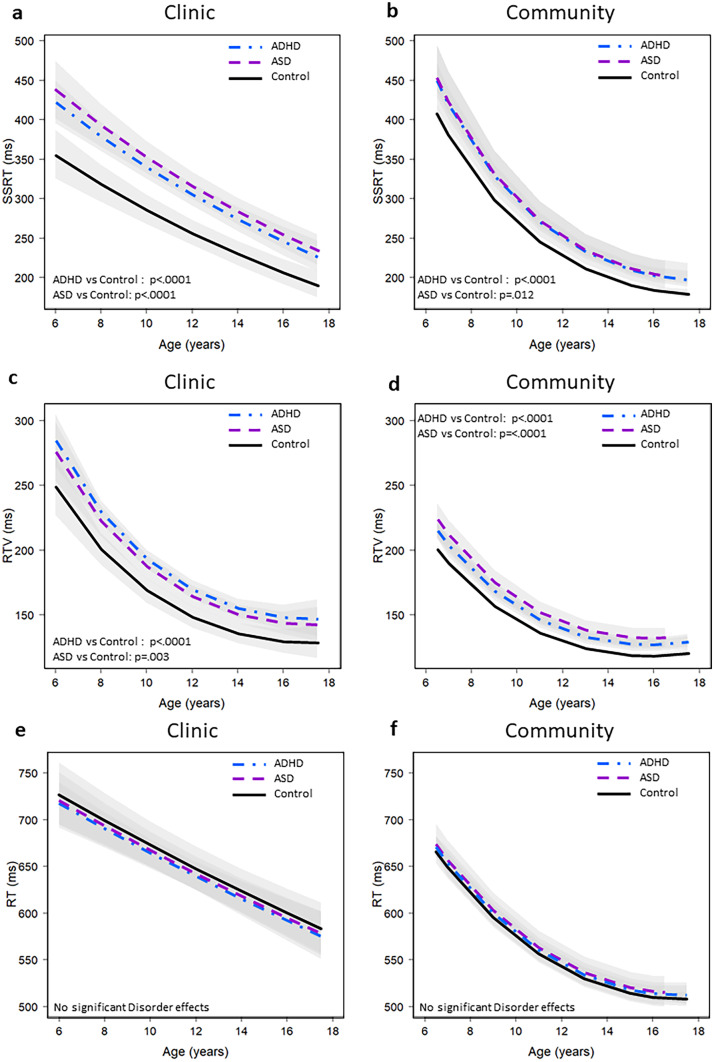
Attention-deficit/hyperactivity (ADHD) and autism spectrum (ASD) disorders are commonly co-occurring conditions characterized by neurocognitive impairments. Few studies have directly compared neurocognitive profiles in ADHD and ASD and fewer still have controlled for comorbidity of ADHD and ASD. All direct comparisons have been in clinic samples, leaving the question of generalizability of results unaddressed. We compared neurocognitive performance in clinically ascertained ASD (n = 261) and ADHD (n = 423) cases and controls (n = 162), 6.0–17.9 years of age. We also compared ASD (n = 190) and ADHD (n = 926) cases ascertained in the community with controls (n = 14,842) of similar age. Using the stop-signal task (SST), we measured response inhibition (stop-signal reaction time–SSRT), sustained attention (defined as reaction time variability–RTV), and reaction time (RT). We controlled for comorbidity using ADHD and ASD trait scores and categorically-defined ADHD. Compared with controls, both clinic ADHD and ASD had significantly longer SSRT and RTV than controls and did not differ from each other. ADHD traits accounted for neurocognitive impairment in ASD, but not vice versa. There were no group differences for RT. Similar patterns of neurocognitive impairment were observed in the community sample. In the largest direct comparison of ADHD and ASD to date, we found impaired response inhibition and sustained attention in both disorders. However, neurocognitive impairment in ASD was almost completely accounted for by comorbid ADHD. Results generalized in the community sample indicating that referral bias alone did not drive results. Response inhibition and sustained attention likely play a role in ADHD and ASD.
Overview
The claims and statistics of this paper haven’t been checked yet.
Free: it reads the open-access text and checks the first 5 claims that cite a source we can check. Create a free account to check every claim.
Integrity signals
Registry
Cites
Statistics
Figures
Verification
Claims the paper makes
The claims and statistics of this paper haven’t been checked yet.
Free: it reads the open-access text and checks the first 5 claims that cite a source we can check. Create a free account to check every claim.
Claims other papers make about this one
Each is checked against this paper’s own text: does it say what the citing paper says it does?
The source backs part of the claim, not all of it — or backs it for a different population, condition or comparison.
In the citing paper
“the three executive function components are moderately interrelated, and there is experimental evidence demonstrating that working memory impacts performance on inhibitory control tests (but not vice versa), which could potentially explain why children with ADHD show deficits on inhibition tests.152,157–159”
From Executive function deficits in attention-deficit/hyperactivity disorder and autism spectrum disorder (2024) · cites this paper as [159]
Experimental — accuracy not yet measuredIn the citing paper
“We found few studies that included a comorbid group, controlled for traits of ASD and ADHD, or distinguished between ADHD subtypes precluding adequate consideration of the effect of comorbidity and subtype on EF performance (Schachar et al., 2022; Semrud-Clikeman et al., 2010).”
From Do ASD and ADHD Have Distinct Executive Function Deficits? A Systematic Review and Meta-Analysis of Direct Comparison Studies (2023) · cites this paper as Schachar et al., 2022
Self-check
Percentages, sums and reported differences re-computed from the paper’s own numbers.
The self-check needs the paper’s full text.
Citations
Cites
Lord, C., Rutter, M., & Le Couteur, A. (1994) · Journal of Autism and Developmental Disorders · doi:10.1007/bf02172145 · Cited by 9,065 · cited 1×
“Each participant was assessed by a psychiatrist and/or a psychologist to confirm their primary diagnosis using the Autism Diagnostic Observation Schedule–2 (ADOS), Autism Diagnostic Interview–Revised (ADI-R) for ASD (Lord et al., 1994) and/or the Parent Interview for Child Symptoms (PICS) for ADHD (Ickowicz et al.”
Method(1998) · Cited by 2,026
Individual differences in executive functions are almost entirely genetic in origin.
Friedman, N. P., Miyake, A., Young, S. E., DeFries, J. C., Corley, R. P., & Hewitt, J. K. (2008) · Journal of Experimental Psychology: General · doi:10.1037/0096-3445.137.2.201 · Cited by 1,547 · cited 1×
“Response inhibition and reaction time variability might prove to be good, cross-disorder markers of aetiological risk factors in disorders characterized by ADHD traits given that both response inhibition and RTV have genetic (Finkel & Pedersen, 2014; Friedman et al., 2008; Schachar et al., 2005) and neurobiological (A…”
BackgroundAutism screening questionnaire: diagnostic validity
Berument, S. K., Rutter, M., Lord, C., Pickles, A., & Bailey, A. (1999) · British Journal of Psychiatry · doi:10.1192/bjp.175.5.444 · Cited by 1,464
Genomic Relationships, Novel Loci, and Pleiotropic Mechanisms across Eight Psychiatric Disorders
Lee, P. H., Anttila, V., Won, H., Feng, Y.-C. A., Rosenthal, J., Zhu, Z., Tucker-Drob, E. M., Nivard, M. G., Grotzinger, A. D., Posthuma, D., et al. (2019) · Cell · doi:10.1016/j.cell.2019.11.020 · Cited by 1,381
Self-citationThe Changing Epidemiology of Autism Spectrum Disorders
Lyall, K., Croen, L., Daniels, J., Fallin, M. D., Ladd-Acosta, C., Lee, B. K., Park, B. Y., Snyder, N. W., Schendel, D., Volk, H., et al. (2017) · Annual Review of Public Health · doi:10.1146/annurev-publhealth-031816-044318 · Cited by 1,011 · cited 2×
“ADHD is the most common comorbidity of ASD with comorbidity estimates of 40–70% (Brookman-Frazee et al., 2018; Joshi et al., 2017; Lyall et al., 2017).”
BackgroundResultVerbruggen, F., Aron, A. R., Band, G. P., Beste, C., Bissett, P. G., Brockett, A. T., Brown, J. W., Chamberlain, S. R., Chambers, C. D., Colonius, H., et al. (2019) · eLife · doi:10.7554/elife.46323 · Cited by 990
Self-citationSonuga-Barke, E. J. S., & Castellanos, F. X. (2007) · Neuroscience & Biobehavioral Reviews · doi:10.1016/j.neubiorev.2007.02.005 · Cited by 890 · cited 1×
“…factors in disorders characterized by ADHD traits given that both response inhibition and RTV have genetic (Finkel & Pedersen, 2014; Friedman et al., 2008; Schachar et al., 2005) and neurobiological (Albaugh et al., 2017; Chevrier & Schachar, 2020; Sonuga-Barke & Castellanos, 2007) underpinnings.”
BackgroundWhy IQ is not a covariate in cognitive studies of neurodevelopmental disorders
DENNIS, M., FRANCIS, D. J., CIRINO, P. T., SCHACHAR, R., BARNES, M. A., & FLETCHER, J. M. (2009) · Journal of the International Neuropsychological Society · doi:10.1017/s1355617709090481 · Cited by 875 · cited 1×
“IQ differences between ASD and ADHD or controls did not explain the observed impairments in neurocognitive test performance (Dennis et al., 2009).”
Self-citationAutism spectrum disorders: a meta-analysis of executive function
Demetriou, E. A., Lampit, A., Quintana, D. S., Naismith, S. L., Song, Y. J. C., Pye, J. E., Hickie, I., & Guastella, A. J. (2018) · Molecular Psychiatry · doi:10.1038/mp.2017.75 · Cited by 841
Research works printed but not linked: 2
- APA Diagnositic and statistical manual of mental disorders 1994 4 American Psychiatric Publishing
- APA Diagnositic and statistical manual of mental disorders 2013 5 American Psychiatric Publishing
Cited by
Townes, P., Liu, C., Panesar, P., Devoe, D., Lee, S. Y., Taylor, G., Arnold, P. D., Crosbie, J., & Schachar, R. (2023) · Journal of Attention Disorders · doi:10.1177/10870547231190494 · Cited by 75
“Studies in which ADHD and ASD traits were controlled indicate that, at least response inhibition and response variability, may be more strongly associated with ADHD than with ASD traits (Karalunas et al., 2018; Schachar et al., 2022).”
BackgroundSelf-citationExecutive function deficits in attention-deficit/hyperactivity disorder and autism spectrum disorder
Kofler, M. J., Soto, E. F., Singh, L. J., Harmon, S. L., Jaisle, E. M., Smith, J. N., Feeney, K. E., & Musser, E. D. (2024) · Nature Reviews Psychology · doi:10.1038/s44159-024-00350-9 · Cited by 51
“before it starts) component of inhibitory control 49,67,69,70,159 .”
Canals, J., Morales‐Hidalgo, P., Voltas, N., & Hernández‐Martínez, C. (2024) · Autism Research · doi:10.1002/aur.3146 · Cited by 54
“…coexist and common data on the clinical, neurobiological characteristics, and genetic associations have been a focus of study since the recognition of this comorbidity in the DSM-5 (American Psychiatric Association, 2013; Boedhoe et al., 2020; Ghirardi et al., 2019, 2021; Schachar et al., 2023).”
BackgroundNovau-Ferré, N., Papandreou, C., Rojo-Marticella, M., Canals, J., & Bulló, M. (2025) · Research in Developmental Disabilities · doi:10.1016/j.ridd.2025.105003 · Cited by 41
Schachar, R. J. (2023) · Neuroscience & Biobehavioral Reviews · doi:10.1016/j.neubiorev.2023.105461 · Cited by 34
Self-citationMontagner, P. S. S., Medeiros, W., da Silva, L. C. R., Borges, C. N., Brasil-Neto, J. P., Barbosa, V. D. D. S., Caixeta, F. V., & Malcher‐Lopes, R. (2023) · Frontiers in Psychiatry · doi:10.3389/fpsyt.2023.1210155 · Cited by 25
“Nonetheless, here they are conjugated in one single category because that combination is frequent among ASD patients (102, 103, 105, 106), and further detailing of the specific effect of cannabinoids in each one could broaden too much the scope of the present study.”
BackgroundChallenges in translating AI-driven ASD/ADHD diagnosis: A methodological systematic review
Rasool, A., Ahmad, F., Bunterngchit, C., & Aslam, S. (2026) · International Journal of Medical Informatics · doi:10.1016/j.ijmedinf.2026.106417 · Cited by 20
Yacoub, M., Smith, S., Abbas, B., Iqbal, F., Jazieh, C., Shaer, N. S. H. A., Luk, C., & Syed, N. I. (2025) · Cells · doi:10.3390/cells14171367 · Cited by 20
“Additionally, several ADHD symptoms may exhibit overlap with ASD, such as impaired response inhibition, challenges with sustained attention, and decreased social functioning [34,35].”
Omotehinwa, T. O., Lawrence, M. O., Oyewola, D. O., & Dada, E. G. (2024) · Journal of Computational Mathematics and Data Science · doi:10.1016/j.jcmds.2024.100105 · Cited by 21
Executive Function in ADHD and ASD: A Scoping Review
Liu, C., Townes, P., Panesar, P., Lee, S., Devoe, D. J. A., Arnold, P. D., Crosbie, J., & Schachar, R. J. (2024) · Review Journal of Autism and Developmental Disorders · doi:10.1007/s40489-024-00444-3 · Cited by 20
Self-citationTrans-ancestry meta-analysis of genome wide association studies of inhibitory control
Arnatkevičiūtė, A., Lemire, M., Morrison, C. L., Mooney, M. A., Ryabinin, P., Roslin, N. M., Nikolas, M. A., Coxon, J. P., Tiego, J., Hawi, Z., et al. (2023) · Molecular Psychiatry · doi:10.1038/s41380-023-02187-9 · Cited by 13
Self-citationAljead, M., Qashta, A., Jalal, Z., & Jones, A. M. (2025) · Pharmaceuticals · doi:10.3390/ph18111644 · Cited by 15
“Approximately 70% of ASD patients have ADHD, which has led to the inclusion of ADHD medications in the ASD treatment guideline [119,120].”
Sadat-Nejad, Y., Vandewouw, M. M., Cardy, R. E., Lerch, J. P., Taylor, M. J., Iaboni, A., Hammill, C. F., Syed, B., Brian, J. A., Kelley, E. A., et al. (2023) · Frontiers in Child and Adolescent Psychiatry · doi:10.3389/frcha.2023.1171337 · Cited by 13
Self-citationBerenguer, C., Baixauli, I., Rosa, E., & STASIO, S. D. (2023) · Autism Research · doi:10.1002/aur.3077 · Cited by 10
“Sleep disturbances are also frequent in Attention-Def-icit/Hyperactivity Disorder (ADHD) (Cortese et al., 2013), a condition with similarities to the ASD neurocognitive profile (Schachar et al., 2023), and with prevalence rates ranging from 70% to 85% (Yürümez & K ı l ı ç, 2016).”
BackgroundAlsayouf, H. A. (2024) · Frontiers in Psychiatry · doi:10.3389/fpsyt.2024.1408876 · Cited by 12
Pehlivanidis, A., Kouklari, E.-C., Kalantzi, E., Korobili, K., Tagkouli, E., & Papanikolaou, Κ. (2025) · BMC Psychiatry · doi:10.1186/s12888-025-06841-0 · Cited by 8
Symptoms of autism in Williams syndrome: a transdiagnostic approach
Willfors, C., Borg, J., Kleberg, J. L., Hallman, A. E. Z., van der Poll, M., Remnélius, K. L., Avdic, H. B., Bölte, S., & Nordgren, A. (2024) · Scientific Reports · doi:10.1038/s41598-024-68089-0 · Cited by 7
Rinaldi, A., Martins, M. C. M., Oliveira, A. C. D. A. M., Rinaldi, S., & Fontani, V. (2023) · Journal of Personalized Medicine · doi:10.3390/jpm13050792 · Cited by 9
Alsayouf, H. A., Alsarhan, O., Khreisat, W. H., & Daoud, A. S. (2024) · Children · doi:10.3390/children11020163 · Cited by 8
“Attention deficit/hyperactivity disorder (ADHD) is a common comorbidity in children with autism spectrum disorder (ASD) [1] and the most commonly diagnosed psychiatric condition in childhood and adolescence [2].”
BackgroundErik, E., Safran, E. E., & Şevgin, Ö. (2025) · Research in Autism · doi:10.1016/j.reia.2025.202543 · Cited by 8
Sarwar, A., & Vitetta, F. (2024) · OALib · doi:10.4236/oalib.1111111 · Cited by 5
Buendia-Corona, R. E., Dey, M. F. V., Robles, L. V., Biviano, H. J. H., Hermosillo‐Abundis, C., & Pastrana, L. I. C. (2026) · Molecules · doi:10.3390/molecules31020366 · Cited by 4
“TS is characterized by repetitive involuntary movements and vocalizations, with approximately 50–60% of patients exhibiting comorbid ADHD and 20–30% showing ASD features [7].”
Chen, Q., Sun, Y., Pan, N., Long, Y., Cao, Y., Luo, Y., Xin, K., Chen, P., Wang, Y., Shu, M., et al. (2026) · European Child & Adolescent Psychiatry · doi:10.1007/s00787-026-03068-6 · Cited by 7
Boxberger, A., Chen, B., Olson, L., Cordova, M., Mahmalji, J., Ríos, A., Linke, A. C., & Fishman, I. (2025) · Journal of Neurodevelopmental Disorders · doi:10.1186/s11689-025-09650-4 · Cited by 4
Identifying Neurodevelopmental Domain Subgroups in Autism and ADHD
Krakowski, A. D., Cost, K. T., Vandewouw, M. M., Szatmári, P., Anagnostou, E. A., Crosbie, J., Schachar, R. J., Duku, E., Georgiades, S., Ayub, M., et al. (2026) · Journal of Autism and Developmental Disorders · doi:10.1007/s10803-026-07266-8 · Cited by 2
Self-citation7-factor model of autism symptoms in 3-6-year-olds: Age-related changes
Nasledov, A., Tkacheva, L. O., & Александрович, М. С. (2024) · Terapia psicológica · doi:10.4067/s0718-48082024000300379 · Cited by 2
Chau, T., Tiego, J., Brown, L. E., Mellahn, O. J., Johnson, B. P., & Bellgrove, M. A. (2024) · JCPP Advances · doi:10.1002/jcv2.12259 · Cited by 1
“The presence of ADHD traits can further impact how autistic children manage social (Harkins & Mazurek, 2023; Liu et al., 2021), cognitive (Schachar et al., 2023), and adaptive demands (Carpenter et al., 2022; distinction between autistic and ADHD ‐ related traits in this population, there is an…”
Neurodevelopmental Disorders and Criminal Behavior
Reddy, K. J. (2025) · Springer eBooks · doi:10.1007/978-3-031-83771-5_4 · Cited by 1
Neurodiversity and Cognitive Load in Online Learning: A Pilot EEG and Eye-Tracking Study
Cunff, A. L., Dommett, E. J., & Giampietro, V. (2025) · Neurodiversity · doi:10.1177/27546330251400677 · Cited by 2
Desenvolvimento da autonomia e habilidades sociais e comportamentais em adolescentes TEA/TDAH
Nascimento, F. C. (2025) · Somma Revista Cientifica do Instituto Federal de Educação Ciência e Tecnologia do Piauí · doi:10.51361/somma.v10i1.431
Gordon Logan's Contribution to the Understanding of Attention Deficit Hyperactivity Disorder
Schachar, R. J. (2025) · The American Journal of Psychology · doi:10.5406/19398298.138.2.04
Self-citationRam, N. (2025) · TSpace (University of Toronto)
Life courses of adults on the autism spectrum and their intermittent work careers
Pulkkinen, H. (2023) · UEF eRepo (University of Eastern Finland)
Ye, Z. (2026) · Pakistan Journal of Pharmaceutical Sciences · doi:10.36721/pjps/2026.40.17027.1
Cruz, C. D. O., Martins, L. R., Mâcedo, L. A. L., Oliveira, F. A., Holanda, C. A. D. P., Santos, F. O., & Simões, M. S. (2026) · Revista Brasileira de Educação Saúde e Bem-estar · doi:10.29327/2654312.1.2-2
Metadata
- Authors
- Schachar, R. J., Dupuis, A., Arnold, P. D., Anagnostou, E., Kelley, E., Georgiades, S., Nicolson, R., Townes, P., Burton, C. L., & Crosbie, J.
- Affiliations
- University of Toronto (CA)
- Hospital for Sick Children (CA)
- Queen's University (CA)
- McMaster University (CA)
- Mathison Centre for Mental Health Research and Education (CA)
- Corresponding author
- Schachar, Russell J.
- ORCID
- Venue
- Research on Child and Adolescent Psychopathology
- Published
- 2022-08-25
- Volume
- 51
- Issue
- 1
- Pages
- 17-31
- ISSN
- 0091-0627 (ISSN-L)
- 2730-7166
- 2730-7174
- PMC
- PMC9763138
- OpenAlex
- W4293052098
- Cited by
- 30
- References
- 67
- Citations by year
- 2026: 5 · 2025: 9 · 2024: 9 · 2023: 7
- FWCI
- 4.07
- Type
- journal article
- Language
- en
- Open access
- hybrid
- doi.org
- Licence
- cc-by
- creativecommons.org/licenses/by/4.0 (tdm)
- creativecommons.org/licenses/by/4.0 (vor)
- Locations
- Research on Child and Adolescent Psychopathology (publishedVersion, cc-by)
- PubMed Central (publishedVersion, cc-by)
- PubMed (publishedVersion)
- Funders
- Canadian Institutes of Health Research (MOP‐93696, MOP‐106573)
- Ontario Brain Institute (IDS-I l-02)
- Topics
- Health Sciences › Medicine › Psychiatry and Mental health › Attention Deficit Hyperactivity Disorder
- Life Sciences › Neuroscience › Cognitive Neuroscience › Autism Spectrum Disorder Research
- Social Sciences › Psychology › Neuropsychology and Physiological Psychology › Developmental and Educational Neuropsychology
- Keywords
- autism spectrum disorder, attention deficit hyperactivity disorder, neurocognitive impairment, response inhibition, sustained attention, reaction time variability, stop-signal reaction time, comorbidities, referral bias, community sample, ADHD traits
- MeSH terms
- Autism Spectrum Disorder, Attention, Attention Deficit Disorder with Hyperactivity, Humans, Reaction Time, Comorbidity
About these checks
Registry, retraction, Cites and statistics results are computed, not judged, with one exception: a printed reference that no index lists is read once by a model before it counts as a citation error. Claims are extracted by a model and kept only when their quote appears verbatim in the text; each cited source is then checked, with a model’s help, for whether it says what the claim relies on. Those verdicts can be wrong — read the claim’s quote and the cited source before relying on one.
Statistics and arithmetic are recomputed, not judged.
Confidence bands are shown only for fields calibrated on our annotated test set. None is calibrated yet, so no band is shown.
What counts as a claim ›How we measure confidence ›How we check this ›
Are you an author, or do you see a problem with this page? Request a review
Data sources
Bibliographic data: Semantic Scholar, OpenAlex, Crossref.
Contains information from the Semantic Scholar Academic Graph Datasets, made available under the ODC Attribution License (ODC-BY 1.0).
Semantic Scholar’s data is described in: Kinney, R., et al. (2023). The Semantic Scholar Open Data Platform. arXiv:2301.10140.
