

Behavioral Profiles of Affected and Unaffected Siblings of Children with Autism: Contribution of Measures of Mother–Infant Interaction and Nonverbal Communication
Open accessThe DOI matches its Crossref record; 79 of the 82 references it cites were found in a registry or an index.
Abstract
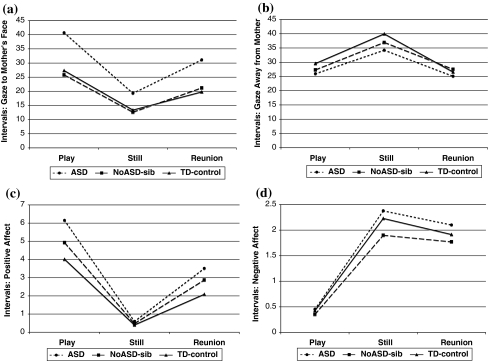
We investigated whether deficits in social gaze and affect and in joint attention behaviors are evident within the first year of life among siblings of children with autism who go on to be diagnosed with autism or ASD (ASD) and siblings who are non-diagnosed (NoASD-sib) compared to low-risk controls. The ASD group did not differ from the other two groups at 6 months of age in the frequency of gaze, smiles, and vocalizations directed toward the caregiver, nor in their sensitivity to her withdrawal from interaction. However, by 12 months, infants in the ASD group exhibited lower rates of joint attention and requesting behaviors. In contrast, NoASD-sibs did not differ from comparison infants on any variables of interest at 6 and 12 months.
Overview
The claims and statistics of this paper haven’t been checked yet.
Free: it reads the open-access text and checks the first 5 claims that cite a source we can check. Create a free account to check every claim.
Integrity signals
Registry
Cites
Statistics
Figures
Verification
Claims the paper makes
The claims and statistics of this paper haven’t been checked yet.
Free: it reads the open-access text and checks the first 5 claims that cite a source we can check. Create a free account to check every claim.
Claims other papers make about this one
Each is checked against this paper’s own text: does it say what the citing paper says it does?
The cited source says what the claim attributes to it.
In the citing paper
“Behavioral responses to the ‘still face’ paradigm were measured in studies of high-risk infants, but were found to be typical at 6 months in Sib-A (Rozga et al., 2011; Young et al., 2009).”
From From early markers to neuro-developmental mechanisms of autism (2014) · cites this paper as Rozga et al., 2011
Self-check
Percentages, sums and reported differences re-computed from the paper’s own numbers.
The self-check needs the paper’s full text.
Citations
Cites
Diagnostic and Statistical Manual of Mental Disorders
Williams, J. B. W., & First, M. (2013) · Encyclopedia of Social Work · doi:10.1093/acrefore/9780199975839.013.104 · Cited by 109,519
Intraclass correlations: Uses in assessing rater reliability.
Shrout, P. E., & Fleiss, J. L. (1979) · Psychological Bulletin · doi:10.1037/0033-2909.86.2.420 · Cited by 24,532
Diagnostic and Statistical Manual of Mental Disorders
American Psychiatric Association (2022) · doi:10.1176/appi.books.9780890425787 · Cited by 23,476
Lord, C., Rutter, M., & Le Couteur, A. (1994) · Journal of Autism and Developmental Disorders · doi:10.1007/bf02172145 · Cited by 9,065 · cited 2×
“Diagnoses of ASD in the older siblings were confirmed using the Autism Diagnostic Interview-Revised (ADI-R; Lord et al. 1994), the Autism Diagnostic Observation Schedule (ADOS; Lord et al. 2000), and DSM-IV criteria (APA 1994) at UCLA, and via the ADOS and Social Communication Questionnaire (SCQ;…”
MethodLord, C., Risi, S., Lambrecht, L., Cook, E. H., Leventhal, B. L., DiLavore, P. C., Pickles, A., & Rutter, M. (2000) · Journal of Autism and Developmental Disorders · doi:10.1023/a:1005592401947 · Cited by 7,520 · cited 15×
“The NoASDsib group consists of 84 infants in the high-risk group who 1 A subset of the infants in the low-risk control group (n = 45) and the autism sibling group (n = 11) were recruited prior to 6 months of age. did not meet criteria for Autism or ASD based on the ADOS and DSM-IV criteria.”
BackgroundMethodInfluentialUnderstanding and sharing intentions: The origins of cultural cognition
Tomasello, M., Carpenter, M., Call, J., Behne, T., & Moll, H. (2005) · Behavioral and Brain Sciences · doi:10.1017/s0140525x05000129 · Cited by 4,882
Social cognition, joint attention, and communicative competence from 9 to 15 months of age.
Carpenter, M., Nagell, K., Tomasello, M., Butterworth, G., & Moore, C. (1998) · Monographs of the Society for Research in Child Development · doi:10.2307/1166214 · Cited by 2,727 · cited 1×
“…face-to-face social exchanges characterizes the earliest social interactions, toward the end of the first year of life infants begin to coordinate their attention and interest with others about external objects and events (Bakeman and Adamson 1984; Bruner and Sherwood 1983; Carpenter et al. 1998).”
BackgroundMullen Scales of Early Learning
Bradley-Johnson, S. (1997) · Psychology in the Schools · doi:10.1002/(sici)1520-6807(199710)34:4<379::aid-pits14>3.0.co;2-e · Cited by 2,325
Handbook of Autism and Pervasive Developmental Disorders
(2005) · Wiley eBooks · doi:10.1002/9780470939352 · Cited by 2,250
The Infant's Response to Entrapment between Contradictory Messages in Face-to-Face Interaction
Tronick, E., Als, H., Adamson, L., Wise, S., & Brazelton, T. B. (1978) · Journal of the American Academy of Child Psychiatry · doi:10.1016/s0002-7138(09)62273-1 · Cited by 1,880 · cited 3×
“…infants participated in the Still Face Procedure (SFP), a structured paradigm in which the caregiver is asked to withdraw completely from interacting with the infant and assume a neutral expression for a pre-specified period of time before resuming contingent interaction (Tronick et al. 1978).”
BackgroundMethodInfluential
Cited by
Items 301–309 of 309
Communication Initiation and Effectiveness in Infants with Elevated Likelihood for ASD
Plate, S. N. (2023) · D-Scholarship@Pitt (University of Pittsburgh)
Autism in Infants and Toddlers
CHAWARSKA, K., & Macari, S. (2026) · Wiley eBooks · doi:10.1002/9781394389933.ch5
Harker, C. M. (2014) · ResearchWorks at the University of Washington (University of Washington)
Montagut-Asunción, M. (2019) · Repository of Digital Objects for Teaching Research and Culture (University of Valencia)
Screening for Autism in Young Children
Attar, S. M., Ibañez, L. V., & STONE, W. L. (2026) · Wiley eBooks · doi:10.1002/9781394489886.ch25
Ravi, S., Bradshaw, A., Abdi, H., Meera, S. S., Parish-Morris, J., Yankowitz, L., Paterson, S., Dager, S. R., Burrows, C. A., Chappell, C., et al. (2022) · doi:10.3389/fcomm.2022.977724.s001
Developmental regression and mitochondrial dysfunction in children with autism spectrum disorder
Boterberg, S. (2020) · Ghent University Academic Bibliography (Ghent University)
Bontinck, C. (2018) · Ghent University Academic Bibliography (Ghent University)
Gesture Development in Infants with Fragile X Syndrome
Hughes, K. R., Klusek, J., Butler, C., & Roberts, J. E. (2026) · Scholar Commons (University of South Carolina)
Metadata
- Authors
- Rozga, A., Hutman, T., Young, G. S., Rogers, S. J., Ozonoff, S., Dapretto, M., & Sigman, M.
- Affiliations
- Georgia Institute of Technology (US)
- University of California, Los Angeles (US)
- University of California, Davis (US)
- Corresponding author
- Rozga, Agata
- Venue
- Journal of Autism and Developmental Disorders
- Published
- 2010-06-22
- Volume
- 41
- Issue
- 3
- Pages
- 287-301
- ISSN
- 0162-3257 (ISSN-L)
- 1573-3432
- PMC
- PMC3044086
- OpenAlex
- W2127303835
- Cited by
- 266
- References
- 82
- Citations by year
- 2026: 4 · 2025: 9 · 2024: 10 · 2023: 8 · 2022: 12 · 2021: 20 · 2020: 50 · 2019: 23 · 2018: 20 · 2017: 13 · 2016: 21 · 2015: 19 · 2014: 21 · 2013: 13 · 2012: 16
- FWCI
- 6.78
- Type
- journal article
- Language
- en
- Open access
- hybrid
- doi.org
- Licence
- cc-by-nc
- Locations
- Journal of Autism and Developmental Disorders (publishedVersion, cc-by-nc)
- PubMed Central (publishedVersion, cc-by-nc)
- PubMed (publishedVersion)
- eScholarship (California Digital Library) (submittedVersion, cc-by-nc)
- eScholarship (California Digital Library) (submittedVersion)
- Funders
- National Institutes of Health
- National Institute of Mental Health (R01MH068398, MH068172, MH068398, U54MH068172)
- Topics
- Life Sciences › Neuroscience › Cognitive Neuroscience › Autism Spectrum Disorder Research
- Social Sciences › Psychology › Developmental and Educational Psychology › Child and Animal Learning Development
- Health Sciences › Medicine › Psychiatry and Mental health › Child Nutrition and Feeding Issues
- Keywords
- autism spectrum disorder, siblings of autistic children, joint attention, social gaze, emotional behavior, mother-infant interaction, nonverbal communication, infant social behavior, requesting behavior
- MeSH terms
- Analysis of Variance, Attention, Autistic Disorder, Female, Humans, Infant, Male, Mother-Child Relations, Nonverbal Communication, Play and Playthings, Social Behavior, Infant Behavior, Siblings
About these checks
Registry, retraction, Cites and statistics results are computed, not judged, with one exception: a printed reference that no index lists is read once by a model before it counts as a citation error. Claims are extracted by a model and kept only when their quote appears verbatim in the text; each cited source is then checked, with a model’s help, for whether it says what the claim relies on. Those verdicts can be wrong — read the claim’s quote and the cited source before relying on one.
Statistics and arithmetic are recomputed, not judged.
Confidence bands are shown only for fields calibrated on our annotated test set. None is calibrated yet, so no band is shown.
What counts as a claim ›How we measure confidence ›How we check this ›
Are you an author, or do you see a problem with this page? Request a review
Data sources
Bibliographic data: Semantic Scholar, OpenAlex, Crossref.
Contains information from the Semantic Scholar Academic Graph Datasets, made available under the ODC Attribution License (ODC-BY 1.0).
Semantic Scholar’s data is described in: Kinney, R., et al. (2023). The Semantic Scholar Open Data Platform. arXiv:2301.10140.
