

Behavioral Profiles of Affected and Unaffected Siblings of Children with Autism: Contribution of Measures of Mother–Infant Interaction and Nonverbal Communication
Open accessThe DOI matches its Crossref record; 79 of the 82 references it cites were found in a registry or an index.
Abstract
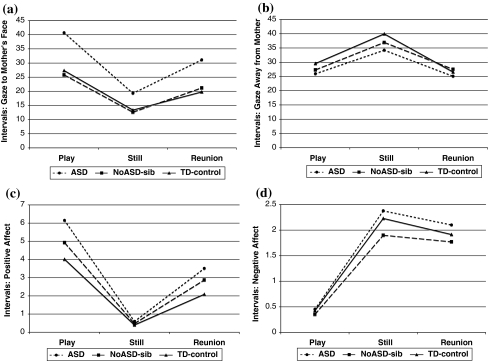
We investigated whether deficits in social gaze and affect and in joint attention behaviors are evident within the first year of life among siblings of children with autism who go on to be diagnosed with autism or ASD (ASD) and siblings who are non-diagnosed (NoASD-sib) compared to low-risk controls. The ASD group did not differ from the other two groups at 6 months of age in the frequency of gaze, smiles, and vocalizations directed toward the caregiver, nor in their sensitivity to her withdrawal from interaction. However, by 12 months, infants in the ASD group exhibited lower rates of joint attention and requesting behaviors. In contrast, NoASD-sibs did not differ from comparison infants on any variables of interest at 6 and 12 months.
Overview
The claims and statistics of this paper haven’t been checked yet.
Free: it reads the open-access text and checks the first 5 claims that cite a source we can check. Create a free account to check every claim.
Integrity signals
Registry
Cites
Statistics
Figures
Verification
Claims the paper makes
The claims and statistics of this paper haven’t been checked yet.
Free: it reads the open-access text and checks the first 5 claims that cite a source we can check. Create a free account to check every claim.
Claims other papers make about this one
Each is checked against this paper’s own text: does it say what the citing paper says it does?
The cited source says what the claim attributes to it.
In the citing paper
“Behavioral responses to the ‘still face’ paradigm were measured in studies of high-risk infants, but were found to be typical at 6 months in Sib-A (Rozga et al., 2011; Young et al., 2009).”
From From early markers to neuro-developmental mechanisms of autism (2014) · cites this paper as Rozga et al., 2011
Self-check
Percentages, sums and reported differences re-computed from the paper’s own numbers.
The self-check needs the paper’s full text.
Citations
Cites
Diagnostic and Statistical Manual of Mental Disorders
Williams, J. B. W., & First, M. (2013) · Encyclopedia of Social Work · doi:10.1093/acrefore/9780199975839.013.104 · Cited by 109,519
Intraclass correlations: Uses in assessing rater reliability.
Shrout, P. E., & Fleiss, J. L. (1979) · Psychological Bulletin · doi:10.1037/0033-2909.86.2.420 · Cited by 24,532
Diagnostic and Statistical Manual of Mental Disorders
American Psychiatric Association (2022) · doi:10.1176/appi.books.9780890425787 · Cited by 23,476
Lord, C., Rutter, M., & Le Couteur, A. (1994) · Journal of Autism and Developmental Disorders · doi:10.1007/bf02172145 · Cited by 9,065 · cited 2×
“Diagnoses of ASD in the older siblings were confirmed using the Autism Diagnostic Interview-Revised (ADI-R; Lord et al. 1994), the Autism Diagnostic Observation Schedule (ADOS; Lord et al. 2000), and DSM-IV criteria (APA 1994) at UCLA, and via the ADOS and Social Communication Questionnaire (SCQ;…”
MethodLord, C., Risi, S., Lambrecht, L., Cook, E. H., Leventhal, B. L., DiLavore, P. C., Pickles, A., & Rutter, M. (2000) · Journal of Autism and Developmental Disorders · doi:10.1023/a:1005592401947 · Cited by 7,520 · cited 15×
“The NoASDsib group consists of 84 infants in the high-risk group who 1 A subset of the infants in the low-risk control group (n = 45) and the autism sibling group (n = 11) were recruited prior to 6 months of age. did not meet criteria for Autism or ASD based on the ADOS and DSM-IV criteria.”
BackgroundMethodInfluentialUnderstanding and sharing intentions: The origins of cultural cognition
Tomasello, M., Carpenter, M., Call, J., Behne, T., & Moll, H. (2005) · Behavioral and Brain Sciences · doi:10.1017/s0140525x05000129 · Cited by 4,882
Social cognition, joint attention, and communicative competence from 9 to 15 months of age.
Carpenter, M., Nagell, K., Tomasello, M., Butterworth, G., & Moore, C. (1998) · Monographs of the Society for Research in Child Development · doi:10.2307/1166214 · Cited by 2,727 · cited 1×
“…face-to-face social exchanges characterizes the earliest social interactions, toward the end of the first year of life infants begin to coordinate their attention and interest with others about external objects and events (Bakeman and Adamson 1984; Bruner and Sherwood 1983; Carpenter et al. 1998).”
BackgroundMullen Scales of Early Learning
Bradley-Johnson, S. (1997) · Psychology in the Schools · doi:10.1002/(sici)1520-6807(199710)34:4<379::aid-pits14>3.0.co;2-e · Cited by 2,325
Handbook of Autism and Pervasive Developmental Disorders
(2005) · Wiley eBooks · doi:10.1002/9780470939352 · Cited by 2,250
The Infant's Response to Entrapment between Contradictory Messages in Face-to-Face Interaction
Tronick, E., Als, H., Adamson, L., Wise, S., & Brazelton, T. B. (1978) · Journal of the American Academy of Child Psychiatry · doi:10.1016/s0002-7138(09)62273-1 · Cited by 1,880 · cited 3×
“…infants participated in the Still Face Procedure (SFP), a structured paradigm in which the caregiver is asked to withdraw completely from interacting with the infant and assume a neutral expression for a pre-specified period of time before resuming contingent interaction (Tronick et al. 1978).”
BackgroundMethodInfluentialMonographs of the Society for Research in Child Development
Ash, M. J., & Torres, J. L. (2008) · Encyclopedia of Special Education · doi:10.1002/9780470373699.speced1386 · Cited by 1,819
Behavioral manifestations of autism in the first year of life
Zwaigenbaum, L., Bryson, S., Rogers, T., Roberts, W., Brian, J., & Szatmari, P. (2005) · International Journal of Developmental Neuroscience · doi:10.1016/j.ijdevneu.2004.05.001 · Cited by 1,602
Robins, D. L., Fein, D., Barton, M. L., & Green, J. A. (2001) · Journal of Autism and Developmental Disorders · doi:10.1023/a:1010738829569 · Cited by 1,563 · cited 2×
“These findings support current practices in autism screening, which incorporate a failure to point to objects, to hold objects up for others to see, and to respond to the pointing gestures of others as red flags for ASD in the first two years of life (Bryson et al. 2008; Lord et al. 2000; Robins et al. 2001; Stone et…”
BackgroundEpidemiological Surveys of Autism and Other Pervasive Developmental Disorders: An Update
Fombonne, E. (2003) · Journal of Autism and Developmental Disorders · doi:10.1023/a:1025054610557 · Cited by 1,505 · cited 2×
“Siblings of children with autism are at heightened risk for developing an autism spectrum disorder (ASD) (Fombonne 2003; Ritvo et al. 1989) and milder difficulties in the domains of social interaction and communication (Bailey et al.”
BackgroundDawson, G., Toth, K., Abbott, R., Osterling, J., Munson, J., Estes, A., & Liaw, J. (2004) · Developmental Psychology · doi:10.1037/0012-1649.40.2.271 · Cited by 1,477 · cited 2×
“Their use of these behaviors for more instrumental purpose, such as pointing to obtain an object, is less impaired (Dawson et al. 2004; Mundy et al. 1986; Sigman and Ruskin 1999).”
BackgroundRegression Models for Categorical Dependent Variables Using Stata, Second Edition
Long, J. S., & Jeremy Freese, A. (2005) · Cited by 1,465
Coordinating Attention to People and Objects in Mother-Infant and Peer-Infant Interaction
Bakeman, R., & Adamson, L. B. (1984) · Child Development · doi:10.2307/1129997 · Cited by 1,439
Journal of Autism and Developmental Disorders
(2013) · Journal of Autism and Developmental Disorders · doi:10.1007/10803.1573-3432 · Cited by 1,361
Early recognition of children with autism: a study of first birthday home videotapes
Osterling, J., & Dawson, G. (1994) · Journal of Autism and Developmental Disorders · doi:10.1007/bf02172225 · Cited by 1,290 · cited 4×
“A growing body of research suggests that these deficits may be among the earliest diagnostic indicators of ASD (Baranek 1999; Charman et al. 1997; Osterling and Dawson 1994 ).”
BackgroundResultInfluentialJoint attention as social cognition.
Tomasello, M. (1995) · Medical Entomology and Zoology · Cited by 1,271
A longitudinal study of joint attention and language development in autistic children
Mundy, P., Sigman, M., & Kasari, C. (1990) · Journal of Autism and Developmental Disorders · doi:10.1007/bf02206861 · Cited by 1,119 · cited 2×
“The implications of such early deficits for the subsequent development are underscored by evidence that individual differences in the initiation of joint attention and gestures in general predict language (Charman et al. 2003; Mundy et al. 1990; Sigman and Ruskin 1999) and theory of mind task performance (Charman et a…”
BackgroundSelf-citationA case-control family history study of autism
Bolton, P., Macdonald, H., Pickles, A., Rios, P., Goode, S., Crowson, M., Bailey, A., & Rutter, M. (1994) · Journal of Child Psychology and Psychiatry · doi:10.1111/j.1469-7610.1994.tb02300.x · Cited by 1,094 · cited 4×
“Although this is a common approach in the infant sibling literature (e.g., Cassel et al. 2007; Yirmiya et al. 2006; Toth et al. 2007), evidence from family studies suggests that only a subset of older siblings and family members may be affected by the BAP (Bailey et al. 1998; Bolton et al. 1994 ).”
BackgroundMethodInfluentialBaranek, G. T. (1999) · Journal of Autism and Developmental Disorders · doi:10.1023/a:1023080005650 · Cited by 1,027 · cited 2×
“A growing body of research suggests that these deficits may be among the earliest diagnostic indicators of ASD (Baranek 1999; Charman et al. 1997; Osterling and Dawson 1994).”
BackgroundA Prospective Study of the Emergence of Early Behavioral Signs of Autism
Ozonoff, S., Iosif, A.-M., Baguio, F., Cook, I. C., Hill, M. M., Hutman, T., Rogers, S. J., Rozga, A., Sangha, S., Sigman, M., et al. (2010) · Journal of the American Academy of Child & Adolescent Psychiatry · doi:10.1016/j.jaac.2009.11.009 · Cited by 1,011 · cited 1×
“…reduced our statistical power to detect group differences at 6 months, our findings nonetheless substantiate the results from other longitudinal studies of infant siblings indicating no clear behavioral markers for ASD at 6 months (Landa et al. 2007; Ozonoff et al. 2010; Zwaigenbaum et al. 2005).”
ResultSelf-citationSocial Communication Questionnaire
Lund, E. (2014) · Encyclopedia of Special Education · doi:10.1002/9781118660584.ese2224 · Cited by 972
Defining the social deficits of autism: the contribution of non-verbal communication measures
Mundy, P., Sigman, M., Ungerer, J., & Sherman, T. (1986) · Journal of Child Psychology and Psychiatry · doi:10.1111/j.1469-7610.1986.tb00190.x · Cited by 956 · cited 1×
“Their use of these behaviors for more instrumental purpose, such as pointing to obtain an object, is less impaired (Dawson et al. 2004; Mundy et al. 1986; Sigman and Ruskin 1999).”
BackgroundSelf-citationWhat minds have in common is space: Spatial mechanisms serving joint visual attention in infancy
Butterworth, G., & Jarrett, N. (1991) · British Journal of Developmental Psychology · doi:10.1111/j.2044-835x.1991.tb00862.x · Cited by 937
Neuroanatomic observations of the brain in autism: a review and future directions
Bauman, M. L., & Kemper, T. L. (2005) · International Journal of Developmental Neuroscience · doi:10.1016/j.ijdevneu.2004.09.006 · Cited by 919 · cited 2×
“Despite recognition that autism is a neurodevelopmental disorder, and evidence that the underlying brain abnormality may be present from birth (Bauman and Kemper 2005; Nelson et al. 2001; Rodier et al. 1996), the limited and largely undifferentiated behavioral repertoires of very young infants may…”
BackgroundThe enactive mind, or from actions to cognition: lessons from autism
Klin, A., Jones, W., Schultz, R., & Volkmar, F. (2003) · Philosophical Transactions of the Royal Society of London. Series B: Biological Sciences · doi:10.1098/rstb.2002.1202 · Cited by 890
Social Communication Questionnaire
Snow, A. (2013) · Encyclopedia of Autism Spectrum Disorders · doi:10.1007/978-1-4419-1698-3_1651 · Cited by 870
(2014) · Psychology Press eBooks · doi:10.4324/9781315806617 · Cited by 867
Infants with autism: an investigation of empathy, pretend play, joint attention, and imitation
Charman, T., Swettenham, J., Baron-Cohen, S., Cox, A., Baird, G., & Drew, A. (1997) · Developmental Psychology · doi:10.1037/0012-1649.33.5.781 · Cited by 813 · cited 1×
“A growing body of research suggests that these deficits may be among the earliest diagnostic indicators of ASD (Baranek 1999; Charman et al. 1997; Osterling and Dawson 1994).”
BackgroundSigman (1999) · doi:10.1111/1540-5834.00002 · Cited by 809
Self-citationEarly recognition of 1-year-old infants with autism spectrum disorder versus mental retardation
OSTERLING, J. A., DAWSON, G., & MUNSON, J. A. (2002) · Development and Psychopathology · doi:10.1017/s0954579402002031 · Cited by 738 · cited 2×
“In sum, our results indicate that previous findings of reduced social orienting (Osterling and Dawson 1994; Osterling et al. 2002) and atypicalities in eye contact and social smiling (Zwaigenbaum et al. 2005) among 12-month-old infants subsequently diagnosed with autism cannot be extended downward…”
Result(2001) · PubMed · Cited by 662
Tronick, E. Z., & Cohn, J. F. (1989) · Child Development · doi:10.1111/j.1467-8624.1989.tb02698.x · Cited by 637
Testing joint attention, imitation, and play as infancy precursors to language and theory of mind
Charman, T., Baron-Cohen, S., Swettenham, J., Baird, G., Cox, A., & Drew, A. (2000) · Cognitive Development · doi:10.1016/s0885-2014(01)00037-5 · Cited by 622
(1995) · Cited by 590
Landa, R. J., Holman, K. C., & Garrett-Mayer, E. (2007) · Archives of General Psychiatry · doi:10.1001/archpsyc.64.7.853 · Cited by 590 · cited 7×
“Finally, findings by Landa et al. (2007) suggest that delays in RJA at 14 months may only be evident in those siblings who subsequently exhibit language delays or social impairments.”
BackgroundMethodResultInfluentialInfant-mother and infant-father synchrony: The coregulation of positive arousal
Feldman, R. (2003) · Infant Mental Health Journal · doi:10.1002/imhj.10041 · Cited by 536 · cited 1×
“…multiple modalities, including vocalization, facial expression, and visual orientation (Messinger et al. 1999; Weinberg and Tronick 1994; Yale et al. 2003) and coordinate the timing of these behaviors with those of their interactive partners (Cohn and Tronick 1988; Feldman 2003; Jaffe et al. 2001).”
BackgroundMITCHELL, S., BRIAN, J., ZWAIGENBAUM, L., ROBERTS, W., SZATMARI, P., SMITH, I., & BRYSON, S. (2006) · Journal of Developmental & Behavioral Pediatrics · doi:10.1097/00004703-200604002-00004 · Cited by 535 · cited 2×
“…with autism indicate that measures of joint attention and requesting skill may be sensitive to early manifestations of autism and the broader phenotype from 14 to 24 months (Cassel et al. 2007; Landa et al. 2007; Mitchell et al. 2006; Sullivan et al. 2007; Toth et al. 2007; Yirmiya et al. 2006).”
BackgroundKasari, C., Sigman, M., Mundy, P., & Yirmiya, N. (1990) · Journal of Autism and Developmental Disorders · doi:10.1007/bf02206859 · Cited by 507
Self-citationPredicting language outcome in infants with autism and pervasive developmental disorder
Charman, T., Baron‐Cohen, S., Swettenham, J., Baird, G., Drew, A., & Cox, A. (2003) · International Journal of Language & Communication Disorders · doi:10.1080/136820310000104830 · Cited by 489 · cited 2×
“…development are underscored by evidence that individual differences in the initiation of joint attention and gestures in general predict language (Charman et al. 2003; Mundy et al. 1990; Sigman and Ruskin 1999) and theory of mind task performance (Charman et al. 2000) among young children with…”
BackgroundFrontiers of infant psychiatry
(1983) · Journal of Affective Disorders · doi:10.1016/0165-0327(83)90013-7 · Cited by 482
Tronick, E. Z., & Cohn, J. F. (1989) · Child Development · doi:10.2307/1131074 · Cited by 471
The still-face: A history of a shared experimental paradigm
Adamson, L. B., & Frick, J. E. (2003) · Infancy · doi:10.1207/s15327078in0404_01 · Cited by 449 · cited 3×
“The caregiver’s sudden withdrawal from interaction is an extremely powerful social cue for young infants (Adamson and Frick 2003), and thus the still face effect may in fact be too robust to capture early autism-specific deficits.”
BackgroundAutism: The Phenotype in Relatives
Bailey, A., Palferman, S., Heavey, L., & Le Couteur, A. (1998) · Journal of Autism and Developmental Disorders · doi:10.1023/a:1026048320785 · Cited by 447
Neuropeptides and neurotrophins in neonatal blood of children with autism or mental retardation
Nelson, K. B., Grether, J. K., Croen, L. A., Dambrosia, J. M., Dickens, B. F., Jelliffe, L. L., Hansen, R. L., & Phillips, T. M. (2001) · Annals of Neurology · doi:10.1002/ana.1024 · Cited by 435
The Autism Observation Scale for Infants: scale development and reliability data
Bryson, S. E., Zwaigenbaum, L., McDermott, C., Rombough, V., & Brian, J. (2008) · Journal of Autism and Developmental Disorders · doi:10.1007/s10803-007-0440-y · Cited by 410 · cited 2×
“These findings support current practices in autism screening, which incorporate a failure to point to objects, to hold objects up for others to see, and to respond to the pointing gestures of others as red flags for ASD in the first two years of life ( Bryson et al. 2008; Lord et al. 2000; Robins et al. 2001; Stone et…”
BackgroundBrief Report: Screening Tool for Autism in Two-Year-Olds (STAT): Development and Preliminary Data
Stone, W. L., Coonrod, E. E., & Ousley, O. Y. (2000) · Journal of Autism and Developmental Disorders · doi:10.1023/a:1005647629002 · Cited by 379
Young, G. S., Merin, N., Rogers, S. J., & Ozonoff, S. (2009) · Developmental Science · doi:10.1111/j.1467-7687.2009.00833.x · Cited by 368 · cited 2×
“Keywords Autism Broader autism phenotype Early identification Mother–infant interaction Still face procedure Nonverbal communication”
BackgroundSelf-citationCohn, J. F., & Tronick, E. Z. (1988) · Developmental Psychology · doi:10.1037/0012-1649.24.3.386 · Cited by 364 · cited 2×
“By 6 months of age, typically developing infants use combinations of expressive behavior in multiple modalities, including vocalization, facial expression, and visual orientation (Messinger et al. 1999; Weinberg and Tronick 1994; Yale et al. 2003) and coordinate the timing of these behaviors with those of their intera…”
BackgroundAffective exchanges between young autistic children and their mothers
Dawson, G., Hill, D., Spencer, A., Galpert, L., & Watson, L. (1990) · Journal of Abnormal Child Psychology · doi:10.1007/bf00916569 · Cited by 358
Yirmiya, N., Gamliel, I., Pilowsky, T., Feldman, R., Baron‐Cohen, S., & Sigman, M. (2006) · Journal of Child Psychology and Psychiatry · doi:10.1111/j.1469-7610.2005.01528.x · Cited by 328
Self-citationVariable Expression of the Autism Broader Phenotype: Findings from Extended Pedigrees
Pickles, A., Starr, E., Kazak, S., Bolton, P., Papanikolaou, K., Bailey, A., Goodman, R., & Rutter, M. (2000) · Journal of Child Psychology and Psychiatry · doi:10.1017/s0021963099005557 · Cited by 289
Regression Models for Categorical Outcomes using Stata
Long, J. S., & Jeremy Freese, A. (2005) · Cited by 288
Neural plasticity, joint attention, and a transactional social-orienting model of autism
(2000) · International Review of Research in Mental Retardation · doi:10.1016/s0074-7750(00)80009-9 · Cited by 284 · cited 1×
“Early joint attention behaviors play a self-organizing function, whereby the child’s tendency to initiate social attention coordination with others assures social information input and experience presumed crucial to promoting normative behavioral and neural development (Bernier et al. 2006; Klin et al. 2005; Mundy and…”
BackgroundResponse to Joint Attention in Toddlers at Risk for Autism Spectrum Disorder: A Prospective Study
Sullivan, M., Finelli, J., Marvin, A., Garrett-Mayer, E., Bauman, M., & Landa, R. (2007) · Journal of Autism and Developmental Disorders · doi:10.1007/s10803-006-0335-3 · Cited by 280
Weinberg, M. K., & Tronick, E. Z. (1994) · Child Development · doi:10.1111/j.1467-8624.1994.tb00832.x · Cited by 278
(1989) · American Journal of Psychiatry · doi:10.1176/ajp.146.8.1032 · Cited by 255 · cited 1×
“Siblings of children with autism are at heightened risk for developing an autism spectrum disorder (ASD) (Fombonne 2003; Ritvo et al. 1989) and milder difficulties in the domains of social interaction and communication (Bailey et al. 1998; Bolton et al. 1994; Pickles et al. 2000).”
BackgroundWeinberg, M. K., & Tronick, E. Z. (1994) · Child Development · doi:10.2307/1131514 · Cited by 247
Merin, N., Young, G. S., Ozonoff, S., & Rogers, S. J. (2007) · Journal of Autism and Developmental Disorders · doi:10.1007/s10803-006-0342-4 · Cited by 229
Self-citationCassel, T. D., Messinger, D. S., Ibanez, L. V., Haltigan, J. D., Acosta, S. I., & Buchman, A. C. (2007) · Journal of Autism and Developmental Disorders · doi:10.1007/s10803-006-0337-1 · Cited by 221
Case Study of the Development of an Infant with Autism from Birth to Two Years of Age
Dawson, G., Osterling, J., Meltzoff, A. N., & Kuhl, P. (2000) · Journal of Applied Developmental Psychology · doi:10.1016/s0193-3973(99)00042-8 · Cited by 215
Assessing Change in Early Intervention Programs for Children with Autism
Kasari, C. (2002) · Journal of Autism and Developmental Disorders · doi:10.1023/a:1020546006971 · Cited by 212 · cited 2×
“…in joint attention and requesting on a group level were identified in the current study at an age when these behaviors are still emerging is quite exciting, and provides new hope for efforts to identify appropriate treatment targets for infants and toddlers showing signs of autism (Kasari 2002).”
BackgroundLinks Between Social Understanding and Social Behavior in Verbally Able Children with Autism
Travis, L. L., Sigman, M., & Ruskin, E. (2001) · Journal of Autism and Developmental Disorders · doi:10.1023/a:1010705912731 · Cited by 207
Self-citationToth, K., Dawson, G., Meltzoff, A. N., Greenson, J., & Fein, D. (2007) · Journal of Autism and Developmental Disorders · doi:10.1007/s10803-006-0336-2 · Cited by 188 · cited 8×
“Longitudinal studies of infant siblings of children with autism indicate that measures of joint attention and requesting skill may be sensitive to early manifestations of autism and the broader phenotype from 14 to 24 months (Cassel et al. 2007; Landa et al. 2007; Mitchell et al. 2006; Sullivan et al. 2007; Toth et al…”
BackgroundMethodInfluentialEffects of stimulus contingency in infant-adult interactions
Hains, S. M. J., & Muir, D. W. (1996) · Infant Behavior and Development · doi:10.1016/s0163-6383(96)90043-0 · Cited by 162
An Investigation of Attention and Affect in Children with Autism and Down Syndrome
Joseph, R. M., & Tager-Flusberg, H. B. (1997) · Journal of Autism and Developmental Disorders · doi:10.1023/a:1025853321118 · Cited by 146
The temporal coordination of early infant communication.
Yale, M. E., Messinger, D. S., Cobo-Lewis, A. B., & Delgado, C. F. (2003) · Developmental Psychology · doi:10.1037/0012-1649.39.5.815 · Cited by 142
The Development of Social EngagementNeurobiological Perspectives
Marshall, P. J., & Fox, N. A. (2006) · Oxford University Press eBooks · doi:10.1093/acprof:oso/9780195168716.001.0001 · Cited by 92
Messinger, D. S., Fogel, A., & Dickson, K. L. (1999) · Developmental Psychology · doi:10.1037//0012-1649.35.3.701 · Cited by 87
Visual disengagement in the infant siblings of children with an autism spectrum disorder (ASD)
Ibanez, L. V., Messinger, D. S., Newell, L., Lambert, B., & Sheskin, M. (2008) · Autism · doi:10.1177/1362361308094504 · Cited by 86
Watkins, M. W., Kush, J. C., & Glutting, J. J. (1997) · Psychology in the Schools · doi:10.1002/(sici)1520-6807(199710)34:4<309::aid-pits2>3.0.co;2-g · Cited by 63
Sigman, M., & Ruskin, E. (1999) · Monographs of the Society for Research in Child Development · doi:10.1111/1540-5834.00010 · Cited by 53
Self-citationThe Enactive Mind—From Actions to Cognition: Lessons from Autism
Klin, A., Jones, W., Schultz, R. T., & Volkmar, F. R. (2005) · Handbook of Autism and Pervasive Developmental Disorders · doi:10.1002/9780470939345.ch26 · Cited by 37
Trad, P. V., Bernstein, D. P., Shapiro, T., & Hertzig, M. E. (1993) · Journal of Autism and Developmental Disorders · doi:10.1007/bf01046225 · Cited by 16
Understanding Impairments in Social Engagement in Autism
Bernier, R., Webb, S. J., & Dawson, G. (2006) · Oxford University Press eBooks · doi:10.1093/acprof:oso/9780195168716.003.0011 · Cited by 16
Rodier (1996) · doi:10.1002/(sici)1096-9861(19960624)370:2<247::aid-cne8>3.0.co;2-2
Cited by
Chawarska, K., Macari, S., & Shic, F. (2013) · Biological Psychiatry · doi:10.1016/j.biopsych.2012.11.022 · Cited by 623
Developmental pathways to autism: A review of prospective studies of infants at risk
Jones, E. J. H., Gliga, T., Bedford, R., Charman, T., & Johnson, M. H. (2014) · Neuroscience & Biobehavioral Reviews · doi:10.1016/j.neubiorev.2013.12.001 · Cited by 607
IBIS network, Estes, A., Zwaigenbaum, L., Gu, H., St. John, T., Paterson, S., Elison, J. T., Hazlett, H., Botteron, K., Dager, S. R., et al. (2015) · Journal of Neurodevelopmental Disorders · doi:10.1186/s11689-015-9117-6 · Cited by 363
“, [19, 39, 41, 45]).”
Mandy, W., & Lai, M. (2016) · Journal of Child Psychology and Psychiatry · doi:10.1111/jcpp.12501 · Cited by 283
“…to social scenes (Chawarska, Macari, & Shic, 2013), showing a decline in attention to eyes between 2 and 6 months (Jones & Klin, 2013), having an atypical neural response to dynamic eye gaze aged 6–10 months (Elsabbagh et al., 2012) and making fewer requests at 12 months (Rozga et al., 2011).”
BackgroundWan, M. W., Green, J., Elsabbagh, M., Johnson, M., Charman, T., Plummer, F., & the BASIS Team (2013) · Journal of Child Psychology and Psychiatry · doi:10.1111/jcpp.12032 · Cited by 266
“By contrast, at-risk sibling studies have found no infant social orientation differences during interaction measured either globally (Wan et al., 2012) or microanalytically in at-risk siblings who develop ASD (Rozga et al., 2011).”
Metadata
- Authors
- Rozga, A., Hutman, T., Young, G. S., Rogers, S. J., Ozonoff, S., Dapretto, M., & Sigman, M.
- Affiliations
- Georgia Institute of Technology (US)
- University of California, Los Angeles (US)
- University of California, Davis (US)
- Corresponding author
- Rozga, Agata
- Venue
- Journal of Autism and Developmental Disorders
- Published
- 2010-06-22
- Volume
- 41
- Issue
- 3
- Pages
- 287-301
- ISSN
- 0162-3257 (ISSN-L)
- 1573-3432
- PMC
- PMC3044086
- OpenAlex
- W2127303835
- Cited by
- 266
- References
- 82
- Citations by year
- 2026: 4 · 2025: 9 · 2024: 10 · 2023: 8 · 2022: 12 · 2021: 20 · 2020: 50 · 2019: 23 · 2018: 20 · 2017: 13 · 2016: 21 · 2015: 19 · 2014: 21 · 2013: 13 · 2012: 16
- FWCI
- 6.78
- Type
- journal article
- Language
- en
- Open access
- hybrid
- doi.org
- Licence
- cc-by-nc
- Locations
- Journal of Autism and Developmental Disorders (publishedVersion, cc-by-nc)
- PubMed Central (publishedVersion, cc-by-nc)
- PubMed (publishedVersion)
- eScholarship (California Digital Library) (submittedVersion, cc-by-nc)
- eScholarship (California Digital Library) (submittedVersion)
- Funders
- National Institutes of Health
- National Institute of Mental Health (R01MH068398, MH068172, MH068398, U54MH068172)
- Topics
- Life Sciences › Neuroscience › Cognitive Neuroscience › Autism Spectrum Disorder Research
- Social Sciences › Psychology › Developmental and Educational Psychology › Child and Animal Learning Development
- Health Sciences › Medicine › Psychiatry and Mental health › Child Nutrition and Feeding Issues
- Keywords
- autism spectrum disorder, siblings of autistic children, joint attention, social gaze, emotional behavior, mother-infant interaction, nonverbal communication, infant social behavior, requesting behavior
- MeSH terms
- Analysis of Variance, Attention, Autistic Disorder, Female, Humans, Infant, Male, Mother-Child Relations, Nonverbal Communication, Play and Playthings, Social Behavior, Infant Behavior, Siblings
About these checks
Registry, retraction, Cites and statistics results are computed, not judged, with one exception: a printed reference that no index lists is read once by a model before it counts as a citation error. Claims are extracted by a model and kept only when their quote appears verbatim in the text; each cited source is then checked, with a model’s help, for whether it says what the claim relies on. Those verdicts can be wrong — read the claim’s quote and the cited source before relying on one.
Statistics and arithmetic are recomputed, not judged.
Confidence bands are shown only for fields calibrated on our annotated test set. None is calibrated yet, so no band is shown.
What counts as a claim ›How we measure confidence ›How we check this ›
Are you an author, or do you see a problem with this page? Request a review
Data sources
Bibliographic data: Semantic Scholar, OpenAlex, Crossref.
Contains information from the Semantic Scholar Academic Graph Datasets, made available under the ODC Attribution License (ODC-BY 1.0).
Semantic Scholar’s data is described in: Kinney, R., et al. (2023). The Semantic Scholar Open Data Platform. arXiv:2301.10140.
