

Behavioral Profiles of Affected and Unaffected Siblings of Children with Autism: Contribution of Measures of Mother–Infant Interaction and Nonverbal Communication
Open accessThe DOI matches its Crossref record; 79 of the 82 references it cites were found in a registry or an index.
Abstract
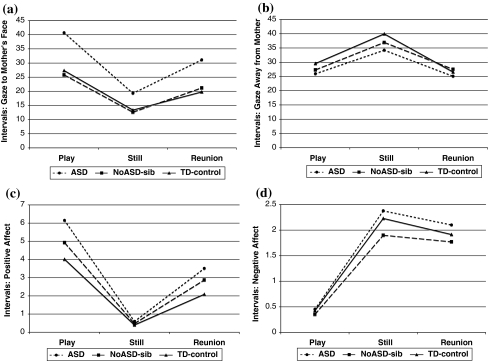
We investigated whether deficits in social gaze and affect and in joint attention behaviors are evident within the first year of life among siblings of children with autism who go on to be diagnosed with autism or ASD (ASD) and siblings who are non-diagnosed (NoASD-sib) compared to low-risk controls. The ASD group did not differ from the other two groups at 6 months of age in the frequency of gaze, smiles, and vocalizations directed toward the caregiver, nor in their sensitivity to her withdrawal from interaction. However, by 12 months, infants in the ASD group exhibited lower rates of joint attention and requesting behaviors. In contrast, NoASD-sibs did not differ from comparison infants on any variables of interest at 6 and 12 months.
Overview
The claims and statistics of this paper haven’t been checked yet.
Free: it reads the open-access text and checks the first 5 claims that cite a source we can check. Create a free account to check every claim.
Integrity signals
Registry
Cites
Statistics
Figures
Verification
Claims the paper makes
The claims and statistics of this paper haven’t been checked yet.
Free: it reads the open-access text and checks the first 5 claims that cite a source we can check. Create a free account to check every claim.
Claims other papers make about this one
Each is checked against this paper’s own text: does it say what the citing paper says it does?
The cited source says what the claim attributes to it.
In the citing paper
“Behavioral responses to the ‘still face’ paradigm were measured in studies of high-risk infants, but were found to be typical at 6 months in Sib-A (Rozga et al., 2011; Young et al., 2009).”
From From early markers to neuro-developmental mechanisms of autism (2014) · cites this paper as Rozga et al., 2011
Self-check
Percentages, sums and reported differences re-computed from the paper’s own numbers.
The self-check needs the paper’s full text.
Citations
Cites
Diagnostic and Statistical Manual of Mental Disorders
Williams, J. B. W., & First, M. (2013) · Encyclopedia of Social Work · doi:10.1093/acrefore/9780199975839.013.104 · Cited by 109,519
Intraclass correlations: Uses in assessing rater reliability.
Shrout, P. E., & Fleiss, J. L. (1979) · Psychological Bulletin · doi:10.1037/0033-2909.86.2.420 · Cited by 24,532
Diagnostic and Statistical Manual of Mental Disorders
American Psychiatric Association (2022) · doi:10.1176/appi.books.9780890425787 · Cited by 23,476
Lord, C., Rutter, M., & Le Couteur, A. (1994) · Journal of Autism and Developmental Disorders · doi:10.1007/bf02172145 · Cited by 9,065 · cited 2×
“Diagnoses of ASD in the older siblings were confirmed using the Autism Diagnostic Interview-Revised (ADI-R; Lord et al. 1994), the Autism Diagnostic Observation Schedule (ADOS; Lord et al. 2000), and DSM-IV criteria (APA 1994) at UCLA, and via the ADOS and Social Communication Questionnaire (SCQ;…”
MethodLord, C., Risi, S., Lambrecht, L., Cook, E. H., Leventhal, B. L., DiLavore, P. C., Pickles, A., & Rutter, M. (2000) · Journal of Autism and Developmental Disorders · doi:10.1023/a:1005592401947 · Cited by 7,520 · cited 15×
“The NoASDsib group consists of 84 infants in the high-risk group who 1 A subset of the infants in the low-risk control group (n = 45) and the autism sibling group (n = 11) were recruited prior to 6 months of age. did not meet criteria for Autism or ASD based on the ADOS and DSM-IV criteria.”
BackgroundMethodInfluentialUnderstanding and sharing intentions: The origins of cultural cognition
Tomasello, M., Carpenter, M., Call, J., Behne, T., & Moll, H. (2005) · Behavioral and Brain Sciences · doi:10.1017/s0140525x05000129 · Cited by 4,882
Social cognition, joint attention, and communicative competence from 9 to 15 months of age.
Carpenter, M., Nagell, K., Tomasello, M., Butterworth, G., & Moore, C. (1998) · Monographs of the Society for Research in Child Development · doi:10.2307/1166214 · Cited by 2,727 · cited 1×
“…face-to-face social exchanges characterizes the earliest social interactions, toward the end of the first year of life infants begin to coordinate their attention and interest with others about external objects and events (Bakeman and Adamson 1984; Bruner and Sherwood 1983; Carpenter et al. 1998).”
BackgroundMullen Scales of Early Learning
Bradley-Johnson, S. (1997) · Psychology in the Schools · doi:10.1002/(sici)1520-6807(199710)34:4<379::aid-pits14>3.0.co;2-e · Cited by 2,325
Handbook of Autism and Pervasive Developmental Disorders
(2005) · Wiley eBooks · doi:10.1002/9780470939352 · Cited by 2,250
The Infant's Response to Entrapment between Contradictory Messages in Face-to-Face Interaction
Tronick, E., Als, H., Adamson, L., Wise, S., & Brazelton, T. B. (1978) · Journal of the American Academy of Child Psychiatry · doi:10.1016/s0002-7138(09)62273-1 · Cited by 1,880 · cited 3×
“…infants participated in the Still Face Procedure (SFP), a structured paradigm in which the caregiver is asked to withdraw completely from interacting with the infant and assume a neutral expression for a pre-specified period of time before resuming contingent interaction (Tronick et al. 1978).”
BackgroundMethodInfluential
Cited by
Chawarska, K., Macari, S., & Shic, F. (2013) · Biological Psychiatry · doi:10.1016/j.biopsych.2012.11.022 · Cited by 623
Developmental pathways to autism: A review of prospective studies of infants at risk
Jones, E. J. H., Gliga, T., Bedford, R., Charman, T., & Johnson, M. H. (2014) · Neuroscience & Biobehavioral Reviews · doi:10.1016/j.neubiorev.2013.12.001 · Cited by 607
IBIS network, Estes, A., Zwaigenbaum, L., Gu, H., St. John, T., Paterson, S., Elison, J. T., Hazlett, H., Botteron, K., Dager, S. R., et al. (2015) · Journal of Neurodevelopmental Disorders · doi:10.1186/s11689-015-9117-6 · Cited by 363
“, [19, 39, 41, 45]).”
Mandy, W., & Lai, M. (2016) · Journal of Child Psychology and Psychiatry · doi:10.1111/jcpp.12501 · Cited by 283
“…to social scenes (Chawarska, Macari, & Shic, 2013), showing a decline in attention to eyes between 2 and 6 months (Jones & Klin, 2013), having an atypical neural response to dynamic eye gaze aged 6–10 months (Elsabbagh et al., 2012) and making fewer requests at 12 months (Rozga et al., 2011).”
BackgroundWan, M. W., Green, J., Elsabbagh, M., Johnson, M., Charman, T., Plummer, F., & the BASIS Team (2013) · Journal of Child Psychology and Psychiatry · doi:10.1111/jcpp.12032 · Cited by 266
“By contrast, at-risk sibling studies have found no infant social orientation differences during interaction measured either globally (Wan et al., 2012) or microanalytically in at-risk siblings who develop ASD (Rozga et al., 2011).”
Annual Research Review: Infant development, autism, and ADHD – early pathways to emerging disorders
Johnson, M. H., Gliga, T., Jones, E., & Charman, T. (2015) · Journal of Child Psychology and Psychiatry · doi:10.1111/jcpp.12328 · Cited by 257
Speech Disturbs Face Scanning in 6-Month-Old Infants Who Develop Autism Spectrum Disorder
Shic, F., Macari, S., & Chawarska, K. (2014) · Biological Psychiatry · doi:10.1016/j.biopsych.2013.07.009 · Cited by 221
“decreased responsiveness to joint attention(40).”
Meta-analysis of receptive and expressive language skills in autism spectrum disorder
Kwok, E. Y. L., Brown, H. M., Smyth, R. E., & Oram Cardy, J. (2015) · Research in Autism Spectrum Disorders · doi:10.1016/j.rasd.2014.10.008 · Cited by 212
Parent–infant interaction in infant siblings at risk of autism
Wan, M. W., Green, J., Elsabbagh, M., Johnson, M., Charman, T., & Plummer, F. (2012) · Research in Developmental Disabilities · doi:10.1016/j.ridd.2011.12.011 · Cited by 188
“…advances in delineating social information processing and communication atypicalities in infants at risk of autism spectrum disorder (ASD) and, increasingly, those who go on to be diagnosed (e.g. Cassel et al., 2007; Goldberg et al., 2005; Rozga et al., 2011; Stone, McMahon, Yoder, & Walden, 2007).”
Communicative Gesture Use in Infants With and Without Autism: A Retrospective Home Video Study
Watson, L. R., Crais, E. R., Baranek, G. T., Dykstra, J. R., & Wilson, K. P. (2013) · American Journal of Speech-Language Pathology · doi:10.1044/1058-0360(2012/11-0145 · Cited by 169
“Rozga et al. (2011) recently reported on the use of gestures for different functions at 12 months of age for infant siblings of children with autism who themselves were eventually diagnosed with autism (“affected siblings”), compared to unaffected infant siblings and infants of siblings without…”
BackgroundJoint Attention in Infancy and the Emergence of Autism
Nyström, P., Thorup, E., Bölte, S., & Falck‐Ytter, T. (2019) · Biological Psychiatry · doi:10.1016/j.biopsych.2019.05.006 · Cited by 162
From early markers to neuro-developmental mechanisms of autism
Gliga, T., Jones, E. J. H., Bedford, R., Charman, T., & Johnson, M. H. (2014) · Developmental Review · doi:10.1016/j.dr.2014.05.003 · Cited by 150
Ozonoff, S., & Iosif, A.-M. (2019) · Neuroscience & Biobehavioral Reviews · doi:10.1016/j.neubiorev.2019.03.012 · Cited by 146
“Similar findings of lack of early group differences (or lack of early predictive ability), followed by later divergence from typically developing infants, have been reported by Landa and Garrett-Mayer (2006) using the Mullen Scales of Early Learning, Rozga et al. (2011) in joint attention, Bedford et al. (2012) on a g…”
Self-citationInfant siblings and the investigation of autism risk factors
Newschaffer, C. J., Croen, L. A., Fallin, M. D., Hertz-Picciotto, I., Nguyen, D. V., Lee, N. L., Berry, C. A., Farzadegan, H., Hess, H. N., Landa, R. J., et al. (2012) · Journal of Neurodevelopmental Disorders · doi:10.1186/1866-1955-4-7 · Cited by 143
Self-citationPatterns of developmental trajectories in toddlers with autism spectrum disorder
Lord, C., Luyster, R., Guthrie, W., & Pickles, A. (2012) · Journal of Consulting and Clinical Psychology · doi:10.1037/a0027214 · Cited by 142
Eye Gaze in Autism Spectrum Disorder: A Review of Neural Evidence for the Eye Avoidance Hypothesis
Stuart, N. E., Whitehouse, A., Palermo, R., Bothe, E., & Badcock, N. A. (2022) · Journal of Autism and Developmental Disorders · doi:10.1007/s10803-022-05443-z · Cited by 134
Early Infant Development and Intervention for Autism Spectrum Disorder
Sacrey, L.-A. R., Bennett, J., & Zwaigenbaum, L. (2015) · Journal of Child Neurology · doi:10.1177/0883073815601500 · Cited by 132
Eye‐Tracking as a Measure of Responsiveness to Joint Attention in Infants at Risk for Autism
Navab, A., Gillespie‐Lynch, K., Johnson, S. P., Sigman, M., & Hutman, T. (2011) · Infancy · doi:10.1111/j.1532-7078.2011.00082.x · Cited by 130
Self-citationThe Development of Referential Communication and Autism Symptomatology in High‐Risk Infants
Ibañez, L. V., Grantz, C. J., & Messinger, D. S. (2012) · Infancy · doi:10.1111/j.1532-7078.2012.00142.x · Cited by 126
Intervention for Infants at Risk of Developing Autism: A Case Series
The BASIS Team, Green, J., Wan, M. W., Guiraud, J. A., Holsgrove, S., McNally, J., Slonims, V., Elsabbagh, M., Charman, T., Pickles, A. R., et al. (2013) · Journal of Autism and Developmental Disorders · doi:10.1007/s10803-013-1797-8 · Cited by 122
Gesture Use and Processing: A Review on Individual Differences in Cognitive Resources
Özer, D., & Göksun, T. (2020) · Frontiers in Psychology · doi:10.3389/fpsyg.2020.573555 · Cited by 118
Macari, S. L., Campbell, D., Gengoux, G. W., Saulnier, C. A., Klin, A. J., & Chawarska, K. (2012) · Journal of Autism and Developmental Disorders · doi:10.1007/s10803-012-1521-0 · Cited by 116
Repetitive Behavior in 12-Month-Olds Later Classified With Autism Spectrum Disorder
Elison, J. T., Wolff, J. J., Reznick, J. S., Botteron, K. N., Estes, A. M., Gu, H., Hazlett, H. C., Meadows, A. J., Paterson, S. J., Zwaigenbaum, L., et al. (2014) · Journal of the American Academy of Child & Adolescent Psychiatry · doi:10.1016/j.jaac.2014.08.004 · Cited by 113
Face Perception and Learning in Autism Spectrum Disorders
Webb, S. J., Neuhaus, E., & Faja, S. (2017) · Quarterly Journal of Experimental Psychology · doi:10.1080/17470218.2016.1151059 · Cited by 113
Talbott, M. R., Nelson, C. A., & Tager-Flusberg, H. B. (2013) · Journal of Autism and Developmental Disorders · doi:10.1007/s10803-013-1820-0 · Cited by 110
the EASE Team, Thorup, E., Nyström, P., Gredebäck, G., Bölte, S., & Falck‐Ytter, T. (2018) · Research on Child and Adolescent Psychopathology · doi:10.1007/s10802-017-0388-0 · Cited by 102
Choi, B., Shah, P., Rowe, M. L., Nelson, C. A., & Tager-Flusberg, H. B. (2019) · Journal of Autism and Developmental Disorders · doi:10.1007/s10803-019-03980-8 · Cited by 100
Varcin, K. J., & Jeste, S. (2016) · Current Opinion in Psychiatry · doi:10.1097/yco.0000000000000312 · Cited by 99
A systematic review of parent–infant interaction in infants at risk of autism
Wan, M. W., Green, J., & Jordan, S. (2018) · Autism · doi:10.1177/1362361318777484 · Cited by 99
Trends in Language Acquisition Research
Abbot‐Smith, K. (2013) · Trends in language acquisition research · doi:10.1075/tilar · Cited by 98
Broader Autism Phenotype in Siblings of Children with ASD—A Review
Pisula, E., & Ziegart-Sadowska, K. (2015) · International Journal of Molecular Sciences · doi:10.3390/ijms160613217 · Cited by 96
Detecting Gaze Towards Eyes in Natural Social Interactions and Its Use in Child Assessment
Chong, E., Chanda, K., Ye, Z., Southerland, A., Ruiz, N., Jones, R., Rozga, A., & Rehg, J. M. (2017) · Proceedings of the ACM on Interactive Mobile Wearable and Ubiquitous Technologies · doi:10.1145/3131902 · Cited by 97
Self-citationSt. John, T., Estes, A. M., Dager, S. R., Kostopoulos, P., Wolff, J. J., Pandey, J., Elison, J. T., Paterson, S. J., Schultz, R. T., Botteron, K., et al. (2016) · Frontiers in Psychology · doi:10.3389/fpsyg.2016.01016 · Cited by 90
Gesture development in toddlers with an older sibling with autism
LeBarton, E. S., & Iverson, J. M. (2015) · International Journal of Language & Communication Disorders · doi:10.1111/1460-6984.12180 · Cited by 85
Assessing and Improving Early Social Engagement in Infants
Koegel, L. K., Singh, A. K., Koegel, R. L., Hollingsworth, J. R., & Bradshaw, J. L. (2013) · Journal of Positive Behavior Interventions · doi:10.1177/1098300713482977 · Cited by 82
Gangi, D. N., Ibañez, L. V., & Messinger, D. S. (2013) · Journal of Autism and Developmental Disorders · doi:10.1007/s10803-013-2002-9 · Cited by 81
Key, A. P. F., & Stone, W. L. (2012) · Autism Research · doi:10.1002/aur.1231 · Cited by 80
Early social communication development in infants with autism spectrum disorder
Bradshaw, J. L., McCracken, C., Pileggi, M. L., Brane, N., Delehanty, A. D., Day, T. N., Federico, A., Klaiman, C., Saulnier, C. A., Klin, A., et al. (2021) · Child Development · doi:10.1111/cdev.13683 · Cited by 80
Response to distress in infants at risk for autism: a prospective longitudinal study
Hutman, T., Rozga, A., DeLaurentis, A. D., Barnwell, J. M., Sugar, C. A., & Sigman, M. (2010) · Journal of Child Psychology and Psychiatry · doi:10.1111/j.1469-7610.2010.02270.x · Cited by 78
Self-citationAtypical Gaze Following in Autism: A Comparison of Three Potential Mechanisms
Gillespie‐Lynch, K., Elias, R., Escudero, P., Hutman, T., & Johnson, S. P. (2013) · Journal of Autism and Developmental Disorders · doi:10.1007/s10803-013-1818-7 · Cited by 78
Self-citationThe Developmental Origins of Gaze‐Following in Human Infants
Bianco, T. D., Falck‐Ytter, T., Thorup, E., & Gredebäck, G. (2018) · Infancy · doi:10.1111/infa.12276 · Cited by 75
Screening for Autism in Young Children
IbaÑez, L. V., Stone, W. L., & Coonrod, E. E. (2014) · Handbook of Autism and Pervasive Developmental Disorders, Fourth Edition · doi:10.1002/9781118911389.hautc24 · Cited by 74
Social Attention: Developmental Foundations and Relevance for Autism Spectrum Disorder
Falck‐Ytter, T., Kleberg, J. L., Portugal, A. M., & Thorup, E. (2022) · Biological Psychiatry · doi:10.1016/j.biopsych.2022.09.035 · Cited by 72
Soto, T. W., Giserman‐Kiss, I., & Carter, A. S. (2016) · Infant Mental Health Journal · doi:10.1002/imhj.21589 · Cited by 71
Bedford, R., Pickles, A., Gliga, T., Elsabbagh, M., Charman, T., Johnson, M. H., & the BASIS Team (2014) · Developmental Science · doi:10.1111/desc.12139 · Cited by 70
Zeanah, C. H., Carter, A. S., Cohen, J., Egger, H., Gleason, M. M., Keren, M., Lieberman, A., Mulrooney, K., & Oser, C. (2016) · Infant Mental Health Journal · doi:10.1002/imhj.21591 · Cited by 70
A scoping review of deictic gesture use in toddlers with or at-risk for autism spectrum disorder
Manwaring, S. S., Stevens, A. L., Mowdood, A., & Lackey, M. J. (2018) · Autism & Developmental Language Impairments · doi:10.1177/2396941517751891 · Cited by 70
The Effect of Parenting Style on Social Smiling in Infants at High and Low Risk for ASD
Harker, C. M., Ibañez, L. V., Nguyen, T. P. H., Messinger, D. S., & Stone, W. L. (2016) · Journal of Autism and Developmental Disorders · doi:10.1007/s10803-016-2772-y · Cited by 68
A New Interactive Screening Test for Autism Spectrum Disorders in Toddlers
Choueiri, R., & Wagner, S. (2015) · The Journal of Pediatrics · doi:10.1016/j.jpeds.2015.05.029 · Cited by 66
Campbell, S. B. G., Leezenbaum, N. B., Mahoney, A. S., Day, T. N., & Schmidt, E. N. (2014) · Autism · doi:10.1177/1362361314555146 · Cited by 63
Detecting bids for eye contact using a wearable camera
Ye, Z., Li, Y., Liu, Y., Bridges, C., Rozga, A., & Rehg, J. M. (2015) · International Conference on Automatic Face and Gesture Recognition · doi:10.1109/fg.2015.7163095 · Cited by 61
Self-citationScreening for Autism Spectrum Disorders in 12-Month-Old High-Risk Siblings by Parental Report
Rowberry, J., Macari, S., Chen, G., Campbell, D., Leventhal, J. M., Weitzman, C., & Chawarska, K. (2015) · Journal of Autism and Developmental Disorders · doi:10.1007/s10803-014-2211-x · Cited by 61
Dyadic Synchrony and Responsiveness in the First Year: Associations with Autism Risk
Kellerman, A. M., Schwichtenberg, A. J., Abu‐Zhaya, R., Miller, M. R., Young, G. S., & Ozonoff, S. J. (2020) · Autism Research · doi:10.1002/aur.2373 · Cited by 58
Self-citationParent-Reported Temperament Trajectories Among Infant Siblings of Children with Autism
del Rosario, M., Gillespie-Lynch, K., Johnson, S., Sigman, M., & Hutman, T. (2014) · Journal of Autism and Developmental Disorders · doi:10.1007/s10803-013-1876-x · Cited by 58
Self-citationFranchini, M., Armstrong, V. L., Schaer, M., & Smith, I. M. (2018) · Child Neuropsychology · doi:10.1080/09297049.2018.1490706 · Cited by 57
de Belen, R. A. J., Pincham, H. L., Hodge, A., Silove, N., Sowmya, A., Bednarz, T. P., & Eapen, V. (2023) · BMC Psychiatry · doi:10.1186/s12888-023-04585-3 · Cited by 54
Costanzo, V., Chericoni, N., Amendola, F. A., Casula, L., Muratori, F., Scattoni, M. L., & Apicella, F. (2015) · Neuroscience & Biobehavioral Reviews · doi:10.1016/j.neubiorev.2015.06.006 · Cited by 54
Heymann, P., Northrup, J. B., West, K. L., Parlade, M. V., Leezenbaum, N. B., & Iverson, J. M. (2018) · International Journal of Language & Communication Disorders · doi:10.1111/1460-6984.12418 · Cited by 53
Macari, S. L., Milgramm, A., Reed, J., Shic, F., Powell, K. K., Macris, D. M., & Chawarska, K. (2020) · Journal of the American Academy of Child & Adolescent Psychiatry · doi:10.1016/j.jaac.2019.12.012 · Cited by 53
Circuits for social learning: a unified model and application to autism spectrum disorder
DeMayo, M. M., Young, L. J., Hickie, I. B., Song, Y. J. C., & Guastella, A. J. (2019) · Neuroscience & Biobehavioral Reviews · doi:10.1016/j.neubiorev.2019.09.034 · Cited by 52
Rethinking the idea of late autism spectrum disorder onset.
Bacon, E. C., Courchesne, E., Barnes, C. C., Cha, D., Pence, S., Schreibman, L., Stahmer, A. C., & Pierce, K. (2018) · Development and Psychopathology · doi:10.1017/s0954579417001067 · Cited by 52
“…2014; Christensen et al., 2010; Cornew, Dobkins, Akshoomoff, McCleery, & Carver, 2012; Ibanez, Grantz, & Messinger, 2013; Landa & Garrett-Mayer, 2006; Landa, Gross, Stuart, & Bauman, 2012; Macari et al., 2012; Nadig et al., 2007; Rozga et al., 2011; Young et al., 2011; Zwaigenbaum et al., 2005).”
BackgroundInfluentialFranchini, M., Hamodat, T., Armstrong, V. L., Sacrey, L.-A. R., Brian, J. A., Bryson, S. E., Garon, N., Roberts, W., Zwaigenbaum, L., & Smith, I. M. (2018) · Research on Child and Adolescent Psychopathology · doi:10.1007/s10802-018-0471-1 · Cited by 52
Selective Visual Attention at Twelve Months: Signs of Autism in Early Social Interactions
Hutman, T., Chela, M. K., Gillespie‐Lynch, K., & Sigman, M. (2011) · Journal of Autism and Developmental Disorders · doi:10.1007/s10803-011-1262-5 · Cited by 52
Self-citationPre-linguistic Vocal Trajectories at 6–18 Months of Age As Early Markers of Autism
Chericoni, N., Wanderley, D. D. B., Costanzo, V., Diniz-Gonçalves, A., Gille, M. L., Parlato-Oliveira, É., Cohen, D., Apicella, F., Calderoni, S., & Muratori, F. (2016) · Frontiers in Psychology · doi:10.3389/fpsyg.2016.01595 · Cited by 51
Holt, S., & Yuill, N. (2016) · International Journal of Child-Computer Interaction · doi:10.1016/j.ijcci.2016.10.005 · Cited by 48
Atypical Head Movement during Face‐to‐Face Interaction in Children with Autism Spectrum Disorder
Zhao, Z., Zhu, Z., Zhang, X., Tang, H., Xing, J., Hu, X., Lu, J., Peng, Q., & Qu, X. (2021) · Autism Research · doi:10.1002/aur.2478 · Cited by 48
Is early joint attention associated with school-age pragmatic language?
Gillespie‐Lynch, K., Khalulyan, A., del Rosario, M., McCarthy, B., Gomez, L., Sigman, M., & Hutman, T. (2013) · Autism · doi:10.1177/1362361313515094 · Cited by 46
Self-citationParent–Child Gesture Use During Problem Solving in Autistic Spectrum Disorder
Medeiros, K. N., & Winsler, A. (2014) · Journal of Autism and Developmental Disorders · doi:10.1007/s10803-014-2069-y · Cited by 44
Stallworthy, I. C., Lasch, C., Berry, D. J., Wolff, J. J., Pruett, J. R., Marrus, N. M., Swanson, M. R., Botteron, K. N., Dager, S. R., Estes, A. M., et al. (2021) · Journal of the American Academy of Child & Adolescent Psychiatry · doi:10.1016/j.jaac.2021.03.023 · Cited by 44
Emerging cognitive profiles in high-risk infants with and without autism spectrum disorder
Brian, A. J., Roncadin, C., Duku, E., Bryson, S. E., Smith, I. M., Roberts, W., Szatmari, P., Drmic, I., & Zwaigenbaum, L. (2014) · Research in Autism Spectrum Disorders · doi:10.1016/j.rasd.2014.07.021 · Cited by 43
Wagner, J., Luyster, R., Moustapha, H., Tager-Flusberg, H. B., & Nelson, C. A. (2016) · International Journal of Behavioral Development · doi:10.1177/0165025416673475 · Cited by 43
Schwichtenberg, A. J., Kellerman, A. M., Young, G. S., Miller, M. R., & Ozonoff, S. J. (2018) · Autism · doi:10.1177/1362361318782220 · Cited by 42
Self-citationAlvari, G., Furlanello, C., & Venuti, P. (2021) · Journal of Clinical Medicine · doi:10.3390/jcm10081776 · Cited by 42
Brignell, A., Williams, K. J., Prior, M. R., Donath, S. M., Reilly, S., Bavin, E. L., Eadie, P. A., & Morgan, A. T. (2016) · Autism · doi:10.1177/1362361316644729 · Cited by 41
the IBIS Network, Paterson, S., Wolff, J. J., Elison, J. T., Winder‐Patel, B., Zwaigenbaum, L., Estes, A. M., Pandey, J., Schultz, R. T., Botteron, K. N., et al. (2019) · Journal of Autism and Developmental Disorders · doi:10.1007/s10803-019-04003-2 · Cited by 41
Social attention: What is it, how can we measure it, and what can it tell us about autism and ADHD?
Braithwaite, E., Gui, A., & Jones, E. J. H. (2020) · Progress in brain research · doi:10.1016/bs.pbr.2020.05.007 · Cited by 39
Parent–Child Interaction Synchrony for Infants At-Risk for Autism Spectrum Disorder
Steiner, A. M., Gengoux, G. W., Smith, A. M., & Chawarska, K. (2018) · Journal of Autism and Developmental Disorders · doi:10.1007/s10803-018-3624-8 · Cited by 39
The BASIS Team, Elsabbagh, M., Bruno, R., Wan, M. W., Charman, T., Johnson, M. H., & Green, J. (2014) · Journal of Autism and Developmental Disorders · doi:10.1007/s10803-014-2192-9 · Cited by 39
Developmental Approaches to Understanding and Treating Autism
Charman, T. (2010) · Folia Phoniatrica et Logopaedica · doi:10.1159/000314032 · Cited by 39
Edmunds, S. R., Rozga, A., Li, Y., Karp, E. A., Ibañez, L. V., Rehg, J. M., & Stone, W. L. (2017) · Journal of Autism and Developmental Disorders · doi:10.1007/s10803-016-3002-3 · Cited by 37
Self-citationPrelinguistic Communication Development
Crais, E. R., & Ogletree, B. T. (2016) · Springer eBooks · doi:10.1007/978-981-10-0713-2_2 · Cited by 37
Bontinck, C., Warreyn, P., Meirsschaut, M., & Roeyers, H. (2017) · Journal of Child and Family Studies · doi:10.1007/s10826-017-0877-3 · Cited by 36
Positive emotional engagement and autism risk.
Lambert, B. L., McDonald, N. M., Mattson, W. I., Martin, K. B., Ibañez, L. V., Stone, W. L., & Messinger, D. S. (2015) · Developmental Psychology · doi:10.1037/a0039182 · Cited by 36
Valle, C. L., Chenausky, K. V., & Tager-Flusberg, H. B. (2021) · Autism & Developmental Language Impairments · doi:10.1177/23969415211035065 · Cited by 36
The Cambridge Handbook of Infant Development: Brain, Behavior, and Cultural Context
Lockman, J. J., & Tamis-LeMonda, C. S. (2020) · Cambridge University Press eBooks · doi:10.1017/9781108351959 · Cited by 35
Key, A. P. F., Ibañez, L. V., Henderson, H. A., Warren, Z. E., Messinger, D. S., & Stone, W. L. (2014) · Journal of Autism and Developmental Disorders · doi:10.1007/s10803-014-2191-x · Cited by 35
Pijl, M., Bontinck, C., Rommelse, N. N. J., Ali, J. B., Cauvet, É., Niedźwiecka, A., Falck‐Ytter, T., Jones, E. J. H., van den Boomen, C., Bölte, S., et al. (2020) · Infant Behavior and Development · doi:10.1016/j.infbeh.2020.101521 · Cited by 34
Roemer, E. J., Kushner, E. H., & Iverson, J. M. (2021) · Journal of Autism and Developmental Disorders · doi:10.1007/s10803-021-05099-1 · Cited by 33
Allely, C. S., Gillberg, C., & Wilson, P. (2014) · Behavioural Neurology · doi:10.1155/2014/210780 · Cited by 33
Brief Report: Gestures in Children at Risk for Autism Spectrum Disorders
Gordon, R. G., & Watson, L. R. (2015) · Journal of Autism and Developmental Disorders · doi:10.1007/s10803-015-2390-0 · Cited by 32
Joint Attention and Its Relationship with Autism Risk Markers at 18 Months of Age
Montagut-Asunción, M., Crespo-Martín, S., Cerezuela, G. P., & Giménez, A. D. (2022) · Children · doi:10.3390/children9040556 · Cited by 32
Krstovska-Guerrero, I., & Jones, E. A. (2015) · Journal of Developmental and Physical Disabilities · doi:10.1007/s10882-015-9466-9 · Cited by 32
The Behavioral Manifestations of Autism Spectrum Disorders
Kim, S. H., & Lord, C. (2013) · The Neuroscience of Autism Spectrum Disorders · doi:10.1016/b978-0-12-391924-3.00002-8 · Cited by 31
Bahrick, L. E., Lickliter, R., & Todd, J. T. T. (2020) · Cambridge University Press eBooks · doi:10.1017/9781108351959.011 · Cited by 31
Seldas, R. P. (2011) · Anales de Pediatría · doi:10.1016/j.anpedi.2011.07.033 · Cited by 31
Bhat, A. N., McDonald, N. M., Eilbott, J. E., & Pelphrey, K. A. (2019) · Infant Behavior and Development · doi:10.1016/j.infbeh.2019.101337 · Cited by 30
Rosario, C. D., Nixon, E., Quigley, J., Whitehouse, A., & Maybery, M. T. (2023) · Infant Behavior and Development · doi:10.1016/j.infbeh.2023.101830 · Cited by 30
Towards a consensus on developmental regression
Zhang, D., Bedogni, F., Boterberg, S., Camfield, C., CAMFIELD, P. R., Charman, T., Curfs, L., Einspieler, C., Esposito, G., Filippis, B. D., et al. (2019) · Neuroscience & Biobehavioral Reviews · doi:10.1016/j.neubiorev.2019.08.014 · Cited by 29
Self-citationSrinivasan, S. M., & Bhat, A. N. (2020) · Infant Behavior and Development · doi:10.1016/j.infbeh.2020.101445 · Cited by 29
Metadata
- Authors
- Rozga, A., Hutman, T., Young, G. S., Rogers, S. J., Ozonoff, S., Dapretto, M., & Sigman, M.
- Affiliations
- Georgia Institute of Technology (US)
- University of California, Los Angeles (US)
- University of California, Davis (US)
- Corresponding author
- Rozga, Agata
- Venue
- Journal of Autism and Developmental Disorders
- Published
- 2010-06-22
- Volume
- 41
- Issue
- 3
- Pages
- 287-301
- ISSN
- 0162-3257 (ISSN-L)
- 1573-3432
- PMC
- PMC3044086
- OpenAlex
- W2127303835
- Cited by
- 266
- References
- 82
- Citations by year
- 2026: 4 · 2025: 9 · 2024: 10 · 2023: 8 · 2022: 12 · 2021: 20 · 2020: 50 · 2019: 23 · 2018: 20 · 2017: 13 · 2016: 21 · 2015: 19 · 2014: 21 · 2013: 13 · 2012: 16
- FWCI
- 6.78
- Type
- journal article
- Language
- en
- Open access
- hybrid
- doi.org
- Licence
- cc-by-nc
- Locations
- Journal of Autism and Developmental Disorders (publishedVersion, cc-by-nc)
- PubMed Central (publishedVersion, cc-by-nc)
- PubMed (publishedVersion)
- eScholarship (California Digital Library) (submittedVersion, cc-by-nc)
- eScholarship (California Digital Library) (submittedVersion)
- Funders
- National Institutes of Health
- National Institute of Mental Health (R01MH068398, MH068172, MH068398, U54MH068172)
- Topics
- Life Sciences › Neuroscience › Cognitive Neuroscience › Autism Spectrum Disorder Research
- Social Sciences › Psychology › Developmental and Educational Psychology › Child and Animal Learning Development
- Health Sciences › Medicine › Psychiatry and Mental health › Child Nutrition and Feeding Issues
- Keywords
- autism spectrum disorder, siblings of autistic children, joint attention, social gaze, emotional behavior, mother-infant interaction, nonverbal communication, infant social behavior, requesting behavior
- MeSH terms
- Analysis of Variance, Attention, Autistic Disorder, Female, Humans, Infant, Male, Mother-Child Relations, Nonverbal Communication, Play and Playthings, Social Behavior, Infant Behavior, Siblings
About these checks
Registry, retraction, Cites and statistics results are computed, not judged, with one exception: a printed reference that no index lists is read once by a model before it counts as a citation error. Claims are extracted by a model and kept only when their quote appears verbatim in the text; each cited source is then checked, with a model’s help, for whether it says what the claim relies on. Those verdicts can be wrong — read the claim’s quote and the cited source before relying on one.
Statistics and arithmetic are recomputed, not judged.
Confidence bands are shown only for fields calibrated on our annotated test set. None is calibrated yet, so no band is shown.
What counts as a claim ›How we measure confidence ›How we check this ›
Are you an author, or do you see a problem with this page? Request a review
Data sources
Bibliographic data: Semantic Scholar, OpenAlex, Crossref.
Contains information from the Semantic Scholar Academic Graph Datasets, made available under the ODC Attribution License (ODC-BY 1.0).
Semantic Scholar’s data is described in: Kinney, R., et al. (2023). The Semantic Scholar Open Data Platform. arXiv:2301.10140.
